- Product Description Description
- Table of Contents TOC
- List of Table & Figure LOT
- Get Free Sample PDF Sample PDF
Market Size, 2025
$4.45 BnMarket Estimate, 2026
$4.75 BnMarket Forecast, 2034
$7.57 BnCAGR, 2026–2034
6.08%Europe Insurance Software Market Report Summary
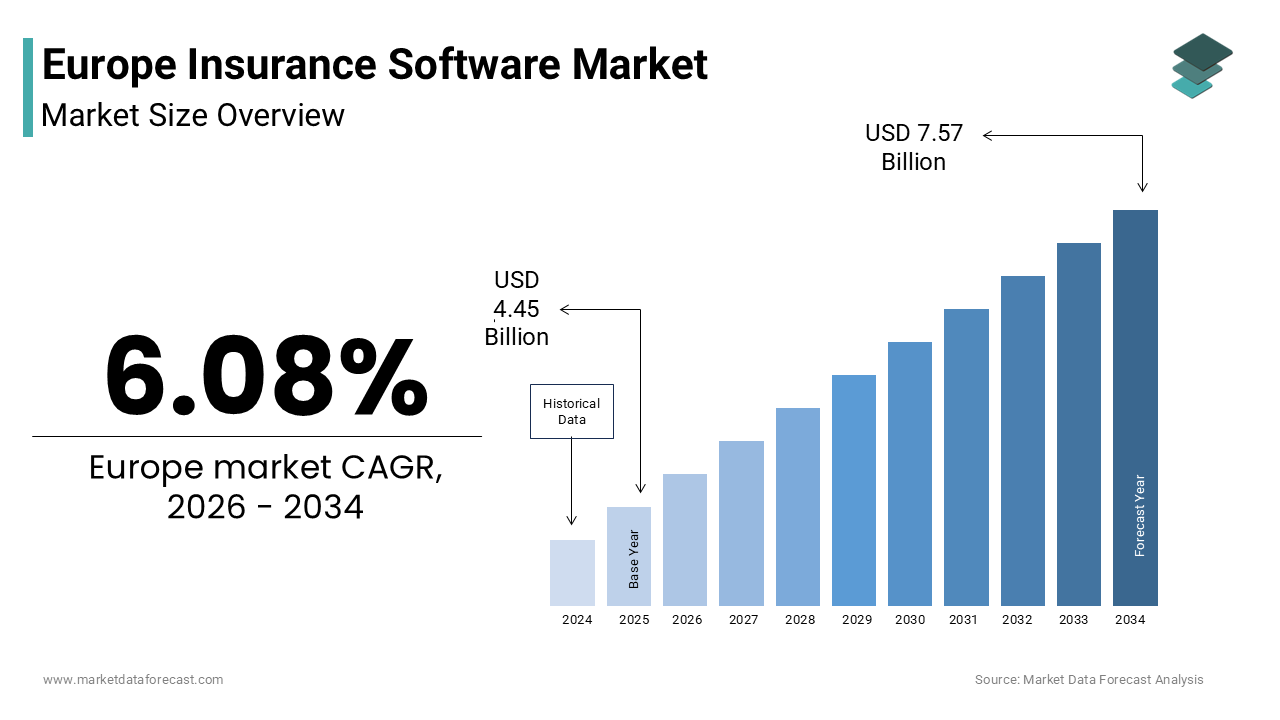
The Europe insurance software market was valued at USD 4.45 billion in 2025, is estimated to reach USD 4.72 billion in 2026, and is projected to reach USD 7.57 billion by 2034, growing at a CAGR of 6.08% during the forecast period from 2026 to 2034. The growth of the Europe insurance software market is driven by increasing regulatory compliance requirements, the rapid digitalization of insurance services, and the rising demand for advanced platforms that support policy management, claims processing, and risk analytics. Insurance companies across Europe are increasingly investing in cloud-based and AI-enabled solutions to enhance operational efficiency and deliver improved customer experiences. Moreover, the shift toward embedded insurance ecosystems and automated underwriting systems is further accelerating the adoption of modern insurance software platforms across the region.
Key Market Trends
-
Increasing adoption of cloud-based insurance software platforms to improve scalability and operational flexibility.
-
Growing implementation of artificial intelligence and predictive analytics in claims processing and fraud detection.
-
Rising demand for embedded insurance models integrated within digital commerce platforms.
-
Expansion of digital customer experience solutions enabling omnichannel policy management and claims services.
-
Strong focus on regulatory compliance automation to address frameworks such as Solvency II and GDPR.
Segmental Insights
- Based on deployment mode, the cloud segment accounted for the largest share of the Europe insurance software market in 2025. The dominance of this segment is attributed to the growing need for scalable infrastructure, real-time analytics capabilities, and seamless integration with third-party digital ecosystems.
- Based on insurance type, the life insurance segment held a significant share of the Europe insurance software market in 2025. The growth of this segment is driven by the complexity of life insurance products, long-term policy administration requirements, and the increasing demand for advanced actuarial modeling and regulatory reporting tools.
- Based on end user, the insurance companies segment occupied the largest share of the Europe insurance software market in 2025. The dominance of this segment stems from the operational need for insurers to manage core functions such as underwriting, policy issuance, claims settlement, and regulatory compliance through integrated digital platforms.
Regional Insights
The Europe insurance software market is expanding steadily across major economies due to the growing digital transformation of the insurance sector and increasing investments in regulatory compliance technologies.
-
Germany held the largest share of the Europe insurance software market in 2025, driven by its strong financial services sector, large insurance industry, and increasing investments in AI-powered risk analytics and fraud detection systems.
-
The United Kingdom remains a key market due to its leadership in insurtech innovation and the presence of global insurance institutions such as Lloyd’s of London, which drive demand for advanced underwriting and claims management platforms.
-
France continues to witness strong growth supported by large mutual insurance groups and government-backed digital transformation initiatives aimed at modernizing insurance IT infrastructure.
-
Italy is experiencing increasing adoption of cloud-based insurance platforms as insurers replace legacy mainframe systems and implement automation tools to improve operational efficiency.
-
Switzerland plays an important role in the regional market due to its concentration of global reinsurers and high demand for sophisticated risk modeling and reinsurance administration software.
Competitive Landscape
The Europe insurance software market is characterized by strong competition between global enterprise technology providers and emerging insurtech firms offering specialized solutions. Established vendors leverage comprehensive product portfolios and strong regulatory compliance capabilities, while niche software providers focus on innovation, faster deployment, and advanced analytics features. Prominent players in the Europe insurance software market include Guidewire Software Inc., Duck Creek Technologies LLC, Majesco, Shift Technology, FRISS, Charles Taylor Ltd., Damco Group, Cover Genius, Getsafe Digital GmbH, wefox Holding AG, and simplesurance GmbH.
 Download Free Sample Report
Europe Insurance Software Market Size
The Europe insurance software market size was valued at USD 4.45 billion in 2025 and is anticipated to reach USD 4.72 billion in 2026 from USD 7.57 billion by 2034, growing at a CAGR of 6.08% during the forecast period from 2026 to 2034.
The insurance software is an ecosystem of digital solutions designed to manage policy administration, claims adjudication, risk modeling, and regulatory compliance across life and non-life segments. These platforms serve as the operational backbone for insurers navigating a complex regional environment characterized by stringent oversight and evolving consumer expectations. According to S&P Global Ratings, the recent Solvency II update approved in April 2024 is projected to release up to €80 billion in capital relief for insurers by 2027, creating a powerful financial incentive to invest in advanced calculation engines and reporting tools. The European Commission notes that approximately 80% of insurers now leverage BigTech cloud services for data storage, signaling a decisive shift away from on premise legacy systems toward scalable cloud architectures. As per a PwC survey, 80% of insurance CEOs have integrated customer satisfaction metrics directly into their long-term corporate strategies, driving procurement decisions toward software that enhances user experience. According to McKinsey, insurers that successfully elevate their customer experience from the bottom to the top quartile can achieve up to 30% improvement in new business acquisition rates. These contextual indicators define the operational environment, where insurance software solutions are deployed to bridge the gap between traditional underwriting practices and modern digital demands.
MARKET DRIVERS
Regulatory Compliance Automation Drives Software Adoption
The regulatory compliance automation and the increasing complexity of statutory requirements is merely propelling the growth of Europe insurance software market. The implementation of the Digital Operational Resilience Act in 2025 mandates comprehensive ICT risk management frameworks, compelling insurers to deploy specialized software for continuous monitoring and real time reporting. According to a study, 52% of surveyed insurers maintain dedicated digital transformation strategies, primarily focused on achieving regulatory alignment rather than mere operational efficiency. Insurers must now conduct climate scenario analysis every three years under updated requirements, driving urgent demand for predictive analytics modules that can simulate diverse environmental stressors. As per the European Insurance and Occupational Pensions Authority, nearly 80% of respondents outsource cloud infrastructure to major technology providers, creating critical integration needs for compliant data governance layers that satisfy cross border regulations. The General Data Protection Regulation continues to shape software architecture, requiring built in privacy controls for all personal data processing activities. According to some reports, compliance related technology investments now account for approximately 8% of gross written premiums allocation. This sustained regulatory evolution ensures that insurance software vendors must continuously enhance platforms to address emerging mandates around operational resilience, climate risk disclosure, and cross border data flows by establishing compliance automation as a structural growth catalyst for the market.
Customer Experience Digitalization Accelerates Platform Investment
The customer experience digitalization for insurance software modernization throughout Europe, as policyholder expectations shift toward instant gratification and seamless interaction. The customer experience digitalization is additionally propelling the growth of Europe insurance software market. Modern consumers expect omnichannel engagement, real time policy adjustments, and instant claims adjudication, compelling insurers to upgrade legacy customer engagement systems that cannot support these capabilities. While telephone, email and face to face interactions remain dominant communication channels, chatbot adoption is projected to rise significantly with the integration of generative AI technologies. A survey indicates that 80% of insurance executives prioritize customer satisfaction metrics within strategic planning, directly influencing software procurement decisions toward user centric platforms. Digital identity verification tools, now reduce know your customer processes from days to seconds, significantly enhancing onboarding efficiency and reducing friction. The customer experience ranks as the primary outcome sought by European insurance leaders from digital transformation initiatives.
MARKET RESTRAINTS
Legacy System Dependency Constrains Modernization Pace
The legacy system with the prevalence of outdated core administration platforms is one of the major factors limiting the growth of Europe insurance software market. Many insurers operate systems deployed decades ago by creating substantial technical debt that complicates integration with modern cloud native solutions and agile development practices. According to a Legacy Modernization Survey, covering 110 European insurance professionals, strong loss aversion continues to hinder system replacement initiatives despite recognized competitive disadvantages and rising maintenance costs. As per analysis, the transition from outdated infrastructure to agile digital platforms represents one of the most relevant organizational constraints cited by participants during strategic planning sessions. The complexity of migrating historical policy data, while maintaining business continuity elevates implementation risks and extends project timelines, often leading to budget overruns. According to the study, structural organizational changes required for platform transition rank among the most impactful barriers to digitalization efforts that often stalling projects at the approval stage. The financial services sector in Europe maintains higher risk aversion profiles compared to other regions, leading to conservative technology adoption cycles that favor incremental updates over transformative change. Legacy environments often lack application programming interface capabilities necessary for embedded insurance models or real time data exchange with third party ecosystems.
Specialized Talent Shortage Limits Implementation Capacity
The specialized talent shortage leads to the scarcity of professionals possessing hybrid skill sets, which is also impeding the growth of Europe insurance software market. The emergence convergence of insurance domain expertise, regulatory knowledge and advanced software engineering skills creates a scarce talent pool that constrains implementation velocity and innovation capacity. According to the research, acquiring adequate talent and skills is viewed as both a major enabler and barrier to successful digital transformation across the sector, with many firms unable to fill critical roles. The cyber risks and skills gaps are consistently ranked among the top challenges arising from digitalization initiatives by limiting the scope of projects insurers can undertake internally. The European insurance workforce faces intense competition from technology firms and financial services peers for professionals proficient in artificial intelligence, cloud architecture and data governance frameworks. The management and executive board approval processes for high impact technology projects often encounter delays due to limited internal expertise for evaluating complex software solutions and vendor proposals. The requirement for human oversight in artificial intelligence applications with 50% of non-life insurers currently deploying such tools, further amplifies demand for hybrid skill sets that are in short supply. The pace of technological evolution outstrips the capacity of educational institutions and corporate training programs to develop qualified candidates quickly enough to meet demand. This talent deficit forces insurers to rely heavily on external consultants and technology partners, increasing project costs and extending time to value realization.
MARKKET OPPORTUNITIES
Embedded Insurance Ecosystems Unlock Distribution Innovation
The embedded insurance ecosystems for software vendors by enabling seamless integration of coverage into third party digital platforms is creating new opportunities for the growth of the Europe insurance software market. The integration of insurance products into third party digital platforms at point of sale creates demand for modular, API first software architectures capable of real time rating and policy issuance without human intervention. As per strategic analyses, insurers adopting embedded models report higher conversion rates compared to standalone policy distribution, while accessing previously untapped customer segments through retail and tech partners. The Digital Operational Resilience Act framework encourages standardized application programming interfaces for secure data exchange by facilitating ecosystem participation and reducing integration friction. According to study, nearly 80% of insurers already utilize BigTech cloud services, establishing foundational infrastructure for scalable embedded deployments that can handle high transaction volumes. Generative artificial intelligence applications enable dynamic product configuration and personalized pricing within embedded workflows by enhancing value propositions for distribution partners and end users. As per the study, specialized API based platforms allow insurers to integrate products into ecosystems of other carriers, insurtech firms and retail distributors without extensive custom development efforts. This shift toward insurance as a service model creates recurring revenue opportunities for software providers offering white label solutions, usage-based billing engines and compliance monitoring tools.
Generative Artificial Intelligence Enhances Operational Efficiency
The generative artificial intelligence applications for insurance software vendors to deliver measurable efficiency gains across European insurance operations through automation of complex tasks. This is additional attribute elevating new opportunities for the growth of Europe insurance software market. Advanced language models enable automated analysis of claim descriptions, medical documentation and policy terms, accelerating adjudication cycles while improving accuracy and reducing manual error rates. As per industry evaluations, customer service, fraud detection and claims management represent the primary use cases where AI delivers immediate operational value and cost savings. Generative AI powered chatbots handle routine inquiries, policy renewals and claims tracking, reducing contact center volumes and enabling human agents to focus on complex cases requiring empathy and judgment. According to strategic assessments, insurers leveraging AI for fraud pattern recognition can identify inconsistencies in submitted documentation that traditional rule-based systems might overlook, saving millions in potential losses. The European Artificial Intelligence Act provides regulatory clarity for high-risk applications, encouraging responsible innovation in underwriting and claims automation while ensuring consumer protection. In house development of simpler explainable AI solutions with human oversight remains the predominant implementation approach, creating opportunities for software vendors offering pre built, compliant AI modules. The ability to process unstructured data from emails, images and voice interactions expands the scope of automatable processes, driving demand for intelligent document processing capabilities. This technological evolution positions generative AI integration as a key differentiator for insurance software platforms seeking to deliver tangible return on investment through reduced operational costs and enhanced decision quality.
MARKET CHALLENGES
Data Privacy Constraints Complicate Artificial Intelligence Deployment
The data privacy vendors developing artificial intelligence solutions in Europe due to the strict limitations imposed by regional regulations, which is acting as a significant barrier for the growth of Europe insurance software market. The General Data Protection Regulation imposes strict limitations on processing personal data for model training, when inferring sensitive attributes from anonymized datasets that could potentially be re identified. According to some studies, several insurers consider GDPR insufficiently flexible to address emerging technologies like artificial intelligence and quantum computing that can re identify individuals through data combination techniques. As per regulatory analyses, the Schrems II ruling restricts cross border data transfers to third countries, complicating cloud-based AI model development that relies on global data pools for training robust algorithms. The requirement to obtain explicit customer consent for personal data processing creates friction in automated underwriting workflows that benefit from comprehensive risk assessment data to ensure accuracy. The inconsistencies between GDPR obligations and anti-money laundering or tax legislation generate compliance complexity for integrated software platforms that must satisfy multiple legal frameworks simultaneously. The proposed European Health Data Space regulation may limit secondary use of health information by insurers, constraining AI applications in life and health insurance segments where such data is critical. These regulatory tensions necessitate sophisticated data governance modules within insurance software, increasing development complexity and time to market for new features. Vendors must invest in privacy enhancing technologies like federated learning and differential privacy to enable compliant AI deployment, raising implementation costs and creating competitive differentiation challenges in a fragmented regulatory landscape.
Cybersecurity Threat Escalation Demands Continuous Platform Hardening
The cybersecurity threat escalation represents an escalating challenge for insurance software vendors operating, as the connectivity of digital platforms expands the attack surface. The increasing connectivity of cloud-based platforms, application programming interfaces and third party integrations expands the attack surface available to malicious actors seeking to exploit vulnerabilities in interconnected systems. As per some studies, the concentration of cloud computing services among major technology providers creates systemic vulnerability, where a single breach could impact numerous insurers simultaneously, threatening market stability. The Digital Operational Resilience Act mandates comprehensive testing of ICT systems, requiring software vendors to implement advanced threat detection, incident response and recovery capabilities to maintain compliance. The growing sophistication of ransomware and supply chain attacks necessitates continuous security updates that can disrupt service availability. The integration of artificial intelligence components introduces novel attack vectors including adversarial machine learning and model poisoning that require specialized defensive measures beyond traditional firewall protections. As per regulatory guidance, the requirement for human oversight in high impact AI applications creates additional authentication and authorization complexities that must be secured against privilege escalation attacks. Insurance platforms processing sensitive personal and financial data face heightened scrutiny from data protection authorities, with potential penalties for security failures creating reputational and financial exposure for vendors and clients alike.
REPORT COVERAGE
| REPORT METRIC | DETAILS |
| Market Size Available | 2025 to 2034 |
| Base Year | 2025 |
| Forecast Period | 2026 to 2034 |
| CAGR | 6.08% |
| Segments Covered | By Deployment, Insurance Type, End-User and Region. |
| Various Analyses Covered | Global, Regional & Country Level Analysis, Segment-Level Analysis, DROC, PESTLE Analysis, Porter’s Five Forces Analysis, Competitive Landscape, Analyst Overview of Investment Opportunities |
| Country Covered | UK, France, Spain, Germany, Italy, Russia, Sweden, Denmark, Switzerland, the Netherlands, Turkey, the Czech Republic, and the Rest of Europe. |
| Market Leaders Profiled | Guidewire Software Inc., Duck Creek Technologies LLC, Majesco, Shift Technology, FRISS, Charles Taylor Ltd., Damco Group, Cover Genius, Getsafe Digital GmbH, wefox Holding AG, and simplesurance GmbH. |
SEGMENTAL ANALYSIS
By Deployment Mode Insights
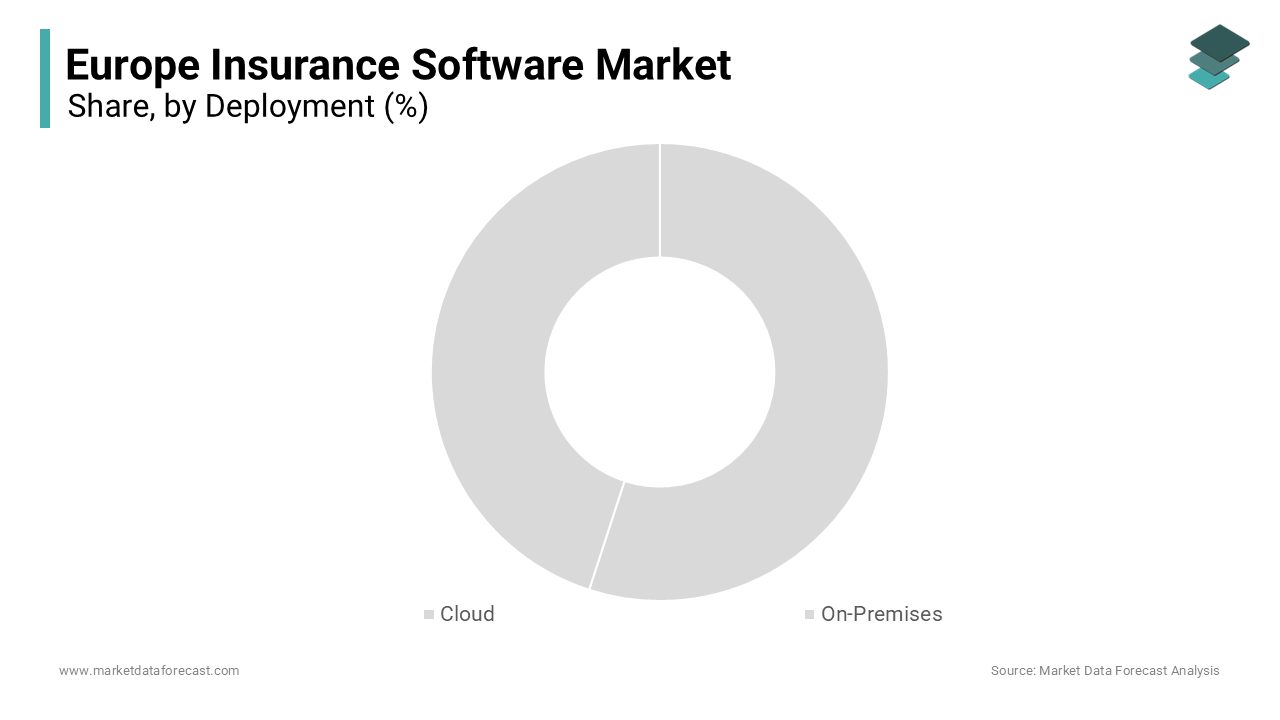
The cloud deployment segment was the largest by accounting for 52.3% of the Europe insurance software market share in 2025 with the urgent need for scalability and the regulatory push toward operational resilience. The implementation of the Digital Operational Resilience Act mandates that insurers maintain robust ICT risk management frameworks, which cloud native platforms facilitate through automated updates and distributed infrastructure. According to some studies, nearly 80% of European insurers, now utilize BigTech cloud services for data storage by reflecting a decisive shift away from on premise legacy systems that struggle to meet modern compliance standards. The ability of cloud solutions to support real time data analytics and seamless integration with third party ecosystems further cements their dominance. The cloud adoption reduces total cost of ownership by up to 30% over a five year period compared to on premise alternatives by making it the preferred choice for both large carriers and smaller niche players seeking agility in a volatile economic environment.
The cloud deployment segment is projected to expand at a CAGR of 14.8% during the forecast period with the rapid adoption of artificial intelligence and machine learning tools that require the massive computational power and elastic storage capabilities inherent to cloud environments. According to McKinsey, insurers leveraging cloud-based AI models for claims processing can reduce adjudication times by up to 50% by creating a compelling business case for migration. As per some sources, the rise of embedded insurance models necessitates API first architectures that are predominantly hosted in the cloud to ensure low latency and high availability across diverse distribution partners. The European Commission notes that digital transformation initiatives funded by post pandemic recovery packages heavily favor cloud infrastructure investments to enhance cross border service delivery. According to some survey, the number of cloud native insurance startups in Europe has doubled since 2022 by forcing incumbent players to accelerate their own cloud migration strategies to remain competitive. The flexibility to scale resources up or down based on seasonal demand fluctuations, such as during natural catastrophe events, provides an operational advantage that on premise systems cannot match, driving sustained double digit growth rates for cloud-based insurance software solutions.
By Insurance Type Insights
The life insurance segment was the largest by capturing 45.3% of the Europe insurance software market share in 2025 with the sheer complexity of life insurance products, which require sophisticated software for long term liability modeling, actuarial calculations, and policy administration over decades. The life insurance sector manages assets exceeding €8 trillion, necessitating advanced software solutions to ensure accurate solvency capital calculations under the updated Solvency II framework. As per a study, the aging demographic profile of Europe, with the population aged 65 and above projected to reach 29% by 2050, drives continuous product innovation in annuities and pension linked life policies that rely on dynamic software platforms for management. The integration of wellness programs and usage-based life insurance models requires real time data ingestion capabilities that modern life insurance software provides. According to strategic assessments, life insurers are investing heavily in digital customer engagement tools to address the declining trust in traditional agents, with 70% of new policies now involving some level of digital interaction.
The accident and health insurance segment is emerging swiftly at a fastest CAGR of 15.2% from 2026 to 2034. The rapid expansion of this segment is driven by the increasing frequency of health related claims and the shift toward personalized, preventive care models that require agile software support. According to the World Health Organization, non-communicable diseases account for 77% of all deaths in the European region, prompting insurers to develop complex health management platforms that integrate with wearable devices and electronic health records. As per industry analysis, the post pandemic surge in demand for critical illness and income protection products has forced insurers to deploy automated underwriting engines capable of processing medical data in real time. The European Health Data Space initiative aims to create a unified framework for health data exchange, enabling accident and health insurers to leverage standardized datasets for more accurate risk assessment and fraud detection. The adoption of telemedicine and digital therapeutics within insurance coverage plans requires software interoperability that legacy systems cannot provide, accelerating replacement cycles.
By End User Insights
The insurance companies segment was the largest by occupying a prominent share of the Europe insurance software market in 2025 with the direct operational necessity for carriers to manage core functions including policy issuance, claims settlement, and regulatory reporting internally. As per strategic evaluations, the pressure to improve combined ratios and operational efficiency drives insurance companies to invest in integrated core systems that eliminate silos between underwriting, finance, and customer service departments. The mandate for direct reporting to regulators under Solvency II and the new Digital Operational Resilience Act places the compliance burden squarely on insurance companies, necessitating proprietary or licensed software stacks that ensure data accuracy and auditability. The trend toward direct to consumer sales channels further empowers insurance companies to bypass intermediaries, requiring robust customer relationship management and digital portal capabilities that reinforce their position as the primary purchasers of insurance software technologies.
The brokers and agencies segment is projected to grow at a fastest CAGR of 13.5% throughout the forecast period. The growth of the segment is driven by the intermediaries to adopt digital comparison tools and client management platforms to remain relevant in an increasingly disintermediated market. The independent brokers who utilize advanced software for multi carrier quoting see a 25% increase in conversion rates compared to those relying on manual processes. The rise of embedded insurance and direct digital competitors forces brokers to differentiate through superior advisory services powered by data analytics and personalized risk profiling tools. The European Insurance Distribution Directive mandates higher transparency and professional standards, compelling agencies to invest in software that automates compliance documentation and client suitability assessments. The consolidation of the brokerage sector through mergers and acquisitions creates demand for scalable platforms that can integrate disparate legacy systems from acquired firms. The growing complexity of commercial insurance lines in cyber and liability coverage, requires brokers to access real time underwriting guidelines from multiple carriers simultaneously, driving adoption of aggregator software solutions.
REGIONAL ANALYSIS
Germany Insurance Software Market Analysis
Germany was the largest contributor of the Europe insurance software market by holding 22.3% of the share in 2025 with the robust industrial base and highly regulated financial sector. The country hosts some of the world's largest reinsurers and primary carriers by creating a dense ecosystem of high value software procurement focused on risk modeling and compliance. As per economic data, Germany's strong manufacturing sector drives significant demand for specialized commercial insurance software covering supply chain interruptions and machinery breakdown. The federal government's push for digital sovereignty and strict data localization laws under the GDPR encourages domestic development of secure cloud solutions, fostering a vibrant local vendor landscape. According to the survey, German insurers are leading the region in adopting artificial intelligence for fraud detection, with investment levels 30% higher than the European average. The ongoing modernization of the public health insurance system further stimulates demand for integrated administration platforms by ensuring Germany remains the primary revenue generator for insurance software vendors operating in the region.
United Kingdom Insurance Software Market Analysis
The United Kingdom insurance software market growth is driven by its role as a global center for insurtech innovation and Lloyd's of London operations. The market status here is characterized by rapid adoption of cutting-edge technologies such as blockchain for parametric insurance and generative AI for claims automation. The post Brexit regulatory divergence has prompted UK insurers to invest heavily in dual reporting systems that satisfy both domestic and international requirements, driving software upgrade cycles. The presence of London as a reinsurance capital fosters demand for high performance trading and placement platforms capable of handling complex treaty structures.
France Insurance Software Market Analysis
France insurance software market growth is driven by the presence of large mutual insurers and a highly consolidated banking insurance sector. The extensive digital transformation programs undertaken by major groups to unify their fragmented IT landscapes following years of mergers. According to the French Federation of Insurance, the sector manages premiums exceeding €200 billion by creating substantial demand for enterprise resource planning and customer experience platforms. As per government initiatives, the "France 2030" investment plan allocates significant funds to digitalizing public services and encouraging private sector innovation in health and retirement insurance software. The strong regulatory emphasis on consumer protection and transparent pricing under the Mutual Insurance Code compels firms to adopt advanced analytics tools for product governance. The unique structure of the mutual insurance sector, which holds a dominant market share in health and auto lines, drives specific demand for member centric software solutions that differ from standard shareholder models.
Italy Insurance Software Market Analysis
Italy insurance software market growth is likely to grow with the pressing need to modernize legacy infrastructure and improve operational efficiency amidst a challenging economic backdrop. The market status reflects a transition phase, where traditional family owned insurers and large bancassurance groups are aggressively replacing outdated mainframe systems with agile cloud platforms. The Italian insurance regulator, the sector faces pressure to reduce administrative costs which historically have been higher than the European average, driving investment in automation and robotic process integration software. The high penetration of motor insurance in Italy, mandated by law, creates a steady demand for telematics and usage based insurance software capable of processing vast amounts of driving data. The government's National Recovery and Resilience Plan includes specific provisions for digitalizing the financial sector by providing fiscal incentives for software upgrades.
Switzerland Insurance Software Market Analysis
Switzerland insurance software market growth is likely to propelled with its focus on high value specialty insurance and wealth management linked life products. The exceptionally high spending per capita on software due to the complexity of products offered by Swiss reinsurers and private bankers. As per the study, the stability of the Swiss Franc and the country's political neutrality attract global risk capital, driving demand for sophisticated reinsurance administration and treaty management platforms. According to the data, Swiss insurers lead in the adoption of blockchain technology for smart contracts in trade credit and surety bonds. The concentration of global headquarters for major reinsurers in Zurich creates a hub for developing and testing next generation software features before global rollout, which is making Switzerland a critical testbed for high end insurance technology innovations despite its smaller geographic size.
COMPETITIVE LANDSCAPE
The competition in the Europe insurance software market is characterized by intense rivalry between established global enterprise vendors and agile specialized insurtech challengers. Incumbent technology giants leverage their broad product portfolios and deep financial resources to offer integrated end to end solutions that appeal to large insurance groups seeking consolidation. Meanwhile niche players differentiate themselves through superior user experience and rapid deployment capabilities targeting mid sized carriers and specific insurance lines. The market witnesses frequent mergers and acquisitions as larger firms seek to acquire innovative technologies such as generative artificial intelligence and blockchain to stay ahead. Regulatory complexity acts as a significant barrier to entry favoring vendors with proven compliance track records in navigating Solvency II and GDPR requirements. Customer switching costs remain high due to the critical nature of core insurance systems yet the push for digital transformation drives carriers to evaluate modern cloud alternatives aggressively.
KEY MARKET PLAYERS
Some of the companies that are playing a dominating role in the Europe Insurance Software Market include
- Guidewire Software Inc.
- Duck Creek Technologies LLC
- Majesco
- Shift Technology
- FRISS
- Charles Taylor Ltd.
- Damco Group
- Cover Genius
- Getsafe Digital GmbH
- wefox Holding AG
- simplesuran
Top Players in the Market
Guidewire Software
Guidewire Software stands as a premier provider of core insurance platforms specifically designed for the property and casualty sector across Europe. The company delivers cloud native solutions that enable carriers to modernize their policy administration and claims handling capabilities efficiently. Guidewire actively engages with major European insurers to replace legacy mainframes with agile digital ecosystems that support real time data analytics. Recently, the firm expanded its European delivery centers to accelerate implementation timelines for regional clients. Their commitment to open architecture allows seamless integration with third party insurtech applications fostering innovation. Guidewire frequently partners with cloud hyperscalers to ensure robust infrastructure resilience meeting strict European regulatory standards. These strategic moves reinforce their position as a critical enabler of digital transformation for established carriers seeking operational excellence and enhanced customer experiences in a competitive landscape.
SAP SE
SAP SE leverages its extensive enterprise resource planning heritage to offer comprehensive insurance management solutions tailored for the complex European market. The company provides integrated suites that cover everything from underwriting and policy management to financial reporting and compliance monitoring. SAP utilizes its powerful HANA database technology to enable real time processing of massive insurance datasets facilitating instant decision making. Recently the corporation enhanced its artificial intelligence capabilities within its insurance cloud to automate routine administrative tasks and detect fraud patterns more effectively. SAP collaborates closely with European regulators to ensure its software modules adhere to evolving solvency and data protection mandates. Their global reach allows them to support multinational insurance groups with standardized processes across borders while accommodating local statutory requirements.
Oracle Corporation
Oracle Corporation delivers a robust portfolio of insurance software solutions that empower European carriers to optimize their business processes and customer interactions. The company offers cloud based applications for policy administration claims management and billing that integrate seamlessly with their broader financial and human capital management systems. Oracle recently invested heavily in generative artificial intelligence features to enhance user productivity and automate complex underwriting workflows for its European client base. Their focus on data sovereignty ensures that sensitive customer information remains compliant with stringent European privacy laws while leveraging global cloud infrastructure. Oracle actively participates in industry consortia to shape standards for digital insurance ecosystems and interoperability.
Top Strategies Used by Key Market Participants
Key players in the Europe insurance software market primarily employ strategic acquisitions to rapidly expand their functional capabilities and geographic reach. Companies frequently purchase specialized insurtech firms to integrate advanced artificial intelligence and machine learning tools into their existing platforms. Another dominant strategy involves forming extensive partnerships with major cloud infrastructure providers to ensure scalability and regulatory compliance for clients. Vendors heavily invest in research and development to create cloud native architectures that replace outdated legacy systems prevalent in the region. Product localization remains crucial as firms adapt their solutions to meet specific national regulations and language requirements across diverse European markets. Additionally, companies focus on building open ecosystem frameworks that allow third party developers to create complementary applications enhancing overall platform value. These combined approaches enable market leaders to maintain competitive advantages and address the evolving needs of European insurance carriers effectively.
MARKET SEGMENTATION
This research report on the Europe insurance software market has been segmented and sub-segmented based on the following categories.
By Deployment
- Cloud
- On-Premises
By Insurance Type
- Life Insurance
- Accident and Health Insurance
- Property and Casualty Insurance
- Other Types
By End User
- Insurance Companies
- Brokers
- Agencies
By Country
- UK
- France
- Spain
- Germany
- Italy
- Russia
- Sweden
- Denmark
- Switzerland
- Netherlands
- Turkey
- Czech Republic
- Rest of Europe