Europe Intelligent Transportation Systems Market Share, Size, Growth, Trends, And Forecast Report, Segmented By Mode of Transportation, Offering, System, Application By Country (U.K France, Germany, Spain, Italy, Sweden, Russia and Denmark, Switzerland, Netherlands, Turkey, Czech Republic and Rest of Europe) - Industry Analysis From (2026 to 2034)
Market Size, 2025
$19.45 BnMarket Estimate, 2026
$21.08 BnMarket Forecast, 2034
$40.06 BnCAGR, 2026–2034
8.36%Executive Summary: Europe Intelligent Transportation Systems Market
- Market Scope: Comprehensive European intelligent transportation systems (ITS) market analysis covering transportation modes, offering categories, system types, national leadership shares, environmental benchmarks, and urban mobility metrics.
- Market Valuation: Valued at USD 19.45 billion (2025), rising to USD 21.08 billion (2026), and reaching USD 40.06 billion by 2034, registering a robust CAGR of 8.36% (2026–2034).
- Primary Growth Drivers: Urban congestion, environmental mandates, and large-scale transport infrastructure upgrades. Key structural and operational benchmarks include more than 25,000 km of the Trans-European Transport Network scheduled for ITS upgrades by 2027, 96% of EU city dwellers exposed to PM2.5 levels exceeding WHO guidelines, AI-driven signal control in Vienna reducing intersection delays by 22% (and stop frequency by 18%), and Germany equipping over 3,000 km of autobahns with cooperative ITS infrastructure.
Key Market Segment Metrics (2026–2034)
| Category | Leading Segment (2025 Position) | Fastest-Growing Segment |
|---|---|---|
| By Transportation Mode | Roadways / Road transport (led with a 43.2% share in 2025) | Railways / Rail transport networks (projected to grow at a 12.2% CAGR) |
| By Offering | Hardware components and field devices (accounted for 43.2% in 2025) | Software and digital platforms (projected to expand at a 12.3% CAGR) |
| By System Type | Advanced Traffic Management Systems / ATMS (held 33.4% in 2025) | Advanced Public Transportation Systems / APTS (forecast to grow at a 14.3% CAGR) |
| By Country / Region | Germany (dominated with a 32.2% share in 2025, followed by France at 15.4%) | Advanced European smart-city hubs deploying cooperative ITS networks |
Major Market Players & Market Structure
Market Structure: Highly competitive European intelligent transportation marketplace featuring defense and aerospace technology leaders, industrial automation giants, and specialized traffic management firms competing intensely on AI-driven traffic optimization, edge computing, multimodal mobility platforms, vehicle-to-infrastructure (V2I) connectivity, robust cybersecurity, cross-border interoperability, and software-as-a-service (SaaS) business models.
Key Companies: L3Harris Technologies, KONGSBERG, Kapsch TrafficCom, NEC Corporation, Teledyne Technologies, Thales Group, Siemens, Advantech, Aireon, Indra Sistemas, and Hitachi.
Europe Intelligent Transportation Systems Market Size
The Europe intelligent transportation systems market size was valued at USD 19.45 billion in 2025 and is anticipated to reach a valuation of USD 21.08 billion in 2026 and USD 40.06 billion by 2034, growing at a CAGR of 8.36% from 2026 to 2034.
The intelligent transportation systems are integrated digital technologies deployed to enhance the safety, efficiency, and sustainability of surface mobility across urban, interurban, and freight corridors. These systems include traffic management platforms, connected vehicle infrastructure, adaptive signal control, mobility as a service applications, automated enforcement tools, and cooperative intelligent transport systems that enable vehicle to infrastructure communication. Unlike isolated traffic monitoring, modern intelligent transportation systems leverage real time data from sensors, cameras, GPS, and vehicles to optimize flow, reduce congestion, and support decarbonization. Furthermore, cities like Helsinki, Barcelona, and Rotterdam have mandated that all new mobility infrastructure incorporate intelligent transportation capabilities as part of their Sustainable Urban Mobility Plans. This regulatory and environmental convergence positions intelligent transportation systems as a foundational layer of Europe’s future mobility ecosystem.
MARKET DRIVERS
EU Mandates for Cooperative Intelligent Transport Systems Accelerate Infrastructure Deployment
The European Union’s binding regulatory framework for cooperative intelligent transport systems for large scale intelligent transportation investments across member states is propelling the growth of Europe intelligent transportation systems market. This mandate ensures a rapidly growing fleet of connected vehicles that can leverage intelligent transportation infrastructure for safety and efficiency applications. According to the European Commission, over 25,000 kilometers of the Trans European Transport Network are scheduled for intelligent transportation system upgrades by 2027 including dynamic lane management and automated incident detection. These coordinated public private efforts transform intelligent transportation systems from optional pilot projects into essential transport infrastructure, generating sustained demand for sensors communication hardware and data analytics platforms.
Urban Congestion and Air Quality Regulations Drive Smart Mobility Integration
Europe’s dense urban centers are increasingly deploying intelligent transportation systems to meet legally binding air quality and congestion reduction targets, which is fuelling the growth of Europe intelligent transportation systems market. According to the European Environment Agency, 96% of EU city dwellers were exposed to PM2.5 levels exceeding WHO guidelines in 2025 while average urban traffic speeds in cities like Rome and Brussels fell below 18 kilometers per hour. In response, cities are implementing integrated mobility platforms that combine traffic signal optimization low emission zone enforcement and multimodal routing. London’s Ultra Low Emission Zone uses automatic number plate recognition linked to a central database to charge non-compliant vehicles with over 99% accuracy as per Transport for London. Similarly, Barcelona’s Superblock model employs intelligent traffic management to restrict through traffic in residential zones redirecting vehicles via perimeter corridors with adaptive signaling.
MARKET RESTRAINTS
Fragmented Data Governance and Interoperability Standards Hinder System Integration
The lack of harmonized data protocols and cross border interoperability frameworks significantly impedes the seamless deployment of intelligent transportation systems. This factor is solely hindering the growth of Europe intelligent transportation systems market. While the EU’s CEN/ISO standards define technical specifications for cooperative systems implementation varies widely among member states leading to incompatible roadside units data formats and authentication mechanisms. In Germany, a vehicle equipped with the standardized C ITS communication stack cannot receive signal phase and timing data from Dutch traffic lights despite geographic proximity. Although the EU’s Common European Mobility Data Space aims to resolve these issues full harmonization is not expected before 2028.
High Capital Expenditure and Uncertain Return on Investment Deter Municipal Adoption
The substantial upfront costs associated with intelligent transportation system deployment present a significant barrier for the growth of Europe intelligent transportation systems market. According to the recent sources, only 28% of EU municipalities have dedicated budgets for intelligent transportation modernization with many relying on competitive EU funding that covers less than 50% of total costs. In Italy, a 2025 audit by the Court of Auditors found that 12 planned intelligent transportation projects were abandoned due to inability to secure co financing. Furthermore, the benefits of these systems, such as reduced travel time or emission savings, which are difficult to monetize directly making cost recovery challenging.
MARKET OPPORTUNITIES
Integration of Artificial Intelligence for Predictive Traffic Management Unlocks New Efficiency Gains
The incorporation of artificial intelligence into traffic operations is creating new opportunities for the growth of Europe intelligent transportation systems market. Machine learning algorithms can now analyze historical and real time data from vehicles cameras and public transport systems to predict congestion incidents and optimize signal timing up to 30 minutes in advance. According to a 2025 pilot by the City of Vienna, AI driven signal control reduced average intersection delay by 22% and lowered stop frequency by 18% during peak hours. The European Commission’s Horizon Europe program has allocated 220 million euros to AI for smart mobility projects under the Digital Key Technologies cluster. These systems not only improve throughput but also reduce unnecessary idling thereby contributing to urban emission targets.
Expansion of Mobility as a Service Platforms Creates Unified Urban Transport Ecosystems
The rise of Mobility as a Service is enabling intelligent transportation systems to evolve from isolated infrastructure into integrated user centric mobility platforms, which is ascribed to boost the growth of the Europe intelligent transportation systems market further. These digital ecosystems aggregate public transit shared bikes scooters and on demand shuttles into a single interface with unified payment and routing. According to the International Association of Public Transport, over 45 European cities now operate official Mobility as a Service schemes with Helsinki’s Whim and Berlin’s Jelbi serving as flagship examples. The European Commission’s Urban Mobility Framework 2023 encourages municipalities to adopt open data standards that allow third party developers to build interoperable applications.
MARKET CHALLENGES
Cybersecurity Vulnerabilities in Connected Infrastructure Pose Systemic Risks
The increasing digitization and interconnectivity of transportation infrastructure introduce significant cybersecurity threats that could compromise safety and operational integrity is to limit the growth of the Europe intelligent transportation systems market. Intelligent transportation systems rely on wireless communication between vehicles and roadside units creating potential attack surfaces for spoofing denial of service or data manipulation. In 2023, a simulated attack on a German motorway’s variable message sign system caused false speed limit displays that could have triggered chain collisions. The fragmented responsibility across vehicle manufacturers telecom providers and road authorities complicates incident response. Although the EU Cyber Resilience Act mandates security by design for digital products compliance verification remains inconsistent.
Legacy Infrastructure and Institutional Silos Impede Holistic Deployment
Europe’s intelligent transportation systems face persistent challenges from outdated physical infrastructure and fragmented institutional governance that prevent integrated implementation. The legacy infrastructure and difficulty in deployment of new techniques are posing huge challenge for the growth of Europe intelligent transportation systems market. Many urban traffic management centers operate on software platforms developed in the early 2000s incapable of processing high resolution sensor data or integrating with modern mobility applications. In Paris,, for example the transport authority RATP and the city’s traffic control center use different geospatial reference frames delaying coordinated responses to disruptions. Road asset owners such as national highway agencies often prioritize capacity expansion over digital optimization further misaligning incentives. This institutional inertia slows the adoption of cross modal solutions like transit signal priority or dynamic curbside management.
REPORT COVERAGE
| REPORT METRIC | DETAILS |
| Market Size Available | 2025 to 2034 |
| Base Year | 2025 |
| Forecast Period | 2026 to 2034 |
| CAGR | 8.36% |
| Segments Covered | By Mode of Transportation, Offering, System, Application, And Region |
| Various Analyses Covered | Global, Regional & Country Level Analysis, Segment-Level Analysis, DROC, PESTLE Analysis, Porter’s Five Forces Analysis, Competitive Landscape, Analyst Overview on Investment Opportunities |
| Regions Covered | UK, France, Spain, Germany, Italy, Russia, Sweden |
| Market Leaders Profiled | L3Harris Technologies, Inc., KONGSBERG, NEC Corporation, Teledyne Technologies Incorporated, Thales Group, Siemens AG, Advantech Co., Ltd., Aireon, Indra Sistemas, S.A., Hitachi, Ltd. |
SEGMENTAL ANALYSIS
By Mode of Transportation Insights
The roadways segment held 43.2% of the Europe intelligent transportation systems market share in 2025 due to the continent’s dense road network high private vehicle ownership and acute urban congestion pressures. This scale necessitates sophisticated traffic management to maintain flow safety and environmental compliance. Cities across Europe have deployed adaptive signal control automated incident detection and low emission zone enforcement systems to manage daily commuter volumes exceeding 2 million vehicles in metropolitan areas like Paris and London. Furthermore, the EU’s General Safety Regulation requires new vehicles to include advanced driver assistance systems that interact with roadside infrastructure. This dual push from infrastructure and vehicle regulation ensures that roadway intelligent transportation systems remain the primary investment focus for national and municipal authorities seeking to reduce travel time emissions and accident rates.
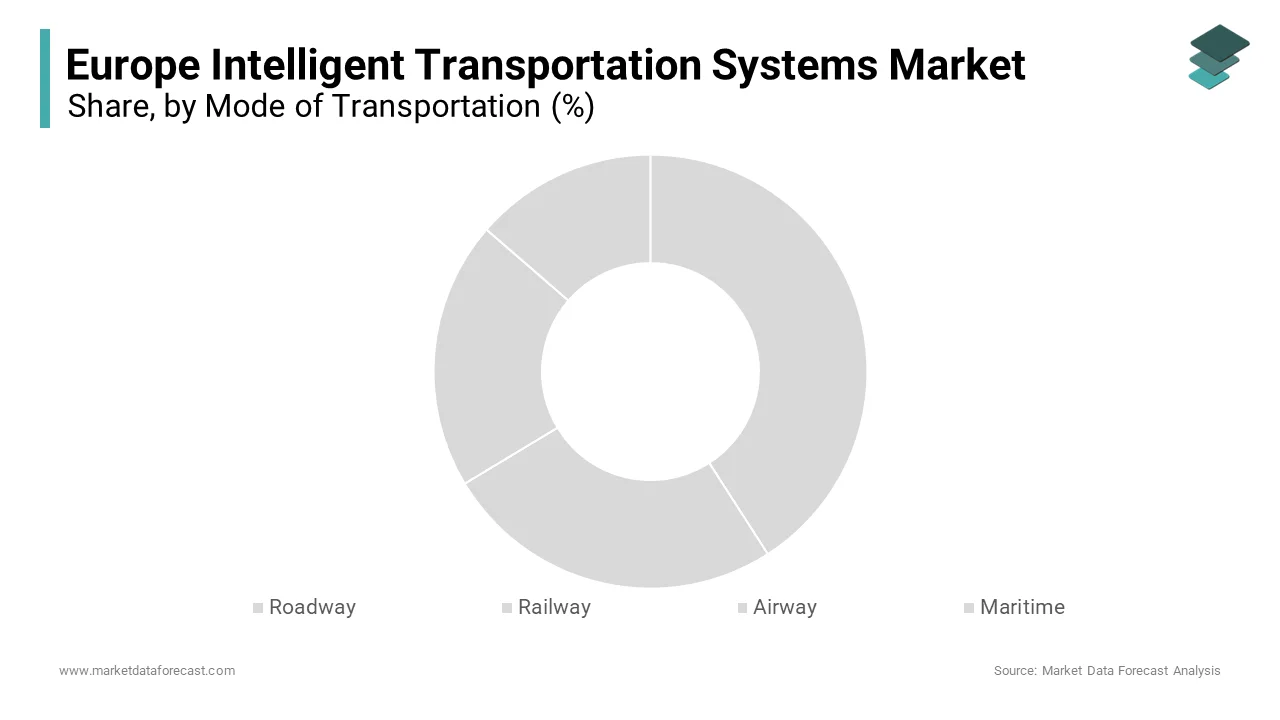
The railways segment is swiftly emerging with an anticipated CAGR of 12.2% from 2025 to 2033 with the EU’s strategic shift toward sustainable mass transit and digital rail modernization. As per the European Union Agency for Railways, over 60% of the EU’s core rail network is scheduled for digital signaling upgrades under the European Rail Traffic Management System by 2030 enabling higher capacity and interoperability. In 2025 Germany launched the Digital Rail Germany program allocating 8.6 billion euros to replace analog interlockings with computer based train control across 5,000 kilometers of track. The Connecting Europe Facility has committed 5.2 billion euros to intelligent rail projects including real time passenger information dynamic capacity allocation and automated fare integration.
By Offering Insights
The hardware segment was the largest by holding 43.2% of the Europe intelligent transportation systems market share in 2025 due to the foundational need for physical infrastructure to enable data collection communication and control. According to the European Commission, over 120,000 adaptive traffic signal controllers were installed across EU cities in 2025 while more than 25,000 kilometers of motorways feature connected roadside infrastructure under the C ITS deployment plan. National highway operators such as Germany’s Autobahn GmbH and France’s SANEF have invested billions in installing fiber backbones and 5G enabled roadside units to support vehicle to infrastructure communication. The EU’s General Safety Regulation mandates that all new vehicles include hardware such as eCall and advanced emergency braking systems which interface with external infrastructure. This regulatory and operational dependency on physical components ensures that hardware remains the dominant expenditure category as cities and transport agencies build out the sensory and communication skeleton of future mobility networks.
The software segment is anticipated to register at a fastest CAGR of 12.3% from 2025 to 2033 with the shift from isolated hardware deployment to integrated data driven mobility platforms. Advanced analytics artificial intelligence and cloud-based traffic management systems are now essential to extract value from the vast sensor networks being installed. According to the International Transport Forum, cities that implemented AI powered traffic optimization software reduced average commute times and emissions. The European Commission’s Digital Europe Programme has allocated over 400 million euros specifically for intelligent transportation software development including open source mobility data platforms and cybersecurity management tools. Companies like Siemens and TomTom now offer subscription-based traffic prediction and incident response suites that update continuously without new hardware. Additionally, the rise of Mobility as a Service platforms requires sophisticated software to integrate multimodal options dynamic pricing and user interfaces.
By System Insights
The Advanced Traffic Management Systems segment was the largest by occupying 33.4% of the Europe intelligent transportation systems market share in 2025 due to their role in optimizing road network performance across urban and interurban corridors. ATMS encompasses real time traffic monitoring adaptive signal control incident management and traveler information systems that directly address congestion safety and emissions. Cities like Barcelona and Rotterdam operate centralized traffic operation centers that integrate data from over 10,000 sensors to dynamically adjust signal timing and reroute vehicles. National initiatives like Germany’s Digital Test Fields and France’s PREDIT program have further accelerated ATMS adoption through public private co development.
The advanced Public Transportation Systems segment is augmented to grow with an anticipated CAGR of 14.3% from 2025 to 2033 with the policy mandates to increase public transit ridership and reduce car dependency. APTS includes automated fare collection real time vehicle tracking passenger information displays and transit signal priority that enhance reliability convenience and user experience. London’s contactless payment system now processes over 12 million daily transactions while Berlin’s Jelbi app integrates bus tram bike and ride share into a single mobility platform. The European Commission’s Urban Mobility Framework requires that all major cities implement integrated ticketing and real time information by 2026. Furthermore, the Connecting Europe Facility has funded over 200 APTS projects including electric bus fleet monitoring and predictive maintenance systems.
COUNTRY ANALYSIS
Germany Intelligent Transportation Systems Market Analysis
Germany was the top performer of the Europe intelligent transportation systems market by accounting for 32.2% of share in 2025. The country operates over 50 urban traffic management centers and has equipped more than 3,000 kilometers of autobahns with cooperative intelligent transport infrastructure. The Digital Rail Germany program and the nationwide rollout of 5G corridors support both road and rail modernization. In 2025, Germany mandated that all new traffic signal systems include adaptive control and vehicle to infrastructure communication capabilities. The presence of automotive giants like BMW and Bosch accelerates testing and deployment of connected vehicle technologies through public private test beds such as the A9 Digital Motorway.
France Intelligent Transportation Systems Market Analysis
France intelligent transportation systems market held second position with 15.4% of share in 2025 with the centralized national programs and ambitious urban mobility reforms. The French government’s PREDIT initiative has funded over 1,200 intelligent transportation projects since 2000 with recent emphasis on AI driven traffic optimization and low emission zone management. According to the Ministry of Transport over 90% of cities with populations above 100,000 now operate integrated traffic control centers using real time data from connected vehicles and sensors. Paris has implemented Europe’s largest automated enforcement network with over 4,000 cameras monitoring traffic flow pollution and parking compliance.
United Kingdom Intelligent Transportation Systems Market Analysis
The United Kingdom intelligent transportation systems market growth is likely to be driven by the high maturity intelligent transportation systems market through its legacy of traffic innovation and data driven governance. Transport for London operates one of the world’s most sophisticated urban traffic control systems managing 6,000 signalized junctions and 15,000 bus stops with real time optimization. According to the UK Department for Transport, major cities now use predictive analytics for incident response and demand forecasting. The National Highways agency has deployed many roadside sensors on strategic roads enabling dynamic speed management and queue detection. The UK’s Smart Mobility Living Lab in London serves as a test bed for autonomous and connected vehicle technologies with over 200 industry partners.
COMPETITIVE LANDSCAPE
The Europe intelligent transportation systems market features a competitive landscape of multinational technology firms specialized infrastructure providers and emerging software startups. Incumbents like Siemens Thales and Kapsch dominate through decades of public sector relationships standardized solutions and pan European deployments. However, they face growing competition from agile software companies offering AI driven traffic optimization and Mobility as a Service platforms often at lower cost. The market is highly project based with procurement governed by national and municipal tenders that emphasize local presence interoperability and long-term support. Differentiation increasingly hinges on data integration capabilities cybersecurity robustness and compliance with EU digital and environmental regulations. While hardware remains important software and analytics are becoming key value drivers. The absence of a single dominant standard encourages vendor diversity but also creates integration complexity.
KEY MARKET PLAYERS
- L3Harris Technologies, Inc.
- KONGSBERG
- Kapsch TrafficCom AG
- NEC Corporation
- Teledyne Technologies Incorporated
- Thales Group
- Siemens AG
- Advantech Co., Ltd.
- Aireon
- Indra Sistemas, S.A.
- Hitachi, Ltd.
Top Players In The Market
- Siemens Mobility GmbH is a leading provider of intelligent transportation solutions across Europe with a strong footprint in rail signaling traffic management and multimodal software platforms. The company supplies advanced traffic control systems to cities like Vienna and Munich and operates the Sitraffic suite for adaptive signal optimization across more than 20 countries. In 2025 Siemens launched its AI powered traffic prediction module integrated with its Mobility Operating System enabling real time congestion forecasting and dynamic route guidance. It also expanded its rail digitalization offerings with cloud based train control solutions aligned with the European Rail Traffic Management System. Globally Siemens contributes to international standards through partnerships with the International Union of Railways and deploys its intelligent infrastructure in North America and Asia. These initiatives reinforce its position as a holistic mobility technology enabler bridging road and rail intelligence.
- Thales Group leverages its expertise in aerospace defense and digital identity to deliver secure and interoperable intelligent transportation systems across Europe. The company provides urban traffic management platforms for cities such as Paris and Lisbon and supplies onboard signaling systems for high speed rail networks in France Italy and Spain. In 2025 Thales enhanced its TopSky Urban solution with edge computing capabilities for low latency traffic signal control and integrated cybersecurity protocols compliant with the EU Cyber Resilience Act. It also partnered with European road operators to deploy vehicle to infrastructure communication units along Trans European corridors. Thales actively contributes to global cooperative intelligent transport standards through the ETSI and CEN technical committees ensuring cross border compatibility. Its focus on secure data exchange and resilient infrastructure positions it as a trusted partner for mission critical mobility systems.
- Kapsch TrafficCom AG is a Vienna based specialist in electronic tolling smart city infrastructure and connected vehicle solutions with extensive deployments across Europe. The company operates tolling systems in 15 European countries including Germany’s truck tolling network and Austria’s vignette system and provides urban traffic management for cities like Brussels and Prague. It also integrated its tolling back office with Mobility as a Service platforms to support multimodal pricing models. Kapsch collaborates with automotive manufacturers to test C ITS applications under the EU’s 5G Mobility Corridors initiative.
Top Strategies Used By The Key Market Participants
Key players in the Europe intelligent transportation systems market are investing heavily in artificial intelligence and edge computing to enable predictive traffic management and real time decision making. They are integrating road rail and public transport data into unified mobility operating systems to support multimodal journeys. Companies are forming strategic alliances with telecom providers automotive OEMs and city authorities to co-develop vehicle to infrastructure ecosystems. Cybersecurity by design is being embedded into all hardware and software to comply with EU digital resilience regulations. Additionally, firms are shifting toward software as a service models offering subscription-based analytics and updates rather than one time hardware sales. These strategies collectively address the need for interoperability scalability and continuous innovation in a rapidly evolving regulatory and technological landscape.
MARKET SEGMENTATION
This research report on the Europe intelligent transportation systems is segmented and sub-segmented into the following categories.
By Mode of Transportation
- Roadway
- Railway
- Airway
- Maritime
By Roadway Offering
-
-
- Hardware
- Interface Boards
- Sensors
- Surveillance Cameras
- Telecommunication Networks
- Monitoring and Detection Systems
- Others
- Software
- Visualization Software
- Video Detection Management Software
- Transit Management Software
- Others
- Services
- Cloud services
- Business services
- Professional services
- Hardware
-
By System Type
- Advanced Traveler Information System (ATIS)
- Advanced Traffic Management System (ATMS)
- Advanced Transportation Pricing System (ATPS)
- Advanced Public Transportation System (APTS)
- Emergency Medical System (EMS)
By Application
- Traffic Management
- Road Safety and Security
- Freight Management
- Public Transport
- Environment Protection
- Automotive Telematics
- Parking Management
- Road Tolling Systems
- Others
By Country
- UK
- France
- Spain
- Germany
- Italy
- Russia
- Sweden
- Denmark
- Switzerland
- Netherlands
- Turkey
- Czech Republic
- Rest of Europe
Frequently Asked Questions
What is driving investment in the Europe Intelligent Transportation Systems Market?
The Europe Intelligent Transportation Systems Market is accelerating due to EU Mobility & Transport Digitalisation Strategy targets, urban congestion pricing (e.g., London, Milan, Berlin), and national ITS Action Plans under the TEN-T revision—prioritizing safety, decarbonization, and multimodal integration.
How is the C-ITS Delegated Act (2023) shaping deployment?
Mandating standardized communication (ITS-G5 & 4G/5G) for new vehicles and road infrastructure by 2025–2027, the C-ITS Delegated Act is catalyzing cross-border corridor projects (e.g., Rhine-Alpine, Scandinavian-Mediterranean), standardizing rollout in the Europe Intelligent Transportation Systems Market.
Which ITS applications are scaling fastest?
Adaptive traffic signal control, dynamic parking guidance, and cooperative speed assistance (C-SA) lead—followed by freight platooning pilots and AI-powered predictive incident detection in motorway management across the Europe Intelligent Transportation Systems Market.
Are cities or national governments leading ITS adoption?
Cities drive innovation (e.g., Helsinki’s MaaS, Barcelona’s superblocks), but national road authorities (e.g., Germany’s BASt, France’s CEREMA) fund backbone infrastructure (V2X RSUs, traffic management centers), creating a dual-layer push in the Europe Intelligent Transportation Systems Market.
How is data governance affecting system interoperability?
The EU Data Act and GAIA-X framework are pushing open, anonymized mobility data sharing—yet fragmentation persists in legacy TMC systems, making API standardization (e.g., DATEX II v3) critical for scalability in the Europe Intelligent Transportation Systems Market.
Which countries lead in ITS implementation?
The Netherlands, Germany, Sweden, and Spain rank highest—thanks to mature traffic centers, widespread roadside ITS-G5 units, and strong public-private testbeds (e.g., ERTICO-led projects) in the Europe Intelligent Transportation Systems Market.
Is cybersecurity a growing concern?
Absolutely—ENISA’s 2024 ITS Security Guidelines require PKI-based authentication for V2X messages and hardened OT systems in traffic control centers, raising compliance costs but building trust in the Europe Intelligent Transportation Systems Market.
How are EVs and micromobility integrating with ITS?
Smart charging station coordination, e-scooter geofencing, and EV priority at traffic lights are emerging use cases—supported by multimodal journey planners (e.g., Mobility as a Service platforms) in the Europe Intelligent Transportation Systems Market.
What role do EU funds play in scaling ITS?
CEF Transport (Connecting Europe Facility) and Recovery and Resilience Facility (RRF) grants cover up to 85% of cross-border ITS infrastructure costs—de-risking municipal budgets and enabling pan-European pilots in the Europe Intelligent Transportation Systems Market.
What’s the outlook for the Europe Intelligent Transportation Systems Market through 2030?
Strong growth (CAGR ~9–11%) is expected, fueled by AI-enabled traffic optimization, automated bus shuttles, and integration with digital twin cities—positioning the Europe Intelligent Transportation Systems Market as foundational to EU climate and mobility sovereignty goals.
Access the study in MULTIPLE FORMATS
Purchase options starting from
$ 2000
Didn’t find what you’re looking for?
TALK TO OUR ANALYST TEAM
Need something within your budget?
NO WORRIES! WE GOT YOU COVERED!
Call us on: +1 888 702 9696 (U.S Toll Free)
Write to us: sales@marketdataforecast.com