- Product Description Description
- Table of Contents TOC
- List of Table & Figure LOT
- Get Free Sample PDF Sample PDF
Market Size, 2025
$45.64 BnMarket Estimate, 2026
$47.30 BnMarket Forecast, 2034
$62.91 BnCAGR, 2026–2034
3.63%Europe Interior Design Market Report Summary
The Europe interior design market was valued at USD 45.64 billion in 2025, is estimated to reach USD 47.30 billion in 2026, and is projected to reach USD 62.91 billion by 2034, growing at a CAGR of 3.63% during the forecast period from 2026 to 2034. The growth of the European interior design market is driven by rising renovation and remodeling activities, urban regeneration programs, increasing residential investments, and evolving lifestyle preferences focused on comfort, functionality, and aesthetics.
Growing demand for high-quality furniture, sustainable materials, and personalized interior solutions is further supporting market expansion. Additionally, trends such as hybrid work environments, tourism-led hospitality development, and climate-responsive design are reshaping interior design requirements across residential and commercial spaces in Europe.
Key Market Trends
- Strong demand for furniture-centric interior solutions, emphasizing durability, design, and material quality.
- Rising preference for remodeling and renovation projects, particularly in aging residential and commercial buildings.
- Increasing adoption of sustainable and locally sourced materials, driven by environmental awareness and regulatory frameworks.
- Growth in residential interior design services is supported by home upgrades, rental property investments, and lifestyle-driven customization.
- Integration of digital design tools, 3D visualization, and smart interior solutions to enhance user experience and project efficiency.
Segmental Insights
- Based on product, the furniture segment commanded the highest share of the Europe interior design market in 2024, supported by strong demand for custom, modular, and premium furnishings.
- By type, the remodeling segment held the largest share in 2024, reflecting increased refurbishment of existing structures rather than new construction.
- Based on end user, the residential segment dominated the market in 2024, driven by housing renovations, interior upgrades, and demand for personalized living spaces.
Regional Insights
The Europe interior design market demonstrates consistent growth across key countries.
- Germany led the market by accounting for 19.1% of the regional share in 2024, supported by strong renovation activity and premium residential demand.
- France remains a heritage-driven market, backed by sustained public renovation support and a strong focus on material provenance.
- United Kingdom continues to show resilience due to its large private rental sector, hybrid work trends, and mature design consultancy ecosystem.
- Italy plays a culturally influential role, anchored by its world-class furniture industry and deep craftsmanship traditions.
- Spain is emerging as a fast-growing market driven by tourism-led hospitality investments and urban regeneration initiatives.
Competitive Landscape
The Europe interior design market is competitive, with a mix of global design consultancies, multidisciplinary firms, and specialized interior studios. Market participants are focusing on design innovation, sustainability integration, and client-centric solutions to strengthen their market position. Prominent players operating in the market include AECOM, Gensler, Hirsch Bedner Associates, Gold Mantis Construction Decoration Co., Steve Leung Design Group, Areen Design Services Ltd., NELSON Worldwide LLC, CannonDesign, Perkins and Will, and Stantec.
Europe Interior Design Market Size
The Europe interior design market size was valued at USD 45.64 billion in 2025 and is anticipated to reach USD 47.30 billion in 2026 to reach USD 62.91 billion by 2034, growing at a CAGR of 3.63% during the forecast period from 2026 to 2034.
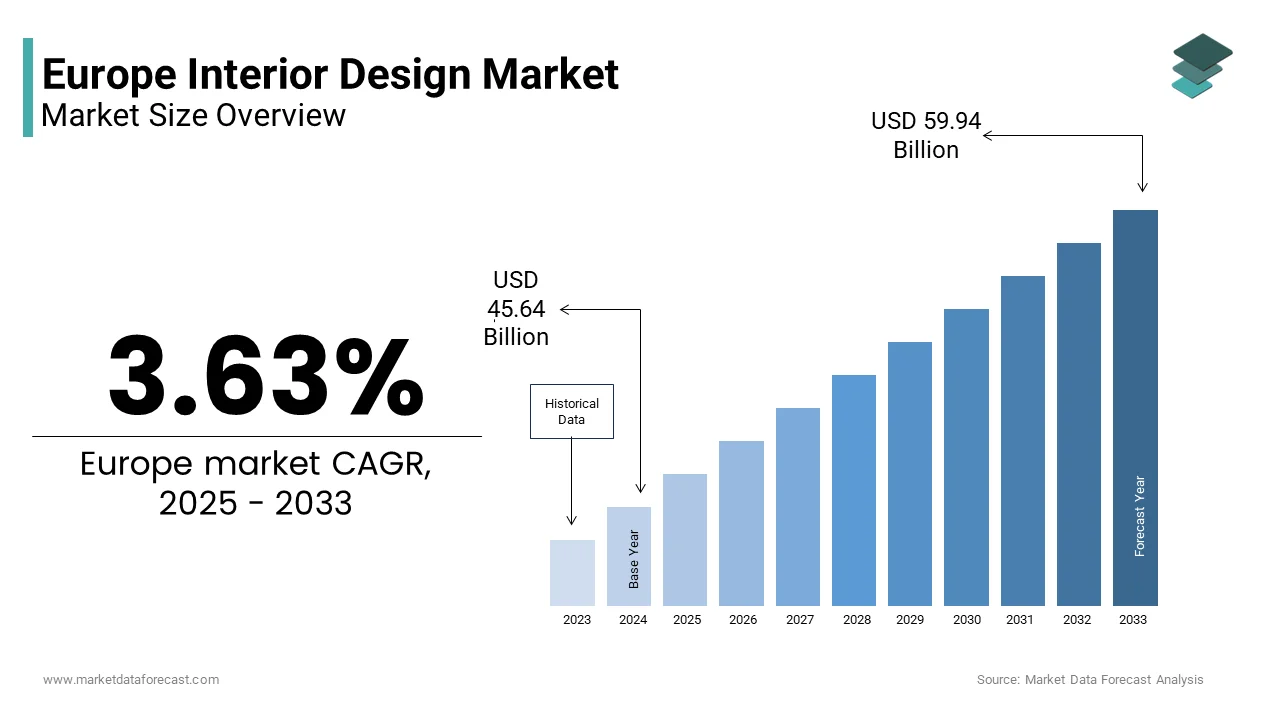
Interior design includes the planning and execution of aesthetic and functional enhancements within residential and commercial built environments across the continent. It integrates spatial layout optimization, material selection, lighting strategies, and furnishing to align with cultural preferences, evolving lifestyles, and regulatory frameworks. Unlike construction or real estate sectors, this market thrives on subjective human experience yet is increasingly shaped by measurable sociodemographic and environmental dynamics. According to Eurostat, approximately 69% of the European Union population lived in owner‑occupied dwellings in 2023, whichreflectsg a stable residential base that regularly engages with interior renovation. Additionally, the Joint Research Centre and other EU building‑stock analyses indicate that a significant share of the EU building stock was constructed before 1970, which points to widespread aging infrastructure that requires redesign for energy efficiency and usability. Urban densification further amplifies demand, with major European cities such as Paris, Berlin, and Amsterdam experiencing measurable residential growth in recent years that increases pressure on housing supply and renovation activity. This evolving built environment, coupled with rising consumer emphasis on personalized and sustainable interiors, defines the contemporary contours of Europe’s interior‑design landscape without directly referencing market valuation or competitive share.
MARKET DRIVERS
Rising Urbanization and Housing Density Drive Interior Customization Demand
Europe’s accelerating urban concentration has intensified the need for space‑efficient and psychologically supportive interior solutions, which is majorly propelling the European interior design market growth. For instance, roughly three‑quarters of Europeans now live in urban areas, which is a share expected to rise further by 2030. This demographic shift compresses living spaces, particularly in high‑demand cities, where average dwelling footprints have trended smaller, and households increasingly prioritise usable square metres over spare rooms. Consequently, consumers commission interior designers to maximise utility through multifunctional furniture, modular layout,s and vertical storage systems that convert constrained footprints into flexible and multiuser environments. The demand is not purely spatial but also experiential: confined environments heighten sensitivity to lighting, acoustics, and material textures, and many residents now view interior ambiance as a core component of mental well-being. This psychological dimension compels designers to integrate biophilic elements, adaptive lighting,g and ergonomic zoning to support comfort, productivity,ity, and restorative rest. Municipal planning and building rules in several European cities are also embedding indoor‑environment standards, and so design choices increasingly intersect with regulatory compliance. Urban densification, therefore,refore transcends occupancy metrics and fuels a qualitative transformation in interior‑design engagement rooted in human‑centred spatial intelligence.
Growing Emphasis on Circular and Low‑Impact Material Sourcing
Sustainability has evolved from a niche preference to a structural imperative in European interior design due to stringent environmental policy and informed consumer behaviour, which is further contributing to the European interior design market expansion. The construction sector’s large waste footprint has focused policy and procurement on reuse, recycling, and low‑impact inputs. As a result, public and private buyers now demand recycled, r,eclaimed and bio‑based materials, transparent supply chains and recognised certifications. Designers routinely specify FSC‑certified timber, low-VOCC paints,, and reclaimed furnishings, and they increasingly evaluate products using lifecycle and circularity metrics to validate claims. National measures and municipal circular programmes are accelerating reuse and resale channels, while laws that prohibit the destruction of unsold goods and procurement targets for circular content are shifting commercial incentives. Cities with explicit circular roadmaps are embedding circular procurement into municipal projects, raising the bar for suppliers. Consequently, sustainability is no longer an aesthetic add‑on but a procurement filter as firms that can document material circularity, offer take‑back or refurbishment services, and demonstrate traceable supply chains gain a clear competitive advantage.
MARKET RESTRAINTS
Skilled Labour Shortages Constrain Project Execution and Innovation
A critical bottleneck in the European interior‑design market is a persistent shortage of qualified artisans and technical installers capable of executing high‑precision custom work. Shortages in carpentry, joinery, and specialist finishing trades lengthen project timelines, increase subcontractor premiums, and force designers to simplify specifications or substitute prefabricated alternatives. The ageing craft workforce and weak vocational uptake further reduce pipeline capacity, while competition from digital and service sectors depresses enrolment in trade apprenticeships. The operational consequence is not only logistical strain but also a dampening of creative ambition as designers oftenscale back bespoke detailing or defer complex finishes to later phases to accommodate available labour. Without targeted investment in apprenticeships, vocational training, and cross‑border labour mobility, the sector’s capacity to deliver complex, innovative interiors will remain structurally constrained despite robust demand.
Fragmented Regulatory Compliance Across European Jurisdictions
Interior design firms face a patchwork of national and municipal regulations that complicate cross‑border work and inflate project overhead, which further hinders the growth of the European interior design market. EU directives set broad objectives for safety, accessibility, and environmental performance, but local implementation varies across fire, acoustic, accessibility, ty, and heritage regimes, producing divergent certification processes and documentation requirements. For example, fire‑resistance and material‑classification systems differ between jurisdictions, and heritage‑protection rules in historic centres often mandate original‑material replication or prohibit modern interventions in designated zones. Regional accessibility norms can also vary within countries, which creates inconsistent fixture heights, ramp gradients, and signage requirements. This regulatory fragmentation generates approval delays, increases legal and technical consultancy needs, a nd limits scalability for firms seeking a pan‑European presence. Managing these compliance burdens requires early local technical partnerships, built‑in contingency for approval, ls and proactive engagement with standards and certification schemes.
MARKET OPPORTUNITIES
Integration of Digital Twin Technology in Residential Design
The emergence of digital twin platforms provides a transformative opportunity for the European interior design market. Unlike static 3D renderings, digital twins create dynamic virtual replicas of physical spaces updated in real time through IoT sensors and user feedback. According to the European Institute of Innovation and Technology, adoption of digital twin technology in European residential projects grew by 37% between 2022 and 2024, driven by smart‑home integration. In countries like Finland and the Netherlands, municipalities now encourage digital documentation of renovations to support energy performance tracking under the Energy Performance of Buildings Directive. Interior designers leverage these models to simulate lighting scenarios, acoustics, and spatial flow before physical implementation, reducing costly revisions. A pilot programme in Copenhagen demonstrated a 22% reduction in material waste when digital twins guided fixture placement and finish selection, as reported by the Danish Building Research Institute. Additionally, clients gain lifelong access to their space’s digital blueprint, enabling future modifications without original designer involvement. Startups such as Spacemaker in Norway and Kreo in the UK are tailoring platforms specifically for interior workflows, incorporating BIM‑compatible libraries of sustainable European materials. This convergence of virtual and physical design not only elevates service quality but positions interior designers as long‑term spatial data stewards, which is a role previously reserved for architects or facility managers.
Revival of Regional Craft Traditions Through Policy and Consumer Demand
A renewed appreciation for localized artisanal heritage is creating fertile ground for interior designers to collaborate with traditional craftspeople and embed cultural identity into contemporary spaces, which is another prominent opportunity in the European interior design market. Supported by the European Commission’s New European Bauhaus initiative, over 120 craft revitalisation programmes have launched since 2021 across Portugal, Greece,ece and the Baltic states, focusing on ceramics, weaving, and wood marquetry. According to Eurostat, cultural and creative sectors contributed 4.4% to the EU’s GDP in 2023, with interior‑related crafts seeing a 9% year‑on‑year employment increase. Consumers are driving this shift. According to a 2024 survey by the European Cultural Foundation, 58% of homeowners in Italy and Spain prefer interiors featuring regionally produced elements such as Sicilian ceramic tiles or Basque linen textiles. Designers act as curators and modernisers, translating heritage techniques into current aesthetic languages. In Portugal, government tax rebates for projects incorporating certified traditional craftsmanship boosted interior commissions involving azulejo tilework by 27%, according to the Portuguese Institute for Architectural Heritage. Similarly, Sweden’s Sami reindeer‑hide cooperatives now supply ethically sourced upholstery to Stockholm‑based studios under strict traceability protocols. This synergy between policy, cultural pride,e and design innovation not only preserves intangible heritage but generates high‑margin, differentiated offerings in an increasingly globalised market.
MARKET CHALLENGES
Volatility in Raw Material Pricing and Supply‑Chain Disruptions
Persistent instability in the cost and availability of key interior materials poses a significant operational challenge for European design practices, which is a key challenge to the growth of the European interior design market. According to the European Central Bank, construction input prices exhibited a cumulative increase of 22% between 2021 and 2024, with episodic spikes exceeding 8% in single quarters due to geopolitical and logistical shocks. The war in Ukraine, for instance, disrupted supplies of specialty glass from Eastern Europe, which accounted for 30% of the EU’s float‑glass production, as reported by Glass for Europe. Simultaneously, droughts in the Rhine River basin in 2022 and 2023 restricted barge transport, reducing raw‑material deliveries to German and Dutch processing hubs by up to 40%, according to the European Environment Agency. These disruptions force designers to constantly revise specifications, often compromising on aesthetic or performance criteria. A 2024 study by the Federation of European Interior Designers found that 73% of firms experienced project overruns directly linked to material substitution, with average cost deviations of 14%. Long lead times for sustainably sourced hardwoods further strain timelines, particularly in markets like France and Australia,ia where clients demand native species such as oak or beech. Unlike large contractors, design studios lack bulk purchasing power or hedging mechanisms, leaving them exposed to market whims. This volatility undermines budget certainty, client trust, and creative continuity, making material procurement a source of chronic project risk rather than a creative opportunity.
Consumer Expectation Mismatch Between Digital Visualization and Physical Reality
The proliferation of hyper‑realistic rendering tools has inadvertently heightened client expectations to a level that physical execution often cannot match, which is leading to dissatisfaction and disputes, and further challenging the expansion of the European interior design market. According to a 2024 analysis by the European Association of Interior Designers, 55% of post‑project complaints stemmed from perceived discrepancies between digital previews and installed outcomes, particularly regarding texture, colour fidelity, itty and spatial perception. Platforms like Enscape and Lumion enable photorealistic simulations but cannot replicate how natural light shifts across a room over seasons or how fabric weaves react to touch. In Mediterranean countries, where sunlight intensity varies dramatically between summer and winter, clients frequently report dissatisfaction with wall and furniture colours that appear warmer in renderings than in situ. As per a study by the Politecnico di Milano, colour‑perception errors in rendered versus real environments occur in over 40% of cases due to uncalibrated screen profiles and simplified light physics. Moreover, virtual models often omit construction tolerances and on‑site variances, causing millimetre‑level mismatches in joinery or alignment that appear glaring in person. This gap is exacerbated by the rise of social media, where static images of flawless interiors set unrealistic benchmarks. Designers must now invest in augmented‑reality walkthroughs and physical sample libraries to bridge this divide, yet many small studios lack the resources. Consequently, the very tools intended to enhance communication have introduced a new layer of perceptual risk in client relationships.
REPORT COVERAGE
| REPORT METRIC | DETAILS |
| Market Size Available | 2025 to 2034 |
| Base Year | 2025 |
| Forecast Period | 2026 to 2034 |
| CAGR | 3.63% |
| Segments Covered | By Product, Type, End-user, and Region. |
| Various Analyses Covered | Global, Regional, and Country-Level Analysis, Segment-Level Analysis, DROC, PESTLE Analysis, Porter’s Five Forces Analysis, Competitive Landscape, Analyst Overview of Investment Opportunities |
| Regions Covered | UK, France, Spain, Germany, Italy, Russia, Sweden, Denmark, Switzerland, Netherlands, Turkey, Czech Republic, and the Rest of Europe |
| Market Leaders Profiled | Aecom (U.S.), Gensler (U.S.), Hirsch Bedner Associates (Singapore), Gold Mantis Construction Decoration Co. (China), Steve Leung Design Group (Hong Kong), Areen DesServices Ltd. (UK), NELSON Worldwide LLC (U.S.), Cannon Design (U.S.), Perkins and Will (U.S.), Stantec (Canada) |
SEGMENTAL ANALYSIS
By Product Insights
The furniture segment commanded the highest share of the European interior design market in 2024. The dominance of the furniture segment in this regional market is attributed to its foundational role in defining spatial function and aesthetic identity. This dominance is primarily driven by rising investments in modular and multifunctional furniture solutions, especially in high‑density urban environments. According to the European Commission’s 2024 Household Consumption Expenditure Survey, European households allocated an average of 8.7% of their discretionary spending to furniture and home equipment, the highest among all interior product categories. For instance, a substantial share of recent urban residential projects incorporated space‑saving and transformable furniture systems between 2022 and 2024. Additionally, the growing alignment of furniture design with circular‑economy principles has intensified demand. For instance, rising recycled content targets and uptake in new furniture are further contributing to the domination of the furniture segment in this regional market. The cultural emphasis on craftsmanship in Italy and Scandinavia further sustains premium demand for bespoke cabinetry and seating, with Italy documented as hosting a large artisanal furniture sector. These converging economic, behavioral, and regulatory forces cement furniture as the cornerstone of interior design expenditure across Europe.
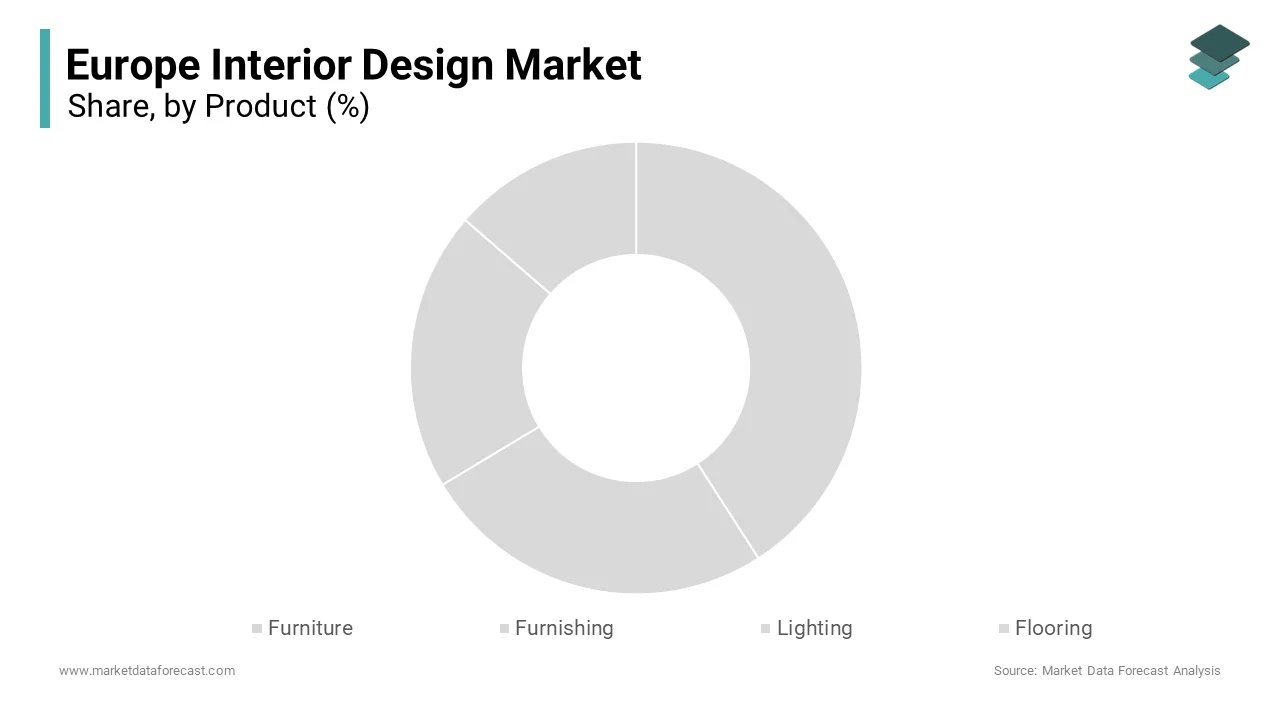
The lighting segment is the fastest-growing product segment in the Europe interior design market and is estimated to grow at a CAGR of 7.07% over the forecast period, owing to the convergence of human‑centric lighting science, smart‑building integration, and stringent energy‑efficiency mandates. As per the European Environment Agency, the EU’s Ecodesign for Energy‑Related Products Directive led to a major phase‑out of non‑LED residential lighting by 2023, which is compelling redesigns to accommodate new fixtures and control systems. Beyond compliance, wellness‑driven demand is reshaping installations. According to European pilot studies and research, wellbeing benefits from tunable white lighting in domestic settings, which is supporting adoption in multiple markets. Moreover, the integration of lighting into Internet‑of‑Things ecosystems has elevated its strategic value. For instance, a growing share of apartments now includes app‑controlled luminaires linked to occupancy and daylight sensors in Nordic countries. Designers now treat lighting not as an afterthought but as a primary spatial orchestrator, which is enabling dynamic ambiance zoning and energy optimization simultaneously. This dual functionality explains why lighting investment is outpacing other interior elements despite its traditionally smaller physical footprint.
By Type Insights
The remodeling segment had the largest share of the European interior design market in 2024, owing to the structural trends in housing‑stock age, energy policy, and lifestyle evolution. According to Eurostat, a large share of the EU’s residential building stock was constructed before 2000, which is creating a substantial retrofit and modernization opportunity that sustains interior redesign activity. The European Commission’s Renovation Wave Strategy targets upgrading 35 million buildings by 2030, directly stimulating interior redesign work. National renovation subsidy schemes and program reporting confirm large‑scale homeowner participation in recent years, with many projects including interior layout changes and material upgrades. Additionally, demographic shifts amplify demand, with many older homeowners increasingly downsizing or reconfiguring homes for accessibility, with a notable share commissioning interior modification. The emotional and financial barrier to relocation further entrenches remodeling as the default path for spatial adaptation, making it the sustained engine of interior design engagement across the region.
The new construction segment is the fastest-growing segment by type and is expected to witness a CAGR of 6.06% over the forecast period due to the urban housing shortages, green‑building mandates, and the institutionalization of interior design in early development phases. Urbanization projections and national housing programs are driving significant new dwelling pipelines in many European cities, and several Member States have fast‑tracked permits for high‑density mixed‑use developments. Critically, the EU’s Energy Performance of Buildings Directive and nearly‑zero energy building requirements are prompting architects and developers to involve interior designers at the schematic stage to optimize daylighting, thermal zoning, and material selection. Furthermore, the rise of build‑to‑rent and co‑living models has professionalized interior specification, with major operators mandating branded design standards across portfolios. This systemic integration of interior intelligence into new developments explains the segment’s accelerating trajectory despite its smaller current footprint.
By End User Insights
The residential segment held the major share of the European interior design market in 2024. The dominance of the residential segment in the European market is driven by the high homeownership rates, sustained renovation cycles, and growing consumer investment in domestic wellbeing. According to Eurostat, 69% of EU households owned their dwellings in 2023, establishing a stable base for discretionary interior spending. For instance, a majority of Europeans now place greater importance on their home environment as a determinant of mental health, which is prompting aesthetic and functional upgrades. In countries with prevalent multigenerational living, interior redesign to accommodate extended families increased in recent years, according to national statistics. Additionally, government incentives amplify activity; national development banks and green loan programs disbursed substantial sums for home modernization in 2023, many earmarked for kitchen and bathroom redesigns. Unlike commercial projects constrained by ROI timelines, residential clients prioritize personalization and longevity, enabling deeper designer engagement and higher per‑project value. This enduring cultural and economic alignment ensures residential interiors remain the market’s dominant force.
The hospitality segment is expanding at the fastest rate and is predicted to register a CAGR of 8.08% over the forecast period, due to the experiential tourism demand, post‑pandemic travel rebounds, and the strategic repositioning of properties through design‑led differentiation. In 2023, Europe welcomed a strong recovery in international tourism, intensifying competition among hotels to offer memorable spatial narratives. Boutique and lifestyle hotels in cities such as Lisbon, Barcelona, and Berlin now allocate a significant portion of project budgets to interior design to curate localized immersive environments. Moreover, sustainability certification has become a common objective for new hotel openings in Western Europe, necessitating redesign of materials, lighting, ing and water systems. The rise of workations and extended‑stay formats further blurs residential and hospitality typologies, requiring designers to embed functionality into aesthetics. This convergence of tourism economics, brand strategy, and regulatory compliance positions hospitality as one of the most dynamically evolving interior design arenas in Europe.
COUNTRY ANALYSIS
Germany Interior Design Market Analysis
Germany accounted for 19.1% in the European interior design market share in 2024. Germany is the region’s largest national market and is expected to remain a leading performer. Germany stands as the largest national contributor to the Europe interior design market, driven by a strong housing‑renovation culture, advanced manufacturing, and a regulatory push for sustainable building upgrades. National renovation activity is high, and a large share of permitsincludese interior layout or finish work, prompting widespread demand for retrofit‑friendly interior solutions. Energy‑efficiency and thermal‑retrofit policies are accelerating interior redesign to accommodate insulation, window replacement, and efficient heating systems. An aging population is increasing demand for age‑friendly, barrier‑free interiors in bathrooms and kitchens. A dense ecosystem of design institutions and premium furniture brands sustains elevated aesthetic expectations, while rising urban rents in major cities encourage tenants and landlords to invest in high‑quality, modular interior enhancements. These demographic, policy, and design drivers underpin Germany’s leadership in both volume and innovation across Europe.
France Interior Design Market Analysis
France is a strong, heritage‑driven market with sustained public support for renovation and a pronounced focus on material provenance. National renovation programs and historic‑building protections generate steady demand for sensitive interior interventions that balance preservation with modern comfort. French design hubs emphasize sustainable luxury and locally sourced materials, and circular‑economy rules have accelerated reuse and upcycling in furniture and finishes. High rates of homeownership further encourage long‑term investment in durable, expressive interiors, positioning France as a laboratory for regenerative and heritage‑conscious design.
United Kingdom Interior Design Market Analysis
The United Kingdom is a resilient market shaped by a large private‑rental sector, evolving hybrid work patterns, and a mature design consultancy industry. Private renters and landlords increasingly collaborate on interior improvements to enhance livability, while major office redesign programs continue to adapt commercial space for hybrid working. Build‑to‑rent growth has institutionalized interior design as an asset‑management tool, and the localization of supply chains has boosted demand for British textiles and finishes. These structural trends sustain the UK’s influential role in residential and commercial interior markets.
Italy Interior Design Market Analysis
Italy is a culturally influential market anchored by a world‑class furniture industry and deep craft traditions. Strong export performance in furniture and interior products supports a vibrant domestic design sector, while multigenerational living patterns drive demand for flexible, multi‑use interior solutions. Milan’s global design events continue to set continental trends, and targeted public incentives for historic‑center revitalization are stimulating renovation activity across southern regions. Italy’s leadership in ceramic, tile, and stone production ensures strong integration of locally made finishes into interior schemes, reinforcing its enduring design authority.
Spain Interior Design Market Analysis
Spain is a fast‑growing market propelled by tourism‑led hospitality investment, urban regeneration programs, and climate‑responsive design innovation. High inbound tourism and hotel renovation cycles create strong demand for hospitality interiors, while national urban‑renewal funding prioritizes interior modernization in social housing and historic districts. Designers are increasingly specifying passive cooling and breathable natural materials to address intense solar exposure, and second‑home and lifestyle migration trends are expanding niche markets for tech‑integrated, culturally rooted interiors. These combined forces are driving Spain’s rising relevance in the European interior design landscape.
COMPETITIVE LANDSCAPE
The Europe interior design market features intense yet fragmented competition characterized by a blend of globally recognized design studios,s regional boutiques, es and multidisciplinary architecture firms. Unlike consolidated sects,ors competition here is not price-driven but centered on design originality, technical innovation, and sustainability credentials. Major players differentiate through proprietary mmethodologieses material research, and deep integration with local regulatory and cultural contexts. The absence of standardized service models allows smaller studios to compete effectively on niche expertise such as heritage conservation or biophilic design. However, large firms gain an advantage through cross-border project execution and strategic partnerships with construction and real estate entities. Digital transformation has lowered entry barriers yet elevated client expectations, demanding constant upskilling and technological adoption. Consequently, the competitive landscape rewardagilityyit, cultural fluency,,cy and evidence-based design over scale alone, fostering a vibrant ecosystem where creativity and compliance coexist.
KEY MARKET PLAYERS
- Aecom (U.S.)
- Gensler (U.S.)
- Foster + Partners
- Gensler Europe
- Patricia Urquiola Studio
- Hirsch Bedner Associates (Singapore)
- Gold Mantis Construction Decoration Co. (China)
- Steve Leung Design Group (Hong Kong)
- Areen Design ServicesnLtd. (UK)
- NELSON Worldwide LLC, (U.S.)
- Cannon Design (U.S.)
- Perkins and Will (U.S.)
- Stantec (Canada)
Top Players In The Market
- Foster + Partners is a globally renowned architecture and interior design firm headquartered in London with a profound influence across Europe. The firm integrates sustainable innovation with spatial elegance, delivehigh-endh end residential,, commerci, al, and institutional interiors. It has expanded its interior design footprint through integrated multidisciplinary studios that emphasizehuman-centricc environments. In 2024, the firm launched a dedicated interior labMadradr,i ,, Madradrid focusing on material circularity and adaptive reuse. This initiative strengthens its European presence by aligning with EU sustainability directives while reinforcing its reputation for design excellence and technical precision in complex urban contexts.
- Patricia Urquiola Studio, based in Mila,n is celebrated for its emotive and tactile approach to interior environments, blending art, craftsmanship, and contemporary technology. The studio contributes significantly to Europe’s design narrative through collaborations with leading furniture and lighting manufacturers while executing bespoke interior projects across hospitality and residential sectors. In early 20,24 the studio partnered with a Danish textile innovator to develop biodegradable upholstery fhigh-trafficfic interiors. This move underscores its commitment to material responsibility and expands its service offering beyond aesthetics into performance-driven sustainable design solutions across European markets.
- Gensler Europe operates as a dynamic extension of the world’s largest design firm with major studios in London, Pari,s and Berlin. It deliverdata-informeded interior strategies for workplaces, retail spaces, retailspacese,s anmixed-usese developments across the continent. The firm emphasizes post pandemic spatial transformation, focusing on flexibility well being and digital integration. In late 202,3 Gensler Europe launched its Adaptive Pace Framework, a proprietary methodology to future-proof interiors through modular systems and real-time occupancy analytics. This approach has enhanced client retention and positioned the firm as a strategic partner in Europe’s evolving commercial and hybrid-use interior landscape.
Top Strategies Used by the Key Market Participants
Key players in the Europe interior design market prioritize sustainability integration through circular material sourcing and low-impact specifications aligned with EU green policies. They invest heavily in digital visualization tools, including real-time rendering and virtual walkthroughs, to enhance client engagement and reduce revision cycles. Strategic collaborations with local artisans and material innovators enable differentiation and cultural authenticity in regional projects. Firms also expand service scope by embedding wellness and behavioral science into spatial planning,g addressing post pandemic occupant expectations. Lastly, they established research-driven innovation labs to prototype adaptive interiors that respond to climate urbanization and technological disruption, ensuring long term relevance.
MARKET SEGMENTATION
This research report on the Europe interior design market is segmented and sub-segmented into the following Categories.
By Product
- Furniture
- Furnishing
- Lighting
- Flooring
By Type
- New Construction
- Remodeling
By End-User
- Residential
- Commercial
- Hospitality
By Country
- UK
- France
- Spain
- Germany
- Italy
- Russia
- Sweden
- Denmark
- Switzerland
- Netherlands
- Turkey
- Czech Republic
- Rest of Europe