- Product Description Description
- Table of Contents TOC
- List of Table & Figure LOT
- Get Free Sample PDF Sample PDF
Market Size, 2025
$13.07 BnMarket Estimate, 2026
$15.93 BnMarket Forecast, 2034
$17.77 BnCAGR, 2026–2034
21.92%Europe Internet of Things (IoT) in Retail Market Report Summary
The Europe Internet of Things (IoT) in retail market was valued at USD 13.07 billion in 2025, is estimated to reach USD 15.93 billion in 2026, and is projected to reach USD 17.77 billion by 2034, growing at a CAGR of 21.92% during the forecast period from 2026 to 2034. The growth of the European IoT in the retail market is driven by the increasing demand for omnichannel retail experiences, rising adoption of connected devices, and the need for real-time inventory and customer insights. The expansion of 5G connectivity, cloud infrastructure, and smart retail technologies such as RFID, sensors, and automated checkout systems is further accelerating market growth. Moreover, the shift toward data-driven decision-making, operational efficiency, and personalized customer engagement is strengthening IoT adoption across the European retail sector.
Key Market Trends
- Rising adoption of smart shelves, RFID tags, and automated checkout systems for real-time inventory management
- Increasing focus on personalized in-store experiences through IoT-enabled analytics and customer tracking
- Growing integration of AI and cloud platforms for predictive retail insights and demand forecasting
- Expansion of contactless payment technologies and mobile-enabled retail solutions
- Strong emphasis on sustainability through smart energy management and waste reduction systems
Segmental Insights
- Based on component, the hardware segment was the largest and held a significant share of the Europe IoT in the retail market in 2025. The segment’s dominance is attributed to high investments in physical infrastructure such as sensors, RFID tags, smart shelves, and connected POS systems required to digitize retail environments.
- Based on technology, the Bluetooth Low Energy (BLE) segment accounted for a major share of the Europe IoT in retail market in 2025. This is driven by its low power consumption, cost-effectiveness, and widespread compatibility with smartphones, enabling proximity marketing and indoor navigation.
Regional Insights
The Europe IoT in retail market is witnessing strong growth across major economies, supported by digital transformation initiatives, high internet penetration, and increasing adoption of smart retail technologies.
Germany was the largest contributor to the European IoT in retail market in 2025, driven by its advanced industrial ecosystem, strong retail infrastructure, and early adoption of Industry 4.0 technologies.
The United Kingdom and France continue to perform well, fueled by high e-commerce penetration, strong digital infrastructure, and increasing demand for personalized retail experiences.
Competitive Landscape
The Europe IoT in retail market is characterized by intense competition among global technology providers and specialized IoT solution companies focusing on end-to-end digital transformation solutions. Leading players are emphasizing AI-driven analytics, cloud integration, cybersecurity, and scalable IoT platforms to enhance operational efficiency and customer engagement. Strategic collaborations, innovation in smart retail technologies, and expansion of cloud-based IoT ecosystems are strengthening market competition. Prominent players in the Europe IoT in retail market include Cisco Systems, Inc., International Business Machines Corporation, Microsoft Corporation, Amazon Web Services, Google LLC, SAP SE, Intel Corporation, Oracle Corporation, NXP Semiconductors, and Siemens AG.
 Download Free Sample Report
Europe Internet of Things in Retail Market Size
The Europe internet of things in retail market size was valued at USD 13.07 billion in 2025 and is anticipated to reach USD 15.93 billion in 2026 from USD 17.77 billion by 2034, growing at a CAGR of 21.92% during the forecast period from 2026 to 2034.
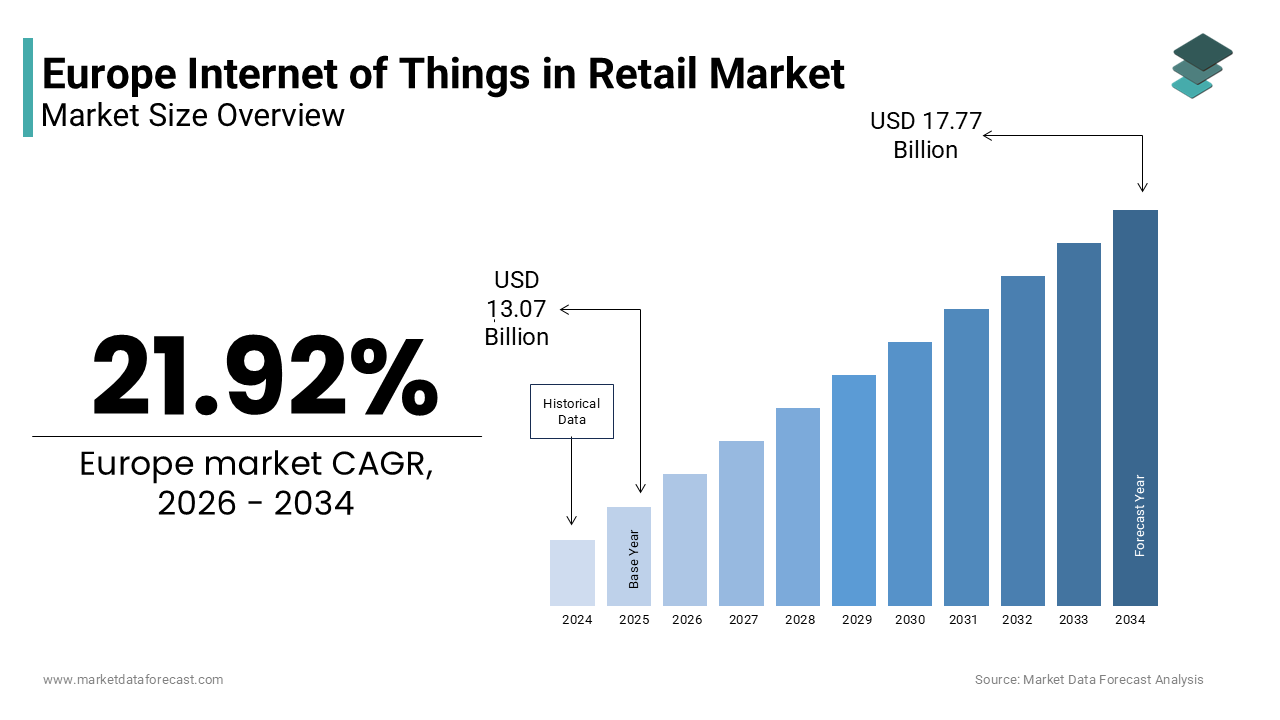
Internet of things (IoT) in retail represents a transformative ecosystem where connected devices and sensors integrate seamlessly with physical store operations to enhance customer experience and operational efficiency. This technological framework encompasses smart shelves, radio frequency identification tags, and intelligent point of sale systems that collect real time data on inventory levels and consumer behavior. As per Eurostat, 45.2% of enterprises in the European Union with ten or more persons employed used cloud computing services in 2023, which indicates a robust digital infrastructure ready to support internet of things deployments. Furthermore, the European Commission stated that 5G coverage in populated areas reached 81% across the EU by the end of 2022, providing the necessary high speed connectivity for latency sensitive retail applications. The adoption of these technologies is driven by the need for retailers to bridge the gap between online and offline shopping experiences. Consumers increasingly expect personalized interactions and instant product availability information, which internet of things solutions facilitate through automated tracking and data analytics. The regulatory environment in Europe also plays a crucial role, with strict data protection laws shaping how retailers collect and process consumer information from connected devices. This market is not merely about hardware installation but involves a comprehensive shift towards data driven decision making processes that optimize supply chain logistics and reduce operational costs while improving sustainability metrics through better resource management and waste reduction strategies in retail environments.
MARKET DRIVERS
Rising Consumer Expectation for Seamless Omnichannel Shopping Experiences Drives Adoption
The demand for frictionless shopping journeys compels European retailers to deploy internet of things solutions extensively, which is one of the major factors propelling the European internet of things in retail market growth. Modern consumers expect a unified experience where online browsing data informs in store interactions and vice versa. According to a study by McKinsey, companies that excel at personalization generate 40% more revenue from those activities than average players. This statistic underscores the financial imperative for retailers to leverage connected devices that track customer movements and preferences in real time. Smart mirrors and beacon technology allow stores to send personalized offers to shopper’s smartphones based on their location within the aisle. Such interventions increase conversion rates significantly as they provide relevant information at the point of decision. The integration of mobile payment systems with internet of things enabled checkout counters reduces waiting times, which is a critical factor for customer satisfaction. As per the Baymard Institute, 17% of shoppers abandon their checkout process because it is too long or complicated, making queues a top reason for cart abandonment. By implementing automated checkout solutions powered by sensor data, retailers can mitigate this issue effectively. Furthermore, the ability to check real time inventory availability through mobile apps enhances trust and reduces frustration among shoppers who wish to avoid wasted trips. This seamless integration of digital and physical realms creates a competitive advantage for early adopters who can offer superior convenience and personalized service that meets the evolving expectations of tech savvy European consumers who value efficiency and relevance in their shopping interactions.
Operational Efficiency Gains through Automated Inventory Management and Loss Prevention
Retailers in Europe face significant pressure to optimize operational costs while maintaining high service standards, which is driving the uptake of internet of things technologies for inventory and security purposes and further contributing to the regional market growth. Automated inventory management systems using radio frequency identification tags and smart shelves provide real time visibility into stock levels, reducing the incidence of out of stock situations which cost retailers billions annually. As per the IHL Group, global out of stocks result in approximately 1.2 trillion USD in lost sales each year and this a figure those European retailers strive to minimize through better tracking. Internet of things sensors detect when items are low on shelves and automatically trigger reordering processes, ensuring optimal stock levels without manual intervention. This automation reduces labor costs associated with routine stock checks and allows staff to focus on customer service tasks. Additionally, smart security tags and video analytics powered by artificial intelligence help in preventing shoplifting and internal theft. According to the European Commission, retail crime and shrinkage account for losses of approximately 49 billion EUR annually in Europe, prompting investment in advanced surveillance systems. These systems analyze customer behavior patterns to identify suspicious activities and alert security personnel immediately. The combination of accurate inventory data and enhanced security measures leads to improved profit margins and operational resilience. By leveraging these technologies, retailers can achieve a leaner operation that responds dynamically to demand fluctuations while safeguarding assets against theft and mismanagement in an increasingly complex retail landscape.
MARKET RESTRAINTS
Stringent Data Privacy Regulations Impose Compliance Burdens on Retailers
The General Data Protection Regulation in Europe is hampering the regional market growth due to the extensive personal data collected by connected devices. Retailers must ensure that every sensor and camera complies with strict consent and data minimization principles, which increases the complexity and cost of deployment. According to the European Data Protection Board, fines for non-compliance can reach up to 20 million EUR or 4% of global annual turnover, whichever is higher. This severe penalty structure makes retailers cautious about adopting technologies that might inadvertently violate privacy norms. Consumer awareness regarding data rights is also high, with Eurobarometer surveys indicating that 46% of Europeans feel they have no control over their personal data used by companies. This skepticism can hinder the acceptance of personalized marketing initiatives driven by internet of things data if customers feel their privacy is invaded. Retailers must invest heavily in legal counsel and secure data architecture to navigate these regulatory requirements, which can be prohibitive for small and medium sized enterprises. The need for transparent data processing policies and robust consent mechanisms slows down the implementation timeline for new internet of things projects. Furthermore, the cross border nature of retail operations in Europe means that companies must adhere to varying interpretations of privacy laws across different member states, creating a fragmented compliance landscape that complicates standardized technology rollouts and increases operational overheads significantly.
High Initial Implementation Costs and Interoperability Issues Limit Scalability
The substantial capital expenditure required for deploying internet of things infrastructure is further hindering the expansion of the European internet of things in retail market. Installing smart shelves, sensors, and connectivity networks involves high upfront costs for hardware, software licenses, and professional services. As per data from the European Investment Bank, approximately 50% of small and medium sized enterprises in the EU identify access to finance as a primary constraint for digital transformation initiatives. The return on investment for internet of things projects may take several years to materialize, making it difficult for retailers to justify the initial outlay in a margin constrained industry. Additionally, interoperability remains a critical challenge as devices from different vendors often use proprietary protocols that do not communicate seamlessly. This lack of standardization forces retailers to commit to single vendor ecosystems or invest in custom integration solutions, both of which increase costs and reduce flexibility. The International Organization for Standardization has been working on universal standards, but widespread adoption is still pending. According to a survey by the European Telecommunications Standards Institute, incompatible systems lead to increased maintenance costs and operational inefficiencies. Retailers hesitate to scale their internet of things deployments when they fear vendor lock in or technical obsolescence. The complexity of integrating legacy systems with new internet of things platforms further exacerbates these issues, requiring specialized technical expertise that is scarce and expensive in the current labor market, thereby slowing down the overall pace of market penetration across the region.
MARKET OPPORTUNITIES
Integration of Augmented Reality with Internet of Things for Enhanced Engagement
The convergence of augmented reality and internet of things technologies offers a lucrative opportunity for the European internet of things in retail market. Augmented reality applications can overlay digital information onto physical products, providing customers with detailed specifications, reviews, and styling suggestions through their smartphones or smart glasses. As per Statista, the augmented reality market in Europe is projected to reach 10.2 billion USD by 2024, with retail being one of the key adoption sectors. Internet of things sensors can trigger these augmented reality experiences based on customer proximity to specific items, creating context aware interactions that are highly relevant and engaging. For instance, a customer pointing their device at a furniture item can see how it would look in their home, with real time data on dimensions and materials fetched from internet of things enabled product tags. This capability reduces purchase hesitation and returns, which are costly for retailers. According to Shopify, products with 3D content show a 94% higher conversion rate than those without. By leveraging this synergy, retailers can differentiate themselves in a crowded market and offer value added services that online pure players cannot easily replicate. The ability to visualize products in a personal context enhances customer confidence and satisfaction. Furthermore, data collected from these interactions provides insights into customer preferences and behavior, enabling retailers to refine their product offerings and marketing strategies. This innovative approach transforms passive shopping into an interactive journey, fostering deeper emotional connections between brands and consumers in the European retail landscape.
Expansion of Sustainable Retail Practices Through Smart Energy Management
Sustainability has become a central concern for European consumers and regulators are creating a promising opportunity for the European internet of things in retail market. Connected devices can monitor and optimize energy consumption in stores by adjusting lighting, heating, and cooling systems based on real time occupancy and weather conditions. As per the European Environment Agency, the building sector is responsible for approximately 40% of energy consumption in Europe, making efficiency improvements a priority. Internet of things enabled smart meters provide granular data on energy usage patterns, allowing retailers to identify inefficiencies and implement corrective measures promptly. This not only reduces operational costs but also helps retailers meet their environmental, social, and governance targets. According to a report by Deloitte, 34% of consumers have stopped purchasing certain products because they had ethical or sustainability concerns. Retailers that demonstrate commitment to sustainability through visible technology deployments can enhance their brand reputation and attract eco conscious shoppers. Additionally, smart waste bins equipped with sensors can optimize collection schedules and reduce overflow, contributing to cleaner store environments and lower waste management costs. The integration of these solutions supports the circular economy initiatives promoted by the European Green Deal. By adopting internet of things technologies for sustainability, retailers can align with regulatory expectations and consumer values, creating a competitive advantage that goes beyond price and product assortment to include ethical and environmental stewardship in their business models.
MARKET CHALLENGES
Cybersecurity Vulnerabilities Pose Significant Risks to Connected Retail Infrastructure
The proliferation of internet of things devices in retail environments expands the attack surface for cybercriminals is challenging the expansion of the European internet of things in retail market. Each connected sensor, camera, or smart shelf represents a potential entry point for malicious actors seeking to steal customer data or disrupt operations. As per ENISA, the European Union Agency for Cybersecurity, the retail sector has seen a sharp rise in ransomware and data extortion attacks, being a frequent target due to the vast amount of personal and financial data it handles. Many internet of things devices have limited processing power and cannot run robust security software, making them vulnerable to exploits. Retailers often struggle to patch these devices regularly due to logistical challenges and lack of vendor support. A successful breach can lead to significant financial losses, reputational damage, and legal liabilities under data protection laws. According to IBM, the average cost of a data breach in the European Union reached 4.45 million USD in 2023, highlighting the severity of the threat. The complexity of managing security across thousands of heterogeneous devices requires specialized skills and tools that many retailers lack. Furthermore, the interconnected nature of internet of things systems means that a compromise in one device can spread to the entire network, causing widespread disruption. Retailers must invest in comprehensive security frameworks that include device authentication, encryption, and continuous monitoring to mitigate these risks. However, the rapid evolution of cyber threats outpaces the development of defensive measures, creating a persistent challenge that requires ongoing vigilance and adaptation to protect critical retail infrastructure and customer trust in the digital age.
Shortage of Skilled Workforce Hinders Effective Deployment and Maintenance
The successful implementation and operation of internet of things systems in retail require a workforce with specialized skills in data analytics, network engineering, and device management, which are currently in short supply across Europe and this factor is further challenging the rapid growth of the European internet of things in retail market. As per the European Centre for the Development of Vocational Training, there is a growing mismatch between the skills demanded by the digital economy and those available in the labor market. Retailers often find it difficult to recruit professionals who understand both the technical aspects of internet of things and the operational nuances of retail environments. This skills gap leads to suboptimal deployment of technologies, where devices are not configured correctly or data is not analyzed effectively to derive actionable insights. Maintenance of these complex systems also requires trained personnel who can troubleshoot connectivity issues and hardware failures promptly. Without adequate support, internet of things installations can become unreliable, leading to downtime and reduced confidence in the technology. The cost of training existing staff or hiring external consultants adds to the financial burden of adoption. According to a survey by ManpowerGroup, 75% of employers in Europe reported difficulty in finding the talent they need in 2024. This scarcity of skilled workers slows down the pace of innovation and limits the ability of retailers to scale their internet of things initiatives. Companies must invest in comprehensive training programs and partnerships with educational institutions to build a pipeline of qualified talent. Until this workforce challenge is addressed, the full potential of internet of things in transforming the European retail sector will remain constrained by human capital limitations.
REPORT COVERAGE
| REPORT METRIC | DETAILS |
| Market Size Available | 2025 to 2034 |
| Base Year | 2025 |
| Forecast Period | 2026 to 2034 |
| CAGR | 21.92% |
| Segments Covered | By Component, Technology and Region |
| Various Analyses Covered | Global, Regional, & Country Level Analysis; Segment-Level Analysis, Drivers, Restraints, Opportunities, Challenges, PESTLE Analysis, Porter’s Five Forces Analysis, Competitive Landscape, Analyst Overview of Investment Opportunities |
| Regions Covered | UK, France, Spain, Germany, Italy, Russia, Sweden, Denmark, Switzerland, the Netherlands, Turkey, the Czech Republic, and the Rest of Europe |
| Key Market Players | Cisco Systems, Inc., International Business Machines Corporation, Microsoft Corporation, Amazon Web Services, Google LLC, SAP SE, Intel Corporation, Oracle Corporation, NXP Semiconductors, and Siemens AG |
SEGMENTAL ANALYSIS
By Component Insights
The hardware segment dominated the market by commanding for 56.5% of the regional market share in 2025. The dominance of hardware segment in the European market is attributed to the extensive infrastructure upgrades required to digitize physical retail spaces. Retailers are investing heavily in smart shelves, radio frequency identification tags, sensors, and beacons to create a connected environment. The initial capital expenditure for these physical devices constitutes the bulk of early stage project costs. As per data from the European Commission, 81% of populated areas in the EU were covered by at least one 5G network by late 2022. This connectivity backbone necessitates robust hardware endpoints to leverage high speed data transmission. Furthermore, the proliferation of smart point of sale terminals and automated checkout kiosks contributes significantly to hardware revenue. According to Eurostat, the number of enterprises investing in internet of things technologies increased significantly, with 33% of EU companies using IoT devices in 2024. The longevity and replacement cycles of these devices also ensure steady revenue streams. Retailers prioritize durable and reliable hardware to minimize downtime, leading to premium pricing for industrial grade sensors and tags. The tangible nature of hardware investments allows for easier budget approval compared to abstract software services, further cementing its leading position in the market composition across the European region
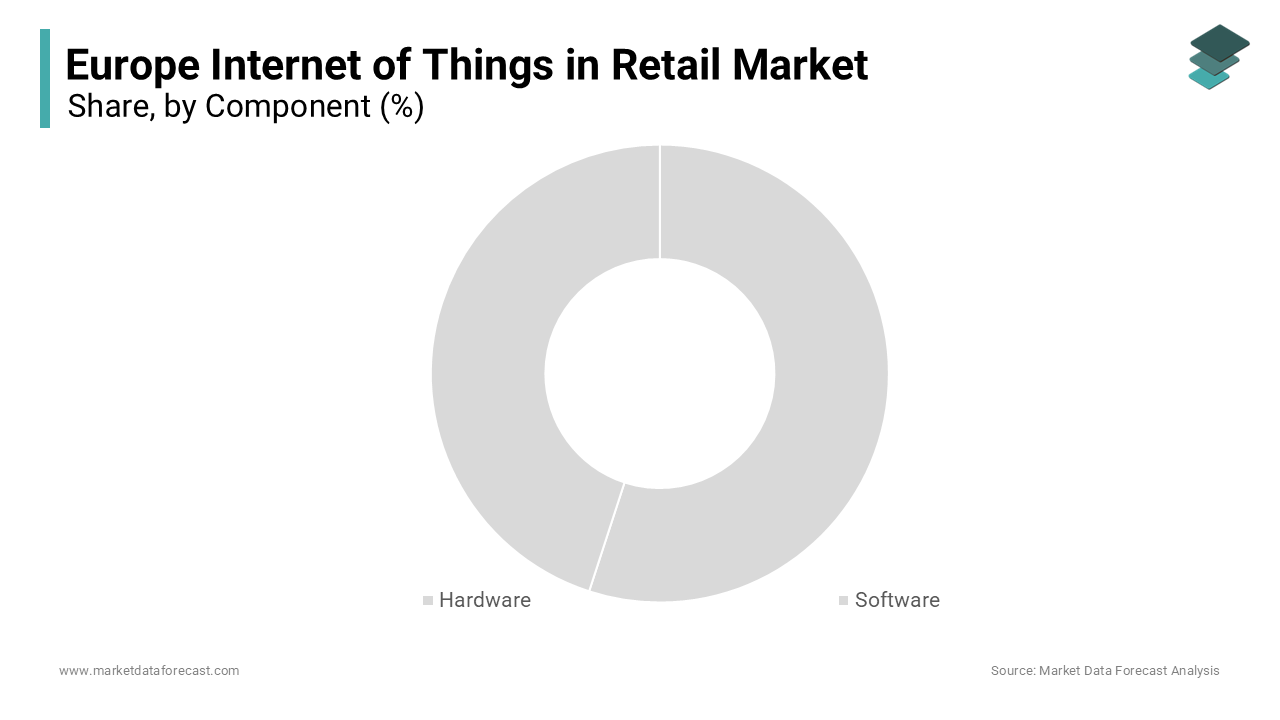
However, the software segment is a promising segment and is estimated to register a CAGR of 15.5% over the forecast period in the European market owing to the increasing need for data analytics and cloud based management platforms. While hardware provides the data, software unlocks its value through actionable insights. Retailers are shifting focus towards artificial intelligence powered analytics that predict consumer behavior and optimize inventory levels in real time. As per a report by McKinsey, advanced analytics can improve retailer margins by up to 60%, incentivizing heavy investment in sophisticated software solutions. The rise of software as a service models lowers the barrier to entry, allowing small and medium sized retailers to access enterprise grade tools without significant upfront costs. According to Eurostat, 45.2% of EU enterprises used cloud computing services in 2023, facilitating the rapid adoption of cloud based internet of things software. These platforms enable seamless integration of data from various hardware sources, providing a unified view of operations. The ability to remotely update and scale software solutions offers flexibility that hardware cannot match. Furthermore, cybersecurity software is becoming a critical component, with retailers spending increasingly on protection against data breaches. The European Union Agency for Cybersecurity noted a sharp increase in cyber threats targeting retail infrastructure, prompting urgent software upgrades. This continuous need for updates, security patches, and advanced analytical capabilities ensures that the software segment grows at a faster pace than hardware, transforming raw data into strategic competitive advantages for European retailers.
By Technology Insights
The Bluetooth low energy segment occupied the major share of 34.3% of the European market share in 2025. The growth of the Bluetooth low energy segment in the European market can be credited to its energy efficiency and widespread compatibility with consumer smartphones. This technology enables proximity marketing and indoor navigation without draining device batteries, which is making it ideal for retail applications. Beacons using Bluetooth Low Energy can send personalized offers to shoppers as they move through aisles, enhancing engagement. As per the Bluetooth Special Interest Group, 5.4 billion Bluetooth enabled devices were shipped in 2023, ensuring broad reach for retailers deploying this technology. The low cost of beacon hardware compared to other connectivity options also drives adoption among budget conscious retailers. According to Statista, the number of Bluetooth enabled devices shipped worldwide is expected to grow, with retail being a key vertical. The ease of deployment and maintenance further strengthens its position, as beacons require minimal infrastructure changes. Retailers can install them quickly and manage them remotely via cloud platforms. The technology’s ability to provide precise location data within stores allows for detailed heat maps of customer movement, helping retailers optimize store layouts. Additionally, Bluetooth Low Energy supports mesh networking, which extends coverage and reliability in large retail spaces. The combination of low power consumption, high penetration in consumer devices, and cost effectiveness makes it the preferred choice for proximity based retail solutions in Europe, sustaining its dominant market share.
On the other hand, the near field communication segment is predicted to expand at a CAGR of 15.9% over the forecast period in the European market due to the surge in contactless payments and secure product authentication. Consumers increasingly prefer tap and go payment methods for their speed and hygiene benefits, especially post pandemic. As per the European Central Bank, the share of contactless card payments at the point of sale in the euro area increased to 62% in 2022, which is indicating the shift towards near field communication enabled transactions. Retailers are integrating near field communication tags into products to combat counterfeiting and provide transparency about supply chains. Shoppers can scan tags with their smartphones to verify authenticity and access detailed product information. This application is particularly strong in luxury goods and pharmaceuticals sectors in Europe. According to GSMA, the adoption of mobile wallets utilizing near field communication technology is high, with over 35% of European consumers using mobile payments regularly. The technology’s inherent security features, which require close proximity for data exchange, reduce the risk of interception compared to other wireless protocols. Furthermore, the integration of near field communication with loyalty programs allows for seamless point accumulation and redemption at the point of sale. The dual functionality of facilitating payments and enhancing product engagement drives its rapid expansion. As retailers seek to streamline checkout processes and build trust through transparency, near field communication emerges as a critical technology, propelling its growth rate above other connectivity options in the European retail landscape.
REGIONAL ANALYSIS
Germany Internet of Things in Retail Market Analysis
Germany led the IoT in retail market in Europe in 2025 with the highest share of the regional market. The growth of Germany in the European market is driven by its robust industrial base and early adoption of Industry 4.0 principles. The country’s retail sector is characterized by high efficiency standards and a strong emphasis on automation, which aligns perfectly with internet of things technologies. German retailers are leveraging smart logistics and automated inventory systems to maintain their competitive edge in a highly saturated market. As per the Federal Ministry for Economic Affairs and Climate Action, Germany is investing heavily in digital infrastructure projects, supporting the deployment of connected retail solutions. The presence of major technology providers and automotive giants in the country fosters a culture of innovation and technical expertise. According to Statista, the e commerce sales in Germany reached 79.7 billion EUR in 2023, prompting brick and mortar stores to adopt internet of things tools to bridge the online offline gap. Smart mirrors and interactive displays are becoming common in flagship stores in Berlin and Munich, enhancing customer engagement. The government’s support for digital transformation through initiatives like the Digital Strategy 2025 further accelerates adoption. Additionally, the strong regulatory framework for data protection ensures that consumers trust digital interactions, encouraging retailers to invest in compliant internet of things solutions. The combination of technological readiness, financial investment, and consumer demand positions Germany as the undisputed leader in the regional market, setting benchmarks for innovation and operational excellence in retail digitalization.
United Kingdom Internet of Things in Retail Market
The United Kingdom secured the second largest share of the European internet of things in retail market in 2025 due to its advanced digital infrastructure and high smartphone penetration. British consumers are among the most tech savvy in Europe, which is demanding seamless omnichannel experiences that drive retailers to adopt connected technologies rapidly. The prevalence of major retail chains with global footprints, such as Tesco and Marks and Spencer, facilitates large scale pilot programs and deployments of internet of things solutions. As per the Office for National Statistics, online sales accounted for 26.6% of total retail sales in the UK in 2023, creating pressure on physical stores to differentiate through technology. Smart checkout systems and automated replenishment tools are widely used to reduce labor costs and improve efficiency. According to UK Finance, contactless payments reached 17 billion transactions in 2022, underpinning the infrastructure for internet of things enabled payment systems. The government’s Digital Strategy aims to make the UK a global leader in digital innovation, providing grants and support for tech adoption in traditional sectors. London serves as a hub for fintech and retail tech startups, fostering an ecosystem of innovation. The strong venture capital presence enables rapid scaling of new internet of things applications. Furthermore, the competitive retail landscape forces continuous innovation, with retailers using data from connected devices to personalize marketing and optimize stock levels, ensuring the UK remains a key growth engine in the European market.
France Internet of Things in Retail Market Analysis
France is predicted to account for a promising share of the European internet of things in retail market during the forecast period due to its strong luxury retail sector and government initiatives promoting digital transformation. French retailers, particularly in the luxury segment, are early adopters of internet of things technologies to enhance customer experience and combat counterfeiting. Smart tags and connected displays allow brands to tell immersive stories about their products, appealing to high end consumers. As per the French Ministry of Economy, the Plan France 2030 includes funding for digital innovation in retail and tourism, encouraging the adoption of smart technologies. Paris remains a global fashion capital, where flagship stores serve as test beds for new retail concepts involving augmented reality and sensor based interactions. According to INSEE, 71% of French companies had a digital transformation strategy in 2023, showing steady growth. The widespread adoption of mobile payment solutions and loyalty apps integrated with internet of things beacons drives engagement. French consumers value personalized service, which internet of things data enables through real time insights into preferences. The regulatory environment, aligned with EU standards, ensures data privacy while allowing innovation. Additionally, the push for sustainable retail practices encourages the use of smart energy management systems in stores. The combination of luxury brand innovation, government support, and consumer demand for personalized experiences sustains France’s prominent position in the regional market, driving steady adoption of connected retail solutions.
Italy Internet of Things in Retail Market Analysis
Italy is estimated to showcase a healthy CAGR in the European internet of things in retail market over the forecast period owing to the modernization of its traditional retail sector and the strength of its fashion and design industries. Italian retailers are increasingly adopting internet of things solutions to improve supply chain visibility and enhance in store experiences. The country’s small and medium sized enterprises are benefiting from government incentives aimed at digitalization, such as the National Recovery and Resilience Plan. As per the Italian National Institute of Statistics, 34% of Italian companies had used at least one IoT technology by 2022. Milan, as a global fashion hub, sees high adoption of smart mirrors and interactive displays in boutique stores, blending heritage with technology. According to Casaleggio Associati, e commerce growth in Italy reached 54.2 billion EUR in 2023, pushing physical stores to integrate digital tools for omni-channel consistency. The tourism sector also plays a vital role, with retailers in tourist hotspots using internet of things beacons to offer multilingual information and personalized offers to international visitors. The emphasis on design and aesthetics in Italian retail means that internet of devices are often seamlessly integrated into store decor, enhancing rather than disrupting the visual appeal. Consumer acceptance of digital payments is growing, supported by infrastructure improvements. The unique blend of traditional craftsmanship and modern technology adoption positions Italy as a dynamic market where internet of things solutions is tailored to enhance the artistic and cultural value of retail offerings.
Netherlands Internet of Things in Retail Market Analysis
The Netherlands is a noteworthy regional segment in the European internet of things in retail market. The high digital literacy and progressive approach to sustainable retail practices are likely to drive the market growth in Netherlands. Dutch retailers are leaders in implementing smart energy management systems and automated logistics to reduce environmental impact. The country’s compact geography and dense urban centers facilitate efficient deployment of internet of things networks. As per Statistics Netherlands, 98% of households had internet access in 2023, creating a highly connected consumer base ready for digital retail interactions. Amsterdam and Rotterdam serve as innovation hubs where retailers test new concepts such as autonomous delivery robots and smart vending machines. According to the Netherlands Enterprise Agency, the government actively supports digital innovation through subsidies and partnerships with tech companies. The strong cooperative culture in Dutch retail encourages knowledge sharing and collaboration.
COMPETITIVE LANDSCAPE
The competition in the Europe internet of things in retail market is characterized by intense rivalry among established technology giants and innovative startups seeking to capture market share. Major players leverage their extensive resources and global presence to offer comprehensive end to end solutions that integrate hardware software and connectivity services. These corporations focus on continuous innovation in artificial intelligence and data analytics to provide superior value propositions to retailers. Smaller specialized firms compete by offering niche solutions tailored to specific retail needs such as smart shelving or automated checkout systems. The market sees frequent collaborations and partnerships as companies seek to combine complementary technologies to create more robust offerings. Regulatory compliance with data protection laws serves as a significant differentiator, with firms investing heavily in security features to gain retailer trust. Price competition remains moderate as customers prioritize reliability and functionality over cost. The rapid pace of technological advancement requires constant investment in research and development to stay ahead. This dynamic environment drives continuous improvement in service quality and feature sets, benefiting retailers through enhanced operational efficiency and customer experience improvements across the European region.
KEY MARKET PLAYERS
Some of the companies that are playing a dominating role in the Europe Internet of Things in Retail Market include
- Cisco Systems, Inc.
- International Business Machines Corporation
- Microsoft Corporation
- Amazon Web Services
- Google LLC
- SAP SE
- Intel Corporation
- Oracle Corporation
- NXP Semiconductors
- Siemens AG
Top Players in the Europe Internet of Things in Retail Market
Siemens AG
Siemens AG leverages its extensive industrial automation expertise to provide robust internet of things infrastructure for European retail environments. The company focuses on integrating smart building technologies with retail operations to enhance energy efficiency and operational visibility. Recent initiatives include the expansion of its MindSphere platform capabilities to support real time inventory tracking and predictive maintenance for retail equipment. Siemens collaborates with major retail chains to deploy sensor networks that monitor environmental conditions and asset performance. These efforts strengthen its position by offering end to end solutions that connect physical store assets with digital management systems. The company emphasizes sustainability by enabling retailers to reduce carbon footprints through optimized energy consumption. Its global presence allows it to bring best practices from other sectors into the retail domain, ensuring high reliability and security for critical retail infrastructure across Europe.
SAP SE
SAP SE dominates the software layer of the internet of things in retail market by providing comprehensive enterprise resource planning solutions integrated with connected device data. The company enables retailers to unify online and offline customer data for personalized experiences and efficient supply chain management. Recent actions include enhancing its SAP Intelligent Retail suite with artificial intelligence capabilities to predict demand and automate replenishment processes. SAP partners with hardware vendors to ensure seamless connectivity between sensors and its cloud platforms. This integration allows retailers to gain actionable insights from real time data collected in stores. The company strengthens its market position by focusing on data analytics and customer journey optimization. Its global reach ensures that European retailers can leverage scalable solutions that comply with local regulations while benefiting from international innovation trends in digital retail transformation.
Cisco Systems Inc
Cisco Systems Inc provides the foundational networking infrastructure required for secure and reliable internet of things deployments in European retail settings. The company offers advanced switching routing and security solutions that handle the massive data traffic generated by connected devices. Recent strategies involve launching specialized retail focused internet of things kits that simplify deployment and management for store operators. Cisco emphasizes cybersecurity by embedding protection mechanisms directly into its networking hardware to safeguard customer data. The company collaborates with retail technology integrators to create certified solutions that ensure interoperability and performance. Its global leadership in networking technology allows it to set standards for connectivity and data transmission in retail environments. By focusing on edge computing capabilities, Cisco enables faster data processing at the store level, reducing latency and improving the responsiveness of smart retail applications across the European market.
Top Strategies Used by the Key Market Participants
Key players in the Europe internet of things in retail market primarily employ strategic partnerships and acquisitions to expand their technological capabilities and market reach. Companies frequently collaborate with software developers and hardware manufacturers to create integrated solutions that address specific retail challenges such as inventory management and customer engagement. Innovation in artificial intelligence and data analytics serves as a core strategy, allowing firms to offer predictive insights that drive operational efficiency. Another major approach involves focusing on cybersecurity features to build trust among retailers concerned about data privacy regulations. Providers also invest heavily in cloud based platforms to enable scalable and flexible deployment options for small and medium sized enterprises. Customization of solutions for different retail segments such as grocery fashion and electronics helps companies differentiate their offerings. Additionally, emphasizing sustainability through energy efficient devices aligns with European regulatory goals and consumer preferences. These strategies collectively enhance competitive positioning by delivering comprehensive secure and value driven internet of things ecosystems for modern retail environments.
MARKET SEGMENTATION
This research report on the Europe Internet of Things in Retail Market has been segmented and sub-segmented based on the following categories.
By Component
- Hardware
- RFID Tags
- Sensors
- Beacons
- Others
- Software
By Technology
- Near field communication
- Bluetooth Low Energy
- ZigBee
- Others
By Country
- UK
- France
- Spain
- Germany
- Italy
- Russia
- Sweden
- Denmark
- Switzerland
- Netherlands
- Turkey
- Czech Republic
- Rest of Europe