- Product Description Description
- Table of Contents TOC
- List of Table & Figure LOT
- Get Free Sample PDF Sample PDF
Market Size, 2025
$0.56 BnMarket Estimate, 2026
$0.59 BnMarket Forecast, 2034
$0.95 BnCAGR, 2026–2034
6.07%Europe Iprodione Market Report Summary
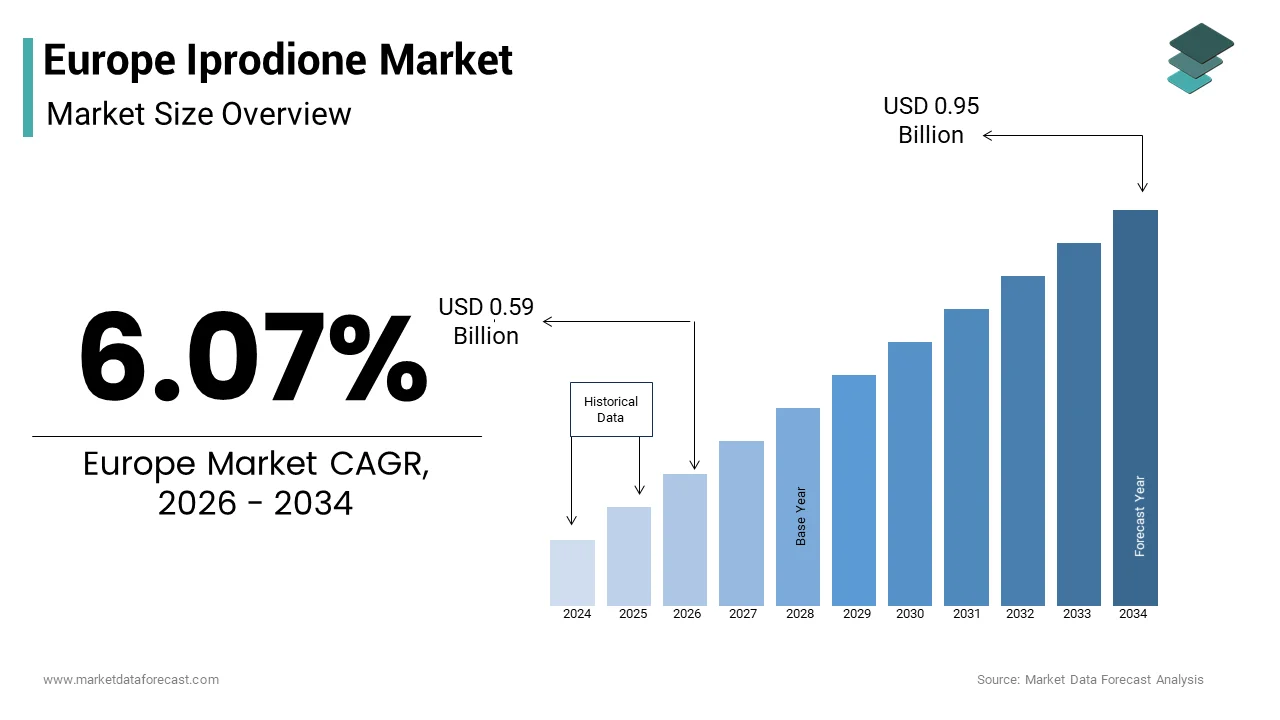
The Europe iprodione market was valued at USD 0.56 billion in 2025, is estimated to reach USD 0.59 billion in 2026, and is projected to expand to USD 0.95 billion by 2034, growing at a CAGR of 6.07% during the forecast period from 2026 to 2034. The growth of the European iprodione market is driven by sustained demand for effective fungicides in high-value crops, particularly fruits and vegetables, and the continued need for disease control solutions in intensive and greenhouse farming systems. Iprodione’s proven efficacy against fungal pathogens such as Botrytis cinerea, combined with its role in crop yield protection and post-harvest quality preservation, is supporting its adoption across Europe. Additionally, pragmatic regulatory enforcement in key countries and the absence of equally cost-effective alternatives for certain applications are contributing to market growth.
Key Market Trends
Continued use of iprodione in fruit and vegetable cultivation to manage fungal diseases affecting crop quality and export value. Strong demand from greenhouse and controlled-environment agriculture, especially in export-oriented horticulture. Preference for established branded formulations with proven performance and farmer familiarity. Dominance of physical pesticide retail outlets for product access, advisory support, and compliance assurance. Increasing focus on responsible usage and adherence to application guidelines amid evolving regulatory scrutiny.
Segmental Insights
- Based on trade name, the Chipco 26019 segment remained the largest in the Europe iprodione market in 2025, accounting for 32.4% of the market share. The segment’s dominance is attributed to strong brand recognition, consistent efficacy, and widespread acceptance among commercial growers.
- Based on application, the fruit crops segment dominated the market by capturing 58.6% of the Europe iprodione market share in 2025. This leadership is driven by the high susceptibility of fruit crops to fungal infections and the critical need to maintain yield quality for both domestic consumption and exports.
- Based on distribution channel, the pesticide stores segment held a significant share of the market in 2024. The dominance of this channel stems from farmers’ reliance on specialized agrochemical retailers for product authenticity, technical guidance, and regulatory-compliant purchasing.
Regional Insights
The Europe iprodione market shows strong concentration in major horticultural economies.
- France emerged as the leading country in 2025, accounting for 22.4% of the regional market share, supported by extensive fruit cultivation and well-established crop protection practices.
- Italy followed with a 19.1% share, driven by high-value fruit and vegetable production.
- Spain remains a major market due to its export-oriented greenhouse horticulture sector.
- Germany expanded steadily, supported by strict yet pragmatic regulatory enforcement.
- The Netherlands is expected to witness growth from 2026 to 2034, driven by advanced greenhouse farming and intensive crop management systems.
Competitive Landscape
The Europe iprodione market is moderately consolidated, with the presence of major global agrochemical manufacturers. Leading companies are focusing on regulatory compliance, formulation reliability, and targeted crop protection solutions to maintain market positions. Prominent players operating in the Europe iprodione market include Bayer CropScience AG, Dow AgroSciences, BASF SE, E.I. DuPont de Nemours & Company, and Syngenta AG.
 Download Free Sample Report
Europe Iprodione Market Size
The European iprodione market size will reach USD 0.56 billion in 2025 and is anticipated to reach USD 0.59 billion in 2026 to reach USD 0.95 billion by 2034, growing at a CAGR of 6.07% during the forecast period from 2026 to 2034.
Iprodione is a broad-spectrum dicarboximide fungicide primarily used in European agriculture to control Botrytis cinerea and other fungal pathogens affecting high-value crops such as grapes, strawberries, tomatoes, and stone fruits. It functions by inhibiting fungal spore germination and mycelial growth, offering both protective and curative action. In the European context, iprodione’s application is tightly regulated under the European Union’s pesticide authorization framework, with its approval subject to periodic scientific reassessment by the European Food Safety Authority. The regulatory trend within the European Union is a phasing out of specific chemical pesticides due to health and environmental concerns. This has led to an increased focus on alternative control methods, such as breeding disease-resistant crop varieties, to manage common agricultural challenges like gray mold in viticulture. European agriculture is increasingly moving towards integrated pest management (IPM) strategies and sustainable practices, with continuous research into bioproducts and genetic solutions for crop diseases. This transition is driven by the European Green Deal and Farm to Fork Strategy goals to significantly reduce reliance on chemical pesticides across the continent. The substance is classified as toxic to aquatic life and is under scrutiny for potential endocrine-disrupting properties, which shape its risk-managed deployment. Despite these constraints, iprodione remains a critical tool in integrated pest management systems where resistance to alternative fungicides, such as strobilurins, has emerged, underscoring its conditional yet persistent role in safeguarding crop yields across climatically vulnerable regions of the continent.
MARKET DRIVERS
Persistent Incidence of Botrytis Cinerea in European Horticulture
The continued high prevalence of Botrytis cinerea across European fruit and vegetable production systems remains a major driver of the Europe iprodione market. This is particularly visible in temperate and Mediterranean climates characterized by spring and autumn humidity. Botrytis cinerea (gray mold) is a widespread and significant pathogen responsible for substantial qualitative and economic losses in both pre- and post-harvest strawberry and grape production globally. The frequency and severity of Botrytis infections in vineyards can fluctuate significantly depending on environmental conditions, such as humidity and temperature, as well as the specific management practices implemented in a given season. Iprodione’s multi-site mode of action makes it a key resistance management component in fungicide rotation programs. Due to growing concerns over fungicide resistance and environmental impact, modern integrated pest management (IPM) strategies in European viticulture are increasingly moving away from broad-spectrum chemical treatments, such as iprodione, and are focusing on alternative solutions, including biological control agents and cultural practices. Its efficacy against latent infections, where the fungus remains dormant until fruit ripening, further enhances its strategic value. Given the limited number of chemically distinct alternatives approved under EU regulations, growers in high-risk zones continue to rely on iprodione within legally mandated application windows, ensuring sustained, albeit controlled, usage despite regulatory pressures.
Limited Availability of Effective Multi-Site Fungicide Alternatives
The scarcity of approved multi-site fungicides with comparable cost effectiveness and spectrum of activity significantly sustains demand for iprodione in European agriculture. This further contributes to the expansion of the Europe iprodione market. Single-site fungicides such as QoIs and SDHIs, while potent, face widespread resistance issues. Resistance to strobilurins (QoI fungicides) in Botrytis populations is a widespread and increasing concern in major agricultural production areas, necessitating careful resistance management strategies. Iprodione, by contrast, acts on multiple fungal metabolic pathways, reducing resistance risk and making it indispensable in anti-resistance strategies. The availability of multi-site fungicides for Botrytis control in the European Union is very limited following recent regulatory withdrawals of key active substances such as chlorothalonil and mancozeb. This regulatory attrition leaves iprodione as one of the few remaining tools for resistance diversification, especially in organic adjacent or low-input systems. Due to stringent EU regulations and the withdrawal of older chemical compounds like iprodione, conventional strawberry growers must rely on a reduced range of authorized products and integrated pest management (IPM) strategies for effective Botrytis control. Iprodione's structural role in sustainable disease control frameworks will persist until new multi-site chemistries are granted EU approval.
MARKET RESTRAINTS
Stringent EU Regulatory Restrictions Under the Sustainable Use Directive
There are increasingly rigorous regulatory controls imposed under the European Union’s Sustainable Use of Pesticides Directive and the associated authorization review process, which is among the major restraints to the Europe iprodione market. Iprodione is a substance of concern due to its classification as a reprotoxic substance and its notable persistence in soil. This classification triggers a requirement for mandatory comparative assessments to identify safer alternatives. Authorizations for the substance can be denied in situations where non-hazardous substitutes are technically and economically feasible. This has led to outright bans in countries like Denmark and Sweden, while others, such as Germany, impose maximum application rates per hectare annually. These cumulative restrictions not only shrink the operational window for iprodione but also increase compliance costs for distributors and applicators, discouraging its inclusion in standard crop protection programs.
Growing Consumer and Retailer Pressure for Residue-Free Produce
Mounting demand from European consumers and major food retailers for produce with minimal pesticide residues obstructs the expansion of the Europe iprodione market. Many shoppers across Europe are concerned about the potential for fungicide residues on fresh fruit. Leading supermarket chains, including Carrefour, Edeka, and Tesco, have implemented private Maximum Residue Level policies that are often stricter than EU legal limits. One major retailer has established specific guidelines that prohibit iprodione residues exceeding a very low limit. Its residue limit is significantly lower than the general maximum residue level set for grapes across the EU. A majority of fresh produce contracts in Western Europe currently incorporate clauses related to low-input or minimal-residue agriculture. This market-driven pressure compels growers to switch to biocontrol agents or non-chemical methods even when efficacy is compromised. Consequently, despite its agronomic value, iprodione is increasingly excluded from supply chains serving premium retail segments, limiting its viable market to commodity or processing crops where residue scrutiny is lower.
MARKET OPPORTUNITIES
Integration of Iprodione in Precision Agriculture and Targeted Application Systems
Its integration into precision agriculture platforms minimizes environmental exposure while maximizing efficacy through a data-driven application, which provides new opportunities for the Europe iprodione market. Advanced sprayer technologies equipped with canopy sensors and variable rate nozzles can reduce iprodione use while maintaining disease control, according to sources. These systems align with the European Commission’s Digital Farming Strategy, which promotes technologies that support the Farm to Fork target of reducing chemical pesticide use by 2030. Furthermore, digital spray record platforms enable growers to document iprodione’s judicious use as part of integrated resistance management, strengthening their compliance posture. Pairing iprodione with targeted delivery allows growers to meet sustainability goals and extend its regulatory lifespan, turning a conventional chemical into a resource for responsible, intensive farming.
Development of Iprodione-Based Formulations with Enhanced Environmental Profiles
Innovation in formulation science offers a potential opportunity to extend iprodione’s functional lifespan in the region through microencapsulation and adjuvant technologies that reduce leaching and drift, and fuel the expansion of the Europe iprodione market. These next-generation formulations bind the active ingredient to biodegradable polymers that release it gradually in response to fungal enzyme activity, minimizing off-target movement. Such technologies can lower groundwater contamination risk below regulatory thresholds, potentially qualifying iprodione for renewed authorization under the EU’s substitution criteria. Besides, tank mix adjuvants that enhance leaf adherence reduce required application rates. So, these innovations offer a pragmatic pathway to reconcile iprodione’s agronomic utility with Europe’s stringent ecological safeguards by improving environmental fate characteristics without altering the molecule itself.
MARKET CHALLENGES
Accelerated Regulatory Phase Out and Risk of Sudden Authorization Withdrawal
The persistent risk of abrupt regulatory discontinuation due to evolving scientific assessments of its toxicological profile challenges the growth of the Europe iprodione market. Iprodione is currently approved for use in the EU until 2027, but this status is subject to ongoing evaluation due to concerns regarding its potential endocrine-disrupting properties. The substance is being continuously reviewed by authorities, with the potential for a final decision on its future authorization to occur before the 2027 expiration date. Based on recent assessments, it has been identified as meeting specific criteria for endocrine disruption, indicating a high risk that its approval may not be renewed in the future. Such uncertainty discourages long-term investment in product development or inventory stocking. Growers, in turn, face last-minute disruptions to disease management plans, particularly in perennial crops like vines, where treatment windows are narrow. This regulatory fragility undermines planning reliability and threatens food security in high-disease-pressure regions.
Escalating Resistance in Non-Target Fungal Pathogens
Its cross-resistance development in non-Botrytis fungal species affects iprodione’s broader utility in complex disease complexes, which hinders the expansion of the Europe iprodione market. Iprodione-insensitive isolates of Sclerotinia sclerotiorum in specific vegetable crops have shown an increasing trend. This trend may be associated with repeated application and rotation with chemically similar fungicides. Reduced sensitivity in Alternaria alternata populations has been noted where iprodione was applied preventively in certain plant-growing structures. This resistance erosion is exacerbated by suboptimal dosing practices, often driven by retailer residue limits, which apply selective pressure without achieving lethal concentrations. Fungicide effectiveness is declining because most EU countries lack strong resistance monitoring and stewardship, which leads to a narrower effective spectrum. This biological limitation, compounded by regulatory and market pressures, threatens iprodione’s role as a reliable tool in diverse cropping systems across the continent.
REPORT COVERAGE
| REPORT METRIC | DETAILS |
| Market Size Available | 2025 to 2034 |
| Base Year | 2025 |
| Forecast Period | 2026 to 2034 |
| CAGR | 6.07% |
| Segments Covered | By Trade Name, Application, Distribution Channel, By Country |
| Various Analyses Covered | Global, Regional & Country Level Analysis; Segment-Level Analysis, DROC, PESTLE Analysis, Porter’s Five Forces Analysis, Competitive Landscape, Analyst Overview of Investment Opportunities |
| Regions Covered | UK, France, Spain, Germany, Italy, Russia, Sweden, Denmark, Switzerland, Netherlands, Turkey, Czech Republic & Rest of Europe |
| Market Leaders Profiled | Bayer Cropscience AG, Dow AgroSciences, BASF SE, E.I. Dupont De Nemours & Company, Syngenta AG. |
SEGMENTAL ANALYSIS
By Trade Name Insights
The chipco 26019 segment remains the largest segment in the Europe iprodione market by holding a 32.4% share in 2025. The supremacy of the Chipco 26019 segment is attributed to its long-standing regulatory approval, broad crop labeling, and integration into established vineyard and strawberry disease management protocols. Developed originally by BASF and now distributed under stewardship agreements, Chipco 26019 benefits from decades of field validation across Southern Europe. Its formulation stability under high temperature storage, critical in Mediterranean climates, further enhances reliability. Besides, agronomic advisory networks in Italy and Greece routinely include Chipco 26019 in official treatment calendars issued by regional plant protection services. This institutional endorsement, combined with farmer familiarity and supply chain consistency, solidifies its dominance despite the availability of generic alternatives.

The verisan segment is on the rise and is expected to be the fastest-growing segment in the market by witnessing a CAGR of 11.2% from 2026 to 2034 due to its registration as a reduced-risk formulation under France’s Ecophyto Plan III, which grants preferential access to public agricultural subsidies for lower-impact products. Verisan's microencapsulated technology offers environmental benefits in soil applications. The technology is considered suitable for use in sensitive areas such as specific river basins. Adoption of Verisan is increasing among some regional fruit farming operations. Specific agricultural agreements encourage the use of compliant products by covering a portion of the associated expenses. Verisan has also received authorization for use with certain greenhouse crops. Authorization was based on a review that noted minimal product dispersion during application methods like fogging. Market adoption is occurring in several regions across different countries. Furthermore, its packaging includes digital traceability via QR codes linked to application logs. These regulatory and technological advantages position Verisan as a future-proof alternative amid tightening environmental standards.
By Application Insights
The fruit crops segment dominated the Europe iprodione market and captured a share of 58.6% share in 2024. The leading position of the fruit crops segment is driven primarily by intensive cultivation of grapes, strawberries, cherries, and stone fruits that are highly susceptible to Botrytis and Monilinia infections. Strawberries and wine production in Europe involve crops that may require multiple fungicide interventions, particularly in the humid season. Fungicide applications for strawberry production in a significant European agricultural region involve a certain number of treatments per season. Grape growers in some areas use a specific fungicide preventively during the ripening stage to avoid post-harvest decay. The economic stakes are high. Iprodione maintains its dominant position in fruit protection because there are few multi-site action alternatives, despite facing regulatory scrutiny.
The vegetables segment is expected to exhibit a noteworthy CAGR of 9.8% during the forecast period, owing to rising outbreaks of Sclerotinia and Botrytis in high-value protected crops such as tomatoes, lettuce, and beans, particularly in greenhouse systems across the Netherlands and Belgium. Iprodione’s curative action against early infection makes it critical in these enclosed environments where biological controls often fail under disease pressure. Furthermore, Eastern European countries like the Czech Republic are expanding greenhouse vegetable production, creating new demand pockets. Iprodione use in vegetable protection is poised for growth within controlled agriculture settings, driven by increasing climate-related fungal threats, which contrasts with its diminishing role in open-field markets.
By Distribution Channel Insights
The pesticide stores segment led the Europe iprodimarket one by occupying a significant share in 2025. The dominance of the pesticide stores segment is propelled by stringent EU regulations requiring certified sellers to verify user licenses and provide application guidance before dispensing restricted substances like iprodione. Authorized pesticide retailers across the EU are required to maintain digital records of transactions concerning certain products, such as iprodione. In specific member states, such as Germany and France, stores where these products are sold also function as points for farmers to complete mandatory sustainability documentation before a purchase. Consultations at pesticide stores for dosage and tank mix compatibility are a preferred practice among growers in the Netherlands. Furthermore, national subsidy schemes require purchases through registered outlets to qualify for reimbursement. This regulatory embeddedness, combined with agronomic support services, ensures pesticide stores remain the primary conduit for iprodione distribution despite digital alternatives.
The e-commerce segment is predicted to witness the highest CAGR of 14.3% from 2026 to 2034. The rapid growth of the e-commerce segment is driven by digital transformation in agricultural supply chains and the rise of B2B platforms that integrate regulatory compliance into online workflows. Agricultural retailers in Spain and Poland are increasingly adopting e-commerce channels to sell crop protection products. Platforms embed digital spray logs and GPS field mapping, ensuring adherence to buffer zone and dosage rules. The digitization of rural agricultural input distribution is receiving substantial funding from the European Union. Younger farmers are leading adoption. A growing number of younger farmers in Romania and the Czech Republic are making their initial pesticide purchases online. E-commerce is revolutionizing accessibility through the use of technology, even as it must operate within existing legal frameworks.
COUNTRY ANALYSIS
France Iprodione Market Analysis
France was the top performer in the Europe iprodione market and accounted for a 22.4% share in 2025. The dominance of the French market is attributed to its vast viticulture and strawberry sectors located in climatically high-risk zones such as Aquitaine and Brittany. France maintains conditional authorization under its national pesticide reduction plan, but permits iprodione use where resistance to alternatives is confirmed. Additionally, research institutions like INRAE have validated iprodione’s role in anti-resistance rotation, embedding it in official technical guidelines. Despite strong environmental oversight, France’s agronomic dependency on iprodione for high-value perishable crops ensures its central position in the European landscape.
Italy Iprodione Market Analysis
Italy was the next prominent country in the European iprodione market and held a 19.1% share in 2025. The growth of the Italian market is due to its intensive horticulture belts. Italy’s Emilia Romagna and Puglia regions, Europe’s top producers of strawberries, table grapes, and cherries, face recurrent Botrytis pressure due to humid microclimates and dense planting systems. National authorization remains active under strict dosage caps per hectare annually, enforced through regional phytosanitary offices. The Italian Ministry of Agricultural Policies also permits emergency use in organic adjacent farms when biocontrol fails, further sustaining demand. Cooperative buying groups negotiate bulk iprodione contracts to stabilize input costs. This combination of climatic vulnerability, regulatory pragmatism, and organized procurement solidifies Italy’s critical role in the European market.
Spain Iprodione Market Analysis
Spain is another major player in the Europe iprodione market due to the export-oriented fruit and vegetable greenhouse industry. Southern Spain’s Almería and Murcia provinces, producing substantial tons of tomatoes and strawberries annually, rely on iprodione to manage fungal outbreaks in high-density protected cultivation. Spain’s authorization includes closed system application requirements, minimizing environmental exposure while preserving efficacy. The country also benefits from EU phytosanitary equivalence agreements that allow produce treated with iprodione to access Northern European markets. Agricultural unions actively lobby for continued access by citing the lack of equally effective alternatives. Spain’s strategic position as Europe’s winter fresh produce supplier ensures steady iprodione demand despite regulatory headwinds.
Germany Iprodione Market Analysis
Germany expanded steadily in the Europe iprodione market owing to strict but pragmatic regulatory enforcement. While Germany maintains some of the EU’s tightest pesticide controls, it permits iprodione use in vineyards and orchards under exceptional authorization when resistance monitoring confirms necessity. The Federal Office of Consumer Protection requires digital documentation of resistance test results before approval, ensuring targeted deployment. Germany’s strong cooperative network distributes iprodione only through certified agronomists who design site-specific spray plans. This science-based, highly regulated approach sustains limited but essential usage in premium wine regions where crop loss could threaten economic viability. Germany thus represents a model of conditional, evidence-driven iprodione deployment.
Netherlands Iprodione Market Analysis
The Netherlands is likely to grow in the European market from 2025 to 2033 due to high-tech greenhouse horticulture. Dutch tomato, pepper, and cucumber growers in the Westland region face persistent Sclerotinia and Botrytis challenges in energy-efficient climate regimes that increase humidity. The Netherlands Food and Consumer Product Safety Authority permits iprodione only in closed-loop irrigation and fogging systems that prevent environmental release. The country also leads in digital compliance. Dutch agrochemical distributors provide real-time resistance diagnostics, ensuring iprodione is used only when necessary. This precision-based, technology-mediated model exemplifies the future of regulated fungicide use in intensive European agriculture.
COMPETITIVE LANDSCAPE
The Europe iprodione market features constrained yet strategic competition shaped by regulatory fragility, scientific scrutiny, and agronomic necessity. Competition is not driven by price alone but by regulatory credibility, technical support, and stewardship capabilities. Global innovators like BASF provide foundational science and active ingredients, supplying generic specialists such as ADAMA and Nufarm focus on localized formulations and distribution efficiency. The market is highly consolidated due to high barriers, including authorization costs, complex residue ma, and mandatory resistance monitoring. National differences in approval status—such as outright bans in Sweden versus conditional use in Spain—create a fragmented operational landscape requiring country-specific strategies. Companies compete on trust rather than volume, emphasizing compliance documentation integration into integrated pest management systems. The looming expiration of EU approval has forced a strategic shift from market expansion to preservation, with firms battling to be the last supplier of a key, but vanishing, agricultural solution.
KEY MARKET PLAYERS
Some of the market players dominating the Europe iprodione market.
- Bayer Cropscience AG
- ADAMA Agricultural Solutions
- Nufarm Limited
- Dow AgroSciences
- BASF SE
- E.I. Dupont De Nemours & Company
- Syngenta AG.
Top Players In The Market
- BASF SE remains a foundational player in the Europe iprodione market as the original developer of the active ingredient and long-time marketer of formulations such as Chipco 26019. Although it has divested certain crop protection assets, BASF continues to supply technical-grade iprodione to authorized formulators across Europe under stewardship agreements. The company also collaborates with national agricultural institutes in France and Italy to validate resistance management protocols. These actions reinforce BASF’s scientific leadership and ensure the molecule’s continued availability within Europe’s evolving pesticide framework while maintaining its global influence in fungicide innovation.
- ADAMA Agricultural Solutions plays a significant role in the Europe iprodione market through its portfolio of generic formulations, including DOP 500F and LFA 2043, tailored to regional crop protection needs. The company leverages its extensive distribution network across Southern and Eastern Europe to deliver competitively priced yet compliant iprodione products. It also completed a formulation upgrade to reduce dust drift during handling, improving occupational safety. ADAMA is expanding its global specialty fungicide market presence while enhancing access to essential disease control tools for mid-scale European farmers through a combination of cost efficiency, strict regulatory adherence, and on-the-ground agronomic support.
- Nufarm Limited contributes to the Europe iprodione market through its Kidan and Rural branded formulations, which are widely used in vineyards and soft fruit systems across France, Italy, and the Netherlands. The company emphasizes stewardship and sustainability by integrating iprodione into broader integrated pest management programs that include biocontrol and cultural practices. It also updated product labels to include digital QR codes linking to EU-compliant spray record templates. These initiatives position Nufarm as a responsible steward of legacy chemistries while supporting its global strategy of offering science-backed solutions in regulated agricultural markets.
Top Strategies Used By The Key Market Participants
Key players in the Europe iprodione market prioritize regulatory stewardship by funding environmental and toxicological studies to support authorization renewals under EU pesticide regulations. They invest in formulation enhancements such as microencapsulation and drift reduction technologies to align with sustainability mandates. Companies actively collaborate with national agricultural authorities and research institutes to validate resistance management protocols and promote responsible use. Digital tools, including QR-code-enabled traceability, spray log integration, and resistance monitoring platforms, are, deployed to ensure compliance and build grower trust. Distribution is optimized through partnerships with certified pesticide retailers and agricultural cooperatives who provide agronomic advice alongside product supply. These strategies collectively extend the functional lifespan of iprodione while navigating Europe’s stringent regulatory and environmental expectations.
MARKET SEGMENTATION
This research report on the Europe iprodione market is segmented and sub-segmented into the following categories:
By Trade Name
- Chipco 26019
- Kidan
- DOP 500F
- NRC 910
- LFA 2043
- Rural
- Verisan
By Application
- fruit
- ornamental trees
- vegetables
- scrubs
- lawns
By distribution channel
- e-commerce
- pesticide stores
- others
By Country
- UK
- France
- Spain
- Germany
- Italy
- Russia
- Sweden
- Denmark
- Switzerland
- Netherlands
- Turkey
- Czech Republic
- Rest of Europe