Europe Iron Steel Market Size, Share, Trends & Growth Forecast Report, Segmented By Type (Iron , Steel), Production Technology, End Use, And Country (UK, France, Spain, Germany, Italy, Russia, Sweden, Denmark, Switzerland, Netherlands, Turkey, Czech Republic & Rest Of Europe) - Industry Analysis From (2026 To 2034)
Market Size, 2025
$518.65 BnMarket Estimate, 2026
$538.43 BnMarket Forecast, 2034
$726.14 BnCAGR, 2026–2034
3.81%Europe Iron Steel Market Size
The Europe iron steel market size was calculated to be USD 518.65 billion in 2025 and is anticipated to be worth USD 726.14 billion by 2034, from USD 538.43 billion in 2026, growing at a CAGR of 3.81% during the forecast period.
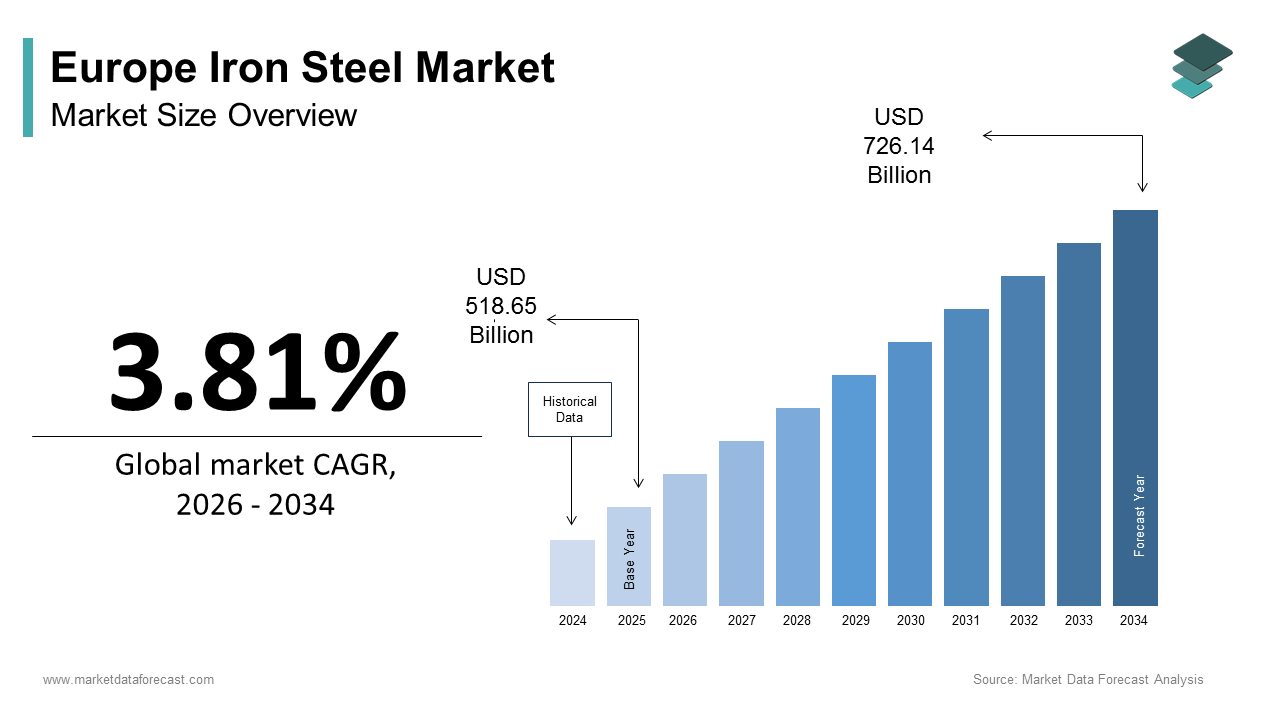
The iron steel industry is the production, processing, and distribution of crude steel and finished steel products derived primarily from iron ore and recycled scrap, serving as the backbone of construction, automotive, energy, and machinery sectors. According to Eurostat, the European Union produced 132 million metric tons of crude steel in 2024, with over 58% sourced from electric arc furnaces using scrap metal with a global leader in secondary steelmaking. As per the European Environment Agency, the sector accounts for approximately 5.4% of the EU’s total greenhouse gas emissions, making it a focal point of the European Green Deal’s industrial transformation agenda. The European Commission’s Critical Raw Materials Act designates high-quality steel as a strategic material for clean tech infrastructure, including wind turbines and EV charging networks. Furthermore, national policies such as Germany’s Steel Action Plan and France’s France 2030 investment scheme prioritize low-carbon steel production through hydrogen-based direct reduction and carbon capture technologies. This regulatory and industrial embedding positions Europe’s iron steel market not as a cyclical commodity play but as a mission-critical enabler of economic sovereignty and climate neutrality.
MARKET DRIVERS
Mandatory Decarbonization Under the EU Carbon Border Adjustment Mechanism
The European Union’s Carbon Border Adjustment Mechanism, by imposing carbon costs on imported materials and incentivizing low-emission domestic production, is propelling the growth of the Europe iron steel market. According to the European Commission, all steel imports entering the EU since October 2023 must declare embedded CO₂ emissions, with financial penalties applied for non-compliance or high intensity benchmarks. As per the World Steel Association, European producers using electric arc furnaces emit an average of 0.3 tons of CO₂ per ton of steel compared to 2.1 tons for coal-based blast furnaces, creating a competitive advantage for scrap-based mills. In Germany, the Federal Ministry for Economic Affairs confirmed that 11 steel plants received state aid in 2024 to transition to hydrogen reduction pilots under the IPCEI Hy2Use program. The CBAM thus functions not as a trade barrier but as a structural catalyst aligning procurement decisions with climate policy and securing long term demand for compliant European steel.
Strategic Reshoring of Industrial Supply Chains Post Geopolitical Disruptions
The geopolitical instability and pandemic-induced supply chain fractures have triggered a deliberate reshoring of steel-intensive manufacturing, which is accelerating the growth of Europe iron steel market. The European Defence Agency reported that 100% of new military vehicle contracts now mandate EU-produced armor-grade steel to ensure supply security and quality control. Similarly, the European Wind Energy Association noted that offshore wind projects commissioned in 2024 specified European rolled steel for turbine towers due to certification traceability and just-in-time delivery reliability. As per the European Commission’s Strategic Dependencies Dashboard, steel is listed among the top five critical inputs for clean tech defense and infrastructure resilience. This shift from cost optimization to supply chain sovereignty has transformed steel from a tradable input into a strategic asset anchoring industrial policy and national security planning across the continent.
MARKET RESTRAINTS
High Energy Costs and Grid Constraints for Green Steel Transition
The ambition to decarbonize steel production faces severe headwinds from prohibitively high electricity prices and insufficient renewable grid capacity, which is limiting the growth of Europe's iron and steel market. According to the European Steel Association, producing one ton of steel via hydrogen-based direct reduction requires approximately 4,000 kilowatt hours of renewable electricity, nearly four times the energy needed for conventional methods. In 2024, Germany’s industrial electricity prices averaged 210 euros per megawatt hour, more than double those in the United States, as reported by the Federal Network Agency. ArcelorMittal suspended its Hamburg green steel pilot in early 202,4 citing the inability to secure long term power purchase agreements below 150 euros per MWh. Without dedicated grid connections and subsidized clean power, European steelmakers cannot achieve cost parity with global competitors.
Fragmented Scrap Quality Standards and Collection Infrastructure
The scrap-basedsteelmaking'sg inconsistent scrap classification and contamination levels undermine quality and recyclability, which is additionally hampering the growth of Europe's iron steel market. According to the European Recycling Industries Confederation, over 22% of ferrous scrap collected in Southern and Eastern Europe contains non-ferrous contaminants such as copper or zinc exceeding the 0.05% threshold required for high-grade automotive steel. The German Steel Institute reported that 31% of electric arc furnace operators incurred additional refining costs in 2024 due to variable scrap composition affecting yield and emissions. As per Eurostat, only 14 EU member states enforce standardized scrap sorting protocols under the End of Life Vehicles Directive, leading to cross-border quality disputes. Furthermore, urban mining remains underdeveloped, where the European Environment Agency estimates that 12 million tons of recoverable steel lie dormant in obsolete buildings and landfills due to inefficient deconstruction practices.
MARKET OPPORTUNITIES
Integration of Steel Production with Renewable Hydrogen Ecosystems
The coordinated push for green hydrogen to decarbonize primary steel production at scale is creating new opportunities for the growth of Europe's iron and steel market. According to the European Clean Hydrogen Alliance, over 45 hydrogen-ready steel projects are underway across the EU, with cumulative investment exceeding 18 billion euros by 2024. In Sweden, HYBRIT, a joint venture between SSAB, LKAB, and Vattenfall, began commercial deliveries of fossil-free steel in 2024 using hydrogen produced from hydroelectric power, replacing coking coal entirely. As per the European Commission’s Important Project of Common European Interest, IPCEI on Hydrogen, 12 member states have approved state aid for integrated hydrogen steel corridors linking electrolyzers, mines, and mills. Germany’s Salzgitter AG partnered with Siemens Energy to build a 100-megawatt electrolyzer onsite, ensuring direct pipeline supply. These ecosystems not only eliminate CO₂ emissions but also create regional industrial clusters, where excess heat and oxygen byproducts support adjacent industries.
Expansion of Circular Steel Use in Sustainable Construction and Infrastructure
The EU’s revised Construction Products Regulation creates a powerful incentive to specify high recycled content steel in public and private building projects. According to the European Committee for Standardization, EN 1090 now requires environmental product declarations for all structural steel used in buildings over 1,000 square meters, effective 2024. As per the source, infrastructure loans approved in 2024 included clauses favoring materials with verified circularity credentials. Dutch railway operator ProRail replaced 120 kilometers of track with 100% recycled rail steel, reducing embodied carbon by 40%. This regulatory shift transforms steel from a generic input into a documented environmental asset.
MARKET CHALLENGES
Global Overcapacity and Dumping Pressures from Non-Regulated Producers
The intense competitive pressure from state-subsidized producers in China, India, and Turkey, who operate without carbon constraints or labor safeguards. According to the European Commission, anti-dumping duties were imposed on 27 steel product categories in 2024 alone due to import surges priced 25 to 40% below EU production costs. While the CBAM addresses carbon leakage, it does not counteract direct subsidies distorting global prices. Without stronger multilateral enforcement or reciprocal climate tariffs, European mills risk being undercut even as they invest billions in decarbonization, creating a perverse disincentive for green transition in a globally fragmented market.
Workforce Shortages in Advanced Steel Manufacturing and Digital Integration
The transformation of Europe’s steel industry toward automation, digital twins, and green chemistry is hampered by a shortage of skilled technicians and engineers. The workforce shortages in advanced steel manufacturing and digital integration are expected to further degrade the growth of Europe iron steel market. According to the European Steel Association, 41% of job vacancies in EU steel plants in 2024 remained unfilled due to a lack of candidates with competencies in hydrogen systems, AI-driven process control, or carbon capture operations. Germany’s Federal Employment Agency listed metallurgical engineers specializing in decarbonization as a national shortage occupation with fewer than 300 qualified graduates annually, against demand for over 2,000. This deficit slows the adoption of advanced technologies, increases reliance on external consultants, and raises operational risks during transitions.
REPORT COVERAGE
| REPORT METRIC | DETAILS |
| Market Size Available | 2025 to 2034 |
| Base Year | 2025 |
| Forecast Period | 2026 to 2034 |
| CAGR | 3.81% |
| Segments Covered | By Type, Production Technology, End Use, And Region |
| Various Analyses Covered | Global, Regional & Country Level Analysis; Segment-Level Analysis; DROC, PESTLE Analysis; Porter’s Five Forces Analysis; Competitive Landscape; Analyst Overview of Investment Opportunities |
| Regions Covered | UK, France, Spain, Germany, Italy, Russia, Sweden, Denmark, Switzerland, Netherlands, Turkey, and the Czech Republic |
| Market Leaders Profiled | ArcelorMittal, Tata Steel Europe, Thyssenkrupp AG, Salzgitter AG, SSAB AB, Voestalpine AG, Acerinox S.A., Outokumpu Oyj, Liberty Steel Group, Dillinger Hütte Group |
SEGMENTAL ANALYSIS
By Type Insights
The steel segment held a significant share of the Europe iron steel market in 2024 with its irreplaceable role as a structural and functional material across industrial and infrastructure domains. According to Eurostat, over 132 million metric tons of crude steel were produced in the European Union in 2024, compared to just 11 million tons of pig iron used primarily as an intermediate input. The dominance stems from steel’s superior mechanical properties, recyclability, and adaptability to advanced manufacturing processes. In automotive, the European Automobile Manufacturers Association reported that high-strength steel constitutes 65% of vehicle body mass, enabling lightweighting without compromising safety. Furthermore, the European Green Deal prioritizes steel over primary iron because electric arc furnace production using scrap emits up to 85% less CO₂ than integrated iron making.
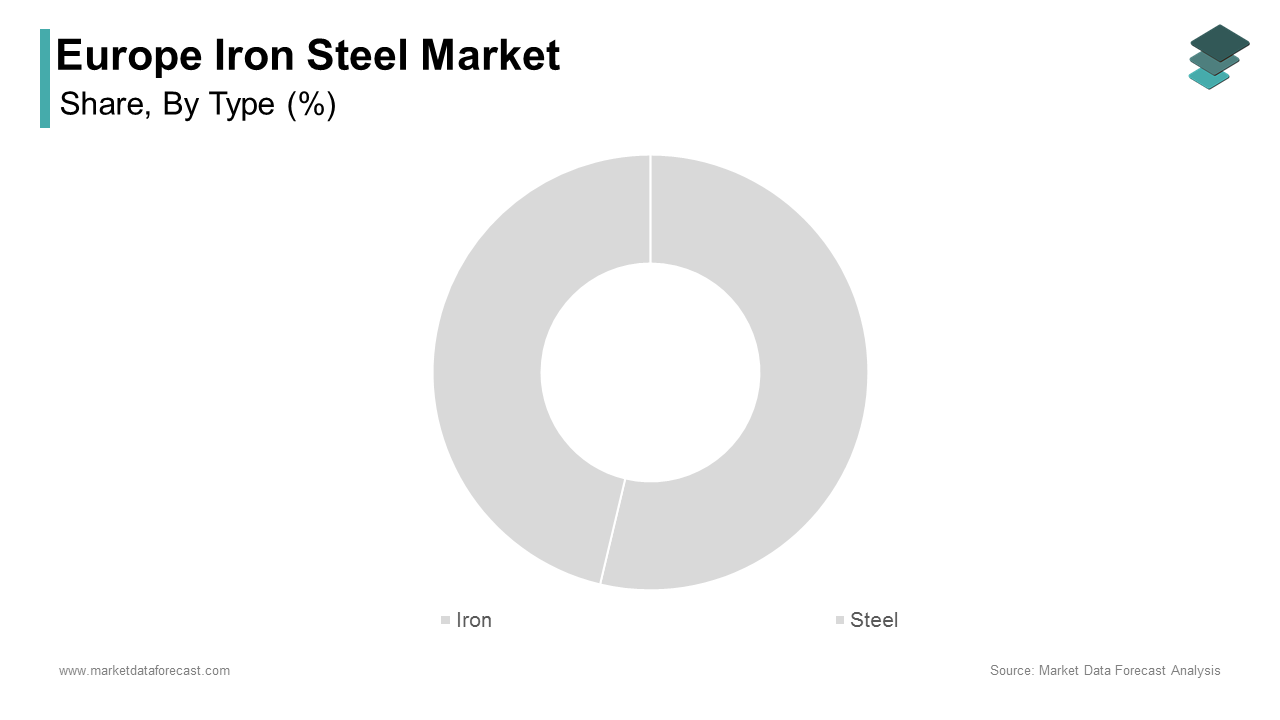
The steel is expected to witness the fastest CAGR of 3.8% throughout the forecast period with the green infrastructure and circular economy mandates. According to the European Commission, the Net Zero Industry Act targets 25 million tons of near-zero emission steel production annually by 2030, requiring sustained capacity expansion. In 2024, Sweden’s SSAB delivered the first commercial volumes of fossil-free steel to Volvo and Mercedes using hydrogen reduction technology certified under ISO 14064. As per the European Wind Energy Association, each offshore wind turbine requires 180 to 250 tons of high-grade steel for towers and foundations, with 30 gigawatts of new capacity planned by 2027. Additionally, the revised End of Life Vehicles Directive mandates 95% material recovery by 2025, driving demand for easily recyclable steel grades.
By Production Technology Insights
Electric arc furnace technology holds the largest share of the Europe iron steel market at approximately 58% of crude steel production in 2025, driven by its alignment with circular economy principles and lower carbon intensity. According to the World Steel Association, EAF-based production in the EU emitted an average of 0.3 tons of CO₂ per ton of steel in 2024 compared to 2.1 tons for blast furnace routes. The European Environment Agency confirmed that 74% of EU steel recycling capacity is integrated with EAF mills, ensuring closed-loop material flows. Germany’s Federal Ministry for Economic Affairs reported that construction rebar and merchant bar output in 2024 came from EAFs due to consistent quality and compliance with EN 10080 standards. As per Eurofer, the European steel federation, EAF adoption accelerated after the EU Emissions Trading System carbon price exceeded 80 euros per ton in 2023, making coal-based routes economically unviable. The technology’s modularity also allows deployment near urban scrap sources, reducing logistics emissions.
The electric arc furnace segment is expected to grow at the fastest CAGR of 5.2% throughout the forecast period, with the policy mandates technological upgrades and scrap availability. According to the European Commission’s Important Project of Common European Interest on Clean Steel, 14 new EAF plants received state aid in 202,4 totaling 6.3 billion euros to replace retiring blast furnaces. In Italy, Marcegaglia commissioned a 2 million-ton EAF in 2024, powered entirely by renewable energy under a PPA with Enel. The EU’s Circular Economy Action Plan further requires all new public infrastructure projects to specify minimum recycled content, directly benefiting EAF producers.
By End-use Industry Insights
The building and construction segment accounted in holding 18.2% of Europe's iron steel market in 2024 due to steel’s structural integrity, speed of assembly, and compliance with seismic and fire safety codes. According to the European Construction Federation, over 70% of non-residential buildings constructed in the EU in 2024 used a structural steel frame,s enabling faster completion and reduced on-site labor. The European Committee for Standardization reported that EN 1090 certification for load-bearing steel components is now mandatory for all public buildings over 1,000 square meters.
The automotive and transportation segment is anticipated to witness the fastest CAGR of 4.6% from 2025 to 2033, with the electrification, lightweighting, and supply chain reshoring. According to the European Automobile Manufacturers Association, electric vehicles use 10 to 15% more advanced high-strength steel than internal combustion models to compensate for battery weight while maintaining crash safety. Stellantis and BMW increased local steel sourcing by 22% to comply with the EU Battery Regulation’s requirement for traceable and low-carbon materials. As per the European Railway Agency, 90% of new high-speed rail projects, including the Lyon-Turin link, specify corrosion-resistant steel for tunnels and viaducts. The European Defence Agency also mandated EU-produced armor steel for all new military vehicles starting in 2024, enhancing strategic autonomy.
REGIONAL ANALYSIS
Germany Iron Steel Market Analysis
Germany was the largest contributor to the Europe iron steel market by capturing 24.3% of the share in 2024, owing to its integrated industrial base and leadership in green steel innovation. According to the German Steel Federation, over 36 million tons of crude steel were produced in 2024, with 61% from electric arc furnaces. The country hosts Europe’s largest automotive and machinery sectors, which consume 70% of domestic steel output under strict quality and traceability standards. As per the Federal Ministry for Economic Affairs, Germany allocated 4.2 billion euros in 2024 through its Steel Action Plan to support hydrogen-based direct reduction pilots at Salzgitter and ThyssenKrupp. Germany’s dual focus on industrial demand and decarbonization infrastructure makes it the undisputed anchor of Europe’s steel ecosystem.
Italy Iron Steel Market Analysis
Italy was ranked second by holding 14.3% of the Europe iron steel market share in 2024, with the strong specialization in long steel products and circular production models. According to a study, Italy produced 22 million tons of crude steel in 2024, with 89% from electric arc furnaces, with the highest EAF ratio in Western Europe. The country’s steel industry is concentrated in the Emilia, Romagna, and Lombardy regions, where companies like Marcegaglia and Riva Group serve automotive construction and appliance markets. As per the Italian Ministry of Ecological Transition, ferrous scrap is recovered from end-of-life vehicles and appliances, ensuring near-closed-loop recycling. This deep integration of scrap logistics, product specialization, and policy support positions Italy as a model for sustainable steelmaking in Southern Europe.
France Iron Steel Market Analysis
France's iron steel market growth is eventually growing with the state-led strategic investment in low-carbon steel and nuclear-powered production. According to the French Ministry of Economy, ArcelorMittal, France, and Liberty Ostrava received 1.8 billion euros in 2024 under the France 2030 plan to deploy hydrogen injection and carbon capture at Dunkirk with the EU’s largest integrated steel site. The country produced 15 million tons of crude steel in 2024, with 52% from EAFs supported by low-carbon grid electricity from nuclear generation. As per the French Environment Agency, steel used in public buildings must now carry environmental product declarations under the E+C scheme. France also leads in defense applications, where Naval Group uses French rolled steel for all submarine hulls, ensuring strategic autonomy. This blend of public investment, energy advantage, and sovereign industrial policy secures France’s pivotal role in Europe’s steel transition.
Spain Iron Steel Market Analysis
Spain's iron steel market growth is likely to grow with the rapid modernization and renewable energy integration. Spain is also a hub for automotive steel, where SEAT and Stellantis source 75% of sheet metal domestically under EU localization incentives. As per Red Electrica, the national grid operator, industrial clusters in Asturias and Catalonia are designated as priority zones for green hydrogen development, supporting future DRI projects. Spain’s combination of clean energy access, industrial demand, and EU funding positions it as a high-growth frontier in Southern Europe.
Sweden Iron Steel Market Analysis
Sweden's iron and steel market is growing with the fossil-free steel production. According to Statistics Sweden, the country produced 5.2 million tons of crude steel in 2024, with HYBRIT delivering the world’s first commercial volumes of hydrogen-reduced steel to global automakers. The Swedish Energy Agency confirmed that 100% of EAF electricity comes from hydro and nuclear sources, ensuring near zero emissions. SSAB’s Lulea plant aims for full conversion to fossil-free production by 2026, supported by 5 terawatt hours of dedicated renewable power. As per the Swedish Environmental Protection Agency, steel exports with verified low carbon credentials grew by 33% in 2024, primarily to German and Dutch manufacturers seeking CBAM compliance.
COMPETITION OVERVIEW
Competition in the Europe iron steel market is defined by a historic shift from cost-driven commodity rivalry to mission-oriented industrial collaboration anchored in climate policy and strategic sovereignty. Unlike global markets where price dominates, European producers compete on verified sustainability traceability and integration with clean tech value chains. The landscape features a mix of integrated giants like ArcelorMittal, specialized leaders like ThyssenKrupp, and disruptive innovators like SSA, B each navigating the dual imperative of decarbonization and competitiveness. Public funding through IPCEI schemes and regulatory frameworks like CBAM and the Net Zero Industry Act create both pressure and opportunity, favoring firms that align early with green standards. At the same time, global overcapacity and subsidized imports from non-regulated regions exert persistent downward pressure on margins. This tension has spurred unprecedented cooperation among competitors on shared infrastructure such as hydrogen pipelines and scrap sorting hubs.
KEY MARKET PLAYERS
A few major players of the Europe iron steel market include
- ArcelorMittal
- Tata Steel Europe
- Thyssenkrupp AG
- Salzgitter AG
- SSAB AB
- Voestalpine AG
- Acerinox S.A
- Outokumpu Oyj
- Liberty Steel Group
- Dillinger Hütte Group
Leading Players in the Market
- ArcelorMittal is a cornerstone of the Europe iron and steel market with integrated operations across France, Germany, Belgium, and Spain, serving the automotive, construction, and energy sectors. The company leads Europe’s green steel transition through its XCarb initiative, which bundles low-carbon products, including hydrogen-based and circular steel. ArcelorMittal commissioned a 2.5 million ton electric arc furnace at its Ghent site powered by renewable energy, and launched certified fossil-free steel deliveries to major European automakers. It also partnered with Siemens Energy to develop carbon capture infrastructure at its Dunkirk plant under the EU’s IPCEI Hy2Use program.
- ThyssenKrupp Steel Europe remains a supplier of high-grade flat steel for automotive and mechanical engineering industries, primarily in Germany and Central Europe. The company has accelerated its decarbonization roadmap through the tkH2Steel program, aiming for near zero CO₂ production by 2045. It began pilot production of hydrogen-reduced iron at its Duisburg site using green hydrogen from a dedicated 100-megawatt electrolyzer. ThyssenKrupp also introduced a digital product passport for all steel coils, enabling full traceability of emissions and recycled content, key for EU Battery Regulation compliance. Its deep integration with German OEMs and focus on technical service ensure continued relevance in high-value segments despite global cost pressures.
- SSAB, a Swedish-Finnish steelmaker, has emerged as a pioneer in fossil-free steel through its HYBRIT joint venture with LKAB and Vattenfall. The company delivers the world’s first commercially available hydrogen-reduced steel to global customers, including Volvo Scania and Mercedes-Benz. In 2024, SSAB scaled production at its Luleå plant and launched certified fossil-free heavy plate for wind turbine towers and mining equipment. It also implemented blockchain-based environmental product declarations verified by DNV, ensuring transparency for EU Green Public Procurement.
MARKET SEGMENTATION
This research report on the Europe iron steel market has been segmented and sub-segmented based on type, production technology, end use, and region.
By Type
- Iron
- Steel
By Production Technology
- Basic Oxygen Furnace
- Electric Arc Furnace
- Open Hearth
- Others
By End Use
- Building & Construction
- Automotive & Transportation
- Heavy Industry
- Consumer Goods
- Others
By Region
- UK
- France
- Spain
- Germany
- Italy
- Russia
- Sweden
- Denmark
- Switzerland
- Netherlands
- Turkey
- Czech Republic
- Rest of Europe
Frequently Asked Questions
1. What factors are driving the growth of the Europe iron and steel market?
Growth is driven by infrastructure development projects, renewable energy expansion, automotive manufacturing demand, industrial modernization, and investments in green steel technologies aligned with EU climate targets.
2. Which industries are the major consumers of steel in Europe?
The construction sector is the largest consumer, followed by automotive, machinery and equipment, energy (including wind and solar infrastructure), transportation, and shipbuilding industries.
3. What are the main types of steel produced in Europe?
Europe produces flat steel, long steel, stainless steel, carbon steel, alloy steel, and advanced high-strength steel used in automotive and engineering applications.
4. Which countries dominate the Europe iron and steel market?
Germany, Italy, France, Spain, and Poland are major contributors due to strong industrial bases, established automotive sectors, and advanced steel manufacturing facilities.
5. How is sustainability influencing the Europe iron and steel market?
Sustainability is a key driver, with companies investing in hydrogen-based steelmaking, electric arc furnaces, carbon capture technologies, and recycling initiatives to reduce carbon emissions and meet EU decarbonization goals.
6. What challenges does the Europe iron and steel market face?
Key challenges include high energy costs, stringent environmental regulations, fluctuating raw material prices, global competition from low-cost producers, and economic uncertainties affecting industrial demand.
7. How do energy costs impact steel production in Europe?
Energy-intensive steel production processes are significantly affected by electricity and gas prices. Rising energy costs can reduce competitiveness and impact profitability for European producers.
8. What role does recycling play in the European steel industry?
Recycling is essential, as steel is highly recyclable. Europe has strong scrap collection systems, and recycled steel is widely used in electric arc furnace production, supporting circular economy initiatives.
9. What impact does the automotive sector have on steel demand?
The automotive industry drives demand for lightweight, high-strength steel used in vehicle manufacturing to improve safety, durability, and fuel efficiency.
10. How is technological advancement shaping the market?
Digitalization, automation, AI-driven production systems, and Industry 4.0 integration are improving operational efficiency, reducing waste, and enhancing product quality in European steel plants.
11. What trends are emerging in the Europe iron and steel market?
Emerging trends include green steel initiatives, increased use of recycled materials, hydrogen-based production technologies, consolidation among key players, and growth in specialty steel demand.
12. What is the future outlook for the Europe iron and steel market?
The outlook remains moderately positive, supported by infrastructure spending, renewable energy projects, and decarbonization investments. However, long-term growth depends on energy cost stability, regulatory alignment, and global trade conditions.
Related Reports
Access the study in MULTIPLE FORMATS
Purchase options starting from
$ 2000
Didn’t find what you’re looking for?
TALK TO OUR ANALYST TEAM
Need something within your budget?
NO WORRIES! WE GOT YOU COVERED!
Call us on: +1 888 702 9696 (U.S Toll Free)
Write to us: sales@marketdataforecast.com