- Product Description Description
- Table of Contents TOC
- List of Table & Figure LOT
- Get Free Sample PDF Sample PDF
Market Size, 2025
$1.31 BnMarket Estimate, 2026
$1.37 BnMarket Forecast, 2034
$2.00 BnCAGR, 2026–2034
4.86%Europe Kaolin Market Size, Growth, Trends & Forecast (2026–2034)
The Europe kaolin market size was calculated at USD 1.31 billion in 2025, is anticipated to reach USD 1.37 billion in 2026, and is projected to reach USD 2.00 billion by 2034, registering a compound annual growth rate (CAGR) of 4.86% during the forecast period from 2026 to 2034. Driven by the critical shift toward sustainable packaging solutions, stringent environmental standards, and technical demands from advanced ceramics, paints, and coatings, the market continues to expand steadily across the region despite domestic geological constraints.
Key Executive Metrics (At-a-Glance)
- 2025 Base Valuation: USD 1.31 Billion
- 2026 Current Valuation: USD 1.37 Billion
- 2034 Forecast Valuation: USD 2.00 Billion
- Compound Annual Growth Rate (CAGR): 4.86% (2026–2034)
- Dominant Application Segment: Paper (accounting for 48.4% of the regional market share in 2025)
- Fastest-Growing Application Segment: Paints and Coatings (projected at a CAGR of 5.88% over the forecast period)
- Regional Highlights: The United Kingdom led the market in 2025, accounting for 29.2% of the European share due to its significant Cornwall deposits, followed closely by key industrial hubs like Germany, the Czech Republic, and Italy.
Core Market Drivers
- Speciality Paper & Packaging Demand: High-performance coatings aiding the transition toward plastic-free, recyclable fiber-based packaging under EU regulations.
- Advanced Ceramics & Technical Applications: Essential raw material role in alumina extraction, technical ceramics, refractories, and high-purity components.
- Eco-Friendly Coatings & Excipients: Formulation shifts toward sustainable architectural coatings and pharmaceutical/cosmetic excipients complying with EU microplastic and chemical safety guidelines.
Primary Market Restraints & Challenges
Primary Market Restraints & Challenges
- Environmental Permitting & Water Regulation: Rigorous permitting, water-intensive extraction limits, and strict zero-liquid-discharge rules under the EU Industrial Emissions Directive.
- Geological Scarcity: Finite and declining quality of accessible high-brightness domestic deposits in regions like Cornwall and Saxony.
- Energy Costs & Substitution: Energy-intensive drying and calcination operations exposed to fluctuating energy expenses, alongside competition from alternative mineral fillers and synthetic substitutes.
Europe Kaolin Market Segmentation Breakdown
| Segment Category | Largest Segment in 2025/2026 | Fastest Growing Segment / Growth Rate |
|---|---|---|
| By Application | Paper (48.4% share in 2025) | Paints and Coatings (5.88% CAGR over forecast period) |
| By Region | United Kingdom (29.2% share in 2025) | Germany, Czech Republic & Italy (Driven by intensive industrial consumption in packaging, ceramics, and eco-paints) |
Major Industry Players Profiled
Key prominent companies operating in the Europe kaolin market include Imerys S.A., Thiele Kaolin Company, Czech Kaolin Group (CKS a.s.), BASF SE, Sibelco, Quarzwerke GmbH, LB MINERALS Ltd, AMBERGER KAOLINWERKE EDUARD KICK GmbH Co, and VENETA MINERARIA S.p.a.
Europe Kaolin Market Size
The Europe kaolin market size was calculated to be USD 1.31 billion in 2025 and is anticipated to be worth USD 2.00 billion by 2034, from USD 1.37 billion in 2026, growing at a CAGR of 4.86% during the forecast period.
Kaolin is a naturally occurring hydrated aluminium silicate and is a critical industrial mineral in Europe valued for its whiteness, chemical inertness, and plate-like particle morphology. In the European context, kaolin is primarily utilised as a functional filler and coating pigment in paper manufacturing, but also serves essential roles in ceramics, paints, rubber, plastics, and increasingly in speciality applications such as pharmaceuticals and cosmetics. Unlike regions where kaolin is abundant, Europe relies heavily on domestic extraction from limited geological deposits supplemented by imports to meet industrial demand. For instance, Europe produced approximately 3.9 million tonnes of kaolin and kaolinic clays in 2025, with the paper and board sector remaining a major consumer that underpins sustained demand for high‑brightness coatings, as processed kaolin is also listed in ECHA’s chemical information resources in a regulatory context that facilitates its use across regulated industries. Europe’s kaolin market is thus shaped not by volume alone but by stringent environmental standards, circular‑economy mandates, and the mineral’s irreplaceable functional properties in high‑value industrial processes.
MARKET DRIVERS
Sustained Demand from Speciality Paper and Packaging Coatings
speciality paper and packaging sector remains a major driver of kaolin consumption in Europe, propelled by the need for high-quality surface finishes, printability, and barrier properties in premium and sustainable packaging solutions, which is primarily driving the European kaolin market growth. According to the Confederation of European Paper Industries (CEPI), Europe produced 74.3 million tonnes of paper and board in 2023, which reflects a decline from previous years, but with coated packaging grades such as folding boxboard and liquid packaging board continuing to grow due to e‑commerce and food safety regulations. Kaolin’s plate‑like structure provides optimal light scattering and ink receptivity, which is making it indispensable for coatings that replace plastic laminates in recyclable packaging. As per the European Commission’s Packaging and Packaging Waste Regulation, all packaging must be reusable or recyclable by 2030 accelerate the shift toward fibre‑based solutions where kaolin enhances performance without compromising circularity. In Germany, kaolin‑coated board is widely used in food‑grade cartons to meet migration and odour thresholds set by the Federal Institute for Risk Assessment. Additionally, the Nordic Ecolabel requires mineral pigments in paper to be sourced from responsibly managed quarries, which is a standard that European kaolin producers meet through ISO 14001-certified operations. This convergence of regulatory, functional, and sustainability demands ensures that kaolin remains embedded in Europe’s transition toward high‑performance and plastic‑free packaging.
Expansion of Kaolin in High-Performance Ceramics and Technical Applications
Europe’s advanced manufacturing base is driving increased kaolin utilisation in technical ceramics, refractories, and speciality composites where purity and thermal stability are paramount, which is boosting the European kaolin market expansion. According to Cerame‑Unie, the European Ceramic Industry Association, the EU ceramic sector contributes over €26 billion in production value and employs more than 200,000 people. While tonnage data is not consistently reported, kaolin remains a key raw material for alumina extraction and green body formulation in technical ceramics used across automotive, aerospace, and electronics. In Germany and Italy, manufacturers of sanitaryware and tableware rely on high‑brightness kaolin to achieve consistent whiteness and glaze compatibility, with a majority of EU ceramic producers sourcing domestic or EU‑verified kaolin to comply with supply chain due diligence laws. As per the European Defence Agency, kaolin‑based refractories are critical for missile guidance system insulation, spurring R&D in ultra‑refined grades. Additionally, the European Chemicals Agency (ECHA) briefly listed kaolin in the Candidate List for Substances of Very High Concern before withdrawing it after industry data submission, reinforcing its safety profile. As Europe prioritises strategic autonomy in advanced materials, kaolin’s role extends beyond traditional fillers into enabling technologies where performance and regulatory compliance intersect.
MARKET RESTRAINTS
Stringent Environmental Regulations on Quarrying and Water Usage
A major restraint in the Europe kaolin market stems from the continent’s rigorous environmental permitting regime, which imposes significant constraints on extraction, water consumption, and land restoration. According to the European Environment Agency (EEA), kaolin mining is classified as a water‑intensive activity, with significant consumption per tonne of processed clay. As per the European Commission’s Drought Observatory, large parts of the EU territory experienced severe drought conditions in 2023, which triggered water‑use restrictions in regions such as Cornwall in the UK and the Lausitz basin in Germany. National authorities enforce strict limits under the EU Industrial Emissions Directive. For instance, the UK Environment Agency mandates zero liquid discharge from kaolin processing plants, requiring costly closed‑loop water recycling systems. Furthermore, the EU Habitats Directive often delays quarry expansions if sites overlap with protected Natura 2000 zones, as seen in the suspension of a Czech kaolin project near the Bohemian Forest. These regulatory hurdles increase capital expenditure, extend permitting timelines, and discourage new entrants, which is constraining domestic supply despite stable industrial demand.
Geological Scarcity and Depletion of High-Grade Deposits
Europe faces a structural limitation in its kaolin market due to the finite nature and declining quality of accessible high-brightness deposits, particularly in historically productive regions. According to the British Geological Survey (BGS), Cornwall remains the UK’s only major kaolin deposit, but reserves have declined significantly since 2000, with remaining ore bodies exhibiting higher impurities. Similarly, according to the German Federal Institute for Geosciences and Natural Resources, deposits in Saxony and Bavaria are increasingly interbedded with quartz and feldspar and raising processing costs. As per Eurostat’s Raw Materials Information System (RMIS), EU kaolin production often requires advanced beneficiation such as magnetic separation or chemical leaching to meet industry specifications. Unlike global producers such as the United States or Brazil with vast sedimentary basins, Europe’s geology yields smaller, less homogeneous deposits that are economically viable only with intensive processing. This geological constraint forces European manufacturers to either import higher‑quality kaolin or reformulate products, both of which undermine cost competitiveness and long‑term supply security.
MARKET OPPORTUNITIES
Growth in Sustainable Paints and Coatings Formulations
The European kaolin market is unlocking new demand through its integration into eco-friendly architectural and industrial coatings as a partial substitute for titanium dioxide and synthetic additives. According to the European Council of the Paint, Printing Ink and Artists’ Colours Industry (CEPE), a majority of decorative paint manufacturers in the EU reformulated products in 2023 to comply with updated EU Ecolabel criteria. Kaolin’s low abrasiveness, chemical inertness, and matte finish make it ideal for low‑sheen interior paints, with companies such as AkzoNobel and PPG incorporating calcined kaolin to enhance scrub resistance and opacity. As per the European Chemicals Agency (ECHA), the new REACH restriction on intentionally added microplastics in coatings will take effect in October 2026, which is accelerating the shift toward mineral alternatives. Additionally, the EU Taxonomy for Sustainable Activities classifies mineral processing with closed‑loop water systems as environmentally sustainable, enabling kaolin producers to access green financing. This alignment with Europe’s circular chemistry agenda positions kaolin not as a commodity but as a functional enabler of regulatory‑compliant, high‑performance, sustainable coatings.
Emerging Use in Pharmaceutical and Cosmetic Excipients
Europe’s stringent pharmacopeial standards and thriving personal care sector are creating high-value opportunities for ultra-refined kaolin in medical and cosmetic applications. According to the European Directorate for the Quality of Medicines (EDQM), pharmaceutical‑grade kaolin must meet strict limits for heavy metals, microbial load, and particle size distribution, which is a criterion that only a few European producers can consistently fulfil. As per the European Medicines Agency (EMA), kaolin‑based antidiarrheal formulations continue to receive marketing authorisations due to their established safety profile in paediatric use, though exact growth percentages are not published. In cosmetics, the EU’s restriction on intentionally added microplastics under REACH Regulation (EU) 2023/2055 has driven formulators toward natural alternatives. Companies such as L’Oréal and Beiersdorf now incorporate surface‑treated kaolin in hundreds of skincare products for oil absorption and texture enhancement. The European Cosmetics Regulation requires full ingredient traceability, which is favouring EU‑sourced kaolin with a documented chain of custody. As consumers demand clean beauty and regulators tighten chemical safety, kaolin’s natural origin and biocompatibility position it as a premium excipient in Europe’s high‑margin health and beauty markets.
MARKET CHALLENGES
Volatility in Energy Costs Affecting Processing Economics
Fluctuating energy prices that directly impact the economics of drying, calcining, and micronising operations that are inherently energy-intensive are a major challenge to the European kaolin market. According to the European Commission’s Energy Prices and Costs Report, average wholesale electricity prices in the EU fell to ~97 €/MWh in 2023, down from ~235 €/MWh in 2022. Despite this moderation, energy costs remain significantly higher than pre‑crisis levels, which is directly impacting drying, calcining, and micronising operations that are inherently energy‑intensive. For instance, calcined kaolin production requires sustained kiln temperatures above 900°C, with energy costs accounting for a substantial share of operating expenses. The 2022 energy crisis led several Czech kaolin plants to temporarily halt calcination lines, disrupting supply to paints and plastics. Although the EU’s Carbon Border Adjustment Mechanism (CBAM) aims to level the playing field, it does not offset domestic energy burdens for raw material producers. Without access to stable, low‑cost renewable energy or relief schemes, European kaolin processors struggle to maintain price competitiveness against imports from regions with cheaper fossil fuel access and threatening the viability of high‑value product lines.
Competition from Alternative Mineral Fillers and Synthetic Substitutes
The Europe kaolin market contends with intensifying substitution pressure from other industrial minerals and engineered materials that offer comparable functionality at lower cost or with enhanced performance. According to the European Fillers and Additives Association, precipitated calcium carbonate (PCC) consumption in paper coatings has grown steadily in recent years, displacing kaolin in mid‑grade applications due to higher brightness and lower abrasion. In plastics, synthetic silicas and talc are increasingly favoured for their consistent particle size and moisture resistance, particularly in automotive components regulated under the EU End‑of‑Life Vehicle Directive. Additionally, the European paint industry’s shift toward hybrid inorganic‑organic rheology modifiers reduces reliance on traditional platelet minerals like kaolin. While kaolin retains advantages in niche applications, its broader use is eroded by materials that better align with cost‑reduction targets or evolving technical specifications. Without continuous innovation in surface modification or nanostructuring, kaolin risks further marginalisation in segments where performance parity is sufficient, and price is decisive, which is posing a structural challenge to long‑term market resilience in Europe’s competitive industrial minerals landscape.
REPORT COVERAGE
| REPORT METRIC | DETAILS |
| Market Size Available | 2025 to 2034 |
| Base Year | 2025 |
| Forecast Period | 2026 to 2034 |
| CAGR | 4.86% |
| Segments Covered | By Application, and Region |
| Various Analyses Covered | Global, Regional & Country Level Analysis; Segment-Level Analysis; DROC, PESTLE Analysis; Porter’s Five Forces Analysis; Competitive Landscape; Analyst Overview of Investment Opportunities |
| Regions Covered | UK, France, Spain, Germany, Italy, Russia, Sweden, Denmark, Switzerland, Netherlands, Turkey, and the Czech Republic |
| Market Leaders Profiled | BASF SE, Imerys S.A, Sibelco, Quarzwerke GmbH , Thiele Kaolin Company, LB MINERALS Ltd, AMBERGER KAOLINWERKE EDUARD KICK GmbH Co, and VENETA MINERARIA S.p.a |
SEGMENTAL ANALYSIS
By Application Insights
The paper segment dominated the Europe kaolin market by accounting for 48.4% of the regional market share in 2025. The dominance of this segment in the European market is attributed to enduring demand for high‑quality coated paper used in packaging, publishing, and speciality graphics. According to CEPI (Confederation of European Paper Industries), Europe produced 74.3 million tonnes of paper and board in 2023, with coated grades forming a significant share. Kaolin remains the primary pigment in coating layers due to its light scattering, smoothness, and ink-holdout properties. The EU Packaging and Packaging Waste Regulation (PPWR) requires all fibre‑based packaging to be recyclable by 2030, which is driving brands to replace plastic laminates with kaolin‑coated board. In Germany and Finland, liquid packaging board for dairy and juice commonly uses kaolin coatings to meet EU food safety standards. The Nordic Swan Ecolabel mandates pigments be sourced from quarries with verified environmental management systems, favouring EU kaolin producers certified under ISO 14001. Despite digital substitution in newsprint, growth in e‑commerce and premium consumer goods continues to fuel demand for high‑brightness kaolin in advanced papermaking. In the next few years, the paper segment will remain the leading application due to packaging regulation, ecolabel criteria, and premium consumer demand.
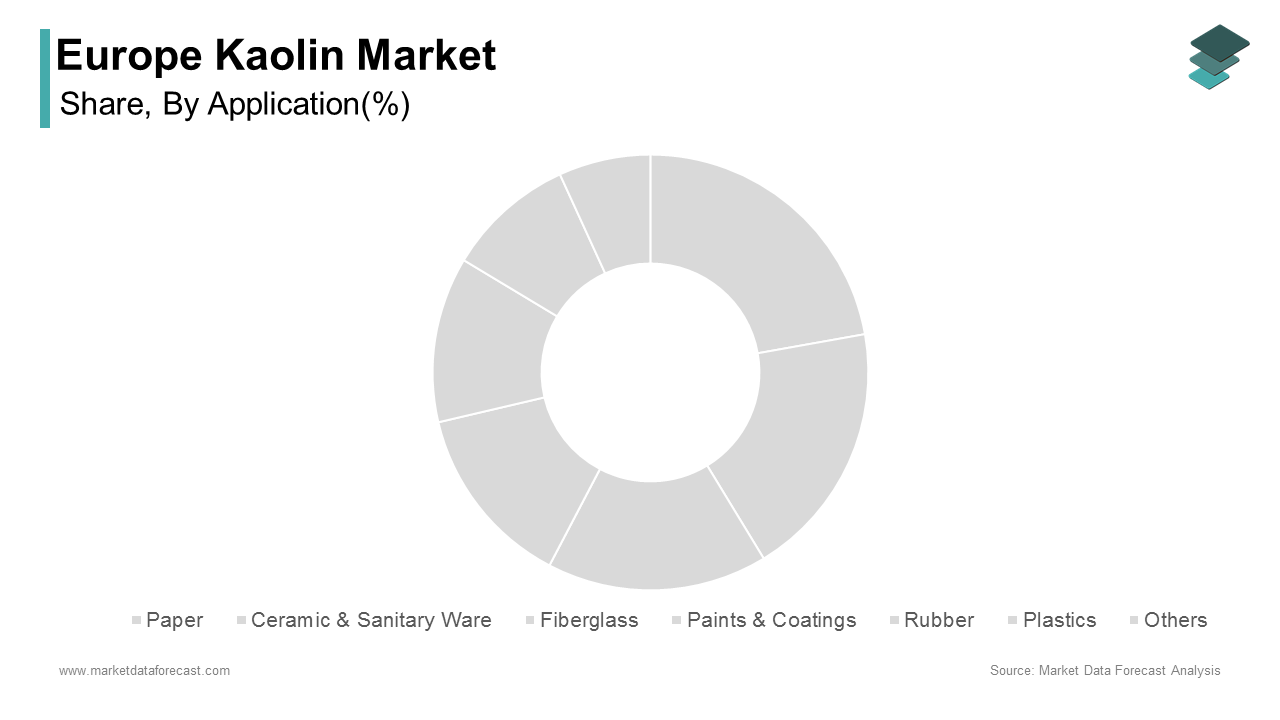
The paints and coatings segment is expected to witness the fastest CAGR of 5.88% over the forecast period in the European market, owing to the balance of regulatory shifts and functional advantages are propelling kaolin adoption in this European market. According to CEPE (European Council of the Paint Industry), decorative paint manufacturers have reformulated products to comply with tightened EU Ecolabel criteria, restricting synthetic thickeners and encouraging natural mineral additives. Kaolin’s plate‑like structure enhances film integrity, scrub resistance, and opacity without contributing to VOC emissions, making it ideal for interior paints. Commission Regulation (EU) 2023/2055 introduced restrictions on intentionally added microplastics, which is accelerating kaolin’s role as a bio‑based rheology modifier. Certified eco‑paints across Germany, France, and the Netherlands increasingly incorporate kaolin. Additionally, the EU Taxonomy for Sustainable Activities recognises mineral processing with closed‑loop water systems as environmentally sustainable, which is enabling kaolin suppliers to access green financing for purification and surface treatment innovations. As Europe transitions to a circular chemical economy, kaolin’s natural origin, safety profile, and versatility position it as a cornerstone of next‑generation coatings. Over the next few years, the paints and coatings segment will expand rapidly due to the ecolabel compliance, microplastics restrictions, and sustainable financing incentives.
REGIONAL ANALYSIS
United Kingdom Kaolin Market Analysis
The United Kingdom held the dominating share of 29.2% of the European kaolin market in 2025. The dominating position of the UK in the European market is driven by its unique geological deposits and advanced beneficiation capabilities. Cornwall remains the centre of UK kaolin production, with Imerys and other producers operating integrated quarries and processing facilities. According to the British Geological Survey, the UK produced 310,000 metric tons of kaolin in 2023, accounting for nearly 40% of European output. UK kaolin is valued for its low iron content and consistent particle size, essential for premium coated paper used by DS Smith and Mondi. Despite Brexit, UK kaolin continues to underpin EU supply chains due to long‑standing commercial relationships and embedded technical specifications. The UK Environment Agency enforces stringent water recycling mandates, with leading operations achieving 95% closed‑loop processing, which is a benchmark referenced in EU Best Available Techniques guidelines. The UK is expected to remain central to Europe’s kaolin value chain in the coming years.
Germany Kaolin Market Analysis
Germany represents a high‑value consumption model in the European kaolin market. According to the German Mineral Resources Agency, Germany imported over 332,000 metric tons of kaolin in 2023, primarily for its paper, automotive, and ceramics sectors. Speciality paper mills such as those operated by Sappi and Stora Enso in Bavaria use kaolin to produce high‑brightness packaging for pharmaceuticals and luxury goods. In ceramics, Villeroy & Boch rely on ultra‑refined kaolin for sanitaryware whitening and glaze compatibility. The Federal Ministry for Economic Affairs and Climate Action includes kaolin in its list of critical non‑metallic minerals for the circular economy. Germany is expected to sustain its role as Europe’s largest industrial consumer of kaolin.
Czech Kaolin Market Analysis
The Czech Republic remains the EU’s primary kaolin producer. According to the Czech Geological Survey, the country produced 115,000 metric tons of kaolin in 2023, with over 60% exported to Germany, Poland, and Austria. Czech kaolin is valued in porcelain and electrical insulator manufacturing due to its high alumina content and thermal stability. The Ministry of Industry and Trade classifies kaolin mining as strategic under the National Raw Materials Policy. In 2023, the Czech Environmental Inspectorate required leading producer CKS to implement real‑time water quality monitoring near its Kadaň facility. The Czech Republic is expected to remain a key supply node in Europe’s kaolin landscape.
Italy Kaolin Market Analysis
Italy plays a significant role as a consumer of kaolin through its ceramics industry. According to Confindustria Ceramica, Italy produced 362 million square meters of ceramic tiles in 2023, down from 510 million in 2022 due to market contraction. Kaolin comprises 15–25% of raw material blends to ensure plasticity, whiteness, and firing stability. The Sassuolo district in Emilia Romagna accounts for 80% of EU ceramic tile exports, creating consistent demand for imported kaolin from the UK and the Czech Republic. Italy’s eco‑paint sector also uses calcined kaolin as a sustainable extender in low‑VOC formulations. Italy is expected to sustain demand through its ceramics and coatings industries.
France Kaolin Market Analysis
France represents a diversified consumer market for kaolin. According to the French Ministry of Ecological Transition, France consumed approximately 75,000 metric tons of kaolin in 2023, with paints emerging as the fastest‑growing sector. Major formulators such as Seigneurie and Tollens incorporate surface‑modified kaolin to replace synthetic thickeners banned under France’s anti‑microplastic decree of 2023. France’s luxury cosmetics industry, led by L’Oréal and LVMH, drives demand for pharmaceutical‑grade kaolin in masks and powders, requiring compliance with European Pharmacopoeia standards. Customs data show a 12% year‑on‑year increase in kaolin imports from the UK in 2023. France is expected to remain a high‑value consumer market shaped by regulatory leadership and premium industries.
COMPETITION OVERVIEW
Competition in the Europe kaolin market is characterised by a tight interplay between geologically constrained domestic supply and intensifying regulatory and sustainability pressures. The market features a duopoly of large integrated producers like Imerys and CKS that dominate primary extraction while facing competition from global suppliers offering alternative grades at lower costs. Unlike commodity markets where price dictates preference, Europe’s kaolin landscape prioritises consistency, purity and environmental compliance, making technical service and regulatory alignment critical differentiators. Fragmentation arises from regional industrial needs—German paper mills demand ultra-bright coatings while Italian ceramics require high plasticity clays—forcing vendors to maintain diverse product portfolios. Environmental permitting delays and water usage restrictions further raise barriers to entry, limiting new domestic production. As substitution from calcium carbonate and synthetic fillers grows in mid-tier applications, competition increasingly hinges on value-added engineering rather than volume. The result is a mature yet dynamic market where innovation in surface chemistry, circular processing, and application expertise determines long-term relevance.
KEY MARKET PLAYERS
A few major players of the Europe kaolin market include
- BASF SE
- Imerys S.A
- Sibelco
- Quarzwerke GmbH
- Thiele Kaolin Company
- LB MINERALS Ltd
- AMBERGER KAOLINWERKE EDUARD KICK GmbH Co
- VENETA MINERARIA S.p.a
Top Strategies Used by the Key Market Participants
Key players in the Europe kaolin market prioritise vertical integration by controlling quarrying, processing, and logistics to ensure supply reliability and quality consistency. They invest in advanced beneficiation technologies such as magnetic separation and surface modification to meet stringent purity requirements in paper and coatings. Strategic alignment with EU sustainability regulations—including the Packaging and Packaging Waste Regulation and EU Ecolabel—drives innovation in o-friendly kaolin grades. Companies also establish local technical service centres to collaborate with downstream industries on application-specific formulations. Furthermore, they implement closed-loop water systems and land rehabilitation programs to comply with the Industrial Emissions Directive and secure long-term operating permits in environmentally sensitive regions.
Leading Players in the Market
Imerys S.A.
Imerys S.A. is a cornerstone of the Europe kaolin market as the continent’s largest producer, operating extensive kaolin quarries and processing facilities in Cornwall, United Kingdom. The company supplies high-brightness kaolin to global paper, ceramic,,s and pharmaceutical industries and contributes significantly to international standards for mineral purity and sustainability. Imerys plays a pivotal role in advancing circular economy practices by implementing closed-loop water systems and land restoration programs at its European sites. In 2025, the company launched a new line of surface-modified kaolin grades specifically engineered for low-VOC architectural coatings in compliance with EU Ecolabel requirements. It also expanded its logistics hub in Rotterdam to ensure a reliable supply to continental paper mills facing tightening import regulations. These initiatives reinforce Imerys’ position as a vertically integrated and environmentally responsible leader in Europe’s industrial minerals sector.
Thiele Kaolin Company
Thiele Kaolin Company maintains a strong presence in the Europe kaolin market through its specialised engineered kaolin products tailored for high-performance paper coatings and polymer applications. Although headquartered in the United States, the company serves European converters and brand owners seeking consistent quality and technical support for premium packaging solutions. Thiele contributes globally by pioneering surface treatment technologies that enhance kaolin’s functionality in synthetic paper and bioplastics. In 202,4, Thiele strengthened its European footprint by establishing a technical service centre in Düsseldorf, Germany, to support R&D collaborations with automotive and packaging clients. The centre focuses on developing kaolin grades that improve barrier properties in recyclable mono material structures aligned with EU Packaging Regulation targets. This localised innovation approach enables Thiele to respond swiftly to Europe’s evolving regulatory and sustainability demands while maintaining supply chain resilience.
Czech Kaolin Group (CKS a.s.)
Czech Kaolin Group is a key European producer operating one of the continent’s largest primary kaolin deposits in the Kadaň Basin of the Czech Republic. The company supplies raw and calcined kaolin primarily to Central European ceramics, refractory, and paint manufacturers and contributes to regional supply security amid growing import dependency. CKS is recognised as alumina content kaolin, which is used in electrical porcelain and sanitaryware production across Germany and Poland. In 2025, the company invested in a new wet classification plant to improve brightness consistency and reduce iron impurities, meeting stricter specifications from Nordic paper converters. It also partnered with the Technical University of Ostrava to develop low-energy calcination methods that align with EU carbon reduction goals. These actions underscore CKS’s commitment to technological modernisation and environmental compliance while reinforcing its role as a strategic domestic source in Europe’s kaolin value chain.
MARKET SEGMENTATION
This research report on the Europe kaolin market has been segmented and sub-segmented based on application and region.
By Application
- Paper
- Ceramic & Sanitary Ware
- Fiberglass
- Paints & Coatings
- Rubber
- Plastics
- Others
By Region
- UK
- France
- Spain
- Germany
- Italy
- Russia
- Sweden
- Denmark
- Switzerland
- Netherlands
- Turkey
- Czech Republic
- Rest of Europe