- Product Description Description
- Table of Contents TOC
- List of Table & Figure LOT
- Get Free Sample PDF Sample PDF
Market Size, 2025
$8.61 BnMarket Estimate, 2026
$8.98 BnMarket Forecast, 2034
$12.57 BnCAGR, 2026–2034
4.29%Europe Kiosk Market Report Summary
The Europe kiosk market size was valued at USD 8.61 billion in 2025 and is projected to reach USD 12.57 billion by 2034 from USD 8.98 billion in 2026, growing at a CAGR of 4.29% during the forecast period. The growth of the Europe kiosk market is driven by rising adoption of self service technologies across retail, banking, healthcare, and transportation sectors. Increasing demand for contactless transactions, digital payment integration, and automated customer engagement solutions is accelerating kiosk deployment across public and commercial environments. The expansion of smart retail infrastructure, growing focus on operational efficiency, and advancements in touchscreen, biometric authentication, and cloud connectivity technologies are further strengthening market growth across Europe.
Key Market Trends
- Growing deployment of self service kiosks in retail stores to enhance customer experience, reduce wait times, and streamline checkout operations.
- Rising adoption of contactless payment enabled kiosks supported by increasing digital wallet penetration across European countries.
- Integration of AI driven analytics and cloud based monitoring systems to improve kiosk performance and predictive maintenance.
- Expansion of kiosks in transportation hubs, healthcare facilities, and hospitality venues to automate ticketing, check in, and information services.
- Increasing demand for customized and interactive kiosks with advanced display technologies and multilingual interfaces.
Segmental Insights
- Based on type, the self service kiosks segment was the largest and accounted for 48.3% of the Europe kiosk market share in 2025. The dominance of this segment is attributed to widespread adoption across retail, quick service restaurants, banking, and airports where automated customer interaction improves operational efficiency and reduces labor dependency.
- Based on end use, the retail segment dominated the Europe kiosk market by holding 36.7% share in 2025. Retailers are increasingly deploying kiosks for self checkout, product information, endless aisle solutions, and loyalty program integration, enhancing customer convenience and in store digital engagement.
Regional Insights
- The Europe kiosk market demonstrates strong growth across major economies driven by digital transformation initiatives and smart infrastructure investments.
- Germany remained the leading country in the European kiosk market by occupying a 23.1% share in 2025. The country’s leadership is supported by advanced retail infrastructure, high adoption of automation technologies, and strong presence of manufacturing and technology providers.
- Other Western European countries continue to witness steady adoption of kiosks across transportation, retail, and financial institutions, supported by increasing consumer preference for fast and contactless service solutions.
Competitive Landscape
The Europe kiosk market is moderately competitive with the presence of global technology providers and regional solution manufacturers focusing on product innovation and strategic partnerships. Leading companies are investing in advanced hardware design, AI enabled software integration, cybersecurity enhancements, and cloud based remote management systems to strengthen their market position. Prominent players in the Europe kiosk market include Kiosk Information Systems Inc., Honeywell International Inc., NCR Corporation, Fujitsu Limited, Diebold Incorporated, Slabb Kiosks, Hitachi Ltd., Glory Limited, IBM Corporation, and Eastman Kodak Company.
Europe Kiosk Market Size
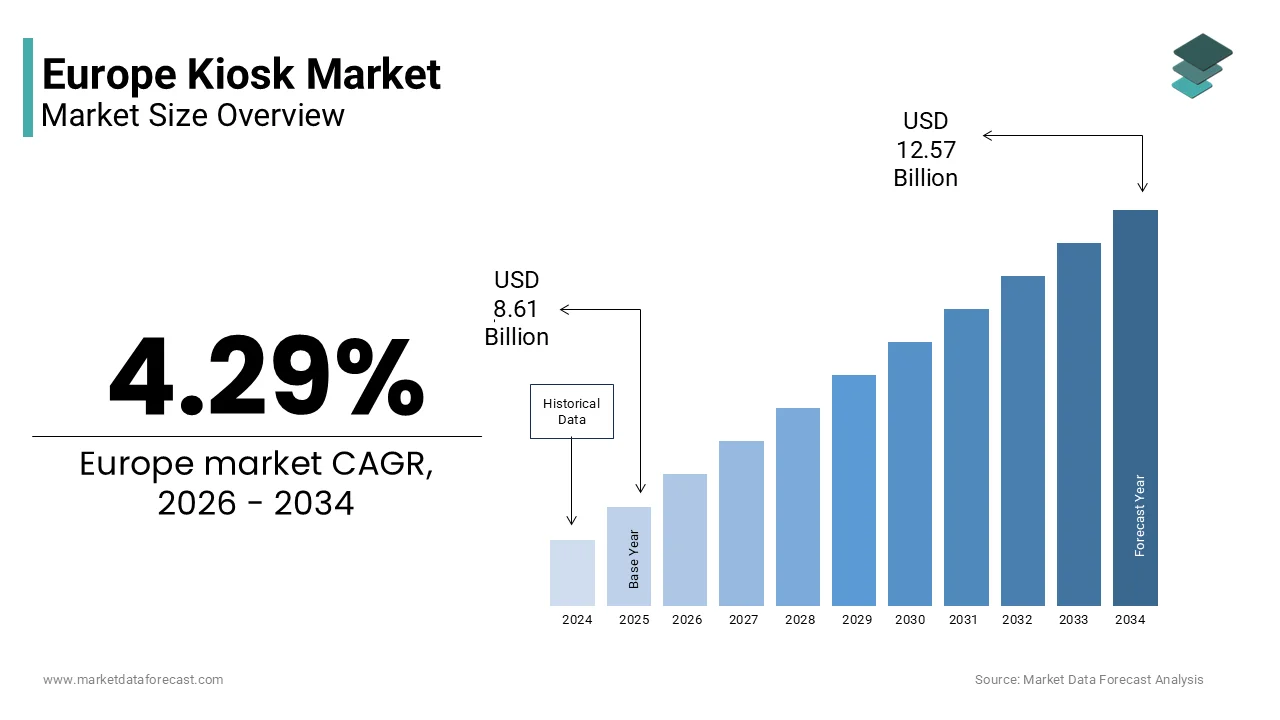
The Europe kiosk market size was valued at USD 8.61 billion in 2025 and is projected to reach USD 12.57 billion by 2034 from USD 8.98 billion in 2026, growing at a CAGR of 4.29%.
A kiosk is a small, standalone structure used in high-traffic areas to provide information, sell products, or offer self-service transactions. Unlike generic vending systems, modern kiosks in Europe are sophisticated digital interfaces integrating touchscreens, payment processing, biometric verification, and cloud-based backend systems compliant with stringent EU data and accessibility regulations. According to various sources, a growing majority of residents across Europe are increasingly adopting online platforms to interact with government authorities and manage administrative tasks. The market operates under frameworks such as the EU Web Accessibility Directive and General Data Protection Regulation, which mandate inclusive design and secure data handling. Furthermore, the shift toward digital administration is encouraging the development of accessible, user-friendly physical interfaces to ensure public services remain inclusive for all individuals in communal and transit locations. This convergence of digital transformation, regulatory compliance, and post-pandemic contactless preferences defines the European kiosk market as a critical enabler of seamless, secure, and equitable service delivery.
MARKET DRIVERS
Digital Public Service Mandates Driving Government and Transport Adoption
The EU’s binding policy framework requiring member states to digitize public services while ensuring universal access is a primary driver of the European kiosk market. The European Union is advancing a policy to ensure all vital public services are accessible digitally, leveraging physical kiosks to assist citizens who lack personal devices or digital proficiency. To improve inclusivity, European municipalities are increasingly deploying multilingual digital kiosks in public spaces for services like tax filings and document applications, although deployment rates vary across the Union. National rail operators in Germany and France are investing heavily in automated ticketing technology, leading to a significant shift away from staffed counters and improved efficiency in handling passenger volume. These systems comply with EN 301 549 accessibility standards, featuring voice guidance and tactile interfaces. This regulatory push transforms kiosks from convenience tools into mandated infrastructure for inclusive digital governance.
Labor Shortages and Operational Efficiency in Retail and Hospitality
Persistent labor scarcity across the regional service sectors has intensified demand for self-service kiosks as a strategic response to staffing gaps and rising wage costs, which acts as a key booster of the Europe kiosk market. The European food service industry is experiencing a, high-level, sustained staff shortage, causing a significant portion of food service businesses to report difficulty in filling roles and high employee turnover, according to industry labor reports. Major quick-service restaurant chains in Europe are extensively deploying digital self-ordering kiosks to address labor shortages and increase average check sizes, a strategy that also improves order accuracy compared to traditional cashiers. Similarly, fashion retailers such as H&M and Zara use kiosks for inventory lookup and checkout, cutting staffing needs by two employees per shift. According to research on European working conditions, the adoption of automation technology in customer-facing roles is rising as a primary method for reducing labor costs and improving operational efficiency. This operational imperative ensures sustained investment in kiosk deployment beyond pandemic-era hygiene concerns.
MARKET RESTRAINTS
Stringent Data Privacy and Cybersecurity Compliance Burdens
The complex and costly requirements of the General Data Protection Regulation and the NIS2 Directive are a major restraint on the European kiosk market. These regulations govern personal data handling and system resilience. Every kiosk collecting user information, whether for loyalty programs, age verification, or service registration, must implement end-to-end encryption, secure authentication, and data minimization protocols. Under strict European privacy regulations, the threat of significant financial penalties based on global revenue for data breaches is encouraging smaller kiosk operators to prioritize compliance measures, potentially slowing the rapid adoption of advanced, data-intensive technologies. Additionally, the implementation of European cybersecurity legislation requiring lifelong vulnerability management and regular software patching for connected devices is driving up maintenance overhead, forcing manufacturers to integrate security costs more heavily into their product development cycles. Many legacy kiosk systems lack secure over-the-air update capabilities, forcing full hardware replacements. This regulatory friction slows innovation, particularly for SMEs, and creates a barrier to entry that favors large vendors with dedicated compliance teams.
Fragmented Accessibility Standards Across Member States
Inconsistent national interpretations of accessibility requirements create significant deployment challenges for kiosk providers, despite EU-wide directives, which limits the expansion of the Europe kiosk market. Despite the EU's baseline accessibility standards, national rules differ. Notably, Germany requires height-adjustable screens, France enforces Braille labeling, and Sweden demands specific contrast ratios. According to a study, these discrepancies force manufacturers to maintain multiple hardware and software configurations, increasing production costs. A kiosk approved in the Netherlands may fail certification in Italy due to differing tactile button specifications. This fragmentation undermines economies of scale, delays rollouts, and complicates pan-European deployments for multinational clients like airports and railway networks. The lack of harmonized technical annexes keeps the market inefficient and exclusionary for vendors and users alike.
MARKET OPPORTUNITIES
Integration of Biometric and Contactless Identity Verification
The adoption of secure biometric authentication, such as facial recognition and fingerprint scanning, to enable seamless and fraud-resistant service access creates the pathway for new opportunities for the Europe kiosk market. The updated European digital identity regulation establishes a standardized, secure framework for digital wallets that allows citizens to prove their identity and credentials across borders, both online and in person. A large portion of the European population already utilizes electronic identification, providing a substantial foundation for the rapid adoption of new, standardized digital identity wallets. Airports like Amsterdam Schiphol and Paris Charles de Gaulle are piloting biometric kiosks for bag drop and lounge access, reducing processing time Similarly, banks such as ING and BNP Paribas deploy identity-verified kiosks for account opening and loan applications. Kiosk providers can boost user experience and security by adopting eIDAS-compliant, high-assurance authentication that removes the need for traditional passwords.
Expansion of Smart City Kiosks for Urban Mobility and Citizen Engagement
The region’s smart city initiatives position kiosks as multifunctional urban nodes for mobility, information, and civic interaction, which exhibits fresh prospects for the Europe kiosk market. Under the EU Mission for 100 Climate-Neutral Cities, municipalities are deploying solar-powered kiosks offering real-time transit data, bike-sharing access, air quality monitoring, and emergency alerts. In Barcelona, “Sentilo” kiosks provide multilingual tourist information and waste reporting, while Helsinki’s “Kioski” network enables residents to report potholes or request services. Numerous European municipalities are integrating interactive digital kiosks into their urban infrastructure to enhance citizen engagement and improve access to city services, supported by European innovation partnership initiatives. These systems generate anonymized foot traffic data that informs urban planning, creating value beyond user interaction. Kiosks are transforming from mere transactional terminals into smart community hubs, strengthening urban resilience and civic engagement as cities demand more interactive digital touchpoints.
MARKET CHALLENGES
Supply Chain Vulnerability for Specialized Components
The dependence on global supply chains for key components, such as touchscreens, secure payment modules, and industrial-grade processors, which are predominantly manufactured in Asia, degrades the growth of the Europe kiosk market. During the widespread semiconductor shortage, extended supply chain delays for certified payment components hindered the deployment of new payment terminals across the European retail and transport sectors. Geopolitical tensions and export controls further exacerbate risk. Restrictions on Chinese-made display panels have forced redesigns for several EU-based kiosk integrators. Unlike consumer electronics, kiosks require long-life components with extended availability, making them vulnerable to obsolescence. European kiosk providers risk logistical delays and inflated costs due to a lack of regional semiconductor and display manufacturing.
User Resistance and Digital Exclusion Among Vulnerable Populations
Persistent user resistance and digital literacy gaps among elderly and low-income groups, despite policy support, pose a fundamental challenge to the Europe kiosk market. According to Eurofound, a significant portion of older Europeans still face challenges with digital interfaces, while residents in low-income households frequently lack confidence in using self-service technologies. In public services, this has led to complaints about reduced human assistance. The UK’s Post Office faced parliamentary scrutiny after replacing counters with kiosks in rural branches. Similarly, transport operators in Southern Europe report higher abandonment rates at ticketing kiosks due to language barriers and complex navigation. Kiosks risk widening the gap between technology users and non-users unless supported by robust fallback options and inclusion programs. Vendors must balance automation with empathy, integrating voice assistance, simplified workflows, and staff support, adding cost and complexity to an already regulated environment.
REPORT COVERAGE
| REPORT METRIC | DETAILS |
| Market Size Available | 2025 to 2034 |
| Base Year | 2025 |
| Forecast Period | 2026 to 2034 |
| CAGR | 4.29% |
| Segments Covered | By Type, End Use, Technology, Installation Type, and Region |
| Various Analyses Covered | Global, Regional, & Country Level Analysis; Segment-Level Analysis; DROC, PESTLE Analysis; Porter’s Five Forces Analysis; Competitive Landscape; Analyst Overview of Investment Opportunities |
| Regions Covered | UK, France, Spain, Germany, Italy, Russia, Sweden, Denmark, Switzerland, Netherlands, Turkey, and the Czech Republic |
| Market Leaders Profiled | Kiosk Information Systems, Inc., Honeywell International, Inc., NCR Corporation, Fujitsu Limited, Diebold, Incorporated, Slabb Kiosks, Hitachi, Ltd., Glory Limited, IBM Corporation, and Eastman Kodak Company |
SEGMENTAL ANALYSIS
By Type Insights
In 2025, the self-service kiosks segment was the largest segment of the European kiosk market and captured a 48.3% share because of its versatility across retail, food service, and public administration, where it automates ordering, check-in, and transaction processes. According to the European Commission’s Digital Economy and Society Index, over 70% of EU citizens now prefer self-service options for routine tasks, accelerating adoption in quick-service restaurants like McDonald’s and retail chains such as H&M. In transportation, Deutsche Bahn and SNCF have deployed more than 12,000 self-service ticketing kiosks across Germany and France, reducing staffing costs by 25% while maintaining service levels. The segment’s growth is further reinforced by labor shortages. European consumers are increasingly adopting digital platforms for routine tasks, accelerating self-service trends in retail and quick-service dining. Major transportation providers are boosting digital ticketing, with a focus on streamlining passenger services. Self-service kiosks are the backbone of Europe's digital services, driving operational efficiency through user-friendly, multilingual, and integrated, loyalty-focused interfaces.
The payment kiosks segment is predicted to witness the highest CAGR of 11.2% from 2026 to 2034 due to the EU’s push for cashless transactions and secure, contactless payment infrastructure in public and private spaces. European regulations require high-security, multi-factor authentication for automated self-service payment terminals,, driving the adoption of, PIN, contactless, and biometric technology in unattended retail. Data indicates that electronic payment usage in the eurozone, particularly through contactless and automated, terminals, continues to rise rapidly,, making unattended kiosks a significant driver of card-present transaction growth in the region. Municipalities like Amsterdam and Stockholm have installed thousands of payment kiosks for parking fines, public transport top-ups, and municipal fees, reducing administrative overhead. Additionally, the rise of open banking enables kiosks to initiate bank transfers via QR codes, expanding financial inclusion. This regulatory and behavioral shift positions payment kiosks as critical nodes in Europe’s digital economy.
By End Use Insights
The retail segment dominated the European kiosk market by holding for a 36.7% share in 2025. The dominance of this segment is driven by the retailers’ need to enhance customer experience, reduce checkout friction, and optimize labor in an era of rising wage costs and e-commerce competition. Leading European retailers are heavily accelerating the implementation of self-checkout kiosks and self-scanning systems to address labor shortages and meet consumer demand for faster transactions, resulting in increased operational throughput and higher basket sizes compared to traditional staffed checkouts. Fashion retailers use kiosks for inventory lookup and endless aisle functionality, bridging online and offline channels. Moreover, post-pandemic hygiene concerns have made contactless payment and scanning essential. The EU’s Digital Markets Act further incentivizes interoperability, allowing kiosks to integrate with multiple payment and loyalty platforms. This convergence of operational efficiency, consumer preference, and regulatory support ensures retail remains the primary engine of kiosk adoption.
The healthcare segment is estimated to register the fastest CAGR of 13.5% over the forecast period owing to the EU’s Digital Health Action Plan, which mandates seamless patient access to services through digital front doors. Hospitals and clinics across Germany, France, and the Netherlands have deployed check-in kiosks that verify insurance, update records, and direct patients to departments, reducing front-desk workload. In public health, kiosks offer vaccination registration, test result retrieval, and telehealth triage, critical during pandemic surges. The General Data Protection Regulation-compliant systems use encrypted smart cards and biometric ID to protect sensitive data. Additionally, aging populations increase demand for accessible interfaces. Kiosks with voice guidance and large text serve elderly patients effectively. In the shift towards digital-first European healthcare, secure and efficient self-service kiosks have become essential touchpoints for patient interaction.
REGIONAL ANALYSIS
Germany Kiosk Market Analysis
Germany remained the leading county in the European kiosk market by occupying a 23.1% share in 2025. Factors such as advanced industrial automation, stringent data protection laws, and high consumer acceptance of self-service technology fuel the dominance of the German market. Germany is a leading market in the deployment of self-service technology, with national rail services using large numbers of ticketing units and major retail discounters expanding self-checkout options to improve service speed. The German Federal Office for Information Security (BSI) establishes stringent technical guidelines for payment security in kiosks, with BSI TR-03151 serving as a technical standard for securing digital signatures and protecting sensitive data within automated systems. Germany’s strong engineering base, including companies like Diebold Nixdorf and Fujitsu Technology Solutions, ensures locally manufactured, high-reliability systems. This blend of technical excellence, regulatory rigor, and user trust solidifies Germany’s role as the innovation and compliance nucleus of the European kiosk ecosystem.
United Kingdom Kiosk Market Analysis
The United Kingdom occupied a substantial share of 19.3% of the Europe kiosk market in 2025. Early and widespread adoption in retail and government services propels the growth of the UK market. Major supermarkets in the UK are significantly increasing the number of self-service kiosks, making automated checkouts the primary option for many shoppers to improve efficiency and reduce staffing costs, though some retailers are now re-evaluating the balance with staffed tills. Post Office branches are increasingly deploying self-service, multi-functional kiosks to handle routine transactions, such as parcel processing and bill payments, freeing up staff for complex inquiries. Local authorities across the UK are adopting digital kiosks to streamline citizen access to services such as housing and tax, supporting a wider government initiative to transition services to digital platforms. Despite Brexit, the UK maintains GDPR-equivalent data rules, ensuring secure kiosk operations. The NHS is implementing automated check-in kiosks across hospitals to enhance patient flow and reduce administrative burden on staff. This deep integration across private and public sectors makes the UK a mature and influential market for scalable kiosk solutions.
France Kiosk Market Analysis
France also holds a significant position in the European kiosk market owing to its national smart city agenda and integrated urban mobility networks. Paris is transforming its traditional newsstands into multifunctional, localized information points that provide tourist guidance, promote local products, and assist with digital services, aiming to enhance urban mobility and support the city’s broader environmental and sustainable transportation initiatives. Retailers like Carrefour and FNAC use kiosks for product customization and loyalty engagement, while airports such as Charles de Gaulle feature biometric bag-drop kiosks compliant with EU eIDAS standards. France’s emphasis on inclusive design, mandating voice assistance and tactile buttons, ensures accessibility. This fusion of urban innovation, mobility, and regulation positions France as a dynamic laboratory for next-generation kiosk applications.
Netherlands Kiosk Market Analysis
The Netherlands continues to be a lucrative region in the Europe kiosk market, which is renowned for its cashless society and advanced digital public infrastructure. The overwhelming majority of Dutch consumers utilize contactless methods for transactions, accelerating the transition to cashless, unmanned payment terminals in public services and institutional environments. The Dutch Central Bank and Payment Association indicate a rapid increase in electronic, non-retail transactions, with automated kiosks becoming a preferred method for quick payments outside traditional retail settings. Schiphol Airport extensively deploys self-service kiosks and biometric technology for check-in, bag drop, and access management, enhancing efficiency through integration with international passenger data and secure digital identity systems. The government’s “Digital Netherlands” program subsidizes kiosk deployment in rural municipalities to ensure equitable service access. High English proficiency and digital literacy further boost user adoption. This ecosystem of trust, infrastructure, and policy makes the Netherlands a benchmark for seamless, secure kiosk integration.
Sweden Kiosk Market Analysis
Sweden is predicted to expand notably in the Europe kiosk market during the forecast period due to its focus on universal design and eco-friendly kiosk manufacturing. All public kiosks must comply with the Swedish Disability Act, featuring height-adjustable screens, Braille labels, and speech synthesis, a standard influencing EU accessibility norms. Swedish municipalities, guided by national digital strategies, are increasingly utilizing interactive kiosks to enhance access to social services, with a focus on improving user experience for the elderly. Companies like Hyosung and NCR source recycled aluminum and low-energy displays for Swedish deployments, aligning with the country’s carbon-neutral goals. The transport sector leads adoption. SJ Rail leverages digital self-service kiosks at various stations to manage ticketing and provide passengers with updated travel information, including tools to initiate delay compensation procedures. This commitment to inclusion, sustainability, and user-centered design establishes Sweden as a moral and technical leader in ethical kiosk deployment across Europe.
COMPETITIVE LANDSCAPE
The Europe kiosk market features intense competition among global technology firms regional specialists and emerging software providers. Established players like Diebold Nixdorf and NCR dominate through scale brand recognition and deep integration with retail and banking ecosystems. However they face pressure from agile European vendors offering niche solutions in healthcare and public services with superior accessibility and sustainability features. The market is highly fragmented due to varying national regulations on data privacy accessibility and payment security which create barriers to pan European standardization. Competition is increasingly defined by compliance capabilities cybersecurity robustness and user inclusivity rather than hardware alone. Success hinges on navigating complex regulatory landscapes delivering seamless multilingual experiences and demonstrating long term reliability in a market where trust and security are paramount.
KEY MARKET PLAYERS
Some of the notable key players in the Europe kiosk market are
- Kiosk Information Systems Inc.
- Honeywell International Inc.
- NCR Corporation
- Fujitsu Limited
- Diebold Incorporated
- Slabb Kiosks
- Hitachi Ltd.
- Glory Limited
- IBM Corporation
- Eastman Kodak Company
Top Players in the Market
- Diebold Nixdorf AG is a German multinational and a leading provider of self-service kiosk and retail automation solutions across Europe. The company supplies integrated systems for banking, retail, and hospitality sectors, emphasizing secure payment processing and omnichannel customer engagement. Diebold Nixdorf has strengthened its position by launching GDPR compliant kiosks with embedded biometric authentication and end to end encryption for public services and transport. It also expanded its cloud based management platform to enable remote diagnostics and software updates across thousands of units. These initiatives reinforce its role as a trusted technology partner in Europe’s digital transformation while influencing global standards for secure, accessible self service infrastructure.
- NCR Corporation is a US based global leader with a strong European footprint in retail and hospitality kiosks. The company provides scalable self checkout and ordering solutions to major chains like Tesco and McDonald’s across the continent. NCR has reinforced its market presence by integrating open banking payment options into its kiosks in compliance with PSD2 and by developing AI driven queue management systems that optimize staffing. It also partnered with EU municipalities to deploy multilingual citizen service kiosks featuring eIDAS compliant digital identity verification. These actions align NCR with Europe’s regulatory and digital inclusion priorities, enhancing its relevance in both commercial and public sectors.
- Fujitsu Technology Solutions GmbH is a German subsidiary of the Japanese tech giant and a key player in enterprise and public sector kiosks across Europe. The company specializes in durable, accessible kiosks for healthcare, transportation, and government use, with a focus on sustainability and user inclusivity. Fujitsu has strengthened its position by introducing kiosks built with recycled aluminum and low energy displays certified under the EU Ecolabel. It also implemented voice guided interfaces and height adjustable screens to meet EN 301 549 accessibility standards. These innovations position Fujitsu as a leader in ethical, human centered kiosk design that supports Europe’s green and inclusive digital agenda.
Top Strategies Used by the Key Market Participants
Key players in the Europe kiosk market are primarily focused on ensuring compliance with GDPR eIDAS and Web Accessibility Directive through secure biometric authentication encrypted data handling and inclusive interface design. Companies are investing in cloud based remote management platforms to enable real time monitoring software updates and predictive maintenance. Strategic integration of open banking and contactless payment options aligns with PSD2 and cashless society trends. Emphasis on sustainable materials such as recycled aluminum and energy efficient components supports EU Green Deal objectives. Additionally firms are developing AI driven analytics to optimize user flow and staffing in retail and hospitality environments enhancing operational efficiency and customer experience.
MARKET SEGMENTATION
This research report on the European kiosk market has been segmented and sub-segmented based on categories.
By Type
- Self Service Kiosks
- Information Kiosks
- Payment Kiosks
- Digital Signage Kiosks
By End Use
- Retail
- Hospitality
- Healthcare
- Transportation
- Education
By Technology
- Interactive Displays
- Touch Screen
- Voice Recognition
- Facial Recognition
By Installation Type
- Indoor
- Outdoor
- Mobile
By Country
- UK
- France
- Spain
- Germany
- Italy
- Russia
- Sweden
- Denmark
- Switzerland
- Netherlands
- Turkey
- Czech Republic
- Rest of Europe