- Product Description Description
- Table of Contents TOC
- List of Table & Figure LOT
- Get Free Sample PDF Sample PDF
Market Size, 2025
$21.86 BnMarket Estimate, 2026
$23.17 BnMarket Forecast, 2034
$36.85 BnCAGR, 2026–2034
5.97%Executive Summary: Europe Kitchenware Market
- Market Scope: Comprehensive European kitchenware market analysis covering material categories, product types, application sectors, country-level leadership frameworks, and regulatory compliance metrics.
- Market Valuation: Valued at USD 21.86 billion (2025), estimated at USD 23.17 billion (2026), and projected to reach USD 36.85 billion by 2034, registering a steady CAGR of 5.97% (2026–2034).
- Primary Growth Drivers: Popularity of home cooking, preference for sustainable and non-toxic materials, compact urban housing trends, demand for multifunctional kitchenware, and smart connected products. Regulatory compliance serves as a notable constraint, with average certification expenses exceeding EUR 15,000 per product line, alongside challenges where 18% of kitchenware sold on major e-commerce platforms in 2023 lacked proper CE marking or misrepresented material composition.
Key Market Segment Metrics (2026–2034)
| Category | Leading Segment (2025 Base Position) | Fastest-Growing Segment |
|---|---|---|
| By Material Category | Stainless Steel (dominated with a 34.3% market share in 2025) | Glass Kitchenware (projected to register the fastest CAGR of 6.3% from 2026 to 2034) |
| By Product Type | Cookware (led the type segment with a 41.7% share in 2025) | Bakeware & Specialized Multifunctional Kitchen Tools (bakeware forecast at 5.8% CAGR) |
| By Application Sector | Household Applications (held a substantial market share in 2025) | Commercial Kitchenware & Hospitality Sectors (projected to expand at a 4.9% CAGR) |
| By Region / Country | Germany (dominated the European market with a 22.7% share in 2025), followed by France (16.9%) | European Urban Innovation & Premium Eco-Friendly Retail Markets |
Major Market Players & Market Structure
Market Structure: Highly competitive European consumer goods and housewares landscape featuring major international brands and regional manufacturers competing intensely on sustainable materials, digital product traceability, premium positioning, localized manufacturing footprints, and rigorous EU regulatory compliance.
Key Companies: Groupe SEB, Tefal, Le Creuset, Zwilling J.A. Henckels AG, WMF Group GmbH, Villeroy & Boch AG, Fiskars Group, Fissler GmbH, Meyer Group Ltd., Brabantia, Joseph Joseph, and Rösle GmbH & Co. KG.
Europe Kitchenware Market Size
The Europe kitchenware market size was valued at USD 21.86 billion in 2025, and is projected to reach USD 36.85 billion by 2034 from USD 23.17 billion in 2026, growing at a CAGR of 5.97%.
Kitchenware refers to the functional and aesthetic products used in food preparation, cooking, and serving, including cookware, bakeware, cutlery, and utensils. This sector reflects evolving culinary habits sustainability imperatives and design sensibilities across the continent’s heterogeneous consumer base. Europeans spend notable time per day on meal preparation and consumption, according to the European Commission, which stresses the cultural centrality of kitchen activities. The market is shaped by stringent regulatory standards such as the EU Framework Regulation EC 1935 2004 which governs materials intended to come into contact with food ensuring safety and chemical inertness. National preferences vary significantly with Germany favoring precision engineered stainless steel France emphasizing enameled cast iron and Southern European countries prioritizing ceramic and terracotta traditions. The rise of compact urban housing has also influenced demand toward space efficient modular and multifunctional kitchen tools. These sociocultural regulatory and spatial dynamics collectively define the contemporary contours of Europe’s kitchenware landscape.
MARKET DRIVERS
Rising Home Cooking Frequency and Culinary Engagement
The sustained increase in home cooking across Europe has become a key propellent for the growth of the Europe kitchenware market. This is driven by health consciousness economic prudence and digital culinary inspiration. According to sources, a portion of adults in the European Union cook at home at multiple times per week a notable rise from that in 2019. This behavioral shift is amplified by the proliferation of online recipe platforms and social media food content. Consequently consumers are investing in specialized tools such as non stick frying pans precision knives and silicone bakeware to replicate restaurant quality results. This deepened emotional and functional attachment to home cooking sustains consistent replacement and expansion cycles in kitchenware ownership across demographic segments.
Demand for Sustainable and Non Toxic Materials
European consumers are increasingly prioritizing kitchenware made from eco friendly and health safe materials, which in turn bolsters the expansion of the Europe kitchenware market. The demand for this is caused by heightened awareness of chemical leaching and environmental impact. According to European Environment Agency reported, a portion of surveyed households actively avoid products containing per and polyfluoroalkyl substances commonly found in conventional non stick coatings. This has accelerated adoption of ceramic titanium and cast iron alternatives with Germany alone recording a year on year increase in ceramic cookware sales, as per sources. Regulatory burden strengthens this trend with the European Chemicals Agency proposing stricter limits on nickel and lead migration from metal utensils under the REACH framework. This convergence of consumer vigilance regulatory foresight and material innovation is redefining product development priorities across the sector.
MARKET RESTRAINTS
Stringent EU Compliance and Material Safety Regulations
Rigorous regulatory regimes governing food contact materials impose significant compliance costs and technical barriers, particularly for small and imported manufacturers, and thereby restrict the growth of the Europe kitchenware market. In addition, the EU flagged number of kitchenware items primarily from non EU countries for excessive lead cadmium or formaldehyde release, according to the research. Domestic producers must undergo costly third party testing and documentation processes with average certification expenses exceeding 15000 euros per product line as reported by the European Committee for Standardization. Furthermore, the upcoming revision of the Framework Regulation will introduce stricter endocrine disruptor screening protocols further escalating development timelines. These requirements while essential for public health disproportionately affect artisanal and emerging brands lacking regulatory expertise, which thereby constrains product diversity and innovation especially in niche segments such as handmade ceramics or bamboo composites.
Price Sensitivity Amid Persistent Inflationary Burdens
Elevated inflation across Europe has intensified consumer price sensitivity, which further holds back the expansion of the Europe kitchenware market. This directly impacts discretionary purchases such as premium kitchenware. The annual inflation rate for household goods in the Eurozone was notable in 2023, according to Eurostat with stainless steel and aluminum prices of key raw materials rising, as per the European Metal Association. Consequently, a portion of European shoppers prioritize price over brand when buying kitchen tools, as per sources. This shift has eroded demand for mid to high end products particularly in Southern and Eastern Europe where disposable income growth remains sluggish. Retailers have responded by expanding private label offerings which now account for a portion of kitchenware sales, as per studies. Innovation in premium categories slows as manufacturers defer R and D investments to maintain margins while value segments gain traction. This economic headwind challenges the market’s ability to sustain quality differentiation and long term brand equity.
MARKET OPPORTUNITIES
Growth of Smart and Multifunctional Kitchenware
The integration of technology into traditional kitchen tools is unlocking new consumer segments, which gives fresh opportunities for the Europe kitchenware market. This growth seeks efficiency precision and connectivity in domestic cooking. Smart kitchenware such as Bluetooth enabled meat thermometers induction compatible cookware with heat mapping and self stirring pots are gaining traction particularly among urban professionals and tech savvy millennials. Companies like WMF and Le Creuset have launched hybrid lines combining traditional craftsmanship with digital functionality such as temperature controlled saucepans. Digital literacy is rising, and IoT infrastructure is expanding. This convergence of culinary tradition and technological utility gives a high-growth frontier for innovative manufacturers.
Revival of Artisanal Craft and Local Manufacturing
A growing consumer preference for authenticity heritage and local economic support is revitalizing small scale and artisanal craft, and also offers new opportunities for the expansion of the Europe kitchenware market. This trend is particularly strong in countries with rich craft legacies such as Portugal where handmade ceramic cookware sales rose in recent years, according to research. National initiatives like France label certify excellence in artisanal manufacturing boosting visibility and trust. Furthermore, the EU’s Common Agricultural Policy includes funding streams for rural craft clusters linking local pottery and metalwork studios to culinary tourism and farm to table experiences. In Greece, multiple artisanal copper workshops have reopened since 2020 producing traditional cookware for both domestic and export markets, as per studies. This resurgence not only preserves cultural heritage but also offers a differentiated value proposition against mass produced imports fostering resilient localized supply chains.
MARKET CHALLENGES
Supply Chain Fragmentation and Raw Material Volatility
Persistent instability due to fragmented global supply chains and fluctuating costs of vital raw materials such as stainless steel, aluminum, and specialty ceramics challenges the growth of the Europe kitchenware market. A portion of Europe’s stainless steel used in cookware is imported from Asia with delivery lead times extending to several weeks, according to the European Steel Association. Geopolitical tensions and export restrictions further exacerbate this dependency with China’s rare earth export controls impacting the production of high performance non stick coatings. Energy costs compound the challenge as ceramic kilns and metal forging require sustained high temperatures. These burdens force manufacturers to either absorb losses or pass costs to consumers eroding competitiveness against lower priced imports. Moreover, the lack of standardized recycling streams for composite kitchenware hinders circularity efforts.
Counterfeit Products and Intellectual Property Infringement
The proliferation of counterfeit products in European online and informal markets affects brand integrity consumer safety and legitimate business revenues, which hampers the expansion of the Europe kitchenware market. The European Union Intellectual Property Office estimated in 2023 that 18 percent of kitchenware sold on major e commerce platforms lacked proper CE marking or misrepresented material composition. Fake versions of iconic designs often use substandard alloys that leach heavy metals when heated posing serious health risks, as per sources. Enforcement remains challenging due to jurisdictional complexities with a portion of infringing goods originating from non EU territories, according to sources. Small and medium enterprises lack resources to pursue legal action while consumers struggle to distinguish authentic products particularly in digital marketplaces. This erosion of trust not only damages brand equity but also distorts price perception and discourages innovation. Strengthening cross border IP enforcement and implementing digital authentication such as QR based verification are important yet underutilized measures to safeguard the market’s integrity and consumer welfare.
REPORT COVERAGE
| REPORT METRIC | DETAILS |
| Market Size Available | 2025 to 2034 |
| Base Year | 2025 |
| Forecast Period | 2026 to 2034 |
| CAGR | 5.97% |
| Segments Covered | By Material, Type, Application, and Region |
| Various Analyses Covered | Global, Regional, & Country Level Analysis; Segment-Level Analysis; DROC; PESTLE Analysis; Porter’s Five Forces Analysis; Competitive Landscape; Analyst Overview of Investment Opportunities |
| Regions Covered | UK, France, Spain, Germany, Italy, Russia, Sweden, Denmark, Switzerland, Netherlands, Turkey, Czech Republic, Rest of Europe |
| Market Leaders Profiled | Groupe SEB (France), Tefal, Le Creuset, Zwilling J.A. Henckels AG, WMF Group GmbH, Villeroy & Boch AG, Fiskars Group, Fissler GmbH, Meyer Group Ltd., Brabantia, Joseph Joseph, and Rösle GmbH & Co. KG, and others. |
SEGMENTAL ANALYSIS
By Material Insights
The stainless steel segment held the largest share of 34.3% of the Europe kitchenware market in 2025. The growth of the stainless steel segment in the regional market is due to its durability hygiene compliance with food safety standards and recyclability. The material’s non porous surface prevents bacterial growth and chemical leaching making it the preferred choice for both household and commercial kitchens across the continent. According to the sources, stainless steel used in kitchenware must meet EN specifications ensuring chromium and nickel content that guarantees corrosion resistance and inertness. Germany alone accounts for a portion of EU stainless steel kitchenware production, as per research, which reflects strong industrial capacity and engineering heritage. Consumer trust is further supported by the European Food Safety Authority which recognizes stainless steel as a safe material for prolonged food contact even at high temperatures. This combination of performance regulatory acceptance and environmental compatibility strengthens stainless steel’s dominance in a market increasingly defined by safety and sustainability.
The glass segment is likely to experience the fastest CAGR of 6.3% from 2026 to 2034 due to transparency chemical inertness and alignment with clean label consumer values. Borosilicate and tempered glass kitchenware such as storage containers bakeware and measuring cups are increasingly favored for their ability to withstand thermal shock without leaching endocrine disruptors, as per research. The material’s full recyclability without quality degradation also supports EU packaging directives. Furthermore, glass enables visual inventory management reducing food waste, a priority under the EU Farm to Fork Strategy which aims to cut household food loss by 2030. Glass kitchenware benefits from both functional and ethical tailwinds. This is due to consumers replacing plastic storage solutions and seeking oven-to-table versatility, which accelerates its adoption among urban and health-conscious demographics.
By Type Insights
The cookware segment was the largest segment and held 41.7% share in 2025. The prominence of the cookware segment is mainly fuelled by its essential role in daily food preparation and frequent replacement cycles. Pots pans pressure cookers and frying pans are foundational items in European households. Technological advancements such as induction compatibility and multi layer heat distribution have elevated product expectations particularly in Germany and Scandinavia where energy efficiency is prioritized. National culinary traditions also sustain demand. Moreover the post pandemic surge in home cooking has extended cookware ownership. This blend of functional necessity cultural embeddedness and regulatory evolution ensures cookware’s continued dominance in the kitchenware ecosystem.
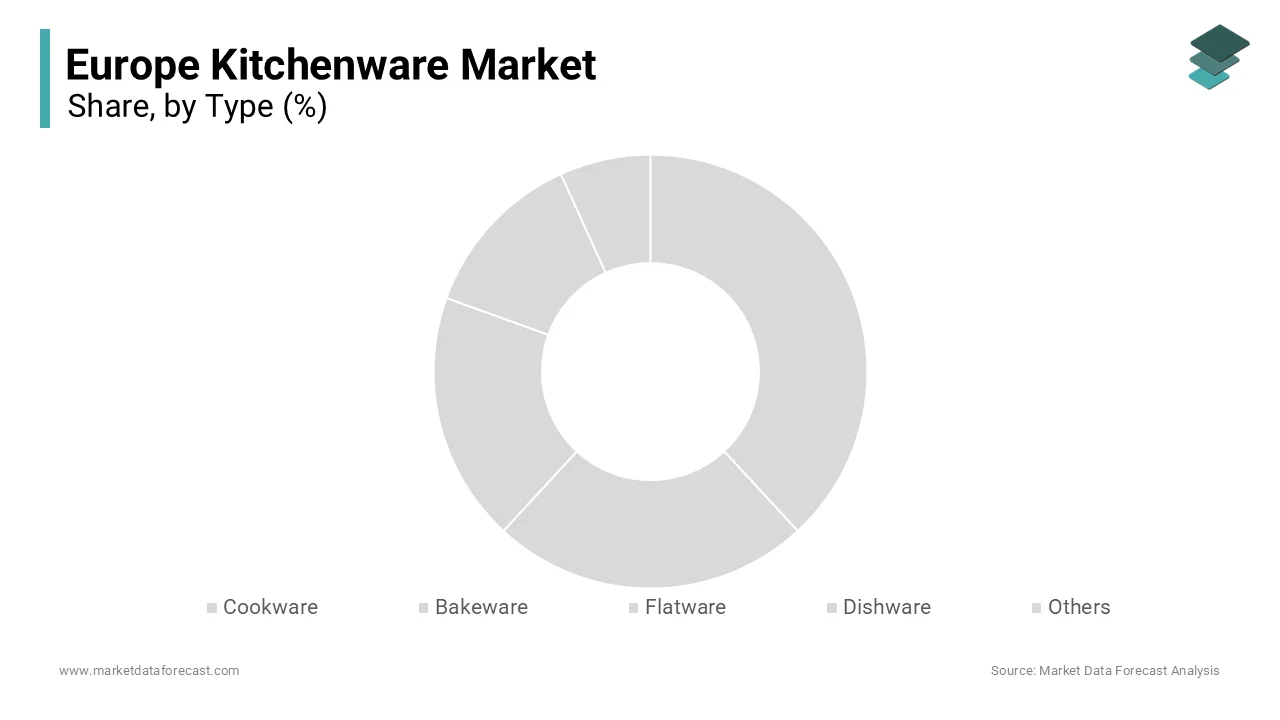
The bakeware segment is on the rise and is expected to be the fastest growing segment in the global market by witnessing a CAGR of 5.8% from 2026 to 2034 owing to the rising popularity of home baking artisanal desserts and social media driven culinary trends. Silicone molds ceramic ramekins and non stick sheet pans have seen heightened demand particularly among millennials and Gen Z consumers who engage with baking as a creative and therapeutic activity. There has been an increase in retail bakeware sales in recent yaers with the United Kingdom and Sweden leading growth. This trend is strengthened by the proliferation of online baking tutorials. Besides, the shift toward plant based and gluten free diets has spurred demand for specialized bakeware that ensures even cooking and easy release.
By Application Insights
The household segment led the Europe kitchenware market by capturing substantial share in 2025. Factor like consistent replacement demand evolving culinary habits and home renovation cycles propels the growth of the household segment. Europeans view kitchenware as an extension of personal identity and domestic aesthetics. Urbanization and the rise of compact living have further amplified demand for multifunctional space saving designs particularly in cities like Paris Berlin and Amsterdam. National housing policies also plays a role. Furthermore, the cultural emphasis on home cooked meals, which ensures continuous usage and replenishment. Household purchases are influenced by design trends brand storytelling and emotional resonance, factors that differ from commercial settings where procurement is centralized and durability focused, which makes this segment both voluminous and dynamic.
The commercial kitchenware segment is expected to exhibit a noteworthy CAGR of 4.9% over the forecast period. The expansion of the commercial kitchenware segment is propelled by the expansion of food service establishments sustainable hospitality mandates and professionalization of culinary operations. These establishments require high performance durable kitchenware compliant with EU hygiene regulations such as Regulation EC which mandates non corrosive and easily cleanable surfaces. Hotels and restaurants are also under force or insistence to meet Green Key and EU Ecolabel criteria driving adoption of certified stainless steel and ceramic items. Furthermore, the rise of ghost kitchens and meal prep services has created demand for standardized stackable and induction ready equipment. Commercial kitchenware transitions from commodity to strategic asset as the hospitality sector recovers and institutionalizes sustainability. This version reverses the order, making the main clause the first part of the sentence.
REGIONAL ANALYSIS
Germany Market Analysis
Germany dominated the Europe kitchenware market by accounting for 22.7% share in 2025. The domination of Germany in the regional market percent characterized by engineering excellence high consumer standards and robust manufacturing infrastructure. The country is home to globally recognized brands such as WMF Fissler and Zwilling which emphasize precision durability and design rooted in the Bauhaus tradition. German consumers prioritize functionality and longevity. The nation also leads in induction compatible cookware adoption. Strict adherence to LFGB food safety standards ensures that all kitchenware undergoes rigorous migration testing. Besides, Germany’s dual vocational training system produces skilled metalworkers and ceramists sustaining artisanal quality alongside industrial scale. This fusion of technical rigor consumer discernment and regulatory discipline cements Germany’s position as the market’s innovation and quality benchmark.
France Market Analysis
France followed closely in the Europe kitchenware market and captured 16.9% share in 2025. The growth of France is led by its rich culinary heritage emphasis on aesthetics and strong support for domestic craftsmanship. Iconic items such as copper sauté pans enameled cast iron cocottes and porcelain tableware remain central to both professional and home kitchens. Consumer behavior reflects this cultural pride. The “Made in France” label carries significant weight . Furthermore, France’s energy transition law mandates energy efficient appliances indirectly boosting demand for high conductivity cookware. This deep intertwining of gastronomy identity and policy ensures France’s, which endures influence on European kitchenware trends.
Italy Market Analysis
Italy witnessed steady expansion in the Europe kitchenware market due to regional diversity artisanal production and integration with culinary traditions. From Neapolitan pizza peels to Sicilian ceramic mortars each region contributes unique tools reflecting local cuisine. Italy hosts number of small and medium kitchenware manufacturers many clustered in industrial districts like Maniago for cutlery and Montelupo for ceramics. The “Made in Italy” designation is protected under EU law ensuring authenticity and quality control. Italian households exhibit high kitchenware ownership. The slow food movement has further elevated demand for traditional non industrial tools such as wooden pasta boards and copper jam pots. Moreover Italy is a key exporter of design led kitchenware with Milan Design Week serving as a global launchpad. This blend of heritage craftsmanship and contemporary design sustains Italy’s distinctive and influential market presence.
United Kingdom Market Analysis
The United Kingdom grew moderately in the Europe kitchenware market marked owing to strong retail innovation digital engagement and post Brexit supply chain recalibration. British consumers are among the most active online shoppers for home goods with a portion purchasing kitchenware via e commerce platforms in 2023, as per sources. Retailers like John Lewis and Lakeland lead in curated collections emphasizing sustainability and British design. The UK also shows high adoption of multifunctional kitchenware driven by compact urban living. Despite Brexit related import complexities UK brands have strengthened local sourcing. Apart from these, the rise of baking and meal prep culture has boosted demand for precision bakeware and storage solutions. This adaptive and digitally fluent market remains a key trendsetter in Northern Europe.
Spain Market Analysis
Spain is likely to grow in the Europe kitchenware market during the forecast period owing to vibrant culinary culture growing domestic manufacturing and tourism linked demand. Traditional items such as paella pans earthenware cazuelas and olive wood utensils remain popular both locally and as souvenirs . Spain has also emerged as a hub for affordable yet design conscious kitchenware with Valencia and Barcelona hosting numerous studios blending Mediterranean aesthetics with modern functionality. Besides, Spanish households prioritize communal dining which sustains demand for large format serving dishes and durable flatware. This fusion of tradition accessibility and export orientation ensures Spain’s dynamic and expanding role in the European kitchenware landscape.
COMPETITIVE LANDSCAPE
KEY MARKET PLAYERS
Some of the notable key players in the Europe kitchenware market are
- Groupe SEB (France)
- Tefal
- Le Creuset
- Zwilling J.A. Henckels AG
- WMF Group GmbH
- Villeroy & Boch AG
- Fiskars Group
- Fissler GmbH
- Meyer Group Ltd.
- Brabantia
- Joseph Joseph
- Rösle GmbH & Co. KG
TOP STRATEGIES USED BY THE KEY MARKET PLAYERS
Key players in the Europe kitchenware market focus on sustainable material innovation digital product traceability premium brand storytelling localized design adaptation and compliance with EU food contact and circular economy regulations. Companies are increasingly launching products made from recycled stainless steel ceramic and bio based composites to meet eco conscious demand. Strategic retail partnerships with both physical and online channels enhance visibility and accessibility. Investment in regional manufacturing reduces carbon footprint and mitigates supply chain risks. Furthermore, firms leverage heritage narratives and artisanal credentials to differentiate in a crowded marketplace while aligning product development with energy efficiency standards such as induction compatibility and thermal performance disclosure mandated under evolving EU legislation.
COMPETITION OVERVIEW
The Europe kitchenware market features intense competition among established premium brands regional artisans and value oriented private labels. Differentiation hinges on material quality design heritage sustainability credentials and regulatory compliance rather than price alone. German and French manufacturers dominate the high end segment through engineering excellence and culinary tradition while Southern European producers emphasize artisanal ceramics and woodcraft. Retailers exert significant influence dictating packaging standards sustainability benchmarks and shelf placement. The rise of e commerce has lowered entry barriers for niche designers yet also intensified visibility competition. Regulatory complexity particularly around food contact materials and recyclability creates both challenges and strategic advantages for well resourced players. Meanwhile consumer demand for multifunctional space saving and smart kitchenware is fostering collaboration between traditional manufacturers and tech developers. Overall the market rewards brands that balance authenticity innovation and environmental responsibility within a fragmented yet highly discerning consumer landscape.
TOP PLAYERS IN THE MARKET
- WMF Group GmbH is a leading German manufacturer of premium kitchenware known for its high quality stainless steel cookware cutlery and coffee machines. The company supplies both household and commercial segments across Europe with products engineered for durability precision and aesthetic refinement. WMF leverages its heritage in metal craftsmanship combined with modern manufacturing to meet stringent EU food safety and sustainability standards. These initiatives support its commitment to circularity and transparency while strengthening its appeal among environmentally conscious consumers and professional kitchens throughout Europe.
- Le Creuset Limited is renowned globally for its enameled cast iron cookware originating from France and widely distributed across European markets. The brand combines artisanal casting techniques with vibrant color palettes to create iconic kitchenware that bridges functionality and design. Le Creuset maintains strong retail partnerships with department stores and specialty kitchen shops while expanding its direct to consumer e commerce platform. These actions align with EU environmental directives and deepen consumer loyalty in a market increasingly driven by ethical consumption and heritage authenticity.
- Zwilling J A Henckels AG is a German multinational specializing in premium cutlery knives and cookware with deep roots in Solingen’s cutlery tradition. The company serves European households and professional chefs through a diversified portfolio that includes Zwilling Miyabi and Staub brands. Zwilling emphasizes innovation through its FRIODUR ice hardening technology and induction compatible cookware lines tailored to Europe’s energy efficient cooking trends. Recently the company invested in a new production facility in Belgium to shorten supply chains and launched a blockchain based traceability system for its knife series enabling consumers to verify origin and craftsmanship. These strategic moves enhance responsiveness to regional demand while strengthening quality dominance in a competitive premium segment.
MARKET SEGMENTATION
This research report on the European Kitchenware market has been segmented and sub-segmented based on categories.
By Material
- Glass
- Stainless Steel
- Ceramic
- Wood
- Plastic
- Others
By Type
- Cookware
- Bakeware
- Flatware
- Dishware
- Others
By Application
- Household
- Commercial
By Country
- UK
- France
- Spain
- Germany
- Italy
- Russia
- Sweden
- Denmark
- Switzerland
- Netherlands
- Turkey
- Czech Republic
- Rest of Europe