- Product Description Description
- Table of Contents TOC
- List of Table & Figure LOT
- Get Free Sample PDF Sample PDF
Market Size, 2025
$1.62 BnMarket Estimate, 2026
$1.71 BnMarket Forecast, 2034
$2.69 BnCAGR, 2026–2034
5.83%Europe Knife Market Report Summary
The European knife market was valued at USD 1.62 billion in 2025, is estimated to reach USD 1.71 billion in 2026, and is projected to reach USD 2.69 billion by 2034, growing at a CAGR of 5.83% during the forecast period from 2026 to 2034. The growth of the European knife market is driven by rising demand from household, commercial, and industrial sectors, along with the increasing popularity of outdoor and culinary activities. Advancements in steel processing, growing emphasis on design precision, and rising preference for high-performance knives among professional chefs and hobbyists are further supporting market expansion. Rapid urbanization and a surge in home cooking trends across Europe are also contributing to the market’s growth trajectory.
Key Market Trends
- Increasing demand for high-quality and durable knives, particularly among culinary professionals and outdoor enthusiasts.
- Growing adoption of premium stainless steel and carbon steel blades for enhanced sharpness, corrosion resistance, and longevity.
- The rising influence of e-commerce platforms in knife distribution, offering wide product accessibility and customization options.
- Expansion of multi-functional and ergonomic knife designs for kitchen and utility use.
- Emphasis on sustainable manufacturing practices and the use of recyclable materials in knife handles and packaging.
Segmental Insights
- Based on type, the fixed blade knives segment dominated the European knife market by accounting for 48.1% share in 2025. The dominance of this segment is attributed to its superior strength, durability, and popularity in both professional kitchens and outdoor applications such as hunting and camping. The segment benefits from rising consumer preference for high-stability tools with precision cutting capabilities.
- Based on material, the steel segment remained the prominent segment in the European knife market and captured a substantial share in 2025. The segment’s growth is driven by the superior properties of steel, including edge retention, ease of sharpening, and resilience against corrosion, making it the preferred choice for culinary and industrial applications.
Regional Insights
- The European knife market exhibits strong performance across major economies, supported by industrial craftsmanship, culinary innovation, and demand for high-quality household tools.
- Germany led the European knife market and accounted for a 22.2% share in 2025, owing to its advanced manufacturing expertise, renowned cutlery brands, and growing exports of premium knives. TheThe
- United Kingdom and France are witnessing steady growth driven by the increasing popularity of cooking shows, luxury kitchenware trends, and rising consumer spending on home improvement products.
- Meanwhile, Italy and Spain continue to strengthen their positions as key markets for artisanal and design-oriented knives.
Competitive Landscape
The European knife market is competitive, featuring both international and regional manufacturers focusing on innovation, material enhancement, and product differentiation. Companies are investing in ergonomic designs, lightweight materials, and advanced forging technologies to enhance product performance and aesthetics. Partnerships with e-commerce platforms and expansion into smart kitchen tools are emerging as key strategies among market leaders. Prominent players in the European knife market include Klein Tools, U.S. Blade, Hyde Tools, Olfa, Apex Tool Group, Milwaukee Tool, Q.E.P. Co Inc, Gerber Life Insurance Company, and Stanley Black & Decker.
Europe Knife Market Size
The Europe knife market size was valued at USD 1.62 billion in 2025 and is projected to reach USD 2.69 billion by 2034 from USD 1.71 billion in 2026, growing at a CAGR of 5.83%.
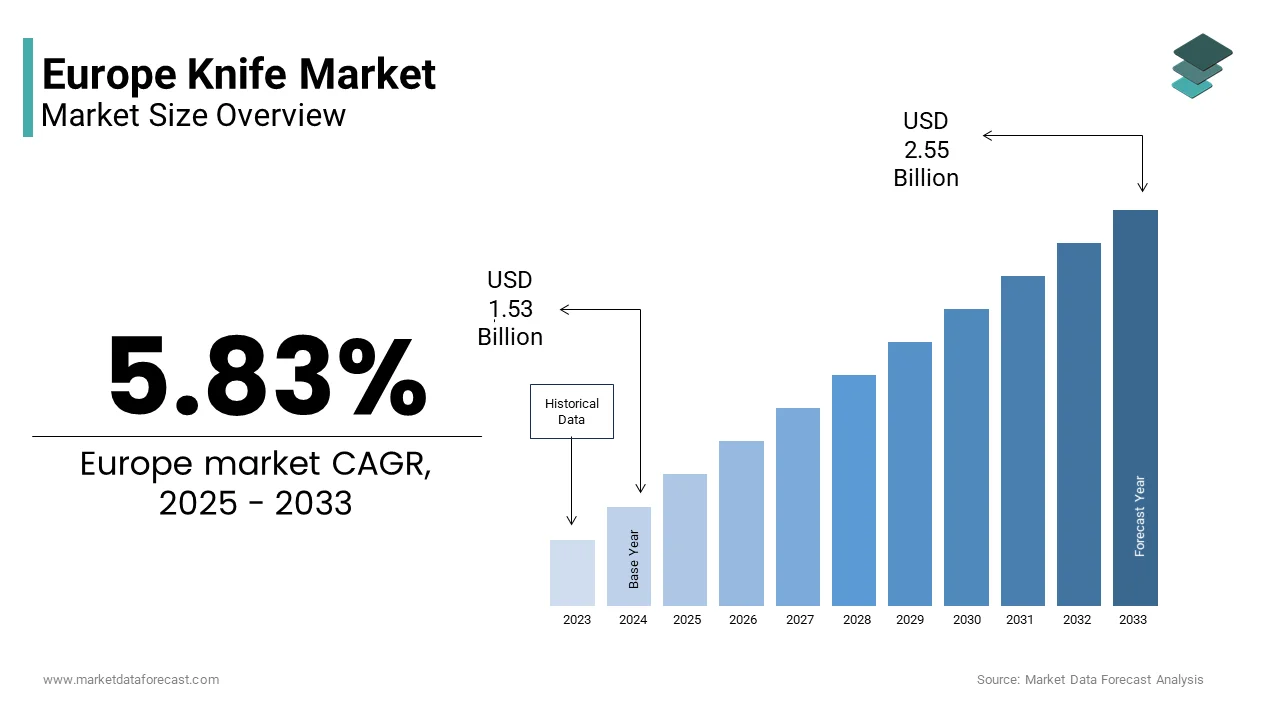
Knife refers to the cutting instruments designed for domestic culinary use, professional kitchens, outdoor activities, and specialized industrial applications. Unlike generic global classifications, this regional market is distinctly shaped by stringent product safety regulations, evolving consumer preferences for premium craftsmanship, and deeply rooted culinary traditions, particularly in countries such as France, Italy, and Germany. According to sources, a portion of European households reported owning at least three different types of kitchen knives in 2022, reflecting the integral role of cutlery in daily food preparation. Furthermore, The European Union's Regulation (EU) 2019/1020 strengthens market surveillance and enforcement for a wide range of non-food products sold in the single market. Cultural heritage also plays a pivotal role, as artisanal knife making persists in regions like Solingen, Germany, and Thiers, France, where centuries-old forging techniques coexist with modern manufacturing. This duality of tradition and regulation defines the structural and operational contours of the contemporary European knife landscape, setting it apart from other global markets through its emphasis on quality, heritage, and legal compliance rather than volume-driven consumption.
MARKET DRIVERS
Rising Demand for Premium Culinary Tools Driven by Home Cooking Trends
The proliferation of home cooking across European households has significantly amplified demand for high-quality kitchen knives, particularly those associated with professional-grade performance and durability, which drives the growth of the Europe knife market. The behavioral shift is especially pronounced in Western and Northern Europe, where disposable income enables consumers to prioritize long-term value over initial cost. Apart from these, the influence of digital culinary content cannot be understated, as platforms like YouTube and Instagram have popularized techniques that require precise blade control, thereby elevating consumer expectations for ergonomic design and sharpness retention. Brands such as Wüsthof and Zwilling have capitalized on this trend by integrating forged high-carbon stainless steel with balanced handles tailored to European hand sizes and grip preferences. Consequently, the convergence of lifestyle changes, digital media exposure, and purchasing power has established a sustained trajectory for premium knife adoption across the region.
Growth in Outdoor and Tactical Knife Adoption Fueled by Recreational Activities
The expanding participation in outdoor recreational pursuits across Europe has catalyzed robust demand for folding knives, multi-tools, and fixed-blade utility knives designed for camping, hiking, and survival scenarios, which propels the expansion of the Europe knife market. Regulatory frameworks vary by country, yet many jurisdictions, including Finland and Switzerland, maintain permissive laws regarding non-locking folding knives under a certain blade length, which further facilitates consumer access. Manufacturers such as Mora of Sweden and Fox Knives of Italy have responded by developing region-specific models that comply with local legislation while incorporating corrosion-resistant materials suitable for Europe’s humid and alpine climates. The alignment between rising outdoor engagement, favorable legal conditions, and localized product innovation continues to drive this segment’s expansion independent of traditional kitchen knife dynamics.
MARKET RESTRAINTS
Stringent Knife Legislation Restricting Product Accessibility and Design
National variations in knife control laws across European countries impose significant constraints on product design, distribution, and consumer access, and thereby limits the growth of the Europe knife market. The United Kingdom maintains one of the most stringent regulatory frameworks in Europe for the sale, possession, and import of certain types of knives, according to sources. France also enforces strict rules on the public carrying of larger non-folding knives under national security legislation, as per research. These divergent legal thresholds complicate cross-border e-commerce and force manufacturers to develop country-specific SKUs, increasing operational costs and inventory complexity. In Germany, while kitchen and hunting knives are permitted, the Weapons Act strictly regulates automatic and gravity knives, effectively excluding entire product categories from mainstream retail. The absence of a unified EU-wide knife policy not only fragments the single market but also discourages investment in new blade technologies that might inadvertently breach ambiguous legal definitions, particularly concerning assisted-opening mechanisms or concealed-carry features.
Environmental Regulations Increasing Production Costs and Material Constraints
The European Union’s aggressive environmental policy framework, particularly the Restriction of Hazardous Substances Directive and the upcoming Ecodesign for Sustainable Products Regulation, which restricts the growth of the Europe knife market. This imposes escalating compliance costs on knife manufacturers by restricting the use of certain alloys, surface treatments, and packaging materials. Evolving EU regulations on chemicals, including REACH and RoHS, are pushing metalworking firms in the cutlery industry toward material substitution and enhanced waste management. For instance, concerns over consumer nickel allergies and the classification of some nickel compounds have driven manufacturers to seek alternatives for coatings, such as titanium nitride or specialized stainless steels, to meet stringent release limits for products with prolonged skin contact. These regulatory pressures disproportionately affect artisanal workshops in regions like Thiers, France, where limited scale hinders investment in compliant production lines. Consequently, environmental stewardship, while socially imperative, introduces structural friction that constrains pricing flexibility and slows product iteration cycles across the European knife industry.
MARKET OPPORTUNITIES
Revival of Heritage Craftsmanship Through Regional Branding Initiatives
The strategic leveraging of geographical indications and artisanal heritage offers a compelling opportunity for the growth of the Europe knife market. Under a new EU-wide regulation for craft and industrial products that takes full effect on December 1, 2026, products like Solingen Cutlery from Germany and Laguiole Cutlery from France are now eligible for EU-level GI protection. These designations not only authenticate origin but also command price premiums. Consumer sentiment further supports this trend. Municipalities and regional development agencies have amplified this momentum through funding programs. These initiatives facilitate modernization of forging facilities while preserving hand-finishing techniques, thereby bridging tradition with contemporary quality standards. European manufacturers can fend off price competition from mass-market imports by employing heritage strategies that emphasize cultural authenticity and traceable production, and thereby captures value that goes beyond a product's simple utility.
Expansion of Direct-to-Consumer E-Commerce Channels Enhancing Market Reach
The accelerated adoption of digital retail platforms offers European knife brands unprecedented access to niche consumer segments while circumventing traditional distribution bottlenecks, and this has led to the expansion of the European knife market. According to the European Commission's 2023 Eurostat data on ICT usage in households and by individuals, 75% of internet users in the EU purchased goods or services online. This shift is particularly transformative for small-scale artisans who previously relied on local fairs or third-party retailers with limited geographic reach. Brands have reported that their proprietary e-commerce sites account for a portion of total revenue, as per sources. The integration of augmented reality tools and virtual try-on features further enhances conversion rates by allowing customers to visualize blade dimensions and handle ergonomics before purchase. Moreover, cross-border digital trade within the EU Single Market has been streamlined through the Digital Services Act, which standardizes consumer rights and return policies, thereby reducing friction for international buyers. Crucially, this channel enables real-time feedback loops where user reviews and behavioral data inform iterative product development, such as the recent introduction of left-handed variants by several Scandinavian makers. The improving digital literacy of consumers and more robust logistics infrastructure will position the direct-to-consumer approach as the main growth catalyst for European knife companies, both new and old.
MARKET CHALLENGES
Counterfeit Imports Undermining Brand Integrity and Consumer Safety
The influx of low-cost counterfeit knives from non-EU countries poses a threat to the Europe knife market growth. This erodes brand equity and compromising user safety through substandard materials and construction. Many of these imitations replicate the design and branding of established names such as Zwilling and Victorinox but utilize recycled steel with inadequate hardness, which leads to premature edge failure or even blade fracture during use. The problem is exacerbated by opaque supply chains on major e-commerce platforms, where counterfeiters exploit minimal verification protocols to list products under misleading descriptions. In contrast to authentic European knives, which adhere to strict EN ISO cutlery standards, these replicas are missing fundamental safety features like non-slip handles or secure riveting. The reputational spillover effect damages consumer trust not only in individual brands but in the broader perception of knife quality associated with European manufacturing.
Labor Shortages in Traditional Cutlery Manufacturing Hubs
A scarcity of skilled artisans in Europe’s historic knife-making centers is impeding production capacity and threatening the continuity of specialized craftsmanship essential to the sector’s premium positioning, which in turn hampers the expansion of the Europe knife market. The decline is due to generational disinterest in manual trades coupled with inadequate alignment between educational curricula and industry needs. The consequences extend beyond output constraints, as the loss of tacit knowledge in hand-honing, blade tempering, and handle fitting diminishes the qualitative distinction that justifies European knives’ premium pricing. Automation has addressed some of our volume shortfalls, but the intricate finishing details of premium goods like Damascus steel knives and hand-stitched leather sheaths still demand manual craftsmanship. The competitive edge of Europe's knife market could diminish if the erosion of human capital continues without focused solutions like subsidized apprenticeships and cross-generational mentorship.
REPORT COVERAGE
| REPORT METRIC | DETAILS |
| Market Size Available | 2025 to 2034 |
| Base Year | 2025 |
| Forecast Period | 2026 to 2034 |
| CAGR | 5.83% |
| Segments Covered | By Type, Material, Size, Application, and Region |
| Various Analyses Covered | Global, Regional, & Country Level Analysis; Segment-Level Analysis; DROC; PESTLE Analysis; Porter’s Five Forces Analysis; Competitive Landscape; Analyst Overview of Investment Opportunities |
| Regions Covered | UK, France, Spain, Germany, Italy, Russia, Sweden, Denmark, Switzerland, Netherlands, Turkey, Czech Republic, Rest of Europe |
| Market Leaders Profiled | Klein Tools, U.S. Blade, Hyde Tools, Olfa, Apex Tool Group, Milwaukee Tool, Q.E.P. Co Inc, Gerber Life Insurance Company, and Stanley Black & Decker, and others. |
SEGMENTAL ANALYSIS
By Type Insights
The fixed blade knives segment dominated the European knife market by accounting for 48.1% share in 2025. The growth of the fixed blade knives segment is driven by their widespread use in professional kitchens, outdoor survival scenarios, and industrial applications where reliability and structural integrity are non negotiable. According to sources, fixed-blade kitchen knives, including full-tang models favored by culinary professionals for their durability and balance, remain popular in the European market. As per studies, professional-grade cutlery, including chef's knives, is an important segment within the European market, which holds a significant global share. Apart from these, the segment benefits from strong demand in Nordic countries where outdoor activities like hunting and bushcraft remain culturally embedded. This dual reliance on both professional culinary standards and rugged outdoor utility supports the fixed blade category’s market leadership across diverse European contexts.
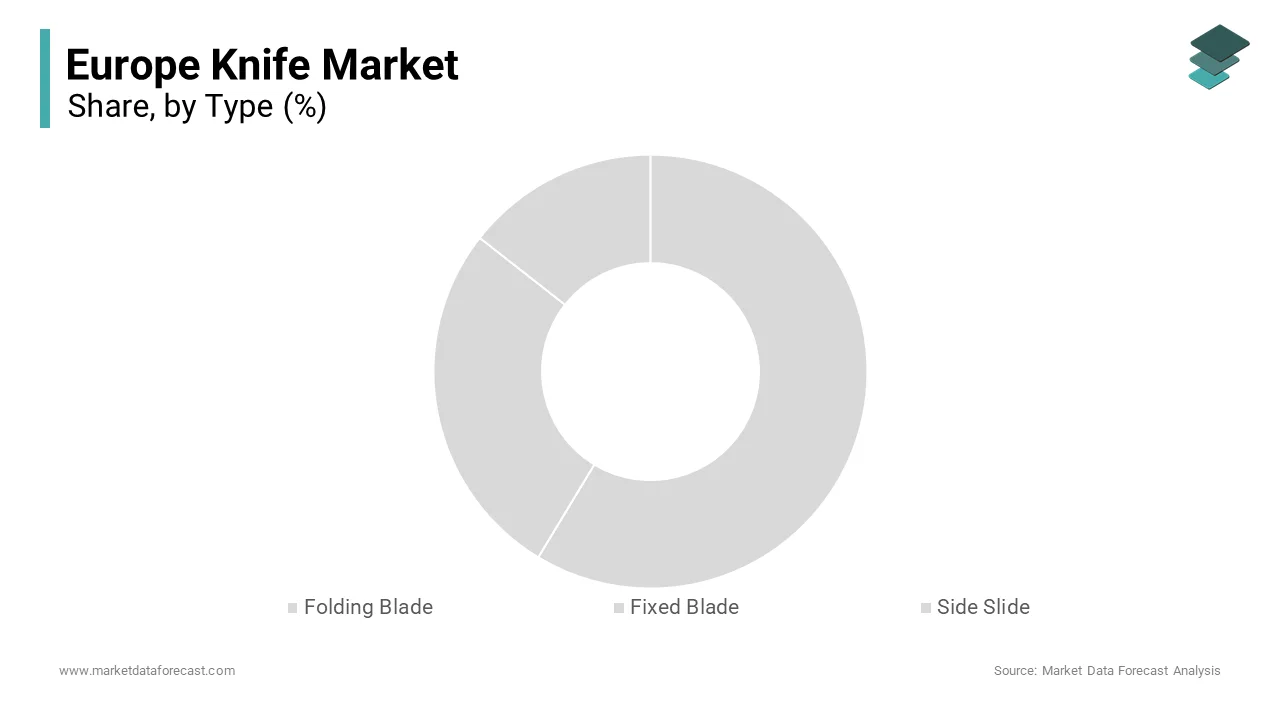
The folding blade knives segment is expected to exhibit a noteworthy CAGR of 6.8% from 2026 to 2034 due to evolving urban lifestyles, legal adaptability, and technological innovation in compact design. The Netherlands and Denmark have seen a rise in legal folding knife ownership, attributed to revised legislation that permits non locking blades under nine centimeters, according to research. Furthermore, manufacturers have integrated ergonomic polymers and one handed opening systems that appeal to younger demographics. The convergence of permissive urban regulations, compact engineering, and generational shifts in personal tool adoption underpins this segment’s accelerated trajectory.
By Material Insights
The steel segment remained the prominent segment in the European knife market and captured substantial share in 2025. The growth of the steel segment is attributed to the its optimal balance of hardness edge retention affordability and manufacturability across both mass produced and artisanal contexts. According to the research, high carbon stainless steel alloys constitute a portion of all blade stock used by EU based cutlers. This prevalence is reinforced by culinary institutions where steel’s compatibility with repeated sharpening and thermal stability during dishwashing is critical. Moreover, heritage manufacturing centers rely on centuries old forging traditions centered exclusively on steel tempering techniques that cannot be replicated with alternative materials. Consumer trust further entrenches steel’s position. These intertwined technical cultural and regulatory factors ensure steel’s continued hegemony in blade composition.
The ceramic knives segment is predicted to witness the highest CAGR of 9.3% during the forecast period owing to health conscious consumers seeking non reactive corrosion free cutting tools that preserve food integrity without metallic transfer. As per studies, ceramic blades demonstrated zero ion leaching during acidic food preparation unlike certain stainless steel grades which released trace nickel under prolonged exposure. This attribute has fueled adoption in Southern Europe where citrus and tomato based cuisines dominate. Apart from these, ceramic’s extreme hardness, ensures edge retention. Ideal for precision slicing, ceramic blades have found their place in kitchens across Europe, where the focus on clean labels and allergen-free food is on the rise, despite the blades' unsuitability for heavy tasks. These functional and dietary advantages position ceramic as the most dynamic material subsegment despite its current modest market footprint.
REGIONAL ANALYSIS
Germany Market Analysis
Germany led the Europe knife market and accounted for 22.2% share in 2025. The dominance of Germany is primarily driven by its globally recognized cutlery heritage industrial scale manufacturing and stringent quality expectations across both domestic and professional sectors. The city of Solingen alone produces a portion of Europe’s premium forged knives and contributes notable amount annually to the national cutlery economy, as per sources. German consumers exhibit strong brand loyalty to domestic makers with a portion of households owning at least one Solingen certified knife, according to sources. The country’s dual emphasis on engineering precision and culinary professionalism ensures consistent demand for full tang steel blades with ergonomic handles. Furthermore Germany’s robust vocational training system sustains a pipeline of skilled grinders and forgers preventing the labor shortages seen elsewhere. This combination of cultural identity manufacturing excellence and consumer sophistication cements Germany’s leadership in the European knife landscape.
France Market Analysis
France is next prominent region in the European knife market and captured 18.1% share in 2025. The growth of France is because of its deep rooted gastronomic identity artisanal craftsmanship and protected regional designations that elevate cutlery to cultural heritage status. The Laguiole knife produced in southern France continues to benefit from its protected regional designation, contributing significantly to the country’s artisanal cutlery industry, according to sources. Professional kitchens across France maintain strict standards for knife quality, which favors precision-balanced carbon steel models as outlined in national culinary equipment guidelines, as per research. Beyond cuisine the French outdoor sector contributes significantly with hunting and field dressing knives seeing a sales increase in rural departments, according to research. Urban consumers also drive demand for elegant folding pocket knives often gifted as ceremonial items during rites of passage. This fusion of culinary tradition rural utility and symbolic gifting ensures France’s sustained prominence in both volume and value segments of the knife market.
United Kingdom Market Analysis
The United Kingdom saw consistent growth in the European knife market, with a complex interplay of restrictive legislation rising home cooking trends and resilient demand for outdoor utility tools despite legal constraints. The UK maintains tight regulations on public knife carrying, yet the market for high-quality kitchen knives has seen continued expansion, backed by a renewed interest in home cooking. A growing number of households across the country now invest in professional-grade chef knives, which reflects changing consumer preferences toward cooking and kitchen equipment, as per research. Simultaneously, the outdoor industry sustains demand for legal folding tools with non locking mechanisms under seventy six millimeters. British brands maintain niche appeal through heritage marketing while imports from Germany and Switzerland fill premium gaps. Thus, the UK market thrives not through permissiveness but through adaptive consumption within tightly regulated boundaries.
Italy Market Analysis
Italy is expanding gradually in the European knife market and is propelled by its artisanal cutlery clusters regional culinary diversity and growing export oriented craftsmanship. The town of Maniago in Friuli Venezia Giulia produces a portion of Italy’s professional kitchen knives and supports specialized workshops, as per research. Italian chefs favor thinner lighter blades suited for delicate tasks like filleting fish or slicing tomatoes a preference reflected in the national standard for kitchen cutlery geometry. Domestic consumption is further amplified by the slow food movement which emphasizes handcrafted tools for authentic preparation. Apart from these, Italy’s ceramic knife segment is the fastest in Europe due to compatibility with acidic Mediterranean ingredients. This blend of regional specialization culinary specificity and material innovation sustains Italy’s distinctive and resilient position in the continental market.
Sweden Market Analysis
Sweden is predicted to grow in the European knife market owing to its integration of functional design outdoor culture and progressive sustainability standards that influence both production and consumption. Swedish regulations permit fixed blade knives under twenty centimeters for outdoor use creating a legally secure environment for manufacturers. Moreover, the country leads in eco conscious blade finishing with water based coatings and FSC certified wooden handles now standard across major brands. This alignment of cultural practice legal clarity and environmental responsibility positions Sweden as a uniquely influential Nordic hub in the broader European knife ecosystem.
COMPETITIVE LANDSCAPE
KEY MARKET PLAYERS
Some of the notable key players in the Europe knife market are
- Klein Tools
- U.S. Blade
- Hyde Tools
- Olfa
- Apex Tool Group
- Milwaukee Tool
- Q.E.P. Co Inc
- Gerber Life Insurance Company
- Stanley Black & Decker
TOP STRATEGIES USED BY THE KEY MARKET PLAYERS
Key players in the Europe knife market employ a range of strategic initiatives to sustain competitiveness and drive growth. Product innovation remains central with companies investing in advanced metallurgy ergonomic design and sustainable materials to meet evolving consumer expectations. Geographic expansion through localized e commerce platforms enables direct engagement with niche audiences across diverse EU nations. Strategic collaborations with culinary institutions outdoor organizations and sustainability certifiers enhance brand credibility and market relevance. Digital transformation including virtual try on features and AI driven customer support improves user experience and conversion rates. Apart from these, compliance with stringent EU regulations on materials safety and environmental impact is leveraged as a competitive differentiator. These multifaceted strategies collectively reinforce brand equity operational resilience and long term market positioning across Europe’s fragmented yet high value knife landscape.
COMPETITION OVERVIEW
The Europe knife market exhibits intense competition characterized by a blend of heritage craftsmanship and modern industrial capabilities. It features a dual structure where globally recognized brands coexist with regional artisans each vying for consumer loyalty through distinct value propositions. Premium manufacturers emphasize material science ergonomic innovation and sustainability certifications to justify higher price points while smaller workshops compete on authenticity traceability and cultural storytelling. Regulatory complexity across EU member states creates both barriers and opportunities as compliant players gain trust and non compliant imports face scrutiny. Digital channels have intensified rivalry by enabling direct consumer access and real time feedback loops that accelerate product iteration. Simultaneously, rising counterfeit activity pressures legitimate brands to invest in anti fraud measures and consumer education. Despite fragmentation, the market rewards those who harmonize tradition with technology regulatory adherence and emotional resonance resulting in a dynamic and highly differentiated competitive environment across Western Central and Northern Europe.
TOP PLAYERS IN THE MARKET
- Wüsthof is a German manufacturer renowned for its precision forged kitchen knives produced in Solingen for over two centuries. The company maintains a strong global footprint by exporting to more than one hundred countries while adhering to European quality and environmental standards. In recent years Wüsthof has invested in sustainable production methods including energy efficient forging and recyclable packaging to align with EU green initiatives. The brand also expanded its digital engagement through virtual knife sharpening workshops and augmented reality product previews targeting younger European consumers. These initiatives reinforce its reputation for craftsmanship while modernizing its market approach without compromising heritage values.
- Victorinox is a Swiss company globally recognized for its Swiss Army Knives and professional kitchen cutlery. Beyond its iconic multi tools the company has significantly strengthened its presence in European culinary and outdoor segments through innovation and sustainability. The company also partnered with European culinary schools to integrate its knives into training curricula fostering brand loyalty among emerging chefs. These actions demonstrate its commitment to functional design environmental responsibility and strategic education based marketing in the European market.
- Opinel is a French heritage brand celebrated for its simple yet effective folding pocket knives featuring the Virobloc safety ring. The company has preserved traditional manufacturing in Savoie while expanding its relevance through contemporary design and material innovation. It also collaborated with European outdoor festivals and national parks to promote responsible knife use in nature. Digital outreach increased through localized social media campaigns in Germany Italy and Spain targeting urban outdoor enthusiasts. Opinel's strategic combination of traditional craftsmanship, eco-conscious production, and experiential marketing has not only reinforced its standing but also broadened its appeal throughout European markets, all without sacrificing its iconic character.
MARKET SEGMENTATION
This research report on the Europe knife market has been segmented and sub-segmented based on categories.
By Type
- Folding Blade
- Fixed Blade
- Side Slide
By Material
- Steel
- Titanium
- Ceramic
- Others
By Size
- 3–6 Inches
- 6–9 Inches
- 9–12 Inches
By Application
- Kitchen
- Outdoor/Survival/Hunting
- Tactical/Military
- Others
By Distribution Channel
- Supermarkets & Hypermarkets
- Specialty Stores
- Department Stores
- Online/E-commerce
- Others
By Country
- UK
- France
- Spain
- Germany
- Italy
- Russia
- Sweden
- Denmark
- Switzerland
- Netherlands
- Turkey
- Czech Republic
- Rest of Europe