- Product Description Description
- Table of Contents TOC
- List of Table & Figure LOT
- Get Free Sample PDF Sample PDF
Market Size, 2025
$24.91 BnMarket Estimate, 2026
$26.89 BnMarket Forecast, 2034
$46.92 BnCAGR, 2026–2034
7.92%Europe Language Learning Market Size, Growth, Trends & Forecast (2026–2034)
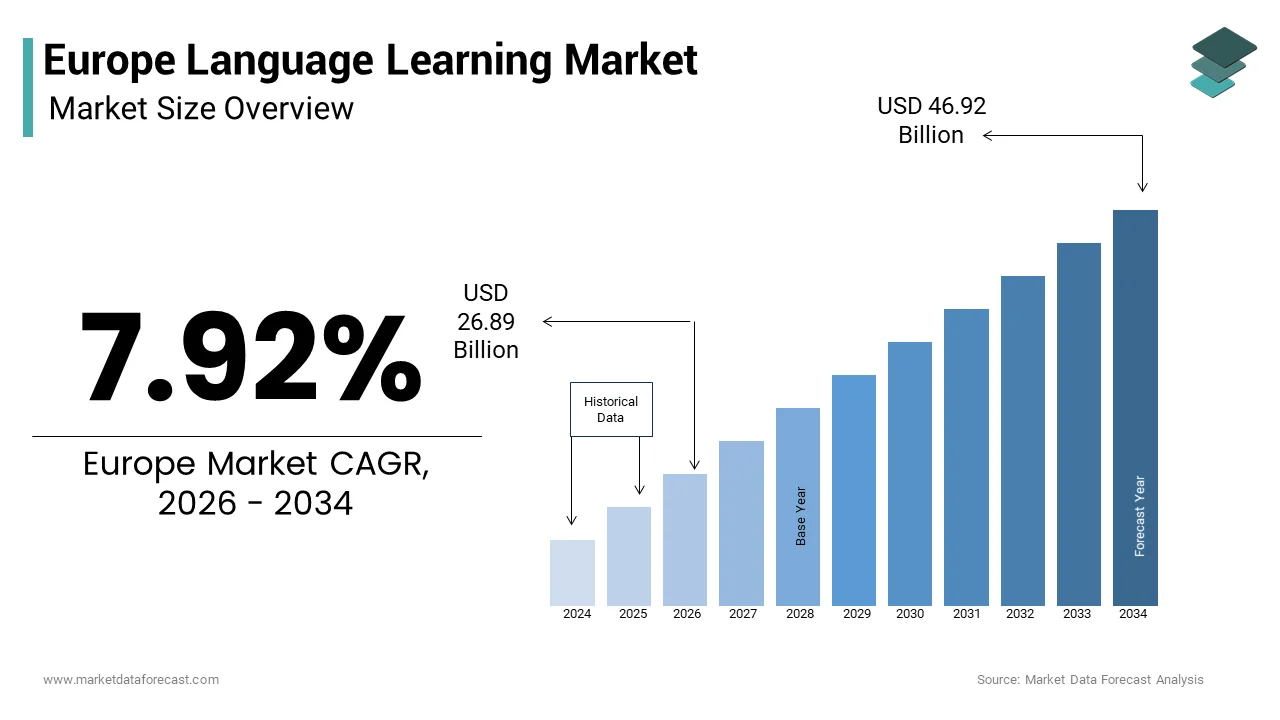
The Europe language learning market size was valued at USD 24.91 billion in 2025, is anticipated to reach USD 26.89 billion in 2026, and is projected to scale up to USD 46.92 billion by 2034, registering a compound annual growth rate (CAGR) of 7.92% during the forecast period from 2026 to 2034. Driven by mandatory multilingual education policies, increasing labor mobility, and the rapid integration of artificial intelligence into digital and hybrid learning platforms, the European language learning sector continues to expand robustly.
Key Executive Metrics (At-a-Glance)
- 2025 Base Valuation: USD 24.91 Billion
- 2026 Current Valuation: USD 26.89 Billion
- 2034 Forecast Valuation: USD 46.92 Billion
- Compound Annual Growth Rate (CAGR): 7.92% (2026–2034)
- Dominant Language Segment: English (dominant share in 2025 as the global lingua franca)
- Fastest-Growing Language Segment: Mandarin (projected at 13.3% CAGR)
- Dominant Learning Mode Segment: Digital Learning Mode (significant share in 2025)
- Fastest-Growing Learning Mode Segment: Hybrid Learning Mode (projected at 15.5% CAGR)
- Dominant End-User Segment: Institutional Language Learning (major share in 2025)
- Fastest-Growing End-User Segment: Self-Study Language Learning (projected at 14.4% CAGR)
- Dominant Country Markets: United Kingdom and Germany
Core Market Drivers
- Mandatory Multilingual Policies: Statutory requirements across European schools mandating foreign language education from primary levels onward.
- Labor Mobility: High cross-border workforce migration and remote working trends driving professional language demands.
- AI & Tech Integration: Emergence of adaptive learning algorithms, real-time feedback, and virtual tutors enhancing accessibility.
Primary Market Restraints & Challenges
- High Costs: Substantial financial barriers associated with premium private instruction and internationally certified proficiency examinations.
- Instructor Shortages: Persistent deficits of qualified language educators, especially for less commonly taught languages.
- High Dropout Rates: Maintaining learner motivation and engagement in long-term self-directed and digital learning formats.
Europe Language Learning Market Segmentation Highlights
| Segment Category | Largest Market Segment | Fastest-Growing Market Segment |
|---|---|---|
| By Language | English Language (Dominant Share) | Mandarin Language (13.3% CAGR) |
| By Learning Mode | Digital Learning Mode (Dominant Share) | Hybrid Learning Mode (15.5% CAGR) |
| By End-User | Institutional Language Learning | Self-Study Language Learning (14.4% CAGR) |
| By Country | United Kingdom (Top Market Share) | Germany, France, and Spain |
Major Industry Players Profiled
Key enterprises dominating the European language learning market include Babbel, Busuu, Duolingo, Berlitz Corporation, EF Education First Ltd, Rosetta Stone LTD., Memrise, Speexx, Sanako Corporation, and Class Central.
Europe Language Learning Market Size
The Europe language learning market size was valued at USD 24.91 billion in 2025 and is anticipated to reach USD 26.89 billion in 2026 to reach USD 46.92 billion by 2034, growing at a CAGR of 7.92% during the forecast period from 2026 to 2034.
Language learning encompasses a diverse ecosystem of educational services, digital platforms, and institutional programs designed to facilitate the acquisition of non-native languages across the continent. This sector extends beyond traditional classroom instruction to include mobile applications, virtual tutoring, corporate training solutions, and standardized testing services. The operational landscape is uniquely shaped by the European Union's multilingual policy framework and the high mobility of its workforce. According to Eurostat, the working-age population in the European Union is widely recognized for reporting knowledge of at least one foreign language, which is indicating a cultural and economic imperative for linguistic competence. As per data from the European Commission, upper secondary students in the EU are noted for learning multiple foreign languages, which is establishing a strong foundation for lifelong language education. The Erasmus+ program continues to be a pivotal driver, with students annually engaging in cross-border exchanges that necessitate rapid language adaptation. As per the Organisation for Economic Co-operation and Development, labor mobility within Europe is acknowledged as being higher compared to other global regions, creating sustained demand for professional language proficiency. This environment fosters a market where technology serves as a critical enabler for personalized learning paths, while regulatory support ensures widespread access to language education as a fundamental skill for social integration and economic participation.
MARKET DRIVERS
Mandatory Multilingual Education Policies Across European Nations
The stringent legislative framework across European nations that mandates foreign language education from an early age is propelling the growth of the Europe language learning market. As per the European Commission, European countries are recognized for requiring students to learn at least one foreign language starting in primary school, with many introducing a second language by lower secondary education. This statutory requirement creates a guaranteed and massive user base for language learning materials, digital tools, and assessment services throughout the compulsory education years. The emphasis on the "mother tongue plus two" strategy ensures that language learning is not an optional extracurricular activity but a core component of the national curriculum. Consequently, governments allocate substantial budgets to procure textbooks, software licenses, and teacher training programs, driving consistent revenue streams for educational providers. The standardization of proficiency levels through the Common European Framework of Reference for Languages further institutionalizes the need for structured learning pathways and certified examinations. This policy-driven demand extends beyond schools into higher education, where language credits are often prerequisites for graduation. The enduring political commitment to multilingualism as a pillar of European identity ensures that the market remains resilient and continuously funded, regardless of broader economic fluctuations.
Increasing Labor Mobility and Cross-Border Employment Opportunities
The growing labor mobility within the European Union and the associated need for professional language skills to secure employment in different member states is further aiding the Europe language learning market growth. According to Eurostat, citizens residing in an EU country other than their own are acknowledged as a growing demographic, which is reflecting the prevalence of remote work and cross-border commuting. Professionals seeking career advancement in multinational corporations or international organizations often require proficiency in English, French, or German, in addition to their native tongues. These economic imperative drives adults to invest in specialized language courses focused on business communication, technical vocabulary, and industry-specific terminology. The rise of the gig economy and digital nomadism further amplifies this trend, as individuals move frequently between European hubs like Berlin, Paris, and Amsterdam, which is requiring rapid language acquisition for daily life and work integration. Companies operating across borders also sponsor language training for their employees to facilitate smoother collaboration and cultural understanding within diverse teams. The direct correlation between language proficiency and employability or salary potential motivates continuous investment in adult language learning solutions. This dynamic labor market ensures a steady flow of motivated learners seeking efficient and flexible ways to master new languages for professional gain.
MARKET RESTRAINTS
High Cost of Premium Language Instruction and Certification
The substantial financial burden associated with high-quality language instruction and internationally recognized certification acts as a significant restraint on market growth, particularly for low-income demographics and small enterprises. As per data from the British Council, the cost of preparing for and taking major proficiency exams such as IELTS or TOEFL is acknowledged as being high, which is creating barriers for many students and job seekers in Southern and Eastern European regions. Similarly, private language schools and intensive immersion programs often charge premium fees that place them out of reach for average consumers, which is limiting access to effective learning environments. Small and medium-sized enterprises, which form the backbone of the European economy, frequently struggle to justify the expense of comprehensive corporate language training programs for their entire workforce, leading to reduced adoption rates. The lack of standardized pricing and the prevalence of hidden costs for materials and assessment further deter potential learners. While free or low-cost digital alternatives exist, they often lack the personalized feedback and accreditation necessary for professional advancement. This economic barrier creates a disparity in language proficiency levels across the continent, restricting the total addressable market for premium services and slowing the overall pace of skill acquisition among disadvantaged groups.
Shortage of Qualified Language Instructors and Educators
The persistent shortage of qualified and experienced language teachers, particularly for less commonly taught languages and specialized business contexts is further impeding the expansion of the Europe language learning market. According to the European Centre for Modern Languages, member states are reported to face difficulties in recruiting and retaining skilled language educators, exacerbated by an aging workforce and insufficient training pipelines. This scarcity leads to oversized class sizes, reduced instructional quality, and limited availability of courses in high-demand languages such as Mandarin or Arabic. The gap is even more pronounced in rural areas and smaller towns where attracting qualified staff is challenging due to lower salaries and fewer professional development opportunities. The reliance on non-native speakers or underqualified instructors can compromise the effectiveness of learning programs, which is leading to learner frustration and high dropout rates. Furthermore, the rapid shift toward digital and hybrid learning models requires teachers to possess advanced technological competencies, a skill set that many traditional educators lack. The inability to scale the teaching workforce to meet rising demand constrains the capacity of institutions to accept new students and limits the geographic reach of quality language education. This human resource bottleneck remains a formidable challenge for sustainable market growth.
MARKET OPPORTUNITIES
Integration of Artificial Intelligence for Personalized Learning Paths
The emergence of sophisticated artificial intelligence and adaptive learning technologies offers a promising opportunity for the Europe language learning market to deliver highly personalized and efficient educational experiences. As per research from the European Association for Computer-Assisted Language Learning, AI-driven platforms are recognized for their ability to analyse learner performance in real time to tailor content difficulty, pacing, and feedback mechanisms. This capability allows for the creation of dynamic curricula that adapt to unique learning styles, strengths, and weaknesses. Natural language processing enables instant pronunciation correction and conversational practice with virtual tutors, providing learners with immersive speaking opportunities that mimic human interaction. The ability to generate customized exercises based on a learner's professional field or personal interests enhances engagement and relevance. Furthermore, predictive analytics can identify potential drop-out risks and intervene proactively with supportive resources. By leveraging AI, providers can scale high-quality instruction to millions of users simultaneously, overcoming the limitations of teacher shortages. This technological evolution opens new revenue streams through premium subscription models and enterprise licensing, which is positioning AI-enhanced platforms as the future standard for language education in Europe.
Expansion of Corporate Language Training for Global Competitiveness
The growing recognition of language proficiency as a strategic asset for global competitiveness offers a lucrative avenue for the expansion of corporate language training services across Europe. As per findings from the Confederation of European Business, European companies are increasingly noted for expanding their operations into emerging markets and diversifying their supply chains, creating a need for employees who can communicate effectively in multiple languages. Organizations are investing in tailored language programs that focus on industry-specific terminology, cross-cultural negotiation skills, and virtual collaboration techniques. The shift toward remote and hybrid work models has further accelerated demand for flexible, on-demand language learning solutions that fit into busy professional schedules. Providers who can offer measurable outcomes, such as improved sales performance in foreign markets or enhanced team cohesion, will find strong uptake among forward-thinking enterprises. The integration of language training with leadership development programs creates additional value, positioning linguistic skills as essential for career progression. The potential to partner with human resources departments to embed language learning into talent management strategies represents a significant growth frontier. As European businesses strive to maintain their edge in a globalized economy, the demand for specialized corporate language solutions is poised to surge.
MARKET CHALLENGES
Fragmentation of Languages and Dialects Across the Continent
The profound linguistic diversity and fragmentation across Europe pose a persistent challenge for the Europe language learning market. As per Eurostat, the European Union is recognized for having twenty-four official languages along with numerous regional and minority languages, each with distinct grammatical structures, vocabularies, and cultural nuances. Creating high-quality content and assessment tools for such a wide array of languages requires substantial investment in localization, expert linguists, and cultural consultants, making it difficult to achieve economies of scale. The variation in learning preferences and educational traditions between countries further complicates the deployment of uniform teaching methodologies. Additionally, the scarcity of digital resources and native speaker data for less commonly taught languages hinders the development of effective AI-driven tools for these markets. This fragmentation forces providers to make strategic choices about which languages to support, often neglecting niche but important languages. The complexity of managing multiple language pairs and ensuring consistent quality across all offerings increases operational costs and slows time to market, limiting the ability to serve the full spectrum of European linguistic needs effectively.
Maintaining Learner Motivation and Reducing High Dropout Rates
Sustaining learner engagement and minimizing high dropout rates remain critical challenges for the Europe language learning market, particularly in self-directed and digital learning environments. As per studies published by the University of Cambridge, online language courses are reported to have low completion rates, with many learners losing motivation due to a lack of immediate progress, isolation, or insufficient feedback. Language acquisition is a long-term endeavour that requires consistent practice and discipline, qualities that are difficult to maintain without the structure of a physical classroom or the accountability of a live instructor. The absence of social interaction and peer support in purely app-based models can lead to feelings of disconnection and reduced commitment. Furthermore, the "plateau effect," where learners feel stuck at an intermediate level despite continued effort, often results in frustration and abandonment of studies. Providers struggle to design gamification elements and reward systems that effectively mimic the intrinsic rewards of human interaction and real-world communication. The challenge is compounded by the diverse motivations of learners, ranging from casual interest to urgent professional necessity, requiring highly differentiated engagement strategies. Overcoming these psychological and behavioral barriers is essential for improving the efficacy and commercial viability of language learning solutions.
REPORT COVERAGE
| REPORT METRIC | DETAILS |
| Market Size Available | 2025 to 2034 |
| Base Year | 2025 |
| Forecast Period | 2026 to 2034 |
| CAGR | 7.92% |
| Segments Covered | By Language, Learning Mode, End-user, and Region |
| Various Analyses Covered | Global, Regional, & Country Level Analysis; Segment-Level Analysis; DROC, PESTLE Analysis; Porter’s Five Forces Analysis; Competitive Landscape; Analyst Overview of Investment Opportunities |
| Regions Covered | UK, France, Spain, Germany, Italy, Russia, Sweden, Denmark, Switzerland, Netherlands, Turkey, and the Czech Republic |
| Market Leaders Profiled | Babbel, Busuu, Class Central, Berlitz Corporation, Duolingo, EF Education First Ltd, Innovative Language, Intap Labs Pvt. Ltd., LanQua, Learn a Language, Loecsen, Memrise, Rosetta Stone LTD., Sanako Corporation, Speexx |
SEGMENTAL ANALYSIS
By Language Insights
The English language segment dominated the market by commanding for the leading share of the Europe language learning market in 2025. The dominance of English segment in the European market is driven by its status as the global lingua franca for business, science, and international diplomacy. The legislative mandate across virtually all European nations that requires English as the first foreign language in school curricula from an early age is further contributing to the expansion of the English segment in the European market. According to Eurostat, English is recognized as the most widely taught foreign language among upper secondary students in the European Union, making it the dominant choice across the region. This statutory requirement creates a massive, consistent demand for textbooks, digital resources, teacher training, and assessment tools throughout the compulsory education years. Governments allocate substantial portions of their education budgets specifically to English language acquisition programs to ensure their workforce remains competitive globally. The standardization of proficiency levels through the Common European Framework of Reference for Languages further institutionalizes the need for structured English learning pathways and certified examinations like Cambridge or IELTS. This policy-driven demand extends beyond schools into higher education, where English proficiency is often a prerequisite for graduation and access to international research. The enduring political commitment to English as a core skill ensures that this segment remains the undisputed leader in market volume and revenue generation across the region.
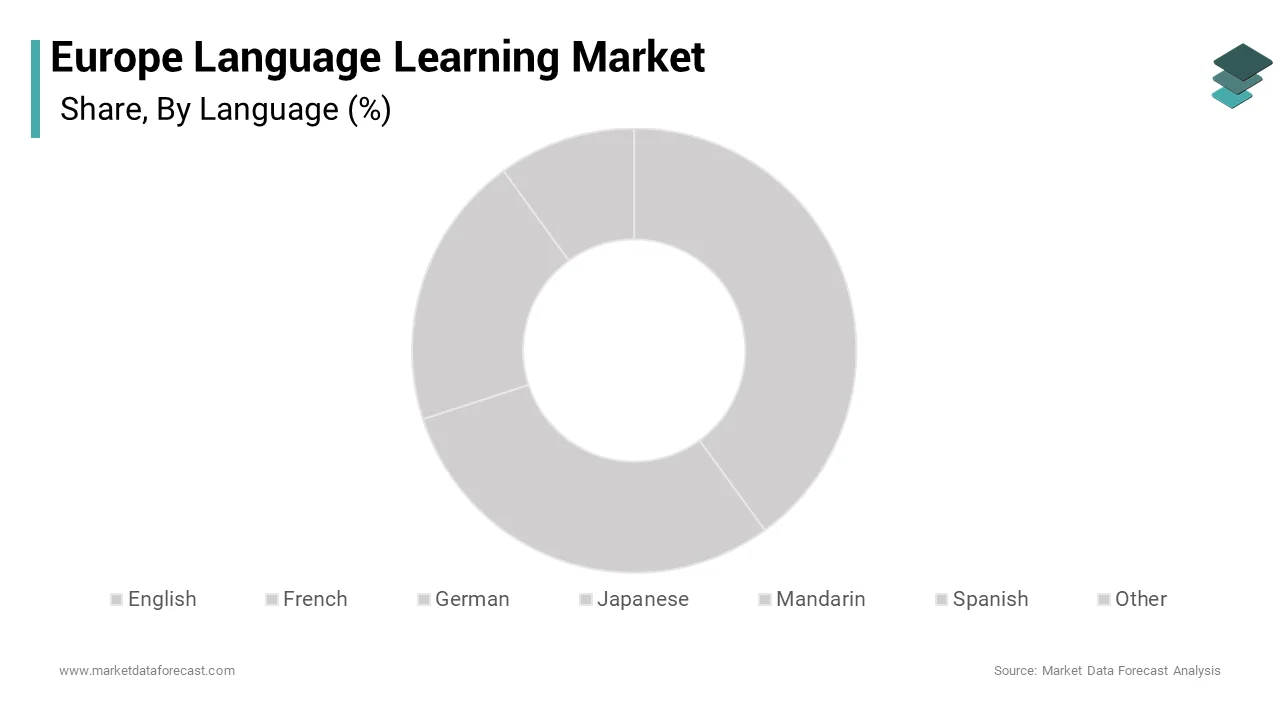
The mandarin language segment is anticipated to register a CAGR of 13.3% over the forecast period in the European market owing to the shifting geopolitical landscape and the growing economic interdependence between Europe and China. The surge in demand for Mandarin learning is primarily driven by the intensifying trade relationships and economic partnerships between European nations and China. According to Eurostat, China is consistently recognized as one of the top trading partners for the European Union, creating an urgent need for professionals who can navigate Chinese business culture and language. European companies expanding their supply chains, manufacturing bases, or sales networks into China require employees with functional Mandarin skills to negotiate contracts, manage logistics, and build local relationships effectively. The Belt and Road Initiative has further connected European infrastructure projects with Asian markets, increasing the demand for linguistic bridges in engineering, finance, and logistics sectors. Universities and business schools are responding by introducing Mandarin modules and exchange programs to prepare students for these emerging opportunities. The perception of Mandarin as a strategic asset for future economic growth drives both individual learners and corporate entities to invest heavily in language acquisition. This economic alignment ensures that the Mandarin segment will outpace traditional European languages in growth rate as commercial ties deepen.
By Learning Mode Insights
The digital learning mode segment accounted for the significant share of the Europe language learning market in 2025. The leading position of digital learning segment in the European market is attributed to the widespread adoption of smartphones, high internet penetration, and the convenience of accessing educational content anytime and anywhere. According to GSMA Intelligence, mobile connectivity in Europe is recognized as being among the highest globally, with the majority of users accessing the internet via handheld devices multiple times daily. This ubiquity allows language learning providers to deliver micro-learning sessions, interactive exercises, and gamified content directly to users during commutes, breaks, or leisure time, fitting education seamlessly into busy lifestyles. The development of sophisticated mobile applications offering speech recognition, instant feedback, and adaptive algorithms has significantly enhanced the effectiveness of self-directed digital learning. Users appreciate the ability to learn at their own pace without the constraints of fixed class schedules or physical locations. The low barrier to entry for downloading free or freemium apps further accelerates user acquisition, creating a vast base of active learners. The continuous improvement in mobile network speeds through fifth generation rollout supports rich media content like video lessons and live tutoring sessions on mobile platforms. This accessibility and flexibility ensure that digital modes remain the preferred choice for the majority of language learners across the continent.
The hybrid learning mode segment is anticipated to witness the fastest CAGR of 15.5% over the forecast period owing to the desire to combine the flexibility of online study with the social benefits and accountability of face-to-face interaction. The increasing adoption of blended learning models in schools and universities across Europe that seek to optimize educational outcomes by merging digital tools with traditional teaching is further contributing to the expansion of hybrid learning segment in the European market. According to the European Commission, educational institutions are increasingly recognized for adopting hybrid curricula to address diverse learner needs. Teachers utilize online platforms for vocabulary drills, grammar exercises, and asynchronous content consumption, reserving valuable classroom time for interactive speaking practice, group discussions, and cultural immersion activities. This model maximizes the efficiency of instruction while maintaining the human element crucial for language acquisition. The post-pandemic era has accelerated this transition, with educators and students alike appreciating the flexibility to switch between modes based on circumstances and learning objectives. Institutions are investing heavily in learning management systems and digital classrooms to support this integrated approach. The proven efficacy of blended learning in improving proficiency levels and student engagement drives its widespread implementation, making hybrid the fastest growing mode as formal education sectors lead the transformation.
By End User Insights
The institutional language learning segment occupied the major share of the Europe language learning market in 2025. The growth of the institutional language learning segment in the European market is attributed to the mandatory nature of language education in schools, universities, and government-funded programs across Europe. This segment serves as the backbone of language acquisition on the continent. The comprehensive legislative frameworks across European nations that mandate foreign language education as a core component of the national curriculum is also supporting the expansion of the institutional language learning segment in the European market. According to the Eurydice network, European countries are recognized for requiring students to learn at least one foreign language starting in primary school, with many introducing a second language by secondary education. This statutory obligation ensures a massive, captive audience for institutional language learning services, supported by substantial public funding allocated to schools and universities. Governments procure vast quantities of textbooks, digital licenses, and assessment tools, which is creating a stable and lucrative market for educational publishers and service providers. The emphasis on multilingualism as a key pillar of European identity further reinforces this commitment, with initiatives like Erasmus+ providing additional financial support for language mobility and exchange programs. The scale of public education systems, encompassing millions of students annually, dwarfs the volume of private or self-study learners. The centralized procurement processes and long-term contracts typical of the public sector provide predictable revenue streams for vendors. This deep integration of language learning into the fabric of public education ensures that the institutional segment remains the dominant force in the market.
The self-study language learning segment is projected to grow at the fastest CAGR of 14.4% over the forecast period in the European market due to the proliferation of user-friendly mobile applications, the gig economy, and the desire for lifelong learning among adults. The explosive growth of the self-study segment is also likely to be fuelled by the advent of highly engaging, gamified mobile applications that make language learning accessible, fun, and effective for independent learners. As per Sensor Tower data, language learning apps in Europe are reported to have surged in downloads, with millions of users engaging daily with platforms that utilize streaks, points, and leaderboards to maintain motivation. These applications leverage artificial intelligence to provide personalized feedback, adaptive difficulty levels, and speech recognition capabilities that mimic human interaction, reducing the need for formal instruction. The convenience of learning in short bursts during commutes or downtime appeals to busy professionals and students who cannot commit to rigid class schedules. The low cost or freemium models of these apps lower the barrier to entry, attracting a vast demographic of casual learners who might not otherwise engage in language study. The continuous innovation in app features, such as augmented reality scenarios and conversational bots, keeps users engaged and drives retention. This technological democratization of language education empowers individuals to take control of their learning journey, driving the rapid expansion of the self-study segment.
COUNTRY ANALYSIS
United Kingdom Language Learning Market Analysis
The United Kingdom led the market in 2025 with the leading market share. The dominance of the UK in the European market is attributed to its robust edtech sector, high demand for English language teaching, and strong emphasis on modern foreign languages in education. The mature ecosystem of innovative startups, and established publishers are driving digital transformation in language education in the UK, which is further propelling the UK market expansion. According to Statista, the UK is recognized as a major contributor to European language learning market revenue, reflecting its position as a hub for educational technology innovation. London serves as a global center for edtech investment, attracting venture capital for language learning apps and platforms that serve both domestic and international audiences. The departure from the European Union has sparked renewed interest in learning diverse languages to maintain global trade links, boosting demand for non-European languages like Mandarin and Arabic. The British Council plays a pivotal role in promoting English language teaching worldwide, generating significant export revenue, and fostering cultural exchange. The high level of digital literacy among the population facilitates the rapid adoption of online and hybrid learning models. The combination of technological prowess, strong institutional frameworks, and a strategic focus on global connectivity ensures the UK remains a dominant force in the regional language learning landscape.
Germany Language Learning Market Analysis
Germany accounted for a prominent share of the Europe language learning market in 2025. The growth of Germany in the European market can be credited to its strong industrial base, high demand for business language skills, and rigorous vocational training systems that integrate language learning. The nation benefits from a large population of migrants and expatriates, requiring German language instruction for integration and employment. As per reports from the Federal Ministry of Education and Research, integration courses for newcomers are acknowledged as a significant portion of the language learning market, driven by legal requirements for residency and citizenship. German corporations, being highly export-oriented, heavily invest in language training for employees to facilitate international business operations, particularly in English, French, and Chinese. The dual education system emphasizes practical language skills alongside technical training, creating a steady demand for specialized vocational language courses. The market sees strong adoption of digital learning tools in corporate settings, with companies leveraging hybrid models to upskill their workforce efficiently. The presence of major publishing houses and educational institutions ensures high-quality content production and distribution. The convergence of migration policies, industrial globalization, and educational excellence sustains Germany's status as a critical, and dynamic pillar of the European language learning market.
France Language Learning Market Analysis
France is anticipated to account for a promising share of the Europe language learning market during the forecast period owing to its strict protection of the French language, extensive network of Alliance Francaise centers globally, and strong government support for multilingual education. The national policies that promote French as a global language, while encouraging citizens to learn other European and world languages is likely to boost the French market growth. According to data from the Ministry of National Education, language learning in schools is recognized as mandatory, with a focus on English, Spanish, and German, creating a large baseline demand for educational resources. The Institut Francais and Alliance Francaise network drive significant revenue through foreign student enrollments, and certification exams, positioning France as a leading exporter of language education services. The rise of digital platforms tailored to French learners, and those wishing to learn French, has expanded the market reach beyond traditional classrooms. Corporate demand for language training is strong in sectors like luxury goods, aerospace, and tourism, where multilingual staff are essential. The cultural emphasis on linguistic heritage, combined with modern pedagogical innovations, ensures France remains a top-tier market where tradition and technology coexist to drive growth.
Spain Language Learning Market Analysis
Spain is anticipated to command for a significant portion of the regional market during the forecast period. Spain is renowned for its popularity as a destination for language immersion, its growing digital adoption, and the global appeal of the Spanish language. The country's market status is defined by a thriving sector of language schools catering to international students seeking to learn Spanish in a native environment. As per data from the Spanish Federation of Associations of Schools of Spanish as a Foreign Language, Spain is recognized for attracting large numbers of students annually for intensive language courses, contributing substantially to the economy, and driving demand for accommodation and cultural activities. Domestically, there is increasing demand for English and other foreign languages to boost employability in the tourism and service sectors. The Spanish government has launched initiatives to improve foreign language proficiency among its youth, to enhance competitiveness in the European labor market. The proliferation of mobile learning apps, and online tutoring platforms, is gaining traction among the younger demographic, who prefer flexible and interactive learning methods. The combination of inbound educational tourism, and domestic upskilling efforts, positions Spain as a vibrant and growing market in the European language learning landscape.
Italy Language Learning Market Analysis
Italy is expected to hold a notable share of the Europe language learning market during the forecast period due to its rich cultural heritage, strong tourism industry, and increasing focus on integrating language learning into its educational and professional sectors. The Italian market status is defined by a high demand for Italian language courses among international enthusiasts, and a growing need for foreign language skills among locals to support the export and tourism industries. According to ISTAT, foreign student enrolment in Italian language and culture courses is acknowledged as steadily rising, driven by the global fascination with Italian art, cuisine, and lifestyle. Domestic demand for English and other languages is increasing, as Italian companies seek to expand their global footprint, and attract international tourists. The government has introduced reforms to strengthen foreign language teaching in schools, recognizing its importance for economic recovery, and youth employment. The adoption of digital learning tools is accelerating, particularly in urban centers like Milan and Rome, where businesses and professionals seek flexible training solutions. The blend of cultural attraction, and economic necessity, creates a unique market dynamic where heritage and modernity drive language learning growth, securing Italy a leading position in the southern European region.
COMPETITIVE LANDSCAPE
The competition within the Europe language learning market is intense and characterized by a dynamic rivalry between established traditional institutions, agile digital startups, and global technology giants. Large corporations leverage their brand reputation and extensive physical networks to offer premium immersive experiences while digital natives compete on affordability, accessibility, and innovative gamified features. The market sees constant product differentiation as companies race to incorporate advanced speech recognition and artificial intelligence tutors to mimic human interaction. Differentiation increasingly depends on the quality of pedagogical content, the breadth of language offerings, and the ability to provide certified outcomes recognized by employers. Price competition is fierce in the consumer segment where freemium models dominate, forcing providers to find value in premium subscriptions and corporate contracts. The fragmentation of languages and cultural preferences across Europe requires localized strategies that challenge global standardization efforts. Talent acquisition for skilled linguists and technologists is another critical battleground. This diverse landscape forces continuous innovation in delivery methods and content quality to capture and retain the attention of motivated learners.
KEY MARKET PLAYERS
A dominant players are in the Europe language learnings market are
- Babbel
- Busuu
- Class Central
- Berlitz Corporation
- Duolingo
- EF Education First Ltd
- Innovative Language
- Intap Labs Pvt. Ltd.
- LanQua
- Learn a Language
- Loecsen
- Memrise
- Rosetta Stone LTD.
- Sanako Corporation
- Speexx
- The Open University
Top Players In The Market
- Duolingo Inc stands as a transformative force in the Europe language learning market by democratizing education through its gamified mobile application accessible to millions. The company contributes significantly to the global market by pioneering adaptive learning algorithms that personalize lessons for diverse linguistic backgrounds. Duolingo recently strengthened its European position by launching specialized courses for regional languages and integrating advanced artificial intelligence for conversational practice. The firm focuses on making language learning free and engaging, thereby removing financial barriers for students across the continent. Strategic partnerships with educational institutions have expanded its reach into formal schooling systems. Duolingo continuously updates its content to reflect cultural nuances and current events, ensuring relevance for European learners. These initiatives solidify its reputation as the leading platform for casual and serious learners seeking flexible and effective language acquisition tools.
- Babbel SE operates as a premier provider of subscription-based language learning solutions with a distinct focus on practical conversation skills for European adults. The company drives global innovation by designing curricula specifically tailored to the native languages of its users, enhancing comprehension and retention rates. Babbel has recently intensified its expansion in Europe by introducing live online classes and business language packages to cater to professional development needs. The corporation leverages speech recognition technology to provide instant feedback on pronunciation, mimicking real-world interactions. Their commitment to pedagogical excellence involves collaboration with linguists and educators to ensure high-quality content delivery. Babbel actively promotes lifelong learning through flexible scheduling that fits busy lifestyles. By addressing the specific linguistic challenges faced by European speakers, Babbel reinforces its status as a trusted partner for individuals and corporations aiming to achieve fluency efficiently.
- Berlitz Corporation maintains a formidable presence in the Europe language learning market through its extensive network of physical centers and comprehensive digital offerings. The group plays a vital role in the global market by setting standards for immersive language training and cross-cultural communication services. Berlitz recently enhanced its European footprint by integrating hybrid learning models that combine face-to-face instruction with virtual classrooms. The company focuses heavily on corporate training solutions, helping multinational teams bridge language gaps and improve collaboration. Recent actions include launching customized programs for specific industries such as healthcare and aviation. Berlitz emphasizes cultural competence alongside linguistic proficiency, preparing learners for global business environments. Their long-standing reputation for quality and personalized attention attracts high-profile clients and government entities. These strategic adaptations ensure Berlitz remains a cornerstone of professional language education in Europe.
Top Strategies Used By Key Market Participants
Key players in the Europe language learning market primarily focus on integrating artificial intelligence and machine learning to deliver hyper-personalized learning experiences that adapt to individual user progress. Companies are aggressively expanding their portfolios to include hybrid models that blend digital self-study with live instructor-led sessions for balanced skill development. Another major strategy involves developing specialized corporate training programs tailored to specific industries and professional roles to capture the B2B segment. Providers are forming strategic partnerships with schools and universities to embed their platforms into formal curricula and gain institutional credibility. Firms are also investing heavily in gamification features to boost user engagement and reduce dropout rates among casual learners. There is a significant push toward creating content for less commonly taught languages to serve niche markets and diverse migrant populations. Finally, companies are prioritizing mobile-first designs to ensure accessibility and convenience for users learning on the go.
MARKET SEGMENTATION
This research report on the Europe language learning market is segmented and sub-segmented into the following categories.
By Language
- English
- French
- German
- Japanese
- Mandarin
- Spanish
- Other
By Learning Mode
- Digital
- Hybrid
- Offline
By End User
- Assessment Certification
- Institutional Language Learning
- Self-Study Language Learning
By Country
- UK
- France
- Spain
- Germany
- Italy
- Russia
- Sweden
- Denmark
- Switzerland
- Netherlands
- Turkey
- Czech Republic
- Rest of Europe