Europe Laser Cutting Machine Market Size, Share, Trends, & Growth Forecast Report By Application (Industrial Automotive, Consumer Electronics, Defense & Aerospace, Others), Technology, Process and Country (UK, France, Spain, Germany, Italy, Russia, Sweden, Denmark, Switzerland, Netherlands, Turkey, Czech Republic and Rest of Europe), Industry Analysis From 2026 to 2034
Market Size, 2025
$2.36 BnMarket Estimate, 2026
$2.47 BnMarket Forecast, 2034
$3.59 BnCAGR, 2026–2034
4.80%Europe Laser Cutting Machine Market Report Summary
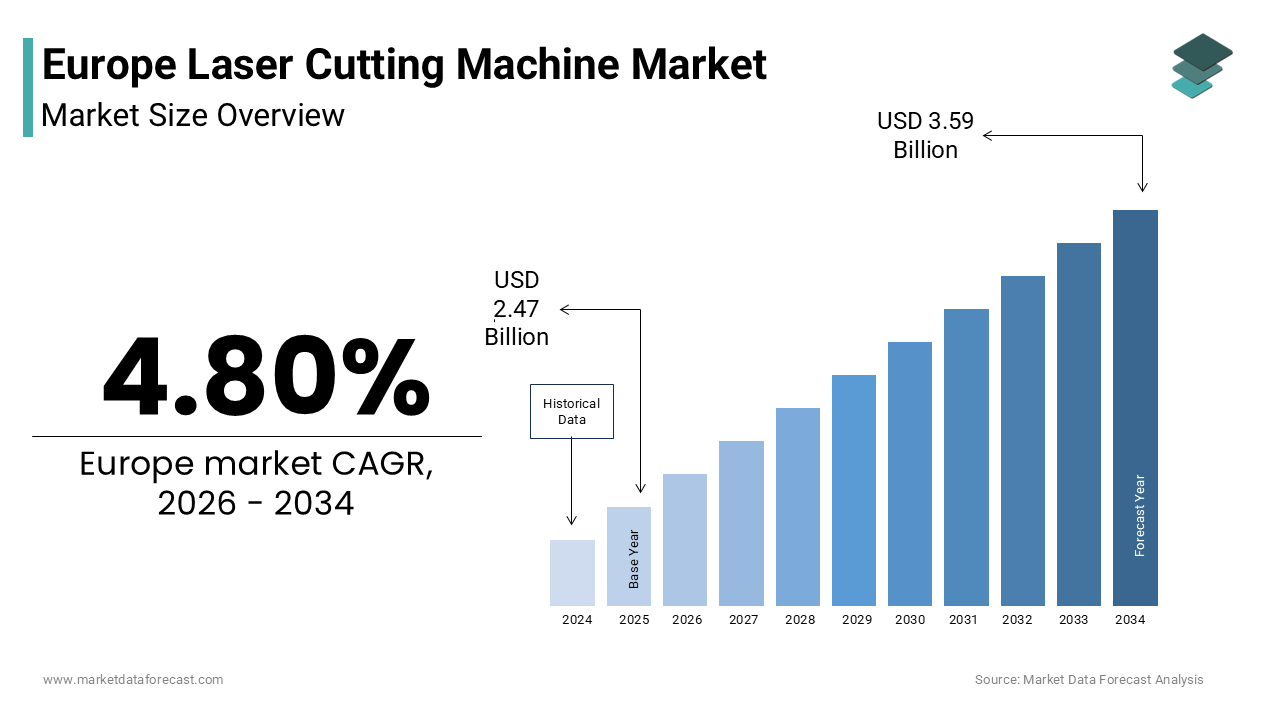
The Europe laser cutting machine market was valued at USD 2.36 billion in 2025 and is anticipated to reach USD 2.47 billion in 2026 from USD 3.59 billion by 2034, growing at a CAGR of 4.80% during the forecast period from 2026 to 2034. The growth of the Europe laser cutting machine market is driven by rising demand for high-precision manufacturing, increasing automation across industrial sectors, and the rapid adoption of advanced fiber laser technologies. Strong growth in automotive lightweighting, aerospace component production, and electronics fabrication is further supporting market expansion. Moreover, EU regulations promoting energy efficiency, smart manufacturing, and sustainable industrial practices are accelerating investments in modern laser-based machining systems across Europe.
Key Market Trends
- Increasing adoption of fiber laser technology due to higher efficiency, faster cutting speeds, and lower operating costs.
- Growing integration of laser cutting machines with Industry 4.0 technologies, including IoT, AI-based monitoring, and smart factory systems.
- Rising demand for precision cutting of advanced materials such as aluminum alloys, high-strength steel, and titanium.
- Expanding use of laser cutting in electric vehicle components, battery enclosures, and renewable energy systems.
- Increasing preference for automation-ready laser cutting systems to address skilled labor shortages in manufacturing.
Segmental Insights
- Based on application, the industrial segment held the largest share (42.1%) in 2025, driven by extensive usage in general metal fabrication, machinery manufacturing, and structural component production across Europe.
- Based on technology, the solid-state lasers segment dominated the market in 2025, owing to higher energy efficiency, minimal maintenance requirements, and strong compatibility with reflective materials used in EVs and renewable applications.
- Based on process, the fusion cutting segment accounted for 65.1% of the market share in 2025, supported by strong demand for high-quality cutting of stainless steel and aluminum in automotive and appliance manufacturing.
Regional Insights
The Europe laser cutting machine market is witnessing strong adoption across key industrial economies, supported by automation investments, advanced manufacturing ecosystems, and policy support for digital industrialization.
- Germany led the market by accounting for 28.5% of the share in 2025, driven by strong automotive production, advanced machinery manufacturing, and the presence of global laser technology leaders such as TRUMPF.
- Italy accounted for 16.7% of the market share in 2025, supported by a dense network of metal fabrication SMEs, growing adoption of fiber laser technology, and government incentives for smart machinery investments.
- France continues to show strong growth due to aerospace, defense, and nuclear industry demand, where high-precision laser cutting is critical for advanced alloy processing.
- The United Kingdom is benefiting from reinvestment in advanced engineering, renewable energy infrastructure, and electric vehicle manufacturing, which is supporting laser cutting equipment demand.
- Spain is emerging as a high-growth market supported by automotive investments, industrial modernization programs, and renewable energy expansion.
Competitive Landscape
The Europe laser cutting machine market is characterized by strong technological competition, continuous innovation, and emphasis on software-driven automation. Leading manufacturers are focusing on AI-enabled cutting optimization, smart factory integration, energy efficiency improvements, and advanced digital platforms to strengthen their competitive position. Strategic investments in after-sales service networks, training centers, and localized support infrastructure are further enhancing customer loyalty. Prominent players in the Europe laser cutting machine market include TRUMPF SE + Co. KG, Bystronic Laser AG, AMADA Co., Ltd., FANUC Corporation, Coherent Corp., IPG Photonics Corporation, Jenoptik AG, DPSS Lasers Inc., Epilog Laser, and Mitsubishi Electric Corporation.
Europe Laser Cutting Machine Market Size
The europe laser cutting machine market size was valued at USD 2.36 billion in 2025 and is anticipated to reach USD 2.47 billion in 2026 from USD 3.59 billion by 2034, growing at a CAGR of 4.80% during the forecast period from 2026 to 2034.
A laser cutting machine is a computer numerical controlled (CNC) fabrication tool that uses a highly focused, high-energy laser beam to accurately cut or engrave a wide range of materials by melting, burning, or vaporizing them. Their deployment spans automotive, aerospace, electronics, and metal fabrication sectors where dimensional accuracy, repeatability, and minimal material waste are paramount. Europe consistently demonstrates a strong and growing adoption of industrial robots, reflecting a broader embrace of precision manufacturing technologies that directly support advanced processes like laser cutting. The European Union’s Green Deal Industrial Plan has accelerated capital investment in energy efficient production infrastructure, further embedding laser systems into next generation factories. Germany maintains its position as Europe's leading nation for robotics, with a large and continuously expanding operational stock of industrial robots underscoring the region's advanced automation ecosystem. Additionally, investments in machine tools across Western Europe show an increasing prioritization of modern, integrated, and efficient systems, aligning closely with the capabilities and demands of advanced manufacturing technologies like laser cutting. This technological alignment, coupled with stringent EU directives on industrial emissions and resource efficiency, positions laser cutting not merely as a production tool but as an enabler of regulatory compliance and circular manufacturing principles across the continent.
MARKET DRIVERS
Rising Demand for High Precision Components in Aerospace and Defense
The aerospace and defense sector in the region is a pivotal force driving the growth of the Europe laser cutting machine market. This is due to escalating requirements for lightweight, high-tolerance metallic components. The increased use of composite materials in aircraft has led to the adoption of advanced cutting techniques to prevent damage and structural issues. Machining a variety of materials like titanium alloys, Inconel, and carbon fiber composites requires high-precision methods that avoid thermal distortion and microcracks. Traditional cutting methods are being replaced by non-contact technologies to mitigate problems like tool wear and burrs. Fiber laser systems are increasingly used for their ability to create narrow cuts and limit heat exposure, which is important for critical aircraft parts. The growth in aerospace manufacturing across Europe is increasing the need for automated, precise cutting solutions. Rising defense budgets and new defense platforms in Europe are driving the demand for manufacturing technologies capable of high accuracy. Consequently, laser cutting machines have become indispensable in meeting aerospace certification standards, which mandate stringent process control and traceability, further cementing their role in advanced European manufacturing ecosystems.
Accelerated Automation in Automotive Lightweighting Initiatives
The region’s automotive industry is undergoing a structural transformation toward electric mobility and lightweight vehicle architectures, which is among the key factors boosting the expansion of the Europe laser cutting machine market. This shift is creating substantial demand for laser cutting systems capable of processing high strength steels and aluminum alloys with minimal scrap. The average weight of a European passenger car has decreased, largely through substitution of conventional steel with advanced high strength steel and aluminum sheets. These materials demand cutting methods that preserve metallurgical properties, a criterion laser systems fulfill through controlled energy input and zero mechanical stress. There is an observed increase in the use of laser-cut aluminum components in electric vehicle body structures to enhance vehicle efficiency and safety. The growing number of electric vehicle registrations in Europe is leading to greater demands on manufacturers to increase production throughput. High-speed fiber laser technology is being used to cut aluminum at high speeds, supporting manufacturers in achieving production volume goals with precision. This convergence of material innovation, regulatory pressure for lower emissions, and production scalability solidifies laser cutting as a foundational technology in Europe’s automotive reindustrialization strategy.
MARKET RESTRAINTS
High Initial Investment and Operational Complexity
Substantial capital outlays and intricate integration demands deter small and medium enterprises, which restrains the growth of the Europe laser cutting machine market. High-power fiber laser systems with automation and optimization software demand a substantial capital investment from manufacturers. The financial burden can increase significantly with necessary infrastructure updates like specialized electrical and environmental control systems. The investment required for this technology can pose considerable entry barriers for smaller manufacturing businesses. Furthermore, operating these systems requires specialized personnel trained in optical alignment, gas assist tuning, and predictive maintenance, skills in acute shortage across Southern and Eastern Europe. The demand for qualified automation technicians in the European market appears to exceed the current supply, which may impact the speed of new technology implementation. Operational efficiency for industrial equipment is a focal point, as machinery such as high-power lasers can lead to substantial energy usage over time. Industrial electricity expenses are a notable factor in production costs, particularly in regions with higher energy tariffs. These financial and human resource barriers collectively constrain widespread adoption despite the technology’s long term productivity benefits.
Stringent Regulatory Compliance and Emissions Controls
European manufacturers face increasingly rigorous environmental and workplace safety regulations, which obstruct the expansion of the Europe laser cutting machine market. These rules complicate laser cutting machine deployment, particularly concerning fume extraction and noise management. Regulations regarding airborne contaminants have prompted a shift toward implementing more advanced filtration technologies for thermal processing equipment. The requirement to capture fine particulate matter during metal fabrication has led to an increase in the overall capital expenditure for manufacturing systems. Occupational health standards for noise levels are influencing the physical design of industrial workspaces and auxiliary machinery. Mitigating sound emissions from cooling and ventilation units often involves the integration of specialized acoustic shielding or structural modifications. The evolution of safety frameworks is driving a pattern of continuous technical upgrades to ensure the well-being of equipment operators. Compliance verification involves third party audits and documentation burdens that disproportionately affect smaller fabricators. The European Commission is expanding the scope of its Ecodesign for Sustainable Products Regulation (ESPR) to include more industrial equipment, aiming to force improvements in lifecycle energy efficiency for products like machine tools in the coming years. This shift compels manufacturers to align with stricter sustainability standards and provide more extensive product performance information by the late 2020s. These overlapping regulatory layers increase both upfront and ongoing operational complexity, slowing procurement decisions and diverting capital from core production upgrades to compliance infrastructure, thereby acting as a structural restraint on market expansion.
MARKET OPPORTUNITIES
Expansion of Greenfield Industrial Parks with Integrated Automation Infrastructure
The region is witnessing a strategic proliferation of greenfield industrial zones designed with embedded digital and energy efficient manufacturing ecosystems, which offers strong potential for the laser cutting machine market. Large-scale financial commitments are being directed toward modernizing industrial zones across various European regions. New industrial developments are being designed with integrated high-capacity utilities and specialized environmental management systems. These infrastructure improvements specifically accommodate the technical requirements of advanced manufacturing technologies. Management within these industrial hubs increasingly favors occupants who utilize digitally integrated and energy-efficient machinery. Financial benefits are being utilized to encourage the adoption of equipment that adheres to international sustainability and efficiency benchmarks. Some regional manufacturing centers have established operational requirements for metal fabrication that include integrated monitoring capabilities. The implementation of these structured entry policies correlates with a more rapid transition toward advanced fabrication tools among participating businesses. Additionally, the EU’s Important Projects of Common European Interest framework has designated laser based micro manufacturing as a strategic capability, unlocking co funding for equipment procurement. This orchestrated industrial planning reduces the traditional barriers of retrofitting legacy facilities, enabling plug and produce deployment of high end laser systems. Consequently, these purpose built zones act as catalysts, transforming regional manufacturing clusters into high precision, low emission production nodes aligned with continental competitiveness goals.
Growth of Circular Economy Driven Remanufacturing Sectors
The formalization of remanufacturing under the EU Circular Economy Action Plan is opening novel demand for laser cutting machines in component recovery and reprocessing applications, which is predicted to boost the expansion of the Europe laser cutting machine market. Unlike conventional recycling, remanufacturing restores used products to original specifications, requiring precision disassembly of complex assemblies, tasks where laser systems excel due to non contact separation of dissimilar materials without contamination. The European remanufacturing sector is experiencing notable economic activity, supported by a substantial workforce and significant turnover. Industrial machinery and automotive sectors represent a large portion of the overall remanufacturing activity. Major industrial players are increasing investment in dedicated, specialized production lines for remanufacturing processes. Advanced techniques, such as precision laser technologies, are employed to dismantle components for reuse, notably in electric motors and gearboxes. These advanced remanufacturing approaches enable significant savings in raw material consumption compared to new manufacturing methods. These policy driven shifts convert end of life products into high value feedstock streams, positioning laser cutting not just as a fabrication tool but as a critical enabler of closed loop industrial systems across Europe.
MARKET CHALLENGES
Persistent Shortage of Skilled Maintenance Technicians
An acute shortage of technicians capable of performing advanced diagnostics and optical subsystem maintenance, despite technological advancements, is challenging the growth of the Europe laser cutting machine market. This directly impacts the machine uptime and return on investment. Fiber laser resonators, beam delivery optics, and chiller systems require calibration expertise that transcends generic CNC knowledge, yet vocational training programs have been slow to incorporate photonics specific curricula. Manufacturing firms across various regions are experiencing challenges in finding qualified personnel to work with laser systems. The gap in skilled workers for these systems appears to be particularly pronounced in specific Southern European countries. A shortage of qualified personnel in certain regions correlates with extended downtimes for machinery service. Regions with a higher availability of certified service partners experience significantly shorter, unplanned maintenance durations for laser equipment. Furthermore, original equipment manufacturers often restrict access to proprietary diagnostic software, forcing users to rely on limited regional service networks. Europe's rising adoption of high-power lasers is creating a dangerous mismatch with the available skilled workforce, disrupting operations and slowing adoption among smaller, budget-conscious fabricators.
Volatility in Strategic Raw Material Supply Chains
Disruptions in critical raw material supply chains, particularly for rare earth elements and specialized optical glass essential to laser resonators and beam delivery systems, impede the expansion of the Europe laser cutting machine market. This makes the production and performance of high-end laser cutting machines in the region increasingly vulnerable. Global capacity for rare earth oxide refining demonstrates significant concentration in one nation, leading to structural supply dependencies for manufacturers. European manufacturing of certain high-tech components relies on imported rare earth elements, identified as high-risk supply dependencies. Potential disruptions in the supply of these materials pose risks to the operational continuity of the European laser production industry, while manufacturing of essential, high-purity components for laser systems depends on specific, non-European raw material sources. Furthermore, geopolitical factors and export adjustments have increased material price volatility, raising production costs for European industrial manufacturers. This supply fragility not only elevates equipment prices but also introduces delivery uncertainties that complicate factory planning, thereby undermining buyer confidence and delaying capital expenditure decisions across the industrial sector.
REPORT COVERAGE
| REPORT METRIC | DETAILS |
| Market Size Available | 2025 to 2034 |
| Base Year | 2025 |
| Forecast Period | 2026 to 2034 |
| CAGR | 4.80% |
| Segments Covered | By Application, Technology, Process and Country |
| Various Analyses Covered | Regional & Country Level Analysis, Segment-Level Analysis, DROC, PESTLE Analysis, Porter’s Five Forces Analysis, Competitive Landscape, Analyst Overview on Investment Opportunities |
| Countries Covered | UK, France, Spain, Germany, Italy, Russia, Sweden, Denmark, Switzerland, the Netherlands, Turkey, the Czech Republic, and the Rest of Europe. |
| Market Leaders Profiled | TRUMPF SE + Co. KG, Bystronic Laser AG, AMADA Co., Ltd., FANUC Corporation, Coherent Corp., IPG Photonics Corporation, Jenoptik AG, DPSS Lasers Inc., Epilog Laser, and Mitsubishi Electric Corporation. |
SEGMENTAL ANALYSIS
By Application Insights
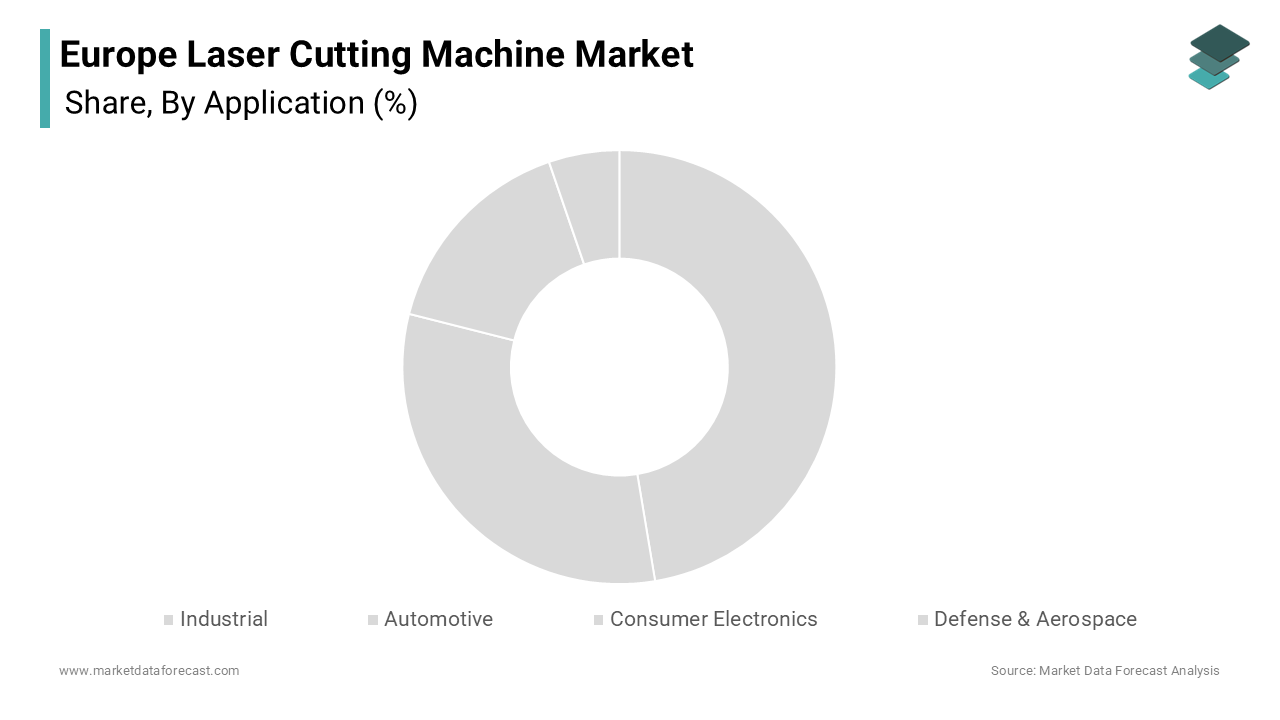
The industrial application segment held the largest share of 42.1% of the Europe laser cutting machine market in 2025. The supremacy of the industrial application segment is attributed to the broad deployment of laser systems across general metal fabrication, machinery production, and structural component manufacturing. Industrial workshops across Germany Italy and Poland increasingly adopt fiber laser cutters to replace plasma and oxy fuel systems due to superior edge quality and reduced post processing. According to sources, a notable share of new sheet metal cutting equipment investments in the EU were laser based, with industrial job shops accounting for more than half of these purchases. The shift is further propelled by the need for just in time production and batch size flexibility, capabilities intrinsic to modern CNC laser platforms. Additionally, rising energy prices have intensified demand for systems with lower specific energy consumption per cut meter, a metric where solid state lasers outperform legacy technologies, as per sources. This convergence of operational efficiency, material versatility, and compatibility with digital workflows solidifies the industrial segment’s leadership in the European landscape.
The defense and aerospace application segment is expected to exhibit a noteworthy CAGR of 9.4% from 2026 to 2034 due to Europe’s strategic push toward defense industrial autonomy and next generation aircraft programs requiring micron level component integrity. Regional defense funding initiatives have identified high-precision laser machining as a critical technological focus for industrial development. The aerospace sector is experiencing a rise in the acquisition of specialized metallic materials, such as titanium and nickel-based alloys. Increased material procurement is occurring alongside efforts to accelerate the assembly of both commercial and military aircraft models. There is a coordinated emphasis on integrating sophisticated manufacturing techniques to meet evolving production demands within the defense and aviation industries. These superalloys are notoriously difficult to cut using mechanical methods due to work hardening, making fiber lasers with nitrogen assist the only viable solution for maintaining fatigue resistance in structural parts. Furthermore, the European Space Agency’s Clean Space Initiative mandates zero contamination during component fabrication, a requirement met exclusively by non contact laser processes. Cross-sector technology transfer is driving rapid innovation, enabling Eastern European defense subcontractors to leapfrog traditional aerospace hubs.
By Technology Insights
The solid state lasers segment led the Europe laser cutting machine market by capturing a significant share in 2025. The leading position of the solid state lasers segment is credited to its unmatched electrical efficiency, minimal maintenance needs, and compatibility with reflective metals like copper and brass, materials increasingly used in electric vehicle and renewable energy componentry. Fiber lasers offer significantly higher energy conversion efficiency compared to traditional CO2 laser systems, often resulting in substantially lower electricity consumption and lower cooling requirements for the same level of operating output. This translates into direct operational savings. Due to superior electro-optical conversion efficiency and reduced cooling demands, high-power fiber laser systems provide substantial annual electricity consumption reductions compared to traditional CO2 systems, leading to significant annual operational cost savings for European industrial manufacturers. Additionally, fiber lasers integrate seamlessly with robotic arms and automated material handling systems, a critical advantage in Europe’s labor constrained manufacturing environment. The German Engineering Federation confirms that new laser cutting installations in Germany are overwhelmingly adopting fiber-based technology, driven by regional alignment with Industry 4.0 standards that prioritize data connectivity and predictive maintenance, features inherent to modern solid-state platforms.
The semiconductor lasers segment is predicted to witness the highest CAGR of 12.1% from 2026 to 2034. Its adoption is surging in micro processing applications within consumer electronics and medical device manufacturing. An additional driver is the proliferation of ultra thin flexible printed circuits and battery foils in wearables and implantable devices, which require cutting features under 20 micrometers without thermal damage. Semiconductor diode-pumped solid-state lasers operating in green or ultraviolet wavelengths provide cold ablation capability. These laser systems with pulse durations below 10 picoseconds are used for cutting polymer-based sensor housings. The utilization of UV semiconductor laser systems is associated with improvements in production yields. Support for advanced packaging infrastructure, which mandates laser-based dicing and scribing, is increasing. Semiconductor lasers are shifting from niche prototyping to high-volume production as miniaturization trends intensify in healthcare and telecommunications hardware.
By Process Insights
The fusion cutting segment dominated the Europe laser cutting machine market by accounting for a 65.1% share in 2025. This process, which employs inert gases like nitrogen to melt and eject material without oxidation, is preferred for stainless steel and aluminum components where surface finish and corrosion resistance are critical. The automotive and white goods industries are the primary adopters, with a significant share of appliance enclosures in the EU fabricated via nitrogen assisted fusion cutting, according to sources. The process eliminates post cutting pickling or passivation steps, reducing cycle time in high mix production environments, as per research. Additionally, fusion cutting enables consistent edge quality across variable sheet thicknesses, a necessity in just in time supply chains serving manufacturers like Electrolux and Bosch. Energy efficiency further reinforces its dominance. Fusion cutting of 1 millimeter stainless steel consumes less power per meter than flame cutting, a metric increasingly scrutinized under the EU’s Energy Efficiency Directive. European fabricators favor fusion cutting for non-ferrous and high-alloy materials to satisfy both aesthetic standards and green production goals.
The sublimation cutting segment is estimated to register the fastest CAGR of 10.7% from 2026 to 2034. The key growth driver of the sublimation cutting segment is Europe’s expanding medical device sector, which generated billions of euros in revenue in 2024, according to sources, with demand for biocompatible stents, catheter tubes, and lab on chip components requiring micron precision without melting. This process, which vaporizes material directly from solid to gas using short pulse lasers, is gaining traction in the processing of thermally sensitive polymers and composites used in medical and electronics applications. Advanced cutting techniques for specialized films in flexible electronics achieve precise feature tolerances while eliminating surface imperfections typical of traditional methods. The absence of thermal or mechanical debris during processing represents a shift toward higher precision standards than those possible with conventional physical tools. Process digital tracking features facilitate compliance with strict oversight requirements for material fabrication. Automated logging within these fabrication systems supports the verification and audit trails necessary for sensitive device production. Patterns in the medical technology sector suggest a movement of these high-precision methods from niche roles into standard cleanroom manufacturing workflows. Regional innovation goals for advanced technology development are driving the wider adoption of digital-first fabrication techniques.
REGIONAL ANALYSIS
Germany Laser Cutting Machine Market Analysis
Germany was the top performer in the Europe laser cutting machine market by capturing a 28.5% share in 2025. The dominance of the German market is propelled by its world leading industrial machinery and automotive sectors. The country’s Mittelstand enterprises, small and medium sized manufacturers, have aggressively modernized production lines with fiber laser systems to maintain global competitiveness amid rising labor costs. The presence of global laser OEMs such as Trumpf and Rofin, both headquartered in Baden Württemberg, ensures rapid technology diffusion and localized after sales support. Furthermore, Germany’s National Industrial Strategy prioritizes “production sovereignty” in key technologies, channeling public funds into automation grants that cover a portion of laser system costs for SMEs. This policy driven ecosystem, combined with deep integration into automotive supply chains for premium brands, sustains Germany’s undisputed leadership in high precision laser cutting adoption across Europe.
Italy Laser Cutting Machine Market Analysis
Italy was the second largest player in the European laser cutting machine market by accounting for a 16.7% share in 2025. The expansion of the Italian market is driven by its dense network of metal fabrication workshops specializing in furniture, architectural elements, and agricultural machinery. A substantial majority of small and medium-sized metalworking enterprises within the Northern Italian regions of Emilia Romagna and Veneto have transitioned to advanced fiber laser technology between 2021 and 2024, signaling a rapid, widespread modernization of manufacturing capacity. This shift was accelerated by soaring natural gas prices that rendered plasma cutting economically unviable; laser systems reduced energy costs per cut meter in stainless steel applications according to sources. Additionally, Italy’s export oriented design sector demands intricate geometries and polished edges unachievable with mechanical methods, making laser cutting essential for high value ornamental and sanitary ware products. The Italian government's industrial policy provides enhanced depreciation incentives for investments in smart machinery, which encourages the adoption of new technology. A significant portion of Italian metal fabricators have incorporated digitally integrated laser cells into their operations. These technological advancements suggest a shift in the Italian manufacturing landscape towards more digitally integrated, precision-focused production.
France Laser Cutting Machine Market Analysis
France is also a key player in the Europe laser cutting machine market due to its robust aerospace and defense industrial base centered around Toulouse and Bordeaux. Companies like Safran and Dassault Aviation rely extensively on high power fiber lasers for cutting nickel based superalloys and titanium airframes, with numerous advanced laser systems installed in their supply chains since 2022, according to sources. Beyond defense, France’s nuclear energy sector is emerging as a secondary driver. EDF’s fleet life extension program requires thousands of custom stainless-steel components for reactor internals, all fabricated via fusion cutting to meet ASME nuclear code standards. Additionally, the French Tech Sovereignty Fund has co invested with laser integrators to develop AI powered nesting software that reduces material waste. This dual focus on strategic autonomy and industrial efficiency solidifies France’s position as a high value application market.
United Kingdom Laser Cutting Machine Market Analysis
The United Kingdom experienced a steady growth in the European laser cutting machine market, and rebounded strongly post Brexit through reinvestment in advanced engineering and renewable energy infrastructure. Policy initiatives aimed at boosting local involvement in offshore wind projects appear to be shaping how structural parts are manufactured. Fabrication facilities in certain areas are integrating advanced laser technology for processing steel plates used in offshore infrastructure. Within the engineering manufacturing sector, there is a reported increase in spending on updated, high-precision cutting equipment. The automotive sector, particularly electric vehicle battery enclosures, is another key driver. Jaguar Land Rover’s Halewood plant now uses laser cut aluminum housings for its modular battery packs, improving thermal management and crash safety. Moreover, Innovate UK has funded many collaborative R&D projects focused on adaptive laser control for dissimilar metal welding, enhancing process versatility. Despite macroeconomic headwinds, the UK’s targeted industrial strategy has repositioned laser cutting as a cornerstone of its advanced manufacturing revival.
Spain Laser Cutting Machine Market Analysis
Spain is likely to expand in the Europe laser cutting machine market from 2026 to 2034. It is emerging as a dynamic growth pole due to automotive foreign direct investment and government backed industrial modernization. The development of large-scale electric vehicle manufacturing centers is encouraging the localization of related suppliers. This is leading to an increase in specialized metal component providers who are adopting advanced fiber laser cutting technology. Government investment programs are supporting smaller businesses in adopting digital manufacturing tools. The expansion of renewable energy infrastructure is also increasing the need for precision-cut aluminum parts. Spain is emerging as a premier European laser adoption hub by combining, more affordable labor than Germany with a highly skilled, polytechnic-trained workforce.
COMPETITIVE LANDSCAPE
Competition in the Europe laser cutting machine market is characterized by intense technological differentiation rather than price rivalry. Established players like Trumpf Bystronic and Amada dominate through continuous innovation in beam quality process automation and energy efficiency while defending their positions with extensive service infrastructures. Emerging challengers from Asia are gaining traction by offering cost competitive systems but face hurdles in after sales support and compliance with EU safety and emissions standards. The competitive landscape is further shaped by customer demand for integrated digital workflows where laser machines function as data generating nodes within broader factory ecosystems. As a result vendors increasingly bundle hardware with proprietary software analytics and cloud connectivity to lock in long term client relationships. Regional specialization also plays a role with German firms excelling in high end aerospace applications while Italian and Spanish suppliers focus on flexible solutions for job shops. This multi tiered rivalry drives rapid advancement but demands constant adaptation from all participants.
KEY MARKET PLAYERS
Some of the companies that are playing a dominating role in the Europe Laser Cutting Machine Market include
- TRUMPF SE + Co. KG
- Bystronic Laser AG
- AMADA Co., Ltd.
- FANUC Corporation
- Coherent Corp.
- IPG Photonics Corporation
- Jenoptik AG
- DPSS Lasers Inc.
- Epilog Laser
- Mitsubishi Electric Corporation
Top Players in the Market
Trumpf GmbH + Co KG is a German industrial technology leader renowned for pioneering fiber laser cutting systems tailored for high precision metal fabrication. The company significantly influences the global market by integrating artificial intelligence and IoT connectivity into its TruLaser platforms, enabling predictive maintenance and real time process optimization. In recent years Trumpf has expanded its smart factory solutions across Europe through partnerships with automotive and aerospace OEMs, reinforcing its role as a technology enabler beyond equipment supply. Its investment in quantum sensor development for laser beam monitoring further underscores a commitment to next generation manufacturing accuracy and sustainability.
Bystronic Group headquartered in Switzerland delivers advanced laser cutting machinery with a strong emphasis on software driven automation and energy efficiency. The company contributes to the global market by offering cloud based nesting and production planning tools that reduce material waste and boost throughput. Recently Bystronic launched its ByVision Cutting operating system with integrated machine learning algorithms that adapt cutting parameters dynamically. This innovation strengthens its position in Europe’s mid tier fabricator segment where operational cost sensitivity drives technology adoption decisions.
Amada Holdings Co Ltd a Japanese multinational maintains a robust footprint in Europe through its high speed hybrid laser systems that combine punch and laser functionalities. The company supports global manufacturing trends by enabling flexible batch production for job shops serving diverse industries. Amada recently inaugurated a European application and training center in Düsseldorf to accelerate customer onboarding and process validation. This facility demonstrates components cut from novel alloys and composite materials, showcasing the company’s R&D responsiveness to evolving European material standards and lightweighting demands.
Top Strategies Used by the Key Market Participants
Key players in the Europe laser cutting machine market primarily pursue technology integration through embedded software and digital twin capabilities to enhance machine intelligence and remote diagnostics. They emphasize localized after sales ecosystems by establishing regional training centers spare parts hubs and certified service networks to minimize downtime. Strategic collaborations with material suppliers and industrial automation firms enable co developed solutions for emerging applications like battery foil and hydrogen component fabrication. Continuous R&D investment focuses on increasing wall plug efficiency reducing consumable dependency and expanding wavelength versatility for non metallic materials. Additionally companies deploy flexible financing models including leasing and pay per use schemes to lower entry barriers for small and medium enterprises across Southern and Eastern Europe.
MARKET SEGMENTATION
This europe laser cutting machine market research report is segmented and sub-segmented into the following categories.
By Application
- Industrial
- Automotive
- Consumer Electronics
- Defense & Aerospace
- Others
By Technology
- Solid State Lasers
- Gas Lasers
- Semiconductor Lasers
By Process
- Flame Cutting
- Fusion Cutting
- Sublimation Cutting
By Country
- UK
- France
- Spain
- Germany
- Italy
- Russia
- Sweden
- Denmark
- Switzerland
- Netherlands
- Turkey
- Czech Republic
- Rest of Europe
Frequently Asked Questions
What is the Europe Laser Cutting Machine Market?
It refers to the market for machines that use laser technology to cut, engrave, and process materials such as metal, plastic, wood, and composites across industrial applications in Europe.
What are the major factors driving the market growth?
Key drivers include rising demand for industrial automation, growth in metal fabrication, expansion of automotive and aerospace industries, and increasing adoption of Industry 4.0 technologies.
What are the major types of laser cutting machines?
The main types include fiber laser, CO₂ laser, and solid-state laser cutting machines.
Which type of laser cutting machine is most popular in Europe?
Fiber laser cutting machines are most popular due to high efficiency and low operating costs.
What industries drive demand for laser cutting machines?
Key industries include automotive, aerospace, electronics, manufacturing, construction, and medical devices.
Which countries contribute most to the market growth?
Germany, the UK, France, Italy, Spain, Switzerland, and the Netherlands are major contributors.
Who are the key players in the Europe Laser Cutting Machine Market?
Major players include TRUMPF, Bystronic, AMADA, FANUC, IPG Photonics, Jenoptik, and Mitsubishi Electric.
What are the major challenges in this market?
High equipment costs and the need for skilled operators are key challenges.
What materials can laser cutting machines process?
They can process metals, plastics, glass, wood, textiles, and composite materials.
What is the future outlook of the market?
The market is expected to grow steadily due to rising demand for advanced manufacturing technologies.
Access the study in MULTIPLE FORMATS
Purchase options starting from
$ 2000
Didn’t find what you’re looking for?
TALK TO OUR ANALYST TEAM
Need something within your budget?
NO WORRIES! WE GOT YOU COVERED!
Call us on: +1 888 702 9696 (U.S Toll Free)
Write to us: sales@marketdataforecast.com