Europe Laser Market Size, Share, Trends, & Growth Forecast Report By Laser Type (Fiber Lasers, Diode Lasers, CO₂ Lasers, Solid-State Lasers), Application, Mode of Operation, and End user Industry and Country (UK, France, Spain, Germany, Italy, Russia, Sweden, Denmark, Switzerland, Netherlands, Turkey, Czech Republic and Rest of Europe), Industry Analysis From 2026 to 2034
Market Size, 2025
$6.06 BnMarket Estimate, 2026
$6.47 BnMarket Forecast, 2034
$10.94 BnCAGR, 2026–2034
6.79%Europe Laser Market Report Summary
The Europe laser market was valued at USD 6.06 billion in 2025, is estimated to reach USD 6.47 billion in 2026, and is projected to reach USD 10.94 billion by 2034, growing at a CAGR of 6.79% during the forecast period from 2026 to 2034. The growth of the Europe laser market is driven by the rapid adoption of Industry 4.0 and smart manufacturing technologies, increasing demand for precision processing in industrial applications, and expanding use of lasers in the medical and semiconductor industries. Rising investments in photonics research, growing electric vehicle production requiring advanced laser welding, and increasing demand for minimally invasive medical procedures are further supporting market expansion. Additionally, the development of ultrafast lasers for semiconductor fabrication and the growing adoption of lidar technology in autonomous mobility are creating new opportunities across Europe.
Key Market Trends
-
Increasing adoption of fiber laser systems in advanced manufacturing due to their high efficiency, reliability, and suitability for cutting, welding, and marking applications.
-
Growing integration of ultrafast lasers in semiconductor and electronics manufacturing to enable micro-precision processing and miniaturization of electronic components.
-
Rising demand for laser-based medical treatments and minimally invasive surgeries across the ophthalmology, dermatology, and dentistry sectors.
-
The expanding use of lidar technologies in autonomous vehicles and smart city infrastructure is driving demand for specialized laser sources.
-
Increasing emphasis on energy-efficient photonic technologies and sustainable manufacturing processes across European industries.
Segmental Insights
- Based on laser type, the fiber lasers segment was the largest and held a significant share of the Europe laser market in 2025. The segment’s dominance is attributed to its superior energy efficiency, high beam quality, and widespread use in industrial material processing such as cutting, welding, and marking across automotive and machinery sectors.
- Based on application, the materials processing segment accounted for the largest share of the Europe laser market in 2025. The growth of this segment is driven by strong manufacturing activity in Europe and the increasing use of laser technology in precision cutting, welding, drilling, and surface treatment across automotive, aerospace, and industrial equipment industries.
- Based on mode of operation, the continuous wave segment held a major share of the Europe laser market in 2025 due to its extensive use in heavy industrial applications requiring constant energy output, including welding, heat treatment, and cutting of thick materials.
- Based on end-user industry, the electronics and semiconductor segment dominated the Europe laser market in 2025. The segment’s growth is supported by rising investments in semiconductor manufacturing, growing demand for advanced chip fabrication technologies, and increasing use of lasers for lithography, drilling, and micro-processing applications.
Regional Insights
The Europe laser market is witnessing steady growth across major countries, supported by strong manufacturing capabilities, advanced photonics research, and increasing adoption of laser technologies in industrial and medical sectors.
-
Germany was the largest contributor, accounting for 29.4% of the Europe laser market share in 2025, driven by its strong automotive and machinery manufacturing industries and the presence of leading laser technology companies.
-
The United Kingdom holds a significant share supported by its aerospace, defense, and medical technology industries.
-
France is emerging as a key market due to government investments in advanced manufacturing and photonics innovation programs.
-
Italy is witnessing increasing demand for laser technologies in machinery manufacturing, fashion processing, and industrial equipment production.
-
Switzerland continues to grow due to its specialization in precision micromachining, medical device manufacturing, and high-end watchmaking industries.
Competitive Landscape
The Europe laser market is characterized by the presence of established global laser technology manufacturers competing through innovation, product efficiency, and advanced photonic solutions. Companies are investing heavily in research and development to develop high-power fiber lasers, ultrafast laser systems, and specialized industrial applications. Strategic collaborations with automotive, semiconductor, and medical device manufacturers are strengthening market positioning. Expanding local manufacturing capabilities, improving software-driven laser control systems, and focusing on energy-efficient solutions are also key strategies adopted by market participants. Prominent players in the Europe laser market include TRUMPF, Coherent Corp., IPG Photonics Corporation, Jenoptik AG, Bystronic Laser AG, Amada Co., Ltd., Lumentum Holdings Inc., MKS Instruments, Inc., Epilog Laser, and Han's Laser Technology Industry Group.
Europe Laser Market Size
The Europe laser market size was valued at USD 6.06 billion in 2025 and is anticipated to reach USD 6.47 billion in 2026 from USD 10.94 billion by 2034, growing at a CAGR of 6.79% during the forecast period from 2026 to 2034.
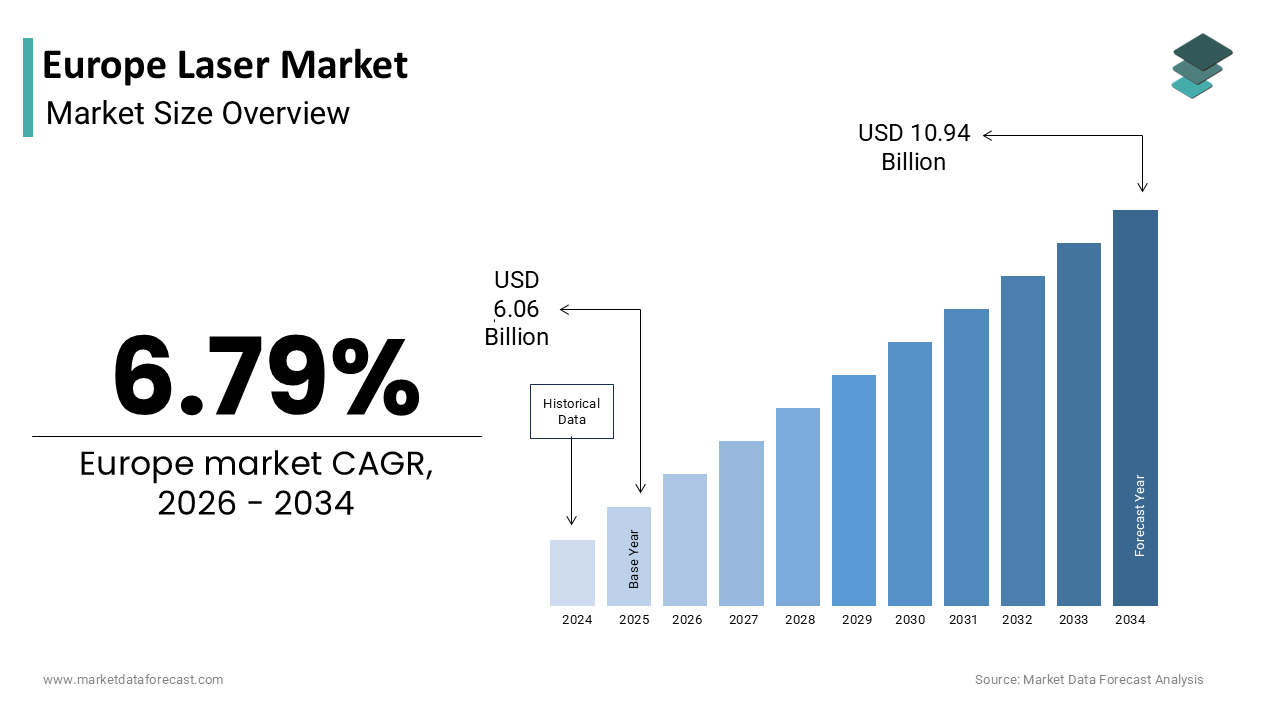
Laser represents a sophisticated ecosystem encompassing the development, manufacturing, and deployment of light amplification by stimulated emission of radiation technologies across industrial, medical, scientific, and consumer sectors. This market is defined not merely by the sale of laser sources but by the integration of photonic solutions into advanced manufacturing processes, precision surgical procedures, and high-speed data transmission networks. The region distinguishes itself through a strong foundation in quantum physics research and a robust regulatory framework that prioritizes safety and energy efficiency. According to Eurostat, the manufacturing sector within the European Union contributes significantly to gross value added, which is creating a substantial baseline demand for laser-based cutting, welding, and marking systems that enhance production precision. As per the European Commission, photonics is identified as a key enabling technology critical for maintaining global competitiveness, with many researchers dedicated to advancing laser capabilities in public and private institutions. Unlike other regions where cost drives adoption, the European landscape is characterized by a demand for ultra-high precision and reliability, particularly in the automotive and aerospace industries which require micron level accuracy. The definition now extends to include ultrafast lasers used in semiconductor lithography and green lasers for environmental monitoring, reflecting a shift towards sustainability and miniaturization in technological applications across the continent.
MARKET DRIVERS
Accelerated Adoption of Industry 4.0 and Smart Manufacturing Initiatives
The widespread implementation of Industry 4.0 principles that mandate the integration of cyber physical systems and automation into traditional manufacturing environments is majorly driving the growth of the Europe laser market. Lasers serve as the fundamental tool for this transformation due to their ability to provide non-contact, high speed, and programmable processing capabilities essential for smart factories. According to the European Commission, significant funding has been allocated through the Horizon Europe program to support digital transformation projects that rely heavily on advanced photonic technologies for flexible production lines. The automotive sector, a cornerstone of the European economy, increasingly utilizes high power fiber lasers for welding electric vehicle battery components and lightweight carbon fiber structures to meet stringent emission standards. As per the European Association of Automotive Suppliers, the transition to electric mobility requires new joining techniques that only laser technology can deliver with the necessary speed and precision. Furthermore, the demand for mass customization in consumer goods drives manufacturers to adopt laser marking and engraving systems that allow for rapid changeovers without tooling delays. This shift towards agile manufacturing ensures that laser systems become indispensable assets rather than optional equipment, securing consistent demand growth as companies strive to optimize throughput and reduce waste in an increasingly competitive global landscape.
Expanding Applications in Medical Diagnostics and Minimally Invasive Surgery
The rising demand for advanced medical technologies that enable minimally invasive procedures and high precision diagnostics is further fuelling the expansion of the Europe laser market. The aging population across Europe has led to a surge in chronic diseases requiring sophisticated surgical interventions where lasers offer superior control and reduced recovery times compared to traditional scalpels. According to the World Health Organization European Region, the proportion of individuals aged sixty five and older is projected to increase considerably by 2050, intensifying the need for efficient medical solutions. Ophthalmology, dermatology, and dentistry sectors are increasingly adopting femtosecond and diode lasers for procedures such as LASIK, tattoo removal, and cavity preparation, driven by patient preference for painless and quick treatments. As per the European Society of Cataract and Refractive Surgeons, the use of laser assisted eye surgeries has grown significantly, reflecting both technological maturity and broader insurance coverage. Additionally, the rise of photodynamic therapy for cancer treatment utilizes specific laser wavelengths to target malignant cells with minimal damage to surrounding healthy tissue. This clinical efficacy combined with the push for outpatient procedures to reduce hospital costs creates a robust demand stream for specialized medical laser systems, positioning the healthcare sector as a critical growth engine for the market.
MARKET RESTRAINTS
Stringent Safety Regulations and Complex Compliance Requirements
The implementation of rigorous safety standards and complex regulatory frameworks acts as a significant restraint on the Europe laser market by increasing the time and cost associated with bringing new products to market. Manufacturers must navigate a labyrinth of directives including the Low Voltage Directive and the Machinery Regulation, which impose strict limits on laser emissions and require comprehensive risk assessments for every device sold within the union. According to the European Committee for Standardization, compliance with norms such as EN 60825 involves extensive testing and documentation, which can delay product launches and inflate development budgets. Small and medium sized enterprises often struggle to afford the specialized legal and technical expertise required to ensure full compliance, limiting their ability to compete with larger multinational corporations. As per feedback from the European Laser Association, the varying interpretations of safety rules by different national authorities create additional barriers to cross border trade, fragmenting the single market potential. Furthermore, the liability risks associated with laser accidents force companies to invest heavily in safety interlocks and training programs, adding to the total cost of ownership for end users. These regulatory hurdles, while essential for protecting workers and consumers, inadvertently slow down the adoption rate of innovative laser technologies and constrain market dynamism.
High Initial Capital Investment and Skilled Labor Shortages
The substantial upfront capital required to acquire advanced laser systems coupled with a severe shortage of skilled operators poses a major barrier to market expansion, particularly for small and medium sized manufacturing firms. High power ultrafast lasers and specialized medical units represent significant financial outlays that many organizations cannot justify without clear long term return on investment projections. According to the European Small Business Alliance, access to finance remains a critical challenge for SMEs, with banks often viewing high tech equipment purchases as risky investments in the current economic climate. Beyond the hardware cost, the operational complexity of modern laser systems demands a workforce proficient in optics, programming, and maintenance, a skill set that is increasingly scarce across the continent. As per the European Centre for the Development of Vocational Training, there is a widening gap between the skills possessed by the existing labor force and those required by advanced photonics industries. This talent deficit leads to underutilization of expensive equipment and increases the reliance on external service contracts, which is further eroding profitability. The combination of financial constraints and human capital limitations forces many potential adopters to stick with conventional mechanical tools, thereby restricting the total addressable market for advanced laser solutions.
MARKET OPPORTUNITIES
Integration of Ultrafast Lasers in Semiconductor and Electronics Manufacturing
The burgeoning demand for smaller, faster, and more efficient electronic components presents a potential opportunity for the Europe laser market through the adoption of ultrafast laser processing technologies. As the semiconductor industry pushes the boundaries of miniaturization, traditional mechanical drilling and etching methods are reaching their physical limits, creating a critical need for cold ablation techniques offered by picosecond and femtosecond lasers. According to the European Semiconductor Industry Association, the region is investing in expanding its chip manufacturing capacity to reduce dependency on foreign supplies, driving demand for precision laser lithography and dicing equipment. These ultrafast lasers enable the creation of micro structures with negligible heat affected zones, which is essential for processing sensitive materials like glass substrates and flexible circuits used in next generation smartphones and wearable devices. As per research from the Fraunhofer Institute, the ability to process transparent materials with high precision opens new avenues for augmented reality displays and advanced sensor packaging. Furthermore, the shift towards wide bandgap semiconductors such as silicon carbide for electric vehicles requires laser processes that can handle extreme hardness without inducing cracks. These technological imperative positions ultrafast lasers as a cornerstone of the European electronics renaissance, offering manufacturers a lucrative avenue for growth and innovation.
Advancements in Lidar Technology for Autonomous Mobility and Smart Cities
The rapid evolution of autonomous driving systems and smart city infrastructure offers a substantial opportunity for the Europe laser market via the widespread deployment of Light Detection and Ranging sensors. Lasers are the core component of Lidar systems, providing the high-resolution three-dimensional mapping necessary for vehicles to navigate complex urban environments safely and efficiently. According to the European Automobile Manufacturers Association, major automotive players in Germany, France, and Sweden are accelerating their roadmaps for higher levels of autonomy, necessitating the integration of robust and cost-effective Lidar units in new vehicles. Beyond transportation, municipal authorities are utilizing laser scanning technology to create digital twins of cities for better traffic management, pollution monitoring, and urban planning. As per the European Innovation Partnership on Smart Cities and Communities, many cities are committed to deploying connected infrastructure that relies on real time spatial data generated by laser sensors. The miniaturization of solid-state lasers has made these systems more affordable and durable, enabling their use in drones for logistics and surveillance as well. This convergence of mobility and urban intelligence creates a massive volume demand for laser sources, transforming the automotive and civic sectors into key growth drivers for the market.
MARKET CHALLENGES
Intense Competition from Low-Cost Asian Manufacturers
A formidable challenge facing the Europe laser market is the aggressive competition from Asian manufacturers, particularly from China, who offer comparable laser sources at significantly lower price points due to economies of scale and government subsidies. These competitors have rapidly improved the quality of their fiber and diode lasers, eroding the traditional price premium enjoyed by European brands in the mid-range segment. According to the European Association of Photonics Industries, the influx of low-cost imports has compressed profit margins for local manufacturers, forcing them to either cut costs or retreat to highly specialized niche markets. The ability of Asian firms to vertically integrate their supply chains allows them to control production costs more effectively, making it difficult for European companies to compete on price alone. As per the World Trade Organization, trade dynamics have shifted such that European integrators increasingly source basic laser modules from Asia to remain competitive in the global marketplace. This dependency on foreign components threatens the sovereignty of the European supply chain and reduces the incentive for domestic investment in basic laser research. Companies must constantly innovate to differentiate their offerings through superior software, service, and application expertise, yet the pressure to lower prices remains a persistent threat to profitability and market share.
Supply Chain Vulnerabilities for Critical Raw Materials
The Europe laser market faces a critical challenge regarding the security of supply chains for rare earth elements and specialized optical materials that are essential for manufacturing high performance laser sources. Many of these critical raw materials, such as neodymium, ytterbium, and gallium, are sourced predominantly from a limited number of countries outside Europe, creating significant geopolitical risks and price volatility. According to the European Commission Raw Materials Information System, the continent relies heavily on imports for rare earth needs, leaving the laser industry exposed to trade disruptions and export restrictions. The recent global logistics crises have further exacerbated these vulnerabilities, leading to extended lead times and unpredictable costs for optical crystals and semiconductor wafers. As per the European Battery Alliance, similar supply chain bottlenecks affecting other high-tech sectors are likely to impact laser production capacity and delivery schedules. The lack of domestic mining and refining capabilities forces manufacturers to maintain large inventories or seek alternative materials, both of which increase operational complexity and costs. Until Europe develops a more resilient and diversified supply chain for these strategic materials, the laser industry will remain susceptible to external shocks that can hinder growth and innovation.
REPORT COVERAGE
| REPORT METRIC | DETAILS |
| Market Size Available | 2025 to 2034 |
| Base Year | 2025 |
| Forecast Period | 2026 to 2034 |
| CAGR | 6.79% |
| Segments Covered | By Laser Type, Application, Mode of Operation, and End user Industry and Region. |
| Various Analyses Covered | Global, Regional & Country Level Analysis, Segment-Level Analysis, DROC, PESTLE Analysis, Porter’s Five Forces Analysis, Competitive Landscape, Analyst Overview of Investment Opportunities |
| Country Covered | UK, France, Spain, Germany, Italy, Russia, Sweden, Denmark, Switzerland, the Netherlands, Turkey, the Czech Republic, and the Rest of Europe. |
| Market Leaders Profiled | TRUMPF, Coherent Corp., IPG Photonics Corporation, Jenoptik AG, Bystronic Laser AG, Amada Co., Ltd., Lumentum Holdings Inc., MKS Instruments, Inc., Epilog Laser, and Han's Laser Technology Industry Group. |
SEGMENTAL ANALYSIS
By Laser Type Insights
The fiber lasers segment dominated the market by holding the largest share of the Europe laser market in 2025. The dominance of fiber lasers segment in the European market is attributed to their superior efficiency, robust design, and minimal maintenance requirements which make them ideal for industrial manufacturing environments. The primary factor sustaining this dominance is the widespread adoption of fiber lasers in the automotive and metal fabrication sectors for high speed cutting and welding applications where reliability is paramount. According to the European Association of Automotive Suppliers, the transition to electric vehicle production has intensified the need for precise battery tab welding and motor component processing, tasks where fiber lasers excel due to their excellent beam quality. Furthermore, the compact nature of fiber laser sources allows for easier integration into robotic cells and automated production lines, a key requirement for Industry 4.0 initiatives across the continent. As per the Fraunhofer Institute for Laser Technology, fiber lasers are known for their long operational lifespan, significantly reducing the total cost of ownership compared to traditional CO2 or lamp pumped systems. This economic advantage coupled with the ability to process reflective metals like copper and aluminum without instability ensures that fiber lasers remain the workhorse of European industry. The continuous improvement in power scaling, with multi kilowatt units becoming standard, further cements their position as the dominant technology for heavy duty material processing.
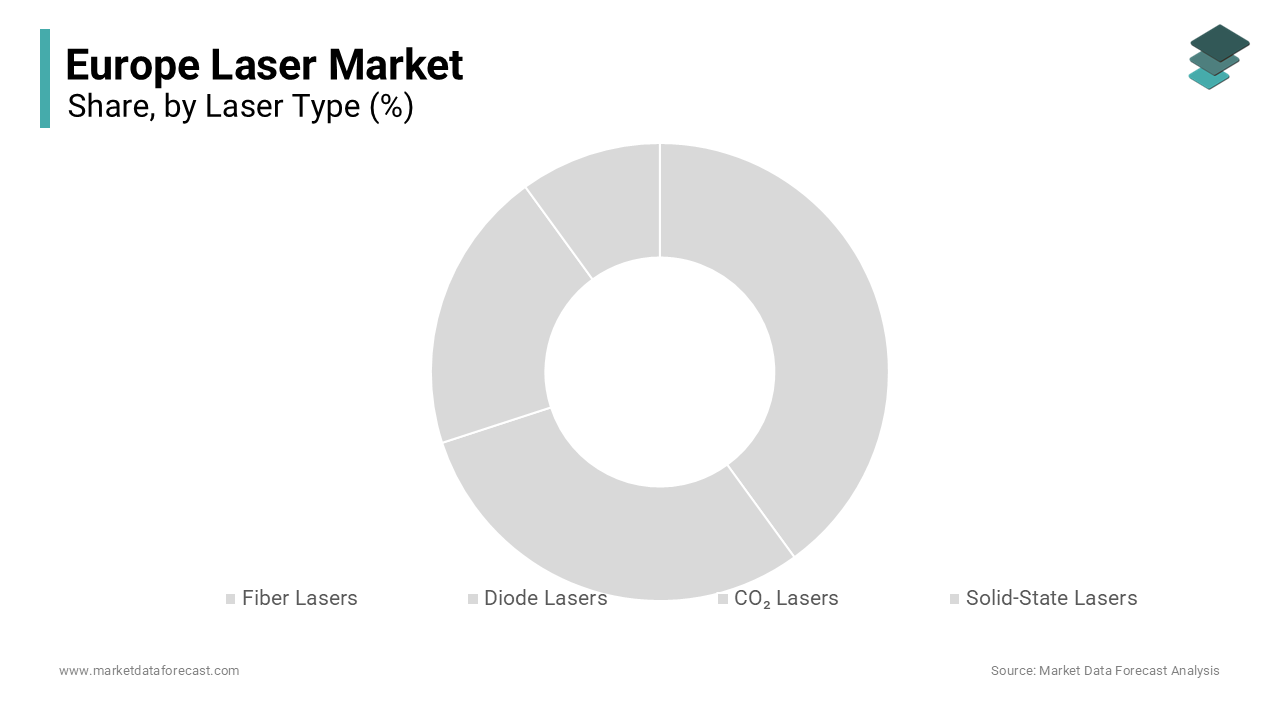
The diode lasers segment is a promising segment and is estimated to witness a CAGR of 13.3% over the forecast period. The versatility of diode lasers in diverse applications ranging from direct material processing to pumping solid state lasers and advanced medical therapies and the ongoing miniaturization and cost reduction of high power diode bars are driving the expansion of the diode lasers segment in the European market. According to the European Semiconductor Industry Association, the demand for direct diode laser systems in brazing and heat treatment applications is increasing because they offer higher electrical efficiency than other laser types. Additionally, the rise of lidar systems for autonomous vehicles relies heavily on specialized diode laser arrays that provide the necessary pulse rates and wavelengths for accurate distance measurement. As per research from the Technical University of Munich, advancements in beam combining techniques have allowed diode lasers to reach higher power levels, opening new markets in thick plate welding and additive manufacturing. The ability to tailor wavelengths for specific material absorption characteristics also drives adoption in the plastics and medical sectors, making diode lasers the most dynamic and rapidly evolving segment in the regional market.
By Application Insights
The materials processing segment held the dominant position in the Europe laser market and occupied the highest share of the Europe laser market in 2025. The leading position of materials processing segment in the European market can be credited to the entrenched role of laser technology in the continent's robust manufacturing base. This segment encompasses cutting, welding, marking, drilling, and surface treatment of metals, polymers, and ceramics, serving as the backbone for automotive, aerospace, and machinery production. The primary driver for this dominance is the relentless pursuit of precision and efficiency in European factories, where lasers replace mechanical tools to achieve faster cycle times and superior edge quality. According to Eurostat, the manufacturing sector contributes significantly to the European Union's gross domestic product, with high value-added industries relying heavily on non-contact processing methods to maintain competitiveness. The shift towards lightweight construction in the automotive industry, utilizing high strength steels and aluminum alloys, necessitates advanced laser welding techniques that ensure structural integrity while minimizing weight. As per the German Engineering Federation, laser based cutting systems have become the standard solution for sheet metal processing. Furthermore, the flexibility of laser systems allows for rapid reconfiguration of production lines to handle customized orders, a crucial capability in the era of mass customization. The continuous innovation in ultrafast lasers for micro machining also expands the scope of materials processing into electronics and medical device manufacturing, securing its leading market share.
The medical and cosmetic segment is poised to grow at a CAGR of 14.1% over the forecast period owing to the aging population, increasing demand for minimally invasive procedures and the expanding use of lasers in dermatology for skin rejuvenation, tattoo removal, and hair reduction, as well as in ophthalmology for vision correction and cataract surgery. The rising disposable income and aesthetic consciousness among European consumers that has led to a proliferation of private clinics offering laser-based treatments is further contributing to the expansion of the medical and cosmetic segment in the European market. According to the European Society of Aesthetic Medicine, the volume of non-surgical cosmetic procedures has increased, with laser therapies constituting the largest share of these interventions. Additionally, advancements in laser technology have made procedures safer and more effective, reducing recovery times and encouraging wider adoption among older demographics. As per the European Commission, the healthcare sector is increasingly integrating laser systems for surgical applications such as tissue ablation and coagulation, where precision is critical to preserving healthy tissue. The development of novel wavelengths specifically targeted at chromophores in the skin and eyes further enhances treatment outcomes, driving demand for specialized medical laser devices. Regulatory approvals for new indications and the trend towards outpatient surgeries also contribute to the rapid expansion of this high value segment.
By Mode of Operation Insights
The continuous wave segment led the market by capturing the major share of the Europe laser market in 2025. The growth of the continuous wave segment in the European market is driven by their extensive use in applications requiring constant energy delivery such as deep penetration welding, cutting of thick materials, and heat treatment. The prevalence of heavy industry in Europe, particularly in the automotive and shipbuilding sectors, where high power continuous wave fiber and CO2 lasers are indispensable for joining large structural components is also significantly contributing to the growth of the continuous wave segment in this Europe laser market. According to the European Steel Association, the production of high strength steel components for infrastructure and transport relies heavily on continuous wave laser welding. These lasers provide a stable thermal input that ensures consistent melt pool dynamics, which is critical for maintaining quality in high volume production environments. As per the International Institute of Welding, continuous wave processes offer superior productivity for thick section welding compared to pulsed modes, making them the preferred choice for heavy fabrication. Furthermore, the maturity of continuous wave technology means that systems are highly reliable and cost effective, with a well-established supply chain for components and service support. The ability to scale power output to multi kilowatt levels allows these lasers to process increasingly thick materials, expanding their utility in energy sector applications such as pipeline construction. This combination of industrial necessity, proven performance, and economic efficiency secures the continuous wave segment its leading position.
The pulsed mode of operation segment is expected to experience the fastest CAGR of 12.2% over the forecast period in this regional market owing to the rising demand for precision micro machining and cold ablation processes and the proliferation of ultrafast lasers including picosecond and femtosecond systems that deliver extremely short pulses to remove material with minimal heat affected zones. A key factor is the booming electronics and semiconductor industry in Europe, which requires the drilling of micro vias, dicing of brittle wafers, and structuring of flexible circuits without thermal damage. According to the European Semiconductor Industry Association, the miniaturization of electronic components necessitates processing techniques that only pulsed lasers can provide. Additionally, the medical device sector utilizes pulsed lasers for stent cutting and surface texturing of implants, where precision and biocompatibility are paramount. As per the Max Planck Institute, the ability of pulsed lasers to process transparent materials like glass and sapphire has opened new avenues in display manufacturing and sensor production. The growing adoption of laser marking for traceability in various industries also favors pulsed systems due to their ability to create high contrast marks on diverse materials. As applications shift towards finer features and more sensitive substrates, the demand for pulsed laser solutions continues to outpace other modes of operation.
By End User Industry Insights
The electronics and semiconductor segment had the dominant share of the Europe laser market in 2025. The dominance of electronics and semiconductor segment in the European market can be credited to the critical need for precision manufacturing in the production of chips, displays, and consumer electronic devices. This sector relies heavily on laser technologies for lithography, dicing, drilling, and annealing processes that define the performance and miniaturization of modern electronics. The primary driver for this dominance is the strategic push by the European Union to strengthen its semiconductor sovereignty through massive investments in new fabrication facilities and research centers. According to the European Chips Act, billions of euros are being mobilized to double the continent's global market share in semiconductor production by 2030, directly stimulating demand for advanced laser equipment. The complexity of packaging heterogeneous chips and integrating three dimensional structures requires laser processes that offer sub micron accuracy and throughput. As per the European Semiconductor Industry Association, the value of semiconductor production in Europe has reached record levels, with laser tools accounting for a significant portion of capital expenditure in fabs. Furthermore, the rise of flexible electronics and organic light emitting diode displays necessitates laser lift off and repair techniques that are unique to photonic solutions. The continuous innovation cycle in consumer electronics, demanding smaller and more powerful devices, ensures a steady and substantial demand for laser systems, cementing this industry's leading position.
The automotive and transportation segment is anticipated to record a CAGR of 13.1% over the forecast period owing to the radical transformation towards electric mobility and lightweight vehicle architectures and the extensive use of lasers in manufacturing electric vehicle batteries, motors, and lightweight body structures made from aluminum and carbon fiber reinforced polymers. The stringent emission regulations in Europe that force manufacturers to adopt laser welding for battery modules and packs to ensure safety and efficiency while reducing overall vehicle weight is further boosting the expansion of automotive and transportation segment in the European market. According to the European Automobile Manufacturers Association, the production of electric vehicles is accelerating, with laser processing being essential for joining dissimilar materials and creating hermetic seals for battery cells. Additionally, the trend towards autonomous driving increases the demand for lidar sensors, which are themselves laser-based systems, which is creating a dual demand for lasers as both a manufacturing tool and
REGIONAL ANALYSIS
Germany Laser Market Analysis
Germany stood as the undisputed leader in the Europe laser market by holding 29.4% of the European laser market share in 2025. The dominance of Germany in the European market is driven by its world class automotive industry, robust machinery sector, strong presence of laser manufacturers and a deep integration of laser technology into its manufacturing DNA, with companies like Trumpf and IPG Photonics having major operations there. The primary driver for this dominance is the "Industrie 4.0" initiative, which has accelerated the adoption of smart laser systems for automated production lines across the nation. According to the German Federal Statistical Office, the manufacturing sector accounts for a significant portion of the national GDP, with laser-based processes being central to maintaining global competitiveness in high precision engineering. Furthermore, Germany is a hub for photonics research, hosting numerous Fraunhofer institutes that collaborate with industry to develop next generation laser sources and applications. As per the German Laser Industries Association, the domestic demand for industrial lasers remains resilient, supported by continuous investment in electric vehicle production and aerospace components. The strong export orientation of German machinery also amplifies the market, as lasers embedded in German machines are deployed globally. This synergy between manufacturing prowess, research excellence, and industrial policy ensures Germany remains the epicentre of the European laser landscape.
United Kingdom Laser Market Analysis
The United Kingdom held the second leading share of the Europe laser market in 2025. The growth of the UK in the European market is attributed to a strong focus on aerospace, defense, and advanced medical technology applications. The vibrant ecosystem of research universities and specialized high-tech clusters that drive innovation in laser physics and applications and the presence of major aerospace manufacturers who utilize lasers for welding titanium components and drilling cooling holes in turbine blades are further boosting the market expansion in the UK. According to the UK Department for Business and Trade, the aerospace sector is a strategic priority, receiving government support to maintain its global leadership, which translates into sustained investment in high power and ultrafast laser systems. Additionally, the UK has a thriving medical device industry that leverages lasers for minimally invasive surgical tools and diagnostic equipment, benefiting from favorable regulatory frameworks post Brexit. As per the Centre for Process Innovation, the adoption of laser additive manufacturing is growing rapidly in the UK for producing complex lightweight parts for defense and motorsport. The government's Industrial Strategy Challenge Fund also provides grants for photonics projects, fostering collaboration between academia and industry. This combination of high value sectors, research strength, and targeted funding sustains the UK's prominent position in the regional market.
France Laser Market Analysis
France is anticipated to account for a promising share of the Europe laser market over the forecast period. Factors such as the strong nuclear energy sector, automotive industry, commitment to sovereign technological capabilities and significant state involvement in strategic industries where laser technology plays a critical role, such as nuclear fuel processing and aerospace assembly are propelling the French market growth. The principal driver for this market position is the "France 2030" investment plan, which allocates substantial resources to reindustrialize the country and support deep tech innovations including photonics. According to the French Ministry of Economy, the plan aims to reduce dependence on foreign technologies by fostering domestic production of critical components, including high power lasers for industrial use. The automotive sector, led by Renault and Stellantis, is increasingly adopting laser welding for electric vehicle batteries, driving demand for flexible and efficient laser sources. As per the French Photonics Cluster, there is a growing network of SMEs specializing in laser applications for luxury goods, such as leather cutting and jewelry marking, adding diversity to the market. The presence of major research organizations like CNRS further strengthens the innovation pipeline, ensuring a steady flow of advanced laser technologies. This strategic alignment of national policy, industrial needs, and research capacity reinforces France's status as a key market player.
Italy Laser Market Analysis
Italy is estimated to showcase a prominent CAGR in the Europe laser market during the forecast period owing to its renowned machinery manufacturing base, particularly in packaging, textile and metalworking equipment. The market status in Italy is heavily influenced by the "Made in Italy" brand, which demands high precision and quality in production processes, driving the adoption of advanced laser systems for cutting and marking. The primary driver for demand is the strong export orientation of Italian machinery builders who integrate laser sources into their equipment for global markets, creating a derived demand for laser technology. According to the Italian National Institute of Statistics, the machinery sector is a cornerstone of the economy, with laser cutting machines being a flagship product for exports to Asia and the Americas. The fashion and leather industries also contribute significantly, utilizing lasers for intricate cutting and engraving of fabrics and leathers to maintain design flexibility and speed. As per the Italian Association of Automation and Measurement Instruments, there is a steady modernization of small and medium sized workshops with fiber laser systems to improve productivity and reduce waste. The government's Industry 4.0 tax credit scheme has further accelerated this uptake by making investments in digital and laser technologies more affordable. The convergence of traditional craftsmanship with modern laser technology ensures Italy remains a vital and dynamic market.
Switzerland Laser Market Analysis
Switzerland is expected to exhibit a healthy CAGR in the Europe laser market during the forecast period due to its specialization in high precision micromachining, medical devices, and watchmaking. The focus on ultra-high value applications where precision and reliability are non-negotiable and the world leading pharmaceutical and medtech sectors that require lasers for stent manufacturing, drug coding, and surgical instrument production are further contributing to the market growth in Switzerland. According to the Swiss State Secretariat for Economic Affairs, the life sciences sector is a major economic pillar, investing heavily in advanced manufacturing technologies to maintain its competitive edge. The watchmaking industry, a symbol of Swiss precision, increasingly uses femtosecond lasers for drilling and structuring components without thermal damage, preserving material integrity. As per the Swiss Photonics Sector, the country hosts a dense network of specialized laser integrators and research institutes like EPFL that push the boundaries of laser applications. The high cost of labor in Switzerland necessitates extreme automation and process efficiency, which laser technology provides through high speed and non-contact processing. This focus on high margin, high precision sectors ensure Switzerland punches above its weight in the European laser market.
COMPETITIVE LANDSCAPE
The competition in the Europe laser market is characterized by intense rivalry among established global giants and agile regional specialists who constantly innovate to capture market share through technological superiority. Major players differentiate themselves by offering comprehensive ecosystems that combine hardware with advanced software for process control and data analytics. The market sees frequent launches of ultrafast and high-power laser systems designed to meet the stringent precision requirements of the semiconductor and aerospace industries. Price competition is moderate since buyers prioritize reliability and total cost of ownership over initial purchase price given the critical nature of laser operations in production lines. Regional specialists compete by providing highly customized solutions and superior local service support for specific applications like medical device manufacturing or luxury goods processing. The threat of new entrants remains low due to high barriers to entry including significant research costs and complex intellectual property landscapes. Collaboration between manufacturers and research institutes is becoming common to accelerate the development of next generation photonic technologies. Overall, the landscape is dynamic with companies vying to establish themselves as leaders in innovation and sustainability while adapting to evolving industrial needs and regulatory standards across the continent.
KEY MARKET PLAYERS
Some of the companies that are playing a dominating role in the Europe laser market include
- TRUMPF
- Coherent Corp.
- IPG Photonics Corporation
- Jenoptik AG
- Bystronic Laser AG
- Amada Co., Ltd.
- Lumentum Holdings Inc.
- MKS Instruments, Inc.
Top Players in the Market
Trumpf GmbH + Co. KG
Trumpf stands as a global pioneer in the Europe laser market, renowned for manufacturing high power solid state and fiber lasers that drive advanced industrial manufacturing processes worldwide. The company significantly contributes to the global landscape by setting benchmarks for precision cutting and welding technologies used in automotive and aerospace sectors. Trumpf recently strengthened its European position by launching next generation ultrafast lasers designed for micro machining in the semiconductor industry. The firm actively invests in quantum technology research to develop future proof photonic solutions that address emerging computational challenges. By expanding its production facilities in Germany and France, Trumpf ensures robust supply chains and faster delivery times for local customers. Their commitment to sustainability drives the development of energy efficient laser sources that reduce operational carbon footprints. This strategic focus on innovation and local manufacturing solidifies their reputation as a leader in the global photonics industry.
Coherent Corp.
Coherent Corp. leverages its extensive portfolio to maintain a strong presence in the Europe laser market with specialized solutions for scientific, medical, and industrial applications. The company contributes globally by providing critical laser components and systems that enable breakthroughs in materials processing and life sciences. Coherent recently enhanced its European offerings by introducing advanced excimer lasers tailored for semiconductor lithography and display manufacturing. The firm focuses on integrating artificial intelligence into laser control systems to optimize process parameters and minimize waste automatically. Through strategic acquisitions of niche technology firms, Coherent expands its capabilities in ultrafast and mid infrared laser segments. Their dedication to customer support includes establishing regional application centers that provide tailored training and process development services. These initiatives demonstrate a clear commitment to advancing technological capabilities and supporting the digital transformation of European industries while reinforcing its global standing.
IPG Photonics Corporation
IPG Photonics is a leading innovator in the Europe laser market, distinguished by its vertical integration model that allows for cost effective production of high-performance fiber lasers. The company plays a pivotal role globally by supplying reliable laser sources that power millions of industrial operations ranging from simple marking to complex additive manufacturing. IPG recently strengthened its market position in Europe by unveiling higher power multi kilowatt lasers capable of welding thick steel plates for shipbuilding and heavy machinery. The firm actively promotes the adoption of green lasers for processing reflective materials like copper and gold in electric vehicle battery production. By investing in local service networks across major European nations, IPG ensures rapid response times and minimal downtime for clients. Their continuous improvement of beam quality and efficiency standards ensures high adoption rates among manufacturers seeking to maximize productivity. This dedication to performance and reliability secures their status as a key partner for industrial automation across the continent.
Top Strategies Used by Key Market Participants
Key players in the Europe laser market primarily employ strategies focused on continuous research and development to introduce innovative laser sources with higher power and better efficiency. Companies frequently acquire specialized technology startups to expand their product portfolios into niche segments such as ultrafast or mid infrared lasers. Strategic partnerships with automotive and semiconductor manufacturers enable firms to co-develop customized solutions that meet specific production requirements. Expanding local manufacturing and assembly facilities helps companies mitigate supply chain risks and reduce delivery times for European customers. Firms increasingly invest in digital services and software integration to offer smart laser systems that provide real time process monitoring and predictive maintenance. Offering comprehensive training programs and application support centers builds strong customer loyalty and ensures optimal utilization of complex laser equipment. Developing energy efficient laser technologies aligns with European sustainability goals and appeals to environmentally conscious buyers. Diversifying into emerging applications like lidar for autonomous vehicles and medical diagnostics allows companies to capture new revenue streams beyond traditional industrial uses.
MARKET SEGMENTATION
This research report on the Europe laser market has been segmented and sub-segmented based on the following categories.
By Laser Type
- Fiber Lasers
- Diode Lasers
- CO₂ Lasers
- Solid-State Lasers
By Application
- Materials Processing
- Medical and Cosmetic
- Communication
- Data Storage
- Military and Defense
By Mode of Operation
- Continuous Wave
- Pulsed Mode
By End User Industry
- Electronics and Semiconductor
- Automotive and Transportation
- Healthcare
- Aerospace and Defense
- Industrial Manufacturing
By Country
- UK
- France
- Spain
- Germany
- Italy
- Russia
- Sweden
- Denmark
- Switzerland
- Netherlands
- Turkey
- Czech Republic
- Rest of Europe
Frequently Asked Questions
What is the Europe Laser Market?
The Europe laser market refers to the industry involved in the production, development, and application of laser technologies used in industrial, medical, research, and defense sectors.
What are the major applications of lasers in Europe?
Lasers in Europe are widely used in material processing, cutting, welding, marking, engraving, medical treatments, and scientific research.
Which industries use laser technology the most in Europe?
Key industries using laser technology include automotive, aerospace, healthcare, electronics, manufacturing, and defense.
What are the key drivers of the Europe Laser Market?
The market is driven by increasing automation in manufacturing, rising demand for precision machining, and technological advancements in laser systems.
What types of lasers are commonly used in Europe?
Commonly used lasers include fiber lasers, solid-state lasers, gas lasers, semiconductor lasers, and diode lasers.
Why are fiber lasers gaining popularity in Europe?
Fiber lasers are gaining popularity due to their high efficiency, low maintenance, compact size, and superior beam quality.
Which countries lead the Europe Laser Market?
Germany, the United Kingdom, France, and Italy are among the leading countries due to strong manufacturing industries and technological advancements
What role does the automotive industry play in the Europe Laser Market?
The automotive industry uses lasers extensively for welding, cutting, and marking components in vehicle manufacturing.
What challenges are faced by the Europe Laser Market?
High equipment costs, technical complexity, and the need for skilled professionals are some of the major challenges.
What is the future outlook for the Europe Laser Market?
The market is expected to grow steadily due to increasing demand for precision manufacturing, expanding healthcare applications, and ongoing technological innovations.
Access the study in MULTIPLE FORMATS
Purchase options starting from
$ 2000
Didn’t find what you’re looking for?
TALK TO OUR ANALYST TEAM
Need something within your budget?
NO WORRIES! WE GOT YOU COVERED!
Call us on: +1 888 702 9696 (U.S Toll Free)
Write to us: sales@marketdataforecast.com