- Product Description Description
- Table of Contents TOC
- List of Table & Figure LOT
- Get Free Sample PDF Sample PDF
Market Size, 2025
$2.12 BnMarket Estimate, 2026
$2.29 BnMarket Forecast, 2034
$4.29 BnCAGR, 2026–2034
8.15%Europe Laser Processing Market Size, Growth, Trends & Forecast (2026–2034)
The Europe laser processing market size was calculated to be USD 2.12 billion in 2025, is estimated to reach USD 2.29 billion in 2026, and is anticipated to be worth USD 4.29 billion by the end of 2034, registering a compound annual growth rate (CAGR) of 8.15% during the forecast period from 2026 to 2034. Driven by the industrial adoption of lightweight materials, stringent manufacturing quality standards, and public-private investments in Industry 4.0 and advanced photonics, the European laser processing sector continues to expand beyond conventional cutting and welding into high-precision micro-processing and AI-driven smart manufacturing.
Key Executive Metrics (At-a-Glance)
- 2025 Base Valuation: USD 2.12 Billion
- 2026 Current Valuation: USD 2.29 Billion
- 2034 Forecast Valuation: USD 4.29 Billion
- Compound Annual Growth Rate (CAGR): 8.15% (2026–2034)
- Largest Process Segment: Material Processing (64.4% share in 2025)
- Fastest-Growing Process Segment: Micro-Processing (13.2% CAGR)
- Largest Regional Market: Germany (28.2% share in 2025)
Core Market Drivers
- Lightweight Materials Adoption: Increasing utilization of advanced alloys, aluminum, and composites in automotive and aerospace manufacturing requiring precise non-contact laser systems.
- Industrial Digitalization Policy: Substantial public funding via EU frameworks like Horizon Europe, IPCEI, and national digitization initiatives embedding laser processing in manufacturing strategies.
Primary Market Restraints & Challenges
- High Capital Expenditure: Substantial upfront investment costs for advanced fiber and ultrafast laser systems, alongside strict regulatory safety enclosure mandates.
- Component Import Dependency: Reliance on external regions for core components like high-brightness laser diodes and specialty optics, leaving the supply chain vulnerable to external shocks.
Europe Laser Processing Market Segmentation Breakdown
| Segment Category | Dominant / Leading Segment | Fastest-Growing / High-Potential Segment |
|---|---|---|
| By Process | Material Processing (64.4% share in 2025) | Micro-Processing (13.2% CAGR) |
| By Region | Germany (28.2% share in 2025) | Italy, France, United Kingdom |
Major Industry Players Profiled
Key enterprises shaping the European laser processing market include AMADA Co Ltd, Bystronic AG, Coherent Inc., Han’s Laser Technology Industry Group Co., Ltd., IPG Photonics Corporation, TRUMPF Group, Jenoptik AG, and Epilog Laser.
Europe Laser Processing Market Size
The Europe laser processing market size was calculated to be USD 2.12 billion in 2025 and is anticipated to be worth USD 4.29 billion by 2034, from USD 2.29 billion in 2026, growing at a CAGR of 8.15% during the forecast period.
Laser processing is the industrial application of high-precision laser technologies, including cutting, welding, drilling, marking, and surface treatment across manufacturing sectors such as automotive, aerospace, electronics, and medical devices. Unlike conventional mechanical methods, laser processing enables micron-level accuracy, minimal thermal distortion, and contact-free operation on materials ranging from ultra-thin foils to high-strength alloys. Europe maintains a leadership position in this domain through its advanced engineering ecosystem, strong public investment in Industry 4 0 and stringent manufacturing quality standards. For instance, a significant share of EU manufacturing firms with more than 250 employees have adopted at least one form of laser‑based production technology as part of their digital transformation initiatives. According to the European Photonics Industry Consortium, Europe accounts for a substantial portion of global high‑power laser system exports, with Germany, Italy, and Finland hosting world‑class laser developers. Driven by the need for lightweighting, energy efficiency, and traceability in critical components, laser processing has evolved from a niche capability to a foundational enabler of modern European industrial competitiveness.
MARKET DRIVERS
Adoption of Lightweight Materials in Automotive and Aerospace Manufacturing
The escalating incidence of advanced material adoption across Europe is one of the key factors propelling the growth of the European laser processing market. According to the European Automobile Manufacturers Association (ACEA), the average weight of new passenger cars in the EU has decreased by approximately 11% since 2015 while maintaining safety standards, largely due to increased use of aluminum, high‑strength steels, and carbon‑fiber composites. These materials are difficult or impossible to machine with conventional tools but respond exceptionally well to fiber and ultrafast lasers. As per Airbus, modern aircraft such as the Airbus A350 incorporate about 70% advanced materials, including more than 50% composites by weight, requiring laser ablation for precise trimming and hole drilling without delamination. According to the Fraunhofer Institute for Laser Technology, German automotive suppliers such as Bosch and ZF employ laser welding for battery tabs in electric vehicles, achieving joint strengths significantly higher than mechanical crimping. This materials revolution necessitates non‑contact, thermally controlled processing, which is making laser systems indispensable for next‑generation European manufacturing.
EU Industrial Policy Prioritizing Advanced Manufacturing and Digitalization
The growth of the European laser processing market is driven by the region’s strategic emphasis on technological sovereignty and resilient production. According to the European Commission, the Important Project of Common European Interest (IPCEI) on Next‑Generation Batteries approved in 2019 involved €6.1 billion in state aid, expected to trigger €13.8 billion in private investment, embedding laser electrode structuring and welding as mandatory process steps. As per Horizon Europe funding data, more than €220 million has been committed between 2021 and 2027 specifically to photonics and laser manufacturing innovation through initiatives such as Photonics21. According to Eurostat and EU Industry 4.0 roadmaps, 74% of EU member states now include laser processing in their national strategies, with Germany’s Plattform Industrie 4.0 and France’s France 2030 explicitly funding laser integration in SMEs. As per national innovation agencies, organizations such as Vinnova in Sweden and Tampere University of Technology (TUT) in Finland operate open‑access laser innovation centers offering subsidized prototyping to startups. This coordinated public‑private investment ensures that laser adoption is not merely market‑driven but structurally embedded in Europe’s vision for high‑value, low‑volume, and sustainable manufacturing.
MARKET RESTRAINTS
High Capital Expenditure and Operational Complexity
One of the primary restraints facing the European laser processing market is the significant upfront investment and technical expertise required for industrial laser systems. According to recent fiber laser price analyses (2025), a mid‑power fiber laser cutting system with automation integration typically costs between €350,000 and €600,000, while ultrafast picosecond systems can exceed €1 million. As per EU Directive 2006/25/EC, laser safety protocols mandate dedicated enclosures, interlocks, and certified operator training, adding 15–20% the o total cost of ownership. According to industry surveys, only a minority of SMEs in Southern and Eastern Europe have implemented laser processing due to financing gaps and a lack of in‑house photonics expertise. Additionally, maintenance requires specialized service contracts with original equipment manufacturers, as third‑party support is often unavailable. These barriers create a two‑tier market where large OEMs advance rapidly while smaller firms lag, undermining the EU’s goal of inclusive industrial modernization.
Dependence on Imported Core Laser Components
The supply chain disruptions and raw material shortages, exacerbated by global trade tensions and logistical bottlenecks, are hampering the European laser processing market growth. According to the European Photonics Industry Consortium (EPIC), Europe remains heavily reliant on imports, with more than 65% of high‑brightness laser diodes sourced from the United States and Japan, while specialty optics coatings and galvanometer scanners are predominantly manufactured in China and Switzerland. As per the Fraunhofer Institute, the 2022 semiconductor shortages extended laser diode lead times from 12 to over 40 weeks. According to the European Commission’s Horizon Europe Photonics Partnership, scaling domestic component production remains slow due to high clean‑room infrastructure costs and limited wafer fabrication capacity. Until Europe achieves greater vertical integration in photonics, its laser processing sector will remain vulnerable to external disruptions despite strong end‑user demand.
MARKET OPPORTUNITIES
Integration of Ultrafast Lasers in Medical Device Manufacturing
The growing adoption of ultrafast laser systems in medical device manufacturing is a significant opportunity for the European laser processing market. According to the European Medical Devices Coordination Group (MDCG), Class III medical devices—including stents, catheters, and orthopedic implants that require micron‑scale features achievable only with femtosecond or picosecond lasers. As per the European Medicines Agency (EMA), Regulation (EU) 2017/745 mandates unique device identifiers, and guidance confirms that laser engraving is increasingly used for traceability. German company B. Braun uses ultrafast lasers to drill 20‑micron holes in neurovascular catheters, while Irish firm Medtronic employs laser texturing for osseointegration on spinal implants. According to MedTech Europe, the EU medical technology market was valued at approximately €170 billion in 2025, representing 26.4% of the global market. With annual growth exceeding 5%, this application offers
Expansion of In-Process Monitoring and AI-Driven Laser Control
The development of advanced AI‑driven in‑process monitoring solutions offers another promising avenue for the European laser processing market expansion. According to European research projects on laser monitoring, systems equipped with real‑time sensing reduce scrap rates by up to 35% and eliminate post‑process inspection in 60% of automotive applications. As per industry announcements, companies such as Trumpf and Bystronic have integrated AI‑based quality prediction into their latest laser platforms, enabling real‑time parameter adjustment. According to the EU’s Digital Europe Programme, €95 million was allocated in 2025 to deploy smart laser systems in SME manufacturing clusters across Poland, Romania, and Portugal. This digital layer not only enhances precision but also enables predictive maintenance and remote operation—positioning European laser processing at the forefront of intelligent manufacturing.
MARKET CHALLENGES
Shortage of Skilled Photonics and Laser Technicians
The absence of a skilled workforce in photonics and laser technology is primarily challenging the European laser processing market. According to Cedefop Skills Forecasts, the EU will face a shortfall of over 120,000 photonics technicians by 2030, with laser applications accounting for nearly half of this gap. As per the Federal Institute for Vocational Education in Germany, 41% of laser machine operators in automotive supply chains received on‑the‑job training rather than formal certification, increasing error rates and downtime. According to the European University Association (EUA), only 11% of life‑science degree programs in the EU include mandatory courses in data governance or informatics. Although initiatives like the European Photonics Skills Alliance aim to harmonize training standards, uptake remains slow due to fragmented national education systems. Without a skilled workforce, even the most advanced laser investments risk underutilization, threatening Europe’s competitiveness in precision manufacturing.
Regulatory Uncertainty Around Laser Safety and Environmental Compliance
The growing instability due to fragmented regulatory interpretations and evolving environmental compliance requirements is also challenging the expansion of the European laser processing market. According to the European Laser Association, 22% of laser system installations in 2023 faced delays due to conflicting local authority interpretations of emission and noise limits. As per the EU Machinery Directive 2006/42/EC and the Artificial Optical Radiation Directive 2006/25/EC, baseline safety requirements are established, but national interpretations vary significantly, as Germany mandates full Class 1 enclosure for all industrial lasers, whereas the Czech Republic permits limited Class 4 operation under strict protocols. According to the European Commission’s Green Deal framework, new environmental rules restrict certain greenhouse gases, such as sulfur hexafluoride used in laser cutting, due to their high global warming potential. This regulatory ambiguity increases project risk, particularly for SMEs lacking legal resources, which is slowing the pace of industrial laser integration despite clear productivity benefits.
REPORT COVERAGE
| REPORT METRIC | DETAILS |
| Market Size Available | 2025 to 2034 |
| Base Year | 2025 |
| Forecast Period | 2026 to 2034 |
| CAGR | 8.15% |
| Segments Covered | By Process, and Region |
| Various Analyses Covered | Global, Regional & Country Level Analysis; Segment-Level Analysis; DROC, PESTLE Analysis; Porter’s Five Forces Analysis; Competitive Landscape; Analyst Overview of Investment Opportunities |
| Regions Covered | UK, France, Spain, Germany, Italy, Russia, Sweden, Denmark, Switzerland, Netherlands, Turkey, and the Czech Republic |
| Market Leaders Profiled | AMADA Co Ltd, Bystronic AG, Coherent Inc., Han’s Laser Technology Industry Group Co., Ltd., IPG Photonics Corporation, TRUMPF Group, Jenoptik AG, Epilog Laser |
SEGMENTAL ANALYSIS
By Process Insights
The material processing segment dominated the Europe laser processing market by holding 64.4% of the market in 2025. The dominance of the material processing segment in this European market is attributed to its foundational role in high‑volume industrial manufacturing, where laser cutting, welding, and drilling are now standard for structural components. According to ACEA and industry studies, laser welding is increasingly used in electric vehicle battery pack production across Europe due to its precision and repeatability. In aerospace, Electro Optics reports that fiber lasers are widely deployed for cutting titanium and composite fuselage panels, offering tolerances far superior to mechanical methods. According to the Fraunhofer ILT, laser‑based manufacturing processes improve energy efficiency in battery cell and component production compared to conventional methods. Additionally, the EU Ecodesign Directive (2009/125/EC, updated 2025) mandates energy efficiency standards for industrial equipment, incentivizing the adoption of high‑efficiency laser systems. This deep integration across strategic sectors ensures material processing remains the economic and technological core of Europe’s laser processing landscape.
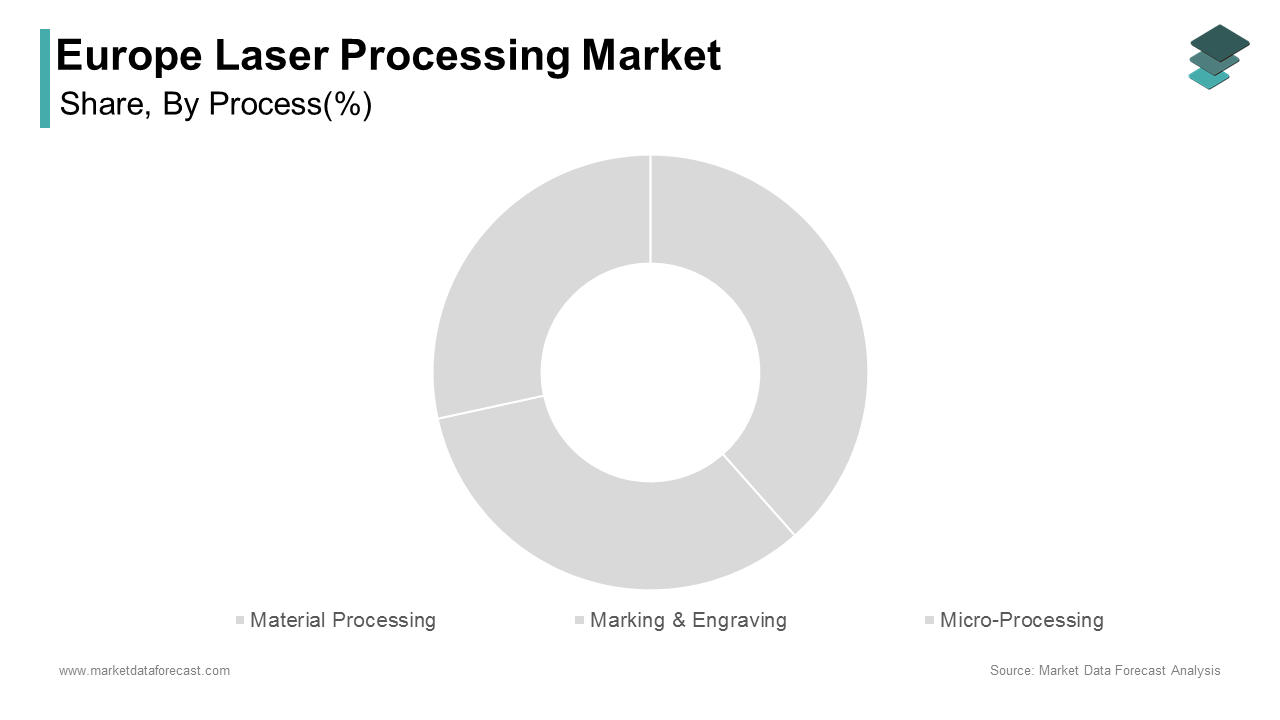
The micro‑processing segment is promising and is anticipated to exhibit a CAGR of 13.2% over the forecast period in the European market. The miniaturization of electronics, medical devices, and sensors requiring sub‑10-micron feature accuracy is favouring the growth of the micro‑processing segment in this European market. Ultrafast lasers enable cold ablation that removes material without thermal damage, critical for brittle substrates like silicon carbide and sapphire used in semiconductor packaging. According to the European Semiconductor Industry Association (ESIA), advanced chip packaging facilities in Europe increasingly integrate laser dicing and via drilling for precision interconnects. In medical technology, European firms employ micro‑processing to fabricate neurostimulator electrodes with micron‑scale channels for precise current delivery. The European Chips Act (2025) allocated significant funding, including €1.3 billion for advanced packaging facilities, reinforcing infrastructure for laser micro‑machining. As demand grows for wearables, implantable, and quantum sensors, this high‑precision segment will continue to outpace traditional applications.
REGIONAL ANALYSIS
Germany Laser Processing Market Analysis
Germany occupied the dominating position of the European market in 2025 by accounting for 28.2% of the regional market share. The dominating position of Germany in the European market is driven by its integrated ecosystem of laser manufacturers, research institutes, and a strong industrial base. According to the German Engineering Federation (VDMA), Germany’s leadership arises from its dense network of laser manufacturers such as TRUMPF and Coherent, alongside Fraunhofer ILT’s world‑class research. As per the German Association of the Automotive Industry (VDA), a majority of automotive suppliers now deploy laser welding for battery and powertrain components. According to the Federal Ministry for Economic Affairs, €420 million was allocated in 2023 under the Photonics Research Germany initiative to accelerate ultrafast laser adoption in SMEs. Germany also hosts Europe’s most advanced laser safety certification infrastructure, ensuring rapid compliance. Germany is expected to remain the technological and industrial nucleus of European laser processing in the coming years.
Italy Laser Processing Market Analysis
Italy held a substantial share of the European laser processing market in 2025. According to the Italian Association for Industrial Laser Applications, Italy’s strength lies in combining artisanal craftsmanship with advanced laser technology across fashion, machinery, and medical devices. Textile machinery leaders such as Diatec and Sperotto Rimar employ laser cutting for high‑speed fabric patterning, serving luxury brands like Prada and Gucci. In the Mirandola biomedical district, hundreds of medical device firms use laser welding and marking for disposable surgical instruments. Italy’s National Recovery and Resilience Plan committed €310 million in 2025 to modernize laser infrastructure in SME clusters across Emilia Romagna and Lombardy. Italy is expected to sustain growth in both high‑volume and high‑precision niches in the next few years.
France Laser Processing Market Analysis
France captured a substantial share of the European laser processing market in 2025. As per the French Photonics Network, France’s market is driven by the aerospace and defense industries, requiring extreme reliability. Airbus facilities in Toulouse and Saint‑Nazaire use multi‑axis laser systems for composite trimming and drilling. The French Defense Procurement Agency mandates laser marking for all serial‑tracked components under UID compliance. France’s “France 2030” investment plan allocated €220 million to photonics innovation, with emphasis on space‑qualified laser processing. Backed by public research labs such as Thales Research and Technology, France is expected to maintain a strategic edge in mission‑critical laser applications.
United Kingdom Laser Processing Market Analysis
The United Kingdom remained an important participant in the European laser processing market in 2025. According to the UK Photonics Leadership Group, the UK has pivoted toward micro‑processing applications in medical technology and semiconductor packaging. The Medicines and Healthcare products Regulatory Agency reported that over 300 medtech firms in Cambridge and Oxford use femtosecond lasers for implantable devices. The Compound Semiconductor Applications Catapult operates Europe’s largest advanced packaging pilot line, where laser lift‑off and dicing are standard processes. Government initiatives such as the National Quantum Strategy and Life Sciences Vision directed £180 million in 2025 toward laser‑based manufacturing infrastructure. The UK is expected to sustain its relevance in Europe’s precision laser landscape in the coming years.
Sweden Laser Processing Market Analysis
Sweden continued to play a notable role in the European laser processing market in 2025. According to the Swedish Photonics Industry Association, Sweden’s market is defined by sustainable manufacturing and renewable energy integration. The Swedish Environmental Protection Agency confirmed that Volvo uses fiber lasers powered by hydroelectricity for battery module welding in Gothenburg, reducing carbon intensity significantly. Research institutions such as Luleå University of Technology pioneer laser processing with green hydrogen as an assist gas. Sweden also leads in eco‑design, with most industrial laser systems sold domestically, including energy recovery and closed‑loop chillers. Sweden is expected to strengthen its role as a leader in sustainable and circular laser technologies in the coming years.
COMPETITION OVERVIEW
The Europe laser processing market is characterized by a tiered competitive structure where German and Swiss engineering giants dominate high-end applications, while niche specialists serve specific sectors like medical devices or electronics. Competition is driven by technological sophistication, service depth, and integration capabilities rather than price alone. TRUMPF Coherent and Bystronic lead through vertical integration in-house photonics R&D and digital ecosystem development. Asian manufacturers are gaining ground in mid-power segments but struggle to match European reliability and application support. Barriers to entry remain high due to capital intensity, regulatory compliance, and the need for deep process know-how. The market is consolidating as digitalization favors companies that offer end-to-end solutions from hardware to data analytics. Innovation in ultrafast lasers, AI control, and sustainability features defines the frontier of competition in the high-precision industrial domain.
KEY MARKET PLAYERS
A few major players of the Europe laser processing market include
- AMADA Co Ltd
- Bystronic AG
- Coherent Inc
- Han’s Laser Technology Industry Group Co., Ltd
- IPG Photonics Corporation
- TRUMPF Group
- Jenoptik AG
- Epilog Laser
Top Strategies Used by the Key Market Participants
Key players in the Europe laser processing market are embedding artificial intelligence and real-time sensor feedback into laser systems to enable adaptive process control and reduce scrap rates. They are developing integrated digital platforms that connect laser machines to enterprise resource planning and predictive maintenance software, enhancing overall equipment effectiveness. Companies are prioritizing energy efficiency and carbon tracking features to align with the EU Green Deal and CSRD compliance requirements. Strategic collaborations with automotive battery and semiconductor manufacturers ensure co-development of application-specific laser solutions. Additionally, firms are expanding regional application centers to provide localized process validation training and andafter-saless support, strengthening customer retention and technical trust.
Leading Players in the Europe Laser Processing Market
TRUMPF GmbH + Co KG
TRUMPF is a German industrial technology leader and a global pioneer in laser processing systems for cutting, welding, and additive manufacturing. The company supplies high-power disk and fiber lasers to automotive, aerospace,ce, and electronics manufacturers across Europe and worldwide. In 2025, TRUMPF launched its next-generation TruLaser Cell 7040 with integrated AI-driven process monitoring for real-time quality control in battery component production. It also expanded its smart factory ecosystem by linking laser machines to its LEANworx digital platform, enabling predictive maintenance and energy optimization. Through strategic partnerships with Siemens and Bosc,h TRUMPF integrates its laser solutions into broader Industry 4.0 production lines, reinforcing its role as a cornerstone of advanced European manufacturing and a key exporter of precision laser technology globally.
Coherent Corp (with major European operations)
Coherent maintains a significant footprint in the Europe laser processing market through its advanced photonics portfolio, including ultrafast high-energy lasers for micro processing and semiconductor applications. Its German and Italian facilities develop picosecond and femtosecond systems used in medical device fabrication and EV battery structuring. In 2023, Coherent introduced its HyperRapid NXT platform, featuring higher pulse rates and improved beam quality for high-throughput glass cutting in consumer electronics. The company also strengthened its European service network with certified application centers in Munich, Eindhoven, and Milan, offering process validation and operator training. Coherent’s deep integration with European semiconductor and medtech supply chains ensures its continued influence in high-precision industrial laser markets worldwide.
Bystronic Group
Bystronic is a Swiss-based global provider of laser cutting and bending solutions with a strong presence across European metal fabrication industries. The company specializes in automated laser cutting cells that combine fiber lasers, robotic loading A G-code-based nesting software. In 2025, Bystronic unveiled its ByVision Cutting 360 platform, featuring real-time adaptive control that adjusts laser parameters based on material reflectivity and thickness variations. It also launched a carbon footprint calculator integrated into its machine interface, helping European fabricators comply with EU sustainability reporting requirements. Bystronic’s focus on ease of use, automation, and energy efficiency resonates with mid-sized industrial customers seeking digital transformation without sacrificing operational simplicity, positioning it as a key enabler of smart manufacturing across Europe and emerging markets.
MARKET SEGMENTATION
This research report on the Europe laser processing market has been segmented and sub-segmented based on process and region.
By Process
- Material Processing
- Marking & Engraving
- Micro-Processing
By Region
- UK
- France
- Spain
- Germany
- Italy
- Russia
- Sweden
- Denmark
- Switzerland
- Netherlands
- Turkey
- Czech Republic
- Rest of Europe