Europe Last Mile Delivery Market Size, Share, Trends & Growth Forecast Report – Segmented By Service Type (B2C, B2B, C2C), Technology, Application, and Country (UK, France, Spain, Germany, Italy, Russia, Sweden, Denmark, Switzerland, Netherlands, Turkey, Czech Republic & Rest of Europe), Industry Analysis From 2026 to 2034
Market Size, 2025
$41.87 BnMarket Estimate, 2026
$45.75 BnMarket Forecast, 2034
$92.91 BnCAGR, 2026–2034
9.26%Europe Last Mile Delivery Market Summary
The Europe last mile delivery market size reached USD 41.87 billion in 2025, is expected to grow to USD 45.75 billion in 2026, and is projected to hit USD 92.91 billion by 2034, expanding at a CAGR of 9.26% from 2026 to 2034. Market growth is fueled by the rapid expansion of e-commerce, increasing consumer expectations for faster and same-day deliveries, and major investments in logistics infrastructure across European economies. Technological advancements, the rise of delivery automation, and the scaling of omnichannel retail strategies are further driving market expansion. Growing demand for efficient delivery operations in urban areas and the rising adoption of green and sustainable delivery solutions are also shaping the market landscape.
Key Market Trends
- Strong growth driven by e-commerce acceleration and rising demand for fast, convenient, and same-day deliveries across Europe.
- Increasing investments in sustainable last-mile models such as electric vans, e-bikes, and carbon-neutral delivery networks.
- Growing adoption of route optimization, advanced tracking, and digital fulfillment technologies by logistics providers.
- Expansion of micro-fulfillment centers and dark stores improving delivery efficiency in high-density urban regions.
- Rising experimentation with autonomous delivery technologies such as drones, robots, and automated lockers.
Segmental Insights
- Based Service Type, the business-to-consumer (B2C) segment dominated the Europe last-mile delivery market in 2025, driven by surging online shopping activity, particularly in fashion, electronics, and food delivery.
- Based Technology, non-autonomous delivery systems held the largest share in 2025, as traditional courier networks, manual delivery fleets, and human-operated logistics systems continue to remain the backbone of European last-mile operations despite increasing automation trials.
Regional Insights
Europe continues to witness strong last-mile delivery growth supported by mature logistics networks, high digital adoption, and rapid e-commerce penetration.
- Germany led the European market with a 23.8% share in 2025, supported by its advanced transportation infrastructure, high-volume e-commerce activity, and strong presence of global logistics giants.
- Other major contributors include the United Kingdom, France, Italy, Spain, and the Nordic region, driven by urbanization and consumer preference for quick and flexible deliveries.
Competitive Landscape
The Europe last-mile delivery market is competitive and characterized by global logistics companies, regional delivery specialists, and emerging autonomous delivery innovators. Companies are focusing on digitalization, network expansion, sustainability initiatives, and automation technologies to strengthen market position.
Prominent players include Power Link Expedite, A2Z Drone Delivery, XPO, Drone Delivery Canada Corp, Kerry Logistics Network Ltd, FedEx Corp, United Parcel Service Inc, DHL Group, and Amazon.com Inc
Europe Last Mile Delivery Market Size
The Europe last-mile delivery market size was valued at USD 41.87 billion in 2025 and is projected to reach USD 92.91 billion by 2034 from USD 45.75 billion in 2026, growing at a CAGR of 9.26%.
Last mile delivery is the final leg of the logistics chain wherein goods are transported from a distribution hub to the end consumer or business recipient. This segment has evolved into a critical determinant of customer satisfaction, supply chain resiliency,,e and urban sustainability across the continent. Unlike earlier models centred on bulk B2B drop-offs offs contemporary last-mile operations must accommodate high-frequency small parcel volumes, dynamic time windows, eco-sensitive routing. The transformation is driven by Europe’s dense urban populations, strict environmental regulations, and digitally empowered consumers who now expect delivery within hours rather than days. According to sources, the European Union has a predominantly urban population, with a significant majority of its inhabitants residing in cities, towns, and suburbs, leading to ongoing efforts to manage associated environmental impacts like traffic and emissions. Furthermore, despite representing a relatively small proportion of total distance travelled by vehicles, urban freight transport operations contribute substantially to road transport carbon dioxide emissions and air pollution within cities. These pressures have caused innovation in micro fulfilment, electric mobility, and delivery orchestration platforms, making last mile delivery both a logistical and policy focal point in Europe’s broader green and digital transition agenda.
MARKET DRIVERS
Explosive Growth of E Commerce and Consumer Expectations for Speed and Convenience
The relentless expansion of online retail has accelerated the European last-mile delivery market. In addition, the proportion of retail sales made through e-commerce channels in the European Union has shown consistent growth over the long term, though annual rates can fluctuate. Consumers now treat fast delivery as a baseline expectation rather than a premium service. Consumer expectations regarding fast delivery, particularly same-day or next-day options, significantly influence purchasing decisions and are a leading cause of shopping cart abandonment across key European markets, as per a study. This pressure has forced retailers and logistics providers to decentralise inventory through urban micro fulfilment centres and dark stores, enabling sub-two-hour dispatch windows. Major players like Zalando and Amazon have established hyperlocal hubs in major cities, which reduces average delivery distances by up to forty per cent. The rise of social commerce and live shopping further intensifies urgency as flash sales generate sudden localised demand spikes requiring agile last-mile networks. This behavioural and operational shift has made delivery speed, reliability, ty and transparency non-negotiable pillars of European retail competitiveness.
Stringent Urban Environmental Regulations Mandating Zero Emission Logistics
Regional cities are implementing aggressive low and zero-emission zone policies that directly contribute to the expansion of the European last-mile delivery market. A significant number of urban areas across the European Union are implementing restrictions on internal combustion engine vehicles, with major cities advancing plans for more comprehensive bans on fossil fuel delivery vehicles in the coming years, according to studies. The European Commission’s Urban Mobility Framework explicitly ties municipal funding to sustainable last-mile strategies, including cargo bike networks, electric vehicle adoption,, on and off-hour deliveries. In response, logistics operators are rapidly electrifying fleets. Major logistics companies like DHL are increasingly incorporating large fleets of electric vans into their global operations to support last-mile deliveries. Besides, Cities, including Copenhagen and Utrecht, are converting conventional parking areas into small-scale urban distribution hubs, which are then serviced by e-cargo bikes to facilitate last-mile deliveries and decrease vehicle mileage within urban centres. These regulatory and infrastructural shifts compel carriers to innovate beyond vehicle replacement toward integrated eco logistics ecosystems that align with Europe’s climate neutrality goals.
MARKET RESTRAINTS
Persistent Urban Congestion and Limited Loading Infrastructure
Chronic urban congestion and inadequate freight handling facilities, despite technological advances, restrain the growth of the European last-mile delivery market. Last-mile delivery in major European cities is increasingly inefficient due to significant time lost searching for available parking or idling while waiting to unload. This inefficiency not only inflates operational costs but also increases emissions and delivery delays. Compounding the issue is the scarcity of dedicated loading bays. Major metropolitan areas like Paris and London face a persistent shortage of designated commercial loading and unloading zones relative to the high volume of daily delivery vehicles. Urban planning policies and competition for street space in central London have resulted in a noticeable reduction in available kerbside space for commercial use over the last decade. Many historic city centres lack space for consolidation hubs, forcing carriers to make multiple trips from distant depots. Municipal policies often prioritise passenger mobility over freight, with delivery windows restricted to off-peak hours that conflict with consumer availability. The last mile will continue to be an efficiency and sustainability challenge unless cities develop shared urban logistics infrastructure, for instance, underground conduits for parcels or multi-carrier lockers.
Fragmented Regulatory Landscape Across Municipalities and Countries
There is a highly fragmented regulatory environment that varies significantly between cities, regions, and member states, which hinders the expansion of the European last-mile delivery market. "A gap exists between EU sustainability frameworks and local application, resulting in patchy regulations for delivery access, operating hours, micro-hub permits, and noise restrictions. For example, Carriers operating across the Benelux region face diverse and evolving urban access regulations, including zero-emission zone mandates in Dutch cities like Amsterdam and low-emission zones based on emission standards in Brussels. This regulatory patchwork presents operational challenges for seamless cross-border logistics. According to sources, the lack of standardised urban logistics regulations across different European municipalities results in increased complexity and operational burdens for last-mile delivery operators. This patchwork impedes economies of scale, prevents standardised fleet deployment, and complicates route planning software development. Unlike the United States, which has federal preemption on vehicle standards, Europe’s subsidiarity principle empowers local governments, creating operational silos that hinder the rollout pan-European delivery innovations such as autonomous shuttles or drone networks.
MARKET OPPORTUNITIES
Rise of Shared Urban Logistics and Consolidation Hubs
Cities in the region are increasingly adopting shared logistics models to optimise last-mile efficiency and reduce urban freight pollution, which provides new opportunities for the growth of the European last-mile delivery market. Consolidation centres located at city peripheries aggregate parcels from multiple retailers before redistributing them via zero-emission vehicles or cargo bikes into urban cores. As per sources, shared delivery schemes and urban logistics initiatives have the potential to significantly reduce the number of delivery vehicles entering busy urban centres, improving traffic flow and air quality. Cities and postal operators are increasingly collaborating on the establishment of inner-city micro-hubs, which enable the use of smaller, zero-emission vehicles like e-vans and cargo tricycles for last-mile delivery. Similarly, Paris’s “Logistics Hotel” initiative repurposes underused railway warehouses into multi-tenant fulfilment spaces, reducing redundant trips. The European Commission’s Urban Mobility Package encourages such models through grants under the Connecting Europe Facility. These collaborative infrastructures lower costs for small retailers, enable better route density and align with circular economy principles by reusing packaging and return flows. The scarcity of urban space necessitates shared logistics as the foundation for sustainable last-mile ecosystems continent-wide.
Integration of AI-Driven Dynamic Routing and Real-Time Consumer Interaction
Advanced artificial intelligence is offering potential opportunities for the expansion of the European last-mile delivery market. This is transforming operations by enabling hyper-adaptive delivery orchestration that responds to live traffic, weather, and consumer availability. Leading European logistics platforms now use machine learning to predict optimal delivery windows based on historical behaviour, our real-time GPS data and municipal traffic feeds. Leading logistics companies leverage AI-optimised routing to significantly reduce operational inefficiencies, including minimising failed delivery attempts and lowering fuel consumption across their networks. Simultaneously, consumer-facing apps offer dynamic rescheduling with carbon impact transparency, allowing users to choose slower green options for loyalty points. Implementing real-time delivery interaction and communication strategies enhances overall delivery efficiency and improves the likelihood of successful first-attempt deliveries in urban environments. These systems also feed data back into inventory placement algorithms, guiding where to position stock for future demand. Integrating AI into last-mile delivery unlocks both operational and strategic value within Europe's increasingly complex urban logistics landscape by transforming it from a mere cost-centre into a responsive and customer-centric experience layer.
MARKET CHALLENGES
High Labour Costs and Chronic Shortage of Delivery Personnel
Mounting pressure from elevated labour costs and persistent workforce shortages challenges the growth of the European last-mile delivery market. Hourly wages for delivery drivers in Western Europe are substantial. Simultaneously, the sector struggles to attract and retain workers due to high physical demands, irregular hours, and perceived job insecurity. A notable portion of last-mile couriers in Germany, France, and Italy anticipate leaving the profession in the near future. This attrition forces companies to rely on gig platforms, which, while flexible, face increasing legal scrutiny. Spain’s Rider Law and upcoming EU platform work directives mandate employee classification algorithm-managed couriers. The resulting cost and compliance uncertainty complicates long-term planning. Without investment in automation or improved working conditions, the labour crunch will continue to constrain service reliability and price competitiveness across the region.
Consumer Unavailability and High Rates of Failed Deliveries
Failed first attempt deliveries remain a persistent operational and environmental burden within the European last-mile delivery market. On average, a significant portion of urban delivery attempts fail for reasons such as recipient absence, incorrect addresses, or access restrictions. Each unsuccessful attempt substantially increases operational costs and significantly elevates the environmental impact per parcel, requiring additional logistical effort. While pickup points and parcel lockers offer partial solutions, adoption remains uneven. Only a minority of European households reside in proximity to parcel lockers, indicating a low density of this delivery infrastructure across the region. Elderly and rural populations often lack digital access to reschedule deliveries, further exacerbating inefficiency. Consumer response rates vary widely, despite carriers implementing real-time notification systems. The absence of standardised digital identity or access protocols for apartment buildings also hinders secure drop-offs. Service quality and sustainability goals across Europe are undermined by ongoing delivery failures, a problem that won't be resolved without aligned consumer, infrastructure, and digital strategies.
REPORT COVERAGE
| REPORT METRIC | DETAILS |
| Market Size Available | 2025 to 2034 |
| Base Year | 2025 |
| Forecast Period | 2026 to 2034 |
| CAGR | 9.26% |
| Segments Covered | By Service Type, Technology, Application, and Region |
| Various Analyses Covered | Global, Regional, & Country Level Analysis; Segment-Level Analysis; DROC, PESTLE Analysis; Porter’s Five Forces Analysis; Competitive Landscape; Analyst Overview of Investment Opportunities |
| Regions Covered | UK, France, Spain, Germany, Italy, Russia, Sweden, Denmark, Switzerland, Netherlands, Turkey, and the Czech Republic |
| Market Leaders Profiled | Power Link Expedite, A2Z Drone Delivery, XPO, Drone Delivery Canada Corp, Kerry Logistics Network Ltd, FedEx Corp, United Parcel Service Inc, DHL Group, and Amazon.com Inc |
SEGMENTAL ANALYSIS
By Service Type Insights
The business-to-consumer (B2C) segment dominated the European last-mile delivery market by capturing a majority share in 2025. The dominance of the B2C segment is due to the explosive growth of e-commerce and shifting retail consumption patterns. Online retail makes up a notable portion of overall retail activity across the European Union, contributing to the delivery of over a billion parcels to households each year. The segment is further propelled by consumer expectations for rapid, flexible and transparent delivery. A majority of shoppers in Western Europe are inclined to abandon their online shopping carts when rapid delivery options, like same-day or next-day shipping, are not provided. Large retailers have adapted to this preference by setting up close networks of urban fulfilment hubs, allowing for quicker product dispatch within major cities. Besides, the rise of social commerce and live shopping generates flash demand spikes that require agile last-mile capacity. This combination of volume consumer pressure and infrastructure investment cements B2C as the core engine of Europe’s last-mile ecosystem.
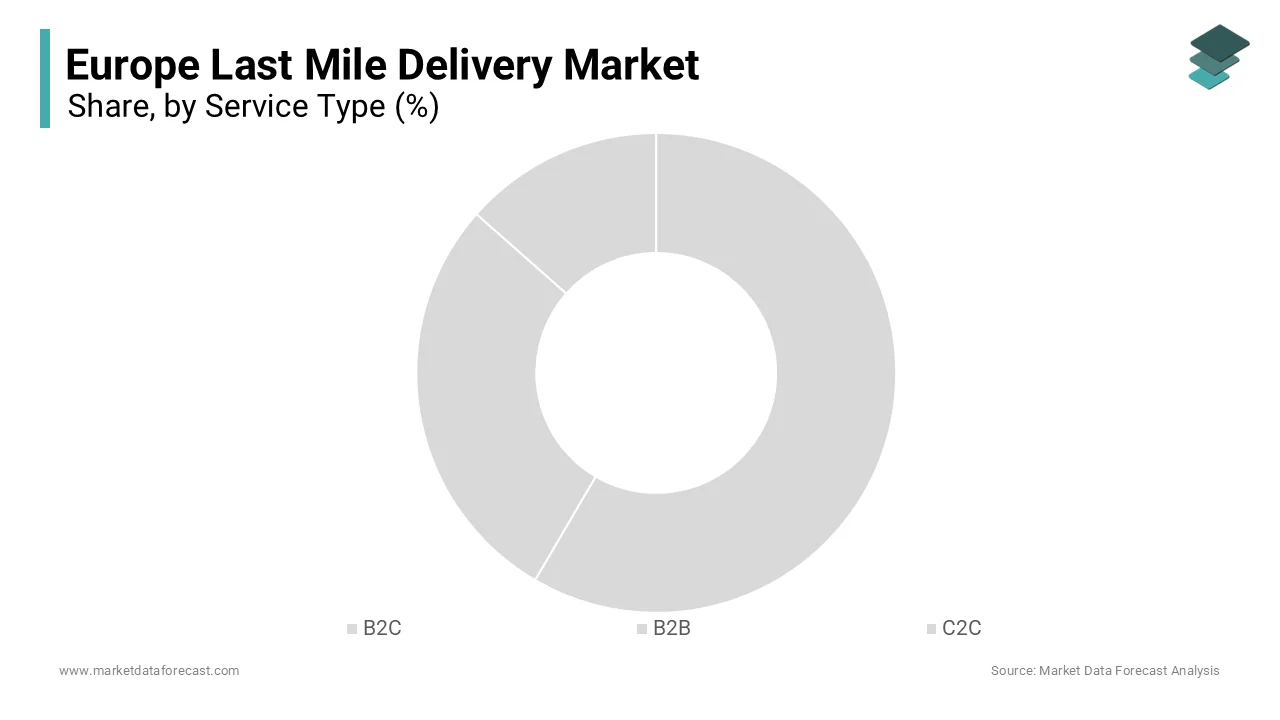
The consumer-to-consumer (C2C) segment is expected to exhibit a noteworthy CAGR of 18.9% from 2026 to 2034 due to the proliferation of peer-to-peer marketplaces, resale platforms, and informal commerce. The market for second-hand fashion in Europe has experienced significant expansion. Platforms like Vinted and Vestiaire Collective facilitate millions of individual parcel shipments monthly. Unlike B2C, which benefits from centralised logistics, C2C relies on integrated shipping solutions that empower individual sellers to generate labels, access discounted rates and track packages, services now embedded directly into marketplace apps. More than half of European adults aged 18 to 35 regularly engage in peer-to-peer (C2C) transactions. Postal operators are adapting their services by providing shipping solutions designed for private sellers. The increasing emphasis on the circular economy in product sustainability strategies is set to drive the expansion of logistics for consumer-to-consumer (C2C) commerce, which makes it a cornerstone of Europe's reuse infrastructure.
By Technology InsightsThe
non-autonomous delivery systems segment remained the prominent segment in the European last-mile delivery market and held a substantial share in 2025. The prominence of the non-autonomous delivery systems segment is credited to regulatory maturity, cost efficiency and operational flexibility. Despite advances in automation, European cities enforce strict safety and liability frameworks that limit autonomous deployment to controlled pilot zones. Most last-mile delivery operators find that uhumandrivers are necessary for successfully navigating challenging urban areas. These challenges often include historic districts, narrow streets, and multi-unit buildings, which have varied access procedures. Additionally, labour models, though facing a shortage, remain more economically viable than capital-intensive robotic alternatives for most parcel volumes. Major delivery services maintain large fleets of human-operated vehicles throughout the continent. This human-centric approach ensures reliability in high-density mixed-use urban settings where unpredictability remains the norm.
The autonomous segment is predicted to witness the highest CAGR of 34.2% over the forecast period as European cities and logistics firms pilot robotic solutions to address labour shortages, congestion, and emissions. Although still a small fraction of total deliveries, autonomous segment expansion is accelerating through controlled urban trials and supportive policy sandboxes. Programs are supporting the testing of autonomous delivery robots in various cities. Startups operate fleets of sidewalk robots delivering groceries and pharmacy items in geofenced zones. Autonomous micro vehicles may help to reduce emissions related to last-mile deliveries when powered sustainably. Universities, hospitals, and business parks serve as proving grounds where predictable routes and private infrastructure minimise regulatory risk. Advances in battery technology and the maturing EU regulatory landscape for light autonomous vehicles are poised to drive exponential growth in semi-controlled environments.
REGIONAL ANALYSIS
Germany Market Analysis
Germany led the European last-mile delivery market and accounted for a 23.8% share in 2025 as a logistics powerhouse with dense urban centres, stringent environmental policies, and high e-commerce penetration. Home to DHL Deutsche Post and major retail headquarters, the country processes a high volume of parcels annually. Major cities enforce strict low-emission zones, which necessitate the use of electric vans or cargo bikes for inner-city deliveries. Government initiatives have funded numerous micro-hub projects to support logistics infrastructure. Consumer expectations are among the highest in Europe. A majority of consumers are increasingly demanding carbon-neutral delivery options. Germany’s robust vocational training system also helps mitigate driver shortages through certified logistics apprenticeships. This combination of regulatory rrigourinfrastructure investment, and consumer sophistication makes Germany the benchmark for sustainable last-mile innovation.
United Kingdom Market Analysis
The United Kingdom was the second largest region in the European last mile delivery market and captured a share of 17.2% in 2025. The growth of the UK market is driven by its mature e-commerce ecosystem, agile postal network, and post-Brexit regulatory autonomy. British consumers receive a high volume of parcels per capita, reflecting the nation's significant engagement in e-commerce and a high rate of online shopping activity. London’s Ultra Low Emission Zone has accelerated the adoption of electric cargo bikes and micro depots. Royal Mail is a prominent operator of electric delivery vehicles within the UK, and continues to expand its significant zero-emission fleet as part of its sustainability objectives. The country’s dense network of parcel lockers supports high first-attempt delivery success. Post Brexit, the UK has hasfast-trackedd trials of autonomous delivery robots on public pavements, granting operational licenses more rapidly than continental regulators. Major retailers use AI-driven dynamic routing that adjusts in real time to traffic and consumer availability. This blend of consumer demand, regulatory agility, and last-mile infrastructure sustains the UK’s influential role in the European market.
France Market Analysis
France occupies a notable position in the European last-mile delivery market because of centralised urban planning, strong labour protection,,s and ambitious green logistics mandates. Paris's goal, established in its Climate Action Plan, is to phase out diesel vehicles by 2025 and all petrol-powered vehicles by 2030. La Poste operates a large fleet of electric vehicles, including electric-assist bicycles. More than half of French households are utilising click-and-collect services. The use of these services helps to decrease the rate of unsuccessful home deliveries. An increasing number of people are opting for click-and-collect as a convenient delivery solution. National labour laws also require gig couriers to be classified as employees. A policy that increases costs but enhances service reliability. This structured approach balances social equity, environmental goals, and operational efficiency.
Netherlands Market Analysis
The Netherlands is steadily growing in the European last-mile delivery market due to its compact geography, dense cycling infrastructure, and open innovation culture. The use of electric freight bicycles in major Dutch cities like Amsterdam, Rotterdam, and Utrecht is a growing trend, especially for last-mile deliveries, supported by government incentives and policies aimed at creating urban zero-emission zones and reducing congestion. The country’s extensive network. PostNL is continually expanding its network of parcel pickup locations and automated parcel lockers across the Netherlands to enhance convenience and ensure a high degree of household proximity to these services, aligning with the general trend toward more efficient last-mile delivery solutions. Dutch municipalities actively repurpose parking spaces into micro distribution hubs serviced by zero-emission vehicles. The national government’s Green Logistics Program subsidises shared last-mile initiatives, including autonomous robot trials in university campuses and business parks. With Europe’s highest e-commerce penetration per capita and strong public-private coordination, the Netherlands functions as a living lab for scalable urban delivery models.
Spain Market Analysis
Spain is a quickly expanding region in the European last-mile delivery market, fueled by booming e-commerce, tourism, and startup-driven innovation. Madrid and Barcelona have implemented low-emission zones that increasingly limit access for more polluting delivery vehicles. Online retail has continued to grow in Spain, building on an established upward trend in e-commerce activity. Spanish logistics startups like Goggo Network and Paack have emerged as European leaders in autonomous delivery and AI-powered routing, respectively. The Spanish government's "Kit Digital" program has actively supported small and medium-sized enterprises in adopting various digital technologies since 2022. Besides, high urban density and warm climate make Spain ideal for cargo bike and locker-based models. Spain's last-mile sophistication is accelerating, thanks to favourable municipal support and a young population adept with technology, allowing it to rapidly narrow the gap with its Northern European counterparts.
COMPETITIVE LANDSCAPE
KEY MARKET PLAYERS
Some of the notable key players in the European last-mile delivery market are
- Power Link Expedite
- A2Z Drone Delivery
- XPO
- Drone Delivery Canada Corp
- Kerry Logistics Network Ltd
- FedEx Corp
- United Parcel Service Inc
- DHL Group
- Amazon.com Inc
TOP STRATEGIES USED BY THE KEY MARKET PLAYERS
Key players in the European last-mile delivery market prioritise electrification of urban delivery fleets through electric vans and cargo bikes to comply with zero-emission zone mandates. They invest in dense networks of parcel lockers and pickup points to reduce failed deliveries and consumer inconvenience. Companies deploy artificial intelligence for dynamic routing time window prediction and real-time carbon tracking to enhance efficiency and transparency. They establish urban micro hubs and consolidation centres to decrease vehicle congestion and enable shared logistics. Additionally, they integrate delivery platforms with e-commerce marketplaces to offer seamless label generation, tracking, and returns management for both businesses and individual sellers.
COMPETITION OVERVIEW
The European last-mile delivery market features intense rivalry among integrated postal operators, specialised couriers, and tech-enabled startups. National postal services like La Poste, PostNL, and Deutsche Post leverage legacy infrastructure, regulatory familiarity, and public trust to dominate B2C parcel flows. Simultaneously, global express carriers such as UPS and FedEx compete on premium time definite services while local players like GLS and Mondial Relay differentiate through regional expertise and niche networks. Competition is increasingly defined by sustainability performance, delivery precision, and consumer experience rather than price alone. Startups are disrupting with autonomous robots, AI orchestration, and C2C shipping integrations, but face scaling hurdles due to regulatory fragmentation and capital intensity. Consolidation is accelerating as large players acquire technology firms to enhance routing analytics and customer engagement. Despite innovation, the market remains constrained by urban spaspacemitationsabour shortages, and inconsistent municipal regulations, which prevent uniform service standards across borders.
TOP PLAYERS IN THE EUROPE MARKET
- Deutsche Post DHL Group is a global logistics leader with deep integration across Europe’s last-mile ecosystem through its DHL Parcel and Post divisions. The company operates one of the continent’s largest electric delivery fleets and has pioneered urban micro hub networks in cities like Berlin, Hamburg, and Vienna to support zero emission deliveries. DHL contributes globally by exporting its StreetScooter electric van technology and urban logistics playbook to markets in Asia and North America. It also launched an anAI-drivenn dynamic routing platform that reduces failed deliveries by adjusting to real-time traffic and consumer availability. These initiatives reinforce DHL’s role as a benchmark for sustainable, scalable last-mile operations worldwide.
- La Poste Group, through its Geopost division and DPD brand, operates a pan-European last-mile network spanning over twenty countries with a strong emphasis on green logistics and consumer flexibility. The company has deployed more than eight thousand electric cargo bikes across France, the UK, and Germany, enabling emission-free urban deliveries. Globally, Geopost sets standards for circular delivery models, including reusable packaging and carbon insetting programs adopted by partners in North America and Australia. The group also integrates real-time carbon footprint displays into its tracking apps, aligning with EU consumer transparency mandates. These innovations position La Poste as a leader in ethical, responsible last-mile delivery.
- PostNL is a Netherlands-based last-mile specialist, renowned for its dense parcel point network, high automation rate, and leadership in sustainable urban logistics. The company serves as a critical delivery partner for major e-commerce platforms across the Benelux region and Germany, leveraging predictive analytics to optimise route density and reduce vehicle kilometres. PostNL’s contribution to the global market lies in its open data approach, sharing anonymised delivery insights with city planners to shape smarter urban freight policies, an initiative now replicated in cities from Copenhagen to Toronto. It also introduced AI-powered delivery time prediction with ninety five cent accuracy, enhancing customer satisfaction. These efforts establish PostNL as a model for public-private last-mile collaboration.
MARKET SEGMENTATION
This research report on the European last-mile delivery market has been segmented and sub-segmented based on categories.
By Service Type
- B2C
- B2B
- C2C
By Technology
- Autonomous
- Non-autonomous
By Application
- Food & Beverages
- Retail & E-commerce
- Healthcare
- Others
By Country
- UK
- France
- Spain
- Germany
- Italy
- Russia
- Sweden
- Denmark
- Switzerland
- Netherlands
- Turkey
- Czech Republic
- Rest of Europe
Frequently Asked Questions
1. What is the Europe Last Mile Delivery Market?
It refers to the final step of the delivery process where goods are transported from a distribution hub to the end customer.
2. Why is last mile delivery important?
Because it directly impacts customer satisfaction, delivery speed, convenience, and overall e-commerce success.
3. What is driving the growth of the last mile delivery market in Europe?
Key drivers include rising e-commerce adoption, demand for same-day/next-day delivery, urbanization, and increasing online grocery orders.
4. Which countries lead the Europe Last Mile Delivery Market?
The United Kingdom, Germany, France, Italy, and the Netherlands are among the leading markets.
5. What are the major delivery models used in last mile logistics?
Common models include traditional courier services, parcel lockers, crowdsourced delivery, autonomous vehicles, and drone delivery.
6. Who are the major players in the Europe Last Mile Delivery Market?
Major companies include DHL, UPS, FedEx, Amazon Logistics, DPDgroup, Hermes, and GLS.
7. How is technology transforming last mile delivery in Europe?
Technology such as route optimization, tracking systems, robotics, electric vehicles, and AI is enhancing speed and efficiency.
8. What challenges does the last mile delivery market face?
Challenges include high operational costs, traffic congestion, failed deliveries, and sustainability pressures.
9. What future trends are expected in the Europe Last Mile Delivery Market?
Key trends include hyperlocal delivery, micro-fulfillment centers, AI-driven logistics, sustainable delivery fleets, and wider use of parcel lockers.
10. How has e-commerce growth impacted last mile delivery?
It has significantly boosted demand for faster deliveries, increased parcel volumes, and pushed logistics providers to expand capacity.
Related Reports
Access the study in MULTIPLE FORMATS
Purchase options starting from
$ 2000
Didn’t find what you’re looking for?
TALK TO OUR ANALYST TEAM
Need something within your budget?
NO WORRIES! WE GOT YOU COVERED!
Call us on: +1 888 702 9696 (U.S Toll Free)
Write to us: sales@marketdataforecast.com