Europe LED Drivers Market Size, Share, Trends & Growth Forecast Report – Segmented By Luminaire Type, Component, Supply Type, Application, and Country (UK, France, Spain, Germany, Italy, Russia, Sweden, Denmark, Switzerland, Netherlands, Turkey, Czech Republic & Rest of Europe), Industry Analysis From 2026 to 2034
Market Size, 2025
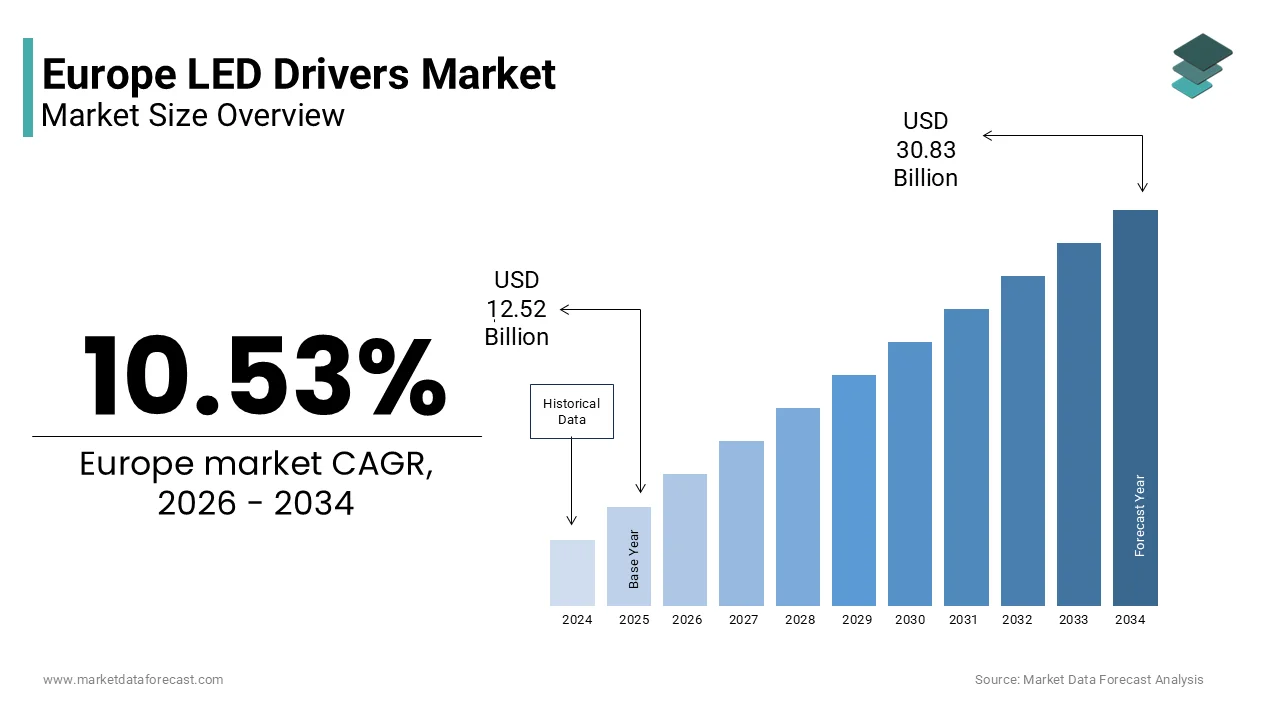
$12.52 BnMarket Estimate, 2026
$13.84 BnMarket Forecast, 2034
$30.83 BnCAGR, 2026–2034
10.53%.Europe LED Drivers Market Size
The Europe LED drivers market size was valued at USD 12.52 billion in 2025 and is projected to reach USD 30.83 billion by 2034 from USD 13.84 billion in 2026, growing at a CAGR of 10.53%.
LED drivers are critical electronic devices that regulate electrical current and voltage supplied to light emitting diodes ensuring stable luminous output and extended operational life. In Europe, their relevance has intensified due to a structural transformation in lighting infrastructure driven by sustainability mandates and technological modernization. Unlike incandescent or fluorescent systems, LEDs cannot operate directly from mains power and require precise driver integration for optimal performance. The European Union’s Ecodesign Directive has systematically eliminated inefficient lighting technologies accelerating adoption of solid-state lighting across residential commercial and public domains. As per Eurostat, in 2023, around 25.5% of residents in the European Union lived in dwellings where energy efficiency improvements had been made in the last five years. Additionally, according to the Copenhagen Centre on Energy Efficiency, public lighting can represent up to 40% of municipal electricity bills. This foundational shift positions LED drivers, not merely as ancillary components, but as strategic enablers of Europe’s broader energy transition framework.
MARKET DRIVERS
Stringent Energy Efficiency Regulations Drive Adoption
The European Union’s regulatory apparatus serves as a primary catalyst for LED driver proliferation, which is majorly driving the growth of the European LED drivers market. The Ecodesign for Energy Related Products Regulation, which came into full effect in 2021, prohibits the sale of halogen and most fluorescent lamps, mandating minimum luminous efficacy thresholds of 85 lumens per watt for general purpose lighting. As per the European Commission, this policy compels manufacturers and end users to adopt LED systems, inherently reliant on high quality drivers for compliance. The reintroduced Energy Labelling Regulation further reinforces this trend by implementing a simplified A to G scale, requiring transparent disclosure of real-world energy consumption data, thereby incentivizing system level efficiency through advanced driver architectures. According to the International Energy Agency, lighting accounts for about 15% of global electricity consumption. As per Eurostat, households in the EU reduced their residential lighting energy consumption significantly between 2015 and 2023, reflecting the widespread adoption of LED technology. These regulatory instruments create consistent demand signals and technical specifications that align market innovation with decarbonization imperatives.
Expansion of Smart Building Infrastructure Fuels Technical Demand
Europe’s accelerated deployment of intelligent building ecosystems has amplified demand for programmable and networked LED drivers, which is further boosting the expansion of the European LED drivers market. Modern commercial and institutional facilities increasingly integrate lighting with IoT platforms, using protocols such as DALI, Zigbee, and Bluetooth Mesh to enable adaptive control based on occupancy, daylight levels, and user behavior. For instance, a growing share of new non-residential constructions in the EU incorporates connected lighting systems. The European Green Deal’s Renovation Wave Strategy targets a doubling of annual building renovation rates by 2030, aiming for a substantial cut in building related emissions, a goal unattainable without granular load management provided by smart drivers. Data from the European Construction Sector Observatory confirms that smart lighting retrofits in existing buildings have been increasing year on year. These drivers function as edge nodes in digital infrastructure, enabling real time energy monitoring, demand response, and predictive maintenance, thereby transforming lighting from a passive utility into an active grid resource.
MARKET RESTRAINTS
Supply Chain Volatility Constrains Component Availability
The European LED drivers market faces persistent constraints due to global semiconductor supply chain fragility. Drivers rely heavily on analog ICs, MOSFETs, and electrolytic capacitors, all subject to prolonged lead times and price volatility. According to the European Semiconductor Industry Association, delivery cycles for power management ICs remained above 25 weeks through much of 2023, impeding production scalability. Europe imports more than 80% of its semiconductors, primarily from Asia and North America, as noted in the European Commission’s 2023 Chips Act Progress Report, rendering local assemblers vulnerable to geopolitical disruptions. The war in Ukraine further destabilized neon gas supply, a key input in chip fabrication, with European availability dropping sharply in early 2022, according to the International Energy Agency. Although the EU Chips Act aims to build domestic capacity, current investments remain insufficient to cover specialized lighting driver components. This dependency inflates costs, delays project timelines, and limits responsiveness to surging retrofit demand, particularly in public sector tenders with fixed delivery schedules.
Fragmented Regional Standards Increase Compliance Complexity
Despite EU harmonization efforts, divergent national certification practices impose significant administrative and financial burdens on LED driver manufacturers, which is further impeding the growth of the European LED drivers market. While CE marking establishes baseline conformity, practical implementation of safety, electromagnetic compatibility, and environmental directives varies across member states. Germany mandates VDE certification, France requires NF EN compliance, and Nordic countries often impose additional cold climate testing, creating redundant validation processes. According to the European Lighting Association, inconsistent application of IEC 61347, the international standard for LED control gear, results in higher compliance expenditures for pan European product launches. Furthermore, inclusion under RoHS and REACH necessitates extensive material documentation across multi-tier supply chains. A survey by Lighting Europe found that a majority of driver suppliers identified regulatory fragmentation as a top barrier to expansion in secondary markets. This complexity disproportionately affects small and medium enterprises, discouraging cross border participation and slowing the diffusion of innovative driver technologies aligned with EU sustainability goals.
MARKET OPPORTUNITIES
Retrofitting Legacy Public Lighting Offers Scalable Growth
Europe’s vast inventory of outdated public streetlights presents a high value opportunity for LED driver deployment through cost effective retrofit strategies. For instance, connected LED luminaires can cut electricity use by 50 to 80% compared to legacy fixtures. The Covenant of Mayors for Climate and Energy gather over 10,500 local authorities committed to EU energy and climate targets. National programs in Spain and Italy have allocated significant funding for smart lighting retrofits, where drivers with photocell dimming and remote monitoring are standard. LED retrofits are widely reported to reduce energy use by up to 75% compared to incandescent bulbs, while extending maintenance cycles. This established asset base enables rapid scalability without new civil works, making it one of the most bankable segments for driver manufacturers.
Integration with Renewable Microgrids Enables New Applications
The rise of decentralized renewable energy systems is creating demand for LED drivers optimized for direct current operation and variable input conditions, which is another significant opportunity for the European LED drivers market. According to SolarPower Europe, EU member states installed around 56 GW of new solar capacity in 2023. Conventional AC LED drivers require inverters when paired with solar panels, reducing overall system efficiency. In contrast, DC compatible drivers can connect directly to photovoltaic arrays or battery storage, eliminating conversion losses. For instance, DC based configurations can improve net efficiency by up to 15%. Pilot projects in Mediterranean islands have successfully deployed solar powered streetlights using native DC drivers, which is reducing reliance on diesel generators. With EU policy actively promoting local energy communities, demand for voltage flexible, resilient drivers is projected to grow at over 18% annually through 2030.
MARKET CHALLENGES
Thermal Management Limitations in Compact Designs
The trend toward ultra slim and integrated LED luminaires intensifies thermal stress on embedded drivers, which is compromising reliability and longevity and is one of the major challenges to the European LED drivers market expansion. As fixtures shrink to meet architectural and aesthetic demands, airflow is restricted, causing internal temperatures to exceed safe operating limits for sensitive electronics. According to reports, sustained high temperatures can significantly reduce the lifespan of electrolytic capacitors. Warranty claims in LED installations often cite driver overheating as a major issue, though precise percentages vary. As per a 2024 study by Fraunhofer Institute for Reliability and Microintegration, internal temperature differentials of up to 40°C in recessed downlights compared to ambient conditions, leading to output drift and flicker. Until wide bandgap semiconductors or advanced thermal interface materials achieve cost effective scale, this physical constraint will limit performance in high density applications across European retail, hospitality, and office sectors.
Counterfeit Components Undermine Product Integrity
The infiltration of counterfeit electronic parts into Europe’s lighting supply chain poses a serious risk to safety, performance, and regulatory compliance, which is further challenging the expansion of the European LED drivers market. EUIPO and DG TAXUD reported that 86 million counterfeit products, valued at over €2 billion, were seized in 2022. These components frequently violate RoHS standards, containing hazardous substances like lead and cadmium. LightingEurope has repeatedly warned about counterfeit drivers undermining compliance and safety. Such units exhibit unstable output, causing perceptible flicker, which the European Agency for Safety and Health at Work associates with increased incidence of visual fatigue and headaches. Certification bodies, including TÜV Rheinland, continue to report safety audit failures in lighting products. Without robust traceability mechanisms, such as digital product passports or blockchain based provenance verification, the market remains exposed to integrity failures that erode consumer confidence and escalate liability for legitimate manufacturers.
REPORT COVERAGE
| REPORT METRIC | DETAILS |
| Market Size Available | 2025 to 2034 |
| Base Year | 2025 |
| Forecast Period | 2026 to 2034 |
| CAGR | 10.53% |
| Segments Covered | By Luminaire Type, Component, Supply Type, Application, and Region |
| Various Analyses Covered | Global, Regional, & Country Level Analysis; Segment-Level Analysis; DROC, PESTLE Analysis; Porter’s Five Forces Analysis; Competitive Landscape; Analyst Overview of Investment Opportunities |
| Regions Covered | UK, France, Spain, Germany, Italy, Russia, Sweden, Denmark, Switzerland, Netherlands, Turkey, and the Czech Republic |
| Market Leaders Profiled | Ace Led Light Co., Eaglerise Electric and Electronic, Onsemi Intelligent Technology, Macroblock, Lutron Electronics, Cree LED, Hubbell Inc., Signify NV, Ams OSRAM AG, Microchip Technology Inc., NXP Semiconductors NV, Texas Instruments Inc., Analog Devices Inc., Rohm Co Ltd, Samsung Electronics Co Ltd, and STMicroelectronics NV |
SEGMENTAL ANALYSIS
By Luminaire Type Insights
Among luminaire types in the European LED drivers market, the Type A Lamp segment dominated the market in 2025 with 60.6% of the regional market share. The domination of type A lamp segment is primarily due to the widespread residential and commercial retrofitting initiatives that prioritize direct replacements for legacy incandescent and halogen bulbs. Type A lamps, characterized by their standard pear shaped form factor, are compatible with existing sockets and fixtures, making them the simplest path to energy efficient lighting without infrastructure overhaul. One key driver is the EU’s Ecodesign Regulation, which banned most non directional halogen lamps in 2018 and fluorescent tubes by 2023, accelerating consumer migration to plug and play LED alternatives. As per Eurostat, a majority of EU households reported using LED or compact fluorescent lamps as their main lighting source in 2023, with Type A LEDs constituting the majority due to ease of adoption. Lighting Europe confirms that Type A LED lamp sales remain the largest category in the EU, driven by retail availability and price declines. The average retail cost of LED bulbs has fallen steadily in major markets, enabling mass accessibility. This combination of regulatory pressure, consumer familiarity, and economic viability solidifies Type A lamps as the cornerstone of Europe’s LED transition.
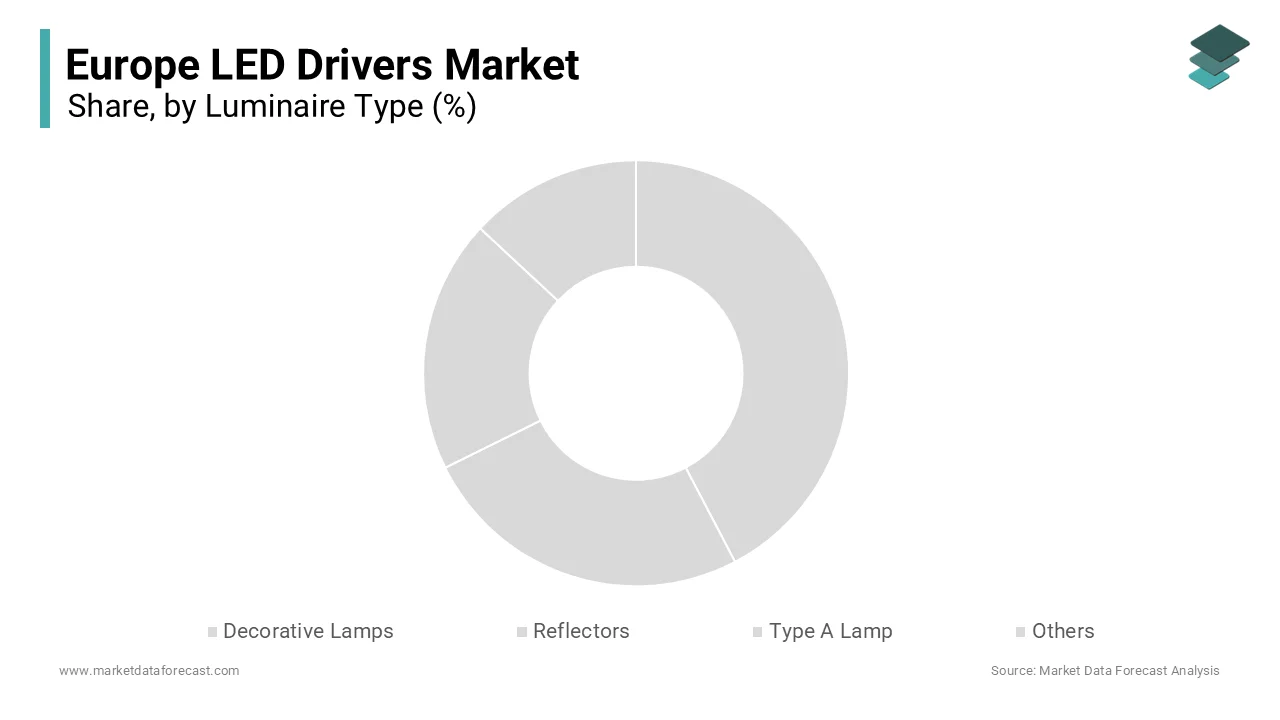
The reflectors segment is the fastest growing and is expected to showcase a CAGR of 10.12% over the forecast period. The growth of reflectors segment in this regional market is likely to be driven by the rising demand for directional lighting in retail, hospitality, and architectural applications where beam control, aesthetics, and high color rendering are critical. Unlike omnidirectional Type A lamps, reflector luminaires such as PAR and MR16 types deliver focused illumination ideal for accent and task lighting. A major catalyst is the modernization of commercial interiors under the EU’s Energy Performance of Buildings Directive, which mandates deep energy retrofits for non-residential structures. As per the European Construction Sector Observatory, directional LED reflectors are increasingly adopted in retail spaces to enhance visual merchandising while cutting energy use. Furthermore, the shift toward human centric lighting in workplaces has increased specification of tuneable white reflector systems requiring advanced constant current drivers with dimming capabilities. Data from Fraunhofer Institute for Building Physics highlights strong growth in LED reflector installations in German office buildings, driven by WELL Building Standard compliance. With cities like Milan and Copenhagen incentivizing façade and urban highlight lighting through municipal grants, reflector-based solutions are gaining traction beyond indoor use, further amplifying driver demand in this high-performance segment.
By Application Insights
The lighting application segment led the market by accounting for 88.4% of the regional market share in 2025. The leading position of lighting segment in the European market is attributed to the continent-wide replacement of conventional lighting across residential, street, commercial, and industrial settings with solid state alternatives that inherently require driver integration. General lighting remains the primary consumption channel due to policy mandates, scale of installed base, and public sector investment. Europe’s regulatory architecture plays a decisive role. The European Commission’s Ecodesign framework has eliminated inefficient light sources, while the Energy Labelling Regulation steers consumers toward high efficacy products. According to the International Energy Agency, lighting consumed significant electricity in the EU in 2022, with general illumination representing the majority of that load. According to the European Environment Agency, public lighting accounts for a notable share of municipal electricity bills, prompting cities such as Barcelona and Amsterdam to complete full LED streetlight conversions. These projects deploy constant current drivers at scale, often with smart controls. Additionally, the Renovation Wave Strategy targets millions of building upgrades by 2030, creating sustained demand for integrated LED luminaires with embedded drivers. Unlike automotive, which is cyclical and volume constrained, general lighting offers consistent high-volume deployment across millions of endpoints, making it the structural backbone of the LED driver ecosystem in Europe.
The automotive segment is the fastest growing application and is anticipated to grow at a CAGR of 12.3% over the forecast period owing to the electrification of vehicle fleets and the premiumization of lighting features in both internal and external automotive design. LED headlights, daytime running lights, and interior ambient systems all depend on compact, high reliability drivers capable of withstanding thermal and electrical stress. Stringent EU safety and efficiency standards are accelerating adoption. As per the European Automobile Manufacturers Association, LED front lighting has become standard in most new passenger cars sold in the EU. Regulations under UNECE Regulation 149 now permit adaptive driving beam systems, which require sophisticated matrix LED drivers with individual pixel control. Moreover, the rise of electric vehicles intensifies demand for energy optimized lighting, since every watt saved extends driving range. The European Environment Agency confirms that EVs represented a growing share of new car registrations in the EU in 2023, creating a natural synergy with low power LED systems. Companies like Valeo and Hella are integrating intelligent drivers that support dynamic signalling and communication functions, aligning with automated driving trends. This convergence of regulation, technology, and consumer expectation positions automotive as the highest growth vector for specialized LED drivers in Europe.
By Component Insights
The Driver IC segment commanded for the largest share of 71.9% of the regional market in 2025. Integrated circuits offer superior efficiency, compactness, and functionality compared to discrete solutions, which is making them the default choice for modern LED luminaires, especially in space constrained or high-performance applications. This dominance is reinforced by advances in semiconductor technology and economies of scale. Leading European and global IC manufacturers have developed highly integrated solutions that combine power management, dimming control, and protection features into single chips, reducing bill of materials complexity. As per the European Semiconductor Industry Association, most new LED driver designs launched in Europe utilize monolithic or modular IC architectures due to their reliability and design simplicity. Furthermore, the push for smart lighting has elevated demand for ICs with embedded communication protocols such as DALI or Bluetooth Low Energy. Fraunhofer Institute for Integrated Circuits reports that IC based drivers achieve higher power conversion efficiency compared to discrete counterparts, significantly lowering lifetime energy costs. Regulatory pressure also favours ICs, as they enable precise compliance with flicker and harmonic distortion limits under IEC TR 61547 1. With lighting OEMs prioritizing miniaturization, performance, and certification readiness, the Driver IC segment remains the technological and commercial anchor of the market.
The discrete component segment is the fastest growing and is estimated to witness a CAGR of 9.4% over the forecast period. While smaller in absolute terms, this growth is driven by niche applications demanding extreme customization, high power handling, or cost sensitivity where off the shelf ICs are unsuitable. Industrial high bay lighting, horticultural systems, and specialty automotive modules often require bespoke driver topologies that discrete components can flexibly accommodate. Lighting Europe notes that discrete based drivers remain prevalent in specialized applications such as vertical farming facilities, due to the need for spectrum tunability and high current stability under variable thermal loads. Similarly, in cost driven retrofit markets such as Eastern Europe, discrete solutions remain common where initial price outweighs long term efficiency gains. The European Photovoltaic Industry Association highlights that off grid solar lighting kits distributed in rural regions often use discrete drivers because they tolerate wide input voltage swings from unstable battery sources. Moreover, geopolitical supply chain concerns have prompted some manufacturers to avoid proprietary ICs in favor of multi sourced discrete parts to mitigate shortage risks. As per the European Anti-Fraud Office, reliance on generic transistors, diodes, and capacitors reduces exposure to counterfeit ICs, a growing issue in informal distribution channels. These factors collectively sustain demand for discrete architectures despite the broader industry shift toward integration.
REGIONAL ANALYSIS
Germany LED Drivers Market Analysis
Germany led the LED drivers market in Europe in 2025 by holding 23.3% of the regional market share. The growth of Germany in the European market is attributed to its robust industrial base, stringent building codes, and leadership in lighting technology. The country’s Energiewende energy transition policy has made efficient lighting a national priority, with bans on inefficient bulbs and strong incentives for smart infrastructure. As per the German Federal Ministry for Economic Affairs and Climate Action, a large majority of public streetlights in Germany have been converted to LED, often incorporating networked drivers for remote monitoring. The VDE certification regime ensures high technical standards, driving demand for reliable constant current drivers compliant with DIN EN 61347. Additionally, Germany hosts major lighting OEMs like Osram and Trilux, whose R&D investments focus on human centric and IoT enabled drivers. According to the Fraunhofer Institute for Reliability and Microintegration, German commercial buildings have undertaken extensive retrofits with advanced drivers under the federal Building Efficiency Program. With manufacturing contributing about 18% to GDP, and factories adopting Industry 4.0 lighting for machine vision and worker safety, Germany’s industrial segment further amplifies driver consumption, solidifying its position as Europe’s largest and most technologically advanced market.
France LED Drivers Market Analysis
France captured a 16.5% of the regional market share in 2025. The growth of France in the European market can be credited to the aggressive public sector modernization and urban sustainability agendas. The French government’s “Plan Lumière,” launched in 2022, allocated significant funding to replace millions of conventional streetlights with smart LED systems by 2026, directly boosting driver procurement. As per France’s Ministry of Ecological Transition, municipalities have completed hundreds of thousands of public lighting upgrades, integrating drivers with motion sensors and adaptive dimming. The tertiaire decree mandating a 40% energy reduction in commercial buildings by 2030 has also accelerated private sector retrofits. Data from ADEME, the French Environment and Energy Management Agency, shows that non-residential lighting energy use declined notably between 2020 and 2023, largely due to LED adoption. Paris, Lyon, and Marseille lead in deploying connected lighting networks, where drivers serve as data collection points for urban analytics. Moreover, France enforces NF EN certification, which requires rigorous electromagnetic compatibility testing, favoring high quality driver ICs from trusted suppliers. With nuclear powered grid electricity enabling low carbon lighting operation and strong consumer awareness, France maintains steady high-volume demand across residential and outdoor segments.
United Kingdom LED Drivers Market Analysis
The United Kingdom is anticipated to record a promising CAGR in the European LED drivers market during the forecast period. The UK’s continued alignment with EU Ecodesign principles through the Ecodesign for Energy Related Products Regulations 2021 sustains momentum for LED transitions. According to the Department for Energy Security and Net Zero, more than 80% of UK households used LED lighting as their primary source in 2023, up from around two thirds in 2020. The Public Sector Decarbonisation Scheme has funded LED retrofits in over a thousand public buildings, including schools, hospitals, and council offices, since 2022, requiring certified constant voltage drivers. London’s Smart Streets initiative aims to convert all borough owned streetlights to LED by 2025, with drivers featuring remote fault detection. The British Standards Institution’s BS EN 61347 framework ensures product safety while discouraging substandard imports. Notably, the UK’s construction sector rebounded strongly in 2023, with the Office for National Statistics reporting a year on year increase in commercial building completions, each incorporating modern LED systems. Although semiconductor sourcing challenges persist, UK manufacturers like Telstar Lighting are increasingly localizing driver assembly to reduce lead times, reinforcing domestic market resilience.
Italy LED Drivers Market Analysis
Italy is estimated to account for a notable share of the European LED drivers market during the forecast period. The southern Europe’s high solar irradiance and extensive retrofit needs in historic urban centers are contributing to the growth of the Italian market. The Italian National Recovery and Resilience Plan dedicates billions of euros to energy efficient public lighting, with millions of streetlights targeted for LED conversion by 2026. As per Italy’s Ministry of Ecological Transition, municipalities in Lombardy and Lazio have replaced hundreds of thousands of luminaires, often using drivers with photocell and timer functions to maximize savings. The country’s warm climate increases cooling loads, making low heat emitting LED systems particularly valuable in retail and hospitality sectors. Data from ENEA, Italy’s National Agency for New Technologies, shows that commercial buildings reduced lighting related electricity consumption significantly between 2021 and 2023 through LED upgrades. Historic preservation laws restrict external modifications in cities like Rome and Florence, favoring discreet retrofit kits with compact drivers that fit within original fixtures. Moreover, Italy’s strong furniture and design industry drives demand for integrated architectural lighting, where drivers must be silent, flicker free, and dimmable to support ambiance. These unique requirements foster a specialized driver ecosystem blending performance with aesthetic sensitivity.
Spain LED Drivers Market Analysis
Spain is predicted to showcase a healthy CAGR in the European market during the forecast period owing to the ambitious renewable energy integration and tourism driven infrastructure upgrades. The Spanish government’s “Plan de Recuperación, Transformación y Resiliencia” includes hundreds of millions of euros for smart public lighting, with emphasis on coastal and island municipalities reliant on diesel generation. As per Spain’s Ministry for Ecological Transition, hundreds of thousands of streetlights were upgraded to LED in 2023, particularly in Andalusia and the Balearic Islands, where drivers with wide input voltage ranges accommodate unstable microgrids. Tourism accounts for about 12% of GDP, according to the Bank of Spain, necessitating high quality lighting in hotels, resorts, and heritage sites to enhance visitor experience. The Technical Building Code mandates minimum lighting efficacy levels in all new constructions, driving specification of high CRI LED systems with precision drivers. Data from Red Eléctrica de España shows that solar power met nearly a quarter of national electricity demand in 2023, encouraging DC coupled LED drivers in off grid applications. Cities like Barcelona and Valencia are piloting circular economy models, where luminaires are leased with driver health monitored remotely, enabling predictive maintenance. This blend of sustainability, tourism, and grid innovation positions Spain as a dynamic growth market with distinctive technical demands.
COMPETITIVE LANDSCAPE
The Europe LED drivers market features intense competition characterized by technological differentiation regulatory alignment and supply chain agility. Established players leverage deep domain expertise in power electronics and lighting standards to offer certified reliable solutions while newer entrants compete on cost and customization particularly in discrete component segments. The market is not dominated by price alone instead value is derived from efficiency thermal performance communication capabilities and compliance with stringent EU directives such as RoHS REACH and Ecodesign. Competition extends beyond product specs into service ecosystems including remote monitoring firmware updates and lifecycle support. Regional disparities in certification requirements create entry barriers favoring incumbents with pan European validation experience. Meanwhile consolidation is accelerating as firms acquire software or semiconductor specialists to bolster smart lighting capabilities. Innovation velocity particularly in intelligent and DC optimized drivers defines leadership with companies investing heavily in R and D to meet the demands of smart cities electric mobility and renewable energy integration across the continent.
KEY MARKET PLAYERS
Some of the notable key players in the Europe LED drivers market are
- Ace Led Light Co.
- Eaglerise Electric and Electronic
- Onsemi Intelligent Technology
- Macroblock
- Lutron Electronics
- Cree LED
- Hubbell Inc.
- Signify NV
- Ams OSRAM AG
- Microchip Technology Inc.
- NXP Semiconductors NV
- Texas Instruments Inc.
- Analog Devices Inc.
- Rohm Co Ltd
- Samsung Electronics Co Ltd
- STMicroelectronics NV
Top Players in the Market
- Signify Holding is a global lighting leader headquartered in the Netherlands with deep integration across the European LED drivers market. The company designs and manufactures intelligent LED drivers that support its connected lighting ecosystems including Interact and Philips Hue platforms. Signify has intensified its focus on human centric and IoT enabled drivers compatible with DALI Zigbee and Bluetooth Mesh protocols. In recent years the company expanded its EMEA driver production capacity and launched energy adaptive drivers that respond to real time grid signals aligning with EU demand response initiatives. Its commitment to circular design includes recyclable driver housings and modular architectures facilitating repair and reuse which resonates strongly with European sustainability mandates.
- Infineon Technologies a German semiconductor powerhouse plays a pivotal role in the LED drivers value chain by supplying high efficiency power ICs and control chips widely used in European lighting systems. The company’s CoolSET and XDP digital power families are engineered for constant current LED applications demanding high reliability and low standby losses. Infineon has strengthened its position through strategic collaborations with luminaire manufacturers to co-develop drivers optimized for wide input voltage ranges and thermal resilience. Recent investments in its Dresden and Villach fabs enhance supply security for European customers amid global chip volatility. Its focus on wide bandgap semiconductors like gallium nitride also positions it at the forefront of next generation ultra compact driver innovation.
- OSRAM Opto Semiconductors now operating under ams OSRAM following its merger with ams AG maintains a strong footprint in the European LED drivers landscape through integrated optoelectronic solutions. While primarily known for LEDs the company develops application specific driver modules for automotive industrial and horticultural lighting where precise current control is critical. It has recently introduced drivers with embedded diagnostics for predictive maintenance in smart city projects. The firm leverages its R and D centers in Germany and Austria to advance driver intelligence including spectral tuning for health-oriented lighting. Its vertical integration from chip to system enables tightly synchronized performance between LEDs and drivers enhancing overall luminous efficacy and longevity in demanding European environments.
Top Strategies Used by the Key Market Participants
Key players in the Europe LED drivers market employ several strategic approaches to reinforce their competitive stance. Product innovation remains central with companies developing smarter more efficient and compact drivers compatible with evolving communication protocols. Vertical integration allows firms to control quality reduce costs and ensure component availability especially amid supply chain disruptions. Strategic partnerships with lighting OEMs municipalities and energy service companies facilitate large scale deployment and co engineered solutions. Geographic expansion within Eastern and Southern Europe targets high growth retrofit opportunities. Sustainability driven design including recyclability energy adaptability and compliance with EU green regulations further differentiates offerings. Investment in localized manufacturing enhances delivery resilience while digitalization of driver functionality supports integration into broader building and grid management ecosystems strengthening long term customer lock in and value creation beyond hardware.
MARKET SEGMENTATION
This research report on the European LED drivers market has been segmented and sub-segmented based on categories.
By Luminaire Type
- Decorative Lamps
- Reflectors
- Type A Lamp
- Others
By Component
- Driver IC
- Discrete Component
- Others
By Supply Type
- Constant Current
- Constant Voltage
By Application
- Consumer Electronics
- Lighting
- Automotive
- Outdoor Displays
By Country
- UK
- France
- Spain
- Germany
- Italy
- Russia
- Sweden
- Denmark
- Switzerland
- Netherlands
- Turkey
- Czech Republic
- Rest of Europe
Frequently Asked Questions
1. What are LED drivers?
LED drivers are electronic components that regulate power supply to LED lighting systems to ensure stable current and voltage performance.
2. What is the Europe LED drivers market?
The Europe LED drivers market includes manufacturers and suppliers providing power control solutions for LED lighting applications across European countries.
3. What factors are driving growth of the LED drivers market in Europe?
Growth is driven by rising adoption of energy efficient lighting, government regulations promoting LED usage, and expansion of smart lighting systems.
4. Which countries lead the Europe LED drivers market?
Germany, the United Kingdom, France, Italy, and the Netherlands are leading markets due to strong infrastructure and lighting modernization projects.
5. What types of LED drivers are commonly used in Europe?
Common types include constant current drivers, constant voltage drivers, and programmable LED drivers.
6. What are the major applications of LED drivers in Europe?
LED drivers are widely used in residential, commercial, industrial, automotive, and outdoor lighting applications.
7. How do energy efficiency regulations impact the LED drivers market in Europe?
Strict energy efficiency standards increase demand for advanced LED drivers that reduce power consumption and improve lighting performance.
8. What role does smart lighting play in the Europe LED drivers market?
Smart lighting systems drive demand for intelligent LED drivers with dimming, control, and connectivity features.
9. What challenges affect the Europe LED drivers market?
Challenges include price pressure, compatibility issues, and rapid technological changes in lighting electronics.
10. How does the construction sector influence LED driver demand in Europe?
Growth in residential and commercial construction increases demand for LED lighting systems and compatible drivers.
Related Reports
Access the study in MULTIPLE FORMATS
Purchase options starting from
$ 2000
Didn’t find what you’re looking for?
TALK TO OUR ANALYST TEAM
Need something within your budget?
NO WORRIES! WE GOT YOU COVERED!
Call us on: +1 888 702 9696 (U.S Toll Free)
Write to us: sales@marketdataforecast.com