Europe Less Than Truckload Market Size, Share, Trends, & Growth Forecast Report By End-User Industry (Agriculture, Fishing, and Forestry Construction, Manufacturing, Oil and Gas, Mining and Quarrying, Wholesale and Retail, Trade, and Others), Fuel Type, Application and Country (UK, France, Spain, Germany, Italy, Russia, Sweden, Denmark, Switzerland, Netherlands, Turkey, Czech Republic and Rest of Europe), Industry Analysis From 2025 to 2033
Europe Less Than Truckload Market Report Summary
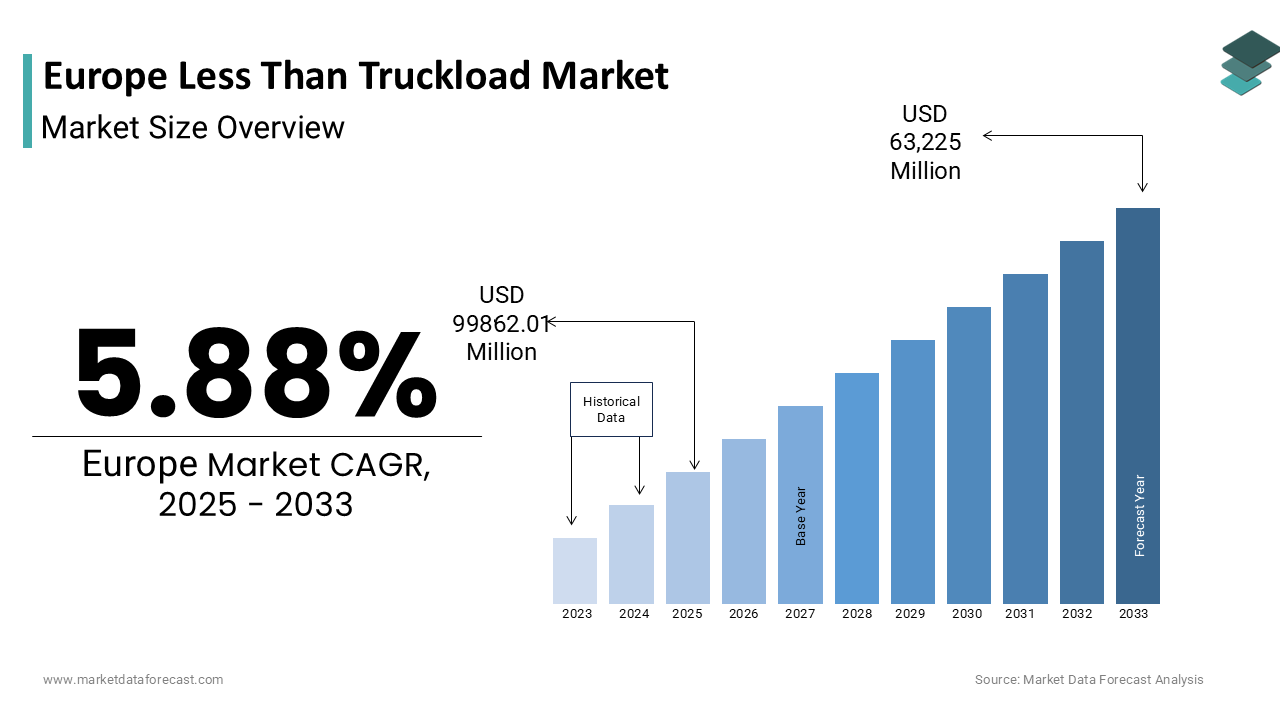
The Europe less than truckload (LTL) market was valued at USD 59,713.93 million in 2024, is estimated to reach USD 99,862.01 million in 2025, and is projected to reach USD 63,225 million by 2033, growing at a CAGR of 5.88% during the forecast period from 2025 to 2033. The growth of the European LTL market is driven by rising e-commerce penetration, the expansion of omnichannel retailing, and increasing demand for mid-volume shipment flexibility among SMEs and manufacturers. The push toward freight consolidation to meet EU decarbonization mandates, alongside the digitization of transport networks, is further accelerating market expansion. Moreover, the rapid adoption of real-time visibility platforms, micro-consolidation hubs in urban logistics zones, and return-logistics optimization has strengthened the operational value of LTL across Europe’s retail, manufacturing, and cross-border supply chains.
Key Market Trends
- Rising e-commerce volumes and high return rates driving demand for frequent mid-volume LTL shipments.
- Increasing adoption of digital freight platforms, real-time tracking tools, and AI-based load optimization.
- Expansion of micro-consolidation centers and urban logistics hubs to meet low-emission transport mandates.
- Electrification of LTL fleets and deployment of alternative-fuel vehicles across metropolitan corridors.
- Growing need for flexible, multi-stop logistics to support omnichannel retail, SMEs, and decentralized manufacturing.
Segmental Insights
- By End-User Industry, he wholesale and retail trade segment was the largest and held a significant share of the Europe less than truckload market in 2024. This dominance is driven by the segment’s reliance on high-frequency, mid-volume replenishment cycles required by urban retail stores, e-commerce fulfillment centers, and reverse-logistics operations. The growth of online fashion and electronics, both reporting return rates above 20%, reinforces sustained LTL demand.
- The manufacturing segment is anticipated to record the fastest growth during the forecast period. The shift toward just-in-time production, modular supply chains, and frequent component deliveries across automotive, machinery, and electronics clusters is strengthening the need for LTL services. Rising adoption among SMEs lacking private fleets also contributes to the segment’s acceleration.
Regional Insights
The European less than truckload market is experiencing strong growth across major economies, supported by dense industrial clusters, increasing digitalization of transport networks, and robust retail supply chains.
- Germany was the largest contributor, accounting for 24.4% of the Europe LTL market share in 2024, driven by its central logistics position, extensive autobahn network, and high concentration of manufacturing hubs requiring daily LTL movements. Germany also leads in fleet electrification and digital hub modernization.
- France continues to perform strongly, supported by nationwide urban-logistics reforms, micro-hub expansion, and the Loi Climat mandate for consolidated city-center deliveries. Its dense retail network and growing reverse-logistics demands reinforce LTL adoption.
- The United Kingdom holds a substantial share, driven by one of Europe’s highest e-commerce penetration rates, widespread use of consolidation centers, and strong parcel-pallet integration across retail supply chains.
- Italy is emerging as a major LTL hub, supported by its decentralized manufacturing base, cross-border flows to Central/Eastern Europe, and logistics modernization funded under the National Recovery and Resilience Plan.
- The Netherlands remains a critical gateway market, supported by the Port of Rotterdam, advanced digitalization of freight networks, and strong integration of AI-driven load optimization systems.
Competitive Landscape
The European less than truckload market is characterized by the dominance of multinational logistics providers with extensive hub-and-spoke networks, complemented by regional specialists serving domestic lanes. Leading companies focus on enhancing network density, deploying digital freight platforms, and expanding micro-consolidation infrastructure to support low-emission zones. Sustainability initiatives, including fleet electrification and carbon-neutral LTL services, are becoming key competitive differentiators. Partnerships with retailers, manufacturers, and freight-tech platforms further strengthen service quality and cross-border reliability. Prominent players in the Europe LTL market include DHL Freight, DB Schenker, DSV, Kuehne + Nagel, XPO Logistics, GEODIS, UPS, FedEx, Raben Group, Dachser, CEVA Logistics, TNT Express, Hermes, GLS, and Norbert Dentressangle (now XPO).
Europe Less Than Truckload Market Size
The europe less than truckload market size was valued at USD 59,713.93 million in 2024 and is anticipated to reach USD 99862.01 million in 2025 from USD 63,225 million by 2033, growing at a CAGR of 5.88% during the forecast period from 2025 to 2033.
Less than truckload (LTL) refers to the transportation of freight shipments that do not require the full capacity of a standard truck trailer typically ranging from 30 kilograms to 3.5 tonnes per consignment. Unlike full truckload services LTL relies on consolidation hubs where multiple shippers’ goods are combined into a single vehicle to optimize asset utilization and reduce per unit logistics costs. This segment serves small and medium enterprises manufacturers and e commerce fulfillment centers that require frequent mid volume deliveries across regional and cross border routes. According to Eurostat, a large majority of European freight enterprises operate with fewer than 10 vehicles, underscoring the structural reliance on shared transport solutions. According to the European Environment Agency, road freight accounts for around 76% of inland tonne‑kilometres in the EU, with LTL playing a critical role in last‑mile and intercity distribution. Driven by supply chain fragmentation, rising e‑commerce return rates, and EU decarbonization mandates, the LTL model is evolving from a cost‑centric service to a digitally integrated logistics enabler emphasizing transparency, speed, and sustainability.
MARKET DRIVERS
Growth of E-Commerce and Demand for Agile Mid Volume Fulfillment
The rising incidence of online retail expansion across Europe is one of the key factors propelling the growth of the European LTL market. According to Ecommerce Europe’s 2024 report, B2C e‑commerce turnover in Europe reached €887 billion in 2023, which is reflecting modest growth amid inflationary pressures. As per Eurostat, more than 70% of EU consumers made online purchases in 2023. This surge generates high‑frequency mid‑sized shipments from regional distribution centers to urban stores and return hubs as precisely the profile LTL is designed to serve. Unlike full truckload, which suits bulk replenishment, LTL enables daily or twice‑daily deliveries required by fast fashion and grocery retailers. According to NielsenIQ retail studies, omnichannel adoption continues to expand, with logistics flexibility cited as a critical enabler. Additionally, EU consumer law guarantees a 14‑day return period, and apparel/electronics categories report return rates exceeding 20%. This symbiosis between digital commerce and fragmented logistics cements LTL as the backbone of modern retail supply chains.
EU Policy Push for Freight Consolidation to Reduce Emissions
The rapidly evolving EU regulatory framework is supporting the expansion of the European LTL market. According to the European Environment Agency, transport accounted for 23% of EU greenhouse gas emissions in 2024. As per the European Commission’s Sustainable and Smart Mobility Strategy, shared transport models such as LTL are promoted to reduce empty running and vehicle kilometers. Germany’s Federal Ministry for Digital and Transport launched a €400 million program in 2023 to electrify freight hubs and expand digital freight matching. France’s Loi Climat (2021) mandates consolidated logistics for city‑center deliveries in municipalities over 150,000 inhabitants by 2026. According to the International Transport Forum, consolidated freight routes can reduce CO₂ emissions by up to 30% compared to fragmented direct deliveries. These measures align with the EU’s target to halve urban freight traffic by 2030, which is transforming LTL from an operational choice into a compliance imperative.
MARKET RESTRAINTS
Fragmented Cross Border Regulatory and Operational Standards
The supply chain disruptions and fragmented regulatory standards are impeding the European LTL market growth. According to the European Court of Auditors, persistent disparities in transport administration and implementation limit seamless cross‑border operations, which is creating inefficiencies for multi‑country corridors. As per IRU, administrative friction and non‑harmonized border procedures can significantly raise the cost of international road transport, with harmonization flagged as a key lever to reduce delays and cost burdens across regions. According to IRU analyses, e‑CMR adoption remains uneven across Europe, with uptake far below full penetration despite its documented benefits for transparency and efficiency. Furthermore, national variances in documentation practices and cabotage enforcement continue to force manual re‑planning at transit points, complicating the core LTL value proposition of predictability and efficiency. This fragmentation undermines end‑to‑end reliability and adds hidden costs to LTL flows that cross internal EU borders.
Chronic Shortage of Qualified LTL Drivers and Terminal Staff
The stringent workforce shortages governing logistics operations are further hindering the European LTL market growth. According to the IRU Global Truck Driver Shortage report, Europe faced 426,000 unfilled truck driver positions in 2024, up sharply from 233,000 in 2023, which is constraining operators’ ability to expand capacity and maintain service quality. As per the European Labour Authority’s 2024 monitoring, widespread shortages persist across multiple transport roles, with national imbalances and migration patterns intensifying regional deficits. According to CEDEFOP’s skills and VET resources, current training pipelines are insufficient to meet near‑term demand for specialized logistics roles, reinforcing recruitment and retention challenges for LTL carriers and terminals. Terminal staff shortages compound the issue, which is automated sortation systems still require trained operators, yet fragmented vocational curricula and slow upskilling limit throughput and service reliability. This human capital gap leads to missed pickups, delayed consolidations, and higher error rates, which is undermining the time‑sensitive reliability that LTL customers demand.
MARKET OPPORTUNITIES
Adoption of Digital Freight Platforms and Real Time Visibility Tools
The growing adoption of digital freight platforms and real‑time visibility tools is a significant opportunity for the European LTL market. According to the European Logistics Association’s project portfolio, real‑time visibility deployments across major networks demonstrate measurable improvements in control tower performance and exception handling. As per DHL Freight tracking initiatives, the expansion of end‑to‑end active tracing across European lanes has improved shipment transparency and reduced manual inquiries, which is supporting better customer experience and SLA adherence. According to the Fraunhofer Institute for Material Flow and Logistics, AI‑driven optimization and packaging/load planning tools can increase utilization and reduce waste, which is enhancing trailer fill rates and route efficiency for LTL operations. As per the European Innovation Council’s 2024 work program, over €1.2 billion in funding is available for strategic technologies, including digital logistics innovations, which is accelerating SME adoption of data‑driven tools under Pathfinder, Transition, and Accelerator schemes. These technologies mature LTL from a transactional service into an integrated, data‑driven supply chain partner.
Expansion of Micro Consolidation Centers in Urban Logistics Zones
The development of micro consolidation centers is another promising avenue for the European LTL market expansion. According to the European Commission’s Urban Logistics guidance, zero‑emission urban freight and last‑mile delivery strategies encourage consolidation in city logistics, with MCCs and microhubs reducing congestion and emissions while improving service reliability. As per Transport for London evaluations, MCC‑aligned initiatives within low‑emission zones have supported measurable reductions in vehicle kilometers and emissions, which is reinforcing the efficacy of urban consolidation models for dense city coresAnnualReports.com. According to the EU Mission for Climate‑Neutral and Smart Cities, 112 Mission Cities are receiving tailored support to reach climate neutrality by 2030, with funding and technical assistance catalyzing logistics pilots and infrastructure investments that include consolidated urban freight solutions. LTL providers such as GEODIS and DPD continue to expand urban networks that bundle parcels and pallets for MCC processing and aligning capacity and service windows with e‑commerce demand and municipal restrictions. This model complies with low‑emission zone mandates while enabling same‑day delivery windows demanded by e‑commerce, which is transforming LTL into the linchpin of sustainable urban freight.
MARKET CHALLENGES
Rising Fuel and Energy Costs Impacting LTL Economics
The growing instability in energy prices is primarily challenging the European LTL market. According to the European Commission’s Weekly Oil Bulletin, diesel prices across the EU averaged around €1.78 per liter in late 2024, remaining elevated compared with pre‑pandemic baselines and pressuring operating margins. As per IRU transport statistics, load factors in many LTL operations sit below full‑truck averages, intensifying cost sensitivity to fuel volatility and reducing revenue kilometers per liter consumed. According to ACEA and market analyses, acquisition and operational costs for electric delivery vehicles remain higher than diesel equivalents in several use cases, with payload and charging constraints limiting multi‑stop efficiency for heavier LTL routes. Until charging infrastructure and battery technology mature for medium‑duty urban distribution, LTL providers must absorb cost shocks or risk losing price‑sensitive customers to in‑house delivery solutions and modal alternatives.
Inadequate Standardization in LTL Pricing and Service Metrics
The absence of harmonized pricing and service metrics is also challenging the European LTL market. According to the European Shippers’ Council and market benchmarks, carrier quotes for identical LTL consignments can diverge widely due to non‑uniform treatment of density, freight class, accessorials, and consolidation efficiency. As per CLECAT, proposals to standardize tariff structures and digital documentation frameworks remain voluntary, limiting cross‑industry adoption and comparability across borders. Service metrics are equally inconsistent as on‑time performance may be measured from pickup to final delivery or only from hub departure, with no EU‑wide definition. This lack of standardization complicates procurement and erodes trust, particularly among SMEs lacking logistics expertise. Until transparency improves, the market will struggle to achieve the efficiency and reliability needed to compete with vertically integrated e‑commerce logistics.
REPORT COVERAGE
| REPORT METRIC | DETAILS |
| Market Size Available | 2024 to 2033 |
| Base Year | 2024 |
| Forecast Period | 2025 to 2033 |
| Segments Covered | By End User Industry and region |
| Various Analyses Covered | Global, Regional & Country Level Analysis, Segment-Level Analysis, DROC, PESTLE Analysis, Porter’s Five Forces Analysis, Competitive Landscape, Analyst Overview on Investment Opportunities |
| Regions Covered | United Kingdom, France, Spain, Germany, Italy, Russia, Sweden, Denmark, Switzerland, the Netherlands, Turkey, and the Czech Republic. |
| Key Market Players | DHL Freight, DB Schenker, DSV, Kuehne + Nagel, XPO Logistics, GEODIS, UPS, FedEx, Raben Group, Dachser, CEVA Logistics, TNT Express, Norbert Dentressangle (now XPO), Hermes, and GLS. |
SEGMENTAL ANALYSIS
By End User Industry Insights
The wholesale and retail trade segment dominated the Europe less than truckload market by accounting for 38.8% of the regional market share in 2024. The dominance of this segment in the European market is attributed to its structural reliance on frequent mid‑volume replenishment across dense store networks and e‑commerce fulfillment centers. According to Eurostat (2024), there were more than 5 million retail enterprises operating in the EU, with over 98% classified as SMEs that lack private fleets and depend on third‑party LTL services. Omnichannel retailing has intensified delivery complexity as retailers such as Carrefour, MediaMarkt, and H&M increasingly require daily or twice‑daily LTL deliveries to urban stores to maintain stock availability and support ship‑from‑store models. According to Statista data (2025), fashion and electronics categories in Europe experience online return rates exceeding 25%, which is driving growth in reverse logistics volumes. The rise of dark stores and micro‑fulfillment centers in cities like Paris and Berlin further demands high‑frequency LTL loops for inventory rotation. This combination of fragmentation, digitization, and urban logistics necessity ensures wholesale and retail remains the anchor of LTL demand.
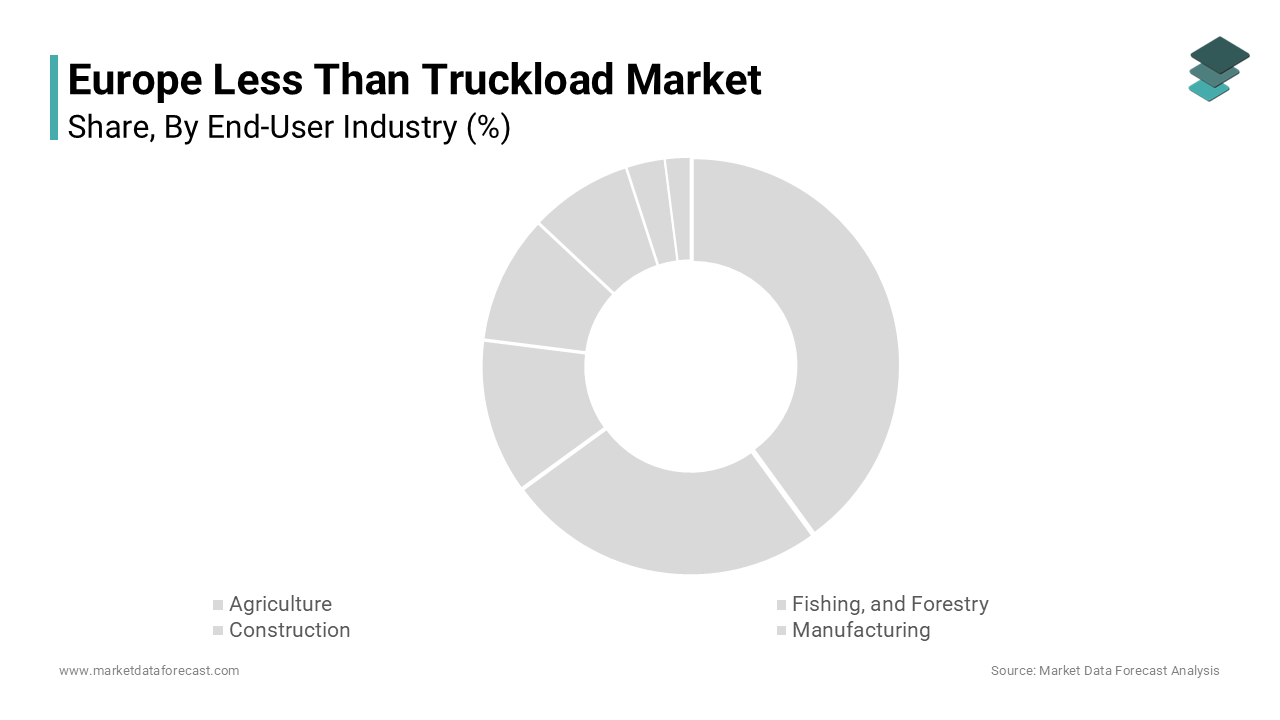
The manufacturing segment is anticipated to grow at the fastest CAGR of 7.9% over the forecast period in the European market due to the shift toward just‑in‑time production and modular supply chains that rely on frequent component deliveries rather than bulk warehousing are propelling the growth of the manufacturing segment in this European market. According to Eurostat (2025), the EU manufacturing sector comprised approximately 2.2 million enterprises employing 30 million people, most of which are SMEs without dedicated logistics fleets. In Germany’s automotive cluster, suppliers increasingly ship parts via LTL to assembly plants multiple times per day, which is reflecting the sector’s reliance on flexible logistics. Italy’s machinery and textile manufacturers also depend on LTL to deliver specialized subassemblies under tight lead times. The European Commission’s Industrial Strategy (2024) emphasizes resilient supply chains and favouring LTL’s flexibility over fixed full‑truckload contracts. Furthermore, the rise of additive manufacturing and on‑demand production generates smaller, more frequent shipments of high‑value components. With SMEs forming the backbone of Europe’s industrial ecosystem, LTL serves as the essential circulatory system for decentralized manufacturing.
REGIONAL ANALYSIS
Germany Europe Less Than Truckload Market Analysis
Germany led the market by accounting for 24.4% of the regional market share in 2024. The dominance of Germany in the European LTL market is driven by its dense manufacturing base, extensive autobahn network, and central geographic position facilitating cross‑border consolidation. According to the German Logistics Association, Germany hosts more than a million freight transport companies, with LTL serving the just‑in‑time needs of automotive, engineering, and chemical sectors. As per the Federal Ministry for Digital and Transport, nearly 70% of German LTL movements originate from or terminate at industrial clusters in Baden‑Württemberg, Bavaria, and North Rhine‑Westphalia. Germany also hosts advanced hubs such as DHL Freight’s Leipzig terminal and DB Schenker’s Smart Logistics Center in Duisburg. The Energiewende transport policy mandates that half of urban freight in Berlin and Hamburg use electric LTL vehicles by 2028, accelerating fleet modernization. Germany is expected to remain the logistical backbone of European LTL in the coming years.
France Europe Less Than Truckload Market Analysis
France held a substantial share of the European less‑than‑truckload market in 2024. According to the French Federation of Transport and Logistics Services, France’s market is defined by aggressive urban logistics reforms and a dense retail network requiring high‑frequency replenishment. The Loi Climat legislation mandates that all cities with populations over 150,000 establish urban consolidation centers by 2026. As per the City of Paris Mobility Agency, Paris operates five micro hubs that reduced inner‑city delivery vehicles by nearly 30% in 2023. INSEE reports that France’s 2.1 million retail SMEs rely heavily on LTL for store deliveries, with e‑commerce return volumes growing at close to 20% annually. France is expected to remain a dynamic and policy‑driven LTL market in the next few years. Sources (France): French Federation of Transport and Logistics Services; City of Paris Mobility Agency; INSEE; Loi Climat
United Kingdom Europe Less Than Truckload Market Analysis
The United Kingdom captured a notable share of the European less‑than‑truckload market in 2024. According to the Road Haulage Association, the UK maintains a robust LTL ecosystem driven by e‑commerce density and retail fragmentation. As per the Office for National Statistics, London, Manchester, and Birmingham host more than 100 urban consolidation centers serving millions of retail outlets. Statista confirms that e‑commerce penetration in the UK reached over 80% in 2024, the highest in Europe, generating strong demand for reverse logistics and multi‑channel fulfillment. Post‑Brexit, LTL providers invested in customs pre‑clearance platforms to reduce Dover border delays, cutting average wait times significantly. The UK is expected to sustain its relevance in European LTL despite geopolitical headwinds. Sources (UK): Road Haulage Association; Office for National Statistics; Statista
Italy Europe Less Than Truckload Market Analysis
Italy continued to play a notable role in the European less‑than‑truckload market in 2024. According to the Italian Logistics Association, Italy’s LTL demand is fueled by its decentralized manufacturing base of hundreds of thousands of small workshops in textiles, machinery, and furniture. ISTAT reports that Northern Italy’s industrial triangle (Milan, Turin, Bologna) generates nearly one‑third of national LTL volumes, with daily shuttle services to Central and Eastern Europe. Italy also serves as a key entry point for Mediterranean e‑commerce flows, with Milan and Rome emerging as major return processing hubs. The National Recovery and Resilience Plan allocated €1.8 billion in 2023 to modernize logistics hubs in Naples and Bari. Italy is expected to sustain its strategic position in the European LTL network in the coming years. Sources (Italy): Italian Logistics Association; ISTAT; National Recovery and Resilience Plan
Netherlands Europe Less Than Truckload Market Analysis
The Netherlands remained an important participant in the European less‑than‑truckload market in 2024. According to the Dutch Transport and Logistics Association, the Port of Rotterdam handled 438.8 million tonnes of cargo in 2023, confirming its role as Europe’s largest trade gateway. As per the Ministry of Infrastructure and Water Management, Dutch LTL networks are among the most digitized in Europe, with most carriers using AI‑based load optimization and electronic consignment notes. The Randstad urban conurbation operates an integrated LTL consolidation system that reduced urban freight emissions by more than 20% between 2021 and 2024. The Netherlands also hosts the European headquarters of GEODIS and DHL Freight, enabling pan‑European coordination. The Netherlands is expected to remain both a physical and technological nerve center for European LTL operations in the coming years. Sources (Netherlands): Dutch Transport and Logistics Association; Port of Rotterdam Authority; Ministry of Infrastructure and Water Management
COMPETITIVE LANDSCAPE
The Europe less than truckload market features a dual competitive structure with global integrators like DB Schenker DHL Freight and GEODIS dominating cross border and multi country services while regional specialists control domestic lanes in countries like Italy Spain and Poland. Competition centers not on price alone but on reliability network density digital transparency and sustainability credentials. Global players leverage scale technology and multimodal integration to offer end to end solutions while local carriers compete through deep regional knowledge and flexible service. Barriers to entry remain high due to capital intensity hub infrastructure requirements and regulatory complexity particularly regarding cross border operations. The market is consolidating as digital platforms favor larger players with data and asset advantages. However niche operators thrive by serving specific industries or remote regions underserved by major networks creating a fragmented yet stratified landscape where service differentiation and operational excellence determine success.
KEY MARKET PLAYERS
Some of the companies that are playing a dominating role in the Europe Less Than Truckload Market include
- DHL Freight
- DB Schenker
- DSV
- Kuehne + Nagel
- XPO Logistics
- GEODIS
- UPS
- FedEx
- Raben Group
- Dachser
- CEVA Logistics
- TNT Express
- Norbert Dentressangle (now XPO)
- Hermes
- GLS
Top Players in the Europe Less Than Truckload Market
DB Schenker
DB Schenker is a leading European logistics provider with an extensive less than truckload network spanning over 30 countries. The company operates a highly integrated LTL system featuring regional consolidation hubs digital freight matching and real time tracking across road rail and air modalities. In 2024 DB Schenker launched its Smart LTL platform in Germany France and Poland leveraging AI to optimize trailer fill rates and reduce empty kilometers by 18%. It also electrified 40% of its last mile LTL fleet in urban centers like Berlin and Amsterdam to comply with low emission zone regulations. Through its global logistics backbone DB Schenker extends European LTL efficiencies to international corridors supporting multinational manufacturers and retailers with seamless cross border consolidation and customs pre clearance.
GEODIS
GEODIS is a major force in Europe’s less than truckload segment offering tailored LTL solutions for retail manufacturing and e commerce sectors. Headquartered in France the company operates over 120 LTL hubs across the continent with advanced sortation systems and dynamic route optimization. In 2023 GEODIS integrated its European LTL network with its global supply chain platform enabling end to end visibility from factory to store. It also partnered with urban authorities in Paris Lyon and Brussels to operate micro consolidation centers using electric vans for final delivery. GEODIS’s emphasis on sustainability is evident in its Science Based Targets initiative commitment reducing scope one and two emissions by 30% by 2027 while maintaining high service reliability for time sensitive LTL shipments.
DHL Freight
DHL Freight a division of Deutsche Post DHL Group is a cornerstone of Europe’s less than truckload market renowned for its EuroConnect LTL network linking 20,000 pickup and delivery points. The company specializes in palletized freight with standardized handling that ensures speed and damage reduction. In 2024 DHL Freight rolled out its GoGreen LTL solution featuring carbon neutral deliveries through verified offsetting and alternative fuels across Western Europe. It also enhanced its digital booking engine with predictive pricing and live capacity indicators improving transparency for SME shippers. DHL’s global reach allows European LTL customers to seamlessly connect to international freight networks making it a preferred partner for exporters and importers requiring domestic consolidation before or after cross border movement.
Top Strategies Used by the Key Market Participants
Key players in the Europe less than truckload market are investing heavily in digital freight platforms that offer real time pricing capacity tracking and carbon footprint analytics to attract SME shippers. They are establishing micro consolidation centers in major cities to comply with urban low emission zone mandates and improve last mile efficiency. Companies are electrifying regional LTL fleets with electric and hydrogen trucks for hub to hub transfers particularly in Germany France and the Netherlands. Strategic partnerships with retailers and manufacturers enable dedicated LTL lanes that guarantee service levels and reduce handling. Additionally firms are integrating cross border customs pre clearance systems to minimize administrative delays and enhance reliability on international LTL corridors across the EU.
MARKET SEGMENTATION
This research report on the Europe Less Than Truckload Market has been segmented and sub–segmented into the following categories.
By End User Industry
- Agriculture
- Fishing, and Forestry
- Construction
- Manufacturing
- Oil and Gas
- Mining and Quarrying
- Wholesale and Retail Trade, and Others
By Country
- UK
- France
- Spain
- Germany
- Italy
- Russia
- Sweden
- Denmark
- Switzerland
- Netherlands
- Turkey
- Czech Republic
- Rest of Europe
Frequently Asked Questions
What is the Europe Less Than Truckload (LTL) market?
The Europe LTL market covers the transportation of smaller freight shipments that do not require a full truckload and are consolidated with other goods. This model reduces cost while improving route efficiency for shippers across the region.
Why is LTL important in Europe’s logistics sector?
Europe's dense geography, interconnected borders, and strong industrial base make consolidated trucking highly efficient. LTL enables frequent, affordable deliveries, especially for SMEs and e-commerce businesses.
What industries rely most on LTL services in Europe?
Sectors like e-commerce, retail, automotive, manufacturing, pharmaceuticals, and consumer goods depend heavily on LTL. These industries frequently ship small to mid-sized loads that benefit from shared truck space.
What factors are driving growth in the Europe LTL market?
Key growth drivers include booming e-commerce, increased B2B trade, rising consumer demand for fast delivery, and digitalization of freight operations. Infrastructure modernization across Europe further supports expansion.
What are the main challenges in the European LTL market?
Challenges include driver shortages, high operational and fuel costs, capacity bottlenecks, and complex regulatory requirements across multiple countries. Seasonal demand fluctuations also impact service efficiency.
Which countries lead the Europe LTL market?
Germany, France, the U.K., Italy, and the Netherlands hold the largest market shares due to advanced logistics networks and high manufacturing output. These countries serve as major freight hubs for intra-European trade.
How does LTL differ from Full Truckload (FTL) shipping?
LTL consolidates multiple customers’ shipments into one truck, making it cost-effective for small loads. FTL dedicates an entire truck to a single shipper, typically used for larger or time-sensitive freight.
How is e-commerce influencing the LTL market?
The surge in online shopping has significantly increased the volume of small, frequent shipments across Europe. This trend boosts demand for flexible, reliable LTL solutions that support last-mile and cross-border delivery.
Who are the major players in the Europe LTL market?
Key companies include DHL Freight, DB Schenker, DSV, Kuehne + Nagel, XPO Logistics, GEODIS, UPS, FedEx, Raben Group, Dachser, CEVA Logistics, Hermes, GLS, and TNT Express. These firms offer extensive European network coverage.
What is the long-term outlook for the Europe LTL market?
The market is expected to grow steadily due to rising e-commerce penetration, enhanced logistics digitalization, and increased cross-border trade. Sustainability-driven fleet upgrades and smart logistics systems will further shape future growth.
Access the study in MULTIPLE FORMATS
Purchase options starting from
$ 2000
Didn’t find what you’re looking for?
TALK TO OUR ANALYST TEAM
Need something within your budget?
NO WORRIES! WE GOT YOU COVERED!
Call us on: +1 888 702 9696 (U.S Toll Free)
Write to us: sales@marketdataforecast.com