- Product Description Description
- Table of Contents TOC
- List of Table & Figure LOT
- Get Free Sample PDF Sample PDF
Market Size, 2025
$0.70 BnMarket Estimate, 2026
$0.75 BnMarket Forecast, 2034
$1.26 BnCAGR, 2026–2034
6.76%Europe Liquid Nitrogen Fertilizers Market Size, Growth, Trends & Forecast (2026–2034)
The European liquid nitrogen fertilizers market size was valued at USD 0.70 billion in 2025, is anticipated to reach a valuation of USD 0.75 billion in 2026, and is projected to scale up to USD 1.26 billion by 2034, registering a compound annual growth rate (CAGR) of 6.76% during the forecast period from 2026 to 2034. Driven by the European Green Deal and Farm to Fork sustainability targets, increasing adoption of precision farming and advanced irrigation systems, and rising demand for efficient nutrient delivery solutions, the European liquid nitrogen fertilizers industry continues to experience steady market expansion.
Key Executive Metrics (At-a-Glance)
- 2025 Base Valuation: USD 0.70 Billion
- 2026 Current Valuation: USD 0.75 Billion
- 2034 Forecast Valuation: USD 1.26 Billion
- Compound Annual Growth Rate (CAGR): 6.76% (2026–2034)
- Dominant Type Segment: Nitrogenous Fertilizers (accounted for 45.9% of the European market share in 2025, driven by essential chlorophyll production and high-yield cereal crop demands)
- Fastest-Growing Type Segment: Micronutrient Fertilizers (projected to grow at a CAGR of 8.2% from 2026 to 2034 due to precise soil health management trends)
- Dominant Mode of Application Segment: Fertigation (held approximately 60% market share, enabling precise root delivery and reduced chemical runoff)
- Fastest-Growing Mode of Application Segment: Foliar Application (projected to grow at a CAGR of 7.8% during the forecast period for immediate nutrient absorption)
- Dominant Crop Type Segment: Field Crops (accounts for approximately 55% of the total market, driven by staple cereal production like wheat, barley, and corn)
- Fastest-Growing Crop Type Segment: Horticultural Crops (growing at a CAGR of 6.8% fueled by health-conscious dietary trends and expanding greenhouse farming)
- Dominant Country: Germany (market leader holding 28% of the European market share backed by advanced precision farming systems and government subsidies)
- Key Country Followers: France (second-largest market supported by extensive agricultural output and EU CAP incentives) and the United Kingdom (fastest-growing market focusing on nitrogen-efficient technologies)
Core Market Drivers
- Precision Agriculture Adoption: Expanding use of GPS-enabled equipment and variable rate application systems that optimize liquid nitrogen usage and minimize resource waste.
- Environmental Sustainability Goals: European Union Green Deal and Farm to Fork mandates driving the shift toward liquid alternatives to reduce chemical runoff and lower greenhouse gas footprints.
- Modern Irrigation Integration: Compatibility of liquid formulations with advanced drip and sprinkler systems for targeted, direct nutrient uptake.
Primary Market Restraints & Challenges
- Stringent Environmental Regulations: Nitrate-vulnerable zone (NVZ) limits and the Nitrates Directive capping nitrogen inputs (e.g., 170 kg/ha/year), increasing compliance complexities.
- High Production and Feedstock Costs: Heavy reliance on natural gas as a key ammonia feedstock, exposing manufacturers to severe price volatility and logistical storage burdens.
- Infrastructure Gaps: Inadequate storage and handling infrastructure for liquid fertilizers among small-scale farmers in Eastern Europe.
Europe Liquid Nitrogen Fertilizers Market Segmentation Breakdown
| Segment Category | Key Segments Covered | Leading / Fastest-Growing Segment |
|---|---|---|
| By Type | Complex, Straight, Micronutrients, Nitrogenous, Phosphatic, Potassic, Secondary Micronutrients | Nitrogenous (Dominant Share) / Micronutrient (8.2% CAGR) |
| By Mode of Application | Fertigation, Foliar | Fertigation (Dominant Share) / Foliar Application (7.8% CAGR) |
| By Crop Type | Field Crops, Horticultural Crops, Turf and Ornamental Crops | Field Crops (Dominant Share) / Horticultural Crops (6.8% CAGR) |
| By Country | UK, France, Spain, Germany, Italy, Russia, Sweden, Denmark, Switzerland, Netherlands, Turkey, Czech Republic, Rest of Europe | Germany (Market Leader) / United Kingdom (Fastest Growth) |
Major Industry Players Profiled
Key enterprises shaping the European liquid nitrogen fertilizers market include Yara International ASA, Nutrien Ltd., CF Industries Holdings, Inc., EuroChem Group AG, OCI N.V., Borealis AG, The Mosaic Company, Haifa Group, Koch Fertilizer, LLC, and Israel Chemicals Ltd. (ICL).
Europe Liquid Nitrogen Fertilizers Market Size
The European liquid nitrogen fertilizers market size was valued at USD 0.70 billion in 2025 and is anticipated to reach a valuaiton of USD 0.75 billion in 2026 and USD 1.26 billion by 2034, growing at a CAGR of 6.76% from 2026 to 2034.
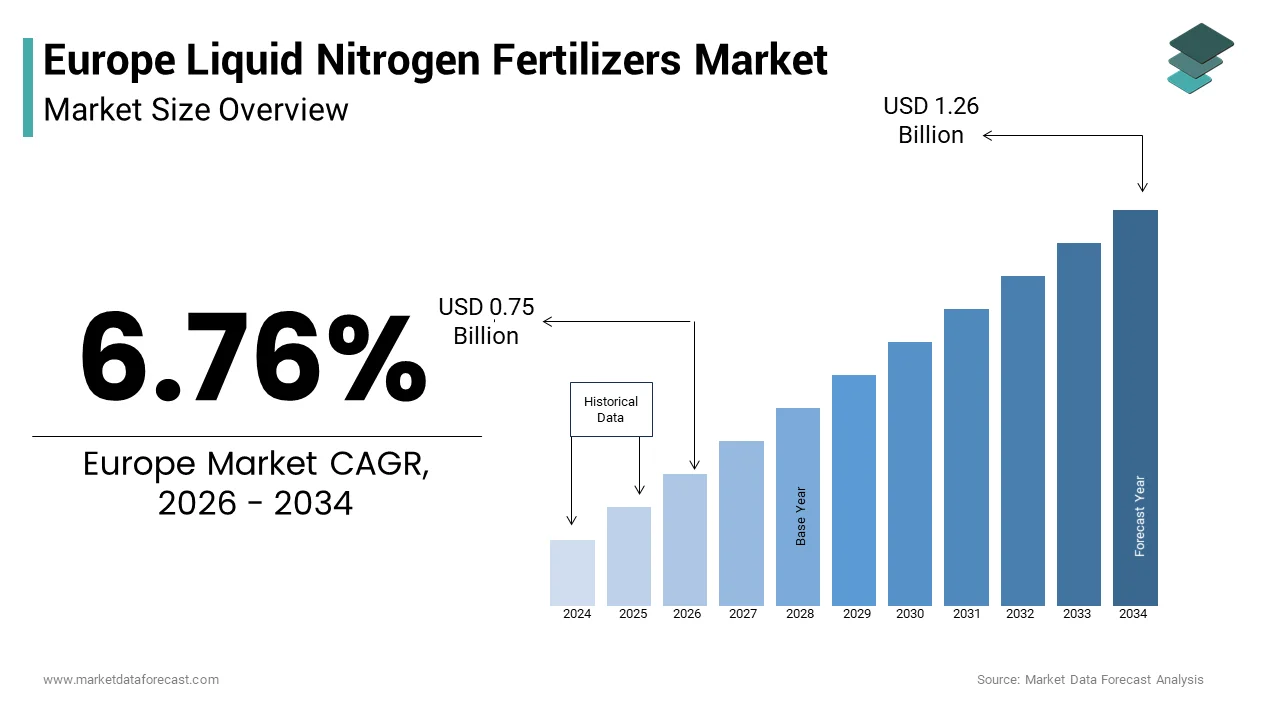
Europe Liquid nitrogen fertilizers, including urea ammonium nitrate (UAN) solutions, are widely used due to their ease of application, rapid absorption, and compatibility with modern irrigation systems such as drip and sprinkler systems. The agricultural sector in Europe is heavily influenced by sustainability goals and environmental regulations. The European Green Deal aims to reduce chemical fertilizer use by 20% by 2030 by encouraging farmers to adopt precision agriculture techniques and liquid fertilizers to minimize waste and environmental impact. Additionally, the rising adoption of advanced farming technologies, such as variable rate application systems, further boosts the demand for these fertilizers across the region.
MARKET DRIVERS
Increasing Adoption of Precision Agriculture in Europe
The shift toward precision agriculture is a significant driver of the Europe liquid nitrogen fertilizers market. Farmers are increasingly adopting technologies such as GPS-enabled equipment and variable rate application systems to optimize fertilizer usage. These systems reduce waste and environmental impact while enhancing crop yields. A 2022 report revealed that 25% of European farms had adopted some form of precision farming, with liquid nitrogen fertilizers playing a crucial role due to their compatibility with advanced application techniques. This trend aligns with EU sustainability goals by ensuring efficient resource utilization and contributing to regional market growth.
Rising Focus on Environmental Sustainability
Environmental concerns are driving the demand for liquid nitrogen fertilizers, which offer precise application and lower runoff compared to granular alternatives. The European Union’s Green Deal and Farm to Fork strategies aim to reduce nutrient losses by 50% by 2030. Liquid fertilizers, which allow for targeted delivery, help farmers meet these requirements while maintaining productivity. For example, UAN solutions reduce ammonia volatilization by 30% to minimize the environmental footprint. This push toward sustainable practices is encouraging farmers to shift toward liquid fertilizers to balance ecological responsibility with agricultural efficiency.
MARKET RESTRAINTS
Stringent Environmental Regulations
Stringent environmental regulations in Europe significantly restrain the Liquid Nitrogen Fertilisers Market. Policies under the European Green Deal and the Farm to Fork Strategy aim to reduce chemical fertilizer usage by 20% by 2030, which makes farmers explore alternative nutrient management strategies. Restrictions on nitrogen application rates, especially in nitrate-vulnerable zones (NVZs), are likely to limit the market’s growth. For instance, the Nitrates Directive mandates that nitrogen inputs must not exceed 170 kg/ha/year in NVZs. These rules increase compliance costs and complicate the adoption of liquid nitrogen fertilizers for small-scale farmers facing limited financial resources.
High Production and Logistical Costs
The production and distribution of liquid nitrogen fertilizers are capital-intensive due to the energy-intensive manufacturing processes and specialized storage requirements. Liquid fertilizers require temperature-controlled storage tanks and transport systems due to increasing operational costs for suppliers. Additionally, Europe’s reliance on imported natural gas, which is a key ingredient for nitrogen fertilizer production, makes the market vulnerable to price volatility. In 2022, natural gas prices in Europe surged by over 150%, significantly impacting fertilizer prices. These high costs deter adoption among cost-sensitive farmers and limit the market’s accessibility in Eastern Europe, where agricultural budgets are often constrained.
MARKET OPPORTUNITIES
Growth in Organic Farming and Sustainable Practices
The expansion of organic farming and sustainable agricultural practices in Europe presents a significant opportunity for liquid nitrogen fertilizers. Innovations such as bio-based liquid nitrogen fertilizers offer solutions compatible with organic certifications, whereas organic systems traditionally rely on natural inputs. Organic farmland in Europe grew by 8% annually, reaching 17.1 million hectares in 2022. Liquid nitrogen fertilizers designed for sustainable use align with EU policies promoting eco-friendly agriculture by allowing farmers to maintain productivity while meeting regulatory requirements. This shift creates opportunities for manufacturers to develop products tailored to the organic and environmentally conscious farming segments.
Adoption of Advanced Irrigation Systems
The increasing adoption of modern irrigation systems, such as drip and sprinkler technologies, offers significant growth potential for liquid nitrogen fertilizers. These systems are highly compatible with liquid formulations by enabling precise nutrient delivery directly to plant roots. In 2022, approximately 30% of Europe’s irrigated farmland utilized advanced irrigation techniques, which is a figure expected to grow as farmers seek to optimize water and fertilizer use. Farmers can achieve higher crop yields while minimizing nutrient losses, creating an opportunity for manufacturers to cater to this growing market segment.
MARKET CHALLENGES
Dependency on Natural Gas for Production
The production of liquid nitrogen fertilizers heavily depends on natural gas, which is a key feedstock in the ammonia synthesis process. Europe’s reliance on imported natural gas, particularly from politically volatile regions, will expose the market to supply disruptions and price volatility. For instance, natural gas prices in Europe surged by over 150% in 2022 is attributed to directly increasing fertilizer production costs. This dependency poses a significant challenge for fertilizer manufacturers who face difficulties in maintaining competitive pricing. Furthermore, the shift toward reducing fossil fuel reliance under the European Green Deal adds additional pressure on the industry to find alternatives.
Lack of Infrastructure in Emerging Markets
Inadequate infrastructure for storage, handling, and transport of liquid nitrogen fertilizers in Eastern Europe and other less developed agricultural regions hampers the market growth. Liquid formulations require specialized tanks, pipelines, and application systems, unlike granular fertilizers, which many farmers lack. A 2023 survey revealed that 60% of small-scale farmers in Eastern Europe cited insufficient infrastructure as a primary barrier to adopting liquid fertilizers. This limitation restricts market penetration in regions where agricultural practices are still transitioning from traditional methods is creating a significant hurdle for manufacturers aiming to expand their presence across Europe.
REPORT COVERAGE
| REPORT METRIC | DETAILS |
| Market Size Available | 2025 to 2034 |
| Base Year | 2025 |
| Forecast Period | 2026 to 2034 |
| CAGR | 6.76% |
| Segments Covered | By Type, Mode of Application, Crop, And Region. |
| Various Analyses Covered | Global, Regional, and Country Level Analysis, Segment-Level Analysis, DROC, PESTLE Analysis, Porter’s Five Forces Analysis, Competitive Landscape, Analyst Overview of Investment Opportunities |
| Regions Covered | UK, France, Spain, Germany, Italy, Russia, Sweden, Denmark, Switzerland, Netherlands, Turkey, Czech Republic & Rest of Europe |
| Market Leaders Profiled | Yara International ASA, Nutrien Ltd., CF Industries Holdings, Inc., EuroChem Group AG, OCI N.V., Borealis AG, The Mosaic Company, Haifa Group, Koch Fertilizer, LLC, Israel Chemicals Ltd. (ICL). |
SEGMENTAL ANALYSIS
By Type Insights
The nitrogenous fertilizers segment dominated the European liquid nitrogen fertilizers market in 2025, accounting for 45.9% of the European market share. Nitrogen is an essential nutrient for plant growth. It promotes chlorophyll production and protein synthesis, making it indispensable for high-yield farming. Liquid nitrogenous fertilizers, such as urea ammonium nitrate (UAN) solutions, are widely used due to their ease of application, compatibility with advanced irrigation systems, and rapid nutrient uptake. Cereals like wheat and corn, which together account for over 50% of Europe’s cultivated land, rely heavily on nitrogenous fertilizers for optimal growth. The efficiency of these fertilizers in meeting the nutrient demands of high-value crops solidifies their market dominance.

The micronutrient fertilizers segment is more likely to grow at a projected CAGR of 8.2% from 2026 to 2034. These fertilizers address specific nutrient deficiencies in soils, providing essential trace elements like zinc, manganese, and iron critical for plant development. The growing adoption of precision agriculture techniques that emphasize targeted nutrient application is a significant factor driving this segment. For instance, approximately 30% of European farms have adopted micronutrient fertilizers to improve crop quality and yield. Rising awareness about soil health and sustainability further boosts demand as these fertilizers enhance plant resilience and minimize environmental impact.
By Mode of Application Insights
The fertigation segment was witnessed in holding approximately 60% of the European liquid nitrogen fertilizers market. Fertigation integrates liquid fertilizers with irrigation systems, enabling precise nutrient delivery directly to plant roots, improving efficiency, and reducing waste. This method is particularly effective for high-value crops such as fruits, vegetables, and cereals, which dominate European agricultural production. Studies indicate that fertigation can reduce fertilizer wastage by up to 30% and increase crop yields by 15–20% compared to conventional methods. Fertigation is widely adopted, with over 30% of irrigated farmland in Europe utilizing advanced irrigation systems with sustainable farming practices and regulatory goals to reduce chemical runoff.
The foliar application segment is solely to grow at a CAGR of 7.8% during the forecast period. Foliar feeding involves spraying liquid fertilizers directly onto plant leaves, facilitating immediate nutrient absorption during critical growth stages. This method is crucial for addressing deficiencies in trace elements such as zinc, manganese, and boron, which are essential for plant health. The increasing adoption of precision farming practices and the focus on improving crop quality drive this segment’s growth. For instance, research shows that foliar application improves nutrient use efficiency by 40%, making it a preferred option for farmers seeking rapid results and higher crop resilience.
By Crop Insights
The field crops segment holds the largest share of the European liquid fertilizers market, accounting for approximately 55% of the total market. This dominance is driven by the extensive cultivation of staple crops like wheat, barley, and corn, which collectively cover over 60% of Europe’s arable land. Liquid fertilizers are widely used for these crops to ensure efficient nutrient delivery and maximize yields. Studies indicate that the use of liquid nitrogen fertilizers can improve wheat yields by 20–30% compared to conventional methods. Additionally, liquid fertilizers are a critical input for maintaining productivity and meeting growing food demands, with cereal production in Europe exceeding 300 million tons annually,
The horticultural crops segment is steadily growing and is more likely to witness a CAGR of 6.8% from 2026 to 2034. This growth is fueled by increasing consumer demand for fruits and vegetables, which has seen a 10% rise in consumption across Europe over the past five years due to health-conscious dietary trends. Liquid fertilizers are particularly effective for high-value horticultural produce like tomatoes, berries, and citrus fruits, offering precise nutrient management and improving crop quality. The expansion of greenhouse farming in Europe grew by 7% annually, which further boosted the demand for liquid fertilizers, which are ideal for controlled-environment agriculture systems.
REGIONAL ANALYSIS
Germany European Nitrogen Fertilizers Market
Germany led the market in Europe and held 28% of the European market share, owing to its advanced precision farming systems and government subsidies promoting sustainable agriculture. The country has led the adoption of precision farming technologies, with over 60% of its agricultural land utilizing tools that optimize fertilizer application and minimize nitrogen loss, according to the Federal Ministry of Food and Agriculture. Germany’s government provides substantial subsidies and incentives to promote sustainable agricultural practices by ensuring compliance with strict EU environmental regulations. Additionally, its advanced infrastructure for fertilizer distribution and strong focus on sustainability drive demand for low-emission and nitrogen-stabilized fertilizers with its leadership in the market.
France European Nitrogen Fertilizers Market.
France is the second-largest market and is estimated to grow at a CAGR of 5.3% during the forecast period. The EU is the largest agricultural producer, contributing 18% of the EU’s total agricultural output, and France has a vast demand for fertilizers to support its extensive crop production, according to the French Ministry of Agriculture. The market is driven by innovations in fertilizer technologies that enhance yields while reducing environmental impact. France also benefits from the EU’s Common Agricultural Policy (CAP), which provides financial incentives for the adoption of sustainable practices. Liquid nitrogen fertilizers are particularly popular due to their efficiency and compatibility with France’s diverse agricultural needs.
United Kingdom European Nitrogen Fertilizers Market.
The United Kingdom is one of the fastest-growing markets with an increasing need for nitrogen-efficient fertilizers to boost productivity in the face of declining arable land. According to the UK Department for Environment, Food & Rural Affairs (DEFRA), initiatives such as reducing nitrogen emissions in farming practices have further encouraged the adoption of liquid nitrogen fertilizers. The UK is also investing in research and development for low-carbon fertilizers to meet its ambitious Net Zero 2050 target.
Italy European Nitrogen Fertilizers Market
The Italy liquid nitrogen fertilizers market is primarily driven by the country’s strong focus on improving agricultural efficiency in small and medium-sized farms. Italy has been adopting liquid nitrogen fertilizers in its wine and olive production, which are key sectors of its agricultural industry. According to the Italian Ministry of Agricultural Policies, over 40% of farmers are transitioning to advanced fertilizer systems to align with the EU's sustainability goals.
The diverse agricultural sector in Spain, which spans cereals, fruits, and vegetables, is promoting the demand for liquid nitrogen fertilizers. The Spanish Ministry of Agriculture, Fisheries, and Food has introduced incentives for farmers to adopt sustainable practices with efficient fertilizer use. Spain is also one of the leading countries in Europe for high-value crops by making it a significant contributor to the region’s fertilizer market.
COMPETITIVE LANDSCAPE
The Europe Liquid Nitrogen Fertilizers Market is highly competitive, with established global players and regional manufacturers vying for market share. Major companies such as Yara International, Nutrien Ltd., and CF Industries dominate due to their extensive distribution networks, advanced production technologies, and focus on sustainability. These leaders invest heavily in R&D to develop eco-friendly formulations that align with Europe’s stringent environmental regulations, such as the European Green Deal.
Regional players, including EuroChem Group and Borealis AG, capitalize on proximity to key agricultural markets and competitive pricing strategies to strengthen their positions. Increasing adoption of precision agriculture further intensifies competition, with companies offering tailored liquid nitrogen solutions for advanced irrigation systems.
The market is also witnessing strategic collaborations, acquisitions, and expansions. For instance, partnerships between fertilizer manufacturers and agritech companies are enabling the integration of liquid nitrogen fertilizers with digital farming tools, enhancing nutrient efficiency.
Price volatility, driven by fluctuating natural gas prices, creates challenges, prompting players to explore alternative feedstocks and production processes. Additionally, companies are focusing on circular economy solutions, such as recycling nitrogen waste, to differentiate themselves.
KEY MARKET PLAYERS
A few of the market players in the Europe liquid nitrogen fertilizers market include
- Yara International ASA
- Nutrien Ltd.
- CF Industries Holdings, Inc.
- EuroChem Group AG
- OCI N.V.
- Borealis AG
- The Mosaic Company
- Haifa Group
- Koch Fertilizer
- LLC
- Israel Chemicals Ltd. (ICL)
RECENT MARKET NEWS
- In 2023, EuroChem completed the construction of its EuroChem Northwest ammonia plant in Kingisepp, Russia. The plant has a production capacity of 1 million tonnes per year, ensuring EuroChem's full self-sufficiency in ammonia and strengthening its production capabilities.
- In 2023, EuroChem approved the construction of EuroChem Northwest 2, a new ammonia and urea plant adjacent to its existing facility in Kingisepp, Russia. This expansion is expected to further increase EuroChem's production capacity and market share.
- In 2023, EuroChem's Usolskiy Potash Project produced 2.223 million tonnes of potash, contributing significantly to the company's product portfolio and market competitiveness.
- In 2023, EuroChem's Kok-Jon phosphate rock mine in Kazakhstan continued its operations, providing essential raw materials for fertilizer production and supporting the company's vertical integration strategy.
- In 2023, EuroChem's Kovdorsky mine near Murmansk produced iron ore as a byproduct, with the majority of the output sold to Chinese buyers. This operation contributes to EuroChem's revenue diversification and market reach.
- In 2023, EuroChem's joint venture with Chinese fertilizer producer Migao continued to produce potassium nitrate and chloride-free complex fertilizers, enhancing EuroChem's presence in the Asian market and expanding its product offerings.
- In January 2022, SABIC Agri-Nutrients Company acquired a 49% stake in ETG Inputs Holdco Limited for $320 million. This acquisition aims to integrate the value chain and distribution of agri-nutrient markets, enhancing SABIC's market position.
- In 2022, Yara International, a leading fertilizer company, delivered its first green ammonia-based fertilizer to Swedish agriculture cooperative Lantmännen from its Porsgrunn plant. This initiative is part of Yara's commitment to sustainability and reducing carbon emissions in fertilizer production.
- In August 2021, EuroChem, a global fertilizer producer, acquired the Serra do Salitre phosphate project in Brazil for $410 million. This strategic acquisition is anticipated to enhance EuroChem's raw material base and expand its production capacity, reinforcing its position in the global fertilizer market.
- In December 2021, EuroChem purchased a 51.48% stake in Fertilizantes Heringer S.A., a Brazilian fertilizer distributor, for approximately $94 million. This investment is expected to strengthen EuroChem's distribution network and market presence in South America.
MARKET SEGMENTATION
This research report on the Europe nitrogenous fertilizers market is segmented and sub-segmented into the following categories.
By Type
- Complex
- Straight
- Micronutrients
- Nitrogenous
- Phosphatic
- Potassic
- Secondary Micronutrients
By Mode of Application
- Fertigation
- Foliar
By Crop Type
- Field Crops
- Horticultural Crops
- Turf and ornamental Crops
By Country
- UK
- France
- Spain
- Germany
- Italy
- Russia
- Sweden
- Denmark
- Switzerland
- Netherlands
- Turkey
- Czech Republic
- Rest of Europe