- Product Description Description
- Table of Contents TOC
- List of Table & Figure LOT
- Get Free Sample PDF Sample PDF
Market Size, 2025
$2.94 BnMarket Estimate, 2026
$3.04 BnMarket Forecast, 2034
$4.01 BnCAGR, 2026–2034
3.51%Executive Summary: Europe Liquid Sugar Market
- Market Scope: Regional analysis of the European liquid sugar market covering origin types, application segments, distribution channels, country-level insights, and key industry developments.
- Market Valuation: Valued at USD 2.94 billion in 2025, estimated at USD 3.04 billion in 2026, and projected to reach USD 4.01 billion by 2034, registering a steady CAGR of 3.51% from 2026 to 2034.
- Primary Growth Drivers: Rising consumer and industrial demand for low-calorie and efficient sweetener alternatives; expanding applications in the baking and confectionery sectors; and operational cost/labor savings by skipping manual sugar dissolving and filtering steps.
Key Market Segment Metrics (2026–2034)
| Category | Leading Segment / Position | Segment Details / Breakdown |
|---|---|---|
| By Origin | Conventional & Organic | Conventional dominates volume share, while organic alternatives experience accelerated growth driven by clean-label preferences. |
| By Application | Beverage, Bakery, Confectionery & Baby Food | Beverages and bakeries represent the core consumption segments, favored for homogeneity, moisture retention, and uniform sweetness. |
| By Distribution Channel | Supermarkets/Hypermarkets, Convenience Stores & Online Stores | Retail and e-commerce platforms cater to household users, alongside robust B2B direct supply chains for industrial chefs and food processors. |
Major Market Players & Market Structure
Market Structure: Highly competitive landscape anchored by dominant multinational agricultural and sweetener processing corporations alongside specialized regional distributors.
Key Companies: Cargill, United Sucroses Corporation, Seidler Chemical Co. Inc., Imperial Sucrose Company, Nordzucker AG, Marigold, Sweeteners Plus LLC, Nordic Sucrose A/S, and Tate & Lyle.
 Download Free Sample Report
Europe Liquid Sugar Market Size
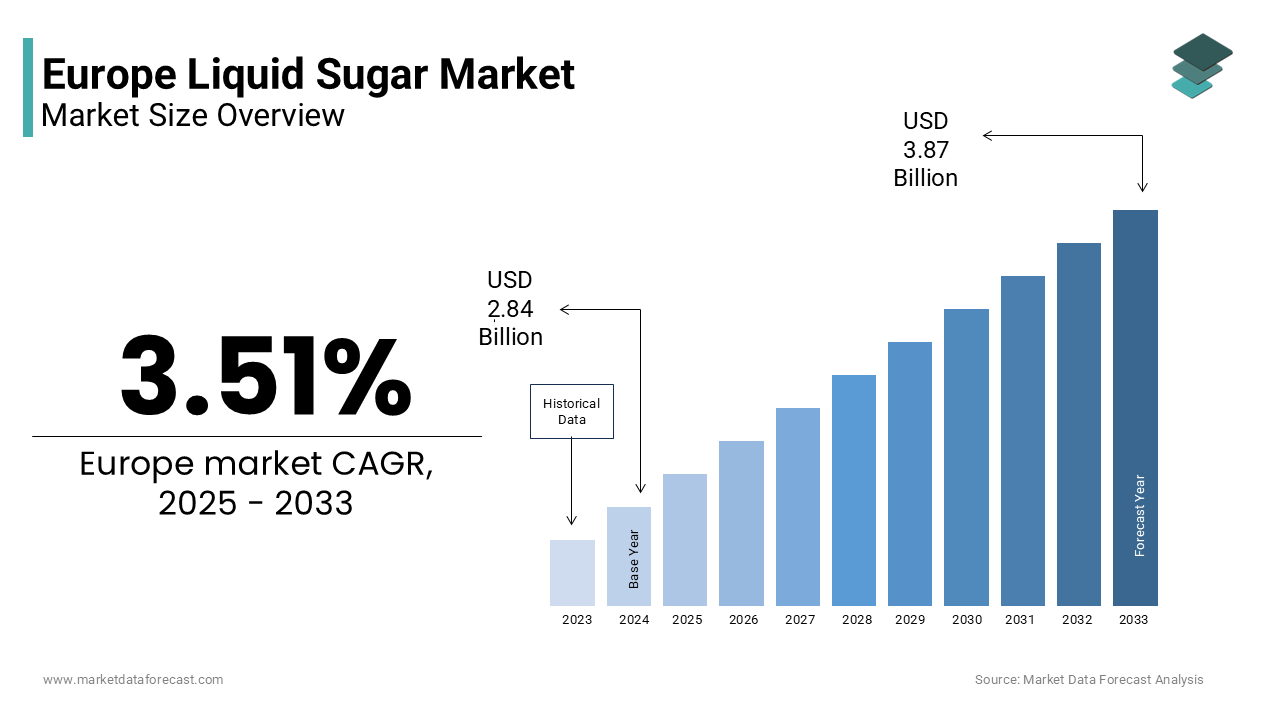
The Europe liquid sugar market size was valued at USD 2.94 billion in 2025 and is expected to reach USD 4.01 billion by 2034 from USD 3.04 billion in 2026, growing at a CAGR of 3.51% from 2026 to 2034.
Liquid sugar is a sweetener that is often used in place of regular sugar. It is prepared by mixing water mainly with white sugar or, sometimes, with brown sugar. Commercially produced liquid sugar is mainly used in our homes or is widely seen in restaurants. The production of liquid sugar can be carried out by any type of sugar, the sugar granules must be finely ground, so that the granules dissolve very easily in water. To create healthy liquid sugars, alternatives can also be used. Liquid sugar has now become an alternative to regular sugar used in various recipes. They are used more today in restaurants to make tea or coffee. Liquid sugar is not only a good alternative to regular sugar, but one of the advantages of liquid sugar compared to conventional sugar is that it is much sweeter than conventional sugar, only a small amount of liquid sugar is necessary to obtain a good amount of sweetness.
Market Drivers and Restraints:
The increasing consumer demand for low calorie sugar plays a key role in stimulating the global liquid sugar market during the forecast period. Increased opportunities in the baking industry is also a key factor driving the global market. Restaurant chefs prefer liquid sugar to create cakes or baked goods. Liquid sugar also saves labor costs and the time required to filter normal sugar, which will stimulate demand and growth in the liquid sugar market. Some of the limiting factors for liquid sugar may be the cost of the raw material, which is constantly increasing and the cost associated with the liquid sugar supply chain is also increasing. Also, foods high in sugar can cause obesity, diabetes, and heart disease.
Market Segmentation
The Europe Liquid Sugar Market is segmented by origin into conventional and organic, and by application into beverage, bakery, baby food, confectionery, and other applications. According to the distribution channel, the world liquid sugar market is segmented as convenience stores, online stores, and supermarkets/hypermarkets.
Impact of covid-19 on Europe Liquid Sugar Market
The Covid-19 pandemic had its adverse effects on the worldwide food & beverage sector and all its associated industries. Existing plans for many organizations will focus on unique catastrophic events, but this situation is very different, as the majority of the population remains healthy and therefore able to work. The decision to stay open or closed can be life and death, and the effects on the long-term viability of the business can be enormous. Businesses may also face shortages of supplies. Contingency plans should be reviewed to determine if other sources or substitutes could be used when main supplies are no longer available. Despite effective contingency plans, many companies may experience interruptions in their services. The shutdown of distribution channels and manufacturing units have resulted in the decline in the sales of liquid sugar across the globe.
Regional Analysis
The Europe Liquid Sugar market has been classified on the basis of geography into nations of United Kingdom, Germany, France, Italy, Spain and the rest of Europe. In terms of business, Europe is considered as the third largest contributor to global the liquid sugar market.
Leading Company
Cargill had the most substantial share of the Liquid Sugar Market in terms of sales and revenue in 2018.
Key Players
Some of the major players in the liquid sugar market are United Sucroses Corporation, Cargill, Incorporated, Seidler Chemical Co, Inc., Imperial Sucrose Company, Nordzucker AG, Marigold, Sweeteners plus, LLC, Nordic Sucrose A/S, Tate & Lyle and Many others.
Recent Developments
- A Stevia & Monk Fruit liquid sweeteners and keto-compatible product has been launched by a Whole Earth Sweetener Company. It is available in e commerce and supermarkets. Brand offers a variety of nine diversities, in which most are adapted to the keto diet, comprising new three products launched this year.
- In 2016, T.H.E.M. (Engineering and Merchandising Technical Support) launched Cane Simple Liquid Sugar in filling bags, improving the packaging design with the inclusion of a practical mouthpiece liner.
- In May 2019, a company called Graycliff Partners LP has declared that it has now completed the acquisition of Sweeteners Plus, Inc., a manufacturer and distributor of essential liquid and dry sweeteners for restaurants, specialty drinks, bakeries, confectionery and pharmaceuticals, among others. Based in Lakeville NY, Sweeteners transforms loose sugar into a wide range of products, including bagged brown and white sugars, organic products, liquid sucrose, and corn syrups.
- In August 2017, Rogers Sugar Inc. have announced the closing of the previously announced acquisition of all issued and outstanding shares of LB Maple Treat Corporation, one of the world's largest private label and private label maple syrup distribution and packaging companies, through a solely retained subsidiary of Lantic Inc., for a acquisition worth of $ 160.3 million.
- In January 2017, A leading chemical technology company and pioneer in renewable chemistry which is well-Known as Avantium based in Netherlands, announced that it had acquired Liquid Light Inc. (Liquid Light), a Princeton University company in 2008, which it developed and patented Low energy electrochemical technologies to convert CO2 into the main chemical products.
- Bayn Europe, a company based in Sweden, aims to use its powerful sugar reduction solutions to assist growth following the purchase of the FMCG Pändy Foods brand. The acquisition of Pändy would mark Bayn's first entry into the consumer space. The Bayn property will represent approximately 51% of the combined group, and the company has said the transaction will be partially financed by the issuance of new shares.