- Product Description Description
- Table of Contents TOC
- List of Table & Figure LOT
- Get Free Sample PDF Sample PDF
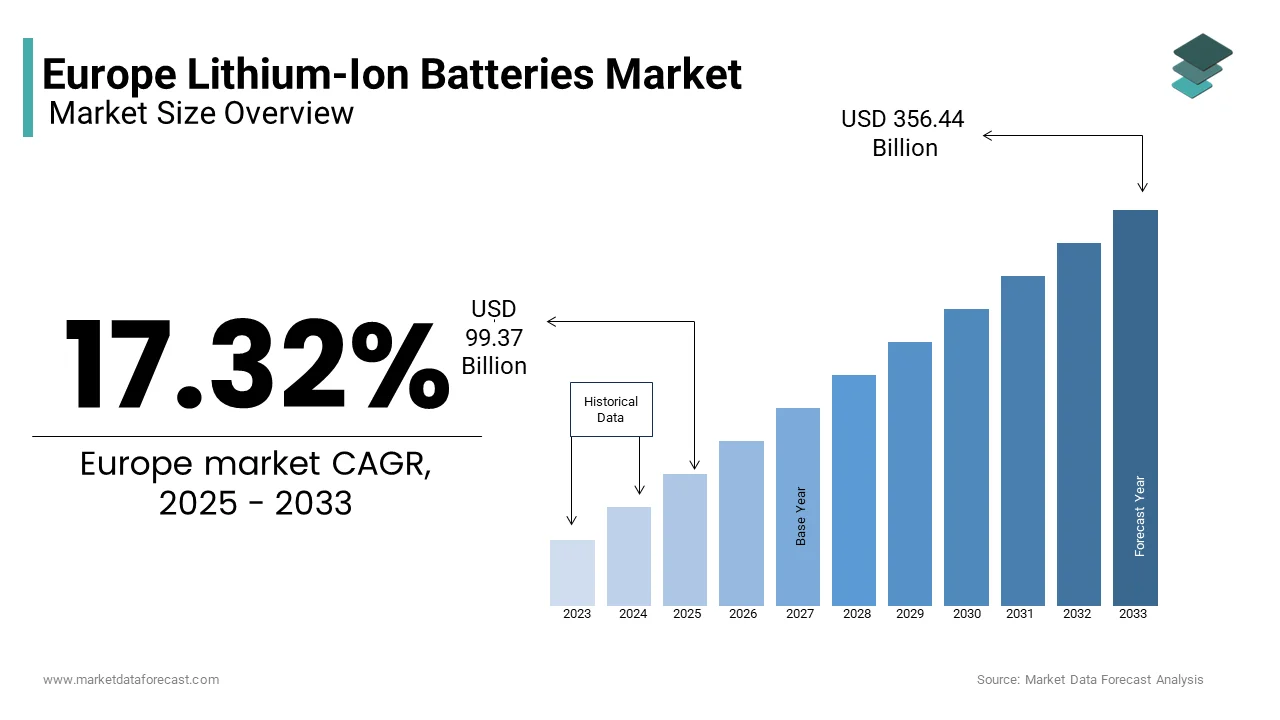
Market Size, 2025
$99.37 BnMarket Estimate, 2026
$116.58 BnMarket Forecast, 2034
$418.41 BnCAGR, 2026–2034
17.32%Executive Summary: Europe Lithium-Ion Batteries Market
- Market Scope: Comprehensive analysis of the European lithium-ion battery industry, examining battery chemistries, capacity ranges, voltage architectures, application industries, and country-level adoption trends.
- Market Valuation: Valued at USD 99.37 billion in 2025, estimated at USD 116.58 billion in 2026, and projected to reach USD 418.41 billion by 2034, expanding at a robust CAGR of 17.32% during the forecast period.
- Primary Growth Drivers: Aggressive EU electrification mandates banning new fossil fuel vehicles by 2035, surging demand for grid-scale renewable energy storage, and strategic regional gigafactory investments.
Key Market Segment Metrics
| Category | Leading Segment (Base Position) | Fastest-Growing / High-Growth Segment |
|---|---|---|
| By Battery Chemistry | Nickel Manganese Cobalt (NMC) (commanded the largest share in 2025, favored for energy density and range) | Lithium Iron Phosphate (LFP) (expanding at a 22.6% CAGR, driven by cost-efficiency, safety, and entry-level EVs) |
| By Capacity Range | Above 60,000 mAh (held dominant share in 2025, essential for electric passenger cars, buses, and grid storage) | 10,001 – 60,000 mAh (growing at a 19.2% CAGR, spurred by light electric vehicles, e-bikes, and home backup) |
| By Voltage Architecture | High Voltage (>36V) (dominant position, powering high-performance electric vehicles and heavy industrial machinery) | Medium Voltage (12V–36V) (growing at a 17.1% CAGR, driven by low-speed EVs, micro-mobility, and urban logistics) |
| By Industry End-Use | Automotive (undisputed market leader holding the highest share, driven by strict EU emission targets and EV adoption) | Power / Stationary Storage (recording a 25.2% CAGR, propelled by grid stabilization and renewable integration) |
| By Country / Region | Germany (regional leader holding 27.7% share in 2025, anchored by its robust automotive hub and energy transition) | Sweden & France (high growth driven by green gigafactory investments, sovereign value chains, and low-carbon energy) |
Major Market Players & Industry Landscape
Market Structure: Highly strategic and competitive ecosystem shaped by localized gigafactory scaling, European supply chain autonomy initiatives, and aggressive joint ventures between automakers and battery cell developers.
Key Companies: BYD Co Ltd ADR, Hitachi Ltd, Johnson Controls International PLC, LG Chem, Panasonic Holdings Corp, Samsung SDI Co Ltd GDR - 144A, Toshiba Tec Corp ADR, and GS Yuasa Corp.
Europe Lithium-Ion Batteries Market Size
The Europe lithium-ion battery market size was valued at USD 99.37 billion in 2025 and is anticipated to reach USD 116.58 billion in 2026 from USD 418.41 billion by 2034, growing at a CAGR of 17.32% during the forecast period from 2026 to 2034.
Lithium-ion batteries represent the critical energy storage backbone enabling the continent's transition toward decarbonization and electrified mobility. These electrochemical cells function by shuttling lithium ions between a cathode and an anode to store and release electrical energy with high efficiency and density. The strategic imperative for this technology stems from the European Union mandate to achieve climate neutrality by 2050 which necessitates a complete overhaul of current energy infrastructure. According to the European Environment Agency, the transport sector is responsible for a significant portion of total greenhouse gas emissions in Europe, which is making the shift to electric vehicles powered by advanced batteries essential for regulatory compliance. As per the International Energy Agency, Europe remains heavily dependent on imported lithium-ion battery cells, with most supply coming from Asian manufacturers, which local production initiatives aim to reduce. National grids increasingly rely on stationary storage systems to balance the intermittency of renewable sources such as wind and solar, which now generate a substantial share of electricity in several member states. As per the European Battery Alliance, securing a domestic supply chain is considered vital for economic sovereignty and for reducing vulnerability to geopolitical disruptions. This ecosystem encompasses raw material extraction, cell manufacturing, and advanced recycling facilities designed to recover valuable metals and minimize environmental impact.
MARKET DRIVERS
Aggressive Electrification Mandates Drive Automotive Demand
The stringent regulatory framework mandating the phase out of internal combustion engines is propelling the growth of the European lithium-ion batteries market. The European Union regulation requiring a 100% reduction in carbon dioxide emissions from new cars and vans by 2035 effectively bans the sale of new fossil fuel vehicles and compels manufacturers to pivot entirely to electric powertrains. As per the European Automobile Manufacturers Association, sales of battery electric vehicles in the European Union have grown significantly, representing a notable share of the total car market. This surge in vehicle production directly correlates with an exponential increase in demand for high-capacity battery packs capable of delivering extended driving ranges. Major automakers like Volkswagen and Stellantis have announced large investment plans to localize battery cell production within Europe by 2030. According to the Consumer Protection Cooperation Network, range anxiety remains a key concern for buyers, which drives the industry to develop cells with higher energy density and faster charging capabilities. Government incentives such as purchase subsidies and tax exemptions in countries like Germany and France further accelerate consumer uptake, thereby sustaining robust demand for battery components. The logistical requirement to equip millions of vehicles annually ensures that the automotive segment will remain the dominant consumption vector for lithium-ion technology throughout the decade.
Expansion of Renewable Energy Infrastructure Necessitates Storage
The rapid deployment of intermittent renewable energy sources across Europe creates an indispensable need for large scale lithium-ion battery storage systems to ensure grid stability and reliability, which is further boosting the expansion of the European lithium-ion batteries market. As nations strive to meet the Renewable Energy Directive target of 42.5% renewable energy in final consumption by 2030, the volatility of wind and solar generation requires sophisticated buffering mechanisms. As per Eurostat, wind and solar power generated a significant share of electricity in the European Union in 2023, yet their output fluctuates based on weather conditions. Lithium-ion batteries provide the fast response times necessary to balance supply and demand instantaneously, preventing blackouts and optimizing the utilization of clean energy assets. The European Network of Transmission System Operators for Electricity estimates that Europe will need substantial flexible storage capacity by 2030 to accommodate the projected growth in renewables. Stationary storage projects are increasingly viable due to declining battery costs and supportive policy frameworks that value ancillary services like frequency regulation. Countries like Germany and Italy lead in installed home storage systems coupled with rooftop solar panels, allowing households to maximize self-consumption and reduce reliance on the grid. This dual application in utility scale and behind the meter installations diversifies the demand base and insulates the market from fluctuations in any single sector while supporting broader energy transition goals.
MARKET RESTRAINTS
Critical Dependence on Imported Raw Materials
The severe lack of domestic access to critical raw materials required for lithium-ion battery production poses a substantial restraint on the growth and autonomy of the European market. The manufacturing of cathodes and anodes relies heavily on lithium, cobalt, nickel, and graphite resources that are predominantly sourced from outside Europe, creating significant supply chain vulnerabilities. As per the Joint Research Centre of the European Commission, the European Union imports nearly all of its lithium and cobalt requirements, with China processing the majority of global supply. This concentration of supply exposes European manufacturers to geopolitical tensions, trade restrictions, and price volatility that can disrupt production schedules and inflate costs. The extraction of these materials often involves complex environmental and social governance issues which complicate procurement strategies for companies adhering to strict sustainability standards. While exploration projects exist in countries like Portugal and Finland, they face lengthy permitting processes and local opposition that delay commercial viability. The European Raw Materials Alliance acknowledges that building a fully integrated domestic value chain will take at least a decade, leaving the industry exposed to external shocks in the interim. Without secure and diversified sources of feedstock, the ambitious targets for local battery manufacturing risk falling short as competitors with better resource access gain a competitive advantage.
Complex Regulatory Landscape for Battery Recycling
The evolving and stringent regulatory requirements regarding battery end of life management and recycling create operational complexities that restrain market fluidity and increase compliance costs, which is further hampering the expansion of the European lithium-ion batteries market. The new European Union Battery Regulation mandates specific collection targets and minimum levels of recycled content in new batteries, which forces manufacturers to overhaul their logistics and processing infrastructure. As per the European Environment Agency, only a portion of portable batteries were collected for recycling in 2022, falling short of the increasing targets set for upcoming years. Establishing efficient reverse logistics networks to gather spent batteries from diverse sources including electric vehicles and consumer electronics requires significant capital investment and coordination among stakeholders. The technical challenge of safely dismantling large format EV packs and recovering high purity materials adds another layer of difficulty as current recycling technologies struggle to achieve economic viability at scale. Companies must navigate varying national implementations of EU directives, which leads to fragmentation and uncertainty in cross border operations. The requirement to provide digital battery passports containing detailed information on composition and carbon footprint demands robust data tracking systems that many smaller players lack. These regulatory hurdles slow down the development of a circular economy for batteries and increase the overall cost of ownership, thereby potentially dampening the pace of market expansion until standardized and cost-effective recycling solutions become widespread.
MARKET OPPORTUNITIES
Development of Solid-State Battery Technology
The emergence of solid-state battery technology presents a transformative opportunity for the Europe lithium-ion batteries market by promising superior performance and safety characteristics compared to conventional liquid electrolyte cells. This next generation technology replaces the flammable liquid electrolyte with a solid material, which significantly reduces the risk of fire and allows for higher energy density, enabling longer driving ranges for electric vehicles. As per the Fraunhofer Institute for Silicate Research, European research institutions hold a leading position globally in solid state battery patents, with many filings originating from Germany and France. Major automotive manufacturers and startups across the continent have formed consortia to accelerate commercialization, with pilot production lines expected to come online before 2030. The potential to use lithium metal anodes in solid state designs could double the energy storage capacity of current batteries, addressing one of the primary barriers to electric vehicle adoption. Government funding through programs like the Important Projects of Common European Interest supports research and industrial scaling of these advanced cells. The ability to operate efficiently in extreme temperatures also opens new applications in aviation and heavy-duty transport. Successfully scaling this innovation would allow Europe to leapfrog existing manufacturing paradigms and establish a technological moat against international competitors.
Establishment of Gigafactories and Local Supply Chains
The strategic construction of massive battery manufacturing facilities known as gigafactories across Europe offers a substantial opportunity for the European lithium-ion batteries market. These large-scale plants aim to reduce dependency on imports, lower logistics costs, and ensure a steady supply of cells for the burgeoning electric vehicle industry. As per the European Battery Alliance, investments announced for battery cell production in Europe have exceeded significant levels, with over 30 gigafactories planned or under construction by 2030. Countries like Hungary, Sweden, and Germany are becoming hubs for these facilities due to favorable energy costs, skilled workforces, and proximity to automotive assembly plants. The localization of supply chains enables tighter integration between cell producers and original equipment manufacturers, facilitating just in time delivery and collaborative product development. This industrial buildup stimulates job creation and fosters a specialized ecosystem of component suppliers and service providers dedicated to battery technology. The European Investment Bank actively finances these projects, recognizing their critical role in achieving strategic autonomy and climate goals. By establishing a robust domestic manufacturing base, Europe can mitigate risks associated with global supply chain disruptions and position itself as a net exporter of advanced battery technology.
MARKET CHALLENGES
Volatility in Energy Prices Affects Manufacturing Costs
The fluctuation of energy prices across Europe presents a formidable challenge for the European lithium-ion batteries market. The production of battery cells is an energy intensive process requiring substantial electricity for electrode drying, cell assembly, and formation cycling, which makes operators highly sensitive to power costs. As per Eurostat, industrial electricity prices in the European Union surged significantly in 2022 following geopolitical conflicts and remain volatile compared to other major manufacturing regions. High energy costs erode profit margins for battery producers who already operate in a highly competitive global market where price pressure from Asian competitors is intense. Manufacturers are forced to either absorb these costs or pass them on to customers, which could slow down the adoption of electric vehicles and storage systems. Some companies have delayed final investment decisions on new gigafactories due to uncertainty regarding long term energy affordability and availability. The reliance on natural gas for certain thermal processes in the supply chain further exacerbates exposure to fossil fuel market dynamics. To mitigate this challenge, producers are exploring on site renewable generation and power purchase agreements, yet these solutions require significant upfront capital and time to implement. Until energy markets stabilize and offer predictable pricing, the economic viability of expanding European battery production capacity remains under constant threat from external macroeconomic forces.
Shortage of Specialized Technical Workforce
A critical scarcity of skilled professionals with expertise in electrochemistry and battery manufacturing processes hampers the rapid scaling of the Europe lithium-ion batteries market. The establishment of numerous gigafactories and research centers has created a surge in demand for engineers, technicians, and scientists possessing niche skills that are currently in short supply across the labor market. As per the European Centre for the Development of Vocational Training, the green transition could leave a large number of jobs unfilled in the energy sector by 2030 due to skills mismatches and talent gaps. Universities and vocational schools are struggling to update curricula fast enough to produce graduates with the specific practical knowledge required for advanced cell production and quality control. This workforce deficit leads to recruitment delays, increased labor costs, and potential operational inefficiencies as companies compete fiercely for a limited pool of qualified candidates. The complexity of battery technology requires continuous training and upskilling, which strains human resource departments and slows down the ramp up of new production lines. Without a coordinated effort to expand educational programs and attract international talent, the industry risks bottlenecks that could derail ambitious production targets. Addressing this human capital challenge is essential to ensure that the physical infrastructure of gigafactories can be operated effectively and safely to meet the growing demand for energy storage solutions.
REPORT COVERAGE
| REPORT METRIC | DETAILS |
| Market Size Available | 2025 to 2034 |
| Base Year | 2025 |
| Forecast Period | 2026 to 2034 |
| CAGR | 17.32% |
| Segments Covered | By Battery, Capacity, Voltage, Industry, And Region. |
| Various Analyses Covered | Global, Regional, and Country Level Analysis, Segment-Level Analysis, DROC, PESTLE Analysis, Porter’s Five Forces Analysis, Competitive Landscape, Analyst Overview of Investment Opportunities |
| Regions Covered | UK, France, Spain, Germany, Italy, Russia, Sweden, Denmark, Switzerland, Netherlands, Turkey, Czech Republic & Rest of Europe |
| Market Leaders Profiled | BYD Co Ltd ADR, Hitachi Ltd, Johnson Controls International PLC, LG Chem, Panasonic Holdings Corp, Samsung SDI Co Ltd GDR - 144A, Toshiba Tec Corp ADR, GS Yuasa Corp. |
SEGMENTAL ANALYSIS
By Battery Insights
The lithium nickel manganese cobalt (NMC) segment commanded for the largest share of the European lithium-ion batteries market in 2025. The dominance of NMC segment in the European market can be credited to its optimal balance of energy density, power output, and thermal stability, which makes it ideal for electric vehicles and the specific requirement of European automakers for battery chemistries that support long driving ranges without compromising vehicle performance or safety standards. As per the International Council on Clean Transportation, a majority of battery electric vehicles sold in Europe in 2023 utilized NMC chemistry because of its high energy density. This allows manufacturers to fit sufficient capacity into limited chassis space while maintaining competitive vehicle weights that adhere to efficiency regulations. The versatility of NMC enables manufacturers to tweak the ratio of nickel, manganese, and cobalt to prioritize either range or longevity depending on the vehicle segment. Major cell producers operating gigafactories in Germany and Hungary have standardized their production lines around NMC formulations to supply key clients like Volkswagen and BMW. The established supply chain for nickel and cobalt processing within Europe further supports the prevalence of this chemistry. As automotive platforms evolve to support faster charging speeds, the thermal management capabilities of NMC cells continue to provide a reliable solution that meets the rigorous safety protocols mandated by European type approval authorities.
The lithium iron phosphate (LFP) segment is emerging as the fastest growing segment in the Europe lithium-ion batteries market and is expected to grow at a CAGR of 22.6% over the forecast period owing to the increasing demand for cost effective and durable battery solutions for entry level electric vehicles and stationary energy storage systems and the inherent safety profile of LFP chemistry, which eliminates the risk of thermal runaway and fire hazards associated with cobalt based cells. As per BloombergNEF, the cost of LFP battery packs has dropped significantly, making them cheaper than NMC alternatives and attractive for mass market adoption. European manufacturers are increasingly adopting LFP for standard range vehicles where affordability and cycle life matter more than extreme energy density. The absence of cobalt and nickel in LFP cathodes also mitigates supply chain risks and aligns with strict environmental and ethical sourcing regulations enforced by the European Union. Stationary storage projects favor LFP due to its ability to withstand thousands of charge discharge cycles without significant degradation. Major automakers including Tesla and Renault have announced plans to introduce LFP powered models in Europe to capture price sensitive consumer segments. The shift toward iron-based chemistry represents a strategic move to diversify the battery mix and reduce dependency on volatile critical mineral markets while supporting the broader electrification goals of the continent.
By Capacity Insights
The above 60,000 mAh capacity segment had the dominant share of the Europe lithium-ion batteries market in 2025. The dominance of above 60,000 mAh segment in the European market is primarily attributed to the massive consumption requirements of the electric vehicle industry. These high-capacity cells are essential for powering electric cars, buses, and trucks which require substantial energy storage to achieve practical driving ranges demanded by consumers and commercial operators. As per the European Automobile Manufacturers Association, the average battery capacity of new electric vehicles registered in Europe exceeded 60 kWh in 2023, reflecting the trend toward larger packs to alleviate range anxiety. The dominance of this segment is further reinforced by the deployment of large-scale stationary storage systems connected to the electrical grid, which utilize high-capacity modules to balance renewable energy fluctuations. Industrial applications such as forklifts and heavy machinery also contribute significantly to demand in this capacity range due to their need for extended operational uptime. Manufacturing economies of scale have favoured the production of larger format cells like the 21700 and 21700 formats, which optimize pack design and reduce overall system costs. The push for longer range commercial vehicles under the Euro VII emission standards necessitates even larger battery installations, ensuring sustained growth for this high-capacity category.
The 10,001 – 60,000 mAh capacity segment is experiencing the fastest growth in the Europe lithium-ion batteries market and is predicted to register a CAGR of 19.2% over the forecast period owing to the expanding market for light electric vehicles including electric scooters, bicycles, and mopeds, which are gaining immense popularity as urban mobility solutions across European cities. As per the European Cyclists Federation, sales of electric bicycles in Europe surpassed millions of units in 2023, with each unit typically requiring a battery within this mid-range capacity. The rise of micro mobility services and shared transportation fleets has further amplified demand as operators seek durable and lightweight power sources that can withstand frequent usage cycles. Additionally, the growing sector of portable power stations and home backup systems for residential solar installations utilizes battery packs in this capacity range to offer flexible and scalable energy storage options. Technological advancements in cell design have enabled manufacturers to produce compact yet high energy density packs that fit seamlessly into the frames of light vehicles. Government incentives promoting zero emission urban transport and last mile delivery solutions are accelerating adoption of these mid capacity batteries. The versatility of this segment allows it to serve diverse applications ranging from consumer gadgets to light industrial tools, making it a dynamic growth engine within the broader market landscape.
By Voltage Insights
The high voltage segment encompassing systems above 36 volts dominates the Europe lithium-ion batteries market due to its critical role in powering electric vehicles and heavy-duty industrial equipment. This voltage range is necessary to deliver the high-power output required for acceleration and sustained performance in automotive and commercial transport applications. As per the Society of Motor Manufacturers and Traders, the majority of electric passenger cars and commercial vans sold in Europe operate on battery packs with nominal voltages ranging from 400 to 800 volts to optimize efficiency and reduce current flow. Higher voltage architectures enable faster charging speeds, which is a key selling point for consumers and fleet operators looking to minimize downtime. The dominance of this segment is also supported by the electrification of public transport buses and delivery trucks, which rely on high voltage systems to carry heavy loads over long distances. Industrial sectors such as construction and agriculture are increasingly adopting high voltage electric machinery to meet stringent emission regulations and reduce operating costs. The development of silicon carbide inverters and other power electronics has made high voltage systems more efficient and reliable, encouraging wider adoption. As the European Union pushes for heavier decarbonization targets in the transport sector, the demand for high voltage battery systems will continue to outpace other segments.
The medium voltage segment spanning from 12 volts to 36 volts is projected to be the fastest growing area in the Europe lithium-ion batteries market and is likely to grow at a CAGR of 17.1% over the forecast period owing to the rapid proliferation of low-speed electric vehicles and electrified two wheelers, which typically operate within this voltage range to balance performance and safety. As per the European Two-Wheeler Association, the market for electric motorcycles and scooters grew significantly in 2023, with most models utilizing 24 volt or 36-volt battery systems to comply with licensing regulations for light vehicles. The segment is also benefiting from the transition of traditional lead acid batteries to lithium-ion in applications such as golf carts, floor cleaning machines, and wheelchair mobility devices. Urban logistics companies are deploying fleets of small electric vans and cargo bikes that operate on medium voltage architectures to navigate city centers efficiently. The modular nature of medium voltage packs allows for easy scalability and replacement, making them attractive for aftermarket conversions of existing fleets. Safety regulations in Europe often favor lower voltage systems for certain consumer and light commercial applications, reducing the complexity of thermal management and electrical insulation requirements. As urbanization intensifies and demand for last mile delivery solutions expands, the medium voltage segment is poised for sustained rapid growth.
By Industry Insights
The automotive segment stood as the undisputed leader in the Europe lithium-ion batteries market by holding the highest share of the automotive segment in the European market. The dominance of automotive segment in the European market is attributed to the mandatory emissions regulations and substantial government incentives that have compelled automakers to rapidly electrify their vehicle portfolios. As per the European Commission, battery electric vehicle registrations in Europe reached record levels in 2023, with millions of new units requiring large format lithium-ion battery packs. The sheer volume of vehicles produced by major European manufacturers like Volkswagen Group, Stellantis, and Mercedes-Benz creates massive demand for battery cells. The shift extends beyond passenger cars to commercial vans, buses, and trucks as logistics companies strive to meet corporate sustainability goals and urban access restrictions. Investments in gigafactories across the continent are primarily targeted at securing supply for the automotive sector. The integration of battery production into the automotive supply chain has become a strategic priority to reduce costs and improve resilience. As the phase out of internal combustion engines approaches, the automotive segment will continue to drive the majority of market growth and innovation in battery technology.
The power segment is anticipated to record a promising CAGR of 25.2% over the forecast period owing to the urgent need for grid stabilization and renewable energy integration and the increasing penetration of intermittent renewable energy sources such as wind and solar that require large scale energy storage to maintain grid reliability. As per the European Network of Transmission System Operators for Electricity, Europe added significant new battery storage capacity in 2023 as utilities and independent power producers invested heavily in flexibility assets. The volatility of electricity prices and the need for frequency regulation services have made lithium-ion batteries an economically viable solution for grid operators. Government policies supporting decarbonization and the phasing out of coal fired power plants are further accelerating deployment of stationary storage systems. The rise of virtual power plants that aggregate distributed battery resources to provide grid services is creating new revenue streams and driving adoption among residential and commercial users. As the continent moves toward a fully renewable energy mix, the role of lithium-ion batteries in the power sector will become increasingly critical, fostering unprecedented growth rates.
COUNTRY ANALYSIS
Germany Lithium-Ion Batteries Market Analysis
Germany maintained its position as the leading market for lithium-ion batteries in Europe in 2025 with 27.7% of the regional market share. The dominance of Germany in the European market is driven by its robust automotive industry, ambitious energy transition goals. The country’s status as a manufacturing hub is reinforced by the presence of major automakers and a dense network of suppliers driving immense demand for battery cells. As per the German Federal Ministry for Economic Affairs and Climate Action, Germany aims to have 15 million electric vehicles on its roads by 2030, necessitating a massive scaling up of domestic battery production capacity. Several gigafactories are under construction in states like Brandenburg and Thuringia to supply local vehicle assembly plants and reduce reliance on imports. The German government provides substantial subsidies for battery research and development, fostering innovation in next generation cell technologies and recycling processes. The industrial sector in Germany is also a major consumer of lithium-ion batteries for material handling equipment and backup power systems. The commitment to phasing out nuclear and coal power has increased the focus on stationary storage solutions to manage renewable energy variability. These factors combined ensure Germany remains the central pillar of the European battery ecosystem.
France Lithium-Ion Batteries Market Analysis
France captured a promising share of the European lithium-ion batteries market in 2025. The growth of France in the European market is attributed to a strong national strategy to build a sovereign battery value chain. As per the French Ministry of Economy and Finance, the France 2030 investment plan allocates billions of euros to support gigafactories and innovative battery technologies. Companies like Verkor and ACC are establishing large scale production facilities to meet growing demand from automakers such as Renault and Stellantis. France emphasizes low carbon battery production by leveraging its nuclear-powered electricity grid. Generous purchase bonuses and infrastructure programs encourage consumer adoption, while investments in recycling aim to secure secondary sources of critical metals. This holistic approach positions France as a key growth engine in the European market.
United Kingdom Lithium-Ion Batteries Market Analysis
The United Kingdom is anticipated to account for a notable share of the European lithium-ion batteries market over the forecast period due to its commitment to net zero emissions and revitalization of its automotive sector. As per the Office for Zero Emission Vehicles, the UK government has set a target for all new car sales to be zero emission by 2035, prompting significant investments in battery production facilities. Projects like the Britishvolt gigafactory highlight the strategic intent to localize cell manufacturing. Automakers such as Nissan and Jaguar Land Rover are committing to electrify their lineups, driving demand for battery packs. The UK’s power sector is also a growing consumer as offshore wind integration requires substantial storage capacity. Despite regulatory uncertainties, the UK remains a vital market due to its engineering heritage and proactive government support.
Sweden Lithium-Ion Batteries Market Analysis
Sweden is predicted to showcase a healthy CAGR in the European lithium-ion batteries market over the forecast period due to its focus on sustainable and fossil free production. The presence of Northvolt has positioned Sweden as a leader in renewable-powered cell manufacturing. As per the Swedish Energy Agency, the nation aims to become a global leader in green battery manufacturing by leveraging hydroelectric and wind resources. The automotive sector, including Volvo and Scania, is transitioning to electric powertrains, creating steady demand for locally produced batteries. Sustainability initiatives extend to recycling and material recovery, ensuring Sweden plays a crucial role in shaping the future of green battery manufacturing in Europe.
Italy Lithium-Ion Batteries Market Analysis
Italy is estimated to grow at a steady CAGR in the European lithium-ion batteries market over the forecast period. The efforts to modernize its automotive industry and expand renewable energy capacity are driving the Italian market growth. As per the Italian Ministry of Enterprises and Made in Italy, the national recovery and resilience plan includes significant funding for domestic battery supply chains and electrification of transport. Partnerships with international firms aim to establish gigafactories in southern Italy. The automotive industry, led by Fiat under Stellantis, is pivoting to electric vehicles, boosting demand for battery components. Italy’s power sector is also contributing to growth as solar capacity expands, requiring storage solutions. Government focus on reducing urban air pollution accelerates adoption of electric buses and commercial vehicles. These dynamics position Italy as an emerging hub with significant potential for expansion aligned with European green deal objectives.
COMPETITIVE LANDSCAPE
The competition in the Europe lithium-ion batteries market is intense and characterized by a dynamic mix of established Asian giants and emerging European startups striving for dominance. Major international corporations leverage their scale and mature technology to secure long-term contracts with leading automakers while local challengers differentiate themselves through sustainability and proximity to customers. The landscape is rapidly evolving as companies race to construct gigafactories and secure access to critical raw materials amidst geopolitical tensions. Competitive advantage increasingly depends on the ability to produce batteries with a low carbon footprint and high recycled content to comply with stringent European regulations. Innovation in battery chemistry such as solid-state and sodium-ion technologies serves as a key battleground for future market leadership. Collaborative ventures between cell manufacturers and automotive original equipment manufacturers are becoming standard to share risks and accelerate product development. This high-stakes environment fosters continuous technological advancement and cost reduction ultimately benefiting the broader energy transition efforts across the continent.
KEY MARKET PLAYERS
A few of the market players in the Europe lithium-ion batteries market
- BYD Co Ltd ADR
- Hitachi Ltd
- Contemporary Amperex Technology Co. Limited
- LG Energy Solution Ltd
- Northvolt AB
- Johnson Controls International PLC
- LG Chem
- Panasonic Holdings Corp
- Samsung SDI Co Ltd GDR - 144A
- Toshiba Tec Corp ADR
- GS Yuasa Corp
Top Players In The Market
- Contemporary Amperex Technology Co. Limited stands as a dominant force in the Europe lithium-ion batteries market by supplying advanced cell solutions to major European automakers. The company contributes significantly to the global market by leading innovation in energy density and charging speed technologies. Recent actions include the construction of a massive gigafactory in Hungary to localize production and reduce logistics costs for European clients. This strategic expansion allows the firm to comply with local content requirements while ensuring a stable supply chain for partners like BMW and Volkswagen. The company also invests heavily in recycling infrastructure to close the loop on material usage. By focusing on sustainable manufacturing processes and cutting-edge battery chemistry research the firm solidifies its position as a critical enabler of the European electric mobility transition.
- LG Energy Solution Ltd plays a pivotal role in the Europe lithium-ion batteries market through its extensive manufacturing footprint and technological leadership in high nickel cathode cells. Globally the company is recognized for setting standards in battery safety and performance which directly benefits European electric vehicle manufacturers. To strengthen its market position the company recently expanded its production facility in Poland to increase output capacity for premium automotive customers. This expansion supports the growing demand for long-range electric vehicles across the continent. The firm actively collaborates with European research institutions to develop next-generation solid-state batteries. Additionally it has secured long-term supply agreements for critical raw materials to mitigate supply chain risks. These strategic moves ensure reliable delivery of high-quality battery packs while fostering innovation in sustainable energy storage solutions.
- Northvolt AB has emerged as a key player in the Europe lithium-ion batteries market by championing the production of batteries with the lowest possible carbon footprint. The company contributes to the global market by demonstrating the viability of fully renewable energy-powered cell manufacturing. Recent actions include the ramp-up of its flagship factory in Sweden and the development of a new facility in Germany to meet surging demand. Northvolt focuses on integrating recycled materials into its production process aiming to use fifty percent recycled content by 2030. The firm has secured partnerships with major automotive brands to supply cells for upcoming electric vehicle platforms. By prioritizing sustainability and localizing the entire value chain from recycling to cell assembly Northvolt strengthens its competitive edge and supports the European Green Deal objectives.
Top Strategies Used By Key Market Participants
Key players in the Europe lithium-ion batteries market primarily focus on establishing local gigafactories to reduce dependency on imports and lower logistics costs. Companies actively pursue vertical integration by securing long-term supply agreements for critical raw materials like lithium and nickel to ensure production stability. Strategic partnerships with automotive manufacturers are common to co-develop customized battery solutions that meet specific vehicle requirements. Investment in research and development drives innovation in solid-state technology and recycling processes to enhance sustainability and performance. Firms also leverage government incentives and subsidies to fund large-scale expansion projects and accelerate the transition to green manufacturing. These strategies collectively aim to build a resilient and competitive domestic supply chain capable of meeting the ambitious electrification targets set by the European Union.
MARKET SEGMENTATION
This research report on the Europe lithium-ion batteries market is segmented and sub-segmented into the following categories.
By Battery Type
- Lithium Nickel Manganese Cobalt (NMC)
- Lithium Iron Phosphate (LFP)
- Lithium Cobalt Oxide (LCO)
- Lithium Titanate Oxide (LTO)
- Lithium Manganese Oxide (LMO)
- Lithium Nickel Cobalt Aluminum Oxide (NCA)
By Capacity
- Below 3,000 Mah
- 3,001 – 10,000 Mah
- 10,001 – 60,000 Mah
- Above 60,000 Mah
By Voltage
- Low (Below 12v)
- Medium (12v - 36v)
- High (Above 36v)
By Industry
- Consumer Electronics
- Automotive
- Aerospace
- Marine
- Medical
- Industrial
- Power
- Telecommunications
By Country
- UK
- Russia
- Germany
- Italy
- France
- Spain
- Sweden
- Denmark
- Poland
- Switzerland
- Netherlands
- Rest of Europe