- Product Description Description
- Table of Contents TOC
- List of Table & Figure LOT
- Get Free Sample PDF Sample PDF
Market Size, 2025
$2.82 BnMarket Estimate, 2026
$3.07 BnMarket Forecast, 2034
$6.05 BnCAGR, 2026–2034
8.86%Europe Lobster Market Size, Growth, Trends & Forecast (2026–2034)
The Europe lobster market size was valued at USD 2.82 billion in 2025, is estimated at USD 3.07 billion in 2026, and is projected to reach USD 6.05 billion by 2034, expanding at a compound annual growth rate (CAGR) of 8.86% from 2026 to 2034. Market expansion is primarily propelled by the premiumization of dining experiences in metropolitan luxury hospitality sectors, an escalating consumer preference for sustainable and traceable seafood sourcing, and the rapid rise of digital grocery retail channels.
Key Executive Metrics (At-a-Glance)
- 2025 Base Valuation: USD 2.82 Billion
- 2026 Current Valuation: USD 3.07 Billion
- 2034 Forecast Valuation: USD 6.05 Billion
- Compound Annual Growth Rate (CAGR): 8.86% (2026–2034)
- Dominant Species Segment: European Lobster (Homarus gammarus), accounting for 42.3% of the 2025 market share due to its culinary heritage and preference in fine dining
- Fastest-Growing Species Segment: American Lobster (Homarus americanus) driven by competitive pricing and year-round availability
- Dominant Product Type Segment: Whole Lobster (capturing 58.3% of the 2025 market share)
- Fastest-Growing Product Type Segment: Lobster Meat (witnessing a 9.1% CAGR due to convenience, food service kitchen labor reduction, and retail adoption)
- Dominant Distribution Channel: Food Service (fine dining, Michelin-starred venues, and luxury hospitality)
- Fastest-Growing Distribution Channel: Retail (growing at an 8.3% CAGR driven by online grocers and high-end supermarket home delivery)
- Dominant Country Market: France (holding 26.4% of the 2025 market share, anchored by Brittany landings and Rungis logistics)
- Key European Countries Covered: UK, France, Spain, Germany, Italy, Russia, Sweden, Denmark, Switzerland, Netherlands, Turkey, and Czech Republic
Core Market Drivers
- Urban Fine Dining Premiumization: Lobster's status as a core symbol of exclusivity and culinary sophistication across luxury hospitality centers like Paris, London, and Milan.
- Traceability & Sustainability Demands: Heightened EU regulatory compliance (Farm to Fork Strategy) and consumer demand for eco-certifications (MSC, Pêche Durable) and blockchain-enabled origin transparency.
Primary Market Restraints & Challenges
- Animal Welfare Regulations & Climate Shifts: Strict laws concerning live transport and crustacean pain perception adding operational complexities and handling costs, alongside warming sea surface temperatures causing habitat shifts for native stocks.
- Supply Chain & Labor Friction: Post-Brexit regulatory divergence causing export clearance delays, paired with coastal labor shortages and an aging fishing workforce.
Europe Lobster Market Segmentation Breakdown
| Segment Category | Leading Sub-Segment | Fastest-Growing Sub-Segment |
|---|---|---|
| By Species | European Lobster | American Lobster |
| By Product Type | Whole Lobster | Lobster Meat |
| By Distribution Channel | Food Service | Retail |
| By Region | France | Germany & Online Retail Hubs |
Major Industry Players Profiled
Key seafood corporations, cooperatives, and distribution leaders shaping the European market include Clearwater Seafoods, Leroy Seafood Group, Pescanova, Icelandic Group, M&J Seafood, Young’s Seafood, Labeyrie Fine Foods, The Fish Society, Nordic Seafood A/S, and Fishworks.
Europe Lobster Market Size
The Europe lobster market size was calculated to be USD 2.82 billion in 2025 and is anticipated to be worth USD 6.05 billion by 2034, from USD 3.07 billion in 2026, growing at a CAGR of 8.86% during the forecast period.
MARKET DRIVERS
Premiumization of Dining Experiences in Urban Luxury Hospitality Sectors
The premiumization trend within high-end hospitality, particularly in metropolitan centers such as Paris, London, and Milan, is driving the growth of the Europe lobster market. Lobster remains a signature ingredient in fine dining, appearing on over 70 % of tasting menus in three-star venues, according to the European Culinary Association. The perception of lobster as a symbol of exclusivity and culinary sophistication continues to reinforce its placement in upscale menus, especially during festive seasons and corporate events.
Growing Consumer Preference for Sustainable and Traceable Seafood Sourcing
The increasing priority for sustainability and transparency in seafood procurement is additionally to accelerate the growth of the Europe lobster market. As per the European Commission’s 2023 Special Eurobarometer on Food Safety, 68 % of EU citizens consider sustainability certifications important when purchasing seafood. This has led to heightened demand for lobsters bearing labels such as the Marine Stewardship Council or regional eco schemes like the French “Pêche Durable” initiative. Furthermore, the EU’s Farm to Fork Strategy mandates full supply chain transparency by 2027, accelerating the adoption of digital tracking systems in lobster distribution. Restaurants in Germany and the Netherlands now routinely display QR codes linking to lobster origin data, responding to consumer expectations.
MARKET RESTRAINTS
Stringent Animal Welfare Legislation Limiting Live Transport and Sale Practices
The evolving animal welfare regulations are imposing operational and legal constraints on the live lobster trade, which is limiting the growth of the Europe lobster market. Similar proposals are under review in the European Parliament following a 2023 scientific opinion from the European Food Safety Authority confirming evidence of pain perception in crustaceans. These regulations increase handling complexity and costs; specialized stunning equipment can add 15 to 20 % to operational expenses, according to the European Federation of Fish Producers. Moreover, live transport durations are being restricted, reducing shelf life and limiting distribution radius.
Climate-Induced Shifts in Lobster Habitat and Stock Availability
The rising sea temperatures and ocean acidification are altering the distribution and abundance of native European lobster populations is also limiting the growth of the Europe lobster market. As per the International Council for the Exploration of the Sea, sea surface temperatures in the North Sea and Celtic Sea have increased by 1.4 degrees Celsius since 1980, causing northward migration of Homarus gammarus. Concurrently, invasive species like the American lobster are appearing more frequently in Norwegian and Scottish waters, potentially competing with or hybridizing with native stocks as documented by the Institute of Marine Research, Norway. These ecological disruptions undermine predictability in domestic supply, forcing reliance on imports or aquaculture alternatives. However, European lobster aquaculture remains nascent due to slow growth cycles and high feed conversion ratios. The resulting volatility in wild catch availability constrains consistent market supply and elevates price instability for regionally branded products like Breton or Cornish lobster.
MARKET OPPORTUNITIES
Expansion of Land-Based Lobster Aquaculture Through EU Blue Economy Funding
The development of recirculating aquaculture systems to stabilize supply and meet ethical sourcing demands is likely to promote new opportunities for the growth of the Europe lobster market. In Ireland, the Marine Institute launched a pilot facility in 2023 capable of producing 50,000 juvenile European lobsters annually using closed-loop systems that eliminate oceanic pollutants and disease exposure. These systems align with the EU’s 2030 Biodiversity Strategy goal of reducing pressure on wild stocks while ensuring food security. Furthermore, land-based farms can integrate real-time welfare monitoring and humane slaughter, addressing regulatory concerns.
Integration of Blockchain for End-to-End Lobster Traceability and Brand Differentiation
Digital traceability solutions to enhance consumer trust and command premium pricing will additionally amplify the growth of the Europe lobster market in the coming years. These systems record data from catch time, vessel identity, handling method, and transport conditions onto immutable ledgers accessible via consumer apps. Similarly, luxury retailers in Switzerland now exclusively source blockchain-tracked lobster, citing reduced fraud and enhanced brand storytelling. This transparency not only satisfies EU regulatory requirements under the upcoming Deforestation and Supply Chain Due Diligence Directive but also appeals to ethically conscious millennials and Gen Z consumers.
MARKET CHALLENGES
Labor Shortages in Coastal Fishing Communities Threaten Harvest Continuity
The aging workforce and declining recruitment in small-scale fisheries are contributing to the decline in the growth of the Europe lobster market. In regions like Cornwall and Brittany, local fishing cooperatives report a 30 % reduction in active lobster potting vessels over the past decade due to a lack of successors. The physically demanding nature of the work, seasonal income instability, and competition from tourism and aquaculture sectors deter younger generations. According to the European Social Survey, only 12 % of coastal youth in Portugal and Ireland express interest in pursuing commercial fishing careers.
Trade Disruptions from Post-Brexit Regulatory Divergence and Export Delays
The United Kingdom’s departure from the European Union has introduced persistent logistical and regulatory friction is slowly hindering the growth of the Europe lobster market. French importers report average border delays of 8 to 12 hours for live crustacean consignments, significantly reducing viability given the 48-hour optimal survival window post catch.
REPORT COVERAGE
| REPORT METRIC | DETAILS |
| Market Size Available | 2025 to 2034 |
| Base Year | 2025 |
| Forecast Period | 2026 to 2034 |
| CAGR | 8.86% |
| Segments Covered | By Species, Product Type, Distribution Channel, And Region |
| Various Analyses Covered | Global, Regional, Country-Level Analysis; Segment-Level Analysis; DROC; PESTLE Analysis; Porter’s Five Forces Analysis; Competitive Landscape; Analyst Overview of Investment Opportunities |
| Regions Covered | UK, France, Spain, Germany, Italy, Russia, Sweden, Denmark, Switzerland, Netherlands, Turkey, and the Czech Republic |
| Market Leaders Profiled | Clearwater Seafoods, Icelandic Group, M&J Seafood, Young’s Seafood, Labeyrie Fine Foods, Morrisons Seafood, The Fish Society, Seafood Company of the Faroe Islands, Nordic Seafood A/S, and Fishworks |
SEGMENTAL ANALYSIS
By Species Insights
The European lobster (Homarus gammarus) segment was the largest by accounting for 42.3% of the Europe lobster market share in 2025. The European lobster’s dominance stems from its deep integration into the gastronomic identity of coastal nations such as France, Sweden, and the United Kingdom. In 2023, France alone imported over 1,200 metric tons of live European lobster from neighboring EU countries to meet domestic restaurant demand, according to FranceAgriMer. The species is prized for its sweeter meat and firmer texture compared to American counterparts, aligning with European palates that favor subtlety over richness.
Regulatory Preference for Native Species in Public Procurement and Sustainability Schemes
The public institutions and sustainability certification bodies in Europe actively favor native lobster species in procurement, and labeling is also used to impede the growth of the Europe lobster market. As per the European Commission’s Green Public Procurement criteria updated in 2022, public catering services in member states are encouraged to source locally caught species with verified stock assessments. Additionally, the Marine Stewardship Council certified 14 European lobster fisheries by 2023, including those in Sweden and Ireland, enabling access to eco-conscious retail chains like E.Leclerc and REWE.
The American lobster (Homarus americanus) segment is likely to grow with an expected CAGR of 6.8% from 2026 to 2034. American lobster’s growth is primarily fueled by its competitive pricing and reliable year-round availability compared to the seasonally constrained European species. As per Statistics Canada, Canadian lobster exports to the EU reached 9,800 metric tons in 2023, a 12 % increase from 2021, with the majority shipped as live or chilled whole specimens.
By Product Type Insights
The whole lobster segment was the largest by capturing 58.3% of the Europe lobster market share in 2025, with the emphasis on theatrical presentation and perceived freshness. In 2023, over 4,200 metric tons of live whole lobster were distributed through food service channels in the EU, according to Eurostat’s fisheries trade database. Chefs argue that whole preparation preserves natural juices and flavor integrity, which is compromised in pre-processed forms.
The lobster meat segment is anticipated to witness a CAGR of 9.1 % throughout the forecast period.
Lobster meat is pre-cooked, pasteurized, and vacuum sealed, which enables brands like Findus and Iglo to launch products such as lobster risotto or thermidor pasta with consistent quality and extended shelf life. The absence of shell waste also appeals to time-poor professionals seeking indulgence without preparation effort. Supermarkets like Carrefour and Albert Heijn now dedicate chilled premium sections to such items is driving household penetration beyond traditional restaurant consumption.
Integration into Food Service Efficiency and Labor Cost Reduction. Restaurants are increasingly adopting pre-extracted lobster meat to streamline kitchen operations and offset labor shortages. As per the European Federation of Chefs, 62 % of mid-tier seafood restaurants in Italy and Spain switched to pre-portioned lobster meat in 2023 to reduce prep time and skilled labor dependency. Extracting meat from whole lobsters requires trained staff and averages 12 to 15 minutes per unit, whereas pre-cooked meat cuts service time by half. In Germany, hotel chains like Motel One now use lobster meat in buffet lines to ensure consistent portion control and minimize waste. Moreover, frozen lobster meat maintains quality for up to 12 months, enabling bulk purchasing and price hedging against seasonal volatility.
By Distribution Channel Insights
The food service segment accounted in holding a dominant share of the Europe lobster market in 2025, as the lobster remains primarily a restaurant-driven indulgence rather than a routine household purchase. As per the European Travel Commission, luxury hotel occupancy in cities like Paris, Barcelona, and Copenhagen exceeded 85 % in 2023, with seafood fine dining as a key attraction. Lobster features prominently in business dinners, weddings, and holiday feasts, occasions where per capita spending on food exceeds 150 euros. Michelin-starred venues alone account for an estimated 1,100 metric tons of annual lobster procurement across the EU.
The retail segment is likely to grow with a CAGR of 8.3 % from 2026 to 2034. The retail channel’s acceleration is driven by the proliferation of high-end seafood sections in European supermarkets and online grocers. Chains like Edeka in Germany and Monoprix in France now offer same-day delivery of live lobster via apps, targeting affluent urban consumers. This digital accessibility removes traditional barriers of proximity to coastal markets by enabling inland cities like Munich and Lyon to participate in luxury seafood consumption.
REGIONAL ANALYSIS
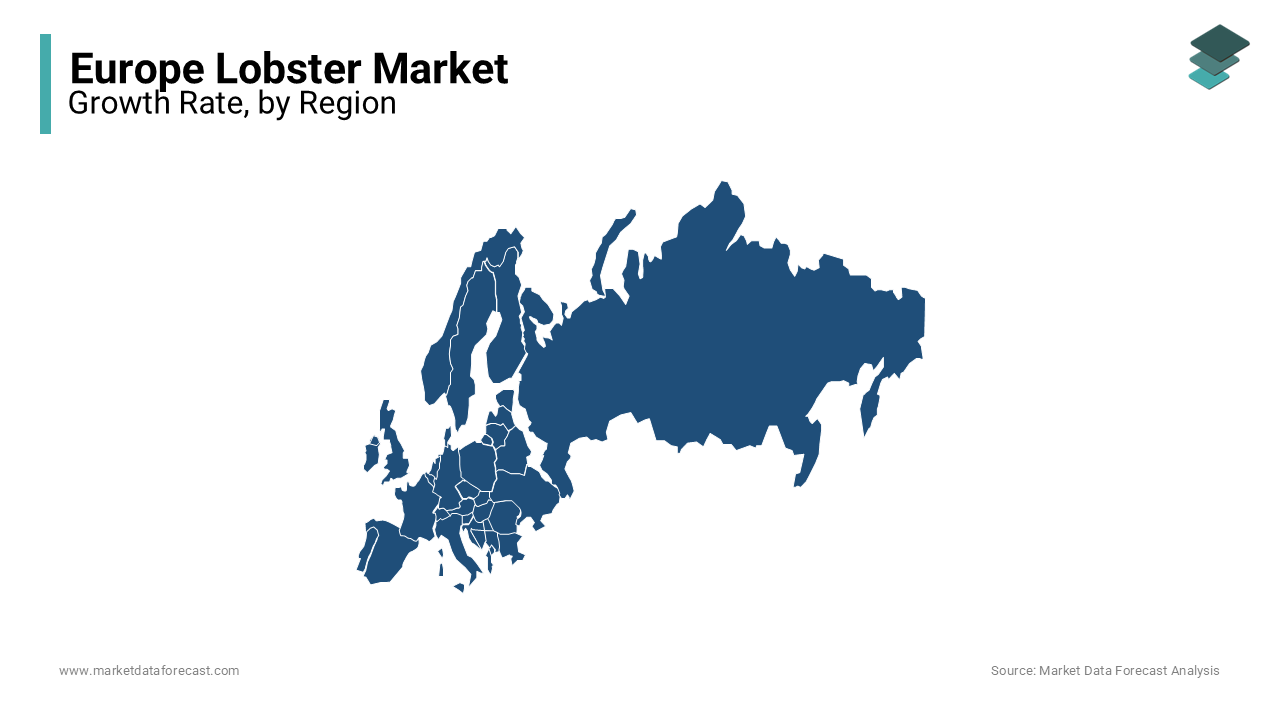
France Market Analysis
France accounted in holding 26.4% of the Europe lobster market share in 2025. The country is both a major consumer and processor, with Brittany alone accounting for over 40 % of EU landings of European lobster. According to FranceAgriMer, French restaurants and hotels purchased 2,100 metric tons of lobster in 2023, the highest in Europe. Moreover, France operates one of the EU’s most advanced live seafood logistics networks, with Rungis International Market distributing live lobster to 18 countries daily.
United Kingdom Market Analysis
The United Kingdom lobster market held 19.2% of the share in 2025. Despite export challenges, domestic consumption remains robust, with London’s restaurant scene driving premium demand. The UK’s 2022 recognition of crustacean sentience has spurred innovation in humane handling, with companies like Loch Fyne adopting electrical stunning systems now being adopted across EU markets. Additionally, British supermarkets such as Waitrose and Marks and Spencer have expanded premium seafood counters featuring traceable lobster from certified fisheries.
Spain Market Analysis
Spain's lobster market growth is attributed to grow with its vibrant seafood culture and strategic import gateway role. Spanish cuisine features lobster prominently in dishes like arroz con bogavante, especially in coastal regions such as Galicia and Catalonia.
Germany Market Analysis
Germany's lobster market growth is likely to be driven by rising affluence and expanding premium foodservice in urban centers. In 2023, German retailers and hotels sourced over 1,800 metric tons of lobster, with demand concentrated in cities like Berlin, Munich, and Hamburg. Additionally, German consumers rank among Europe’s most sustainability-conscious; 74 % prefer MSC-certified seafood as per the Federal Ministry of Food and Agriculture. This drives demand for traceable, ethically sourced lobster, encouraging suppliers to adopt certification.
COMPETITION OVERVIEW
The Europe lobster market features a competitive landscape shaped by a mix of large integrated seafood corporations, regional fishing cooperatives, and specialized importers. Competition is primarily driven by product quality, ty freshn, sustainability credentials, and compliance with evolving animal welfare regulations rather than price alone. Major players differentiate through traceability certifications, premium branding, and logistical reliability, particularly for live specimens. Regional players leverage geographical indications and local culinary heritage to command loyalty in domestic markets while multinational firms capitalize on scale and distribution reach.
KEY MARKET PLAYERS
A few of the dominating players in the Europe lobster market include
- Clearwater Seafoods
- Icelandic Group
- M&J Seafood
- Young’s Seafood
- Labeyrie Fine Foods
- Morrisons Seafood
- The Fish Society
- Seafood Company of the Faroe Islands
- Nordic Seafood A/S
- Fishworks
Top Strategies Used by the Key Market Participants
Key players in the Europe lobster market focus on enhancing supply chain transparency through digital traceability systems to meet stringent EU sustainability and animal welfare requirements. Companies are investing in cold chain infrastructure to ensure live lobster viability during transport and expanding value-added processing to cater to convenience-driven retail demand. Strategic partnerships with local fisheries and hospitality groups enable consistent supply and brand differentiation. Firms are also aligning product offerings with premiumization trends by emphasizing origin storytelling and certification labels such as MSC.
LEADING PLAYERS IN THE EUROPE LOBSTER MARKET
Clearwater Seafoods
Clearwater Seafoods is a globally recognized leader in sustainable shellfish harvesting with a significant footprint in the Europe lobster market. The company supplies premium cold water lobster primarily from Canadian and Norwegian waters to high-end restaurants and retailers across Western Europe. Clearwater has strengthened its European presence by investing in state-of-the-art traceability systems that provide real-time data on catch location and handling practices. In 2023, the company launched a blockchain-enabled platform for its European lobster supply chain, enhancing transparency and aligning with EU sustainability directives. These initiatives reinforce Clearwater’s reputation as a reliable source of ethically sourced premium lobster in a market increasingly driven by provenance and environmental responsibility.
Leroy Seafood Group
Leroy Seafood Group plays a pivotal role in the Europe lobster market through its integrated operations spanning wild catch coordination and premium seafood distribution. Based in Norway, the company leverages its access to pristine North Atlantic waters to supply live and processed European and American lobster to key markets in France, Germany, and the Benelux region. Lerøy has recently expanded its logistics capabilities by upgrading its Oslo-based cold chain hub to maintain optimal conditions for live crustacean transport.
Pescanova
Pescanova contributes significantly to the Europe lobster market through its extensive distribution network and focus on value-added seafood products. Headquartered in Spain, the company sources lobster from both North American and European fisheries and processes it into ready-to-cook formats for retail and food service channels. Pescanova has reinforced its position by modernizing its Vigo processing facility to include dedicated lobster meat extraction and pasteurization lines. In 2023, the company introduced a premium ready meal range featuring lobster thermidor and risotto sold across major European supermarket chains. These innovations cater to the growing demand for convenient yet luxurious at-home dining experiences and demonstrate Pescanova’s agility in responding to evolving consumer preferences in the European seafood landscape.
MARKET SEGMENTATION
This research report on the European lobster market is segmented and sub-segmented into the following categories.
By Species
- American Lobster
- Spiny Lobster
- Rock Lobster
- European Lobster
By Product Type
- Whole Lobster
- Lobster Tail
- Lobster Meat
- Lobster Claw
By Distribution Channel
- Food Service
- Retail
By Region
- UK
- France
- Spain
- Germany
- Italy
- Russia
- Sweden
- Denmark
- Switzerland
- Netherlands
- Turkey
- Czech Republic
- Rest of Europe