- Product Description Description
- Table of Contents TOC
- List of Table & Figure LOT
- Get Free Sample PDF Sample PDF
Europe Logistics Automation Market Report Summary
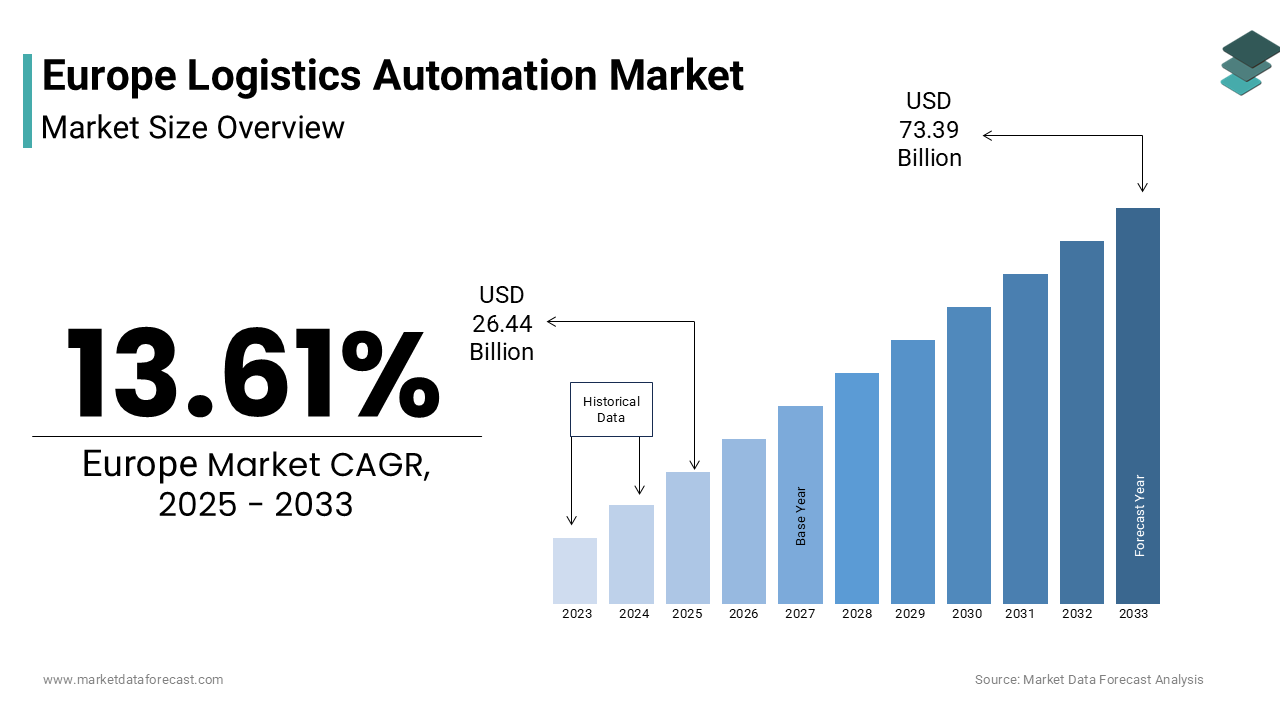
The Europe logistics automation market was valued at USD 23.28 billion in 2024, is estimated to reach USD 26.44 billion in 2025, and is projected to reach USD 73.39 billion by 2033, growing at a CAGR of 13.61% during the forecast period from 2025 to 2033. The growth of the Europe logistics automation market is driven by persistent labor shortages across warehousing and transportation, the exponential rise of e-commerce requiring faster fulfillment cycles, and increasing pressure to optimise supply chain workflows. Expanding adoption of autonomous mobile robots, automated guided vehicles, sortation systems, and warehouse management software is further fueling market growth. Moreover, the integration of artificial intelligence, the rise of micro-fulfilment centers in urban areas, and the region’s strong focus on sustainability and energy-efficient logistics operations are accelerating automation deployment across Europe.
Key Market Trends
- Rising deployment of autonomous mobile robots (AMRs) and automated guided vehicles (AGVs) to address chronic labor shortages and improve operational continuity.
- Growing influence of e-commerce driving demand for high-velocity fulfilment centers, robotic picking, and automated sortation systems.
- Increasing integration of AI and predictive analytics to enhance slotting optimization, routing, and real-time warehouse orchestration.
- Expansion of micro-fulfilment centers in metropolitan areas to support rapid delivery and comply with low-emission zone regulations.
- Strong focus on sustainability, with companies adopting energy-efficient automation systems and digital tools that reduce carbon emissions and enhance traceability.
Segmental Insights
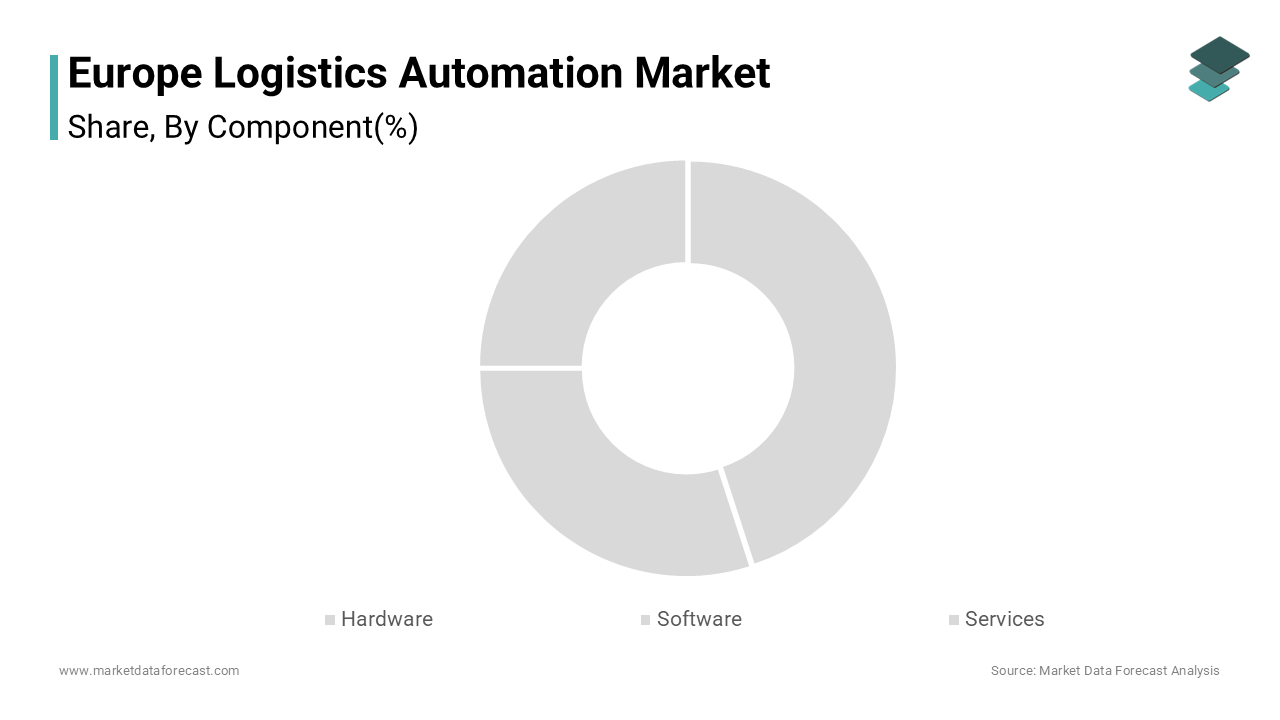
- Based on component, the hardware segment held 48.3% of the Europe logistics automation market share in 2024. The segment’s dominance is attributed to the rapid adoption of AGVs, robotic arms, conveyor systems, and automated sortation machinery essential for high-precision logistics operations.
- Based on logistics type, the sales logistics segment captured 41.4% of the Europe logistics automation market share in 2024, supported by the growing need for automated fulfilment, packaging, and final-mile dispatch associated with e-commerce.
- Based on application, the warehouse management segment held a significant share of 45.3% of the Europe logistics automation market in 2024, reflecting strong dependence on automated storage, picking, packing, and shipping systems.
- Based on enterprise type, the large enterprises segment occupied a prominent share of the Europe logistics automation market in 2024, driven by major retailers, manufacturers and 3PL providers investing heavily in automated infrastructures.
- Based on industry, the retail & e-commerce segment was the largest, holding 38.3% share in 2024, owing to stringent delivery expectations and rising adoption of automated inventory and order management systems.
Regional Insights
The Europe logistics automation market is experiencing robust growth across major economies, supported by industrial expansion, e-commerce acceleration, and rising investments in digital logistics infrastructure.
- Germany was the largest contributor, accounting for 24.3% of the Europe logistics automation market share in 2024, driven by strong manufacturing activity, advanced intralogistics capabilities, and high automation readiness.
- The United Kingdom continues to expand rapidly, supported by a mature e-commerce ecosystem, strategic port operations, and growing adoption of micro-fulfilment centers in major cities.
- France is witnessing strong momentum due to state-led digitalization initiatives and the dominance of retail and luxury supply chains requiring precision logistics.
- Italy is emerging as a fast-growing market, supported by government incentives for logistics modernization and rising automation adoption in fashion and food supply chains.
Competitive Landscape
The Europe logistics automation market is characterized by the presence of established global players and specialized regional automation providers with strong expertise in warehouse management, robotic operations, and material handling. Leading companies are focusing on AI-driven orchestration, modular automation solutions, scalable software platforms, and energy-efficient systems to enhance operational efficiency across the supply chain. Strategic collaborations, RaaS business models, and expansions across digital and omnichannel logistics ecosystems are strengthening market competitiveness. Prominent players in the Europe logistics automation market include Dematic, Swisslog Holding AG, KNAPP AG, TGW Logistics Group GmbH, BEUMER Group GmbH & Co KG, Daifuku Co. Ltd., SSI Schäfer AG, Jungheinrich AG, KION Group AG, ABB Ltd., and SAP SE
Europe Logistics Automation Market Size
The europe logistics automation market size was valued at USD 23.28 billion in 2024 and is anticipated to reach USD 26.44 billion in 2025 from USD 73.39 billion by 2033, growing at a CAGR of 13.61% during the forecast period from 2025 to 2033.
The logistics automation is an integrated technology and intelligent system, such as automated guided vehicles robotic sortation conveyors warehouse management software and autonomous mobile robots that streamline the movement storage and tracking of goods across supply chains. Unlike manual or semi automated processes, these solutions enhance throughput accuracy and labor efficiency while reducing operational errors and delivery lead times. Europe’s position as a global trade hub with dense cross border freight corridors and advanced industrial infrastructure creates a high baseline demand for automation. According to Eurostat, some tonnes of goods were transported by EU enterprises via road rail inland waterways and sea in 2023, underscoring the scale of logistical activity requiring optimization. Furthermore, freight transport emissions accounted for nearly 30% of the EU’s total transport related CO2 output in 2023, intensifying pressure on logistics operators to adopt energy efficient and space optimized automated facilities.
MARKET DRIVERS
-
Persistent Labor Shortages in European Warehousing and Transport Operations
The structural deficit in qualified logistics labor in warehousing trucking and last mile delivery roles, accelerating the shift toward automation is efficiently fuelling the growth of the Europe logistics automation market. According to the European Commission’s 2023 Labour Market Monitor, the EU recorded over 270000 unfilled vacancies in transport and storage sectors, with Germany Poland and Italy experiencing the most acute shortages. In warehousing, the problem is exacerbated by aging workforces, where Germany’s Federal Employment Agency reported that 38% of warehouse operatives were aged 50 or older in 2023 by signaling looming retirement waves. Automation mitigates this gap by deploying autonomous mobile robots for picking and palletizing, thereby reducing dependency on manual labor while maintaining operational continuity.
-
Exponential Growth of E Commerce Driving Demand for High Velocity Fulfillment
The rapid expansion of online retail across Europe has fundamentally reshaped logistics expectations by necessitating faster order processing smaller batch sizes and near perfect inventory accuracy, where all of which automation delivers at scale. This surge has compressed delivery windows, with 68% of European consumers now expecting same day or next day delivery, as per the European Consumer Organisation’s 2023 survey. Traditional manual warehouses cannot sustain such velocity without prohibitive labor costs and error rates. Spain’s National Statistics Institute reported that 55% of large retail distribution centers implemented some form of automation in 2023 to meet e-commerce service level agreements.
MARKET RESTRAINTS
-
High Capital Expenditure and Extended Return on Investment Timelines
The substantial upfront investment required for logistics automation systems, particularly for small and medium sized enterprises is declining the growth of Europe logistics automation market. According to the European DIGITAL SME Alliance, logistics firms in the EU employ fewer than 250 people, and most operate on thin margins with limited access to capital. Fully automating a mid-sized warehouse can cost between 5 million and 15 million euros, with payback periods often exceeding three to five years depending on throughput volume. Only 28% of EU logistics SMEs secured long term loans for digital transformation due to stringent collateral requirements and perceived technology risk.
-
Fragmented Regulatory and Safety Standards Across Member States
The absence of harmonized safety and interoperability regulations for logistics automation equipment across EU countries complicates cross border deployment and increases compliance complexity. The growing complexity due to regulations is another attribute hampering the growth of Europe logistics automation market. While the EU Machinery Regulation 2023/1230 provides a baseline framework, national interpretations vary significantly. Germany’s Technical Inspection Association mandates additional safety validations for collaborative robots that are not required in Portugal or Greece. According to the European Committee for Standardization, only 60% of automated guided vehicle installations in 2023 achieved full compliance with local occupational safety directives on the first audit attempt, leading to operational delays.
MARKET OPPORTUNITIES
-
Integration of Artificial Intelligence and Predictive Analytics into Warehouse Operations
The integration of logistics automation with artificial intelligence is unlocking unprecedented operational intelligence across European distribution networks is creating new opportunities for the growth of Europe logistics automation market. AI powered systems now forecast demand spikes optimize storage slotting and dynamically reroute autonomous vehicles in real time based on order priority and congestion. According to a 2024 study by the Technical University of Munich, warehouses using AI enhanced automation reduced stockouts by 34% and improved space utilization by 27% compared to rule based systems. The European Union’s Horizon Europe program has allocated over 200 million euros to AI in logistics projects through 2027, fostering public private collaboration.
-
Expansion of Automated Micro Fulfillment Centers in Urban Areas
The dense urban populations and strict city logistics regulations are the rise of compact automated micro fulfillment centers located within or near metropolitan zones, are substantially to fuel the growth of Europe logistics automation market in coming years. These facilities often under 10000 square feet leverage vertical lift modules and robotic arms to store and dispatch thousands of SKUs with minimal footprint by enabling retailers to fulfill e commerce orders in under two hours. According to the Urban Logistics Observatory hosted by the Polytechnic University of Milan, 63 European cities introduced low emission zone restrictions in 2023, thereby pushing last mile operators to consolidate deliveries from urban hubs. In response, retailers like Zalando and Carrefour have deployed micro fulfillment centers in Berlin Paris and Madrid.
MARKET CHALLENGES
-
Interoperability Deficits Between Legacy Systems and Modern Automation Platforms
Many European logistics operators continue to rely on decades old warehouse management and enterprise resource planning systems that lack standardized APIs or real time data exchange capabilities by creating integration with new automation technologies. The interoperability deficits between legacy systems and modern automation platforms is to inhibit the growth of Europe logistics automation market. According to the Fraunhofer Institute for Material Flow and Logistics, 68% of large EU logistics providers still use on premise ERP systems developed before 2010, often written in legacy languages like COBOL. These technical silos not only inflate total cost of ownership but also limit data visibility across the supply chain, undermining the very efficiency gains automation promises.
-
Cybersecurity Vulnerabilities in Connected Logistics Infrastructure
As logistics automation becomes increasingly software defined and interconnected, it expands the attack surface for cyber threats targeting operational technology networks. Automated warehouses now integrate cloud based fleet management robotics control systems and IoT sensors all potential entry points for ransomware or data exfiltration. The EU’s Network and Information Systems Directive mandates baseline security for essential services, but many logistics firms fall outside its scope.
REPORT COVERAGE
| REPORT METRIC | DETAILS |
| Market Size Available | 2024 to 2033 |
| Base Year | 2024 |
| Forecast Period | 2025 to 2033 |
| Segments Analysed | By Component, Logistics Type, Enterprise Type, Application, Industry and Region |
| Various Analyses Covered | Global, Regional & Country Level Analysis, Segment-Level Analysis, DROC, PESTLE Analysis, Porter’s Five Forces Analysis, Competitive Landscape, Analyst Overview on Investment Opportunities |
| Regions Analysed | United Kingdom (UK), France, Spain, Germany, Italy, Russia, Sweden, Denmark, Switzerland, the Netherlands, Turkey, the Czech Republic, and the Rest of Europe. |
| Market Leaders Profiled | Swisslog Holding AG, KNAPP AG, TGW Logistics Group GmbH, BEUMER Group GmbH & Co KG, Daifuku Co. Ltd., SSI Schäfer AG, Jungheinrich AG, KION Group AG, ABB Ltd., and SAP SE. |
SEGMENTAL ANALYSIS
By Component Insights
- The hardware segment was accounted in holding 48.3% of the Europe logistics automation market share in 2024
Automated guided vehicles robotic arms conveyor systems and sortation machinery constitute the foundational layer of logistics automation without which higher level software coordination cannot function. According to the European Materials Handling Federation over 220000 automated guided vehicles were deployed across EU warehouses and distribution centers in 2023 a 19% increase from the previous year. These physical assets are non-substitutable in tasks like palletizing case picking and cross docking where mechanical precision and load capacity are paramount.
The Software segment is expected to grow at a CAGR of 18.7% from 2025 to 2033. According to a 2024 study by the Fraunhofer Institute for Material Flow and Logistics, EU logistics firms now prioritize software that offers end to end visibility from procurement to last mile delivery. The European Commission’s Digital Transport and Logistics Forum also advocates for interoperable software standards under the TEN T policy framework further driving adoption of advanced logistics software suites that support cross border data exchange and regulatory compliance.
By Logistics Type Insights
- The sales logistics segment was the largest by capturing 41.4% of Europe logistics automation market share in 2024.
Sales logistics are the movement of finished goods from distribution centers to end customers, which is the most visible and time sensitive segment heavily influenced by e commerce growth. This expectation forces retailers to automate final mile preparation including sortation packing and dispatch. In Germany, Zalando’s automated fulfillment center in Erfurt processes over 500000 orders daily using robotic arms and conveyor networks exclusively dedicated to sales logistics. Modern retail relies on unified inventory across online and physical stores requiring real time synchronization managed through automated sales logistics systems.
The Recovery Logistics segment is projected to expand at a CAGR of 20.3% from 2025 to 2033. The European Commission’s Circular Economy Action Plan mandates that by 2030 all packaging must be reusable or recyclable prompting massive growth in reverse logistics for product returns refurbishment and recycling. This regulatory push transforms recovery from a cost center into a value recovery stream accelerating automation investment. Managing these returns manually is prohibitively expensive and environmentally unsustainable. France’s Anti Waste Law requires companies to disclose reuse rates starting in 2024 incentivizing automation to track and report recovery metrics accurately.
By Application Insights
The warehouse management segment held 45.3% of the Europe logistics automation market share in 2024. Warehouse management systems orchestrate storage picking packing and shipping activities often interfacing directly with automated storage and retrieval systems robotic pickers and conveyor networks. According to the European Logistics Association, automated warehouses in the EU rely on integrated warehouse management software to maintain inventory accuracy above 99.5% a threshold required by pharmaceutical and automotive industries. Seasonal surges during holidays or promotional events require dynamic resource allocation only possible through advanced warehouse management. In Germany, Deutsche Post DHL’s Bonn facility uses a warehouse management system that automatically reconfigures robot workflows based on real time order mix and priority.
The Labor Management segment is projected to expand at a CAGR of 19.2% from 2025 to 2033. As warehouses deploy collaborative robots labor management systems now track human worker performance alongside robot productivity to optimize task allocation. These systems use real time data to assign tasks based on skill availability and physical load reducing injury rates by up to 27%, as documented by the German Social Accident Insurance.
By Enterprise Type Insights
- The large enterprises segment was the largest by occupying a prominent share of the Europe logistics automation market in 2024.
Large enterprises possess the financial resources to invest in multimillion euro automation infrastructure. Companies like Amazon DHL and Carrefour operate dozens of fully automated fulfillment centers across Europe each requiring integrated hardware software and services. Multinational enterprises manage intricate pan European distribution networks that demand standardized automated processes. For instance, Unilever’s automated distribution hub in the Netherlands serves 18 European countries using a single warehouse management backbone.
The SME segment is projected to expand at a CAGR of 21.4% from 2025 to 2033. Cloud based and subscription based automation models are lowering entry barriers for SMEs. According to the European DIGITAL SME Alliance 43% of small logistics firms adopted robotics as a service in 2023 reducing upfront costs by up to 60%. Governments are actively subsidizing automation for small businesses. Similarly, Germany’s BAFA grants supported over 3000 SME intralogistics projects in 2023. These initiatives are rapidly closing the automation adoption gap and driving the highest growth rate in the SME segment.
By Industry Insights
- The Retail & E Commerce segment was the largest by holding 38.3% of share in 2024 with the sector’s relentless focus on speed and customer experience.
In retail and e-commerce, even minor delays or errors result in cart abandonment and negative reviews. According to the European E Commerce Association, online shoppers abandoned a retailer after one poor delivery experience in 2023. Modern retailers must synchronize online and in store inventory in real time.
The Healthcare & Pharma segment is lucratively growing with a CAGR of 22.1% from 2025 to 2033.
Pharmaceutical logistics must comply with EU GDP guidelines requiring full temperature and chain of custody tracking. According to the European Medicines Agency, 100% of vaccine and biologic shipments must include real time environmental monitoring. Automated warehouses with integrated sensors and robotic handling ensure zero manual contact reducing contamination risk. The rise of cell and gene therapies requires ultra precise logistics for patient specific treatments.
REGIONAL ANALYSIS
Germany Logistics Automation Market Analysis
- Germany was the largest contributor of the Europe logistics automation market by holding 24.3% of share in 2024 with its status as the continent’s industrial and logistics powerhouse.
The country’s dense manufacturing base particularly in automotive and machinery generates immense inbound and outbound logistics volume requiring high precision automation. The VDMA trade association reported that intralogistics automation investment reached 6.8 billion euros in 2023 driven by just in time production demands. Additionally, Germany’s skilled engineering workforce and strong vocational training system support complex automation maintenance and integration.
United Kingdom Logistics Automation Market Analysis
- The United Kingdom logistics automation market growth is likely to be driven with its advanced e commerce ecosystem and strategic port infrastructure.
According to the UK Department for Transport, 78% of major retailers automated their distribution centers in 2023 to meet next day delivery expectations from 68% of online shoppers. The growth of dark stores and urban micro fulfillment centers in London Manchester and Birmingham has further accelerated demand for compact robotic systems. Additionally, the NHS’s push for automated pharmaceutical distribution in response to post pandemic supply chain vulnerabilities has spurred healthcare logistics automation.
France Logistics Automation Market Analysis
- France logistics automation market growth is propelled by state led digitalization initiatives and a strong retail and luxury goods sector.
According to France Logistique Federation, 52% of distribution centers in the Paris Lyon Marseille corridor implemented robotic picking systems in 2023 to handle e commerce growth and comply with urban delivery restrictions. The luxury fashion industry including LVMH and Kering requires high integrity automated handling for high value goods with near zero-defect tolerance. Additionally, France’s extensive high speed rail freight network between major cities creates demand for synchronized automated transshipment hubs.
Italy Logistics Automation Market Analysis
- Italy logistics automation market growth is driven by digital transformation incentives and the modernization of its fragmented logistics sector.
Italy’s National Recovery and Resilience Plan dedicates over 3 billion euros to logistics digitization with tax credits covering up to 50% of automation investments for SMEs. According to ISTAT Italy’s National Institute of Statistics, 38% of logistics firms implemented their first automation system in 2023 primarily in the fashion and food sectors where traceability and speed are important. The Milan Turin corridor is emerging as an automation hotspot with luxury brands like Prada and Ferrero deploying robotic warehouses to manage global e commerce demand. Additionally, Italy’s extensive port network including Gioia Tauro and Genoa is undergoing automation to compete with northern European hubs.
COMPETITIVE LANDSCAPE
The Europe logistics automation market features intense competition among global technology leaders regional specialists and emerging robotics startups all vying to address diverse industry needs under a stringent regulatory environment. Incumbents leverage decades of domain expertise in material handling while newer entrants differentiate through AI driven software and agile deployment models. Competition is shaped by the ability to deliver end to end integration reduce total cost of ownership and ensure compliance with evolving standards on data privacy labor safety and carbon emissions. The market is further fragmented by country specific infrastructure maturity with Western Europe favoring advanced autonomous systems while Southern and Eastern regions prioritize cost effective semi automation.
KEY MARKET PLAYERS
Some of the companies that are playing a dominating role in the Europe Logistics Automation Market include
- Swisslog Holding AG
- KNAPP AG
- TGW Logistics Group GmbH
- BEUMER Group GmbH & Co KG
- Daifuku Co. Ltd.
- SSI Schäfer AG
- Jungheinrich AG
- KION Group AG
- ABB Ltd.
- SAP SE
Top Players in the Market
Dematic
Dematic is a leading global provider of intelligent logistics automation solutions with deep roots in European industrial and retail supply chains. The company specializes in automated storage and retrieval systems automated guided vehicles and scalable warehouse execution software. In Europe, Dematic serves automotive pharmaceutical and e commerce sectors with fully integrated intralogistics solutions. Recent actions include the launch of its Dematic AI powered fulfillment platform in 2023 which uses machine learning to optimize robotic workflows in real time.
Swisslog
Swisslog a subsidiary of KUKA Group is a prominent force in healthcare and warehouse automation with a strong presence across Western and Central Europe. The company is renowned for its robotic pharmacy dispensing systems and AutoStore cube storage technology widely adopted by hospitals and retail distributors. To reinforce its market position Swisslog introduced the SynQ warehouse management software suite in 2023 featuring cloud based orchestration and real time analytics compliant with EU data regulations. The company partnered with major European hospital networks in France and Sweden to deploy end to end automated medication logistics platforms aligning with Europe’s digital health transformation agenda and expanding its influence beyond traditional industrial sectors.
Honeywell Intelligrated
Honeywell Intelligrated delivers integrated robotics software and automation solutions tailored for high velocity distribution environments across Europe. The company’s portfolio includes robotic palletizing sortation systems and Momentum warehouse execution software deeply embedded in retail and e commerce operations. In response to rising demand for sustainable logistics Honeywell launched its Green Automation Initiative in late 2023 focusing on energy efficient motor controls and regenerative braking in conveyor systems.
Top Strategies Used by the Key Market Participants
Key players in the Europe logistics automation market focus on developing modular and scalable solutions that cater to both large enterprises and SMEs through flexible deployment models such as robotics as a service. They invest heavily in artificial intelligence and predictive analytics to enhance real time decision making and energy efficiency in automated facilities. Strategic partnerships with national governments and industry consortia help align offerings with EU regulatory frameworks including the Green Deal and Digital Product Passport initiatives. Companies also localize their engineering and service capabilities to ensure rapid deployment and compliance with country specific safety and data laws. Continuous innovation in human robot collaboration and cold chain automation further differentiates their portfolios in highly competitive verticals such as healthcare and food logistics across the European region.
MARKET SEGMENTATION
The research report on the Europe Logistics Automation Market has been segmented and sub-segmented based on categories.
By Component
- Hardware
- Software
- Services
By Logistics Type
- Sales Logistics
- Production Logistics
- Recovery Logistics
- Procurement Logistics
By Enterprise Type
- SMEs
- Large Enterprises
By Application
- Transport Management
- Warehouse Management
- Labor Management
- Others
By Industry
- Retail & E-commerce
- Healthcare & Pharma
- Food & Beverages
- Aerospace & Defense
- Energy & Utility
- Automotive
- Others
By Country
- UK
- France
- Spain
- Germany
- Italy
- Russia
- Sweden
- Denmark
- Switzerland
- Netherlands
- Turkey
- Czech Republic
- Rest of Europe