- Product Description Description
- Table of Contents TOC
- List of Table & Figure LOT
- Get Free Sample PDF Sample PDF
Europe Luggage Market Report Summary
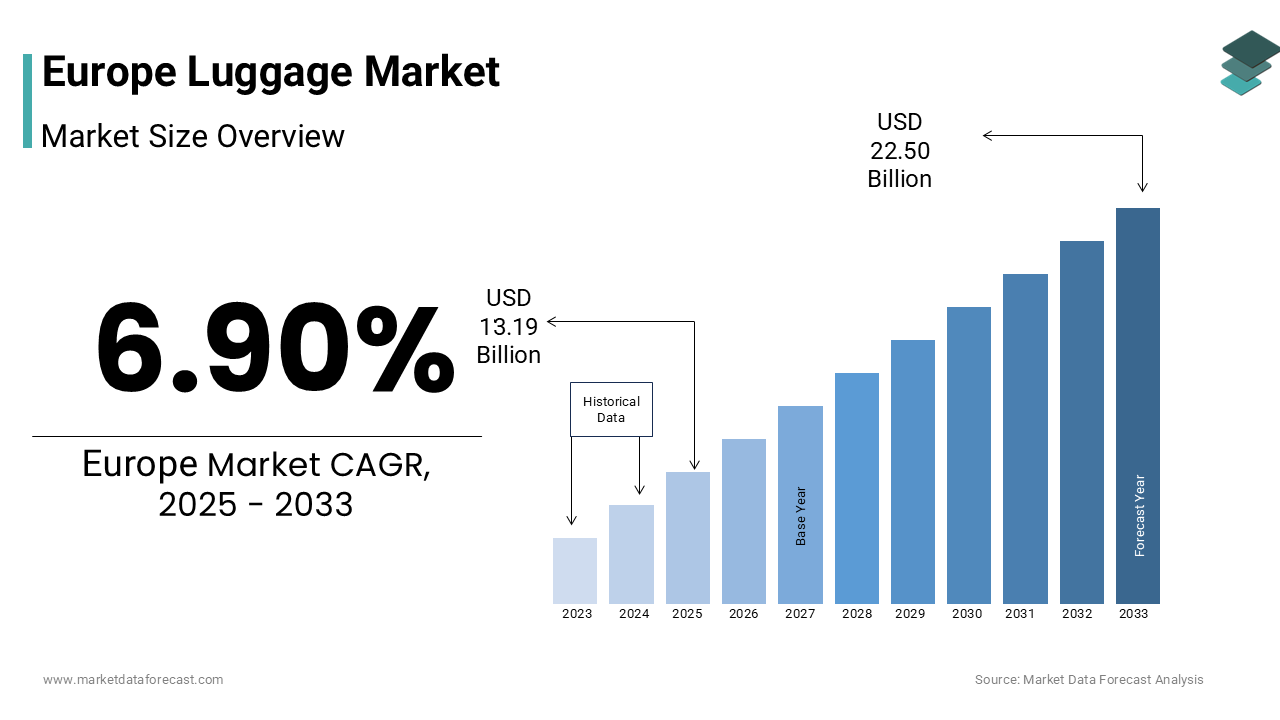
The European luggage market was valued at USD 12.34 billion in 2024, is estimated to reach USD 13.19 billion in 2025, and is projected to reach USD 22.50 billion by 2033, growing at a CAGR of 6.9% from 2025 to 2033. The growth of the European luggage market is driven by increasing travel frequency, expanding tourism and business travel, and the rising adoption of lightweight, durable, and premium luggage. The growing influence of travel fashion, coupled with innovations such as GPS-enabled and smart luggage, is further accelerating the market expansion across the region.
Key Market Trends
- Rising demand for hard-sided luggage made from polycarbonate and ABS materials for enhanced durability and protection.
- The increasing popularity of premium and designer luggage driven by fashion-conscious consumers and luxury travel trends.
- Rapid growth of e-commerce platforms offering wider accessibility, product variety, and competitive pricing.
- Growing focus on eco-friendly and sustainable luggage materials, such as recycled plastics and biodegradable fibers.
- Expansion of smart luggage technologies, including digital locks, GPS tracking, and USB charging ports for connected travelers.
Segmental Insights
- Based on Type, the travel bags segment dominated the European luggage market by accounting for 59.2% share in 2024. The dominance of this segment is attributed to increasing international travel, rising disposable incomes, and growing preference for multipurpose bags that suit both business and leisure travel needs.
- Based on Material, the hard-sided luggage segment held a significant share of the Europe luggage market in 2024. This segment’s growth is driven by rising consumer demand for durable and impact-resistant products that protect belongings during transit.
- Based on Distribution Channel, the offline segment accounted for 54.3% of the market share in 2024. The prevalence of well-established retail networks, exclusive brand outlets, and airport stores continues to strengthen this segment’s dominance, although the online channel is gaining momentum with the rise of digital shopping trends.
Regional Insights
The European luggage market is witnessing strong growth across major economies, supported by high travel spending, product innovation, and tourism development.
- Germany was the top performer in the European luggage market, capturing 21.3% share in 2024, driven by strong outbound tourism, high adoption of premium luggage brands, and a robust retail infrastructure.
- The United Kingdom continues to experience steady growth, supported by a well-developed travel sector and the popularity of designer luggage brands.
- France remains a key market due to its large luxury goods industry and high spending on fashionable travel accessories.
- Italy is emerging as a hub for stylish and innovative luggage, backed by strong manufacturing capabilities and heritage brands.
- Spain and Eastern European countries are expected to witness faster growth during the forecast period due to expanding middle-class populations and increasing domestic tourism activities.
Competitive Landscape
The European luggage market is moderately consolidated and characterized by the presence of global and regional players emphasizing innovation, sustainability, and brand differentiation. Leading companies are focusing on developing lightweight, eco-friendly, and smart luggage solutions to enhance consumer convenience and align with evolving travel trends. Strategic partnerships, online retail expansion, and product personalization are key competitive strategies shaping the market. Prominent players in the Europe luggage market include Samsonite International S.A., VF Corporation, Rimowa GmbH, Delsey Paris, VIP Industries Ltd., Briggs & Riley Travelware, Away, Travelpro International Inc., Tumi Holdings Inc., and Antler Ltd
Europe Luggage Market Size
The europe luggage market size was valued at USD 12.34 billion in 2024 and is anticipated to reach USD 13.19 billion in 2025 from USD 22.50 billion by 2033, growing at a CAGR of 6.90% during the forecast period from 2025 to 2033.
The luggage is the design manufacturing distribution and retail of travel bags suitcases and related accessories intended for personal and business mobility across the European Economic Area.
MARKET DRIVERS
Resumption of International Leisure Travel Drives Volume Demand
The robust recovery of international tourism across Europe has reactivated mass demand for durable and compliant luggage following years of pandemic induced stagnation. Airlines have also reinstated strict baggage policies with Lufthansa and Air France with a 19 % rise in overweight baggage fees in 2024 which incentivizes travelers to invest in accurately calibrated and lightweight models.
Rise of Business Travel with Extended Stay Patterns Increases Premium Demand
The transformation of business travel into hybrid work and leisure itineraries has elevated demand for premium luggage that is propelling the growth of Europe luggage market with seamlessly transitions from boardroom to weekend getaway featuring built in laptop sleeves garment compartments and smart organization. Brands like Rimowa and Tumi have responded with collections integrating removable laundry bags portable garment steamers and RFID protected document sleeves.
MARKET RESTRAINTS
Stringent EU Chemical Regulations Increase Compliance Costs
The rigorous restrictions on substances used in luggage manufacturing including phthalates azo dyes and perfluorinated compounds commonly found in zippers coatings and synthetic fabrics is restraining the growth of Europe luggage market. Small and medium sized luggage brands particularly those sourcing from Asia face disproportionate burdens as they lack in house compliance teams and must rely on costly external consultants. These enforcement actions not only cause financial losses but also damage brand reputation.
Volatility in Raw Material Prices Disrupts Pricing Stability
Fluctuations in the cost of key luggage materials virgin polycarbonate aluminum and ballistic nylon that is likely to hampering the growth of Europe luggage market. Brands operating on fixed retail price points are forced to absorb losses or downgrade material quality both of which risk consumer dissatisfaction. This erosion of perceived value undermines brand loyalty and accelerates commoditization.
MARKET OPPORTUNITIES
Integration of Smart Luggage with Airport Ecosystems Creates New Value
The emergence of smart luggage interoperable with European airport infrastructure is creating new opportunities for the growth of Europe luggage market. Several EU airports including Amsterdam Schiphol and Munich have piloted digital bag tagging systems that sync with embedded Bluetooth trackers in suitcases allowing real time location updates via airline apps. These innovations transform luggage from passive containers into active travel companions reducing stress and lost baggage incidents.
Circular Business Models Enable Sustainable Product Lifecycles
The adoption of circular economy principles is unlocking new commercial models through take back programs refurbishment services and material recycling is gearing up the growth of Europe luggage market.
MARKET CHALLENGES
Counterfeit Luggage Undermines Brand Integrity and Safety
The proliferation of counterfeit luggage falsely branded as premium European or global labels is . Europol’s 2024 Intellectual Property Crime Threat Assessment reported the seizure of over 1.2 million fake suitcases at EU borders with 68 % mimicking brands like Samsonite Rimowa and Away. These replicas often use substandard plastics brittle zippers and toxic adhesives that fail under normal travel stress.
Inconsistent Airline Baggage Policies Create Consumer Confusion
The lack of standardized carry on and checked baggage regulations across European airlines generates significant consumer uncertainty that dampens luggage purchasing confidence is also to hamper the growth of Europe luggage market. This inconsistency forces travelers to own multiple luggage types or risk gate check fees which averaged 65 euros per incident in 2023 according to the European Consumer Organisation. A survey by the European Travel Commission found that 52 % of frequent flyers delayed luggage purchases due to uncertainty about future airline requirements. Manufacturers respond by producing adjustable or compressible designs but these add cost and complexity without guaranteeing compliance.
REPORT COVERAGE
| REPORT METRIC | DETAILS |
| Market Size Available | 2024 to 2033 |
| Base Year | 2024 |
| Forecast Period | 2025 to 2033 |
| Segments Covered | By Type, Distribution Channel, and Region. |
| Various Analyses Covered | Global, Regional, & Country Level Analysis; Segment-Level Analysis, Drivers, Restraints, Opportunities, Challenges, PESTLE Analysis, Porter’s Five Forces Analysis, Competitive Landscape, Analyst Overview of Investment Opportunities |
| Regions Covered | United Kingdom, France, Spain, Germany, Italy, Russia, Sweden, Denmark, Switzerland, the Netherlands, Turkey, and the Czech Republic and The Rest of Europe. |
| Key Market Players | Samsonite International S.A., VF Corporation, Rimowa GmbH, Delsey Paris, VIP Industries Ltd., Briggs & Riley Travelware, Away, Travelpro International Inc., Tumi Holdings Inc., and Antler Ltd. |
SEGMENTAL ANALYSIS
By Type Insights
The travel bags segment was the largest by accounting for 59.2% of the Europe luggage market share in 2024 with the high volume of leisure and multi destination tourism across the region which necessitates durable versatile and regulation compliant suitcases. These trips demand full size checked luggage with robust wheel systems expandable compartments and TSA approved locks. Travel bags are engineered to meet strict IATA dimensional and weight guidelines which are uniformly enforced across European carriers. The European Union Aviation Safety Agency mandates that all checked luggage comply with impact resistance and handle strength benchmarks. Manufacturers have responded by integrating reinforced corners aluminum frames and silent spinner wheels tested under EN 16893 durability protocols.
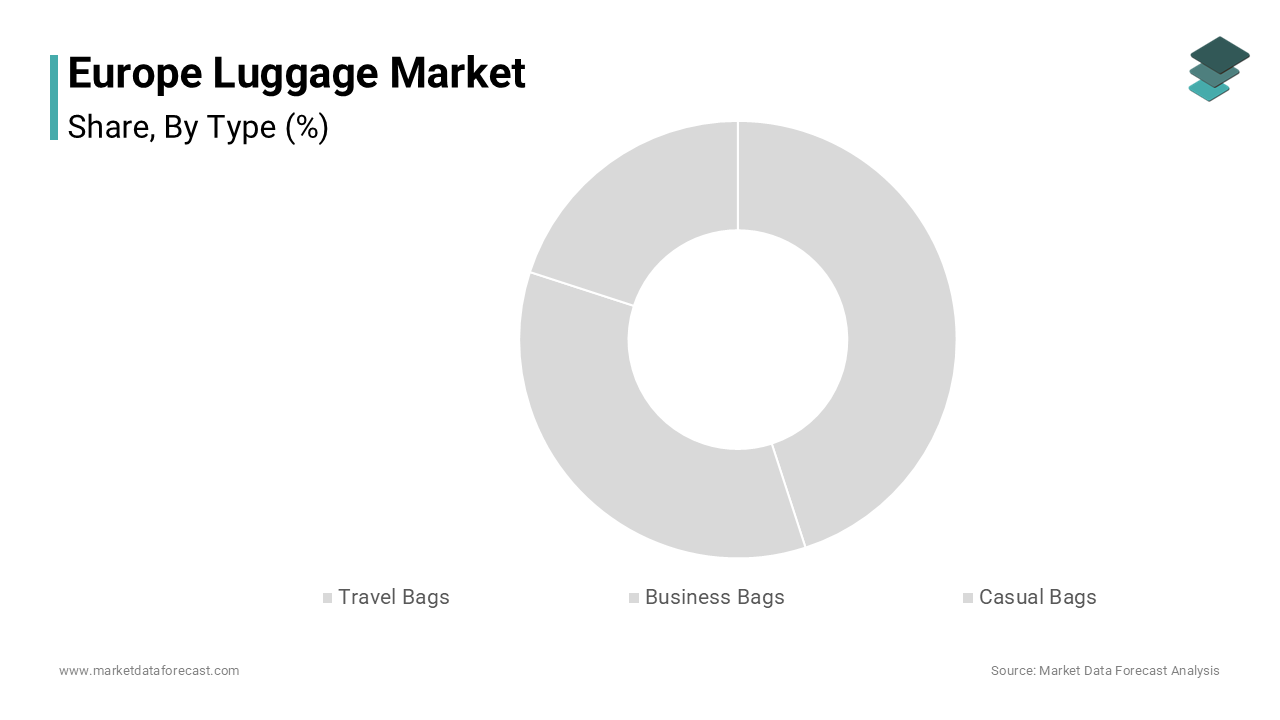
The business bags segment is more likely to grow with a significant CAGR of 7.4 % during the forecast period. The blending of business and leisure travel known as bleisure has redefined professional packing needs. This trend necessitates compact yet sophisticated bags with dedicated laptop sleeves garment folders and quick access pockets. Brands like Tumi and Montblanc have introduced modular business bags with removable tech organizers and water resistant exteriors tailored for European rail and air commutes.
By Material Insights
The Hard sided luggage segment held a significant share of the Europe luggage market in 2024.
Modern travelers carry expensive electronics including laptops cameras and smart devices requiring impact resistant enclosures. Hard shells made from polycarbonate or ABS offer crush resistance that soft fabrics cannot match. This functional advantage is especially critical in Europe where baggage often undergoes multiple transfers across regional carriers with varying handling protocols.
Leading European and global brands use hard sided construction to convey innovation and durability. Brands like Rimowa and Samsonite showcase seamless shell designs scratch resistant finishes and integrated digital locks that appeal to style conscious consumers.
The soft sided luggage segment is esteemed to witness a CAGR of 6.9 % from 2025 to 2033.
Soft sided bags offer expandable compartments and lighter base weights typically 1.5 to 2 kilograms less than hard shells by making them ideal for budget airlines with strict weight limits. Ryanair’s 2024 customer data shows that 59 % of passengers on basic fares chose soft luggage to stay under the 10 kilogram carry on threshold.
By Distribution Channel Insights
The offline distribution segment was accounted in holding 54.3% of the Europe luggage market share in 2024. Consumers prioritize hands on assessment of wheel smoothness handle stability and compartment layout before purchasing luggage. Last minute travelers often replace damaged bags or upgrade before long haul flights.
The online distribution segment is expected to exhibit a noteworthy CAGR of 10.2% during the forecast period. Retailers like Zalando and About You have integrated 360 degrees product views size comparison tools and AR room placement features that replicate in store evaluation.
Online platforms enable European consumers to discover eco conscious or design led brands unavailable locally. Platforms like Green Story and EcoLabs curate verified eco labels and carbon footprint data empowering informed choices.
REGIONAL ANALYSIS
Germany Luggage Market Analysis
Germany was the top performer of the Europe luggage market by capturing 21.3% of the share in 2024 with high disposable income stringent product standards and extensive business travel. German consumers prioritize durability and technical precision leading to strong demand for hard sided polycarbonate suitcases with lifetime warranties. The nation also hosts major trade fairs like ILM Offenbach which serves as a pan European distribution hub.
United Kingdom Luggage Market Analysis
The United Kingdom held 17.3% of the Europe luggage market share in 2024 with high air travel frequency and fashion led consumption. London’s status as a global fashion capital fuels demand for designer luggage from brands like Mulberry and Globe Trotter which blend heritage craftsmanship with modern functionality. Additionally, the rise of remote work has increased domestic staycations requiring compact weekend bags further diversifying product demand across urban and suburban demographics.
France Luggage Market Analysis
France luggage market growth is majorly propelled by luxury branding tourism and urban mobility. French brands like Longchamp and Moynat emphasize artisanal leatherwork and minimalist design appealing to both domestic and global consumers.
Italy Luggage Market Analysis
Italy luggage market growth is likely to grow with its fusion of fashion heritage and artisanal manufacturing. The country is home to luxury houses such as Prada and Gucci whose luggage lines command global prestige and high margins. This material authenticity supports premium positioning and export value. Moreover, Italy’s dense network of small boutiques in cities like Milan and Florence offers personalized fittings and monogramming services that enhance customer loyalty and differentiate from mass market alternatives.
Spain Luggage Market Analysis
Spain luggage market growth is likely to grow with the mass tourism coastal travel and value oriented consumption. Spanish retailers like El Corte Inglés have developed private label lines using recycled polyester that meet EU eco labeling standards. Additionally Spain’s warm climate favors lightweight soft sided bags with water resistant coatings and ventilated compartments.
COMPETITVE LANDSCAPE
The Europe luggage market features intense rivalry among global brands regional designers and fast fashion entrants each targeting distinct consumer segments through differentiated value propositions. Premium players compete on heritage craftsmanship digital innovation and luxury aesthetics while mid tier brands emphasize durability regulatory compliance and price performance balance. The entry of fashion retailers such as Zara and H&M with affordable travel collections has intensified pressure on traditional mid-range manufacturers. Competition is further shaped by sustainability mandates with brands racing to achieve EU Ecolabel or Global Recycled Standard certification. Offline dominance persists in luxury and professional segments due to tactile evaluation needs yet online channels grow rapidly through AR visualization and cross border accessibility. Differentiation hinges on material innovation repairability smart features and alignment with European travel infrastructure including rail networks and airport protocols.
KEY MARKET PLAYERS
A few of the major companies in the europe luggage market include
- Samsonite International S.A.
- VF Corporation
- Rimowa GmbH
- Delsey Paris
- VIP Industries Ltd.
- Briggs & Riley Travelware
- Away
- Travelpro International Inc.
- Tumi Holdings Inc.
- Antler Ltd.
Top Players in the Europe Luggage Market
Samsonite International S.A.
Samsonite International S.A. maintains a prominent position in the Europe luggage market through its diversified portfolio spanning entry level to premium segments. The company leverages its global supply chain and design centers in Belgium and Asia to deliver products aligned with European travel behaviors and regulatory standards. These initiatives reinforce its reputation for durability innovation and sustainability while strengthening long term consumer loyalty in a highly competitive landscape.
Rimowa GmbH
Rimowa GmbH exerts significant influence in the Europe luggage market through its heritage in aluminum craftsmanship and premium positioning. Owned by LVMH the brand integrates luxury aesthetics with functional engineering catering to high net worth travelers and fashion conscious professionals. The company also partnered with Munich Airport to pilot a smart baggage drop service using embedded RFID technology. These moves enhance user convenience while reinforcing Rimowa’s identity as a leader in high end travel innovation and seamless airport integration across the European region.
Delsey Paris
Delsey Paris plays a distinctive role in the Europe luggage market by blending French design sensibility with practical functionality. The brand emphasizes lightweight construction vibrant color palettes and urban mobility features tailored to European commuters and leisure travelers. In 2024 Delsey launched its “ReDelsey” program offering customers discounts for returning old suitcases which are then disassembled and recycled into new shells using a closed loop process verified by the French Environment and Energy Management Agency.
Top Strategies Used by the Key Market Participants
Key players in the Europe luggage market prioritize sustainability by incorporating recycled materials and launching take back programs to comply with EU circular economy mandates. They invest in smart luggage technologies including digital tags GPS tracking and airline app integration to enhance traveler convenience. Brands strengthen premium positioning through collaborations with fashion houses and limited edition collections that appeal to style conscious consumers. Expansion of omnichannel retail with virtual try on features and in store repair services improves customer experience and reduces returns.
MARKET SEGMENTATION
This research report on the europe luggage market has been segmented based on the following categories.
By Type
- Travel Bags
- Business Bags
- Casual Bags
By Material
- Soft-sided
- Hard-sided
By Distribution Channel
- Online
- Offline
By Country
- UK
- France
- Spain
- Germany
- Italy
- Russia
- Sweden
- Denmark
- Switzerland
- Netherlands
- Turkey
- Czech Republic
- Rest of Europe