Europe Luxury Watch Market Size, Share, Trends, & Growth Forecast Report By Type (Mechanical, Electronic), Band Type, Distribution Channel, and Country (UK, France, Spain, Germany, Italy, Russia, Sweden, Denmark, Switzerland, Netherlands, Turkey, Czech Republic and Rest of Europe), Industry Analysis From 2025 to 2033
Europe Luxury Watch Market Report Summary
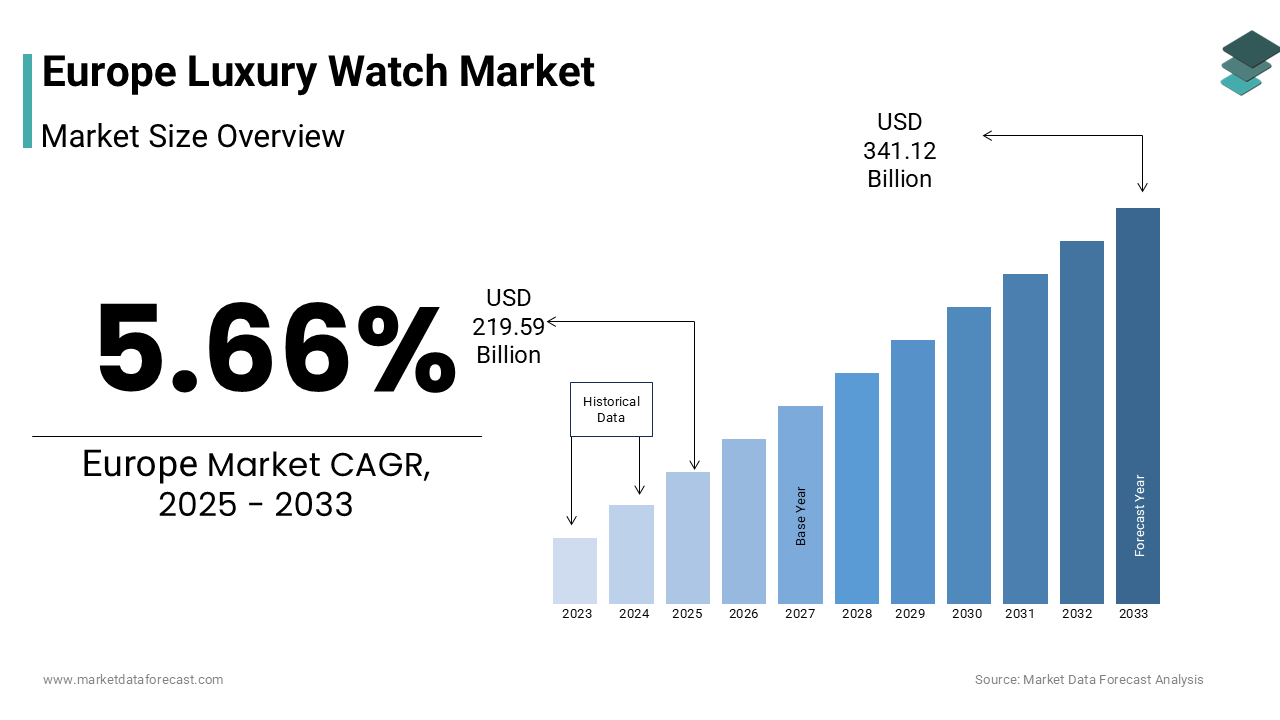
The European luxury watch market was valued at USD 207.83 billion in 2024, is estimated to reach USD 219.59 billion in 2025, and is projected to reach USD 341.12 billion by 2033, growing at a CAGR of 5.66% during the forecast period from 2025 to 2033. The growth of the European luxury watch market is driven by rising disposable incomes, increasing preference for premium fashion accessories, and the region’s deep-rooted tradition of horological craftsmanship. Growing demand for mechanical timepieces, the influence of luxury fashion trends, and the expansion of high-end retail channels are further fueling market growth. Moreover, the rise of pre-owned luxury watch trading and digital boutiques has broadened access to luxury watches for new consumer demographics across Europe.
Key Market Trends
- Rising demand for mechanical watches driven by their craftsmanship, heritage value, and investment potential among high-net-worth individuals.
- Growing popularity of vintage and pre-owned luxury watches supported by authenticated resale platforms and collectors’ interest.
- Increasing use of online channels and digital showrooms by luxury brands to engage younger audiences and expand market reach.
- Strong focus on sustainability and traceability in luxury watchmaking, with brands emphasizing ethical sourcing and eco-friendly materials.
- Emergence of customization and personalization trends, offering bespoke designs and exclusive limited-edition models.
Segmental Insights
- Based on type, the mechanical watches segment was the largest and held a significant share of the Europe luxury watch market in 2024. The segment’s dominance is attributed to the prestige, craftsmanship, and heritage value associated with mechanical movements, appealing to collectors and enthusiasts seeking intricate designs and long-term durability.
- Based on band type, the strap-based luxury watches segment accounted for 62.3% of the Europe luxury watch market share in 2024. Leather and fabric straps remain preferred due to their comfort, classic aesthetics, and association with traditional luxury styling, while luxury sports models with rubber straps continue to gain traction among younger consumers.
- Based on distribution channel, the offline retail segment was the largest, occupying a prominent share of the Europe luxury watch market in 2024. The dominance of this segment stems from the importance of exclusive brand boutiques, authorized dealers, and luxury department stores that offer personalized in-store experiences crucial for premium watch purchases.
Regional Insights
The European luxury watch market is witnessing robust growth across major economies, supported by strong consumer affinity toward luxury fashion and heritage watchmaking excellence.
- Germany was the largest contributor, accounting for 18.3% of the European luxury watch market share in 2024, driven by its growing base of affluent consumers, high export volumes, and strong appreciation for Swiss and German-engineered timepieces.
- Switzerland remains the center of luxury watch production, with its globally dominant manufacturing ecosystem and innovation leadership.
- The United Kingdom and France continue to perform well, fueled by tourism, flagship retail stores, and expanding pre-owned watch networks.
- Italy is also emerging as a major hub for luxury fashion-driven watch consumption and collector interest.
Competitive Landscape
The European luxury watch market is characterized by the dominance of established heritage brands with strong brand equity, craftsmanship excellence, and global recognition. Leading companies are focusing on blending tradition with innovation, introducing smart-luxury hybrids, and expanding their presence across digital and omnichannel retail. Marketing collaborations with luxury fashion houses, sports personalities, and cultural icons are strengthening brand appeal across diverse demographics. Prominent players in the Europe luxury watch market include Rolex, Patek Philippe, Audemars Piguet, Omega, Cartier, TAG Heuer, Breitling, Jaeger LeCoultre, Vacheron Constantin, IWC Schaffhausen, Hublot, Richard Mille, Blancpain, Breguet, and Piaget.
Europe Luxury Watch Market Size
The europe luxury watch market size was valued at USD 207.83 billion in 2024 and is anticipated to reach USD 219.59 billion in 2025 from USD 341.12 billion by 2033, growing at a CAGR of 5.66% during the forecast period from 2025 to 2033.
The luxury watch is a high end timepiece typically priced above five thousand euros and distinguished by artisanal craftsmanship mechanical sophistication and centuries old brand legacies. Cultural appreciation for precision engineering intergenerational gifting and discretionary wealth underpin sustained demand
MARKET DRIVERS
Enduring Cultural Affinity for Horological Heritage Drives Demand
The Europe’s deep seated reverence for fine watchmaking functions is driving the growth of Europe luxury watch market. In nations, such as Switzerland Germany and France horology is embedded in national identity and technical education systems. This cultural capital translates into consumer behavior that prioritizes authenticity mechanical integrity and brand lineage over trends. Switzerland’s vocational training system graduates over two thousand certified watchmakers annually by ensuring the preservation of traditional skills.
Rising Concentration of Ultra High Net Worth Individuals Fuels Premiumization
The rapid growth of ultra-high net worth individuals, those with investable assets exceeding 30 million USD has intensified demand for rare and complicated timepieces, which is additionally levelling up the growth of Europe luxury watch market.
MARKET RESTRAINTS
Counterfeit Proliferation Undermines Brand Integrity and Consumer Trust
The counterfeit luxury watches are affecting brand equity and consumer confidence is restraining the growth of Europe luxury watch market. Sophisticated replicas increasingly incorporate recycled genuine parts making detection difficult even for experts. Europol’s 2024 Organized Crime Threat Assessment identified Eastern European and Balkan networks as key players in industrial scale counterfeit production. The erosion of perceived exclusivity due to widespread fakes weakens the psychological premium that underpins luxury pricing.
Regulatory Pressure on Environmental and Ethical Sourcing Practices Constrains Operations
The stringent EU sustainability mandates are imposing significant compliance burdens on luxury watchmakers is also hampering the growth of Europe luxury watch market. Additionally, the European Green Deal’s carbon border adjustment mechanism indirectly raises costs for components sourced outside the EU.
MARKET OPPORTUNITIES
Digital Transformation Enables Hyper Personalized Client Engagement
The digital innovation is unlocking new dimensions of client intimacy and brand storytelling without compromising exclusivity, which is promoting the new opportunities for the growth of Europe luxury watch market. Leading houses are deploying artificial intelligence virtual try on experiences and blockchain based digital passports to enhance the omnichannel journey.
Growing Appeal Among Female Collectors Expands Market Demographics
The rising engagement of women as serious collectors is greatly influencing the growth of Europe luxury watch market with the increasing female representation in executive roles. Brands are developing mechanically complex by aesthetically refined models such as Jaeger LeCoultre’s Rendez Vous and Cartier’s Panthère.
MARKET CHALLENGES
Intensifying Competition from Independent Microbrands Disrupts Traditional Hierarchies
The rise of digitally native microbrands is fragmenting the luxury watch landscape and pressuring established players, which is one of the challenges for the growth of Europe luxury watch market. Brands like Farer UK and Ming Switzerland cultivate loyal followings via Instagram and Discord with product cycles as short as six months that far quicker than the eighteen to twenty four months typical for heritage houses.
Geopolitical Instability and Currency Volatility Disrupt Cross Border Demand
The macroeconomic turbulence and geopolitical uncertainty are dampening cross border luxury watch sales particularly in tourist places is also to pose a challenge for the growth of Europe luxury watch market. Simultaneously, reduced international tourism from Russia and the Middle East has diminished foot traffic in luxury districts like Geneva’s Rue du Rhône and Milan’s Via Montenapoleone.
REPORT COVERAGE
| REPORT METRIC | DETAILS |
| Market Size Available | 2024 to 2033 |
| Base Year | 2024 |
| Forecast Period | 2025 to 2033 |
| Segments Covered | By Type, Band Type, Distribution Channel, and Region. |
| Various Analyses Covered | Global, Regional, & Country Level Analysis; Segment-Level Analysis, Drivers, Restraints, Opportunities, Challenges, PESTLE Analysis, Porter’s Five Forces Analysis, Competitive Landscape, Analyst Overview of Investment Opportunities |
| Regions Covered | UK, France, Spain, Germany, Italy, Russia, Sweden, Denmark, Switzerland, Netherlands, Turkey, Czech Republic, Rest of Europe |
| Key Market Players | Rolex SA, Patek Philippe SA, Audemars Piguet, Omega, Cartier, TAG Heuer, Richard Mille, Vacheron Constantin, Breitling, Hublot, Richard Mille, Blancpain, Breguet and Piaget |
SEGMENTAL ANALYSIS
By Type Insights
The mechanical watches segment was the largest and held a significant share of the Europe luxury watch market in 2024 with the deep cultural and technical reverence for mechanical horology across Europe where timepieces are valued not merely as instruments but as kinetic art. This enduring demand is further sustained by Switzerland’s institutional commitment to mechanical excellence which trains over two thousand watchmakers annually through federal apprenticeship programs ensuring uninterrupted transmission of skills.
The electronic watch segment is estimated to grow with a noteworthy CAGR of 6.4% from 2025 to 2033 with smartwatch functionality but by hybrid luxury models that integrate discreet electronic enhancements such as GPS time calibration or power reserve indicators without compromising aesthetic tradition. Furthermore, the integration of blockchain authentication chips that embedded in watches by brands like Breitling that relies on microelectronics to enable digital passports which saw adoption in over seventy thousand units by early 2024.
By Band Type Insights
The strap based luxury watches segment was accounted in holding 62.3% of Europe luxury watch market share in 2024 with the versatility customization and alignment with contemporary sartorial trends. Leather rubber and fabric straps allow for easy interchangeability enabling consumers to adapt a single timepiece to formal casual or sportive contexts.
The chain based or metal bracelet watches segment is likely to exhibit a CAGR of 5.1% from 2025 to 2033 with a resurgence in formal luxury aesthetics and investment grade durability. This revival is linked to the post pandemic return to office culture and black tie events where integrated metal bracelets convey timeless elegance. Additionally, innovations in comfort such as Rolex’s patented Glidelock clasp and Patek Philippe’s fold over safety systems have mitigated historical complaints about rigidity.
By Distribution Channel Insights
The offline retail segment was the largest by occupying a prominent share of the Europe luxury watch market share in 2024 with the experiential and trust intensive nature of high value watch purchases which often exceed twenty thousand euros. Flagship stores in cities like Paris Milan and Zurich function as brand temples with immersive storytelling and after sales services such as movement demonstrations and engraving.
The online channel is anticipated to witness a fastest CAGR of 12.3% from 2025 to 2033 with the strategic digitization of high touch experiences rather than pure transactional e commerce. Additionally, certified pre-owned platforms like WatchBox and Chrono24 have gained credibility with the latter processing over two billion euros in European transactions in 2023 as per its annual transparency report.
REGIONAL ANALYSIS
Germany Luxury Watch Market Analysis
Germany was the largest contributor by accounting for 18.3% of Europe luxury watch market share in 2024. The country also hosts Europe’s largest watch collector community with over two hundred fifty active horological societies and annual events like the Glashütte Watchmakers’ Symposium attracting fifteen thousand attendees.
France Luxury Watch Market Analysis
France luxury watch market was ranked second with its status as a global fashion capital and tourist magnet. French consumers blend sartorial elegance with horological interest favoring integrated designs like Cartier’s Tank and Chanel’s J12.
Italy Luxury Watch Market Analysis
Italy luxury watch market growth is likely to grow with demand driven by artisanal appreciation and intergenerational gifting traditions. Milan and Florence serve as key retail hubs hosting over one hundred and twenty mono brand boutiques.
COMPETITIVE LANDSCAPE
Competition in the Europe luxury watch market is characterized by intense rivalry among heritage driven brands that prioritize craftsmanship scarcity and emotional resonance over volume. Unlike mass market segments where price and features dominate the luxury arena competes on legacy technical mastery and narrative depth. Established Swiss houses face pressure not only from peers but also from agile microbrands that leverage digital storytelling and transparent pricing to attract younger collectors. However incumbents retain significant advantages through vertically integrated manufacturing proprietary complications and global boutique networks that ensure consistent brand experience.
KEY MARKET PLAYERS
A few of the major companies in the europe luxury watch market include
- Rolex
- Patek Philippe
- Audemars Piguet
- Omega
- Cartier
- TAG Heuer
- Breitling
- Jaeger‑LeCoultre
- Vacheron Constantin
- IWC Schaffhausen
- Hublot
- Richard Mille
- Blancpain
- Breguet
- Piaget
Top Players in the Market
Rolex SA stands as a defining force in the Europe luxury watch market through its unwavering commitment to mechanical excellence and vertical integration. Headquartered in Geneva the company designs manufactures and assembles every component of its timepieces in house ensuring unparalleled quality control. In recent years Rolex has intensified its direct retail strategy by opening flagship boutiques in key European cities including Madrid and Stockholm, thereby reducing reliance on third party dealers.
Patek Philippe remains a paragon of haute horlogerie in Europe distinguished by its family owned structure and dedication to artistic craftsmanship. The Geneva based manufacturer continues to set benchmarks in complications and hand finishing with each timepiece requiring months or even years to complete. The company also enhanced its digital clienteling tools allowing boutique advisors to access detailed provenance and service history for every watch.
Richemont Group exerts substantial influence in the Europe luxury watch market through its portfolio of prestigious maisons including Cartier Jaeger LeCoultre and IWC Schaffhausen. The Swiss luxury conglomerate has strategically consolidated its distribution by acquiring independent retailers across Germany and Italy to bolster mono brand boutique penetration. In 2024 Richemont expanded its blockchain based digital passport system to all its watch brands enabling real time verification of authenticity and service records. The group also invested in advanced after sales infrastructure including a centralized service hub in Le Locle capable of handling over fifty thousand watches annually.
Top Strategies Used by the Key Market Participants
Key players in the Europe luxury watch market deploy a range of sophisticated strategies to maintain exclusivity and drive long term value. Vertical integration remains central with leading brands controlling everything from movement development to final assembly to ensure quality and scarcity. Direct retail expansion is another critical tactic as companies increasingly open mono brand boutiques in prime European locations to enhance brand storytelling and customer engagement. Digital transformation is selectively embraced through blockchain authentication virtual consultations and AI powered clienteling without compromising the tactile luxury experience.
MARKET SEGMENTATION
This research report on the Europe luxury watch market has been segmented based on the following categories.
By Type
- Mechanical
- Electronic
By Band Type
- Strap based
- Chain based
By Distribution Channel
- Offline Stores
- Online Channel
By Country
- UK
- France
- Spain
- Germany
- Italy
- Russia
- Sweden
- Denmark
- Switzerland
- Netherlands
- Turkey
- Czech Republic
- Rest of Europe
Frequently Asked Questions
What is the luxury watch market?
The Europe luxury watch market comprises premium timepieces made by renowned brands known for craftsmanship, heritage, and exclusivity. These watches often serve as status symbols and collectibles.
What factors are driving the growth of the Europe luxury watch market?
Key drivers include rising disposable income, growing interest in luxury fashion and accessories, expansion of e-commerce channels, and the influence of social media and celebrity endorsements.
Which countries lead the Europe luxury watch market?
Switzerland, France, the United Kingdom, Germany, and Italy are the leading countries due to their strong manufacturing base and affluent consumer populations.
What materials are commonly used in luxury watches?
Luxury watches are typically made from gold, platinum, titanium, stainless steel, ceramic, and sapphire crystal, often combined with leather or metal straps.
Which brands dominate the European luxury watch market?
Major brands include Rolex, Patek Philippe, Audemars Piguet, Omega, Cartier, TAG Heuer, and Breitling.
What are current trends shaping the luxury watch market in Europe?
Key trends include smart-luxury hybrids, sustainability initiatives, vintage watch resales, and limited-edition collaborations.
Access the study in MULTIPLE FORMATS
Purchase options starting from
$ 2000
Didn’t find what you’re looking for?
TALK TO OUR ANALYST TEAM
Need something within your budget?
NO WORRIES! WE GOT YOU COVERED!
Call us on: +1 888 702 9696 (U.S Toll Free)
Write to us: sales@marketdataforecast.com