- Product Description Description
- Table of Contents TOC
- List of Table & Figure LOT
- Get Free Sample PDF Sample PDF
Market Size, 2025
$1.12 BnMarket Estimate, 2026
$1.21 BnMarket Forecast, 2034
$2.21 BnCAGR, 2026–2034
7.83%Europe Machine Condition Monitoring Market Report Summary
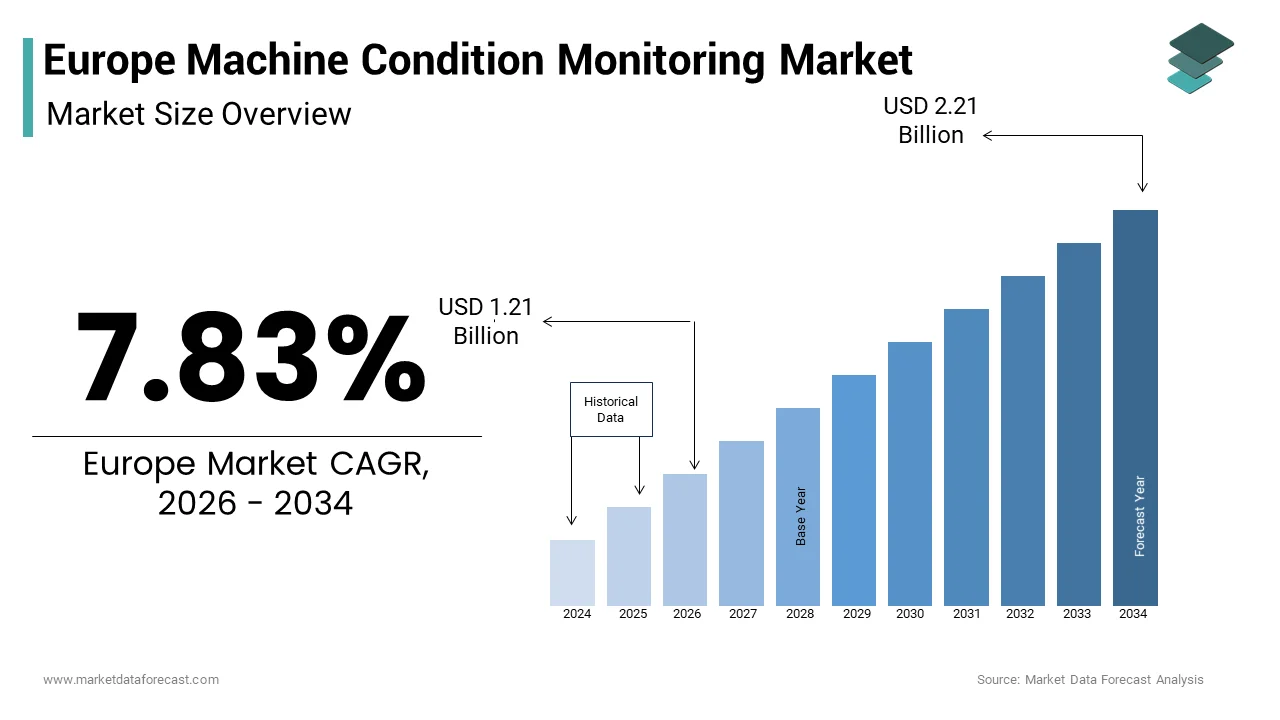
The European machine condition monitoring market was valued at USD 1.12 billion in 2025, is estimated to reach USD 1.21 billion in 2026, and is projected to grow to USD 2.21 billion by 2034, advancing at a CAGR of 7.83% from 2026 to 2034. This growth is fueled by rising industrial automation, the push toward predictive maintenance in smart factories, and stringent EU regulations on operational efficiency and equipment safety. Accelerated adoption of Industry 4.0 technologies, increasing downtime costs, and the need to extend asset lifespans across manufacturing and energy sectors are key drivers shaping market expansion across the region.
Key Market Trends
- Rapid integration of IoT-enabled sensors and cloud-based analytics for real-time equipment health tracking.
- Growing preference for online condition monitoring systems over manual or offline methods due to continuous data insights and reduced human error.
- Surging demand in discrete manufacturing—especially automotive, aerospace, and machinery—where unplanned downtime carries high operational risk.
- Expansion of AI and machine learning algorithms to enhance fault detection accuracy and enable prescriptive maintenance.
- Rising emphasis on sustainability and energy efficiency, with condition monitoring helping optimize power consumption and reduce waste in industrial processes.
Segmental Insights
- By type, the hardware segment dominated the market in 2025 with a 54.6% share, driven by widespread deployment of vibration sensors, temperature probes, and acoustic emission detectors. Software and services are the fastest-growing sub-segments, supported by cloud platforms and subscription-based monitoring solutions.
- By monitoring technique, online condition monitoring led with 63.5% market share, reflecting the shift toward automated, always-on diagnostic systems in critical industrial environments.
- By end-user vertical, discrete manufacturing held the largest share at 32.7%, followed by process industries (oil & gas, chemicals) and power generation, where asset reliability is mission-critical.
Regional Insights
- Germany emerged as the largest national market in Europe, capturing a 25.7% share in 2024, thanks to its advanced industrial base, strong machinery sector, and leadership in Industry 4.0 implementation.
- France ranked second with 17.8% market share, supported by government initiatives in digital manufacturing and energy transition.
- The United Kingdom remains a key player, leveraging its strengths in engineering innovation and green finance to adopt next-gen monitoring solutions.
- Sweden is gaining traction through its sustainability-first industrial policies, while the Netherlands is poised for robust growth (2025–2033) due to its highly electrified logistics infrastructure and dense network of smart factories.
Competitive Landscape
The Europe machine condition monitoring market is highly competitive, featuring a mix of industrial automation giants, specialized sensor manufacturers, and predictive analytics providers. Leading players—including SKF AB, Siemens AG, Emerson Electric Co, Schaeffler Technologies, Honeywell International, and Rockwell Automation—are focusing on strategic partnerships, AI-integrated platforms, and modular hardware solutions to strengthen their foothold. Companies like I-care NV, SPM Instrument AB, and Brüel & Kjær Vibro are carving niches through domain expertise in vibration analysis and reliability engineering. M&A activity and R&D investments in edge computing and digital twins are further intensifying competition.
Europe Machine Condition Monitoring Market Size
The Europe machine condition monitoring market size was valued at USD 1.12 billion in 2025 and is anticipated to reach USD 1.21 billion in 2026 and USD 2.21 billion by 2034, growing at a CAGR of 7.83% during the forecast period from 2026 to 2034.
Machine condition monitoring refers to the technologies and services that assess the real-time health of industrial machinery through vibration analysis, thermal imaging, oil debris detection, acoustic emission, and other predictive diagnostics. These systems enable operators to detect anomalies before catastrophic failure occurs, thereby minimizing unplanned downtime, enhancing worker safety, and optimizing maintenance expenditures. In Europe, this practice has evolved from periodic manual checks to continuous digital surveillance integrated within industrial IoT and smart factory frameworks. According to sources, there is a growing trend among large manufacturers toward adopting advanced operational principles that emphasize data use in managing physical assets. Unplanned operational interruptions result in significant financial loss, with mechanical issues being a notable cause of these disruptions. A new regulation for equipment includes requirements for safety-focused monitoring features in certain machinery, thereby encouraging maintenance approaches based on actual equipment condition. Moreover, the European Green Deal’s emphasis on resource efficiency incentivizes extended machinery lifespans through proactive care. These regulators, operational, and sustainability imperatives define the strategic relevance of machine condition monitoring in Europe’s advanced industrial landscape.
MARKET DRIVERS
Mandatory Compliance with the EU Machinery Regulation and Safety Directives
The revised EU Machinery Regulation, which is now in force, is a key driver of the Europe machine condition monitoring market. It explicitly requires high-risk industrial equipment to integrate real-time monitoring systems that detect hazardous mechanical anomalies before they compromise operator safety. According to research, Regulations are evolving, leading to a new classification for many types of industrial machinery as high risk, which necessitates robust condition monitoring as a standard compliance requirement. Operational safety is a significant concern, with equipment issues being a notable factor in workplace incidents. Compliance efforts are increasingly focusing on maintenance documentation, and verifiable condition monitoring records are now an integral part of routine operational assessments. Manufacturers of packaging equipment, machine tools, and material handling systems have responded by embedding vibration and temperature sensors directly into new equipment designs. This regulatory compulsion transforms condition monitoring from an optional efficiency tool into a non-negotiable safety and compliance requirement across Europe’s industrial base.
Integration with Industrial IoT and Smart Factory Initiatives
The accelerating adoption of Industrial Internet of Things architectures across European manufacturing is another key accelerator of the Europe machine condition monitoring market. This is significantly boosting demand for advanced machine condition monitoring solutions that feed real-time asset health data into centralized analytics platforms. A majority of large industrial firms in the EU are now operating smart factories, utilizing interconnected machinery. Interconnection commonly relies on standardized communication protocols. Manufacturers often prioritize predictive maintenance as a primary use case for their Industrial Internet of Things investments. Condition monitoring serves as a crucial data layer for these applications. Companies have developed edge computing gateways that process vibration and thermal signals locally before transmitting only actionable insights to cloud dashboards, reducing bandwidth costs and latency. This fusion of digital infrastructure,re-operationall efficiency, and data-driven decision making establishes machine condition monitoring as a core enabler of Europe’s industrial transformation.
MARKET RESTRAINTS
High Initial Investment and Integration Complexity for Legacy Systems
The substantial capital expenditure and technical complexity involved in retrofitting legacy industrial equipment with modern sensing and connectivity infrastructure a major restraints to the Europe machine condition monitoring market. A significant amount of operational machinery in manufacturing predates modern digital integration standards. This older machinery often lacks standardized connectivity options, complicating the integration of contemporary sensors. The cost associated with upgrading individual pieces of older equipment can be substantial. Small and medium enterprises, which are a large portion of manufacturers, often face challenges with the necessary capital investment. Furthermore, integrating disparate monitoring systems from multiple vendors into a unified platform remains technically challenging due to proprietary data formats and protocol incompatibilities. Only a portion of European SMEs have implemented continuous condition monitoring primarily due to cost and complexity barriers. Adoption will remain concentrated among large industrial players until plug-and-play retrofit kits and government subsidy programs scale up.
Lack of Standardized Data Protocols and Interoperability Frameworks
Persistent fragmentation due to the absence of universally adopted data standards and interoperability frameworks impedes seamless integration across multi-vendor machinery and analytics platforms, which ultimately slows down the expansion of the Europe machine condition monitoring market. Initiatives such as the Asset Administration Shell show promise within the Industrial Digital Twin framework, though their adoption varies across organizations. A diverse range of proprietary communication protocols currently in use across factories can make it difficult for condition monitoring systems to aggregate data consistently from machines produced by different manufacturers. Even within a single facility, operators often deploy separate monitoring solutions for pumps, motors, and gearboxes, leading to data silos and redundant hardware. A lack of EU mandates for open sensor interfaces and a common failure taxonomy keeps the industry reliant on proprietary ecosystems, which limits growth potential and increases overall expenses.
MARKET OPPORTUNITIES
Expansion into Renewable Energy Infrastructure Monitoring
The rapid deployment of wind and solar power infrastructure across the region is offering new opportunities for the Europe machine condition monitoring market. This is creating a high-value opportunity for specialized machine condition monitoring systems tailored to the unique reliability challenges of renewable energy assets. According to research, there is continued growth in renewable energy capacity within the region. Wind energy installations, encompassing both onshore and offshore locations, are widespread. System component issues, specifically with gearboxes and bearings, contribute to operational interruptions in wind turbines. Maintenance interventions for such issues, particularly for offshore units, involve high costs due to the logistics of equipment and personnel movement. This vulnerability has triggered mandatory condition monitoring requirements. Companies like SKF and Baker Hughes have developed nacelle-mounted vibration and oil debris sensors that withstand extreme temperatures and salt corrosion while transmitting data via satellite from remote offshore locations. This regulatory and operational convergence establishes renewable energy as a strategic growth frontier for Europe’s condition monitoring market.
Adoption in Rail and Urban Transit Maintenance Programs
The modernization of the region’s rail and urban transit networks presents a significant opportunity for the Europe machine condition monitoring market. These systems enhance safety, reliability, ty and fleet availability in passenger transportation. As per sources, many countries are currently upgrading older trains and track signaling systems as part of an initiative to reduce carbon emissions by the end of the decade. Issues with train motors and wheel parts are a notable factor in urban metro system delays across major cities. In response, national operators have mandated continuous condition monitoring for all new train procurements. Deutsche Bahn, for instance, requires real-time axle temperature and vibration monitoring on all ICE 4 trains, while Transport for London has deployed acoustic emission sensors on Underground escalators to predict bearing wear. The European Commission encourages such investments through the Connecting Europe Facility, which allocated funds for smart maintenance technologies. Policy-driven shift transforms public transit from reactive to predictive maintenance, creating a stable and expanding market for specialized monitoring solutions.
MARKET CHALLENGES
Shortage of Skilled Personnel for Data Interpretation and System Management
The acute shortage of industrial data scientists and reliability engineers capable of interpreting complex sensor outputs and translating them into actionable maintenance decisions is a major obstacle for the Europe machine condition monitoring market. According to studies, there is an observed deficit of qualified personnel in industrial data analytics across the European Union. Only a small minority of vocational programs offer specialized training in relevant areas like predictive maintenance. Manufacturers deploying condition monitoring systems frequently report underutilization of those systems. This underutilization is often attributed to staff challenges in distinguishing between normal operational noise and genuine fault signatures. False alarms lead to unnecessary maintenance, while missed anomalies result in catastrophic failures. Even large firms rely heavily on external consultants for advanced diagnostics due to internal skill gaps. Europe's industries will not fully benefit from condition monitoring systems without synchronized spending on educational certification programs and vendor-provided training.
Cybersecurity Vulnerabilities in Connected Monitoring Systems
The increasing connectivity of machine condition monitoring devices within Industrial Internet of Things networks introduces significant cybersecurity risks that deter adoption in safety-critical and high-value manufacturing environments, and negatively affect the expansion of the Europe machine condition market. Industrial cyber incidents frequently involve unauthorized access through unsecured devices used for condition monitoring. Regulatory changes are being implemented to address cybersecurity risks in industrial monitoring systems, focusing on requirements for features like secure boot firmware signing and encrypted data transmission. However, many legacy and low-cost monitoring solutions still operate on default credentials and unpatched operating systems, creating exploitable entry points. Europe's sensitive industries will not fully deploy new systems until the perceived risk from cyber threats is mitigated through widespread vendor adoption of zero trust and stringent user implementation of network segmentation.
REPORT COVERAGE
| REPORT METRIC | DETAILS |
| Market Size Available | 2025 to 2034 |
| Base Year | 2025 |
| Forecast Period | 2026 to 2034 |
| CAGR | 7.83% |
| Segments Covered | By Type, Monitoring Technique, Deployment Mode, End-User, And & Region |
| Various Analyses Covered | Global, Regional & Country Level Analysis, Segment-Level Analysis, DROC, PESTLE Analysis, Porter’s Five Forces Analysis, Competitive Landscape, Analyst Overview on Investment Opportunities |
| Regions Covered | UK, France, Spain, Germany, Italy, Russia, Sweden, Denmark, Switzerland, Netherlands, Turkey, Czech Republic & Rest of Europe |
| Market Leaders Profiled | SKF AB, Schaeffler Technologies AG and Co. KG, Emerson Electric Co, Honeywell International Inc., General Electric Company, Siemens AG, Brüel and Kjær Vibro A/S, Baker Hughes Company, Meggitt PLC, Pruftechnik Dieter Busch GmbH, I-care NV, SPM Instrument AB, Spectris PLC, PCE Instruments (PCE Holding GmbH), PCB Piezotronics Inc, Rockwell Automation Inc, Parker Hannifin Corporation, Fluke Corporation, Ametek Inc. (Spectro Scientific), ALS Limited, National Instruments Corporation, FLIR Systems Inc, ABB Ltd. |
SEGMENTAL ANALYSIS
By Type Insights
The hardware segment was the largest in the Europe machine condition monitoring market by accounting for a 54.6% share in 2024. The prominence of the hardware segment is driven by the foundational role of sensor data acquisition systems and edge devices in enabling real-time asset surveillance. According to sources, new industrial machinery sold in the European Union often includes embedded sensors as standard features, a trend influenced by regulatory changes. Hardware investments represent a significant portion of the total condition monitoring budgets within discrete manufacturing, where equipment reliability is a primary focus. Companies supply ruggedized accelerometers, infrared cameras, and oil debris monitors that operate in extreme environments such as steel mills and offshore platforms. Additionally, the EU’s Green Deal Industrial Plan incentivizes capital expenditure for energy-efficient machinery, which often integrates advanced monitoring hardware to optimize performance. This regulatory and operational reliance on physical sensing infrastructure ensures hardware remains the dominant segment.
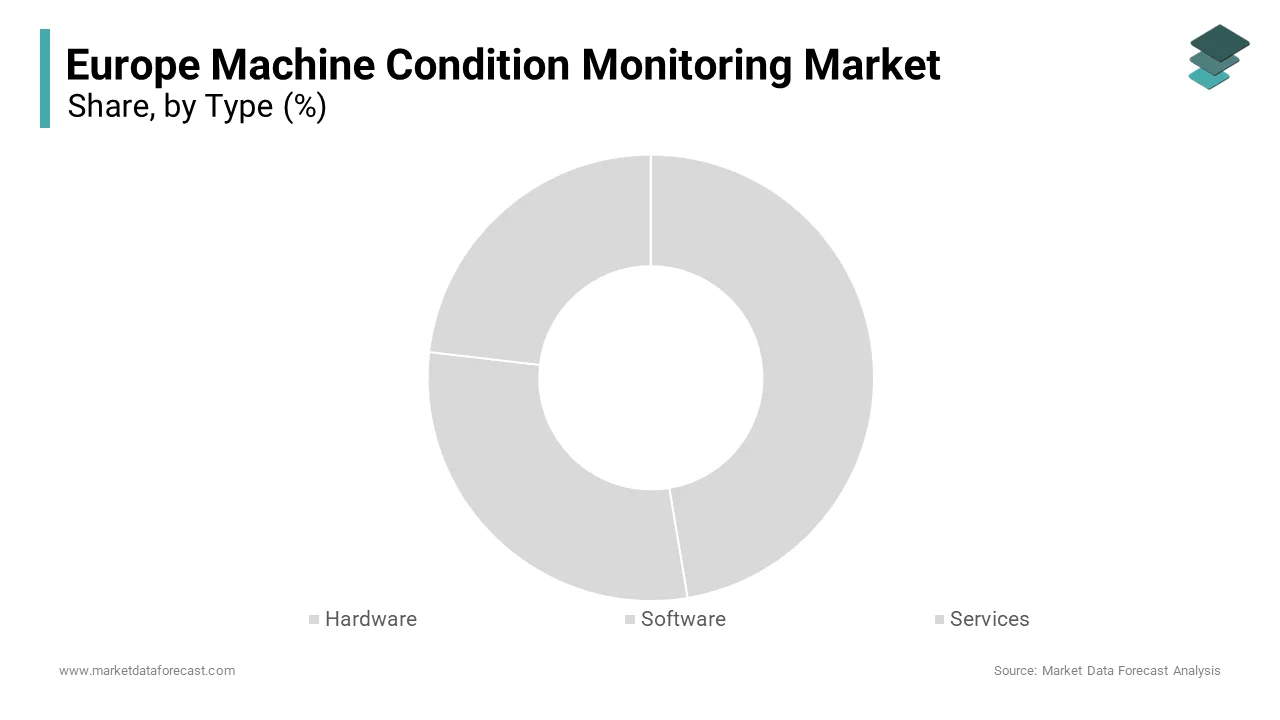
The software segment is anticipated to witness the fastest CAGR of 14.3% from 2025 to 2033 due to the shift from standalone diagnostics to AI-driven predictive analytics integrated within industrial cloud platforms. Manufacturers are focusing on software that can integrate vibration, thermal, and process data to forecast potential failure modes, moving beyond merely identifying existing problems. Standardized data models support the use of third-party analytics applications across diverse machinery from various suppliers, helping to avoid limitations imposed by proprietary systems. Companies have launched cloud-based condition monitoring suites that use machine learning to reduce false alarms and extend prediction windows to several days. The European Investment Bank has allocated funds to support SME adoption of such software under its Digital Europe program. This convergence of open data frameworks, AI innovation,n and policy support positions software as the highest growth segment in Europe’s predictive maintenance landscape.
By Monitoring Technique Insights
The online condition monitoring segment led the Europe machine condition monitoring market and occupied a 63.5% share in 2025. Its ability to provide continuous real-time surveillance of critical machinery without production interruption has mainly contributed to the leading position of the online condition monitoring segment. Facilities across the EU are increasingly adopting permanent monitoring systems for key industrial equipment, such as compressors, turbines, and extruders. The demand for automated alarming and the ability to integrate monitoring systems with broader enterprise maintenance platforms is growing. Industries like power generation and oil and gas rely on these systems to prevent catastrophic failures. Major operators, including TotalEnergies and RW, have deployed thousands of permanently installed vibration and temperature sensors across refineries and power plants, with data streamed to centralized dashboards. The combination of regulatory compulsion, operational necessity, and cost of failure ensures online monitoring remains the dominant technique across Europe’s heavy industry sectors.
The offline and portable condition monitoring segment is likely to experience the fastest CAGR of 11.8% during the forecast period due to cost-effective deployment in small and medium enterprises and flexible diagnostics for rotating equipment across multiple sites. Many manufacturers operate with a smaller number of machines, which can make a permanent online system economically unviable for their operational scale. Portable vibration analyzers offer significant diagnostic capability, providing a viable option for route-based inspections using technician handheld devices. Companies have introduced Bluetooth-enabled sensors that sync with smartphone apps, allowing maintenance teams to build asset histories without IT integration. This affordability, ease of use, and policy support establish portable monitoring as the highest growth technique in Europe’s fragmented industrial landscape.
By End User Vertical Insights
The discrete manufacturing segment held the leading share of 32.7% of the Europe machine condition monitoring market in 2025. Europe’s strong automotive machinery and electronics production base, where equipment uptime directly impacts just-in-time delivery and quality control, drives the growth of the discrete manufacturing segment. European automotive assembly lines are operating near full capacity, necessitating minimal unplanned downtime. Brief production halts in these high-volume facilities can result in substantial financial losses. This operational pressure has driven widespread adoption of continuous monitoring on robots, stamping presses, and CNC machines. Companies use integrated vibration and current sensors to predict spindle bearing failures several days in advance, achieving high equipment availability. The European Commission’s Important Project of Common European Interest in microelectronics has further mandated condition monitoring for all new semiconductor fabrication lines receiving EU subsidies. This combination of economic imperative, regulatory alignment, and production intensity solidifies discrete manufacturing as the dominant vertical.
The power generation segment is on the rise and is expected to befastest-growingowing segment in the market by witnessing a CAGR of 13.6% from 2025 to 2033, owing to the reliability demands of renewable integration and aging thermal infrastructure. Renewable capacity addition has occurred, but grid stability now requires balancing with other power plants. Balancing generators have experienced more frequent unplanned outages from repeated cycling. This operational challenge has led to requirements for condition monitoring and predictive maintenance plans for larger generators. Companies embed vibration and partial discharge sensors in new turbines while retrofitting legacy units with wireless monitoring kits. This regulatory and grid reliability pressure establishes power generation as the highest growth vertical in Europe’s condition monitoring market.
COUNTRY ANALYSIS
Germany Vehicle Electrification Market Analysis
Germany dominated the Europe vehicle electrification market and captured a 25.7% share in 2025 as the continent’s engineering and manufacturing nucleus. Its dominance spans battery cells, electric motors, and charging infrastructure through a vertically integrated industrial ecosystem. The registration of battery electric vehicles is substantial and continues to grow. Major domestic automotive manufacturers are converting their primary production facilities to focus entirely on electric vehicle output. The nation is actively expanding its public charging network infrastructure to accommodate increasing demand. The electrical grid incorporates a significant amount of renewable energy, which enables environmentally friendly charging options. Key automotive suppliers within the country provide a large share of essential components for electric drivetrains throughout the region. This fusion of industrial might, policy coherence, and clean energy infrastructure solidifies Germany’s structural leadership in European vehicle electrification.
France Vehicle Electrification Market Analysis
France was the second-largest region in the Europe machine condition monitoring market and held a 17.8% share in 2025, with an assertive industrial policy and equitable consumer incentives. Government policy discourages the use of internal combustion engines. Incentives for purchasers of low-emission vehicles help promote wider consumer uptake. Policies aim to support domestic production capabilities for electric vehicle power components, which may help reduce reliance on external suppliers. There is substantial manufacturing capacity for electric vehicles within the region, with the potential for increased output. The regional electricity grid, which uses nuclear power, provides a low-carbon energy source, supporting the environmental advantages associated with electric vehicle use during their operational lifespan. This blend of demand stimulation, supply chain sovereignty, and clean energy ensures France’s cohesive and scalable electrification model.
United Kingdom Vehicle Electrification Market Analysis
The United Kingdom is a noteworthy player in the Europe machine condition monitoring market due to its fusion of advanced engineering and green finance leadership. Despite Brexit, it maintains alignment with EU emissions standards and has legislated a 2030 fossil fuel vehicle ban. The number of electric vehicles on the roads is increasing significantly. The UK has a strong position in the development and production of power electronics technology. Ongoing financial support is being allocated for advanced battery research and development. Financial initiatives focused on sustainable development are helping to fund the growth of electric vehicle infrastructure. Urban environmental zones are encouraging a faster transition to zero-emission fleets, including a large number of zero-emission taxis in operation. This synergy of technological depth, capital allocation,n and urban policy sustains the UK’s pivotal role in Europe’s electrification transition.
Sweden Vehicle Electrification Market Analysis
Sweden grew steadily in the Europe machine condition monitoring market owing to a model that prioritizes sustainability, ty, ethics, and equity. Electricity generation from hydro and nuclear sources forms a substantial part of the power mix. The high share of low-carbon electricity generation means that electric vehicles (EVs) have favorable lifecycle emissions. Battery electric vehicles constitute a significant portion of new vehicle registrations. A major domestic car manufacturer is focusing on a complete transition to EV sales. Domestic production facilities are adopting renewable energy and recycled materials in their processes. Government programs exist to provide financial support for increasing EV usage in certain areas to help ensure broader access. There is a trend towards finding secondary uses for batteries, with collaborations in place to use retired packs for grid storage. This ecosystem of clean power, industrial responsibility, and social inclusion makes Sweden a benchmark for sustainable vehicle electrification.
Netherlands Vehicle Electrification Market Analysis
The Netherlands is predicted to grow in the Europe machine condition monitoring market from 2025 to 2033 due to unmatched charging density and logistics electrification. Electric car registrations are increasing, and these vehicles comprise a notable portion of new sales. The country features a significant number of public chargers in a leading position relative to other areas in Europe, with a favorable ratio of chargers to electric vehicles. Major cities are implementing regulations to foster the adoption of zero-emission urban delivery vehicles, which encourages the use of light commercial vehicles. A substantial percentage of corporate fleets from key leasing companies are now electric. Grid operator integrates EVs into demand response programs to balance renewable intermittency. The Netherlands also serves as Europe’s EV logistics gateway, with Tesla and BMW using Dutch ports for distribution. This combination of infrastructural readiness policy foresight and logistical centrality cements the Netherlands as a critical enabler of Europe’s electrified mobility transition.
COMPETITIVE LANDSCAPE
The Europe machine condition monitoring market features a competitive landscape dominated by global industrial technology leaders such as Siemens, Emerson, SK, F, who leverage decades of mechanical expertise and regulatory fluency. These firms compete not on price but on system reliability, data sovereignty, compliance with EU safety directs, and depth of vertical integration. Niche players like Pruftechnik and Baker Hughes maintain strong positions in specialized segments such as portable diagnostics and oil debris analysis, but lack the end-to-end platform offerings. Competition is intensifying around software intelligence, with vendors racing to embed AI that can correlate multi-sensor data into actionable maintenance insights. The revised EU Machinery Regulation and Cyber Resilience Act have raised entry barriers favoring incumbents with certified secure architectures. Meanwhile, small and medium enterprises often rely on channel partnership,n creating a layered ecosystem of vendvendorsintegrat,orsd service providers. OH, really, the market rewards technical, depth regulatory alignment, and trusted industrial relationships over rapid commercialization.
KEY MARKET PLAYERS
A few of the market players in the Europe machine condition monitoring market are
- SKF AB
- Schaeffler Technologies AG and Co. KG
- Emerson Electric Co.
- Honeywell International Inc.
- General Electric Company
- Siemens AG
- Brüel and Kjær Vibro A/S
- Baker Hughes Company
- Meggitt PLC
- Pruftechnik Dieter Busch GmbH
- I-care NV
- SPM Instrument AB
- Spectris PLC
- PCE Instruments (PCE Holding GmbH)
- PCB Piezotronics Inc.
- Rockwell Automation Inc.
- Parker Hannifin Corporation
- Fluke Corporation
- Ametek Inc. (Spectro Scientific)
- ALS Limited
- National Instruments Corporation
- FLIR Systems Inc.
- ABB Ltd.
Top Players In The Market
- Siemens AG is a global industrial technology leader with a strong presence in the Europe machine condition monitoring market through its comprehensive portfolio of sensors, RSs, edge devices, and MindSphere cloud analytics. The company serves critical sectors, including automotive, energy, and manufacturing, with integrated condition monitoring solutions that comply with EU Machinery Regulation standards. It also launched a cybersecurity-certified vibration monitoring gateway compatible with OPC UA over TSN, ensuring safe data transmission in industrial networks. These innovations reinforce Siemens’ position as a trusted provider of secure, scalable, le regulation-aligned monitoring systems across Europe’s advanced industrial base.
- Emerson Electric Co maintains a significant footprint in the Europe machine condition monitoring market through its Plantweb digital ecosystem, offering sensors, software, and expert services for predictive maintenance. The company specializes in harsh environment monitoring for oil and gas power and the chemical industry, where reliability is non-negotiable. It also expanded its European analytics center in Germany to support real-time diagnostics for discrete manufacturers using machine learning models trained on European asset data. These actions demonstrate Emerson’s commitment to delivering localized high-integrity monitoring solutions tailored to Europe’s stringent safety and environmental standards.
- SKF Group, a Swedish multinational and global bearing leader, plays a pivotal role in the Europe machine condition monitoring market through its integrated rotating equipment reliability solutions. The company combines hardware such as wireless vibration sensors with its Enlight AI platform to deliver end-to-end diagnostics for industrial machinery. It also partnered with leading European rail operators to deploy condition monitoring on high-speed train bogies, reducing wheel wear in pilot trials. SKF’s deep mechanical expertise and regulatory alignment position it as a preferred reliability partner across Europe’s transport and heavy industry sectors.
Top Strategies Used by the Key Market Participants
Key participants in the Europe machine condition monitoring market focus on embedding cybersecurity by design to comply with the EU Cyber Resilience Act and NIS2 Directive. They develop AI-powered analytics trained on European industrial asset data to improve prediction accuracy and reduce false alarms. Companies integrate their monitoring platforms with open industrial standards like OPC UA and Asset Administration Shell to ensure interoperability. Strategic partnerships with the rail, energy, and automotive sectors enable the development of vertical-specific solutions. Additionally, firms invest in localized data centers and GDPR compliant cloud architectures to address data sovereignty concerns and strengthen client trust across the European Union.
MARKET SEGMENTATION
This research report on the Europe machine condition monitoring market is segmented and sub-segmented into the following categories.
By Type
- Hardware
- Vibration Condition Monitoring Equipment
- Thermography Equipment
- Ultrasonic Detection Systems
- Lubricating Oil Analysis
- Current Signature Analysis
- Acoustic Emission Monitoring
- Software
- Services
By Monitoring Technique
- Online Condition Monitoring
- Portable Condition Monitoring
- Edge AI-enabled Sensors
By Deployment Mode
- On-Premises
- Cloud-Based Solutions
By End-user Vertical
- Oil and Gas
- Power Generation
- Process Manufacturing
- Discrete Manufacturing
- Aerospace and Defense
- Automotive and Transportation
- Marine, Mining, and Metals
- Other End-user Verticals
By Country
- UK
- France
- Spain
- Germany
- Italy
- Russia
- Sweden
- Denmark
- Switzerland
- Netherlands
- Turkey
- Czech Republic
- Rest of Europe