- Product Description Description
- Table of Contents TOC
- List of Table & Figure LOT
- Get Free Sample PDF Sample PDF
Market Size, 2025
$5.76 BnMarket Estimate, 2026
$6.38 BnMarket Forecast, 2034
$14.37 BnCAGR, 2026–2034
10.68%Europe Machine Vision Market Report Summary
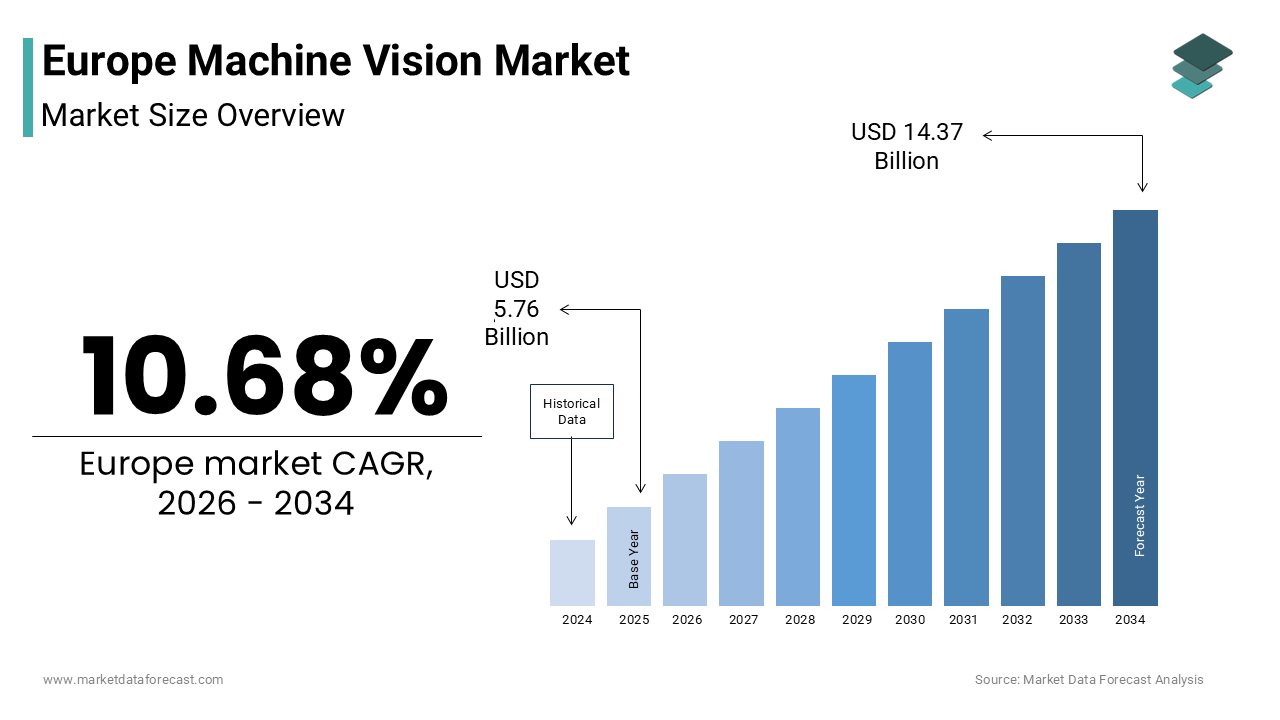
The Europe machine vision market was valued at USD 5.76 billion in 2025, is estimated to reach USD 6.38 billion in 2026, and is projected to reach USD 14.37 billion by 2034, growing at a CAGR of 10.68% during the forecast period from 2026 to 2034. The growth of the Europe machine vision market is driven by increasing automation across automotive, aerospace, and pharmaceutical industries, along with the region’s strong emphasis on zero-defect manufacturing, regulatory traceability, and industrial digitalization. Machine vision systems have evolved into essential infrastructure for automated inspection, robot guidance, and compliance verification, enabling manufacturers to achieve micron-level precision and real-time analytics. Additionally, the adoption of AI-enabled vision software, smart cameras, and edge computing technologies is transforming production workflows, while strict European standards for safety, cybersecurity, and electromagnetic compatibility continue to shape innovation and deployment strategies across the region.
Key Market Trends
- Rising adoption of AI-powered inspection systems to support zero-defect production in automotive and aerospace manufacturing.
- The growing integration of serialization and traceability solutions in pharmaceutical packaging is driven by EU regulatory mandates.
- Increasing demand for smart camera-based vision systems among small and medium-sized enterprises due to ease of deployment.
- Expansion of vision-guided robotics in food and beverage processing for hygiene compliance and waste reduction.
- Emergence of circular economy applications, including automated sorting, recycling, and remanufacturing powered by machine vision technologies.
Segmental Insights
- Based on component, the hardware segment was the largest and held a significant share of the Europe machine vision market in 2025. The segment’s dominance is attributed to the essential role of cameras, optics, illumination systems, and sensors in achieving high-precision inspection and regulatory compliance across European manufacturing environments.
- Based on product, the PC-based systems segment accounted for the largest share of the Europe machine vision market in 2025. The growth of this segment is driven by its high processing power, flexibility, and ability to support complex multi-camera inspection and deep learning applications.
- Based on end-user industry, the automotive segment was the largest, occupying a prominent share of the Europe machine vision market in 2025. The dominance of this segment stems from extensive automation, stringent quality requirements, and growing demand for advanced inspection systems in electric vehicle battery production.
Regional Insights
The Europe machine vision market is experiencing strong growth across key industrial economies, supported by advanced manufacturing ecosystems, regulatory mandates, and increasing adoption of Industry 4.0 technologies.
- Germany was the largest contributor, driven by its strong automotive manufacturing base, advanced robotics adoption, and leadership in precision engineering and industrial automation.
- The United Kingdom continues to expand with innovation in AI-based inspection systems and strong collaboration between academic research institutions and industrial automation companies.
- France is emerging as a strategic market supported by national initiatives focused on technological sovereignty, semiconductor innovation, and secure industrial data infrastructure.
- Italy is witnessing steady growth fueled by the increasing adoption of smart camera systems among SMEs in the packaging, textiles, and food machinery sectors.
- Sweden is gaining traction through sustainability-focused automation projects and advanced vision systems used in mining, forestry, and clean-tech manufacturing.
Competitive Landscape
The Europe machine vision market is characterized by strong competition among global technology providers and specialized European manufacturers focusing on engineering precision, regulatory compliance, and AI-driven innovation. Leading companies are investing in edge AI processing, interoperable software platforms, and cybersecurity-compliant architectures to meet evolving European industrial standards. Strategic collaborations with research institutes, localization of technical support, and development of application-specific solutions are strengthening competitive positioning across sectors. Prominent players in the Europe machine vision market include Cognex Corporation, Keyence Corporation, Basler AG, Teledyne Technologies Incorporated, Omron Corporation, Sony Semiconductor Solutions Corporation, National Instruments Corporation, IDS Imaging Development Systems GmbH, Allied Vision Technologies GmbH, Sick AG, Baumer Group, ISRA Vision AG, TKH Group N.V., Stemmer Imaging AG, and Datalogic S.p.A.
Europe Machine Vision Market Size
The Europe machine vision market size was valued at USD 5.76 billion in 2025 and is anticipated to reach USD 6.38 billion in 2026 from USD 14.37 billion by 2034, growing at a CAGR of 10.68% during the forecast period from 2026 to 2034
Machine Vision (MV) is a specialized field of industrial automation that uses hardware and software to provide imaging-based automatic inspection, analysis, and robot guidance. Unlike generic imaging systems, machine vision in this context operates as a deterministic component within closed-loop production or diagnostic workflows requiring micron-level precision, real-time processing, and compliance with functional safety standards. In the European manufacturing sector, machine vision has become a fundamental technology for automated quality control, especially within the automotive and pharmaceutical industries where precision and regulatory compliance are essential. European factories are increasingly adopting industrial robots to enhance production efficiency, with a growing reliance on integrated vision systems to handle complex tasks like part localization and assembly verification. The region’s emphasis on zero defect manufacturing, traceability under the EU Medical Device Regulation, and circular economy principles has elevated machine vision from a peripheral sensor to a core enabler of industrial sovereignty. Its deployment is further shaped by stringent electromagnetic compatibility and cybersecurity requirements unique to European industrial ecosystems.
MARKET DRIVERS
Enforcement of Zero Defect Manufacturing in Automotive and Aerospace Sectors
The pursuit of zero defect production in the region’s high precision industries has made machine vision indispensable for ensuring component integrity and process reliability, which drives the growth of the Europe machine vision market. German automotive Tier 1 suppliers are rapidly integrating fully automated visual inspection systems to bolster safety-critical part quality, focusing on components like steering and braking systems. Airbus is increasing its focus on advanced imaging, such as multispectral techniques, to enhance the detection of structural anomalies within composite materials, aiming to improve structural health monitoring. European aviation authorities are moving toward regulating AI-based inspection, requiring robust, traceable data, such as timestamped images, to validate digital audit trails for structural maintenance. Similarly, BMW has successfully implemented AI-powered vision technology in its electric vehicle battery production to reduce false rejections and ensure high-precision defect detection. Modern industrial vision applications in manufacturing are expanding beyond basic cosmetic checks to include high-precision dimensional measurements and surface roughness analysis, aligning with international quality standards. Escalating warranty costs and stricter product liability laws have forced European manufacturers to adopt machine vision as essential, non-negotiable quality assurance infrastructure.
Regulatory Mandates for Traceability and Serialization in Pharmaceutical Packaging
Stringent EU regulations governing drug safety have transformed machine vision into a compliance-critical technology across the pharmaceutical supply chain, which further propels the expansion of the Europe machine vision market. Regulatory mandates in the European Union for pharmaceutical traceability necessitate the use of machine-readable, unique identifiers on prescription products, which are verified throughout the distribution chain. The implementation of these regulations has prompted the industry to adopt advanced vision systems capable of scanning codes on various packaging types at high speeds. Companies are integrating sophisticated camera technology, such as thermal and high-dynamic-range imaging, to inspect sterile barrier seals for defects at a granular level, fulfilling medical device documentation requirements. The deployment of automated vision-guided stations has shown high accuracy in verifying serialized products, including vials, blisters, and cartons. The use of vision-based verification systems has proved effective in identifying labeling discrepancies prior to product distribution, assisting in the reduction of batch recalls. In this highly regulated environment machine vision serves as both inspector and legal witness ensuring patient safety while shielding manufacturers from regulatory penalties.
MARKET RESTRAINTS
Shortage of Cross Disciplinary Engineers Skilled in Optics Embedded Systems and Industrial AI
There is a critical shortage of experts proficient in optical engineering, real-time programming, and domain-specific knowledge, which is one of the factors restricting the growth of the European machine vision market. This scarcity is a major barrier for the regional rollout of advanced machine vision. Cedefop data indicates that the annual supply of graduates with advanced technical skills, particularly for managing complex vision architectures, is insufficient to meet the rapidly rising demands of the European automation sector. Germany's Federal Employment Agency data confirms that demand for specialized technical skills, including machine vision, significantly exceeds supply, particularly within manufacturing hubs such as Baden-Württemberg, causing severe staffing issues. This gap delays project implementation. Trends indicate that a majority of system integrators are facing project delays due to a shortage of qualified personnel, making talent acquisition the primary challenge for automation projects. Universities offer limited interdisciplinary programs. The number of specialized, interdisciplinary academic programs that comprehensively combine photonics, robotics, and computer vision remains limited across European institutions, resulting in a niche, high-demand education market. Meanwhile global tech firms lure talent with higher salaries for generic AI roles leaving industrial vision under resourced. Until education aligns with the hybrid competencies demanded by smart factories Europe’s machine vision potential will remain constrained by human capital bottlenecks.
Fragmented Integration Standards Across Legacy and Modern Production Lines
The coexistence of decades old machinery and new Industry 4.0 platforms is lacking common communication protocols, which causes operational friction, and thereby impedes the expansion of the Europe machine vision market. A significant portion of European factories operate mixed-generation equipment, requiring costly integration efforts to enable older, legacy controllers to interpret modern, high-speed machine vision data streams. Small and medium-sized enterprises in the Italian textile machinery sector face substantial investment costs for customized middleware development when retrofitting existing machinery with new machine vision systems. Even within new installations interoperability remains elusive. The adoption of standardized OPC UA for machine vision is still growing among manufacturers, leading to delays in achieving seamless, direct data flow from vision systems to cloud analytics and MES layers. Furthermore, proprietary camera interfaces from dominant vendors lock users into single ecosystem upgrades stifling competition. The upcoming EU Cyber Resilience Act mandates stringent cybersecurity and secure firmware updates for connected devices, but leaves the burden of mapping pixel data to specific production KPIs to system integrators, as it does not address semantic interoperability. This fragmentation inflates total cost of ownership and deters smaller manufacturers from initiating vision projects despite clear ROI potential.
MARKET OPPORTUNITIES
Integration of Vision Systems into Circular Economy and Remanufacturing Workflows
The region’s push toward a circular economy is creating novel demand for machine vision in reverse logistics and component refurbishment. This integration is expected to fuel the growth of the Europe machine vision market. The recycling of end-of-life vehicles frequently experiences low recovery rates for high-value components due to reliance on manual sorting processes. Advanced machine vision technologies are being implemented to improve the automated grading and sorting of these components. Pilot initiatives demonstrate that hyperspectral imaging can accurately identify material composition and wear, enhancing the reuse potential of disassembled parts. Vision-guided systems, such as structured light scanning, are reducing the time required to inspect complex components for structural flaws. Upcoming regulatory updates for vehicles are shifting toward digital product passports, which will facilitate the use of scanning technologies to access maintenance and material information. Startups like Circularise are developing blockchain linked vision agents that authenticate recycled content in real time. Machine vision serves as the eyes of the regenerative industrial loop, enabling the shift from aspirational sustainability to regulated circularity.
Expansion of Vision Guided Robotics in Food and Beverage Processing
The food and beverage sector is emerging as a high-growth frontier for machine vision due to labour shortages, hygiene mandates, and customization demands. Consequently, this shift offers significant prospects for the European machine vision market. Food processing facilities in the meat, poultry, and dairy sectors are increasing the adoption of contactless vision-guided robotics to enhance hygiene protocols. Poultry deboning systems are utilizing 3D stereo vision technology to adapt to individual product anatomy, improving yield and reducing human exposure to potential pathogens. Bakery automation is incorporating vision-based robots to reduce waste by adjusting portioning based on real-time shape analysis. Moreover, consumer trends toward personalized nutrition are fueling demand for vision systems that read ingredient labels and allergen markers on mixed SKUs, tasks performed by deep learning cameras in Ocado’s automated fulfillment centers. Machine vision technology is transforming Europe’s essential food industry, moving beyond traditional quality control to generate value through improved traceability and waste reduction, in alignment with the EU Farm to Fork strategy.
MARKET CHALLENGES
Real Time Performance Constraints Under Functional Safety and Cybersecurity Overheads
Deploying machine vision in safety critical industrial environments is increasingly challenged by the computational burden of concurrent functional safety and cybersecurity protocols that slow down the growth of the Europe machine vision market. Industrial vision systems are increasingly failing functional safety certifications because the addition of mandatory security layers introduces processing delays that interfere with high-speed emergency stop requirements. In automotive press shops where vision guides robot arms near human operators this delay can compromise safety integrity levels. Implementing high-level encryption for industrial camera feeds significantly consumes processing resources, forcing manufacturers to balance data protection against real-time operational speed. Furthermore, new European cybersecurity regulations requiring remote update capabilities are creating technical hurdles for legacy industrial hardware and specialized operating systems that lack the extra memory needed for automated patching. Hardware accelerators improve performance but raise cost and power usage, creating hurdles for compact vision sensors. The scope of vision in high-speed collaborative systems is currently limited by performance compromises, pending the maturity of lightweight security and safety-certified AI inference.
Environmental Sensitivity and Robustness Gaps in Harsh Industrial Conditions
Machine vision systems frequently underperform in the region’s diverse and demanding industrial environments, which constrains the expansion of the Europe machine vision market. These environments degrade optical fidelity through temperature fluctuation, particulate contamination, and electromagnetic interference. Vision system failures in Nordic industrial settings have been linked to environmental factors such as steam and intense glare affecting lenses and sensors. In Southern European processing facilities, high humidity levels have resulted in condensation on protective housings. The presence of environmental moisture and debris, including condensation, has been observed to reduce image contrast in inspection systems. The IP67 rating protects against environmental particulates and water, but it fails to address calibration misalignment resulting from temperature fluctuations. Variations in ambient temperature can affect the focal positioning of standard CMOS sensors, which may impact measurements requiring high precision. The magnitude of this focal shift suggests that temperature changes within common operating ranges can influence the accuracy of industrial imaging systems. Ruggedized sensors designed to mitigate these environmental effects often come at a higher cost, which may influence their adoption rate among small and medium-sized enterprises. The cost differential between standard and hardened imaging components can influence the decision-making process for companies operating with budget constraints. Vision components in European factories will remain unreliable until materials innovation and adaptive optics allow them to operate independently of environmental conditions.
| REPORT METRIC | DETAILS |
| Market Size Available | 2025 to 2034 |
| Base Year | 2025 |
| Forecast Period | 2026 to 2034 |
| CAGR | 10.68% |
| Segments Covered | By Component, Product, Application and Region |
| Various Analyses Covered | Regional & Country Level Analysis, Segment-Level Analysis, DROC, PESTLE Analysis, Porter’s Five Forces Analysis, Competitive Landscape, Analyst Overview on Investment Opportunities |
| Countries Covered | UK, France, Spain, Germany, Italy, Russia, Sweden, Denmark, Switzerland, the Netherlands, Turkey, the Czech Republic, and the Rest of Europe. |
| Market Leaders Profiled | Cognex Corporation, Keyence Corporation, Basler AG, Teledyne Technologies Incorporated, Omron Corporation, Sony Semiconductor Solutions Corporation, National Instruments Corporation, IDS Imaging Development Systems GmbH, Allied Vision Technologies GmbH, Sick AG, Baumer Group, ISRA Vision AG, TKH Group N.V., Stemmer Imaging AG, and Datalogic S.p.A. |
SEGMENTAL ANALYSIS
By Component Insights
The hardware segment captured the majority share of the Europe machine vision market in 2025. The prominence of the hardware segment is driven by the foundational role of physical imaging components in industrial automation ecosystems. A further key factor sustaining this dominance is the non substitutable nature of optics sensors and illumination in achieving micron level inspection accuracy required by European manufacturing standards. German manufacturing is increasingly integrating multiple, advanced machine vision stations within new automated production lines to handle complex tasks like surface inspection and robotic guidance. European machine vision integrators heavily rely on leading high-performance CMOS sensor manufacturers, specifically Sony and onsemi, for their imaging technologies in smart factory applications. Additionally stringent hygiene regulations in food and pharmaceutical sectors mandate stainless steel housings IP69K rated illumination and washdown compatible lenses, components that cannot be virtualized. European safety regulations regarding light radiation necessitate that industrial LED lighting systems used in production environments be certified to prevent eye and skin hazards. Hardware will remain the foundation of the European machine vision value chain as long as physical, real-world object interaction is central to industry.
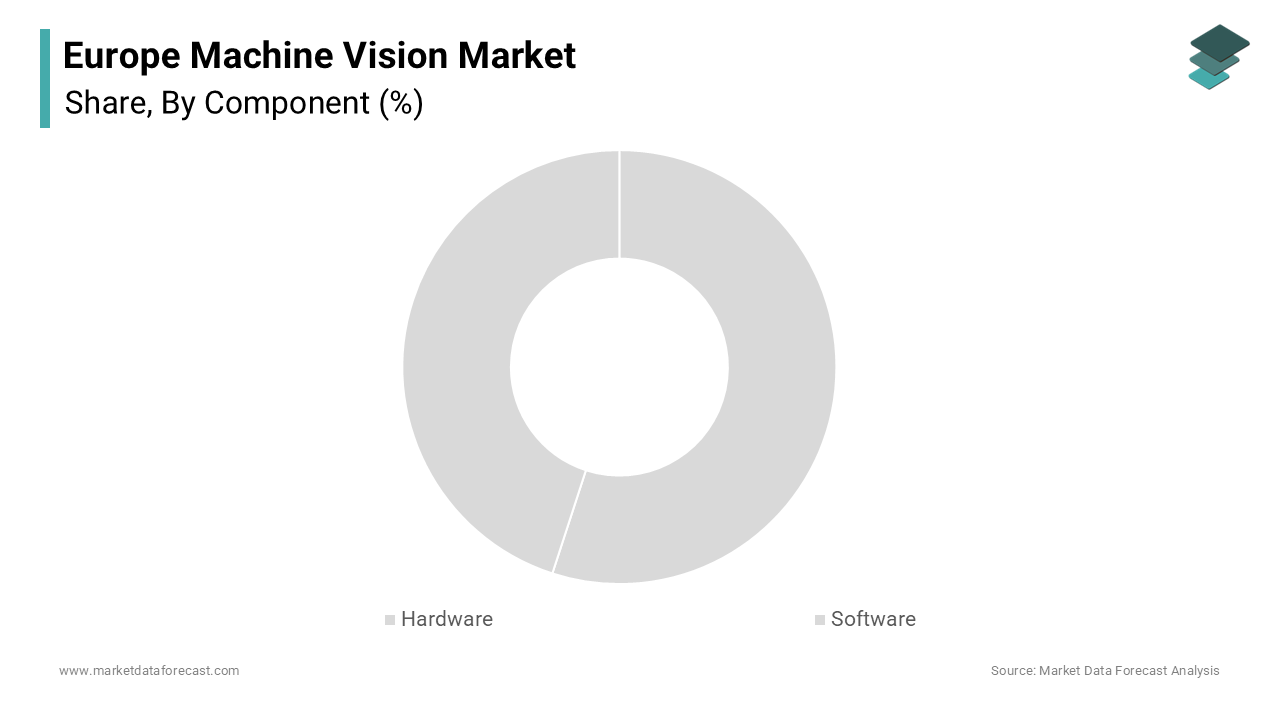
The software segment is predicted to witness the highest CAGR of 23.6% between 2026 and 2034 due to the shift toward flexible reconfigurable vision systems powered by deep learning and cloud connected analytics. European machine vision integrators are increasingly adopting modular software platforms, which enables end users to change inspection algorithms while keeping existing cameras. The ability to switch inspection algorithms without replacing hardware provides enhanced flexibility for manufacturing environments handling multiple products. Engineering professionals are utilizing established machine vision toolkits for specialized applications, such as identifying defects in battery components and composite materials. There is growing interest in applying pretrained models for anomaly detection within industrial and academic contexts. Regulatory drivers also fuel adoption. Regulations regarding artificial intelligence in European markets are increasing the requirement for documented version control and bias testing for specific vision technologies. The management of these compliance requirements is increasingly integrated into dedicated software layers rather than handled separately. The implementation of unified communication standards for machine vision is improving data exchange between industrial vision systems and manufacturing execution systems. The adoption of these standardized interfaces is contributing to a decrease in the time required for system integration. The shift from static firmware to dynamic, adaptive software transforms technology from a commodity into a competitive differentiator.
By Product Insights
The PC-based systems segment led the Europe machine vision market by holding a 59.8% share in 2025. The leading position of the PC-based systems segment is attributed to its superior processing power flexibility and compatibility with complex multi camera inspection tasks. Their prevalence is especially pronounced in automotive aerospace and electronics where high resolution line scan cameras generate terabytes of data per hour requiring GPU accelerated analysis. European battery manufacturing is increasingly utilizing high-speed industrial computer-based visual inspection systems to meet, in real-time, the stringent quality and precision standards for, and in line with, new regional battery regulations. The modularity of PC architectures also supports regulatory compliance. Pharmaceutical packaging lines use redundant PC setups to maintain 21 CFR Part 11 compliant audit trails during serialization checks. Cybersecurity authorities in Germany emphasize that industrial computer systems, utilizing hardware-based security features like Trusted Platform Modules and network segmentation, provide superior security hardening for critical production systems compared to many standard embedded alternatives. For applications demanding deterministic latency combined with algorithmic complexity PC based systems remain the engineering standard across Europe’s high precision industries.
The smart camera based systems segment is estimated to register the fastest CAGR of 26.8% over the forecast period owing to demand for compact low cost and easy to deploy vision solutions in small and medium enterprises. Many new vision installations in specific food processing and textile regions are utilizing self-contained smart cameras, reducing the requirement for external computers and extensive cabling. Certain camera series are experiencing increased sales in specific European markets for applications like label verification and fill level control in beverage lines. The adoption of IO-Link and OPC UA over TSN protocols allows vision devices to connect directly to PLC networks, which facilitates the transmission of pass-fail results without needing intermediate processing. Moreover EU energy efficiency directives favor low power edge devices. Smart cameras are democratizing machine vision, moving it beyond complex engineering environments as plug-and-play intelligence replaces centralized systems.
By End User Industry Insights
The automotive segment was the largest segment in the Europe machine vision market by occupying a 34.1% share in 2025 because of its role as the continent’s most automated and quality conscious manufacturing domain. European vehicle manufacturing processes incorporate numerous automated visual inspections to evaluate various aspects of production, such as weld integrity and paint quality. Quality control protocols require rigorous checks at different stages of production. The application of advanced 3D scanning technology has become common in Western European body shops for checking panel alignment. Production standards include specific tolerances for ensuring precise fitment of vehicle body components. Battery production for electric vehicles further intensifies demand. Advanced imaging technology is being utilized in battery production to identify microscopic contaminants on materials, which helps mitigate safety risks related to thermal runaway. Regulatory requirements in certain regions necessitate the retention of digital records for critical assembly processes to ensure traceability. The transition toward electric vehicles, combined with the high volume of vehicle production, positions the automotive sector as a major driver for the adoption of machine vision systems.
The food and beverage segment is anticipated to witness the fastest CAGR of 28.4% from 2026 to 2034. The rapid growth of the food and beverage segment is propelled by labour shortages hygiene mandates and personalized nutrition trends. Meat, poultry, and dairy processors are increasingly adopting contactless, vision-guided robotics to enhance sanitation standards and minimize manual handling in sterile production environments. Advanced vision-guided deboning systems are being deployed to customize cuts based on individual carcass characteristics, improving overall product yield while reducing human contact with the product. In the bakery sector, vision-based portioning robots are being utilized to analyze product shapes in real time, leading to a reduction in material waste. Moreover, consumer demand for allergen free and customized meals drives vision systems that read ingredient labels on mixed SKUs, tasks performed by deep learning cameras in Ocado’s fulfillment centers. The EU Farm to Fork Strategy’s emphasis on traceability and waste reduction positions machine vision not just as inspector but as value creator in Europe’s essential food supply chain.
REGIONAL ANALYSIS
Germany Machine Vision Market Analysis
Germany dominated the Europe machine vision market by accounting for a 29.6% share in 2025. The supremacy of German market is credited to its world class manufacturing base and engineering culture of precision. The country hosts the highest concentration of automotive Tier 1 suppliers and mechanical engineering firms that treat machine vision as integral to zero defect production. The industrial sector is experiencing a rise in the deployment of automated visual inspection technologies, with a notable focus on quality control processes within electric vehicle component manufacturing. Advancements in automation technologies are being supported by research organizations focused on enhancing practical application. New, accessible platforms are being introduced to assist smaller enterprises in utilizing machine learning for industrial processes without requiring advanced technical expertise. The integration of artificial intelligence in industrial settings is being facilitated by the early adoption of standardized validation frameworks. Germany sets the benchmark for quality and technology across Europe, supported by top-tier domestic manufacturers such as IDS Imaging and Basler and a dense network of integrators.
United Kingdom Machine Vision Market Analysis
The United Kingdom was the second largest player in the Europe machine vision market by captured a 13.2% share in 2025. The growth of the Uk market is driven by its strength in agile automation and academic commercialization of vision technologies. Despite Brexit UK universities remain deeply integrated into European research. Academic institutions are collaborating with automotive manufacturers to create vision technologies capable of maintaining accuracy despite fluctuating temperatures in industrial environments. The region demonstrates proficiency in specialized, targeted automation applications. Startup technologies employing spectral imaging are being integrated into food processing lines to identify contaminants not visible to standard cameras. Government funding initiatives are focused on supporting small and medium-sized enterprises in implementing vision-guided robotic systems. London’s tech ecosystem also fosters AI startups like Datature that provide no code training platforms for custom inspection models. This blend of academic excellence venture capital and practical deployment makes the UK a crucible for next generation vision innovation beyond traditional industrial paradigms.
France Machine Vision Market Analysis
France holds a significant share of the Europe machine vision market due to national strategies to secure technological sovereignty in critical manufacturing. National investment strategies are prioritizing the enhancement of local semiconductor, sensor, and imaging technology capabilities. The deployment of advanced vision-guided manufacturing systems is increasing within the domestic battery production sector, while new procurement guidelines are driving a shift toward prioritizing locally sourced or European-made components for industrial machinery. Research initiatives are focusing on developing efficient, data-optimized sensors that improve processing speed and reduce computational load. Advanced imaging technology, such as event-based vision, is transitioning from research settings into practical applications in aerospace assembly. Stringent cybersecurity regulations are requiring critical infrastructure systems to manage and store data within national borders, influencing the implementation of vision technologies. This policy driven ecosystem prioritizes resilience over cost creating a distinct but influential market trajectory.
Italy Machine Vision Market Analysis
Italy grew steadily in the Europe machine vision market owing to rapid machine vision adoption among small and medium enterprises in traditional sectors like textiles food machinery and ceramics. A significant portion of Italian machinery manufacturers has incorporated smart cameras into their standard equipment to meet international demand for automated quality control systems. The Emilia Romagna region emerged as a hub for vision enabled packaging machines with companies like IMA deploying color and shape recognition systems that adjust to variable product formats without manual recalibration. Government incentives played a key role. Government initiatives have provided financial incentives and tax credits to support the adoption of Industry 4.0 technologies, such as vision systems, for industrial upgrades. Unlike large scale automotive deployments Italian adoption focuses on affordability ease of use and quick ROI, making it a bellwether for broader European SME transformation.
Sweden Machine Vision Market Analysis
Sweden is predicted to expand in the Europe machine vision market from 2026 to 2034 due to its fusion of environmental responsibility and high precision engineering. The country’s machine vision applications prioritize resource efficiency and worker safety in mining forestry and clean tech manufacturing. ndustrial automation is increasingly adopting integrated vision systems to remove human operators from hazardous environments, such as those involving high temperatures or dangerous materials. The utilization of advanced spectral vision technology for real-time monitoring of machinery allows for improved resource management and reduced premature tool replacements. Sustainability is driving design choices, with a focus on creating automated systems that minimize energy consumption and material waste. Educational institutions are strengthening ties with industry to train specialists in designing and implementing sustainable, vision-enabled automation solutions. A pattern of increasing digital sophistication is observed, wherein vision systems and data analytics are combined to enhance accuracy, safety, and efficiency in manufacturing processes. Sweden showcases how, backed by high tech-trust and a commitment to circularity, machine vision can harmonize industrial productivity with ecological limits.
COMPETITIVE LANDSCAPE
Competition in the Europe machine vision market is characterized by a dual emphasis on engineering excellence and regulatory alignment distinguishing it from cost driven global counterparts. European buyers prioritize deterministic performance long term reliability and compliance with functional safety cybersecurity and data governance frameworks over initial purchase price. Incumbent vendors leverage deep domain knowledge in automotive aerospace and pharmaceuticals to deliver application specific solutions while global players adapt through localized certification and support structures. Differentiation arises through software flexibility optical precision and integration readiness rather than hardware specifications alone. The presence of world class research institutes stringent product liability laws and a culture of zero defect manufacturing intensifies rivalry as companies race to embed intelligence closer to the sensor without compromising robustness. This environment fosters innovation but demands rigorous validation making Europe a high barrier yet high trust market for industrial vision technologies.
KEY MARKET PLAYERS
Some of the companies that are playing a dominating role in the Europe Machine Vision Market include
- Cognex Corporation
- Keyence Corporation
- Basler AG
- Teledyne Technologies Incorporated
- Omron Corporation
- Sony Semiconductor Solutions Corporation
- National Instruments Corporation
- IDS Imaging Development Systems GmbH
- Allied Vision Technologies GmbH
- Sick AG
- Baumer Group
- ISRA Vision AG
- TKH Group N.V.
- Stemmer Imaging AG
- Datalogic S.p.A.
Top Players in the Market
Basler AG
Basler AG is a cornerstone of the Europe machine vision market renowned for its high performance industrial cameras and embedded vision solutions tailored to European manufacturing standards. The company supplies imaging components to automotive battery gigafactories pharmaceutical packaging lines and robotics integrators across the continent. In recent years Basler has accelerated its software capabilities launching the Basler blaze 3D camera series with integrated depth processing and expanding its pylon SDK to support deep learning inference at the edge. It actively contributes to European standardization efforts including OPC UA for Vision and participates in EU funded research consortia focused on AI validation in industrial settings. Globally Basler exports its Europe certified architectures to markets seeking reliable deterministic vision systems compliant with functional safety norms.
Cognex Corporation
Cognex maintains a strong presence in the Europe machine vision market through its smart cameras and vision sensors that empower small and medium enterprises to automate quality control without complex infrastructure. The company’s DataMan and In-Sight platforms are widely deployed in food beverage and logistics sectors for code reading and defect detection. Recently Cognex enhanced its edge AI offerings with the release of ViDi ELA software enabling no code training of anomaly detection models for textured surfaces. It established a dedicated European cybersecurity compliance team to ensure all devices meet the EU Cyber Resilience Act requirements including secure boot and encrypted firmware updates. Cognex connects sophisticated vision technology with real-world factory floor application through localized support.
Keyence Corporation
Keyence plays a pivotal role in the Europe machine vision market by delivering plug and play vision systems that combine hardware optics and software in sealed units requiring minimal integration effort. Its CV X series vision controllers are extensively used in precision electronics assembly and medical device manufacturing where repeatability and ease of validation are paramount. Keyence has strengthened its European footprint by expanding its technical support centers in Germany France and the Netherlands to provide rapid on site assistance and application development services. The company also introduced GDPR aligned data handling protocols ensuring that image storage and transmission comply with regional privacy expectations. Globally Keyence leverages its Europe refined usability principles to offer turnkey vision solutions that reduce engineering dependency across diverse industrial landscapes.
Top Strategies Used by the Key Market Participants
Key players in the Europe machine vision market focus on developing edge AI capable devices that process data locally to meet cybersecurity and latency requirements under EU regulations. They invest in interoperability by adopting OPC UA for Vision and GigE Vision standards to ensure seamless integration with existing industrial networks. Companies prioritize regulatory compliance through certifications from TÜV and BSI covering functional safety electromagnetic compatibility and secure firmware updates. Strategic localization of software development and technical support teams enhances responsiveness to regional industry needs. Additionally firms collaborate with academic institutions and public research agencies to co create validated vision algorithms for emerging applications like battery inspection and circular economy sorting.
MARKET SEGMENTATION
This research report on the europe machine vision market has been segmented and sub-segmented based on following categories.
By Component
- Hardware
- Vision Systems
- Cameras
- Optics and Illumination Systems
- Frame Grabbers
- Other Hardware
- Software
By Product
- PC-Based
- Smart Camera-Based
- By End-User Industry
- Automotive
- Electronics and Semiconductors
- Food and Beverage
- Healthcare and Pharmaceutical
- Logistics and Retail
- Other Industries
By Application
- Quality Inspection
- Measurement and Metrology
- Identification and Code Reading
- Positioning and Guidance
- Robotics Safety and Others
By Country
- UK
- France
- Spain
- Germany
- Italy
- Russia
- Sweden
- Denmark
- Switzerland
- Netherlands
- Turkey
- Czech Republic
- Rest of Europe