- Product Description Description
- Table of Contents TOC
- List of Table & Figure LOT
- Get Free Sample PDF Sample PDF
Market Size, 2025
$10.16 BnMarket Estimate, 2026
$10.51 BnMarket Forecast, 2034
$13.67 BnCAGR, 2026–2034
3.48%Europe Manganese Market Size, Growth, Trends & Forecast (2026–2034)
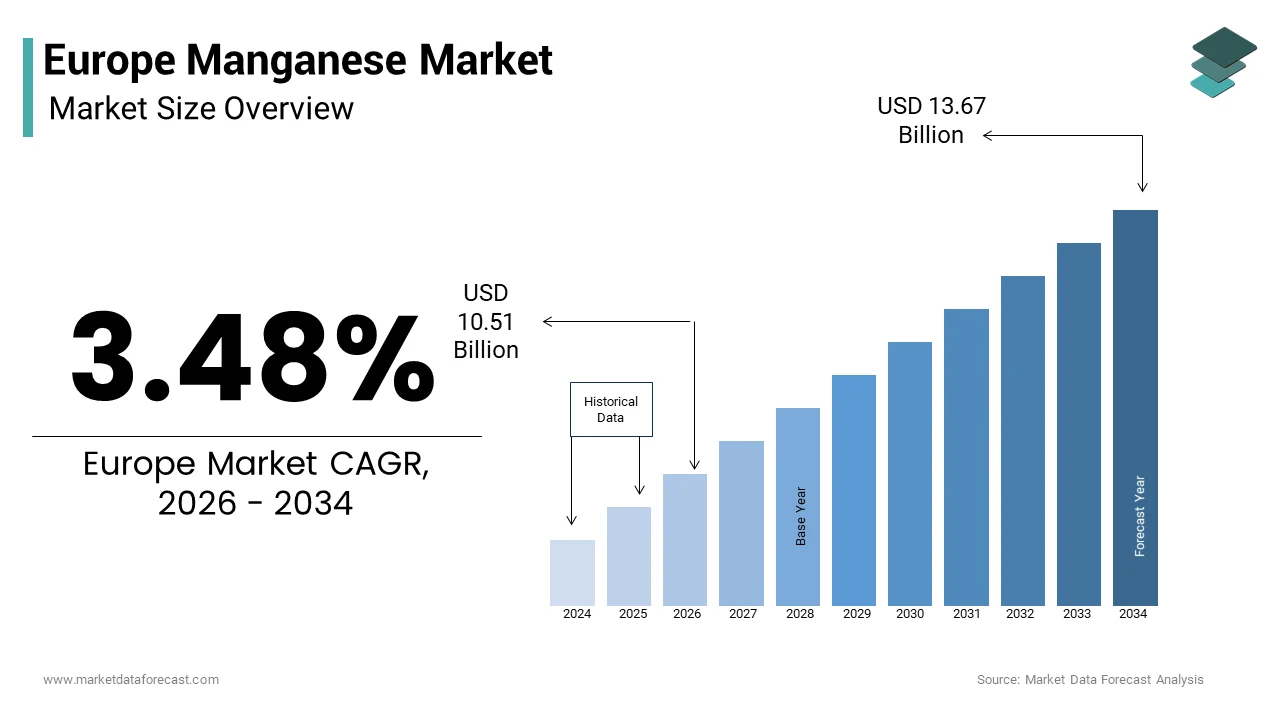
The Europe manganese market size was valued at USD 10.16 billion in 2025, is anticipated to reach USD 10.51 billion in 2026, and is projected to scale up to USD 13.67 billion by 2034, registering a compound annual growth rate (CAGR) of 3.48% during the forecast period from 2026 to 2034. Driven by the robust demand from traditional steel manufacturing, the expansion of electric vehicle battery gigafactories, and strategic policy support under the Critical Raw Materials Act, the European manganese sector continues to experience steady structural evolution.
Key Executive Metrics (At-a-Glance)
- 2025 Base Valuation: USD 10.16 Billion
- 2026 Current Valuation: USD 10.51 Billion
- 2034 Forecast Valuation: USD 13.67 Billion
- Compound Annual Growth Rate (CAGR): 3.48% (2026–2034)
- Dominant Application Segment: Alloys Segment (86.8% share in 2025)
- Fastest-Growing Application Segment: Electrolytic Manganese Metals Segment (projected at 13.5% CAGR)
- Dominant End-Use Sector: Industrial Segment (76.1% share in 2025)
- Fastest-Growing End-Use Sector: Power Storage & Electricity Segment (projected at 16.6% CAGR)
- Dominant Ore Grade Segment: Standard Grade Segment (62.6% share in 2025)
- Fastest-Growing Ore Grade Segment: Battery Grade Segment (projected at 19.1% CAGR)
- Dominant Country Market: Germany (23.5% share in 2025) followed by Italy and France
Core Market Drivers
- Steel Industry Demand: Indispensable role of manganese as a deoxidizer and desulfurizer in high-strength low-alloy (HSLA) steels for automotive lightweighting.
- EV Battery Expansion: Rapid growth of lithium-ion battery production (such as LMFP and NMC chemistries) across European gigafactories.
- Critical Raw Material Status: Strategic policy measures under the EU Critical Raw Materials Act aiming to secure resilient supply chains.
Primary Market Restraints & Challenges
- Import Dependency: Heavy reliance on external ore imports from South Africa, Gabon, and Australia creating geopolitical and logistical exposure.
- Stringent Regulations: High compliance costs associated with EU environmental directives, carbon pricing, and waste management.
- Price Volatility: Fluctuations in global ore prices and stiff competition from lower-cost international alloy producers.
Europe Manganese Market Segmentation Highlights
| Segment Category | Largest Market Segment | Fastest-Growing Market Segment |
|---|---|---|
| By Application | Alloys Segment (86.8% share in 2025) | Electrolytic Manganese Metals (13.5% CAGR) |
| By End-Use Sector | Industrial Segment (76.1% share in 2025) | Power Storage & Electricity (16.6% CAGR) |
| By Ore Grade | Standard Grade Segment (62.6% share in 2025) | Battery Grade Segment (19.1% CAGR) |
| By Country | Germany (23.5% share in 2025) | Italy, France, and Spain |
Major Industry Players Profiled
Key enterprises operating in the European manganese market include Eramet, South32, BHP, Anglo American plc, Tata Steel, Vale, African Rainbow Minerals Limited, Manganese Metal Company (Pty) Ltd., Giyani Metals Corp, and Element 25 Limited.
Europe Manganese Market Size
The Europe manganese market size was valued at USD 10.16 billion in 2025 and is anticipated to reach USD 10.51 billion in 2026 to reach USD 13.67 billion by 2034, growing at a CAGR of 3.48% during the forecast period from 2026 to 2034.
Manganese is a critical segment of the continent’s metallurgical and chemical supply chains characterized by the import processing and consumption of manganese ores alloys and compounds. Manganese is an essential ferroalloy element primarily utilized in steel production to enhance strength toughness and hardness while also serving as a vital component in aluminum alloys and battery chemistries. The region lacks significant domestic manganese ore reserves necessitating heavy reliance on imports from countries such as South Africa Gabon and Australia. As per Eurostat, the European Union steel industry has produced crude steel in significant volumes in recent years, which is indicating the substantial underlying demand for manganese as a deoxidizer and desulfurizer. The transition towards electric mobility has further elevated the strategic importance of manganese, particularly in lithium ion battery cathodes such as lithium manganese iron phosphate. According to the European Commission, the Critical Raw Materials Act identifies manganese as a strategic raw material due to its economic importance and supply risk. The market dynamics are influenced by global trade policies, environmental regulations, and the decarbonization agendas of major industrial consumers. According to the data from the International Energy Agency, the demand for critical minerals including manganese could increase several times by 2040, which is driven by clean energy technologies. This shifting landscape requires European stakeholders to secure resilient supply chains and invest in recycling infrastructure. The interplay between traditional steelmaking needs and emerging battery applications defines the current operational context for manganese in Europe.
MARKET DRIVERS
Robust Demand from the Steel Manufacturing Industry
The steel manufacturing industry remains the major driver for the Europe manganese market and is accounting for approximately 90% of total manganese consumption. Manganese is indispensable in steel production where it acts as a deoxidizer and desulfurizer, improving the mechanical properties of the final product. According to the World Steel Association, global steel demand is projected to remain stable with Europe maintaining a significant share due to its advanced automotive, construction, and machinery sectors. As per the European Steel Association, high strength low alloy steels, which require higher manganese content, are increasingly used in automotive lightweighting initiatives to improve fuel efficiency and safety. As per the European Automobile Manufacturers Association, the average vehicle contains approximately 15 kilograms of manganese primarily in steel components. The construction sector also drives demand through the use of reinforcing bars and structural steel which rely on manganese for durability. The recovery of industrial activity post pandemic has led to increased steel production rates, thereby boosting manganese consumption. Furthermore, the modernization of infrastructure across European nations necessitates large volumes of high quality steel. The inability to substitute manganese with other elements in steelmaking ensures a consistent and inelastic demand base. This structural dependency on manganese for steel quality and performance sustains its market prominence. The ongoing investment in green steel technologies also requires precise control of alloy compositions, further reinforcing the need for high purity manganese products.
Expansion of Electric Vehicle Battery Production
The rapid expansion of the electric vehicle battery sector is another key growth driver for the Europe manganese market, particularly for high purity manganese sulfate. Manganese is a key component in various battery cathode chemistries including nickel manganese cobalt and the emerging lithium manganese iron phosphate formulations. According to the European Battery Alliance, the continent aims to establish a self sufficient battery value chain with numerous gigafactories planned or under construction across Germany, France, and Sweden. These facilities require substantial quantities of battery grade manganese to meet the growing demand for electric vehicles. As per the International Energy Agency, the global stock of electric cars is expected to increase significantly by 2030, with Europe representing a major market share. The shift towards lithium manganese iron phosphate batteries is driven by their lower cost, improved safety, and reduced reliance on cobalt and nickel. European automakers are increasingly adopting these chemistries to diversify supply chains and reduce costs. The European Commission’s support for domestic battery production through funding and regulatory frameworks further accelerates this trend. Investments in refining capabilities to convert manganese ore into battery grade materials are increasing within the region. This diversification beyond traditional steel applications opens new revenue streams and reduces dependency on cyclical steel markets. The strategic importance of manganese in energy storage solutions ensures long term demand growth.
MARKET RESTRAINTS
Heavy Dependence on Imports and Supply Chain Vulnerabilities
The Europe manganese market faces a significant restraint due to its heavy dependence on imports and associated supply chain vulnerabilities. Europe possesses negligible domestic manganese ore reserves, forcing it to rely on external sources for nearly 100% of its raw material needs. According to the United States Geological Survey, the global supply of manganese is highly concentrated with South Africa, Gabon, and Australia accounting for the majority of production. This geographic concentration exposes European consumers to geopolitical risks, trade disruptions, and logistical bottlenecks. As per the European Commission’s Critical Raw Materials Dashboard, the supply risk for manganese is considered high due to the limited number of producing countries and potential export restrictions. Recent global events have highlighted the fragility of long distance supply chains, leading to price volatility and availability concerns. The lack of diversified sourcing options limits the bargaining power of European buyers. Any disruption in mining operations or shipping routes can have immediate and severe impacts on downstream industries such as steel and battery manufacturing. The complexity of securing long term supply agreements with international producers adds to the operational challenges. Additionally, the environmental and social governance standards in some producing countries may conflict with European regulatory requirements, creating compliance hurdles. This structural dependency undermines supply security and increases the cost of risk mitigation strategies for European companies.
Stringent Environmental Regulations and Processing Costs
Stringent environmental regulations and high processing costs is also impeding the expansion of the European manganese market, particularly for local refining and alloy production activities. The extraction and processing of manganese involve energy intensive processes and generate significant waste products including slag and dust. According to the European Environment Agency, industrial emissions from metal processing are strictly regulated under the Industrial Emissions Directive, requiring operators to implement best available techniques. Compliance with these standards necessitates substantial capital investment in pollution control technologies and waste management systems. As per the European Chemicals Agency, manganese compounds are subject to rigorous classification and labeling requirements due to their potential health and environmental hazards. These regulatory burdens increase operational costs and reduce the competitiveness of European processors compared to counterparts in regions with laxer environmental standards. The carbon pricing mechanism under the European Union Emissions Trading System further elevates production costs for energy intensive manganese alloy manufacturers. The transition towards greener production methods requires significant research and development expenditure which may not be immediately recoverable. Small and medium sized enterprises often struggle to meet these financial and regulatory demands, leading to market consolidation. The high cost of adhering to environmental standards can discourage new investments in domestic processing capacity. This regulatory intensity limits the ability of European companies to expand production and maintain price competitiveness in the global market.
MARKET OPPORTUNITIES
Development of Domestic Recycling Infrastructure
The development of domestic recycling infrastructure is a significant opportunity for the Europe manganese market by reducing reliance on primary imports and enhancing supply security. Manganese is fully recyclable and can be recovered from end of life steel products and batteries through established metallurgical processes. As per the European Scrap Committee, the recycling rate for steel in Europe is among the highest globally, providing a substantial secondary source of manganese. According to the European Battery Regulation, new mandates require higher levels of recycled content in new batteries, creating a dedicated stream for manganese recovery from spent lithium ion batteries. Investing in advanced hydrometallurgical and pyrometallurgical technologies allows European companies to extract high purity manganese from complex waste streams. The European Commission’s Circular Economy Action Plan supports initiatives that promote resource efficiency and waste reduction, offering financial incentives for recycling projects. Establishing closed loop systems for manganese in the battery value chain can mitigate supply risks and reduce environmental impacts. The growing volume of electric vehicle batteries reaching end of life in the coming decade will provide a steady feedstock for recycling facilities. Companies that develop efficient and cost effective recycling processes can capture value from waste materials and contribute to sustainability goals. This opportunity aligns with broader industrial trends towards circularity and resource independence, while enhancing the resilience of the European manganese supply chain against external shocks.
Innovation in High Purity Manganese Products for Advanced Applications
Innovation in high purity manganese products for advanced applications offers a promising opportunity for the Europe manganese market to move up the value chain. Beyond traditional steelmaking, there is growing demand for high purity manganese sulfate and metal for use in electronics, aerospace, and specialized alloys. As per industry analysis, the market for battery grade manganese sulfate is expanding rapidly, driven by the electrification of transport. According to the European Chemical Industry Council, innovation in material science is a key priority for maintaining competitiveness in global markets. Developing proprietary processes for refining manganese to meet stringent specifications for semiconductor and medical applications can open new niche markets. The aerospace industry requires high strength aluminum manganese alloys for aircraft structures, which offer weight savings and corrosion resistance. Investment in research and development to optimize production techniques and improve product consistency is essential. Collaborations with downstream manufacturers can facilitate the development of customized solutions tailored to specific application needs. This focus on high value added products reduces exposure to commodity price fluctuations and enhances profitability. The ability to supply certified high purity materials strengthens the strategic position of European producers in the global supply chain.
MARKET CHALLENGES
Volatility in Global Manganese Ore Prices
The Europe manganese market faces substantial challenges from volatility in global manganese ore prices, which directly impacts production costs and profit margins for downstream users. Manganese ore prices are influenced by a complex interplay of supply demand dynamics, currency fluctuations, and speculative trading in international commodity markets. According to the London Metal Exchange, manganese alloy prices have experienced fluctuations in recent years due to supply disruptions and changing demand patterns. As per the International Monetary Fund, commodity price volatility poses a risk to industrial planning and budgeting for European manufacturers who rely on stable input costs. Sudden spikes in ore prices can squeeze margins for steelmakers and alloy producers who may struggle to pass on costs to customers in competitive markets. The lack of transparent pricing mechanisms for certain manganese products adds to the uncertainty. Geopolitical tensions in key producing regions can lead to sudden supply shortages and price surges. European companies often hedge against price risks, but this involves additional financial costs and complexity. The unpredictability of raw material costs makes long term contract negotiations challenging. This volatility discourages investment in new production capacity and innovation. Managing price risk requires sophisticated supply chain strategies and financial instruments, which may not be accessible to all market participants. The persistent instability in ore prices remains a critical challenge for the industry.
Competition from Low Cost International Producers
Competition from low cost international producers is another major challenge to the Europe manganese market, particularly for ferroalloy and refined product manufacturing. Countries such as China, India, and South Africa benefit from lower labor, energy, and raw material costs, allowing them to produce manganese alloys at significantly lower prices. According to the World Bank, industrial production costs in these regions are often substantially lower than in Europe due to favorable economic conditions and less stringent regulatory environments. As per the European Ferroalloy Association, European producers struggle to compete on price with imported alloys, leading to a decline in domestic production capacity. The influx of cheap imports can undercut local manufacturers, forcing them to reduce output or exit the market. This trend threatens the strategic autonomy of the European steel and battery industries. Trade defence instruments such as anti-dumping duties provide some protection but are not always sufficient to offset cost disadvantages. The relocation of energy intensive processing stages to low cost regions further erodes the European industrial base. Maintaining competitiveness requires continuous improvement in efficiency and innovation, which involves significant investment. The pressure from low cost competitors limits the ability of European companies to expand market share and invest in sustainable technologies. This competitive imbalance remains a persistent structural challenge for the industry.
REPORT COVERAGE
| REPORT METRIC | DETAILS |
| Market Size Available | 2025 to 2034 |
| Base Year | 2025 |
| Forecast Period | 2026 to 2034 |
| CAGR | 3.48% |
| Segments Covered | By Application, End-use Sector, Ore Grade, Country |
| Various Analyses Covered | Global, Regional & Country Level Analysis, Segment-Level Analysis, DROC, PESTLE Analysis, Porter’s Five Forces Analysis, Competitive Landscape, Analyst Overview on Investment Opportunities |
| Regions Covered | UK, France, Spain, Germany, Italy, Russia, Sweden, Denmark, Switzerland, Netherlands, Turkey, the Czech Republic, and the Rest of Europe |
| Market Leaders Profiled | African Rainbow Minerals Limited., Anglo American plc, Assore Limited (Assmang Proprietary Limited), BHP, CITIC LIMITED, Consolidated Minerals Limited., Element 25 Limited, Eramet, Giyani Metals Corp, Jupiter Mines Limited, Manganese Metal Company (Pty) Ltd., MOIL LIMITED, Ningxia Tianyuan Manganese Industry Group Co. Ltd, NIPPON DENKO CO. LTD, OM Holdings Ltd., POSCO M-TECH., South32, Tata Steel, Vale, Vibrantz |
SEGMENTAL ANALYSIS
By Application Insights
The alloys segment led the market by capturing the dominating share of 86.8% of the European market in 2025. This overwhelming dominance of alloys segment in the European market is majorly driven by the indispensable role of manganese ferroalloys such as ferromanganese and silicomanganese in steel production. Manganese acts as a critical deoxidizer and desulfurizer, enhancing the strength, toughness, and hardenability of steel. According to the World Steel Association, steel production remains the largest industrial consumer of manganese globally, with Europe maintaining a significant share due to its advanced automotive and construction sectors. According to the European Steel Association, every tonne of steel produced requires manganese in notable quantities, making it an irreplaceable component in metallurgy. As per the European Automobile Manufacturers Association, the automotive industry continues to demand high strength low alloy steels for vehicle lightweighting and safety improvements. These specialized steels require precise manganese content to achieve desired mechanical properties. The construction sector also contributes significantly through the use of reinforcing bars and structural beams which rely on manganese for durability and resistance to wear. The inability to substitute manganese with other elements in large scale steelmaking ensures a stable and inelastic demand base. Furthermore, the recovery of industrial manufacturing activities post pandemic has led to increased steel output, thereby boosting alloy consumption. The established infrastructure for alloy production and integration into steelmaking processes cements this segment's leadership.
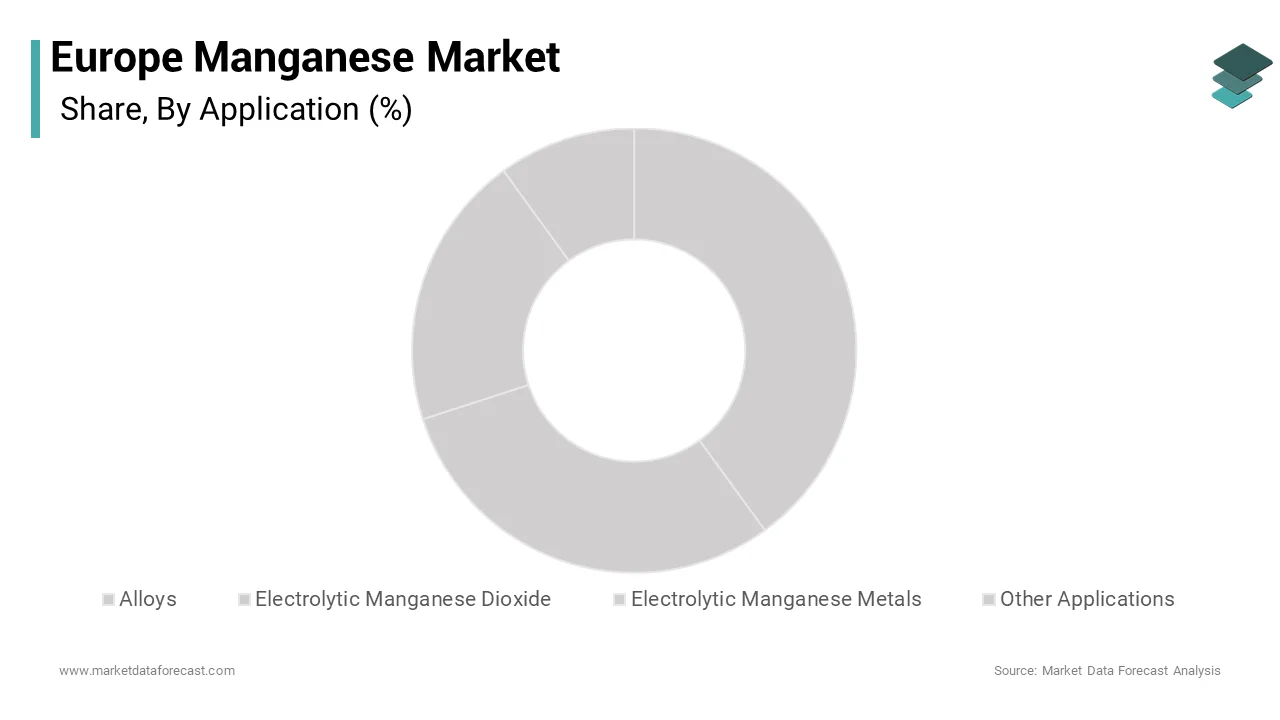
However, the electrolytic manganese metals segment is expected to exhibit a CAGR of 13.5% over the forecast period in the European market owing to the surging demand for high purity manganese in lithium ion battery cathodes, particularly for electric vehicles. Electrolytic manganese metal offers the high purity levels required for advanced battery chemistries such as lithium manganese iron phosphate and nickel manganese cobalt. According to the European Battery Alliance, the continent is aggressively expanding its battery manufacturing capacity with numerous gigafactories planned across Germany, France, and Sweden. These facilities require substantial quantities of battery grade manganese to meet the growing demand for electric mobility. As per the International Energy Agency, the global stock of electric cars is expected to increase significantly by 2030, with Europe representing a major market share. The shift towards manganese rich cathodes is driven by their cost effectiveness, improved thermal stability, and reduced reliance on expensive cobalt and nickel. European automakers are increasingly adopting these chemistries to diversify supply chains and enhance vehicle range. The European Commission’s support for domestic battery production through funding and regulatory frameworks further accelerates this trend. Investments in refining capabilities to produce high purity electrolytic manganese are increasing within the region. This transition from traditional metallurgical applications to high tech energy storage solutions drives the accelerated growth of this segment.
By End-Use Sector Insights
The industrial segment commanded for the highest share of 76.1% of the European market in 2025. The growth of the industrial segment in the European market is attributed to the extensive use of manganese in heavy industries including steel manufacturing, chemical production, and machinery fabrication. Steel production alone accounts for the vast majority of manganese consumption within the industrial sector. According to the European Steel Association, the region produces crude steel in significant volumes annually, requiring consistent supplies of manganese ferroalloys. The chemical industry also utilizes manganese compounds in the production of fertilizers, animal feed additives, and water treatment chemicals. As per the European Chemical Industry Council, the sector relies on manganese for various catalytic and oxidative processes. The machinery and equipment manufacturing industry depends on high strength steel components containing manganese for durability and performance. The industrial sector’s demand is characterized by large volume contracts and long term supply agreements, ensuring market stability. The integration of manganese into industrial standards and specifications makes it difficult to substitute. Furthermore, the modernization of industrial facilities and adoption of advanced manufacturing techniques often require specialized manganese alloys. The resilience of the industrial base in Europe despite economic fluctuations supports steady demand. Government initiatives to revitalize manufacturing and promote industrial sovereignty further reinforce this segment’s leading position. The sheer scale of industrial activity ensures that manganese remains a critical raw material for the region’s economic engine.
On the other end, the power storage and electricity segment is estimated to register a promising CAGR of 16.6% over the forecast period. This explosive growth is driven by the rapid adoption of renewable energy systems and the corresponding need for efficient energy storage solutions. Manganese based batteries, particularly lithium manganese iron phosphate, are gaining traction due to their safety, longevity, and cost advantages. According to the European Network of Transmission System Operators for Electricity, the integration of variable renewable energy sources such as wind and solar requires robust storage capabilities to ensure grid stability. As per the European Energy Storage Association, the capacity for stationary battery storage in Europe is expanding rapidly to support decarbonization goals. Manganese plays a crucial role in these storage systems by providing stable cathode materials that enhance battery performance. The electrification of transport also contributes to this growth, as electric vehicles serve as mobile storage units connected to the grid. The European Commission’s Green Deal initiatives prioritize the development of sustainable energy infrastructure, driving investment in battery technologies. The shift away from fossil fuels towards electric power systems increases the demand for manganese in both vehicle and stationary batteries. This segment benefits from strong policy support and technological advancements. The convergence of energy transition and digitalization creates a fertile ground for manganese applications in power storage.
By Ore Grade Insights
The standard grade segment held the leading position in the Europe manganese market by accounting 62.6% of the European market share in 2025. The leading position of standard grade segment in the European market is attributed to its widespread use in the production of carbon ferromanganese and silicomanganese, which are essential for mainstream steelmaking. Standard grade ores typically contain manganese levels between 30% and 44%, which is offering a cost effective balance between quality and availability. According to the United States Geological Survey, the majority of global manganese ore trade consists of standard grade material sourced from major producers such as South Africa and Gabon. European steelmakers prefer standard grade ores for bulk steel production where extreme purity is not required but consistent chemical composition is vital. As per the European Steel Association, the production of construction steel and automotive bodies relies heavily on alloys derived from standard grade ores. The established logistics and processing infrastructure for standard grade materials ensures reliable supply chains. The cost efficiency of using standard grade ores makes them the preferred choice for high volume applications. While higher grade ores are available, they are often reserved for specialized applications due to higher costs. The abundance of standard grade reserves globally ensures stable pricing and availability. This segment’s maturity and integration into existing industrial processes sustain its market leadership. The ability to blend standard grade ores with other materials allows for flexible production strategies.
On the other hand, the battery grade segment is experiencing the fastest growth and is estimated to register a promising CAGR of 19.1% over the forecast period owing to the escalating demand for high purity manganese sulfate and metal for use in electric vehicle batteries. Battery grade manganese requires purity levels exceeding 99.7% to ensure optimal electrochemical performance and safety. According to the European Battery Alliance, the ramp up of gigafactory production in Europe is creating unprecedented demand for battery ready materials. For instance, the shift towards lithium manganese iron phosphate cathodes is accelerating due to their lower cost and reduced dependency on critical minerals such as cobalt. European battery manufacturers are securing long term supply contracts for battery grade manganese to ensure production continuity. The European Commission’s Critical Raw Materials Act emphasizes the need for domestic processing capabilities for battery materials, which is encouraging investment in refining technologies. The technical requirements for battery grade manganese are stringent that need advanced purification processes. Companies that can deliver consistent high purity products are gaining competitive advantage. The expansion of the electric vehicle market directly translates into increased consumption of battery grade manganese. This segment represents a strategic pivot for the manganese industry towards high value added applications. The growth trajectory is supported by strong policy incentives and technological innovation.
COUNTRY ANALYSIS
Germany Manganese Market Analysis
Germany dominated the manganese market in Europe in 2025 with 23.5% of the regional market share. The growth of Germany in the European market can be credited to the country’s robust steel and automotive industries. According to the German Federal Ministry for Economic Affairs and Climate Action, the manufacturing sector remains a cornerstone of the economy with significant output in vehicles and machinery. Germany is home to major steel producers who utilize large quantities of manganese ferroalloys for high quality steel production. As per the German Steel Federation, the industry is increasingly focusing on green steel technologies which still require manganese for alloying. The presence of leading automotive manufacturers such as Volkswagen, BMW, and Mercedes Benz drives demand for high strength steel components. Germany is also at the forefront of battery technology development with several gigafactories under construction. The government’s support for electric mobility and industrial decarbonization boosts manganese demand. The country’s advanced logistics infrastructure facilitates efficient import and distribution of manganese ores and alloys. Germany’s commitment to research and development fosters innovation in manganese applications. The market status is characterized by high technological standards and strict environmental compliance. Investment in sustainable production methods enhances competitiveness. These factors collectively sustain Germany’s dominance in the regional manganese landscape.
Italy Manganese Market Analysis
Italy was another promising regional segment in the European manganese market in 2025. The country’s strong steel production capabilities, particularly in specialty steels that drive substantial manganese demand, which is further boosting the expansion of the Italian market. According to the Italian National Institute of Statistics, the manufacturing sector contributes significantly to national GDP with steel being a key component. Italy is home to major steelmakers who produce high value added products for automotive, construction, and appliance industries. As per the Italian Steel Union, the industry relies on manganese ferroalloys to enhance the mechanical properties of steel. The automotive sector in Italy, although smaller than Germany’s, focuses on premium vehicles that require high quality materials. The construction industry also consumes significant amounts of steel reinforcing bars containing manganese. Italy’s strategic location in the Mediterranean facilitates efficient import of manganese ores from Africa. The country’s expertise in metallurgy and engineering supports the development of advanced manganese applications. The market status is defined by a focus on quality and specialization. Regulatory frameworks promoting sustainability influence production practices. Investment in modernizing steel plants ensures continued efficiency. Italy’s integrated industrial ecosystem supports steady manganese consumption.
France Manganese Market Analysis
France is anticipated to account for a prominent share of the European manganese market during the forecast period owing to the country’s diverse industrial base, including aerospace, automotive, and nuclear energy. According to the French Ministry of Economy, the manufacturing sector is a strategic priority with significant investments in high tech industries. France is home to major steel producers who utilize manganese for various applications. As per the French Steel Industry Federation, the sector is transitioning towards low carbon production methods while maintaining output levels. The aerospace industry in France requires high strength aluminum manganese alloys for aircraft structures, contributing to niche demand. The nuclear energy sector also uses manganese in certain components and maintenance activities. France’s commitment to electric mobility is driving the establishment of battery production facilities. The government’s industrial strategy supports the development of critical raw material supply chains. The market status is characterized by a balance between traditional industries and emerging technologies. Regulatory support for sustainability encourages innovation. France’s strong research capabilities foster advancements in manganese applications. The country’s central location in Europe facilitates trade and collaboration.
Spain Manganese Market Analysis
Spain is estimated to progress at a healthy CAGR in the European manganese market over the forecast period. The country’s growing steel and automotive industries are the main drivers of manganese demand in Spain. According to the Spanish Ministry of Industry, Trade and Tourism, the manufacturing sector is recovering with increased investment in modernization. Spain is home to significant steel production facilities that rely on manganese ferroalloys. As per the Spanish Steel Association, the industry is focusing on improving efficiency and sustainability. The automotive sector in Spain is a major producer of vehicles for export, utilizing high strength steel components. The construction industry also contributes to demand through infrastructure projects and residential building. Spain’s strategic location facilitates import of manganese ores via its ports. The government’s support for industrial revitalization boosts market activity. The market status is defined by emerging growth potential and infrastructure development. Regulatory improvements enhance environmental standards. Investment in renewable energy supports industrial decarbonization. Spain’s integration into European supply chains strengthens its position. The diversity of end use applications provides stability.
United Kingdom Manganese Market Analysis
The United Kingdom is expected to hold a notable share of the European manganese market over the forecast period. The country’s steel and automotive industries drive manganese consumption despite recent structural changes. According to the UK Office for National Statistics, the manufacturing sector remains a vital part of the economy. The UK steel industry, although smaller than in the past, continues to produce specialized steels requiring manganese. As per the UK Steel Association, the sector is investing in low carbon technologies to remain competitive. The automotive industry in the UK is transitioning towards electric vehicles, creating new demand for battery grade manganese. The construction sector also utilizes steel products containing manganese. The UK’s departure from the EU has introduced new trade dynamics, but demand for essential raw materials remains. The government’s industrial strategy supports the development of critical supply chains. The market status is characterized by adaptation and innovation. Regulatory frameworks promote sustainability and efficiency. Investment in advanced manufacturing technologies supports growth. The UK’s strong financial and trading services facilitate international manganese trade.
COMPETITIVE LANDSCAPE
The Europe manganese market exhibits a consolidated competitive landscape dominated by international mining giants and specialized alloy producers. Competition is primarily driven by product quality supply reliability and adherence to stringent environmental standards rather than price alone. Major players leverage their global resource bases and established logistics networks to maintain market leadership. The market sees intense rivalry in developing high purity manganese products for the burgeoning battery sector with companies investing significantly in refining technologies. New entrants face high barriers due to capital intensive requirements and complex regulatory compliance needs. Strategic collaborations with downstream industries such as automotive and steel are common tactics to secure long term contracts. The shift towards sustainable and low carbon production has intensified competition in green manganese segments. Companies differentiate themselves through certification of responsible sourcing and carbon footprint transparency. This dynamic environment fosters continuous improvement and innovation among participants striving to maintain competitive edges in a market influenced by geopolitical factors and energy transition goals.
KEY MARKET PLAYERS
A few of the market players that are dominating the Europe manganese market are
- African Rainbow Minerals Limited.
- Anglo American plc
- Assore Limited (Assmang Proprietary Limited)
- BHP
- CITIC LIMITED
- Consolidated Minerals Limited.
- Element 25 Limited
- Eramet
- Giyani Metals Corp
- Jupiter Mines Limited
- Manganese Metal Company (Pty) Ltd.
- MOIL LIMITED
- Ningxia Tianyuan Manganese Industry Group Co. Ltd
- NIPPON DENKO CO. LTD
- OM Holdings Ltd.
- POSCO M-TECH.
- South32
- Tata Steel
- Vale
- Vibrantz
Top Players In The Market
- Eramet SA is a French mining and metallurgy group with a significant presence in the Europe manganese market through its Comilog subsidiary. The company produces high quality manganese ores and alloys essential for steelmaking and battery applications. Eramet recently focused on developing sustainable production methods and expanding its low carbon manganese offerings. The company invested in research to enhance the purity of manganese products for electric vehicle batteries. These initiatives strengthen its position as a key supplier to European industries. Eramet collaborates with automotive manufacturers to secure long term supply agreements for battery grade materials. Its commitment to environmental stewardship and innovation drives competitiveness. The company continues to optimize its logistics network to ensure reliable delivery. Eramet’s strategic focus on critical raw materials aligns with European Union priorities. This approach ensures long term growth and resilience in the evolving market landscape.
- South32 Limited is a globally diversified metals and mining company with substantial manganese operations supplying the European market. The company produces manganese ore and alloys used extensively in steel production and emerging battery technologies. South32 recently prioritized sustainability by reducing carbon emissions across its mining and processing facilities. The company invested in digital technologies to improve operational efficiency and safety standards. These actions enhance its reliability as a strategic partner for European customers. South32 engages in partnerships with battery manufacturers to develop high purity manganese sulfate solutions. Its robust supply chain infrastructure ensures consistent product availability. The company focuses on responsible sourcing practices to meet stringent European regulations. South32 continues to explore opportunities for expanding its value added product portfolio. These efforts solidify its reputation as a leader in sustainable manganese production. The company’s global reach supports stable supply to the European region.
- Assmang Proprietary Limited is a leading producer of manganese ore and chrome with significant exports to the European market. The company supplies high grade manganese ore crucial for ferroalloy production in European steel mills. Assmang recently focused on optimizing its mining operations to enhance productivity and reduce environmental impact. The company invested in infrastructure upgrades to improve logistics and transportation efficiency. These initiatives strengthen its competitive position by ensuring timely and cost effective deliveries. Assmang adheres to strict environmental and social governance standards appealing to European buyers. The company collaborates with industry stakeholders to promote sustainable mining practices. Its consistent product quality and reliability make it a preferred supplier. Assmang continues to invest in community development projects in its operating regions. These efforts build strong relationships and support long term operational stability. The company’s strategic focus on efficiency and sustainability drives its market presence.
Top Strategies Used By The Key Market Participants
Key players in the Europe manganese market predominantly focus on securing sustainable supply chains through vertical integration and strategic partnerships. Companies invest heavily in research and development to produce high purity manganese for battery applications. Participants prioritize environmental compliance and carbon reduction to meet stringent European regulations. Strategic alliances with automotive and steel manufacturers ensure long term off take agreements. Expansion into recycling infrastructure supports circular economy goals and supply security. Manufacturers leverage digital technologies to optimize production efficiency and traceability. These strategies collectively strengthen market positions by enhancing sustainability ensuring regulatory compliance and meeting evolving customer demands in a competitive industrial landscape.
MARKET SEGMENTATION
This research report on the Europe Manganese market is segmented and sub-segmented into the following categories.
By Application
- Alloys
- Electrolytic Manganese Dioxide
- Electrolytic Manganese Metals
- Other Applications
By End-use Sector
- Industrial
- Construction
- Power Storage and Electricity
- Other End-use Sectors
By Ore Grade
- Battery Grade
- High Purity Grade
- Standard Grade
- Technical Grade
By Country
- UK
- France
- Spain
- Germany
- Italy
- Russia
- Sweden
- Denmark
- Switzerland
- Netherlands
- Turkey
- Czech Republic