- Product Description Description
- Table of Contents TOC
- List of Table & Figure LOT
- Get Free Sample PDF Sample PDF
Market Size, 2025
$2.14 BnMarket Estimate, 2026
$2.27 BnMarket Forecast, 2034
$3.66 BnCAGR, 2026–2034
6.16%Europe Manufactured Soil (Soil Blends & Mixes) Market Size, Growth, Trends & Forecast (2026–2034)
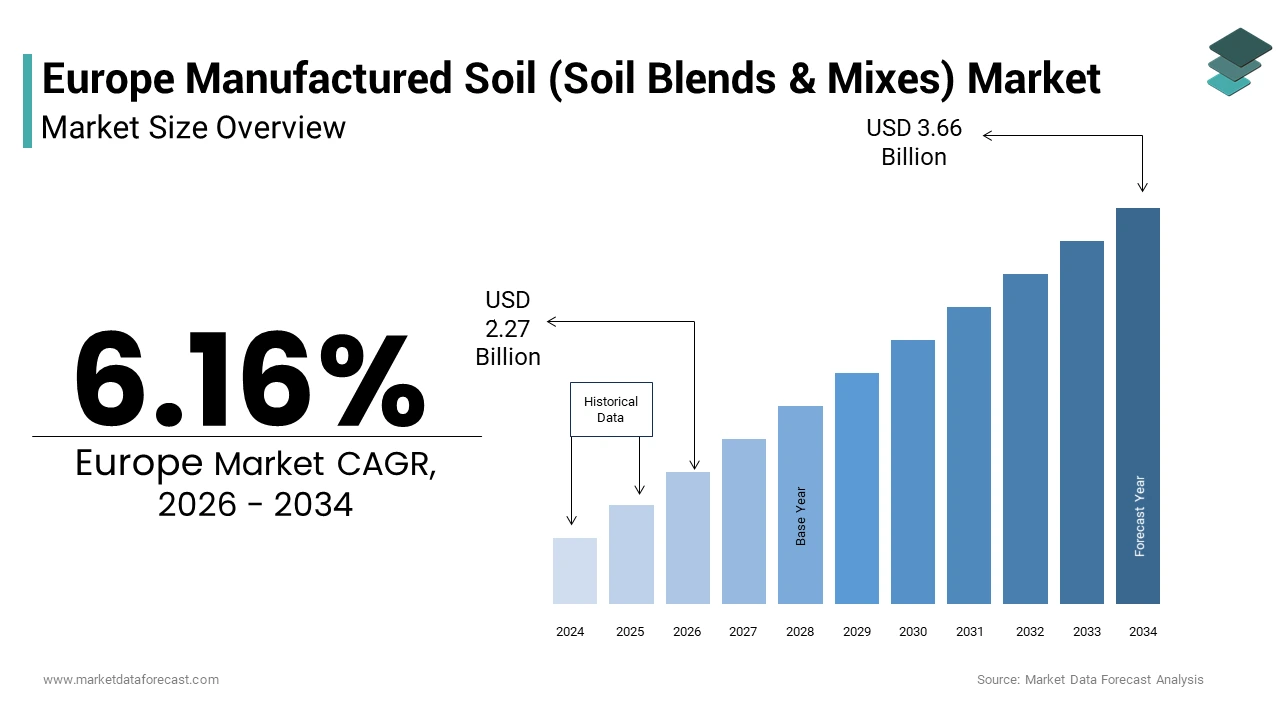
The Europe Manufactured Soil (Soil Blends & Mixes) Market was valued at USD 2.14 billion in 2025, is anticipated to reach USD 2.27 billion in 2026, and is projected to expand up to USD 3.66 billion by 2034, registering a compound annual growth rate (CAGR) of 6.16% during the forecast period from 2026 to 2034. Market growth is aggressively propelled by urban green infrastructure expansion, circular bioeconomy waste mandates, and stringent peat-reduction regulations.
Key Executive Metrics (At-a-Glance)
- 2025 Base Valuation: USD 2.14 Billion
- 2026 Current Valuation: USD 2.27 Billion
- 2034 Forecast Valuation: USD 3.66 Billion
- Compound Annual Growth Rate (CAGR): 6.16% (2026–2034)
- Dominant Application Segment: Cultivation (capturing a dominant share via commercial horticulture and greenhouse farming)
- Fastest-Growing Application Segment: Green Spaces (projected at a rapid CAGR driven by municipal biodiversity and urban greening plans)
- Dominant Type Segment: Soil Mix (maintaining the majority share through engineered custom growing media)
- Fastest-Growing Type Segment: Manure & Compost-based Blends (expanding rapidly due to EU biowaste valorisation initiatives)
- Dominant Country Market: Germany (accounting for a leading share anchored by advanced horticulture and circular infrastructure)
- Fastest-Growing Country Market: Netherlands & Sweden
Core Market Drivers
- Urbanization & Green Infrastructure: High demand for engineered growing media to support urban trees, green roofs, and climate adaptation strategies.
- Circular Economy Mandates: European policy frameworks like "A Soil Deal for Europe" driving the valorisation of municipal organic waste into certified soil inputs.
Primary Market Restraints & Challenges
- Regulatory Fragmentation: Absence of harmonized EU-wide standards for soil composition, complicating cross-border trade and compliance.
- Peat Extraction Phase-Outs: Transition away from traditional peat components requiring intensive R&D to maintain structural formulation stability.
Europe Manufactured Soil Market Segmentation Breakdown
| Segment Category | Largest (Dominant) Sub-Segment | Fastest-Growing Sub-Segment |
|---|---|---|
| By Application | Cultivation | Green Spaces |
| By Type | Soil Mix | Manure & Compost-based Blends |
| By Brand | Super Soil & Jiffy Mix | Peaceful Valley & Regional Formulations |
| By Country | Germany | Netherlands & Sweden |
Major Industry Players Profiled
Key corporations steering the European manufactured soil market include Klasmann-Deilmann, Eurofins Agro, Florentaise, The Scotts Miracle-Gro Company, Casella Organics Inc., Resource Management Inc. (RMI), Boxley Materials Company Inc., Jiffy International, Boughton Loam & Turf Management Limited, and London Rock Supplies Limited.
Europe Manufactured Soil (Soil Blends & Mixes) Market Size
Europe's manufactured soil (Soil Blends & Mixes) market size was valued at USD 2.14 billion in 2025 and is anticipated to reach a valuation of USD 2.27 billion in 2026 from USD 3.66 billion by 2034, growing at a CAGR of 6.16% from 2026 to 2034.
Current Introduction of the European-manufactured Soil (Soil Blends & Mixes) Market
Manufactured soil (or soil blends/mixes) is a custom-engineered growing medium created by blending inorganic materials (like sand, crushed rock, subsoil) with various organic components (compost, bark fines) and other additives to meet specific needs for plant growth, landscaping, or site restoration, essentially fast-tracking natural soil formation for consistent, high-quality results. Unlike native topsoil, which is often degraded or unavailable due to erosion and construction activity, engineered soil substrates are precisely formulated to support plant establishment,t nutrient retention, and water efficiency. These blends serve critical functions in green infrastructure projects, rooftop gardens, public parks, ks and controlled environment agriculture where natural soil is unsuitable or absent. Urban green space development across the European Union increasingly incorporates engineered or manufactured soil, a practice driven by concerns over contamination in existing city soils and the push for sustainable urban regeneration strategies. As per research, a continuing trend of significant agricultural land conversion to urban development in the EU underscores growing concerns over soil sealing, which in turn stimulates the development and demand for engineered alternatives that aim to restore essential ecological functionality without further depleting natural soil reserves. This shift reflects a broader policy-driven transition toward circular bioeconomy principles where waste streams such as food compost, green waste, and digestate are valorised into high-performance growing media, aligning with the European Green Deal’s soil health mission.
MARKET DRIVERS
Urbanization and Green Infrastructure Expansion Drive Substrate Demand
The rapid pace of urbanization across the region has intensified demand for manufactured soil because cities are integrating green infrastructure, which in turn drives the growth of tEuropeanope manufactured soil (soil blends & mixes) market. This integration helps to mitigate heat islands, improve stormwater management, and enhance public well-being. A significant majority of the European Union population lives in urban areas, a proportion that continues to increase over time. Recent revisions to the European Union's Urban Wastewater Treatment Directive emphasize improved management and control of urban runoff and stormwater overflows. In addition, the City of Copenhagen is making substantial investments in expanding its urban tree canopy as part of its climate adaptation and green infrastructure strategies. Similarly, the Milan Forestami project has made significant strides in large-scale urban forestation, expanding the city's green coverage considerably since its launch. National building codes now frequently specify soil performance criteria, such as minimum organic content, bulk density, and infiltration rates, creating standardized demand for certified blends. This regulatory and planning shift transforms manufactured soil from a gardening product into a foundational material of climate-resilient urban design.
Policy Mandates for Soil Health and Circular Organic Waste Utilization
European Union policy frameworks are causing the adoption of manufactured soil by linking it to soil health restoration and organic waste valorisation targets. This further propels the expansion of the Europe-manufactured soil (soil blends & mixes) market. The European Union's soil health initiative, A Soil Deal for Europe, is fostering extensive research and innovation to transition towards healthy soils by encouraging the development and use of innovative solutions and materials where native soil is damaged. Simultaneously, the revised Waste Framework Directive is driving a significant shift in European waste management by requiring all member states to implement universal separate collection of biowaste, encouraging its use as a valuable organic resource rather than a disposal problem. Across the EU, some leading nations have successfully established systems to recover the vast majority of their municipal organic waste, processing it into valuable soil and energy inputs. French legislation, notably the Anti-Waste for a Circular Economy Law, is accelerating national efforts to end the disposal of organic materials in landfills, promoting widespread sorting and local recovery infrastructure. Germany’s Federal Soil Protection Act further requires developers to use certified soil substitutes in all land rehabilitation projects involving industrial brownfields. These converging policies create a stable and growing supply of raw materials while simultaneously mandating end uses that elevate manufactured soil from optional to essential in both public and private land management.
MARKET RESTRAINTS
Inconsistent Regulatory Standards for Soil Composition Across Member States
The absence of harmonized EU-wide standards for manufactured soil composition creates market fragmentation and complicates cross-border trade, which is among the major restraints for the European manufactured soil (soil blends & mixes) market. In contrast to the rigorous RAL/NEN certifications in Germany and the Netherlands, many countries have no specific rules for organic levels, pH stability, or contaminant limits. According to sources, there is a notable inconsistency in the establishment of formal standards across European Union member states concerning the use of compost-based soil blends in public sector projects. This regulatory patchwork forces manufacturers to reformulate products for each national market, increasing production costs and delaying project timelines. For instance, a soil blend compliant with Swedish environmental guidelines may exceed permissible heavy metal limits in Italy due to differing interpretations of EU sludge directives. The European Committee for Standardization (CEN) has developed harmonized standards for manufactured growing media, but their implementation remains a voluntary choice, and market penetration has been limited. As a result, contractors in multi-country infrastructure projects often default to generic topsoil or avoid engineered blends altogether, undermining performance and sustainability objectives.
Limited Availability of High Quality Organic Feedstock in Southern and Eastern Europe
Manufactured soil production in Southern and Eastern Europe faces structural constraints due to insufficient collection infrastructure for high-quality organic waste streams, which ultimately impedes the expansion of the European manufactured soil (soil blends & mixes) market. Bulgaria, Romania, and Greece exhibit significantly lower rates of municipal bio-waste separate collection compared to the substantially higher collection rates observed in Germany and Austria. This gap results in reliance on lower-grade inputs such as unsorted green waste or imported compost, which compromise soil performance and microbial activity. Composting facilities in some regions, particularly those with lower recycling rates, often face challenges with ensuring proper organic material maturation and effective contaminant screening, indicating a need for improved infrastructure and processes. Furthermore, seasonal drought conditions in Spain and Portugal reduce green waste availability during summer months, disrupt in year-round production. In contrast, Northern European producers benefit from a stable feedstock supply from food processing and municipal programs, enabling consistent formulation. These regions risk deeper reliance on costly imported soil and destructive peat extraction, widening the gap in quality and sustainability, if EU Cohesion funds for bio-waste don't materialize.
MARKET OPPORTUNITIES
Integration of Biochar and Carbon Sequestration Incentives Opens Premium Segments
The incorporation of biochar into manufactured soil blends offers a potential opportunity aligned with the region’s carbon farming and soil carbon sequestration goals, which is anticipated to boost the growth of the European manufactured soil (soil blends & mixes) market. Biochar, produced from pyrolyzed agricultural or forestry residues, enhances water retention, nutrient availability, and long-term carbon storage in soil. There is a notable rise in the integration of certified biochar into regional soil enhancement products. Also, the establishment of standardized frameworks for carbon removal has enabled manufacturers to monetize soil sequestration through credit markets. Governmental financial support initiatives are lowering the cost barriers for incorporating biochar into municipal landscaping and infrastructure. Public sector pilot programs are increasingly linking the use of carbon-negative soil additives to supplemental funding for urban green spaces. A shift toward formal verification systems is facilitating the growth of biochar as both an agricultural input and a revenue-generating environmental tool. These mechanisms incentivize premium product development and position manufactured soil not just as a growing medium but as a carbon removal technology contributing directly to national climate targets.
Growth of Controlled Environment Agriculture Fuels Demand for Precision Substrates
The rapid expansion of vertical farms, greenhouse complexes, and hydroponic systems across the region is creating specialized demand for precision-engineered soil blends, and thereby further promotes the expansion of the Europe-manufactured soil (soil blends & mixes) market. These blends support high-density crop production with minimal inputs. According to sources, the number of commercial controlled environment agriculture facilities operating within the European Union has seen significant growth in recent years, reflecting an expanding sector and increasing interest in technological farming solutions. These operations require sterile, consistent, and nutritionally balanced substrates, often combining peat alternative, s, coir, vermiculite, and slow-release fertilizers. The Dutch greenhouse horticulture sector is actively working to minimize its environmental impact, which includes efforts to optimize resource usage and explore more sustainable alternatives to traditional growing media. Manufacturers are responding with modular formulations tailored to specific crops, such as leafy greens, onions, tomatoes,s or herbs, optimizing root aeration and nutrient release profiles. Retailers have also partnered with urban farms to source produce grown in certified sustainable substrates, amplifying consumer awareness. This convergence of food security, urbanization, and sustainability transforms manufactured soil into a critical input for next-generation agriculture.
MARKET CHALLENGES
Peat Extraction Restrictions Threaten Traditional Formulation Stability
The accelerating phase out of peat, a historically dominant component in European soil blends, poses a significant reformulation challenge for manufacturers, and this degrades the growth of the European-manufactured soil (soil blends & mixes) market. Peat provides excellent water retention, aeration, and microbial stability, but its extraction degrades carbon-rich wetlands. Across the European Union, a substantial majority of historical peatlands have been damaged or lost, primarily due to drainage for agriculture, forestry, and peat extraction. These degraded lands are a significant and disproportionate source of regional greenhouse gas emissions. In response to this environmental concern, many EU nations and the UK are increasingly committed to phasing out the use of peat in horticulture. This shift is driven by voluntary agreements, national strategies, and developing legislation, with various target dates set by individual countries for ending or significantly restricting peat sales to both amateur and professional gardeners. Coir, wood fiber, and compost serve as alternative materials, but their non-uniform nature often means they require blending adjustments, which in turn affects performance compared to peat. As per a study, peat-free blends reduced seedling survival rates in sensitive ornamental species. Manufacturers must therefore invest in R and D to stabilize new formulations while maintaining cost parity, a process that increases production complexity and delays product availability, particularly for niche applications like alpine or acid-loving plants.
Contamination Risks from Recycled Organic Feedstocks Undermine Product Safety
Use of municipal and agricultural waste streams in manufactured soil introduces persistent contamination risks, despite circular economy ambitions, that threaten plant and human health, and negatively impact the expansion of theEuropeane manufactured soil (soil blends & mixes) market. Organic inputs such as food waste, green clipping, and digestate may contain microplastics, heavy metals, and persistent organic pollutants if collection and processing controls are inadequate. According to a study, a portion of compost samples from municipal facilities exceeded EU threshold limits for cadmium or lead, rendering them unsuitable for horticultural use. In urban settings, legacy soil contamination from industrial sites further complicates blending when recycled materials are used on brownfields. The European Food Safety Authority has raised concerns about the uptake of microplastics by edible crops grown in contaminated substrates, though long-term health impacts remain under study. Manufacturers who neglect to implement mandatory pre-processing testing and traceability systems leave themselves vulnerable to both reputational damage and legal action. This uncertainty deters large-scale adoption in food production and public landscaping, where safety liabilities are highest.
REPORT COVERAGE
| REPORT METRIC | DETAILS |
| Market Size Available | 2024 to 2033 |
| Base Year | 2024 |
| Forecast Period | 2025 to 2033 |
| CAGR | 6.16% |
| Segments Covered | By Brand, Application, Type, And By Country |
| Various Analyses Covered | Global, Regional & Country Level Analysis; Segment-Level Analysis, DROC, PESTLE Analysis, Porter’s Five Forces Analysis, Competitive Landscape, Analyst Overview of Investment Opportunities |
| Regions Covered | UK, France, Spain, Germany, Italy, Russia, Sweden, Denmark, Switzerland, Netherlands, Turkey, Czech Republic, & Rest of Europe |
| Market Leaders Profiled | The Scotts Miracle-GRO Company, Casella Organics Inc., Resource Management Inc. (RMI), Boxley Materials Company Inc., TiO’Harere Associates LLP, B.D. White Top Soil Company Inc., Peaceful Valley Farm & Garden Supply, Boughton Loam & Turf Management Limited, Jiffy International, London Rock Supplies Limited. |
SEGMENT ANALYSIS
By Application Insights
The cultivation segment was the largest in the Europe-manufactured soil (soil blends & mixes) market by accounting for a 46.6% share in 2024. The supremacy of the cultivation segment is driven by the intensification of horticulture, greenhouse farming, and home gardening across the continent. Eurostat data shows that the European Union dedicates a significant amount of agricultural land to horticultural production, with recent data indicating that a substantial area is utilised across member states. Within Europe, certain countries in the Mediterranean region and the Netherlands are consistently recognized as having the most prominent and expansive areas dedicated to protected cultivation, such as greenhouses. Urban agriculture has further amplified demand. Additionally, policy support for food security has encouraged domestic production. Retail chains have expanded their bagged soil offerings with tailored blends for vegetables, herbs,s and fruits. This convergence of commercial and consumer horticulture sustains cultivation as the primary outlet for manufactured soil across diverse scales.
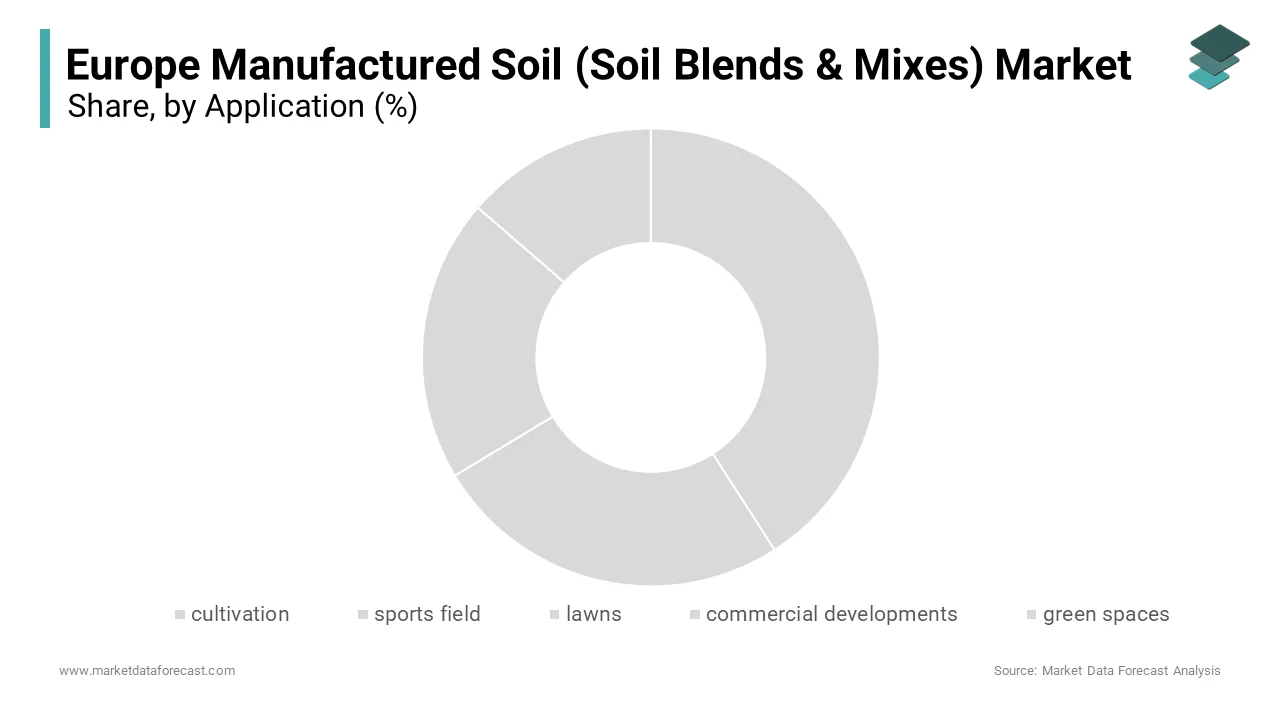
The green spaces segment is on the rise and is expected to be the fastest-growing segment in the market by witnessing a CAGR of 9.4% from 2025 to 2033 due to binding urban greening mandates under the EU Biodiversity Strategy, which requires all cities with thousands of inhabitants to develop urban greening plans. Major urban centers across Europe are actively working toward expanding natural vegetation and green spaces. Municipalities are increasingly utilizing specialized soil mixtures to support the growth of plants in parks and along transportation routes. City planners are prioritizing the creation of ecological pathways to foster greater biological variety within densely populated areas. National funding mechanisms such as Sweden’s Green Infrastructure Subsidy and Italy’s PNRR urban regeneration funds further drive public investment. The policy-driven projects transform green spaces from aesthetic amenities into regulated ecological infrastructure with standardized soil performance criteria.
By Type Insights
The soil mix segment maintained the majority share of 52.7% of the Europe-manufactured soil (soil blends & mixes) market in 2024. These engineered formulations, typically combining peat alternatives, coir compost, and mineral aggregates, are tailored for specific horticultural or landscaping needs, offering consistent texture, nutrient content, and drainage. Professional growers in the Netherlands and Belgium are increasingly adopting certified and quality-assured growing media, reflecting a strong emphasis on reliability and consistency in production outputs. Retail demand is equally strong. Home gardeners across key European markets show a growing inclination towards purchasing specific, often branded, soil mixes, moving away from generic, unspecialized topsoil options. Regulatory alignment also supports this segment. The European Union is actively developing and implementing new regulations designed to standardize labeling requirements, enhance transparency of product composition, and incorporate sustainability metrics for products, including growing media. Additionally, manufacturers have reformulated products to meet peat reduction targets, enhancing market acceptance among environmentally conscious users.
The manure and compost-based blends segment is expected to exhibit a noteworthy CAGR of 8.9% over the forecast period, owing to the EU’s Circular Economy Action Plan, which mandates the separate collection of biowasteby 2024 and promotes its reuse in soil regeneration. A substantial amount of specific organic material is generated annually across a group of countries. More than half of this generated material is now being managed through conversion processes that produce soil-enhancing products. In certain specific regions, a high rate of the resulting compost material is applied per person, both in agricultural areas and in urban landscapes. New regulations in one country have led to the establishment of numerous new processing sites within a short period, with the output from these new sites being converted into certified products used to improve soil quality. The European Commission’s Carbon Farming Initiative further incentivizes compost use by recognizing its role in soil organic carbon sequestration. This regulatory and environmental alignment positions manure and compost not as waste byproducts but as strategic inputs in Europe’s regenerative soil economy.
COUNTRY ANALYSIS
Germany Manufactured Soil (Soil Blends & Mixes) Analysis
Germany led thEuropeanpe manufactured soil market by accounting for a 21.1% share in 2024. The leading position of the German market is driven by its advanced horticulture sector, stringent environmental regulations, and strong circular economy infrastructure. The majority of municipal organic waste is collected separately and processed into compost or digestate. This process creates a stable source of materials for soil manufacturing. Regulations mandate the use of certified soil substitutes in land restoration efforts, particularly on former industrial sites. A shift in regional funding prioritizes urban greening projects. These projects require specialized substrates for applications like tree planting and green roofs. Leading producers like Klasmann Deilmann and Eurofins Agro operate large-scale blending facilities near major cities, ensuring rapid distribution. Additionally, German consumers exhibit high environmental awareness. This combination of policy, industry,,ry and public engagement solidifies Germany’s leadership in sustainable soil innovation.
Netherlands Manufactured Soil (Soil Blends & Mixes) Analysis
The Netherlands was the next prominent country in theEuropeane manufactured soil (soil blends & mixes) market by holding a 17.6% share in 2024. The expansion of the Netherlands market is credited to its world-leading greenhouse horticulture and precision agriculture. Local greenhouse agriculture consistently relies on engineered soil or soilless substrates for year-round crop production. There is a clear trend toward sustainable practices, with new regulations encouraging the incorporation of recycled organic materials into growing media blends. This policy shift has accelerated investment in and the adoption of alternative materials like coir, wood fiber, and compost-based blends. The region currently serves as a central supply hub, distributing a substantial amount of engineered soil products to neighboring areas. Major companies have developed crop-specific formulations for tomatoes, peppers,s and ornamentals, achieving water use efficiencies higher than conventional soil. Additionally, Dutch cities like Rotterdam and Utrecht integrate manufactured soil into climate-adaptive urban design, including water-absorbing parks and green facades. This fusion of agritech and urban planning makes the Netherlands a high-value and high-volume market.
France Manufactured Soil (Soil Blends & Mixes) Analysis
France continues to maintain a noteworthy position in the European manufactured soil market, which is propelled by ambitious urban greening targets and national food sovereignty policies. New building requirements mandate the inclusion of natural coverings on government structures, which is increasing the need for specialized construction materials. Waste management laws are encouraging the establishment of numerous composting facilities, creating a supply of organic materials for custom soil blends. Urban projects are undertaking large-scale tree planting, requiring the creation of specific soil mixes designed for difficult environmental conditions. Additionally, France’s National Food Strategy promotes urban agriculture with numerous municipal farms established since 2020, all using certified growing media. Retailers like Truffaut and Jardiland have expandedprivate-labell organic soil lines with full traceability. This policy-driven ecosystem ensures consistent and expanding demand across public, private, te, and consumer channels.
United Kingdom Manufactured Soil (Soil Blends & Mixes) Analysis
The United Kingdom is moving ahead steadfastly in tEuropean-manufacturedred soil (soil blends & mixes) market, owing to its peat ban legislation, strong gardening culture, re and post Brexit focus on domestic food production. A regulatory change is approaching that will soon restrict the availability of peat-based compost for purchase by the public, necessitating a broader acceptance of different growing media. The high level of participation in gardening across many households indicates a substantial market with a large number of individuals who will need to adapt their purchasing habits regarding compost materials. There is significant financial support being directed toward projects focused on restoring natural habitats in urban areas, creating a demand for specialized, non-peat-based soil mixtures for these restoration efforts. The combination of an active gardening population and regulatory changes suggests a growing market and a shift in demand towards alternative materials such as coir, bark, and composted green waste. Companies have scaled production peat-freeree blends meeting both consumer and professional standards. Additionally, the Environment Agency now requires manufactured soil for all floodplain restoration and riverbank stabilization projects. This regulatory and cultural alignment positions the UK as a leader in sustainable soil transition.
Sweden Manufactured Soil (Soil Blends & Mixes) Analysis
Sweden is anticipated to expand in the European manufactured soil (soil blends & mixes) market from 2025 to 2033 due to its leadership in climate-resilient urban planning and circular bioeconomy policies. The country’s National Strategy for Urban Green Infrastructure mandates that all new residential developments include green spaces with engineered soil to manage stormwater and reduce heat stress. Furthermore, Sweden’s stringent chemical safety regulations prohibit the use of non-certified growing media in public projects, ensuring high-quality standards. Research institutions like the Swedish University of Agricultural Sciences collaborate with manufacturers to develop cold climate optimized blends that support plant establishment during short growing seasons. This integration of science policy and sustainability makes Sweden a highly influential market for next-generation soil solutions.
COMPETITIVE LANDSCAPE
The European-manufactured soil market features a competitive landscape combining large multinational substrate producers, regional specialists,s and emerging circular economy startups. Established players leverage decades of agronomic expertise,se automated production facilities, and strong relationships with professional growers and public authorities to maintain leadership, particularly in Western Europe. At the same time, smaller innovators are gaining ground by offering hyperlocal blends using municipal compost or industrial byproducts tailored to specific urban or ecological restoration needs. Regulatory pressure—especially around peat phase out and bio waste valorization—is reshaping competition by raising entry barriers related to feedstock traceability, product certification, and environmental compliance. National differences in green infrastructure funding, ing soil standards, and waste management infrastructure further fragment the market, creating both challenges and opportunities. As cities and farms increasingly rely on engineered soils for climate adaptation and food security, competition is shifting from price to performance, sustainability, and policy alignment across the continent.
KEY MARKET PLAYERS
These are the market players that are dominating the European-manufactured soil market.
- The Scotts Miracle-GRO Company
- Casella Organics Inc.
- Eurofins Agro
- Florentaise
- Klasmann-Deilmann
- Resource Management Inc. (RMI)
- Boxley Materials Company Inc.
- TiO’Harere Associates LLP
- B.D. White Top Soil CompanyInc.c
- Peaceful Valley Farm & Garden Supply
- Boughton Loam & Turf Management Limited
- Jiffy International
- London Rock Supplies Limited
Top Players In The Market
- Klasmann-Deilmann is a leading European manufacturer of soil blends and growing media with a strong global footprint across North AAmerica Asia, and Australia. Headquartered in Germany, the company specializes in peat-reduced and peat-free substrates tailored for professional horticulture greenhouse cultivation and urban greening. In recent years, Klasmann-Deilmann has accelerated its sustainability agenda by investing in large-scale coir and wood fiber processing facilities across the Netherlands and Poland. Its initiatives reinforce its role as an innovation driver in engineered soil solutions while aligning with EU environmental mandates and global circular economy principles.
- Eurofins Agro, a subsidiary of the Eurofins Scientific Group,p plays a critical role in thEuropeanpe manufactured soil market through its dual expertise in soil analytics and custom blend formulation. Based in the Netherlands, the company provides certified growing media for high-tech horticulture and urban agriculture across Western Europe. It also introduced a digital platform that links soil composition data to crop performance metrics, enabling precision recommendations for growers. This integration of science and technology strengthens its position as a trusted partner in sustainable substrate development.
- Florentaise is a major French manufacturer of engineered soils specializing in green infrastructu, re, public landscaping, and ecological restoration projects. The company supplies custom soil blends for urban parks, green roofs, and biodiversity corridors across France, Belgium, and Switzerland. It also achieved certification under France’s NF Environnement label for its entire product rang,e, ensuring compliance with national circular economy standards. These actions demonstrate Florentaise’s commitment to combining environmental performance with large-scale public sector delivery in Europe’s evolving green infrastructure landscape.
Top Strategies Used By The Key Market Participants
Key players in theEuropeane manufactured soil market prioritize the development of peat-free and bio-based formulations to comply with tightening environmental regulations and consumer demand for sustainable products. They invest in advanced blending technologies to ensure consistent performance in specialized applications such as urban greening, greenhouse horticulture, and ecological restoration. Companies actively integrate circular economy principles by sourcing compost, coi,r, and wood fiber from certified municipal and agricultural waste streams. Strategic partnerships with municipalities, research institutions, and landscape architects enhance product validation and public sector adoption. Additionally, firms are obtaining national and EU-level eco certifications to differentiate their offerings and meet procurement requirements for green infrastructure projects across diverse European markets.
MARKET SEGMENTATION
This research report on tEuropean-manufacturedred soil (Soil Blends & Mixes) market is segmented and sub-segmented into the following categories.
By Brand
- peaceful valley farsupplyle
- super soil
- Ferry Morse Jiffy Mix
By Application
- cultivation
- sports field
- lawns
- commercial developments
- green spaces
By Type
- soil mix
- garden soil
- manure & compost
By Country
- UK
- France
- Spain
- Germany
- Italy
- Russia
- Sweden
- Denmark
- Switzerland
- Netherlands
- Turkey
- Czech Republic
- Rest of Europe