- Product Description Description
- Table of Contents TOC
- List of Table & Figure LOT
- Get Free Sample PDF Sample PDF
Market Size, 2025
$5.69 BnMarket Estimate, 2026
$6.23 BnMarket Forecast, 2034
$12.80 BnCAGR, 2026–2034
9.42%Europe Manufacturing Execution Systems Market Report Summary
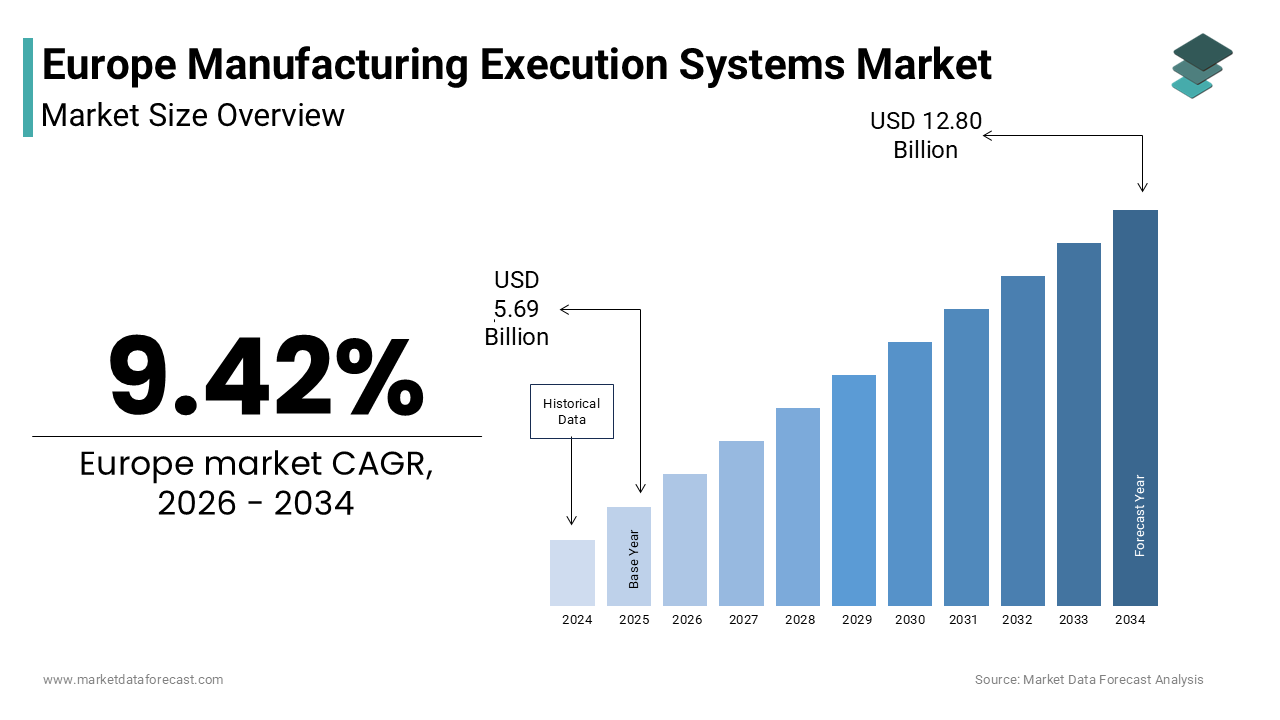
The Europe manufacturing execution systems market was valued at USD 5.69 billion in 2025, is anticipated to reach USD 6.23 billion in 2026, and is projected to reach USD 12.80 billion by 2034, growing at a CAGR of 9.42% during the forecast period from 2026 to 2034. The growth of the Europe manufacturing execution systems market is driven by stringent regulatory requirements for traceability and quality compliance, rising adoption of Industry 4.0 and smart manufacturing practices, and increasing need for real-time production visibility. The expansion of digital factories, industrial IoT integration, and private 5G networks is further strengthening market growth. Moreover, growing emphasis on sustainability reporting, resource efficiency, and carbon footprint tracking is accelerating the adoption of advanced MES platforms across European manufacturing sectors.
Key Market Trends
- Increasing deployment of MES for regulatory compliance in pharmaceuticals, automotive, and medical devices.
- Growing integration of MES with industrial IoT, advanced analytics, and real-time machine monitoring systems.
- Rising adoption of cloud-based and sovereign cloud MES solutions to meet data residency requirements.
- Strong focus on energy monitoring, material traceability, and sustainability reporting modules within MES platforms.
- Expanding use of MES for digital work instructions and workforce optimization in response to labor shortages.
Segmental Insights
- Based on deployment mode, the on-premise segment dominated the market, supported by strict data sovereignty regulations, cybersecurity mandates, and legacy infrastructure constraints across regulated industries.
- Based on end-user industry, the automotive segment held the largest share in 2024, driven by stringent traceability requirements, complex multi-tier supply chains, and rising electric vehicle production.
- The small and medium enterprises (SMEs) segment is expected to grow at the fastest pace, supported by government digitization incentives, modular MES solutions, and affordable cloud deployment models.
Regional Insights
The Europe manufacturing execution systems market is witnessing strong adoption across major economies, supported by industrial digitization policies, regulatory enforcement, and advanced manufacturing ecosystems.
- Germany led the market by holding 27.3% of the share in 2024, driven by strong Industry 4.0 adoption, high MES penetration among large manufacturers, and government-supported digitalization initiatives.
- France accounted for 18.3% of the market share in 2024, supported by aerospace and defense digitization, regulatory mandates, and national funding under the France 2030 program.
- The United Kingdom continues to show strong growth, fueled by pharmaceutical compliance requirements, advanced engineering sectors, and government-backed Made Smarter digitization programs.
- Italy is emerging as a high-growth market due to strong SME manufacturing base, Industry 4.0 tax incentives, and increasing digitalization across food, machinery, and specialty manufacturing.
- The Netherlands is witnessing steady adoption supported by high-tech manufacturing hubs, strong MES penetration in chemicals and semiconductors, and logistics-driven industrial digitalization.
Competitive Landscape
The Europe manufacturing execution systems market is characterized by the presence of global industrial software leaders, strong regulatory-driven adoption, and increasing innovation in cloud-native and AI-enabled MES platforms. Vendors are focusing on sovereign cloud deployment, cybersecurity compliance, sustainability analytics, and deep integration with ERP and automation systems to strengthen their positioning. Strategic collaborations with telecom providers, system integrators, and government-backed digitalization programs are shaping competitive differentiation. Prominent players in the Europe manufacturing execution systems market include Siemens AG, SAP SE, Rockwell Automation, Schneider Electric, Dassault Systèmes, ABB Ltd., Honeywell International Inc., Emerson Electric Co., Oracle Corporation, and AVEVA Group plc.
Europe Manufacturing Execution Systems Market Size
The europe manufacturing execution systems market size was valued at USD 5.69 billion in 2025 and is anticipated to reach USD 6.23 billion in 2026 from USD 12.80 billion by 2034, growing at a CAGR of 9.42% during the forecast period from 2026 to 2034.
A Manufacturing Execution System (MES) is an integrated software platform that bridges enterprise resource planning (ERP) systems and shop floor operations by providing real time monitoring control and documentation of production workflows. Unlike generic production tracking tools MES in Europe must comply with stringent data governance standards under the General Data Protection Regulation and sector specific requirements, such as Annex 11 of the EU Good Manufacturing Practice for pharmaceuticals. According to Eurostat, over 218 million metric tons of manufactured goods were produced in the European Union in 2023 across automotive chemicals and machinery sectors where traceability batch genealogy and process adherence are non-negotiable. Furthermore, the European Environment Agency reported that many large industrial facilities now track energy and material consumption at the machine level, a capability enabled primarily by MES integration.
MARKET DRIVERS
EU Regulatory Mandates for Traceability and Quality Compliance Accelerate MES Adoption
The stringent European regulations governing product safety data integrity and environmental reporting have made Manufacturing Execution Systems indispensable, across regulated industries. The EU regulated mandates for traceability and quality compliance is majorly propelling the growth of Europe manufacturing execution systems market. In 2023, the agency conducted over 1800 inspections and issued 217 non-compliance notices primarily for inadequate production documentation systems. Similarly, the EU’s Medical Device Regulation 2017/745 mandates Unique Device Identification (UDI) traceability from raw material to end user compelling medical device makers to deploy MES with full genealogy capabilities. Germany’s Federal Institute for Drugs and Medical Devices reported that 92% of Class III device manufacturers upgraded their MES in 2023 to meet UDI serialization deadlines. In food processing, the EU General Food Law Regulation requires full lot traceability within four hours a standard that prompted Nestle and Danone to integrate MES with supplier and logistics data, across 140 European plants. These legally binding frameworks transform MES from a productivity tool into a compliance necessity shielding companies from recalls market access denials and reputational damage.
Labor Shortages and Skills Gaps Drive Demand for Digital Workforce Orchestration via MES
The persistent workforce in manufacturing sectors are compelling firms to deploy Manufacturing Execution Systems, as digital work coaches that standardize and guide human machine interactions is also elevating the growth of Europe manufacturing execution systems market. According to the European Commission’s 2023 Industrial Skills Gap Report, over 43% of manufacturers cited difficulty in finding qualified production technicians, a challenge most acute in Germany, Italy, and Poland. In response companies are using MES to deliver dynamic work instructions visual checklists and real time quality alerts directly to operator terminals or augmented reality glasses. BMW’s Dingolfing plant reported a 28% reduction in assembly errors after integrating step by step MES guided workflows for electric vehicle battery module installations. The European Social Fund allocated 1.8 billion euros in 2023 to upskill industrial workers with digital manufacturing competencies including MES interface literacy.
MARKET RESTRAINTS
Legacy Infrastructure and Heterogeneous Equipment Ecosystems Impede Seamless MES Integration
The prevalence of aging machinery and non-standardized automation protocols is significantly hampering the growth of Europe manufacturing execution systems market. According to the European Association of Manufacturing Industries, over 60% of production equipment in EU factories was installed before 2010 and lacks native connectivity to modern industrial networks. In Germany, the VDMA reported that only 38% of machine tools in small and medium enterprises support OPC UA, where the interoperability standard essential for real time MES data exchange. This fragmentation forces manufacturers to deploy costly edge gateways protocol converters and custom middleware to bridge legacy PLCs and CNC systems. Moreover, in multi-site operations, such as those of Saint Gobain or ArcelorMittal each plant often runs different machine brands requiring bespoke integration logic. These complexities delay time to value increase total cost of ownership and deter smaller players despite clear operational benefits.
Data Localization and Cybersecurity Requirements Increase Implementation Complexity
The strict data sovereignty and industrial cybersecurity mandates significantly complicate MES architecture design and cloud adoption strategies, which is additionally to limit the growth of Europe manufacturing execution systems market. According to the European Union Agency for Cybersecurity (ENISA), all industrial control systems handling critical infrastructure data must comply with the NIS2 Directive. This rules out global public cloud deployments for many automotive and defense manufacturers even when the vendor offers EU regions. In 2023, France’s ANSSI mandated that all defense subcontractors store production data within national borders, a rule affecting over 1200 suppliers using MES. Similarly, Germany’s Federal Office for Information Security requires MES providers to undergo rigorous certification under the IT Grundschutz framework before handling automotive production data. These requirements force vendors to maintain parallel infrastructure for on premise private cloud and sovereign cloud offerings increasing development costs and fragmenting feature rollouts. A survey by Bitkom found that 67% of German manufacturers delayed MES upgrades in 2023 due to unresolved data residency questions. This regulatory diligence while essential for security creates implementation delays and vendor selection constraints unique to the European landscape.
MARKET OPPORTUNITIES
Expansion of Industrial IoT and 5G Private Networks Enables Real Time MES Capabilities
The rollout of dedicated 5G networks and Industrial Internet of Things (IIoT) infrastructure is unlocking advanced real time functionalities, which is ascribed to boost the growth of Europe manufacturing execution systems market. According to the European 5G Observatory, over 320 private 5G networks were deployed in EU manufacturing sites by the end of 2023 with major installations at BASF’s Ludwigshafen chemical complex and Volvo’s Ghent vehicle plant. These networks provide sub 10 millisecond latency and massive device connectivity enabling MES to ingest data from thousands of sensors per production line. In Sweden, SKF uses 5G connected vibration and temperature sensors feeding real time tool wear data into its MES which auto adjusts machining parameters to prevent defects. Similarly, the European Institute of Innovation and Technology funded the FACTLOG project in 2023 which demonstrated closed loop MES control of robotic welding cells using live thermal imaging feedback. The European Commission’s Cloud Manufacturing initiative further promotes interoperable MES IIoT platforms through the Gaia-X framework.
Growth of Sustainable Manufacturing Initiatives Fuels Demand for Resource Tracking Modules in MES
The regulatory and corporate push toward circular and low carbon manufacturing is driving integration of sustainability modules. This factor is also to create certain opportunities for the growth of Europe manufacturing execution systems market. According to the European Environment Agency, over 8200 industrial facilities now report annual resource consumption under the EU’s Extended Producer Responsibility schemes, where a requirement that demands granular energy water and material tracking at the production order level. In 2023, the EU’s Corporate Sustainability Reporting Directive mandated large manufacturers to disclose product specific carbon footprints making MES based material and energy attribution essential. Schneider Electric’s Le Vaudreuil plant in France uses its MES to calculate real time CO2e per batch by linking electricity gas and compressed air usage to individual production runs. Similarly, Germany’s BMW Group integrated scrap rate and regrind tracking into its MES across 31 European plants to comply with the EU Battery Regulation’s recycled content targets. This regulatory and investor driven transparency imperative is transforming MES into a cornerstone of industrial environmental accountability.
MARKET CHALLENGES
Shortage of Skilled MES Implementation and Integration Talent Constrains Deployment Velocity
Manufacturers are facing shortages of professionals capable of configuring integrating and customizing Manufacturing Execution Systems to complex production environments. The shortage of these professionals is likely to pose as a challenge for the growth of Europe manufacturing execution systems market. According to the European Federation of National Engineering Associations, over 210000 industrial software roles remained unfilled in the EU in 2023 with MES specialists among the most scarce due to required hybrid expertise in production processes IT architecture and regulatory compliance. In Italy, Confindustria reported that 68% of medium sized manufacturers delayed MES projects in 2023, due to inability to secure qualified system integrators. The problem is exacerbated by vendor lock in SAP ME Roland Berger or Rockwell Automation, each require distinct certification paths limiting labor mobility. While universities like KTH Stockholm and TU Delft have introduced MES courses graduate output remains insufficient to meet demand. This human capital deficit not only inflates consulting costs but also increases project failure risk when generic IT staff attempt complex production integrations without domain knowledge.
Fragmented National Industrial Digitization Policies Create Inconsistent Incentive Landscapes
The absence of a harmonized EU wide strategy for MES adoption results in uneven support mechanisms that distort investment decisions and fragment vendor is additionally to hamper the growth of Europe manufacturing execution systems market. According to the European Digital SME Alliance, national digitization grants for MES range from 30000 euros in Greece to 500000 euros in Germany with varying eligibility criteria documentation burdens and audit requirements. In France, the France 2030 plan offers full MES subsidies for aerospace and battery manufacturers but excludes food processors. Meanwhile, Sweden’s Vinnova provides innovation vouchers only for MES projects involving AI or digital twin integration excluding basic deployment. This patchwork forces vendors to maintain separate sales compliance and support teams for each major countries, increasing operational costs. A 2023 survey by the European Automation Association found that 59% of MES providers considered scaling across Southern Europe unprofitable due to low grant uptake and complex local validation rules.
REPORT COVERAGE
| REPORT METRIC | DETAILS |
| Market Size Available | 2025 to 2034 |
| Base Year | 2025 |
| Forecast Period | 2026 to 2034 |
| CAGR | 9.42% |
| Segments Covered | By Deployment Mode, Offering, End-User Industry, Enterprise Size, Process Type and Country |
| Various Analyses Covered | Regional & Country Level Analysis, Segment-Level Analysis, DROC, PESTLE Analysis, Porter’s Five Forces Analysis, Competitive Landscape, Analyst Overview on Investment Opportunities |
| Countries Covered | UK, France, Spain, Germany, Italy, Russia, Sweden, Denmark, Switzerland, the Netherlands, Turkey, the Czech Republic, and the Rest of Europe. |
| Market Leaders Profiled | Siemens AG, SAP SE, Rockwell Automation, Schneider Electric, Dassault Systèmes, ABB Ltd., Honeywell International Inc., Emerson Electric Co., Oracle Corporation, and AVEVA Group plc. |
SEGMENTAL ANALYSIS
By Deployment Insights
The on-premise deployment segment held a dominant share of the Europe manufacturing execution systems market in 2024 owing to the stringent data sovereignty requirements, across regulated industries such as pharmaceuticals defense and automotive where production data must remain within national borders. The European Union Agency for Cybersecurity mandates under the NIS2 Directive that critical infrastructure operators store industrial control data on physically controlled servers with a condition met only by on-premise MES architectures. In Germany, the Federal Office for Information Security requires all Tier 1 automotive suppliers to maintain on-site data repositories for production logs as confirmed in its 2023 Industrial Security Guidelines. Legacy integration also plays a role, where 68% of European factories operate machinery installed before 2012 that lacks secure cloud connectivity, as per a survey. These regulatory and technical realities make on-premise the default choice for important production environments despite higher upfront costs.
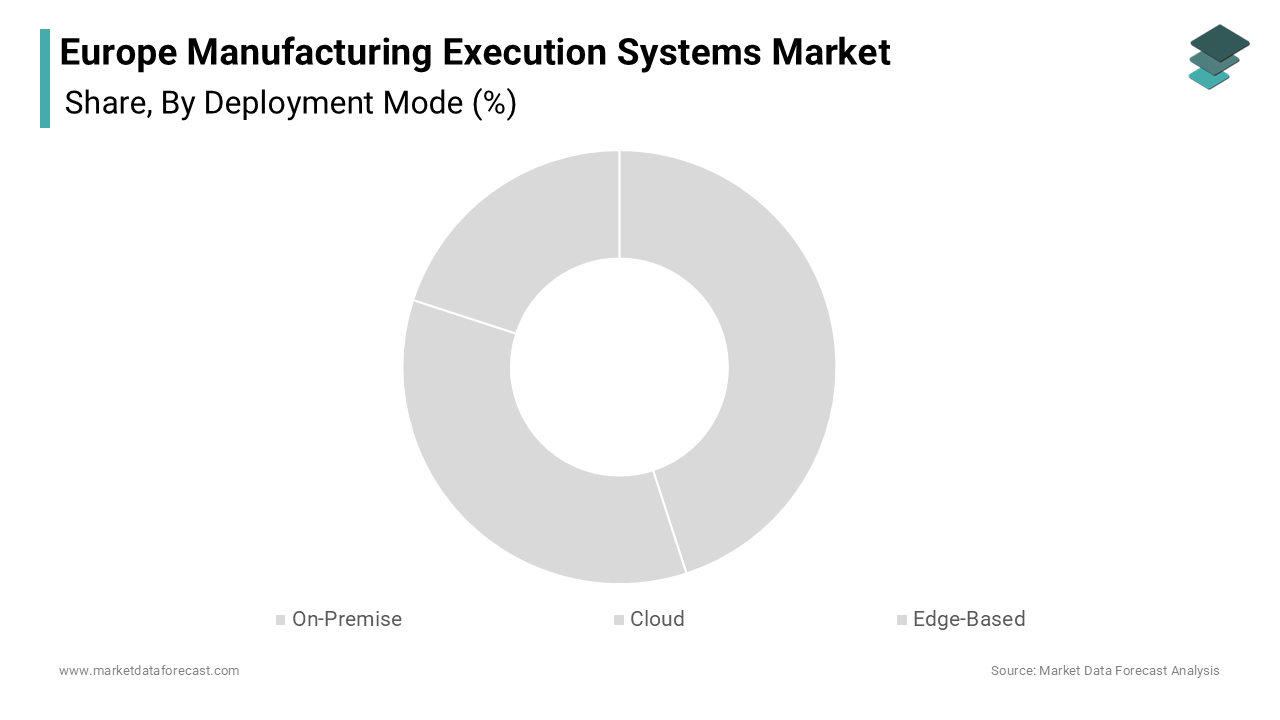
The cloud-based MES segment is lucratively growing with an anticipated CAGR of 14.8% from 2025 to 2033 with the rise of sovereign cloud infrastructure compliant with EU data regulations. In 2023, Microsoft launched its Azure Cloud for Germany West Central with full GAIA-X certification enabling manufacturers to store production data within national borders while leveraging scalable cloud analytics. Similarly, SAP’s EU-hosted cloud MES on its Rise platform saw 42% year-on-year adoption growth among food and beverage producers in 2023, as per the study. Small and medium enterprises are primary adopters due to lower capital expenditure, Italy’s Ministry of Economic Development documented that 5800 SMEs migrated to cloud MES in 2023, under its Industry 4.0 tax credit scheme. The European Commission’s Digital Europe Programme allocated 620 million euros in 2023 specifically for cloud-native production software in non-strategic sectors such as furniture and textiles. These developments indicate a strategic shift toward agile scalable and compliant cloud models where data residency is assured.
By End-User Industry Insights
The automotive industry segment was accounted in holding 32.1% of Europe manufacturing execution systems market share in 2024 with the sector’s extreme demands for traceability quality control and production flexibility across complex multi-tier supply chains. Every vehicle produced in the EU must comply with UNECE Regulation 155 on cyber security and software updates which requires immutable production logs for every electronic control unit, an unattainable standard without integrated MES. In 2023, Volkswagen reported that its Zwickau EV plant processed over 2.1 million production events daily through its MES to track battery module genealogy and torque validation. Similarly, Stellantis implemented a unified MES across 14 European assembly plants to standardize electric vehicle platform production reducing changeover time by 37%. The European Battery Regulation further mandates full material traceability for recycled content verification pushing suppliers to adopt MES with blockchain-grade data integrity.
The food and beverage segment is projected to expand at a CAGR of 12.3% throughout the forecast period owing to the tightening regulatory requirements for allergen control batch traceability and sustainability reporting. Nestle’s facilities in Switzerland and Spain, now use MES to auto quarantine batches at risk of gluten cross contamination based on sensor data from shared production lines. Additionally, the Corporate Sustainability Reporting Directive mandates disclosure of water energy and waste metrics per product line capabilities embedded in modern MES platforms. With the EU organic food market exceeding 56 billion euros in 2023 as per FiBL consumer demand for transparency further accelerates digital production tracking in this high-volume low-margin sector.
By Enterprise Size Insights
The large enterprises segment was the largest by holding a significant share of the Europe manufacturing execution systems market in 2024 from their operational complexity regulatory exposure and capital capacity to support multi-year MES implementations. Companies with over 250 employees operate on average 12 production sites, each requiring standardized workflows quality enforcement and global compliance, a scale that justifies MES investment. In 2023, the European Commission’s REACH and CLP regulations required chemical manufacturers like BASF and Solvay to track substance usage at the batch level across 40+ EU plants, where a task automated only through enterprise-grade MES. Similarly, pharmaceutical giants, such as Novartis and Sanofi maintain validated MES environments certified under EU GMP Annex 11, across all European facilities to ensure audit readiness. These organizations also benefit from dedicated IT teams to manage integrations with ERP PLM and supply chain systems, resources unavailable to smaller firms. Thus, scale regulatory necessity and ROI potential cement large enterprises as the market’s core.
The small and medium enterprises segment is likely to witness a fastest CAGR of 13.6% from 2025 to 2033 with the national digitization incentives and the emergence of modular affordable MES solutions tailored to limited production footprints. Germany’s BAFA program provided 38000 SMEs with grants covering up to 50% of MES costs in 2023, under its “Digital Now” initiative. Similarly, Italy’s Industry 4.0 tax credit reimbursed 15000 euro per SME for cloud MES adoption with a policy that spurred 7200 deployments in 2023, as per the study. Vendors, now offer pre-configured MES packages for specific sectors, such as bakery machinery or metal stamping requiring no custom coding. These enablers are transforming MES from an enterprise luxury into an accessible competitiveness tool for Europe’s industrial backbone.
REGIONAL ANALYSIS
Germany Manufacturing Execution Systems Market Analysis
Germany was the top performer of the Europe manufacturing execution systems market by holding 27.3% of share in 2024 with its world class industrial base stringent quality culture and proactive public support for Industry 4.0. According to the Federal Ministry for Economic Affairs and Climate Action, over 85000 manufacturing firms operate in the country with 72% of large enterprises having implemented MES by 2023. The nation’s automotive chemical and machinery sectors demand extreme traceability, Volkswagen’s Wolfsburg plant alone generates 1.8 terabytes of production data daily managed through its MES. Additionally, the Plattform Industrie 4.0 initiative has standardized MES interoperability through the Administration Shell framework enabling seamless integration with machines and ERP systems.
France Manufacturing Execution Systems Market Analysis
France was ranked second by accounting for 18.3% of the Europe manufacturing execution systems market share in 2024 due to its strategic focus on aerospace defense and green manufacturing. According to France’s Ministry of Economy, over 6500 industrial firms received MES-related subsidies under the France 2030 investment plan in 2023 including Safran and Airbus for digital thread implementation across engine and wing production. The country mandates MES for all defense contractors handling classified production data under ANSSI cybersecurity rules with a requirement affecting 1200 suppliers. The national Industrie du Futur program, also offers free MES readiness assessments to SMEs with 8200 companies participating in 2023. This blend of sovereign industrial policy regulatory enforcement and SME enablement creates a robust and diversified MES adoption landscape anchored in national strategic priorities.
United Kingdom Manufacturing Execution Systems Market Analysis
The United Kingdom manufacturing execution systems market growth is leveraging with its strength in life sciences advanced engineering and post-Brexit regulatory autonomy. According to the Medicines and Healthcare products Regulatory Agency all UK pharmaceutical manufacturers must maintain electronic batch records compliant with MHRA Annex 11, a standard enforced through MES validation. AstraZeneca’s Speke facility uses a unified MES to track 12000 production parameters per vaccine batch ensuring real time compliance with both UK and EU regulators. In automotive, Jaguar Land Rover implemented a cloud MES across its Halewood plant in 2023 to manage flexible EV and ICE production on the same line. The UK’s Made Smarter adoption program provided 4200 grants for MES deployment in 2023 with a focus on food processing and aerospace SMEs.
Italy Manufacturing Execution Systems Market Analysis
Italy manufacturing execution systems market growth is fueled by its dense network of small and medium enterprises in fashion machinery and food production. According to the survey, over 180000 manufacturing SMEs operate in the country many specializing in niche high-precision components for global supply chains. The government’s Industry 4.0 tax credit reimbursed 50% of MES costs up to 15000 euros per company driving 7200 deployments in 2023. In Emilia, Romagna ceramic tile producers like Iris Ceramica use MES to auto adjust kiln parameters based on real time quality camera feedback reducing energy use by 19%. Similarly, Parmesan cheese consortiums implemented MES to enforce aging time and temperature compliance across 350 dairies ensuring PDO certification.
Netherlands Manufacturing Execution Systems Market Analysis
The Netherlands manufacturing execution systems market growth is driven by its role as a logistics and high-tech manufacturing hub. According to the reports, over 90% of the country’s 12000 manufacturers use some form of digital production tracking with MES penetration exceeding 65% in chemical and semiconductor sectors. ASML’s Veldhoven facility relies on a real time MES to manage the assembly of extreme ultraviolet lithography machines, each containing over 100000 components requiring full genealogy. The Port of Rotterdam’s industrial zone hosts 45 chemical plants all using MES for safety compliance under the Seveso III Directive. Additionally, the Dutch government’s TechDelta program offers subsidized MES pilots for SMEs in agrifood and metalworking with 620 companies participating in 2023.
COMPETITIVE LANDSCAPE
Competition in the Europe manufacturing execution systems market is shaped by a triad of global enterprise software leaders regional automation specialists and emerging cloud native vendors. Siemens SAP and Rockwell Automation dominate high complexity regulated environments where integration with existing control and ERP systems is paramount. These incumbents benefit from decades of domain expertise certified validation protocols and deep relationships with large industrial conglomerates. Meanwhile, players like Parsec and Manufacturing gain traction among SMEs through modular agile and cost effective solutions aligned with national digitization grants. The market is characterized by high switching costs long implementation cycles and intense scrutiny over data residency and cybersecurity compliance. Innovation is increasingly focused on AI driven quality prediction sustainability analytics and interoperability via the GAIA-X framework. Despite growing cloud adoption on premise remains preferred in defense automotive and pharma due to regulatory caution.
KEY MARKET PLAYERS
Some of the companies that are playing a dominating role in the Europe Manufacturing Execution Systems Market include
- Siemens AG
- SAP SE
- Rockwell Automation
- Schneider Electric
- Dassault Systèmes
- ABB Ltd.
- Honeywell International Inc.
- Emerson Electric Co.
- Oracle Corporation
- AVEVA Group plc
Top Players in the Market
Siemens AG
Siemens AG is a German multinational and a global leader in industrial automation with its Opcenter Execution suite serving as a cornerstone of digital manufacturing across Europe. The company provides deeply integrated MES solutions tailored for automotive pharmaceuticals and electronics industries complying with EU GMP Annex 11 and UNECE vehicle regulations. Siemens operates certified validation centers in Germany, France, and the UK, to support life sciences and automotive clients with audit ready deployments. Siemens enhanced its Opcenter platform with AI driven quality prediction modules trained on European production data from automotive battery assembly lines. It also launched a sovereign cloud MES option hosted on Deutsche Telekom infrastructure to meet NIS2 Directive requirements.
Rockwell Automation
Rockwell Automation is a US based industrial technology company with a strong European footprint through its FactoryTalk ProductionCentre MES platform widely adopted in food and beverage automotive and industrial equipment sectors. The company leverages its PlantPAx and Logix control ecosystems to deliver seamless vertical integration from sensor to enterprise. In Europe, Rockwell serves over 3000 manufacturing sites including Nestle Danone and Stellantis with localized support centers in the Netherlands, Germany, and Sweden. It also partnered with Orange Business Services to offer GAIA-X compliant cloud hosting for its MES in France and Belgium. These actions demonstrate its commitment to regulatory alignment and accelerated adoption for European manufacturers.
SAP SE
SAP SE is a German enterprise software giant whose SAP Digital Manufacturing Cloud and SAP MES solutions are deeply integrated into the production operations of multinational corporations across Europe. The platform connects seamlessly with SAP S/4HANA ERP enabling real time production visibility from order to delivery. SAP’s MES is particularly dominant in process industries such as chemicals and pharmaceuticals where batch genealogy and electronic batch records are mandated under EU regulations. SAP expanded its sustainability module to automatically calculate product carbon footprints per the EU Corporate Sustainability Reporting Directive using live MES data. It also achieved certification under Germany’s IT Security Act for its on premise MES deployments in critical infrastructure. These enhancements position SAP as a strategic enabler of compliant transparent and sustainable manufacturing in the European industrial landscape.
Top Strategies Used by the Key Market Participants
Key players in the Europe manufacturing execution systems market prioritize compliance with EU data sovereignty cybersecurity and sector specific regulatory frameworks such as GMP Annex 11 and UNECE vehicle rules. They invest in sovereign cloud infrastructure hosted within national borders to satisfy NIS2 and GDPR requirements. Companies develop pre validated industry templates to accelerate deployment for food automotive and pharmaceutical use cases. Strategic partnerships with local telecom providers and system integrators enhance regional support and trust. Additionally, vendors embed sustainability modules to support mandatory carbon and resource reporting under the EU Corporate Sustainability Reporting Directive and Battery Regulation.
MARKET SEGMENTATION
This europe manufacturing execution systems market research report is segmented and sub-segmented into the following categories.
By Deployment Mode
- On-Premise
- Cloud
- Edge-Based
By Offering
- Software
- Services
By End-User Industry
- Food and Beverage
- Oil and Gas
- Pharmaceutical and Life Sciences
- Automotive
- Electronics and Semiconductor
- Chemicals
- Metals and Mining
- Pulp and Paper
- Aerospace and Defense
- Other End-User Industries
By Enterprise Size
- Large Enterprises
- Small and Medium Enterprises
By Process Type
- Discrete Manufacturing
- Process Manufacturing
- Hybrid
By Country
- UK
- France
- Spain
- Germany
- Italy
- Russia
- Sweden
- Denmark
- Switzerland
- Netherlands
- Turkey
- Czech Republic
- Rest of Europe