- Product Description Description
- Table of Contents TOC
- List of Table & Figure LOT
- Get Free Sample PDF Sample PDF
Market Size, 2025
$3.52 BnMarket Estimate, 2026
$3.87 BnMarket Forecast, 2034
$8.21 BnCAGR, 2026–2034
9.85%Europe Meat Substitutes Market Size, Growth, Trends & Forecast (2025–2034)
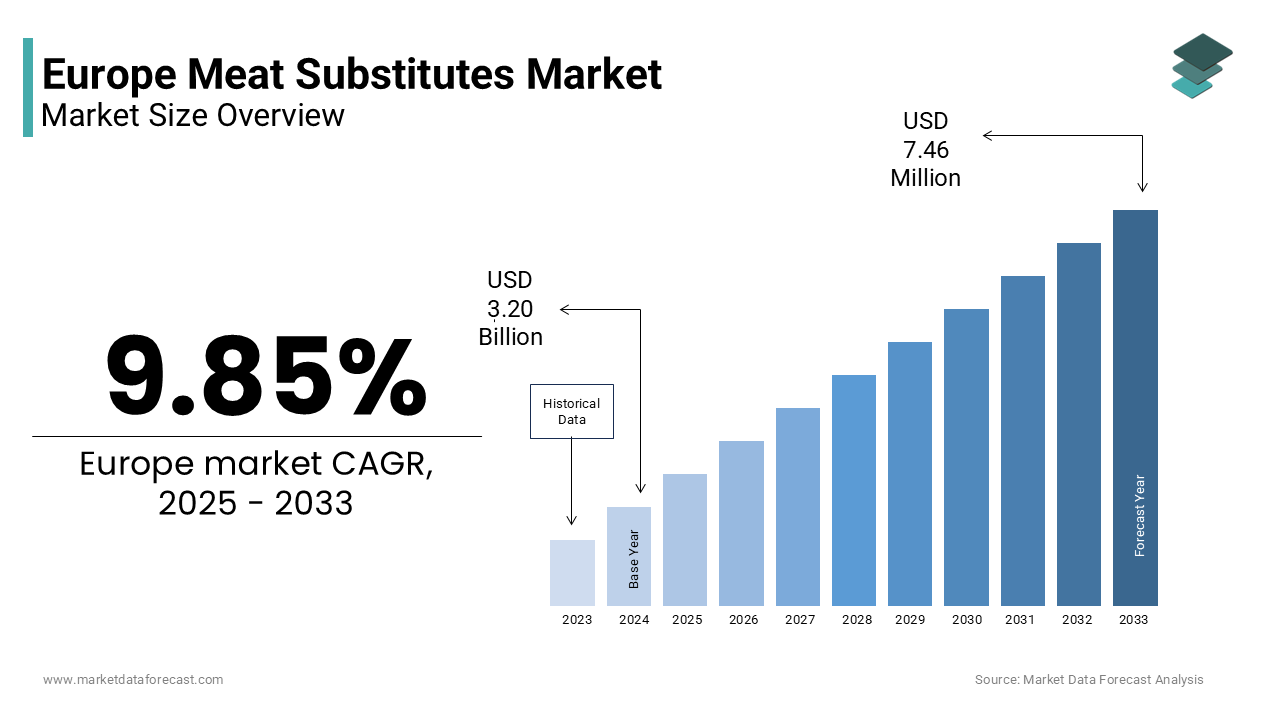
The European meat substitutes market size was valued at USD 3.52 billion in 2025, stands at USD 3.87 billion in 2026, and is projected to reach USD 8.21 billion by 2034, registering a compound annual growth rate (CAGR) of 9.85% during the forecast period. Driven by EU climate and dietary guidelines, expanding retail and foodservice distribution channels, and advancements in mycoprotein and fermentation technologies, the industry continues to experience robust expansion across the region.
Key Executive Metrics (At-a-Glance)
- 2025 Base Valuation: USD 3.52 Billion
- 2026 Current Valuation: USD 3.87 Billion
- 2034 Forecast Valuation: USD 8.21 Billion
- Compound Annual Growth Rate (CAGR): 9.85% (2026–2034)
- Dominant Type Segment: Textured Vegetable Protein (holding 54.5% market share in 2025 due to cost efficiency and versatility)
- Fastest-Growing Type Segment: Tempeh (projected to witness a CAGR of 11.06%)
- Dominant Source Segment: Soy (holding 45.75% market share in 2025, supported by long-standing cultivation and functional performance)
- Fastest-Growing Source Segment: Mycoprotein (projected to register a CAGR of 10.65%)
- Dominant Region: Germany (accounting for 24.7% of the market share in 2025)
Core Market Drivers & Challenges
- Drivers: EU climate mitigation policies, updated dietary guidelines promoting plant protein, and widespread retail/foodservice expansion (e.g., Burger King, IKEA).
- Restraints & Challenges: Consumer skepticism over taste and texture, strict EU labeling and "meat naming" regulations, high price premiums compared to conventional meat, and a lack of harmonized sustainability metrics.
Market Segmentation Breakdown
| Segment Category | Leading Sub-Segment (2025 Base) | Fastest-Growing Sub-Segment (2026–2034) |
|---|---|---|
| By Type | Textured Vegetable Protein (54.5% share) | Tempeh (11.06% CAGR) |
| By Source | Soy (45.75% share) | Mycoprotein (10.65% CAGR) |
| By Distribution Channel | Off-Trade (Supermarkets, Hypermarkets) | On-Trade Foodservice (10.4% CAGR) |
| By Region | Germany (24.7% share) & UK (15.4% share) | Germany and the Netherlands |
Major Industry Players
Monde Nissin Corporation (Quorn), Beyond Meat Inc., The Tofoo Co., Respel & Deiters, Wilmar International Limited, Suedzucker AG, CHS Inc., Puris, MGP Ingredients Inc., The Top Health Ingredients, Sonic Biochem Ltd., Cargill, The Emsland Group, Kerry Ingredion, Roquette Frère, and Axiom Foods.
Europe Meat Substitutes Market Size
The European meat substitutes market size was valued at USD 3.52 billion in 2025 and is expected to reach USD 8.21 billion by 2034 from USD 3.87 billion in 2026. The market is growing at a CAGR of 9.85% during the forecast period.
The meat substitutes are plant-based, fungal-derived derived and cell-cultivated products designed to replicate the sensory and nutritional profile of conventional meat, while aligning with evolving dietary, environmental and ethical preferences. These alternatives include items made from soy pea wheat, mycoprotein, and emerging precision fermentation ingredients. According to Eurostat, many Europeans now identify as flexitarians, consciously reducing but not eliminating meat, driving consistent demand for realistic alternatives. The European Commission’s Farm to Fork Strategy targets a reduction in pesticide use and an increase in organic farming by 2030, indirectly favouring plant protein crops like peas and fava beans that serve as feedstock for meat substitutes. Additionally, the European Food Safety Authority has fast-tracked safety evaluations for novel proteins to promote new companies.
MARKET DRIVERS
EU Climate and Dietary Guidelines Promote Plant Protein Consumption
The European Union’s dual focus on climate mitigation and public health is systematically steering protein consumption toward plant-based alternatives. The Eu climate and diet promote plant protein consumption is majorly driving the growth of the European meat substitutes market. According to the European Commission’s updated dietary guidelines issued in 2025, citizens are advised to limit red and processed meat intake to no more than three hundred grams per week, a reduction from current averages in countries like Germany and Spain. Simultaneously, the EU’s Climate Law mandates a reduction in net greenhouse gas emissions by 20,30 with the agricultural sector under scrutiny due to its high methane output. As per research, replacing just 20% of beef consumption with plant-based alternatives could reduce food-related emissions by over 12 million metric tons of carbon dioxide equivalent annually. National policies reinforce this shift. France’s National Nutrition and Health Program allocates 18 million euros annually to promote plant protein education in schools, while the Netherlands includes meat substitutes in its public procurement framework for hospitals and schools.
Expansion of Retail and Foodservice Distribution Channels Enhances Accessibility
Meat substitutes have moved beyond speciality health stores into mainstream retail and foodservice networks, which is additionally to drive the growth of the European meat substitutes market. According to the European Plant-Based Foods Association, supermarkets in the UK, Germany, and the Netherlands now stock plant-based meat SKUs with prominent end cap and chilled aisle placements. In 2025, Burger King expanded its Plant-Based Whopper to many European locations following a successful pilot that increased lunchtime traffic, as reported by its franchisee association. Similarly, IKEA introduced mycoprotein meatballs across all European cafeterias, achieving a substitution rate for traditional beef versions. Retailers like Carrefour and Tesco have launched private-label meat substitute lines priced below branded equivalents, accelerating the adoption of meat substitutes. The European Commission’s school fruit, vegetable, and milk schemes now permit plant-based meat inclusion in student meals, further embedding these products in daily consumption.
MARKET RESTRAINTS
Consumer Scepticism Regarding Taste and Texture Limits Mass Appeal
The unconvinced by the sensory performance of current meat substitutes in replicating the juiciness, fibrous structure, and umami depth of animal meat is one of the common factors limiting the growth of the European meat substitutes market. According to a 2025 consumer survey by the European Consumer Organisation, occasional buyers cited “unrealistic mouthfeel” or “artificial aftertaste” as reasons for discontinuing purchases. In blind taste tests conducted by the German Institute for Consumer Research, participants correctly identified a leading plant-based burger as meat-free, with its texture as “rubbery” or “spongy.” This gap between visual mimicry and actual eating experience creates a high churn rate, especially among flexitarians, who seek parity, not compromise. Additionally, clean label expectations are rising, with 59% of Europeans now actively avoiding products containing methylcellulose or soy leghemoglobin, as per a study. Until next-generation technologies like structured mycoprotein or hybrid, these sensory and ingredient hurdles, mainstream adoption will remain constrained by culinary dissatisfaction.
Stringent EU Labelling and “Meat Naming” Regulations Restrict Marketing Claims
The regulatory frameworks impose strict limitations on how meat substitutes can be labelled and promoted, creating barriers to consumer communication and category growth. The stringent EU labelling and meat analogues regulations restrict marketing claims, which is also degrading the growth of the European meat substitutes market. According to Regulation (EU) No 1169 2011 terms, such as “burger” “, sausage” and “steak” are legally reserved for products containing actual animal meat, a rule rigorously enforced by national food safety authorities. In 2023, Germany’s Federal Office of Consumer Protection fined a plant-based brand for using the word “veggie schnitzel” on packaging, deeming it misleading despite clear vegetarian labelling. Similarly, France’s consumer code prohibits imagery that implies animal origin, such as grill marks or orblood-likee juices, even in plant-based contexts. These restrictions prevent brands from leveraging familiar culinary language that aids consumer understanding and trial. The European Court of Justice reaffirmed this stance in its 2021 TofuTown ruling, which barred non-dairy products from using dairy-associated terms.
MARKET OPPORTUNITIES
Integration into Public Institutional Menus Creates Stable Demand Pools
The public institutions are increasingly embedding meat substitutes into standardised meal programs, creating predictable offtake for producers normalising alternative proteins, among diverse demographics. This attribute is substantially elevating new opportunities for the growth of Europe's meat substitutes market. According to the European Commission’s Green Public Procurement, all public canteens receiving EU funding must offer at least one plant-based main dish daily by 2026. Similarly, the UK’s National Health Service has committed to reducing meat procurement by 30% by 2027, substituting it with approved plant-based alternatives in all hospital kitchens. The Dutch Ministry of Defence recently trialled insect and fungal protein meals in military barracks, achieving an acceptance rate among personnel. These institutional commitments provide volume stability for manufacturers, while exposing meat substitutes to populations less influenced by marketing is accelerating cultural integration beyond urban vegan enclaves.
Advancement in Mycoprotein and Fermentation-Derived Ingredients Enhances Realism
Next-generation protein technologies, particularly mycoprotein and precision fermentation, are overcoming the sensory and nutritional limitations of first-wave soy and pea isolates. The advancement in mycoprotein and fermentation-derived ingredients enhances realism, and is also expected to enhance the growth of the European meat substitutes market in he coming years. According to the European Alternative Proteins Partnership, many mycoprotein production facilities are now operational or under construction across Finland, the Netherlands, and France, with combined annual capacity exceeding eighty thousand metric tons. Companies like ENOUGH and Quorn have refined filamentous fungal fermentation to create fibrous structures that closely mimic muscle tissue, achieving chewiness scores within chicken breast in independent texture analysis by the Danish Meat Research Institute. Additionally, fermentation-derived heme and flavour compounds enable authentic umami and browning without controversial additives. The European Food Safety Authority granted novel food approval to three new fungal strains in 20,24, accelerating commercialisation.
MARKET CHALLENGES
High Price Premium Over Conventional Meat Deters Price-Sensitive Shoppers
The meat substitutes remain significantly more expensive than their animal counterparts, creating a barrier to sustained adoption among middle- and lower-income households. The fluctuating prices of meat substitutes are one of the major challenges for the growth of the European meat substitutes market. In Southern and Eastern Europe, where food budgets are tighter, this gap is even more pronounced, with plant-based sausages costing more than pork versions, as reported by the European Consumer Organisation. Although private label offerings have narrowed the differential to 30-50% in discount chains like Lidl and Aldi, these products often sacrifice ingredient quality or texture realism. The European Commission’s Farm to Fork impact assessment notes that price parity is unlikely before 2030 without targeted subsidies or carbon pricing on livestock.
Lack of Harmonised Sustainability Metrics Undermines Environmental Messaging
The absence of standardised life cycle assessment protocols for meat substitutes creates confusion among consumers and erodes trust in environmental claims. The lack of complete awareness and misleading protocols are also inhibiting the growth of the European meat substitutes market. According to the European Environment Agency, over 40 different methodologies are currently used by brands to calculate carbon, water and land footprints, leading to incomparable and sometimes contradictory results. A 2025 audit by the European Consumer Organisation found that two leading plant-based burgers with similar ingredient lists reported carbon footprints ranging from 0.9 to 2.4 kilograms of CO2 equivalent per kilogram, with a discrepancy that exceeds the footprint of some poultry products. The European Commission’s Product Environmental Footprint initiative has yet to finalise a binding category rule for meat analogues, leaving brands to self-declare impacts.
REPORT COVERAGE
| REPORT METRIC | DETAILS |
| Market Size Available | 2025 to 2034 |
| Base Year | 2025 |
| Forecast Period | 2026 to 2034 |
| CAGR | 9.85% |
| Segments Covered | By Type, Source, Form, Distribution Channel, and Region |
| Various Analyses Covered | Global, Regional, & Country Level Analysis; Segment-Level Analysis; DROC; PESTLE Analysis; Porter’s Five Forces Analysis; Competitive Landscape; Analyst Overview of Investment Opportunities |
| Regions Covered | UK, France, Spain, Germany, Italy, Russia, Sweden, Denmark, Switzerland, Netherlands, Turkey, Czech Republic, Rest of Europe |
| Market Leaders Profiled | RESPEL & DEITERS, Wilmar International Limited, Suedzucker AG, CHS INC., Puris, MGP Ingredient INC., The Top Health Ingredients, Sonic Biochem Ltd., Cargill, The Emsland Group and Kerry Ingredion, Roquette Frère, Axiom Foods, and others. |
SEGMENTAL ANALYSIS
By Type Insights
The textured vegetable protein segment was the largest by accounting for 54.5% of the European meat substitutes market share in 2025, from its cost efficiency, functional versatility and established integration across retail and foodservice supply chains. TVP is primarily derived from defatted soy flour or pea protein and rehydrates to mimic ground meat texture, making it ideal for ready meals, sauces and plant-based mince. According to the European Plant-Based Foods Association, supermarket-brand meat alternatives in Germany and the Netherlands use TVP as a base due to its neutral flavour profile and high protein content of over 50 grams per hundred grams. Additionally, TVP’s shelf stability enables distribution through conventional dry goods logistics, eliminating the need for cold chain investment. These economic and logistical advantages position TVP as the foundational ingredient for mass market meat substitution across Europe.
The tempeh segment is likely to witness the fastest CAGR of 11.06% throughout the forecast period, owing to the rising consumer interest in traditional fermented foods that offer gut health benefits alongside high nutritional value. Unlike highly processed alternatives, tempeh is made from whole soybeans fermented with Rhizopus oligosporus, creating a firm, fibrous cake rich in probiotics, complete protein and dietary fibre. According to the European Food Information Council, health-conscious, now actively seek fermented plant foods for digestive wellness. Manufacturers are also addressing taste barriers by introducing smoked, marinated, and spice-infused variants that appeal to non-Asian palates.
By Source Insights
The soy segment accounted in holding 45.75% of the European meat substitutes market share in 2025, owing to decades of cultivation, processing and formulation expertise that ensures consistent quality cost cost-effectiveness and functional performance. Soy protein isolate and concentrate deliver high protein density, neutral taste,, te and excellent binding properties, making them ideal for burgers,anggets. The European Commission reports that over two million hectares of soy are cultivated annually within the EU pr,, primarily in Italy, Romania and France, supporting regional supply chain resilience. Additionally, soy’s established safety profile under European Food Safety Authority regulations accelerates product approval timelines compared to novel proteins. Retailers favour soy-based alternatives due to consumer familiarity with tofu and soy milk, which reduces trial barriers.
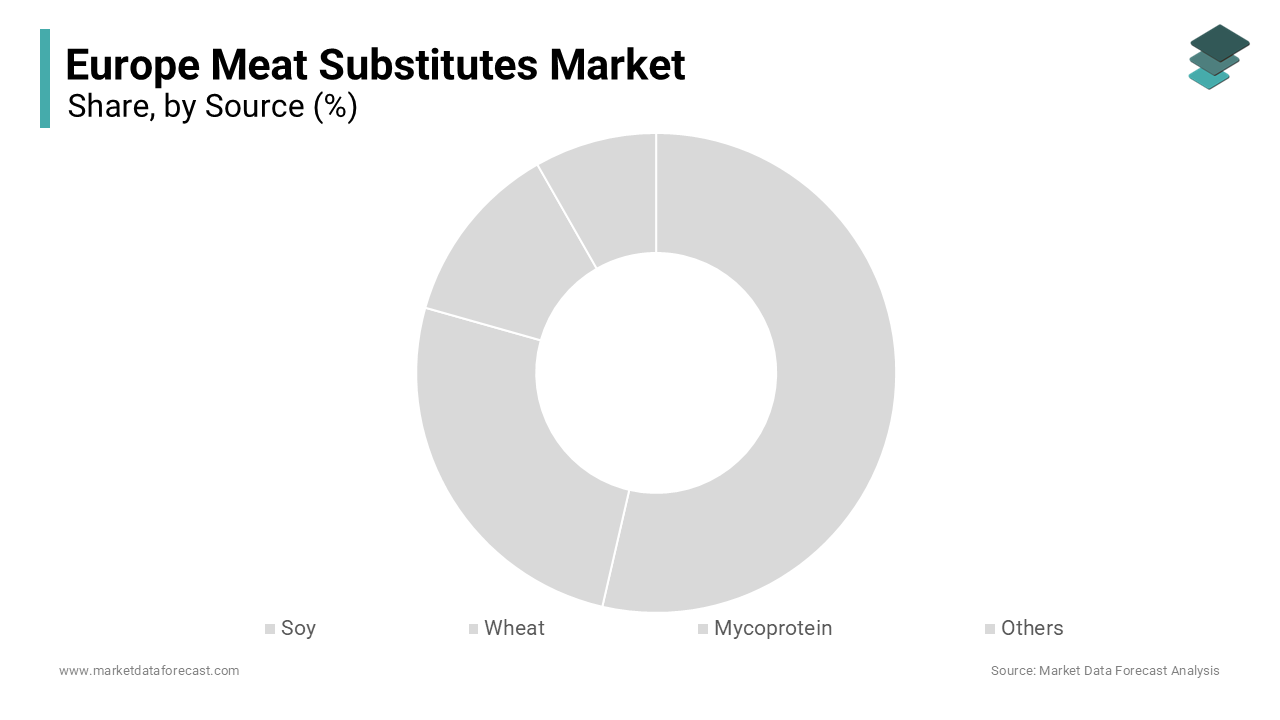
The mycoprotein segment is anticipated to register the fastest CAGR of 10.65% throughout the forecast period, with its unique nutritional profile, environmental benefits and superior meat-like texture achieved through fungal fermentation. Mycoprotein contains all nine essential amino acids, is low in saturated fat and high in fibre with a fibrous structure that closely mimics chicken or pork. According to the Danish Meat Research Institute, sensory panels rate mycoprotein products within 15% of real meat on chewiness and umami depth significantly closer than soy or pea alternatives. Companies like Quorn and ENOUGH have scaled production across the Netherlands and Finland, with combined European capacity exceeding sixty thousand metric tons annually. In 2025, Revo Foods launched The Kra, a mycoprotein-based octopus alternative, demonstrating culinary versatility. These functional and sustainability attributes position mycoprotein as the leading next-generation protein source in Europe.
By Distribution Channel Insights
The off-trade channel segment held a dominant share of the European meat substitutes market in 2025, with the entrenched role of supermarkets, hypermarkets and online retailers as primary points of household grocery purchase. Major chains like Carrefour, ur Tesco, and Lidl have aggressively expanded private label meat substitute lines priced 20-30% below branded equivalents, increasing accessibility. The off-trade segment also benefits from strategic shelf placement, often adjacent to refrigerated meat sections, which normalises substitution behaviour. Online channels within off-trade grew with the subscription boxes and same-day delivery of plant-based meal kits.
The on-trade foodservice segment is likely to grow at the fastest CAGR of 10.4% throughout the forecast period, owing to the rising consumer demand for diverse sustainable dining options in restaurants, cafés and quick service establishments. Chains like Leon Vapiano and Pret A Manger, which offer permanent meat substitute options, with Pret reporting that its vegan sausage roll accounts for one in every five pastry sales, across UK and European locations. Corporate sustainability mandates also drive adoption, with IKEA and Compass Group committing to reducing meat procurement by 30% by 2027 through plant-based swaps. Additionally, culinary innovation is accelerating chefs in Paris and Amsterdam use seitan and mycoprotein to recreate traditional dishes like boeuf bourguignon and schnitzel.
REGIONAL ANALYSIS
Germany Meat Substitutes Market Analysis
Germany was the top performer of the European meat substitutes market by holding 24.7% of share in 2025. Its position is anchored in strong domestic production, widespread consumer acceptance,ce and supportive policy frameworks. The country is home to over 200 plant-based food companies, including global brands like Rügenwalder Mühle and Vegan, driving innovation and scale. According to the Federal Statistical Office, Germany produced 126.48 thousand metric tons of meat substitutes in 2025, more than any other European nation. The government’s National Nutrition Strategy promotes plant protein education in schools, while the Federal Ministry of Food and Agriculture funds research into fermentation and extrusion technologies. These structural, economic, and cultural factors establish Germany as the continent’s most mature and self-sustaining meat substitute ecosystem.
United Kingdom Meat Substitutes Market Analysis
The United Kingdom meat substitute market was ranked second by capturing 15.4% of share in 2025, with robust adoption across retail and foodservice sectors. Whilst the exact share is not specified in the source UK is identified as a mature market leader due to its developed plant-based ecosystem, significant research investments and regulatory support. Brands like THIS and The Tofoo Co have gained international recognition for hyper-realistic meat analogues, with THIS reporting triple-digit growth in European exports. Supermarkets, such as Sainsbury’s and Waitrose, allocate entire chilled aisles to plant-based products, reflecting high consumer demand. Additionally, the UK’s post-Brexit regulatory autonomy allows faster novel food approvals. Quorn’s mycoprotein received approval a full year before its counterparts.
France Meat Substitutes Market Analysis
The French meat substitute market growth is likely to be driven by culinary tradition, showing steady growth in meat substitute adoption. Though growth is measured due to strong attachment to animal protein, French consumers are increasingly open to plant-based options when aligned with gastronomic quality. According to the French Ministry of Agriculture, plant-based product sales are driven by premium offerings in organic and speciality stores. The government’s Protein Plan incentivises domestic legume cultivation, including peas and fava beans, to reduce soy import dependency and support local meat substitute production. Major retailers like Carrefour have launched French-made vegan lines under their “Vegan by Carrefour” label e,, emphasising traceability and terroir.
Netherlands Meat Substitutes Market Analysis
The Netherlands' meat substitutes market growth is likely to grow with the strong institutional support for alternative proteins. The country hosts leading mycoprotein and fermentation startups, including ENOUGH and Meatable, benefiting from the Netherlands’ advanced agri-food research infrastructure. According to the Dutch Nutrition Centre, households purchased meat substitutes at least once a month in 2025, with tempeh and seitan gaining traction among health-conscious consumers. The government’s National Protein Strategy allocates funding for scaling alternative protein production, while Amsterdam’s city council mandates that food served in public institutions be plant-based by 2026. Retailers like Albert Heijn place significant emphasis on sustainability labellingwith carbon footprint metrics displayed alongside price.
Sweden Meat Substitutes Market Analysis
Sweden's meat substitutes market growth is likely to grow with its progressive dietary policies and environmentally conscious consumer base. The Swedish National Food Agency includes legumes and plant proteins as core components of its official dietary guidelines, encouraging reduced meat consumption. Public procurement rules require all school and hospital cafeterias to offer plant-based options, driving consistent institutional demand. Additionally, Swedish consumers prioritise transparency by checking ingredient lists for additives, as per the Swedish Consumer Agency. These cultural and regulatory conditions foster a market that values authenticity, sustainability, and nutritional integrity over imitation alone.
COMPETITIVE LANDSCAPE
Competition in the European meat substitutes market is characterised by a blend of global brands, specialised local producers and food industry giants vying for consumer trust through taste authenticity and sustainability. The market is moderately fragmented, with established players like Monde Nissin and Beyond Meat competing alongside agile regional companies such as The Tofoo Co. and Vivera. Differentiation hinges on the ability to deliver realistic sensory experiences using clean ingredients while maintaining price competitiveness. Regulatory constraints as restrictions on meat-related naming and strict labelling laws, require careful marketing alignment. Retail shelf space is fiercely contested, driving promotional investments and private label collaborations. Innovation in fermentation mycoprotein and hybrid proteins is accelerating as companies seek to overcome the limitations of first-generation soy and pea isolates.
KEY MARKET PLAYERS
Some of the notable key players in the European meat substitutes market are
- RESPEL & DEITERS
- Wilmar International Limited
- Suedzucker AG
- CHS INC.
- Puris
- MGP Ingredients INC.
- The Top Health Ingredients
- Sonic Biochem Ltd.
- Cargill
- The Emsland Group and Kerry Ingredion
- Roquette Frère
- Axiom Foods
Top Players in the Market
- Monde Nissin Corporation is a global leader in meat alternatives through its Quorn brand, which pioneered mycoprotein-based products over four decades ago. The company has a strong presence across Europe, offering a wide portfolio of ready-to-cook and ready-to-eat meat substitutes that replicate chicken and seafood. Quorn products are available in over thirteen thousand retail outlets across the United Kingdom,m Germa, and the Netherlands,,nds and are used by major foodservice operators including Compass Group and IKEA. Monde Nissin expanded its mycoprotein production capacity in the United Kingdom to meet rising European demand and reduced its carbon footprint per ton of product through renewable energy integration.
- Beyond Meat Inc. is a US-based innovator with significant influence in the European plant-based meat sector through its pea protein-based burgers, sausages, and mince. The company partners with leading European retailers like Tesco, Carrefour, our and Albert Heijn to offer products that closely mimic the taste and texture of animal meat. Beyond Meat also collaborates with McDonald’s on the McPlant burger, which is available in over two thousand restaurants across G, Germany, the UK and the Netherlands. The company launched a reformulated European product line with cleaner R labels, fewer in, and improved cooking performance to address consumer feedback. These strategic retail and foodservice alliances strengthen its foothold in Europe’s competitive alternative protein landscape.
- The Tofoo Co UK-based specialist known for its premium minimally processed meat substitutes centred on tofu and tempeh. The company caters to health-conscious, environmentally aware consumers seeking clean-label alternatives free from artificial additives. Its products are widely distributed in major British supermarkets, including Sainsbury’s, Waitrose and Oc, and have gained traction in select German and Dutch organic chains. The ToCo.o Co relaunched its tempeh with a simplified recipe containing only four ingredients: organic soy live cultureraw apple cider vinegar, reinforcing its commitment to transparency and natural fermentation.
Top Strategies Used by the Key Market Participants
Key players in the European meat substitutes market focus on product innovation to close the sensory gap with conventional meat by improving taste, texture, and cooking behaviour through advanced extrusion, fermentation, and ingredient blending. They expand distribution through strategic partnerships with major retailers and foodservice chains to increase visibility and trial. Companies invest in clean label formulations by removing artificial additives and simplifying ingredient lists to meet European consumer expectations. Sustainability is centred on efforts to reduce carbon, water, and land footprints while promoting circular packaging. Additionally, firms tailor products to local culinary preferences, classic-based schnitzel or bourguignon, to drive cultural relevance.
MARKET SEGMENTATION
This research report on the European meat substitutes market has been segmented and sub-segmented based on categories.
By Type
- Tofu
- Tempeh
- Textured Vegetable Protein
- Seitan
- Other Meat Substitutes
By Source
- Soy
- Wheat
- Mycoprotein
- Others
By Form
- Frozen
- Refrigerated
- Shelf-Stable
By Distribution Channel
- On-Trade
- Off-Trade
By Country
- UK
- France
- Spain
- Germany
- Italy
- Russia
- Sweden
- Denmark
- Switzerland
- Netherlands
- Turkey
- Czech Republic
- Rest of Europe