- Product Description Description
- Table of Contents TOC
- List of Table & Figure LOT
- Get Free Sample PDF Sample PDF
Market Size, 2025
$6.31 BnMarket Estimate, 2026
$7.09 BnMarket Forecast, 2034
$18.07 BnCAGR, 2026–2034
12.4%Europe Mechanized Irrigation Systems Market Size, Growth, Trends & Forecast (2026–2034)
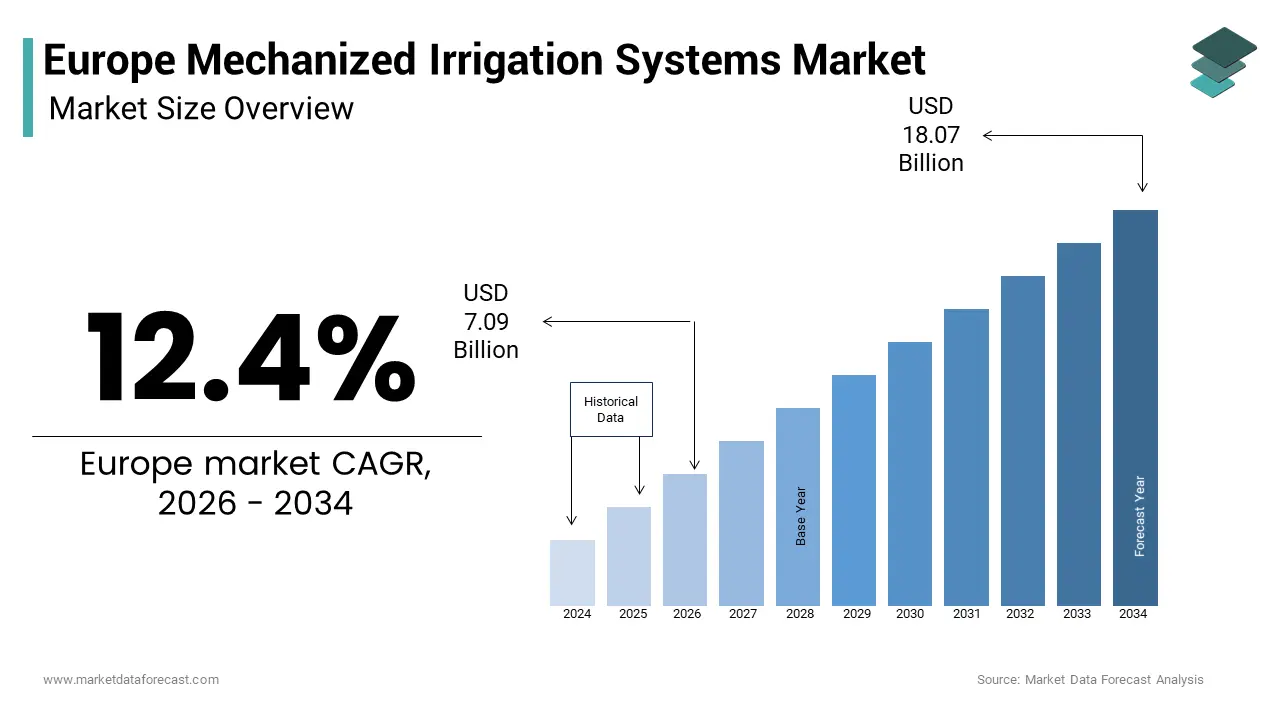
The European mechanized irrigation systems market size was valued at USD 6.31 billion in 2025, is anticipated to reach a valuation of USD 7.09 billion in 2026, and is projected to scale up to USD 18.07 billion by 2034, registering a compound annual growth rate (CAGR) of 12.4% during the forecast period from 2026 to 2034. Driven by escalating drought frequencies across agricultural regions, policy mandates under the Common Agricultural Policy (CAP) promoting water efficiency, and the integration of IoT-based smart sensors, the regional market continues to expand rapidly.
Key Executive Metrics (At-a-Glance)
- 2025 Base Valuation: USD 6.31 Billion
- 2026 Current Valuation: USD 7.09 Billion
- 2034 Forecast Valuation: USD 18.07 Billion
- Compound Annual Growth Rate (CAGR): 12.4% (2026–2034)
- Dominant Type Segment: Center Pivot Irrigation Systems (driven by efficiency on large cereal and oilseed farm holdings)
- Dominant Application Segment: Nursery Crops (capturing a 52.4% share in 2025 due to high water sensitivity and value density)
- Dominant Country Market: Spain (holding a 24.6% market share in 2025 anchored by semi-arid climate, extensive horticulture, and modernization initiatives)
Core Market Drivers
- Drought Severity & Climate Change: Altered precipitation patterns and severe summer dry spells making pressurized mechanized systems essential for crop security.
- CAP Policy Incentives: Financial support and regulatory frameworks linking direct payments to sustainable water management and precision irrigation technologies.
Primary Market Restraints & Challenges
- High Initial Outlays & Smallholder Constraints: Substantial upfront investment requirements and complex administrative procedures hindering adoption among small-scale farms.
- Energy Dependency & Water Rights: High electricity consumption for pressurized networks and fragmented groundwater abstraction permits limiting expansion.
Europe Mechanized Irrigation Systems Market Segmentation Breakdown
| Segment Category | Leading Sub-Segment (Base/Current) | Fastest-Growing Sub-Segment |
|---|---|---|
| By Type | Center Pivot Irrigation Systems (dominant share) | Lateral Move Irrigation Systems (7.9% CAGR due to flexibility in irregular fields) |
| By Application | Nursery Crops (52.4% share in 2025) | Land Application of Wastes (9.3% CAGR driven by EU Water Reuse Regulation) |
| By Region / Country | Spain (24.6% share in 2025) & Italy (18.3%) | Turkey & Eastern European adoption zones |
Major Industry Players Profiled
Key enterprises shaping the competitive European mechanized irrigation systems market include Lindsay Corporation, Valmont Industries, Netafim Limited, Nelson Irrigation Corporation, Jain Irrigation Systems Limited, Driptech India Pvt. Ltd., Rain Bird Corporation, Premier Irrigation Adritec, Rivulis Irrigation, The Toro Company, and T-L Irrigation.
Europe Mechanized Irrigation Systems Market Size
The European mechanized irrigation systems market size was valued at USD 6.31 billion in 2025 and is anticipated to reach a valuation of USD 7.09 billion in 2026 from USD 18.07 billion by 2034, growing at a CAGR of 12.4% from 2026 to 2034.
Current Introduction of the European Mechanized Irrigation Systems Market
Mechanized irrigation systems are automated agricultural setups that use machinery, sensors, and mechanical components to deliver water efficiently to crops. These systems are increasingly vital as climate volatility intensifies across the continent, disrupting traditional growing cycles and water availability. Large portions of European land have recently experienced significant drought, causing substantial stress on agricultural production in major cultivation areas. Agricultural activities represent a substantial share of total freshwater usage, while inefficient irrigation techniques remain in use across a significant portion of farmland. Policy frameworks are increasingly designed to encourage the adoption of water-saving technologies in farming practices. Regulatory changes now facilitate the use of treated wastewater for irrigation, driving interest in specialized filtration and irrigation machinery. In this context, mechanized irrigation is evolving from a productivity tool into a strategic adaptation mechanism for climate resilience, regulatory compliance, and sustainable intensification across European farming landscapes.
MARKET DRIVERS
Escalating Frequency and Severity of Droughts Across Agricultural Regions
Climate change has fundamentally altered precipitation patterns across Europe, which makes mechanized irrigation not merely advantageous but essential for crop security, and thereby drives the growth of the European mechanized irrigation systems market. According to the Copernicus Climate Change Service, Europe experienced its warmest summer on record in 2022, characterized by severe, widespread drought conditions that significantly affected agricultural production in key European Union cereal-producing nations such as France, Germany, and Romania. These conditions reduced maize yields in Southern Europe. In response, farmers are transitioning frorain-feded or surface irrigation to pressurized mechanized systems that optimize every liter of water. Agricultural regions in Southern Europe are actively expanding modernized, efficient irrigation systems to protect permanent crops like olives and almonds from intensifying water scarcity. Key agricultural basins, which hold significant importance for national food production, are facing reduced water availability, triggering increased adoption of water-saving technology in critical sectors like rice and tomato farming. A widespread, recurring pattern of drought stress is emerging across the European Union, necessitating a structural shift in agricultural practices. This environmental trend is causing a long-term, increased demand for reliable water management infrastructure designed to sustain agricultural yields under persistent hydrological uncertainty.
Policy Mandates Under the Common Agricultural Policy Promoting Water Efficiency
The reformed Common Agricultural Policy has become a powerful enabler for mechanized irrigation adoption by linking direct payments to sustainable water management practices, which in turn propels the expansion of the European mechanized irrigation systems market. Multiple European nations are incorporating financial incentives for adopting advanced, precision-based irrigation technologies into their agricultural support frameworks. Specific national programs provide subsidies for moisture-monitored pivot systems and water-recycling technology, reducing modernization costs for farmers. These incentives have spurred a significant number of approved projects aimed at upgrading irrigation infrastructure. Furthermore, new sustainability requirements, which mandate documentation of nutrient and water usage for larger agricultural operations, indirectly encourage the adoption of more efficient technology. The policy framework is further reinforced by the EU Green Deal’s target to reduce nutrient losses by 2030, a goal unattainable without precise fertigation capabilities offered by mechanized systems. This alignment of fiscal support, regulatory obligation,n and environmental targets transforms irrigation from a capital expense into a compliance and competitiveness necessity for European farmers.
MARKET RESTRAINTS
High Initial Investment and Limited Access to Financing for Smallholders
Substantial upfront costs, despite clear agronomic and policy benefits, continue to obstruct the growth of thEuropeanpe mechanized irrigation systems market. These expenses disproportionately affect small and medium-sized farms, which, according to Eurostat, constitute a significant share of EU agricultural holdings. High-tech, automated center pivot irrigation systems for large-scale agricultural operations represent a significant capital investment for European farmers, which does not include the essential expenditures for installation and energy supply infrastructure. The potential of CAP subsidies to reduce financial strain is often undermined by complex administrative procedures and payment delays, particularly in Eastern Europe. In Romania, Bulgaria, and Croatia, the majority of European Investment Bank-supported agricultural financing is focused on general modernization, with a smaller portion specifically dedicated to irrigation modernization projects. Moreover, maintenance and energy expenses add long-term operational burdens. The adoption of pressurized irrigation systems in Europe, while enhancing water management, significantly increases the electricity consumption requirements for farming operations compared to gravity-fed methods. The lack of tailored leasing and microfinancing for irrigation equipment forces many viable farms to rely on inefficient flood methods due to capital constraints, creating a major obstacle to large-scale water sustainability.
Fragmented Water Rights and Regulatory Restrictions on Groundwater Abstraction
Legal and administrative complexities surrounding water access significantly impede mechanized irrigation deployment across several EU countries, which poses a major restraint to the European mechanized irrigation systems market. Groundwater management often relies on permitting systems that may reflect past water use patterns rather than contemporary agricultural requirements. In certain regions facing significant water stress, restrictions on new irrigation licenses are being implemented to prevent further depletion of aquifers. Regulatory actions in some European areas involve pausing or limiting new groundwater extraction approvals in response to declining water levels. These restrictions render investments in permanent mechanized systems economically unviable if water allocation is uncertain or declining. Furthermore, transboundary water governance adds another layer of complexity. Even where infrastructure is installed, inconsistent enforcement of metering requirements, as seen in parts of Greece and Portugal, undermines fair distribution and discourages conservation-oriented technologies. The potential for mechanized irrigation to achieve sustainable intensification in critical agricultural zones will remain unmet until water governance systems adopt greater adaptability, transparency, and independence from legacy rights.
MARKET OPPORTUNITIES
Integration of Smart Sensors andIoT-Basedd Irrigation Management
The convergence of mechanized irrigation with digital agriculture offers a potential opportunity to maximize water productivity while minimizing labor and energy inputs, which is predicted to fuel the growth of the European mechanized irrigation systems market. Internet of Things-enabled soil moisture sensors, weather stations, satellite-baseded evapotranspiration models now allow real-time adjustment of irrigation schedules with sub-field precision. Sustainable agricultural practices in Europe are increasingly shaped by the integration of satellite data, automated local systems, and targeted digital initiatives. Satellite missions now provide accessible, high-resolution imagery that allows farmers to monitor vegetation health and soil conditions across vast regions. These space-based observations are increasingly being integrated into specialized digital platforms to assist in large-scale crop management and environmental oversight. In advanced horticultural sectors, there is a clear shift toward using wireless sensor networks to automate irrigation, which helps optimize water consumption. The adoption of these automated controllers has demonstrated a consistent pattern of lowering operational resource requirements in both controlled greenhouse environments and open fields. Regional digital strategies are focusing on funding pilot programs that bring advanced technologies like artificial intelligence to the field level. These initiatives are particularly directed toward areas facing environmental challenges, where AI-driven advisory services help manage resource scarcity more effectively. Furthermore, companies like Valmont and Lindsay have launched European-compatible control panels that integrate with farm management software such as 365FarmNet, enabling seamless data flow from field to decision. This digitization not only enhances resource efficiency but also generates auditable sustainability metrics increasingly demanded by food retailers and carbon credit programs.
Expansion of Treated Wastewater Reuse for Agricultural Irrigation
The EU’s Water Reuse Regulation, which became fully applicable in June 202,3 establishes minimum quality standards for using reclaimed urban wastewater in agriculture, which provides fresh prospects for the European mechanized irrigation systems market. This creates a stable alternative water source for mechanized systems. The volume of municipal wastewater treated and reused for agricultural irrigation in European regions is currently low, indicating an opportunity for increased adoption compared to higher rates observed in specific, water-stressed regions elsewhere. The utilization of treated effluent for agriculture, such as in the cultivation of citrus, olive, and vine crops, shows potential for expansion as a sustainable water management strategy. Certain locations are establishing a precedent for utilizing reclaimed water, demonstrating a shift toward adopting non-conventional water resources in agricultural practices. The regulation mandates pathogen and contaminant thresholds that necessitate filtration and disinfection compatible with pressurized drip and sprinkler systems, directly driving demand for corrosion-resistant components and backflow prevention devices. Regional authorities are upgrading wastewater treatment infrastructure to meet standards for agricultural reuse. This initiative enables consistent, year-round irrigation for peri-urban farming areas. Climate projections indicate a long-term decline in summer river flows, which is expected to intensify water scarcity. Consequently, recycled water is becoming a necessary resource for sustaining agricultural output in response to reduced water availability. Mechanized irrigation providers are thus positioning themselves as enablers of circular water economies by designing systems that safely and efficiently utilize this emerging resource stream.
MARKET CHALLENGES
Energy Dependency and Carbon Footprint of Pressurized Irrigation Systems
Significant energy consumption required to operate pressurized networks, particularly in gravity-deficient terrains, impedes the growth of the European mechanized irrigation systems market. Agricultural operations in Europe represent a notable portion of final energy consumption, with water distribution systems, particularly pressurized techniques, driving a significant share of this demand. Energy-intensive irrigation technologies, often reliant on conventional fuels for pressurization, present challenges to achieving broader agricultural sustainability targets. The high energy requirements of specialized irrigation setups create a conflict with regional environmental goals focused on reducing emissions from farming activities. Although renewable energy options for irrigation are available, intermittent output and high storage costs currently limit their widespread adoption in large-scale agriculture. Elevated energy costs, particularly in specific Mediterranean regions, are influencing farmers to reconsider the adoption of advanced, high-energy methods, sometimes leading to the continued use of less water-efficient but energy-efficient traditional techniques. Decarbonizing irrigation will lag behind other agricultural sectors without scalable renewable integration and dynamic, off-peak pricing, threatening both climate goals and long-term viability.
Lack of Technical Expertise and After-Sales Support in Rural Areas
The effective deployment and maintenance of advanced mechanized irrigation systems requires specialized knowledge that is often unavailable in remote agricultural communities across the region, thereby constraining the expansion of theEuropeane irrigation systems market. An analysis of rural development evaluations and agricultural engineering studies reveals that access to certified professionals for irrigation system maintenance is limited in specific rural areas of certain Eastern European nations. This skill deficiency contributes to inefficient system design, while delayed maintenance and a lack of qualified technicians reduce the potential water-saving performance of agricultural infrastructure. Language barriers further complicate support. Manuals and digital interfaces from multinational manufacturers are rarely localized for minority farming regions such as Sardinia or Transylvania. Moreover, training programs under Erasmus+ and national agricultural schools focus predominantly on crop science rather than hydraulic engineering or automation programming. Consequently, even when subsidies cover equipment costs, farmers hesitate to adopt complex system,s, fearing operational failure. Mobile service units and remote diagnostics via cloud platforms are emerging solutions,s but coverage remains sparse outside Western Europe. Mechanized irrigation won't reach its full potential in Africa until local technical capacity is systematically built.
REPORT COVERAGE
| REPORT METRIC | DETAILS |
| Market Size Available | 2025 to 2034 |
| Base Year | 2025 |
| Forecast Period | 2026 to 2034 |
| CAGR | 12.4% |
| Segments Covered | By Type, Application, And By Region |
| Various Analyses Covered | Global, Regional, and Country-Level Analysis; Segment-Level Analysis; DROC; PESTLE Analysis; Porter’s Five Forces Analysis; Competitive Landscape; Analyst Overview of Investment Opportunities |
| Regions Covered | UK, France, Spain, Germany, Italy, Russia, Sweden, Denmark, Switzerland, Netherlands, Turkey, the Czech Republic, and the Rest of Europe |
| Market Leaders Profiled | Lindsay Corporation, Nelson Irrigation Corporation, Jain Irrigation Systems Limited, Driptech India Pvt. Ltd., Rain Bird Corporation, Premier Irrigation Adritec, Rivulis Irrigation, Netafim Limited, The Toro Company, T-L Irrigation, and Valmont Industries. |
SEGMENTAL ANALYSIS
By Type Insights
The center pivot irrigation systems segment dominated the European mechanized irrigation market by accounting for a substantial share in 2025. The dominance of the center pivot irrigation systems segment is driven by its operational efficiency on large contiguous fields typical of cereal and oilseed production in Central and Eastern Europe. In several major European agricultural nations, a substantial portion of crop-producing land is concentrated within large farm holdings, making these regions particularly well-suited for automated large-scale irrigation systems. The system’s low labor requirement is particularly valuable in regions facing acute agricultural workforce shortages. There is a consistent and long-term reduction in the number of people working in the European agricultural sector, driving a greater need for labor-saving technological solutions. Additionally, center pivots integrate seamlessly with precision agriculture toolss including GPS guidance,nce variable rate nozzles, and soil moisture telemetry. Regional authorities in southwestern Spain have observed that modern mechanized irrigation systems significantly outperform older methods in conserving water resources during periods of severe environmental stress. Their modular design also allows phased investment; farmers can start with a short span and extend as capital permits, making them adaptable to diverse financial capacities while maintaining high water application uniformity.
The lateral move irrigation systems segment is anticipated to witness the fastest CAGR of 7.9% between 2026 and 2034 due to rising demand in rectangular or irregularly shaped fields where center pivots are impractical due to terrain or plot boundaries. Lateral move systems offer linear coverage with similar automation benefits but greater spatial flexibility, critical in Western Europe where land fragmentation persists. Many agricultural operations in specific European nations are characterized by smaller plot sizes that are frequently bordered by infrastructure or natural features. In these restricted environments, lateral move irrigation systems, whether mounted on tracks or wheels, are utilized to provide targeted water application and improve crop yields during dry periods. Furthermore, solar-powered lateral systems eliminate grid dependency, a key advantage in remote areas of Portugal and Greece. Small and mid-scale farmers seeking resilience are rapidly adopting lateral move systems, prioritized by recent EU funding for efficient water use, to avoid land restructuring.
By Application Insights
The nursery crops segment led the European mechanized irrigation systems market by capturing a 52.4% share in 2025. The leading position of the nursery crops segment is attributed to the high water sensitivity and value density of ornamental plants, fruit trees,s and young vines, es which require consistent moisture for root development and aesthetic quality. Unlike field crops, nursery operations cannot tolerate water stress even for short periods. Variability in water supply during the nursery stage correlates with lower survival rates in young, grafted saplings. The adoption of mechanized, targeted irrigation systems is increasing to optimize moisture delivery directly to root zones. Precision irrigation technologies are being employed to reduce nutrient leaching and limit foliar diseases by keeping water away from plant leaves. A shift toward automated, sensor-linked irrigation is evident in professional plant nurseries, often aligning with sanitary safety protocols. Pressurized, automated systems are commonly used for managing large-scale, high-density tree nurseries, contributing to uniform plant development before final transplantation. The economic stakes are high,h justifying investment in reliable water delivery. Moreover, the EU Biodiversity Strategy 2030’s push for urban greening and reforestation will solidify this segment's market leadership by driving up the demand for premium planting materials.
The land application of wastes segment is likely to experience the fastest CAGR of 9.3% over the forecast period, od owing to the EU Water Reuse Regulationn, which came into full effect in June 2023 and mandates safe agricultural use of treated municipal wastewater. Mechanized irrigation systems, particularly center pivots equipped with filtration and backflow prevention, are essential for distributing reclaimed water uniformly while complying with pathogen and heavy metal limits. Treated wastewater is increasingly being used to irrigate non-food crops, such as fiber hemp and energy grasses, in specific Spanish regions. The use of treated effluent for irrigation is a growing practice in coastal areas of Spain. In Italy, investments are being directed towards upgrading wastewater treatment infrastructure to facilitate the reuse of water for industrial crop plantations. There is a shift toward using recycled water for year-round irrigation of biomass crops in certain Italian regions. These applications not only conserve freshwater but also recycle nutrients, reducing synthetic fertilizer needs. Mechanized systems for wastewater recycling are now indispensable for circular farming, enabling the conversion of waste into agricultural resources in line with stringent EU environmental goals.
COUNTRY ANALYSIS
Spain Mechanized Irrigation Systems Market Analysis
Spain was the top performer in the European mechanized irrigation systems market by holding a 24.6% share in 2025. The supremacy of the Spanish market is credited to its semi-arid climate,e extensive horticulture sector, and long history of irrigation modernization. Spanish agriculture is rapidly transitioning away from traditional gravity-based irrigation toward localized, high-efficiency pressure systems, resulting in a majority of irrigated land being modernized. The Guadalquivir and Ebro river basins host vast expanses of olive, citrus,trus and almond orchards where center pivots and drip networks are critical for yield stability amid recurring droughts. The Spanish government is heavily investing in national irrigation modernization initiatives, prioritizing the rehabilitation of pipe networks and the implementation of automated systems to improve water management. Recent extreme droughts have accelerated adoption. Regional authorities in Andalusia are fast-tracking financial aid to help farmers switch from inefficient flood irrigation to modern, automated mechanised systems. Spain also leads in wastewater reuse with substantial hectares irrigated using treated effluent, creating demandcorrosion-resistantstant components. This combination of climatic pressure, policy support,t and crop economics solidifies Spain’s role as Europe’s most advanced and voluminous irrigation market.
Italy Mechanized Irrigation Systems Market Analysis
Italy was the next prominent country in the European mechanized irrigation systems market by accounting for a 18.3% share in 2025. The expansion of the Italian market is attributed to its diverse high-value agriculture, spanning rice paddies in Lombardy, vineyards in Tuscany, and vegetable farms in Puglia, all requiring precise water management. The Po River basin experienced significantly reduced water levels, leading to the implementation of emergency measures to manage resources. Subsidies were introduced to support the adoption of efficient irrigation techniques such as drip and sprinkler systems. A shift toward mechanized irrigation occurred, driven in part by changes in water abstraction regulations. The agricultural sector in this region adjusted to new water management requirements. Northern regions lead in technology adoption. Additionally, Italy is pioneering the integration of solar pumping in off-grid areas of Sicily and Sardinia, reducing diesel dependence. The EU's Water Framework Directive designation of the Po basin as a "water-stressed" region makes long-term, efficient irrigation investment an economic and regulatory necessity, highlighting Italy’s pivotal market role.
France Mechanized Irrigation Systems Market Analysis
France holds a significant position in the European mechanized irrigation systems market due to its large-scale cereal and oilseed farming in the Paris Basin and Beauce regions, where center pivots optimize water use across vast fields. Despite relatively abundant rainfall, climate volatility has intensified. Reduced water availability has impacted maize production, leading to increased focus on modernizing irrigation infrastructure. The national agricultural strategy now provides enhanced financial support for adopting precise, technology-driven irrigation tools. Prioritization is given to irrigation systems that utilize soil moisture monitoring and remote management capabilities. There is a notable transition toward mechanized irrigation, particularly in regions frequently affected by drought conditions. France also leads in research. France remains at the forefront of European temperate agriculture by combining high-tech readiness with strong institutional backing to combat climate change.
Germany Mechanized Irrigation Systems Market Analysis
Germany is moving ahead steadfastly in the European mechanized irrigation systems market. While traditionally rain-fed German agriculture is rapidly adapting to increasing summer dryness. Observations indicate a significant, long-term decline in soil moisture levels across specific regions, highlighting a trend toward drier conditions. In response to these agricultural challenges, there is a shift toward implementing enhanced water management strategies and infrastructure for crop cultivation. Technological adoption, particularly of mechanized irrigation systems, is increasing for high-water-demand crops. The rate of adoption for these new irrigation systems has accelerated, showing a substantial rise compared to previous trends over the last decade. Germany’s engineering prowess also drives innovation; companies like Kärcher and Güttler develop compact automated units tailored for fragmented Central European plots. Strict groundwater regulations in states like Bavaria further incentivize closed-loop systems that minimize abstraction. This convergence of climate adaptation policy support and technical customization positions Germany as a dynamic growth market despite its historically low irrigation baseline.
Turkey Mechanized Irrigation Systems Market Analysis
Turkey is anticipated to expand in the European mechanized irrigation systems market over the forecast period due to its strategic location bridging Europe and Asia, its extensive agricultural base, and severe water stress in key regions like the Southeastern Anatolia Project zone. Irrigated land usage in the region has reached a high level, placing it prominently among continental peers, while undergoing significant technological upgrades to transition away from traditional, less efficient methods. A substantial portion of agricultural land has recently transitioned toward more controlled, localized irrigation systems. Financial incentives, such as low-interest loans, are accelerating the modernization of agricultural irrigation infrastructure. In specific agricultural regions, improved water efficiency is becoming increasingly crucial for enhancing the competitiveness of key exported crops. Recent EU alignment efforts under the Green Deal have accelerated the adoption of EU-compliant irrigation standards, particularly for farms exporting fruits and vegetables to the bloc. Additionally, Turkey benefits from lower equipment costs and local manufacturing capacity, with firms like Netafim Turkey producing affordable drip kits. Given projections of reduced Euphrates River flow by 2040, the transition to mechanized irrigation is an existential requirement, thereby reinforcing Turkey's role as a leading high-growth economy within the European landscape.
COMPETITIVE LANDSCAPE
The European Mechanized Irrigation Systems Market features a mix of global leaders and regional specialists competing on technological sophistication, regulatory compliance,, and service accessibility rather than price alone. While US-based firms like Lindsay and Valmont dominate large-scale center pivot segments, Israeli and European companies such as Netafim and Güttler lead in drip and compact lateral systems suited for fragmented landscapes. Competition is increasingly defined by digital integration capabilities, with platforms enabling real-time monitoring, predictive maintenance, and carbon footprint tracking, gaining prominence. The EU’s stringent environmental regulations, including the Water Framework Directive and Farm to Fork Strategy, raise entry barriers favoring established players with robust certification and R&D infrastructure. However, regional manufacturers in Turkey,, Spain, and Italy are gaining ground through cost-effective localized solutions and agile distribution. Differentiation now hinges on total water productivity lifecycle support and alignment with national CAP implementation plans, making partnerships with agronomic advisors and public agencies as critical as hardware performance.
KEY MARKET PLAYERS
Some of the major players in the Mechanized Irrigation Systems market are
- Lindsay Corporation
- Nelson Irrigation Corporation
- Valmont Industries
- Jain Irrigation Systems Limited
- Driptech India Pvt. Ltd
- Rain Bird Corporation
- Premier Irrigation Adritec
- Rivulis Irrigation
- Netafim Limited
- The Toro Company
- T-L Irrigation and Valmont Industries.
Top Players In The Market
- Lindsay Corporation is a global leader in irrigation and infrastructure solutions with a strong foothold in the European mechanized irrigation market through its Zimmatic brand. The company supplies advanced center pivot and lateral move systems tailored to diverse European farming conditions from the arid plains of Spain to the fragmented fields of Central Europe. Lindsay emphasizes precision agriculture integration,o ffering GGPS-guided machines with remote monitoring via its FieldNET platform. In recent years,t he company has expanded its European service network by opening technical support hubs in France and Poland to provide faster installation and maintenance. It also collaborates with EU agricultural research institutes to validate water savings under local climate scenarios, reinforcing its commitment to sustainable intensification aligned with CAP objectives.
- Valmont Industries operates globally as a premier provider of mechanized irrigation equipment, including its Valley brand center pivots, widely used across Southern and Eastern Europe. The company’s European strategy focuses on customization for regional crop patterns and regulatory requirements such as CE certification and water efficiency standards. Valmont has invested in localized manufacturing partnerships in Italy and Turkey to reduce lead times and adapt designs for smaller plots. Recently ,it launched solar-powered pivot models compatible with EU renewable energy incentives and integrated its AgSense telemetry system with major European farm management software platforms. These initiatives enhance operational flexibility for farmers facing rising energy costs and labor shortages while supporting compliance with Green Deal sustainability metrics.
- Netafim, a global pioneer in drip and micro irrigation,n plays a strategic role in Europe’s shift toward high efficiency water deliver , particularly in horticultur , viticulture, and nursery applications. Headquartered in Israel but deeply embedded in European markts , Netafim operates production facilities in Spain, Portugl , and the Netherlands, enabling rapid response to regional demand. The company specializefertigation-readyready systems that align with EU nutrient reduction targets under the Farm to Fork Strategy. It also partners with water utilities to design irrigation networks compatible with treated wastewater reuse mandated by the EU Water Reuse Regulation, strengthening its position at the intersection of agriculture thee circular econ my and digital innovation.
Top Strategies Used By The Key Market Participants
Key players in the European Mechanized Irrigation Systems Market are prioritizing localization of product design to address field size variability and crop specificity across regions. They are integrating digital technologies such as IoT sensors,sors remote control platforms,formsAI-drivenriven scheduling to enhance water use efficiency and comply with EU sustainability reporting requirements. Companies are forming strategic alliances with water utilities and research institutions to develop systems compatible with treated wastewater reuse under the EU Water Reuse Regulation. Expansion of after-sales service networks, including mobile technicians and spare parts, ts ensures operational continuity in rural areasAdditionally nyly firms are aligning product portfolios with Common Agricultural Policy eco schemes by offering certified water saving solutions eligible for subsidies,s thereby lowering adoption barriers for farmers.
MARKET SEGMENTATION
This research report on the European mechanized irrigation systems market is segmented and sub-segmented into the following categories.
By Type
- Center pivot irrigation systems
- Laterally move irrigation systems
By Applications
- Land application of wastes
- nursery crops crops
- lawns & gardens
By Country
- UK
- France
- Spain
- Germany
- Italy
- Russia
- Sweden
- Denmark
- Switzerland
- Netherlands
- Turkey
- Czech Republic
- Rest of Europe