- Product Description Description
- Table of Contents TOC
- List of Table & Figure LOT
- Get Free Sample PDF Sample PDF
Market Size, 2025
$0.70 BnMarket Estimate, 2026
$0.80 BnMarket Forecast, 2034
$2.26 BnCAGR, 2026–2034
13.77%Europe Media Asset Management Market Report Summary
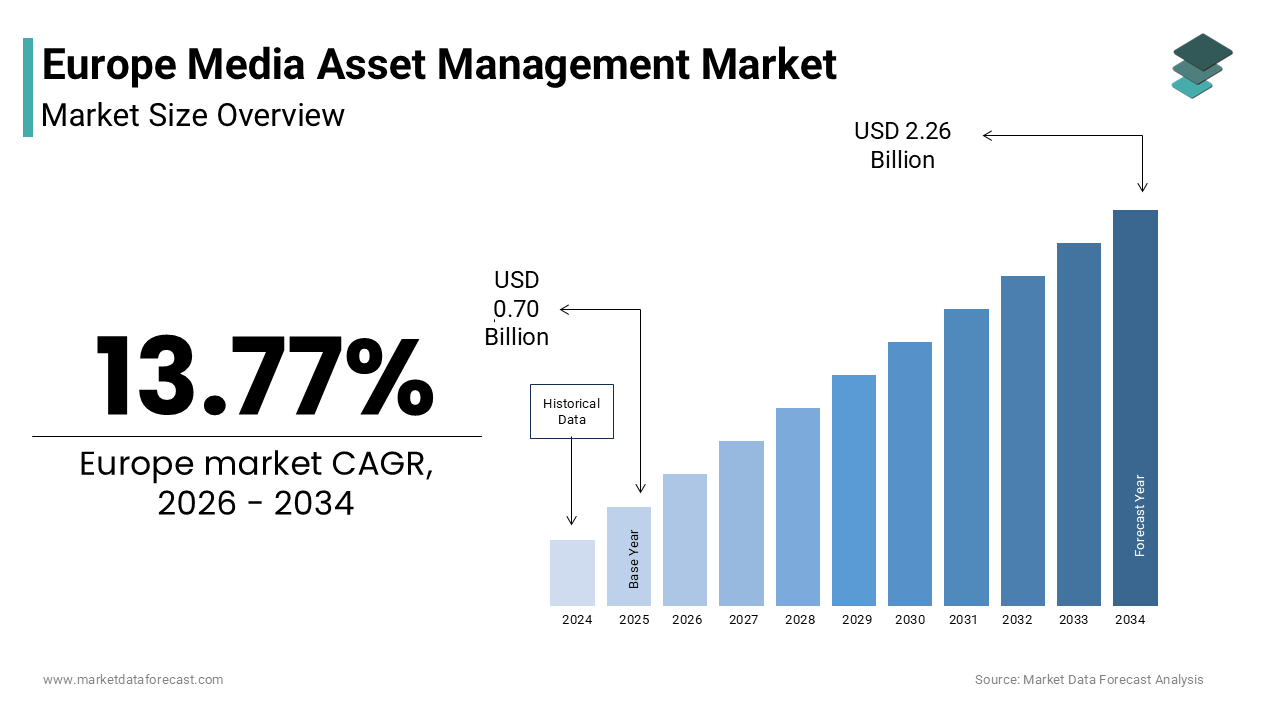
The Europe media asset management market was valued at USD 0.70 billion in 2025, is estimated to reach USD 0.80 billion in 2026, and is projected to reach USD 2.26 billion by 2034, growing at a CAGR of 13.77% during the forecast period from 2026 to 2034. The growth of the Europe media asset management market is driven by the rapid increase in high-resolution video production, rising demand for streaming services, and the growing need to efficiently organize and manage large volumes of digital media content. Increasing adoption of cloud-based media workflows, expansion of digital broadcasting platforms, and the need for regulatory compliance under data protection frameworks such as GDPR are further accelerating market growth. Moreover, the integration of artificial intelligence for automated metadata tagging and content discovery is transforming media asset management platforms into intelligent tools for content management, distribution, and monetization across Europe.
Key Market Trends
-
Rising demand for high-resolution content management driven by the increasing production of 4K and 8K video content across film, broadcasting, and streaming platforms.
-
Growing adoption of cloud-based and hybrid media asset management systems is enabling remote collaboration and scalable storage infrastructure.
-
Increasing integration of artificial intelligence and machine learning for automated metadata tagging, content indexing, and advanced search capabilities.
-
Strong emphasis on data sovereignty and regulatory compliance as organizations adopt systems that ensure GDPR-compliant storage and access control.
-
Expansion of digital archives and heritage preservation projects, particularly among public broadcasters and national media institutions.
Segmental Insights
- Based on deployment, the on-premise segment was the largest and held a 58.1% share of the Europe media asset management market in 2025. The dominance of this segment is attributed to the need for low-latency performance when managing large high-resolution video files and the preference among broadcasters and public service media organizations to maintain full control over sensitive digital assets due to strict data sovereignty requirements.
- Based on enterprise size, the large enterprises segment accounted for 64.5% of the Europe media asset management market share in 2025. The segment’s dominance is driven by the extensive digital media libraries managed by major broadcasters, film studios, and multinational corporations that require advanced asset management platforms with high scalability, security, and compliance capabilities.
Regional Insights
The Europe media asset management market is witnessing strong growth across several countries supported by expanding digital media production, increasing streaming consumption, and the modernization of broadcasting infrastructure.
-
The United Kingdom dominated the market with 22.8% of the Europe media asset management market share in 2025, driven by its strong television and film production ecosystem and the presence of major broadcasters and post-production studios.
-
Germany held 16.5% of the market share in 2025, supported by large-scale digitization initiatives by public broadcasters and strong demand for secure media archiving solutions.
-
France continues to grow as a major media production hub, supported by government funding for the film industry and the expansion of streaming services by national media groups.
-
Italy is witnessing steady growth driven by film restoration projects, increased international co-productions, and rising global demand for Italian content.
-
The Netherlands is emerging as a strategic digital media hub due to its advanced broadband infrastructure and the concentration of major data centers supporting cloud-based media management platforms.
Competitive Landscape
The Europe media asset management market is characterized by intense competition between global technology providers and specialized media software vendors. Market participants are focusing on developing cloud-native platforms, integrating artificial intelligence capabilities, and ensuring compliance with European data protection regulations. Companies are also forming strategic partnerships with broadcasters, film studios, and cloud infrastructure providers to deliver scalable and secure media management solutions. Continuous product innovation, enhanced metadata automation, and hybrid deployment models are key strategies adopted by vendors to strengthen their market position. Prominent players in the Europe media asset management market include Adobe Inc., Oracle Corporation, IBM Corporation, Microsoft Corporation, Sony Group Corporation, Dalet Digital Media Systems, Prime Focus Technologies, Tedial S.L., VSN Video Stream Networks S.L., Evertz Microsystems Ltd., Signiant Inc., and MediaBeacon Inc.
Europe Media Asset Management Market Size
The Europe media asset management market size was valued at USD 0.70 billion in 2025 and is anticipated to reach USD 0.80 billion in 2026 from USD 2.26 billion by 2034, growing at a CAGR of 13.77% during the forecast period from 2026 to 2034.
Media Asset Management (MAM) is a specialized system and set of processes used to store, organize, and manage high-volume video and multimedia files. These systems serve as the central nervous system for broadcasters, production houses, and corporate entities managing vast libraries of video, audio, and image content. The operational landscape in Europe is distinct due to stringent regulatory frameworks regarding data sovereignty and content localization. As per Eurostat, the European Union had a total population of approximately 449 million in 2024, with an estimated 415 million regular internet users (representing over 90% of the population). This widespread connectivity has created an unprecedented volume of user-generated content that necessitates robust archival and retrieval mechanisms. Furthermore, the European Broadcasting Union indicates that public service broadcasters in the region collectively manage archives millions of hours of audiovisual material (comprising film, video, and audio), much of which requires digitization and metadata enrichment.
The shift toward cloud native architectures has accelerated as organizations seek to reduce physical storage overheads while ensuring compliance with the General Data Protection Regulation. This regulatory environment mandates precise control over personal data embedded within media files, driving the adoption of intelligent tagging and access control features. The proliferation of high definition and 4K content production across major European film hubs like London, Paris, and Berlin further intensifies the need for scalable infrastructure capable of handling large file sizes without latency. Consequently, the market evolves beyond simple storage to become a strategic tool for content monetization and operational efficiency in a highly digitized continental ecosystem.
MARKET DRIVERS
Surge in High Resolution Content Production and Streaming Demand
The exponential rise in high resolution content creation is among the key reasons for the adoption of MAM and the overall growth of the Europe media asset management market. Production studios and broadcasting networks increasingly generate content in 4K and 8K formats to meet consumer expectations for immersive viewing experiences. According to research, There is a consistent upward trajectory in the availability and consumption of streaming services across Europe, heavily supported by a rise in the production of original local content. This surge generates massive data volumes where a single hour of uncompressed 4K footage can exceed 500 gigabytes, rendering traditional storage methods inefficient and cost prohibitive. Organizations must implement advanced media asset management systems to handle the ingestion, transcoding, and distribution of these large files seamlessly.
The demand extends beyond entertainment as corporate sectors utilize high quality video for training and marketing, further straining existing IT infrastructures. As per a study, high-speed internet access is nearing universal availability in Western European countries, enabling the widespread use of data-heavy streaming and digital services. This connectivity drives producers to create richer content, knowing the delivery pipeline exists. The sheer velocity of file creation leads to data silos and version control issues. Without centralized management, these problems are inevitable. Companies are therefore compelled to invest in solutions that offer automated workflow orchestration to manage the lifecycle of these assets from capture to archive. The inability to efficiently process such high bit rate content results in delayed time to market, making robust asset management not merely an option but an operational necessity for maintaining competitiveness in the European digital landscape.
Mandatory Compliance with Data Sovereignty and Privacy Regulations
Strict adherence to data protection laws serves as a critical driver forcing European organizations to upgrade their MAM capabilities, which also propels the expansion of the Europe media asset management market. The General Data Protection Regulation imposes rigorous requirements on how personal data within media files is stored, accessed, and processed. Regulatory authorities in Europe are maintaining a rigorous enforcement environment for data privacy, resulting in substantial financial penalties for organizations that fail to protect user information. Media files often contain biometric data such as facial images and voice recordings which fall under special category data requiring enhanced security measures. Organizations must deploy media asset management platforms that offer granular access controls, audit trails, and automated redaction capabilities to ensure lawful processing.
The complexity increases with cross border data transfers where media assets moved between European nations or outside the EU must comply with specific adequacy decisions. Organizations are increasingly aligning their technology budgets with legal requirements to mitigate the risks associated with evolving data protection laws. Failure to integrate these compliance features into asset management workflows can lead to legal liabilities and reputational damage. Consequently, vendors are innovating to include privacy by design features directly into their software architectures. This regulatory pressure ensures that even smaller production houses invest in compliant systems to avoid penalties. The drive for compliance transforms media asset management from a logistical tool into a legal safeguard, ensuring that every digital asset is tracked and managed according to the strictest privacy standards mandated by European law.
MARKET RESTRAINTS
Fragmentation of Legacy Infrastructure Across Regional Markets
The persistence of fragmented legacy infrastructure poses a significant restraint on the growth of the Europe media asset management market. Many established broadcasters and production companies operate on disparate systems acquired over decades, creating complex integration challenges for modern cloud based solutions. Public media organizations in specific European regions are facing substantial hurdles in modernizing their historical content due to the persistence of physical storage formats and a lack of searchable digital information. The heterogeneity of technical standards across different European countries further complicates the deployment of unified asset management systems. Organizations face substantial downtime and operational disruption when attempting to migrate petabytes of data from obsolete formats to contemporary digital repositories.
The high financial cost associated with converting physical film into high-standard digital formats remains a primary barrier for smaller and mid-sized heritage institutions. Additionally, the shortage of skilled personnel capable of managing hybrid environments comprising both legacy and modern systems exacerbates the issue. A significant shortage of skilled technology professionals in Europe is slowing down the ability of organizations to transition to more advanced digital infrastructures. This technological debt forces companies to maintain parallel systems, increasing operational costs and reducing the overall efficiency gains expected from new media asset management implementations. The reluctance to abandon sunk costs in older infrastructure slows the adoption rate of advanced solutions, thereby restraining market momentum despite the clear long term benefits of modernization.
High Implementation Costs and Economic Volatility
Elevated implementation costs coupled with regional economic volatility act as a formidable barrier to widespread MAM adoption and the Europe media asset management market. Deploying enterprise grade solutions requires significant capital expenditure for software licensing, cloud storage subscription, and specialized hardware upgrades. Although price increases have stabilized in the largest European markets, the lingering effects of previous high-inflation periods continue to strain corporate spending on technology. Small and medium sized enterprises, which constitute a large portion of the European creative sector, find the total cost of ownership for advanced media asset management systems prohibitive. The financial strain is compounded by the recurring costs associated with data egress fees and premium support services required for mission critical operations.
Rising operational expenses are forcing smaller media producers to deprioritize long-term technology upgrades in favor of maintaining immediate daily operations. Furthermore, the unpredictable economic landscape makes long term financial planning difficult, causing decision makers to opt for cheaper, less capable alternatives that fail to meet future scalability needs. Currency fluctuations within the Eurozone and between the Euro and other European currencies also impact the pricing models of international software vendors, adding another layer of financial uncertainty. These economic pressures restrict the market penetration of high end solutions, limiting growth to only the largest players who can absorb the initial financial shock. The result is a slowed adoption curve where potential users remain on inadequate systems, hindering the overall expansion and innovation velocity of the media asset management sector in the region.
MARKET OPPORTUNITIES
Integration of Artificial Intelligence for Automated Metadata Tagging
The integration of artificial intelligence for automated metadata tagging offers a transformative opportunity for the Europe media asset management market. AI driven algorithms can analyze visual and audio content to automatically generate descriptive tags, significantly reducing manual labor and enhancing searchability. Media organizations are rapidly integrating artificial intelligence to handle repetitive tasks like generating captions and identifying visual elements within their large content libraries. This technology enables organizations to unlock the value of dormant archives by making previously unsearchable content instantly retrievable based on context, sentiment, or specific visual elements. For instance, a broadcaster can instantly locate all clips containing a specific landmark or public figure without manual review, drastically cutting down production time.
A substantial portion of the daily workload for content professionals is currently dedicated to organizing and labeling assets, highlighting a major opportunity for automation. By automating this process, companies can reallocate human resources to creative tasks while ensuring consistent and accurate metadata application across vast libraries. Furthermore, AI capabilities continue to evolve with multilingual support, addressing the linguistic diversity of the European market by accurately tagging content in dozens of local languages. This facilitates better content localization and distribution across borders. Vendors offering AI enhanced platforms gain a competitive edge as clients seek to maximize the utility of their existing assets. The opportunity lies in shifting from passive storage to active content intelligence, where the system proactively suggests edits, identifies licensing opportunities, and detects compliance issues. This evolution positions media asset management as a strategic revenue generator rather than a cost center, opening new avenues for market growth driven by operational excellence and content monetization.
Expansion of Cloud Native Architectures and Hybrid Workflows
The shift toward cloud-native architectures and hybrid workflows creates many new options for the Europe media asset management market expansion. This is happening as European organizations seek greater flexibility and scalability. Cloud based media asset management solutions eliminate the need for heavy upfront capital investment in physical servers while providing elastic storage capacity that scales with content volume. Businesses across Europe, particularly in the creative sectors, are shifting their budgets toward internet-based computing services to replace traditional physical hardware. Hybrid models allow companies to keep sensitive or frequently accessed assets on premise while leveraging the cloud for archiving and collaborative editing, optimizing both cost and performance. This approach supports the growing trend of remote production where teams distributed across different European cities collaborate in real time on the same project files.
The capability to access high resolution assets from any location with secure internet connectivity democratizes content creation and accelerates project timelines. The film industry is moving away from centralized studio work, creating a growing need for software that allows teams to collaborate on high-quality video files from different locations. Vendors who provide seamless interoperability between on premise and cloud environments cater to this evolving demand effectively. Additionally, cloud providers are establishing data centers within Europe to address sovereignty concerns, making cloud adoption more palatable for regulated industries. This infrastructure evolution lowers the entry barrier for smaller players and enables agile scaling for larger enterprises. The opportunity resides in delivering flexible, secure, and globally accessible platforms that align with the modern distributed nature of the European media industry.
MARKET CHALLENGES
Complexity of Cross Border Data Transfer and Jurisdictional Conflicts
The complexity of cross border data transfer and jurisdictional conflicts is a persistent challenge for the Europe media asset management market. Media assets often flow across national boundaries for co productions, distribution, and cloud processing, triggering a web of conflicting legal requirements. As per research, discrepancies in how different member states interpret and enforce the General Data Protection Regulation create legal ambiguities for multinational media operations. A file containing personal data uploaded to a cloud server in one country may be processed in another, potentially violating local data residency laws if not meticulously managed. This fragmentation forces vendors to build highly complex compliance engines that can dynamically route data based on its content and destination, increasing development costs and system latency.
The challenge is exacerbated by the invalidation of certain international data transfer frameworks, which limits the ability to use global cloud infrastructure for European content. According to a study, the increasing number of digital regulations in Europe is creating a complex legal environment that raises administrative burdens and can slow down the launch of new digital services. Media asset management providers must constantly update their systems to reflect changing judicial rulings and regulatory guidance, a resource intensive process that slows innovation. Furthermore, the lack of a fully harmonized digital single market means that a solution compliant in Germany might require significant modification to operate legally in France or Italy. This regulatory patchwork hinders the deployment of standardized global solutions and forces a localized approach that fragments the market. Organizations face the daunting task of navigating these legal minefields while ensuring uninterrupted content workflows, making jurisdictional compliance a critical operational hurdle.
Security Vulnerabilities Amidst Rising Cyber Threats
Escalating security vulnerabilities amidst rising cyber threats pose a severe challenge to the integrity and trustworthiness of MAM systems in the region and the Europe media asset management market. As media libraries become centralized digital repositories, they attract sophisticated cybercriminals seeking to steal unreleased content, hold data for ransom, or disrupt broadcasting operations. Ransomware remains a dominant and evolving threat in Europe, with attackers using increasingly professional methods to extort organizations across multiple industries. The high value of pre release films and exclusive news footage makes these assets prime targets, necessitating military grade encryption and zero trust security architectures. However, implementing such rigorous security measures often conflicts with the need for fast, frictionless access required by creative teams.
Balancing robust security with user experience remains a delicate and often elusive goal for system architects. The challenge is compounded by the insider threat where disgruntled employees or compromised credentials lead to data leaks from within the organization. Managing who has access to sensitive digital assets remains a major difficulty for large organizations, as unauthorized internal access continues to be a notable factor in security incidents. Moreover, the integration of third party plugins and APIs to extend functionality introduces additional attack vectors that hackers exploit to bypass perimeter defenses. Vendors must continuously patch vulnerabilities and monitor for anomalous behavior, yet the rapidly evolving threat landscape often outpaces defensive updates. This perpetual security arms race increases the total cost of ownership and creates anxiety among potential adopters who fear that a single breach could result in catastrophic financial and reputational loss.
REPORT COVERAGE
| REPORT METRIC | DETAILS |
| Market Size Available | 2025 to 2034 |
| Base Year | 2025 |
| Forecast Period | 2026 to 2034 |
| CAGR | 13.77% |
| Segments Covered | By Deployment, Enterprise Size and Region. |
| Various Analyses Covered | Global, Regional & Country Level Analysis, Segment-Level Analysis, DROC, PESTLE Analysis, Porter’s Five Forces Analysis, Competitive Landscape, Analyst Overview of Investment Opportunities |
| Country Covered | UK, France, Spain, Germany, Italy, Russia, Sweden, Denmark, Switzerland, the Netherlands, Turkey, the Czech Republic, and the Rest of Europe. |
| Market Leaders Profiled | Adobe Inc., Oracle Corporation, IBM Corporation, Microsoft Corporation, Sony Group Corporation, Dalet Digital Media Systems, Prime Focus Technologies, Tedial S.L., VSN Video Stream Networks S.L., Evertz Microsystems Ltd., Signiant Inc., and MediaBeacon Inc. |
SEGMENTAL ANALYSIS
By Deployment Insights
The on-premise deployment segment held the majority share of 58.1% of the Europe media asset management market in 2025. The supremacy of the segment is supported by the critical need for low-latency performance when handling uncompressed high-resolution video files, which cloud networks often struggle to support without significant bandwidth costs. Moreover, the segment’s position is also supported by the deep-rooted preference among major European broadcasters and public service entities to maintain absolute control over their data infrastructure due to stringent sovereignty laws. As per sources, public broadcasters are increasingly adopting hybrid infrastructure models, keeping some critical operations on-premise for security while migrating deep archives to private or sovereign cloud environments to leverage AI tools. Furthermore, the General Data Protection Regulation imposes strict data residency requirements that make many large institutions hesitant to migrate sensitive content to third-party cloud environments. According to a study, data sovereignty has become a dominant factor in IT decision-making for European companies, leading to a preference for "sovereign cloud" providers that guarantee data remains within EU legal jurisdictions. The substantial existing investment in physical storage hardware also creates a high switching cost barrier, compelling firms to extend the lifecycle of their current infrastructure rather than incur the capital expenditure required for a full cloud migration. This combination of regulatory caution, performance necessity, and sunk costs solidifies the on-premise segment as the market leader for the immediate future.

The cloud deployment segment is predicted to witness the highest CAGR of 14.8% during the forecast period due to the increasing adoption of hybrid workflows where creative teams distributed across different countries require seamless access to shared assets without the logistical burden of physical data transfer. In addition, this rapid expansion is also fueled by the escalating demand for remote collaboration tools and the economic shift from capital expenditure to operational expenditure models among independent production houses. The media industry is steadily moving its production pipelines to the cloud to support remote collaboration and fluctuating storage needs, though this is often hindered by "egress fees" and vendor lock-in concerns. Additionally, advancements in edge computing have significantly reduced latency issues, making cloud-based editing and rendering viable for high-definition content. Cross-border co-production remains a vital financing and distribution strategy for European filmmakers, maintaining a consistent presence in the market despite broader economic pressures reducing overall production volumes. The ability to deploy artificial intelligence tools for automated tagging and analytics directly within the cloud environment further accelerates adoption, as these services are more easily integrated into cloud-native architectures than legacy on-premise systems. This convergence of technological maturity, collaborative necessity, and financial flexibility propels the cloud segment to outpace all other deployment modes in growth velocity.
By Enterprise Size Insights
In 2025, the large enterprises segment dominated the Europe media asset management market and accounted for a 64.5% share. The dominance of the segment is driven by the complex regulatory compliance burden that large organizations face, necessitating sophisticated systems capable of managing granular access controls and detailed audit trails. Following that, this segment is pushed by the massive volume of digital assets generated by major broadcasting networks, film studios, and multinational corporate communication departments that require enterprise-grade scalability and security. Large multinational media groups continue to dominate the European revenue landscape, driving a critical need for large-scale digital infrastructure to manage their vast catalogues. Furthermore, large enterprises possess the financial resources to invest in comprehensive digital transformation initiatives, including the integration of artificial intelligence and machine learning capabilities into their workflows. Large-scale media organizations are prioritizing the modernization of their archiving and management systems to better handle the demands of personalized streaming services. The need to monetize extensive back catalogs through multi-platform distribution also forces these giants to adopt advanced solutions that can automate metadata enrichment and rights management. This combination of asset volume, regulatory complexity, and financial capability ensures that large enterprises remain the primary revenue source for media asset management vendors across the continent.
The small and medium size enterprise segment is estimated to register the fastest CAGR of 13.5% from 2026 to 2034. The swift growth of this segment is propelled by the rise of digital-first media startups and independent production agencies that rely entirely on agile, cloud-native workflows to compete with established broadcasters. This accelerated growth is also attributed to the democratization of high-quality content creation tools and the proliferation of affordable, subscription-based cloud solutions that lower the entry barrier for smaller players. The independent production sector remains a resilient and growing part of the European media ecosystem, increasingly turning to flexible digital tools to stay competitive. Additionally, the shifting consumer landscape towards niche streaming channels and social media content has empowered smaller entities to produce specialized content that requires efficient organization and rapid deployment. Smaller media entities are finding that automating routine organizational tasks allows their teams to focus more on creative content production and less on manual file management. The flexibility of pay-as-you-go pricing models allows these businesses to scale their storage and processing power in line with project demands without heavy upfront capital outlays. This alignment of affordable technology with the exploding gig economy of content creation drives the exceptional growth trajectory of the small and medium size enterprise segment.
REGIONAL ANALYSIS
United Kingdom Media Asset Management Market Analysis
The United Kingdom dominated the Europe media asset management market and captured a 22.8% share in 2025. The leading position of the UK market is driven by the generous tax relief scheme for high-end television production, which has attracted significant international investment and spurred the creation of vast amounts of digital content requiring sophisticated management. The nation serves as the undisputed hub for high-end television production and post-production services, driven by a robust ecosystem of world-class studios and visual effects houses concentrated in London and Manchester. The UK remains a premier global hub for large-scale television and film projects, with production spending reaching record highs and driving a massive requirement for digital storage and asset management. Furthermore, the presence of global broadcasting giants like the BBC and ITV, alongside numerous independent producers, creates a dense demand for solutions that can handle complex rights management and multi-platform distribution. The creative economy is one of the fastest-growing sectors in the UK, significantly outperforming the wider economy and relying heavily on digital infrastructure to maintain its competitive edge. The early adoption of cloud technologies and AI-driven workflows by UK firms further cements its leadership, as organizations strive to maintain their competitive edge in a globalized content market. This confluence of financial incentives, industrial density, and technological maturity ensures the United Kingdom remains the dominant force in the European landscape.
Germany Media Asset Management Market Analysis
Germany was the second largest country in the Europe media asset management market and held a 16.5% share in 2025. A major driving factor is the mandatory digitization of extensive analog archives held by public broadcasters like ARD and ZDF, which house decades of historical content that must be made accessible for modern digital consumption. The country's market status is defined by its powerful public broadcasting sector and a highly regulated media environment that prioritizes data sovereignty and long-term archival preservation. Germany is making a concerted effort to preserve its cultural history by converting physical film and audio records into secure, searchable digital formats. Additionally, the strong automotive and manufacturing sectors in Germany utilize media asset management for technical documentation and training videos, expanding the market beyond traditional entertainment. The volume of locally produced content in Germany remains high, necessitating strict metadata management to ensure content meets complex broadcasting and regulatory standards. The rigorous enforcement of the General Data Protection Regulation within Germany also compels organizations to invest in premium on-premise or sovereign cloud solutions that guarantee data residency. This blend of public sector mandates, industrial application, and regulatory strictness drives the sustained prominence of Germany in the market.
France Media Asset Management Market Analysis
France is another significant player in the Europe media asset management market due to the Centre National du Cinéma et de l'image animée funding mechanisms, which require beneficiaries to maintain detailed digital records of their productions, thereby standardizing the use of professional asset management systems. It is underpinned by its rich cultural heritage and state-supported film industry. The market status in France is characterized by a strong emphasis on preserving national cinematic identity and supporting independent creators through generous government subsidies. As per the French Ministry of Culture, the country produced over 300 feature films in 2024, the highest volume in Europe, generating immense data flows that require efficient organization and distribution capabilities. Furthermore, the strategic push by major French media groups like Canal+ and TF1 to expand their streaming services has intensified the need for scalable platforms capable of managing vast libraries of on-demand content. French media firms are increasingly investing in technical upgrades to support the industry's shift toward high-resolution digital production and cloud-based collaboration. The linguistic diversity within the Francophone world also necessitates advanced metadata capabilities for multi-language versioning and subtitling, further driving the adoption of sophisticated software. This synergy of cultural policy, production volume, and digital expansion solidifies France as a critical market node.
Italy Media Asset Management Market Analysis
Italy grew steadily in the Europe media asset management market owing to the extensive restoration projects undertaken by institutions like Cinecittà and the National Film Museum, which convert fragile film reels into high-resolution digital assets requiring secure and organized storage. The market dynamics in Italy are heavily influenced by its historic role as a center for film production and its growing focus on restoring and digitizing classic cinema for global distribution. Additionally, the resurgence of international co-productions filming in Italy has brought foreign capital and modern workflow requirements to local studios, pushing them to upgrade their technological infrastructure. The rising popularity of Italian content on global streaming platforms also drives local producers to adopt systems that facilitate easy localization and rights tracking. This fusion of heritage preservation, international collaboration, and global content demand propels Italy's significant standing in the market.
Netherlands Media Asset Management Market Analysis
The Netherlands is likely to expand notably in the Europe media asset management market during the forecast period due to the exceptional broadband connectivity and data center density in Amsterdam, which makes the Netherlands a preferred location for hosting cloud-based media asset management platforms serving the broader European region. The country serves as a strategic gateway for digital media in Northern Europe, distinguished by its advanced digital infrastructure and high concentration of multinational corporate headquarters. Furthermore, the Dutch public broadcasting system NPO has been a pioneer in implementing open standards for media archiving, setting a benchmark that encourages widespread adoption of compatible management systems across the sector. The strong presence of tech-savvy startups and a supportive ecosystem for digital innovation further accelerate the deployment of cutting-edge solutions. This combination of infrastructural superiority, public sector leadership, and technological agility establishes the Netherlands as a key growth engine in the European market.
COMPETITIVE LANDSCAPE
The competition in the Europe media asset management market is characterized by a dynamic interplay between established technology giants and specialized niche vendors who compete on innovation and regulatory compliance. Large multinational corporations leverage their extensive resources to offer comprehensive ecosystems that integrate storage computing and analytics while smaller firms differentiate themselves through agile customization and deep industry expertise. The rivalry intensifies as companies race to embed artificial intelligence capabilities that automate complex workflows and reduce operational costs for media organizations facing budget pressures. Data sovereignty remains a pivotal battleground where vendors must prove their ability to keep content within European borders to win contracts from public broadcasters and government entities. Strategic alliances with local system integrators become essential for navigating the fragmented regulatory landscape across different nations. Customers increasingly demand flexible pricing models and seamless interoperability which forces competitors to constantly evolve their service offerings. The market sees frequent mergers and acquisitions as larger players seek to absorb innovative startups to accelerate their technological roadmaps and expand their geographic reach within the continent.
KEY MARKET PLAYERS
Some of the companies that are playing a dominating role in the Europe Media Asset Management Market include
- Adobe Inc.
- Oracle Corporation
- IBM Corporation
- Microsoft Corporatio
- Sony Group Corporation
- Dalet Digital Media Systems
- Prime Focus Technologies
- Tedial S.L.
- VSN Video Stream Networks S.L.
- Evertz Microsystems Ltd.
- Signiant Inc.
- MediaBeacon Inc.
Top Players in the Europe Media Asset Management Market
Avid Technology
Avid Technology remains a cornerstone of the European media landscape by providing industry standard editing and asset management solutions used by major broadcasters and film studios. The company deeply integrates its Interplay platform with creative workflows to ensure seamless collaboration across distributed teams in cities like London and Berlin. Recently Avid has focused on enhancing its cloud native capabilities through the launch of Avid Cloud Collaboration which allows editors to access high resolution assets remotely without compromising quality. This strategic shift addresses the growing demand for flexible production environments driven by recent global changes in working patterns. Avid continues to invest heavily in artificial intelligence features that automate metadata tagging and content discovery within its systems. These innovations help European clients manage vast archives more efficiently while reducing manual labor costs significantly. The firm actively partners with local system integrators to ensure customized deployments that meet specific regulatory requirements across different European nations.
IBM Corporation
IBM Corporation leverages its extensive expertise in artificial intelligence and hybrid cloud infrastructure to deliver robust media asset management solutions tailored for large European enterprises. The company utilizes its Watson AI technology to provide advanced cognitive capabilities such as automatic speech recognition and visual analysis within its Content Manager On Demand platform. IBM recently strengthened its position by expanding its cloud data center footprint across Germany and France to ensure strict compliance with European data sovereignty laws. This expansion allows media companies to store and process sensitive content locally while benefiting from global scale and security. The firm actively collaborates with European broadcasters to modernize legacy archives through digitization projects that unlock historical content for new revenue streams. IBM emphasizes security and governance in its offerings which appeals to highly regulated sectors like public broadcasting and government media agencies. Their continuous investment in quantum ready encryption technologies further solidifies trust among clients concerned about future cyber threats.
Sony Group Corporation
Sony Group Corporation capitalizes on its dual identity as both a content creator and technology provider to offer holistic media asset management solutions across Europe. The company integrates its professional camera and storage hardware with sophisticated software platforms to create end to end workflows that optimize performance for high resolution video production. Sony recently launched updated versions of its Ci media cloud platform which facilitates secure sharing and collaboration for creative teams working on complex international co-productions. This enhancement supports the increasing volume of four K and eight K content generated by European studios and post-production houses. The firm actively engages with European film festivals and production guilds to showcase how its technology streamlines the entire lifecycle of media assets from capture to distribution. Sony also focuses on sustainability by developing energy efficient storage solutions that reduce the carbon footprint of large scale data centers. Their commitment to open standards ensures interoperability with third party tools which is crucial for diverse European production ecosystems.
Top Strategies Used by Key Market Participants
Key players in the Europe media asset management market primarily employ strategic acquisitions to integrate emerging technologies such as artificial intelligence and machine learning into their existing portfolios. Companies frequently pursue partnerships with cloud infrastructure providers to offer hybrid deployment models that satisfy strict European data residency regulations while enabling scalable remote workflows. Product innovation remains a central strategy where vendors continuously release updates featuring automated metadata tagging and advanced search capabilities to enhance user efficiency. Market participants also focus on vertical specialization by developing tailored solutions for specific sectors like broadcast sports or independent film production to address unique operational requirements. Expanding local support networks and establishing regional data centers are critical tactics used to build trust and ensure low latency performance for clients across diverse European geographies.
MARKET SEGMENTATION
This research report on the Europe Media Asset Management Market has been segmented and sub-segmented based on the following categories.
By Deployment
- Cloud
- On-premise
By Enterprise Size
- Small & Medium Size Enterprise
- Large Enterprise
By Country
- UK
- France
- Spain
- Germany
- Italy
- Russia
- Sweden
- Denmark
- Switzerland
- Netherlands
- Turkey
- Czech Republic
- Rest of Europe