Europe Medical Billing Outsourcing Market Size, Share, Trends, & Growth Forecast Report By Service (Front-End, Middle-End, Back-End), Type of Deployment, End-User and Country (UK, France, Spain, Germany, Italy, Russia, Sweden, Denmark, Switzerland, Netherlands, Turkey, Czech Republic and Rest of Europe), Industry Analysis From 2025 to 2033
Europe Medical Billing Outsourcing Market Size
The europe medical billing outsourcing market size was valued at USD 2.95 billion in 2024 and is anticipated to reach USD 3.27 billion in 2025 from USD 7.57 billion by 2033, growing at a CAGR of 11.06% during the forecast period from 2025 to 2033.
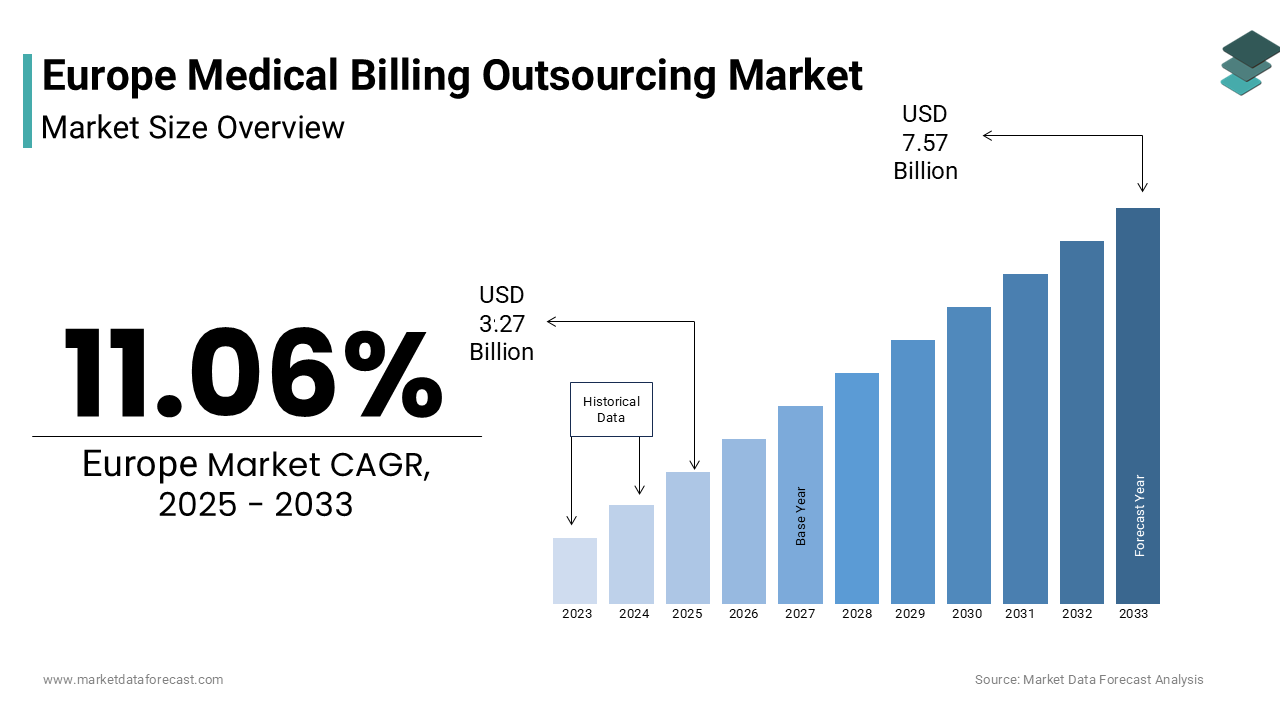
Medical billing outsourcing is the third-party service providers that manage end to end revenue cycle functions for hospitals, clinics and private practices across the European Union. Unlike in fragmented or insurance dominated systems, Europe’s predominantly public or multi payer healthcare frameworks create unique billing complexities, particularly in countries with mixed statutory and private reimbursement models. According to Eurostat, around 81% of healthcare expenditure in the EU is publicly financed, yet private insurance and out-of-pocket payments still account for significant billing workloads in Germany, France and the UK. Concurrently, according to sources, administrative costs represent a notable share of hospital expenditures in Europe and billing and coding errors contribute to between 15 and 20% of claim denials. These systemic inefficiencies, coupled with chronic workforce shortages have propelled medical billing outsourcing from a cost-saving measure to a strategic necessity for revenue integrity and operational resilience.
MARKET DRIVERS
Chronic Shortage of Certified Medical Coders and Billing Specialists Drives Outsourcing Adoption
Europe faces a severe scarcity of professionals trained in standardized medical coding systems such as ICD 10, ICD 11 and local nomenclature like the German OPS or French CCAM, which is one of the key factors driving the growth of the medical billing outsourcing market in Europe. Across the EU, there is a significant shortage of certified medical coders with particularly acute gaps in Southern and Eastern member states. This shortage stems from limited academic pipelines and high attrition due to the repetitive, high-pressure nature of billing work. In the UK, hospital finance departments have reported widespread unfilled coding positions, which is leading to backlogs and delayed reimbursements. Outsourcing providers address this gap by centralizing expertise in shared service centers where teams undergo continuous training on evolving coding rules and payer policies. For instance, Germany’s statutory health insurers require OPS code validation for every inpatient procedure and errors can result in claim rejections exceeding 20%. By leveraging specialized, scalable teams, outsourcing ensures coding accuracy, faster cash flow and compliance with national reimbursement frameworks.
Increasing Complexity of Multi Payer Reimbursement Systems Elevates Need for Specialized Billing Expertise
While Europe’s healthcare is largely public, the coexistence of statutory insurance, private health plans, cross border care schemes and self-pay models creates a highly fragmented billing environment that demands deep payer specific knowledge, which is further boosting the regional market expansion. In Germany alone, there are over 100 statutory sickness funds, each with slight variations in documentation requirements and processing timelines. In France, private supplemental insurance covers the vast majority of the population, which requires dual billing for every outpatient consultation. Similarly, the UK’s mixed system requires practices to manage two distinct coding and claims workflows. Studies have shown that billing errors in multi-payer settings are significantly more frequent than in single-payer contexts. Outsourcing firms mitigate this risk by maintaining dedicated payer rule engines and localized billing teams familiar with national and regional nuances. This specialization reduces denial rates, which accelerates collections and allows clinicians to focus on care delivery rather than administrative reconciliation.
MARKET RESTRAINTS
Stringent and Fragmented Data Protection Regulations Impede Cross Border Outsourcing Models
The General Data Protection Regulation establishes a high baseline for health data handling, but its implementation varies significantly across EU member states, which is creating legal uncertainty for medical billing outsourcing and hampering the European medical billing outsourcing market growth. According to the European Data Protection Board, a notable share of healthcare-related GDPR investigations have involved third-party processors transmitting patient billing data without adequate safeguards or explicit consent. Countries like Germany and Austria require additional contractual clauses and prior supervisory authority approval for any health data transfer, even within the EU. This regulatory patchwork forces outsourcing providers to establish localized processing centers in each major market, inflating operational costs. For instance, many hospital administrators have delayed or cancelled outsourcing plans due to concerns over data residency and liability allocation. Until harmonized guidance emerges on health data processing in revenue cycle contexts, cross-border scalability will remain constrained.
Reluctance to Cede Control Over Financial Operations Persists Among Smaller Providers
Despite cost and efficiency benefits, many small and mid-sized healthcare practices in Europe remain hesitant to outsource core billing functions due to concerns over transparency, responsiveness and perceived loss of financial autonomy, which is further hindering the growth of the European market. In Italy, Spain and Greece, many solo and group practices report that maintaining in-house billing preserves direct oversight of cash flow and patient communication. This sentiment is reinforced by cultural preferences for personal relationships in healthcare administration, particularly in Southern Europe. Additionally, fragmented electronic health record systems complicate data integration with external billing platforms. In Italy, only a minority of private clinics use interoperable billing software, forcing manual data exports that increase error risk in outsourced models. Until outsourcing providers offer more transparent dashboards, real-time reconciliation and localized customer support, resistance among smaller providers will continue to limit market penetration.
MARKET OPPORTUNITIES
Expansion of Value Based Care Models Creates Demand for Advanced Revenue Cycle Analytics
As European healthcare systems shift toward outcome-based reimbursement, providers require billing partners capable of linking clinical performance data to financial claims, which is a significant opportunity for the European medical billing outsourcing market. Across the EU, many countries have launched value-based care initiatives, necessitating sophisticated billing systems that track quality indicators alongside procedural codes. Outsourcing firms are responding by embedding business intelligence into their platforms. For instance, Dutch providers now use dashboards that correlate diabetes care bundle compliance with quarterly payments from health insurers. Similarly, the UK’s NHS Integrated Care Boards require real-time reporting on activity volumes and outcome metrics as part of capitation adjustments. These evolving reimbursement structures transform billing from a transactional task into a strategic function that supports financial risk management and contract optimization, which is opening opportunities for high-value, analytics-driven outsourcing partnerships.
Adoption of AI Powered Automation in Coding and Claims Processing Unlocks New Service Tiers
European medical billing outsourcing providers are increasingly integrating artificial intelligence to enhance accuracy, reduce turnaround time and lower operational costs, which is another promising opportunity for the regional market. By 2024, many leading revenue cycle management firms in the EU had deployed AI-driven coding assistants capable of auto-suggesting ICD-10 codes from clinical notes with high accuracy. These systems learn from national coding guidelines and historical payer decisions, which are adapting to local nuances in Germany’s OPS or France’s NGAP fee schedules. Furthermore, machine learning models now predict claim denial risk based on payer behaviour patterns, allowing pre-submission corrections that significantly reduce rejection rates. This technological sophistication enables providers to offer tiered services, which align with Europe’s demand for both cost efficiency and compliance assurance in an era of fiscal constraint.
MARKET CHALLENGES
Ambiguity in Liability Allocation for Billing Errors Under Shared Service Models
A persistent challenge in the Europe medical billing outsourcing market is the unclear delineation of legal and financial responsibility when coding or claims errors occur. While the GDPR designates the healthcare provider as the data controller, billing mistakes can trigger audits, fines, or reimbursement clawbacks from national health insurers. In Germany, billing audits frequently result in financial penalties, yet contracts often lack specific clauses on whether the provider or outsourcer bears liability. Similarly, France’s National Health Insurance Fund does not recognize third-party billing agents as accountable entities, which places full legal onus on the clinician or hospital. This asymmetry discourages providers from fully delegating complex billing tasks, particularly in high-risk specialties like radiology or oncology. Until standardized service level agreements with enforceable error accountability mechanisms are adopted across the EU, trust in outsourcing partnerships will remain partial and cautious.
Integration Barriers with Legacy Health IT Systems Limit Operational Efficiency
Many European healthcare providers still operate on outdated practice management or hospital information systems that lack modern interoperability standards, which is making seamless data exchange with external billing platforms difficult and is further challenging the regional market expansion. According to the European Commission’s Digital Health Survey 2024, only 38% of small clinics in the EU used systems compliant with the HL7 or FHIR standards with many relying on proprietary or paper-based workflows. For instance, over 60% of private radiology centers used custom billing software that cannot export structured data in Italy, which is forcing outsourcing firms to manually rekey information. Even in digitally advanced nations, integration gaps persist. According to the UK’s NHS Digital, 29% of GP practices used EHR systems without automated claims export functionality. These technical frictions inflate implementation timelines, reduce automation potential and undermine the core value proposition of outsourcing. Until legacy system modernization accelerates through EU digital health funding, integration will remain a critical bottleneck.
REPORT COVERAGE
| REPORT METRIC | DETAILS |
| Market Size Available | 2024 to 2033 |
| Base Year | 2024 |
| Forecast Period | 2025 to 2033 |
| Segments Covered | By Service, Type of Deployment, End-User and Region |
| Various Analyses Covered | Global, Regional & Country Level Analysis, Segment-Level Analysis, Drivers, Restraints, Opportunities, Challenges, PESTLE Analysis, Porter’s Five Forces Analysis, Competitive Landscape, Analyst Overview of Investment Opportunities |
| Regions Covered | United Kingdom (UK), France, Spain, Germany, Italy, Russia, Sweden, Denmark, Switzerland, the Netherlands, Turkey, the Czech Republic, and the Rest of Europe. |
| Market Leaders Profiled | R1 RCM Inc., Cerner Corporation, Allscripts Healthcare Solutions, Inc., McKesson Corporation, Experian Information Solutions, Inc., HCL Technologies Limited, Accenture plc, GE Healthcare, Quest Diagnostics Incorporated, and The SSI Group, LLC. |
SEGMENTAL ANALYSIS
By Service Insights
The back-end segment dominates the Europe medical billing outsourcing market by accounting for 47.5% of the regional market share in 2024 owing to its critical role in revenue realization through claims adjudication, denial management, payment posting and accounts receivable follow up and the high complexity and labor intensity of post submission billing processes that require deep payer-specific expertise and persistent communication with insurers. Back-end errors account for a significant share of unrecovered revenue losses in European hospitals. Given the fragmented payer landscape, where even public insurers like Germany’s sickness funds apply regional processing variations, providers increasingly rely on specialized outsourcing partners to navigate reimbursement intricacies. The financial pressure on healthcare institutions to accelerate cash flow in an era of constrained public funding is further contributing to the dominance of the back-end segment in the European market. Across the EU, hospitals have reported rising accounts receivable days in recent years due to administrative backlogs and staffing shortages. Outsourced back-end teams use structured workflows and payer relationship databases to reduce this cycle time by 20 to 30%, as demonstrated in pilot programs across Dutch and Swedish hospital networks. Their ability to proactively manage denials, track underpayments and reconcile remittance advice ensures maximum reimbursement recovery, which is making back-end outsourcing not just operational but financially strategic for European providers.
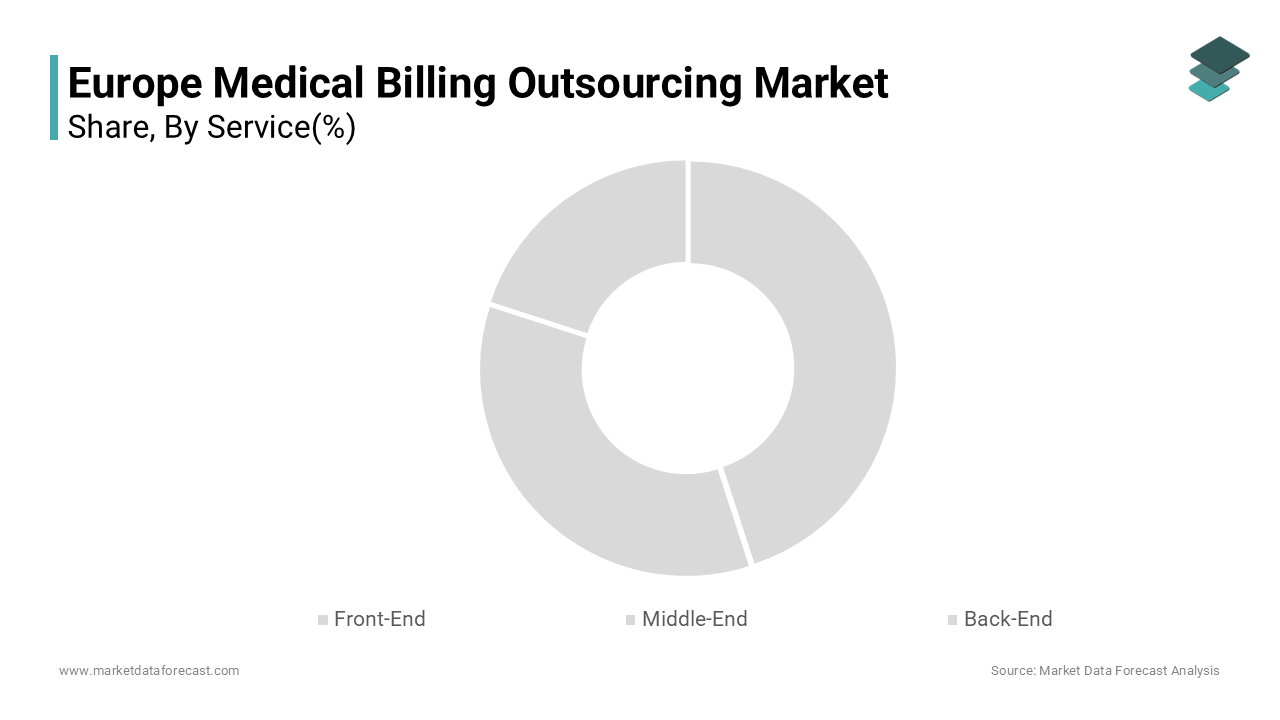
The front-end segment is estimated to register the fastest CAGR of 13.3% over the forecast period in the European medical billing outsourcing market. The growth of the front-end segment in the European market is fuelled by the increasing emphasis on clean claim submission, where errors in eligibility verification or patient registration directly cause downstream denials. Across Europe, a significant share of initial claim rejections originates from front-end inaccuracies such as outdated insurance details or missing authorization codes as these issues which are preventable with robust pre-service validation. The regulatory push for digital patient onboarding under national eHealth strategies is driving the growth of the front-end segment in the European market. The UK’s NHS Digital Transformation Framework now mandates real-time eligibility checks for all private patient episodes, while Germany’s ePA (electronic patient record) rollout requires integrated insurance validation at the point of care. Outsourcing providers are responding with AI-enabled front-end platforms that auto-verify coverage, estimate patient responsibility and capture consent digitally, which is reducing registration errors significantly in trials conducted by French private clinics. As European health systems prioritize first-pass yield and patient financial transparency, front-end outsourcing is evolving from a clerical function to a strategic gateway for revenue integrity and customer experience.
By Type of Deployment Insights
The cloud-based deployment segment commanded 58.5% of the European market share in 2024. The growth of the cloud-based deployment segment in the European market is primarily driven by its agility, scalability and seamless integration with modern health IT ecosystems. European healthcare providers favour cloud platforms for their ability to support real time claims tracking, remote staff access and automatic regulatory updates without on premise infrastructure investments. Across the EU, many new revenues cycle management contracts now specify cloud-native architecture as a mandatory requirement, citing faster implementation and lower total cost of ownership. The alignment of cloud deployment with EU data governance frameworks like the European Health Data Space is further boosting the expansion of the cloud-based segment in the European market. Contrary to common perception, major cloud providers now offer sovereign health data regions that comply with GDPR and national data residency laws. Regulatory bodies have confirmed that a large share of approved health data processing agreements involve cloud environments with certified encryption and audit trails. This regulatory validation, combined with built-in disaster recovery and automatic software updates, has made cloud the default choice for forward-looking providers seeking both compliance and operational resilience.
By End User Insights
The hospitals segment occupied the major share of the European market in 2024. The growth of the hospitals segment in the European market is attributed to their complex billing environments, which involve multiple departments, high patient volumes and interactions with numerous payers, including statutory insurers, private schemes and cross border reimbursement mechanisms. According to the European Hospital Association, the average European hospital manages over 120,000 billing transactions annually with denial rates averaging 18% due to coding inconsistencies and documentation gaps. The administrative burden imposed by value-based care transitions is further boosting the growth of the hospitals segment in the European market. As per the European Observatory on Health Systems and Policies, 22 EU countries now tie a portion of hospital payments to quality and efficiency metrics, requiring sophisticated billing systems that link clinical outcomes to financial claims. German university hospitals, for instance, must submit detailed cost and activity reports to sickness funds under integrated care contracts, which is a task increasingly delegated to specialized outsourcing partners. With persistent staffing shortages and rising compliance demands, hospitals view billing outsourcing as essential for revenue protection and operational focus.
The ambulatory and other providers segment is estimated to witness a CAGR of 14.2% over the forecast period owing to the proliferation of specialized outpatient centers, such as dialysis, clinics, imaging facilities and oncology infusion suites that operate on thin margins and lack in house billing expertise. The number of ambulatory care centers in the EU has grown significantly in recent years, particularly in Spain, Italy and Poland, where private investment in outpatient infrastructure has surged. The regulatory push for standardized billing in non-hospital settings is further propelling the expansion of the ambulatory and other providers segment in the European market. France’s 2023 Health Modernization Act mandates that all private clinics use certified billing software with audit trails, while the UK’s Care Quality Commission now evaluates revenue cycle compliance as part of facility licensing. Outsourcing offers these smaller entities access to enterprise-grade systems without capital expenditure. Additionally, nearshore billing centers in countries like the Czech Republic and Portugal provide multilingual, time zone-aligned support at competitive rates—enabling ambulatory providers to maintain cash flow while focusing on clinical delivery.
REGIONAL ANALYSIS
Germany Medical Billing Outsourcing Market Analysis
Germany accounted for the leading share of 23.5% of the Europe medical billing outsourcing market in 2024 due to its complex multi payer system and high reliance on private practice physicians. Germany’s statutory health insurance framework involves over 100 independent sickness funds, each with distinct billing rules and processing timelines, which is creating significant administrative overhead for providers. Many solo and group practices outsource at least one billing function to navigate this complexity. Additionally, Germany’s stringent documentation requirements drive demand for specialized coding expertise. The federal government’s push for digital health applications and ePA integration has further accelerated cloud-based billing adoption. With strong private healthcare expenditure and regulatory rigor, Germany remains the most sophisticated and active market for medical billing outsourcing in Europe.
United Kingdom Medical Billing Outsourcing Market Analysis
The United Kingdom had the second biggest share of the European market in 2024. The growth of the UK is driven by its mixed NHS and private care model and acute workforce shortages. While the NHS uses a centralized payment system, private patient billing requires complex eligibility checks, insurance coordination and international billing for medical tourists. Many NHS foundation trusts now outsource private patient billing to third parties to maintain revenue integrity. Simultaneously, general practices facing administrative burnout increasingly delegate claims management, especially for enhanced services and flu vaccination programs. The UK’s clear data protection enforcement and mature outsourcing ecosystem facilitate compliant and efficient partnerships. Post-Brexit regulatory autonomy has also enabled faster adoption of AI-driven billing tools, which is reinforcing the UK’s position as a high-value market.
France Medical Billing Outsourcing Market Analysis
France is anticipated to command a prominent share of the European medical billing outsourcing market during the forecast period due to its mandatory supplemental insurance system and growing private clinic sector. Over 95% of the French population holds complementary private coverage, necessitating dual billing for nearly every outpatient consultation, which is a process prone to errors and delays. Many initial claims from private providers require correction due to mismatched codes between public and private nomenclatures. This complexity has made outsourcing essential, particularly for small clinics lacking billing staff. The government’s “Ma Santé 2022” digital strategy further mandates interoperable billing systems by 2026, which is accelerating cloud migration. With strong private healthcare growth and regulatory momentum toward digital compliance, France offers a dynamic environment for specialized billing services.
Italy Medical Billing Outsourcing Market Analysis
Italy is projected to register a notable CAGR in the Europe medical billing outsourcing market during the forecast period due to its fragmented regional health systems and high rate of private practice. Italy’s National Health Service is decentralized across 21 regions, each with its own reimbursement protocols and documentation requirements for private providers. Many private clinics still rely on non-standardized billing software, leading to widespread manual processing and claim denials. This inefficiency, coupled with chronic administrative staffing shortages, has driven rapid outsourcing adoption, particularly in Lombardy and Lazio, where private healthcare demand is highest. Additionally, Italy’s aging population and rising chronic disease burden increase outpatient billing volumes. As the government pushes for digital health modernization under the PNRR recovery plan, outsourcing providers offering localized, multilingual support are gaining strategic relevance.
Spain Medical Billing Outsourcing Market Analysis
Spain is estimated to witness a healthy CAGR in the European market during the forecast period owing to its expanding private healthcare sector and recent regulatory reforms. Private health insurance penetration in Spain has risen notably and is mainly driven by public system wait times and employer-sponsored plans. This growth has increased billing complexity for clinics managing both public referrals and private episodes. Regulatory reforms, such as the 2023 Royal Decree on Digital Health mandating electronic billing interoperability by 2026, are forcing providers to modernize legacy systems. Outsourcing offers a cost-effective path to compliance, particularly for small and mid-sized practices. Spain’s strategic location also enables partnerships with Latin American billing specialists fluent in Spanish and familiar with ICD-10 coding nuances. With rising private investment in clinics and diagnostics, Spain’s market is poised for accelerated outsourcing adoption focused on efficiency and regulatory alignment.
COMPETITIVE LANDSCAPE
The Europe medical billing outsourcing market features a dynamic mix of global revenue cycle management firms and regional specialists, all competing on compliance expertise, technological sophistication and localized service delivery. Unlike the US market, which is driven by private insurance complexity, Europe’s competition centers on navigating fragmented public payer systems, multilingual coding standards and strict data sovereignty laws. Incumbents leverage cloud based AI platforms to automate coding and claims processing, but success hinges on deep knowledge of national reimbursement rules in Germany, France and the UK. New entrants face high barriers due to regulatory accreditation requirements and the need for native language billing staff. At the same time, hospitals and private clinics increasingly demand end to end transparency, real time dashboards and value based billing analytics. As European healthcare systems modernize under digital health mandates, competition is shifting from cost arbitrage to trust, accuracy and strategic partnership in revenue integrity.
KEY MARKET PLAYERS
Some of the companies that are playing a dominating role in the Europe medical billing outsourcing market include
- R1 RCM Inc.
- Cerner Corporation
- Allscripts Healthcare Solutions, Inc
- McKesson Corporation
- Experian Information Solutions, Inc.
- HCL Technologies Limited
- Accenture plc
- GE Healthcare
- Quest Diagnostics Incorporated
- The SSI Group, LLC
Top Players in the Europe Medical Billing Outsourcing Market
R1 RCM is a leading global revenue cycle management company with a strong footprint in the Europe medical billing outsourcing market, particularly in the UK and Ireland. The company partners with hospitals and health systems to manage end to end billing operations, leveraging proprietary technology and AI driven workflows to improve reimbursement accuracy and speed. In 2024 R1 RCM expanded its European compliance team to align its platforms with the EU General Data Protection Regulation and national health data governance frameworks. It also launched a multilingual denial management center in Dublin to support providers across Western Europe, enhancing its ability to navigate complex payer environments while ensuring secure, localized service delivery.
GeBBS Healthcare Solutions plays a significant role in the Europe medical billing outsourcing market by offering specialized coding, billing and revenue integrity services tailored to European regulatory and reimbursement landscapes. Headquartered in the United States but with delivery centers in Poland and Portugal, the company serves both public and private healthcare providers across Germany, France and the Nordic regions. In 2024 GeBBS implemented a cloud based, AI enhanced coding validation platform compliant with German OPS and French CCAM nomenclature systems. This innovation reduced coding errors by over 30% in pilot engagements and strengthened its value proposition for European clients seeking accuracy and audit readiness in a tightening compliance climate.
Sutherland Healthcare Solutions contributes to the Europe medical billing outsourcing market through its nearshore delivery model and deep integration with European electronic health record systems. The company provides front end, middle end and back end revenue cycle services with a focus on multilingual support and payer specific expertise across the EU. In 2024 Sutherland launched a dedicated European compliance hub in Barcelona staffed with legal and health informatics experts to ensure all billing processes adhere to national data protection laws and reimbursement guidelines. It also enhanced its cloud platform with real time eligibility verification modules aligned with NHS Digital and German ePA standards, enabling faster clean claim submission and improving cash flow for ambulatory and hospital clients alike.
Top Strategies Used by the Key Market Participants
Key players in the Europe medical billing outsourcing market invest in localized compliance infrastructure to meet stringent and varying national data protection and health coding regulations across member states. They establish nearshore delivery centers in countries like Poland Portugal and the Czech Republic to provide multilingual support with minimal time zone differences. Companies integrate artificial intelligence and machine learning into cloud based platforms to enhance coding accuracy denial prediction and real time eligibility verification. Strategic alignment with national digital health roadmaps such as Germany’s ePA and the UK’s NHS Digital Framework ensures interoperability and regulatory relevance. Continuous training of billing specialists on country-specific nomenclature like OPS in Germany and CCAM in France maintains high first pass yield and audit readiness across diverse European payer environments.
RECENT MARKET DEVELOPMENTS
- In March 2024, R1 RCM expanded its European compliance team to ensure full alignment with GDPR and national health data laws and strengthening the Europe medical billing outsourcing market presence
- In May 2024, GeBBS Healthcare Solutions implemented an AI enhanced coding validation platform compliant with German OPS and French CCAM standards and strengthening the Europe medical billing outsourcing market presence
- In February 2024, Sutherland Healthcare Solutions launched a dedicated European compliance hub in Barcelona staffed with legal and health informatics experts and strengthening the Europe medical billing outsourcing market presence
- In June 2024, GeBBS enhanced its denial management workflows with payer specific rule engines for German sickness funds and French private insurers and strengthening the Europe medical billing outsourcing market presence
- In January 2024, Sutherland integrated real time eligibility verification modules aligned with NHS Digital and German ePA standards into its cloud billing platform and strengthening the Europe medical billing outsourcing market presence
MARKET SEGMENTATION
The research report on the Europe medical billing outsourcing market has been segmented and sub-segmented based on categories.
By Service
- Front-End
- Middle-End
- Back-End
By Type of Deployment
- On-Premise
- Cloud-based
By End User
- Hospitals
- Physicians’ Offices
- Ambulatory/Other Providers
By Country
- UK
- France
- Spain
- Germany
- Italy
- Russia
- Sweden
- Denmark
- Switzerland
- Netherlands
- Turkey
- Czech Republic
- Rest of Europe
Frequently Asked Questions
What is the Europe Medical Billing Outsourcing Market?
It refers to the practice of healthcare providers outsourcing billing, coding, and claims management to third-party companies. This helps improve revenue cycle efficiency and reduces administrative burden.
What does this market come under?
It comes under the Healthcare IT (Health Information Technology) sector. The market combines digital health, revenue cycle management, and administrative automation.
What drives the demand for medical billing outsourcing in Europe?
Rising healthcare costs, complex reimbursement rules, and increasing administrative workload drive adoption. Healthcare providers prefer outsourcing to improve accuracy and reduce claim denials.
What are the main deployment types in this market?
Solutions are deployed either on-premise or cloud-based. Cloud deployment is growing fast due to better scalability and lower operational cost.
Who are the key end users?
Hospitals, physicians’ offices, and ambulatory/other healthcare providers are the main users. Larger hospitals often outsource more due to high claim volumes.
Why are hospitals major adopters?
Hospitals handle large volumes of patient claims and require efficient revenue cycle management. Outsourcing reduces errors and improves turnaround time for reimbursements.
What challenges does the market face?
Data security concerns, dependency on external vendors, and varying regulations across Europe are key challenges. Some providers hesitate due to loss of control over the billing process.
Which countries lead the market in Europe?
The U.K., Germany, France, and the Netherlands are the leading markets. These countries have advanced healthcare IT adoption and higher outsourcing demand.
How does digitalization impact the market?
Digital health transformation and automation technologies like AI and RPA are boosting billing accuracy. This reduces manual workload and improves efficiency.
Who are the major market players?
Key players include R1 RCM Inc., Cerner Corporation, Allscripts Healthcare Solutions Inc., McKesson Corporation, Experian Information Solutions Inc., HCL Technologies Limited, Accenture plc, GE Healthcare, Quest Diagnostics Incorporated, and The SSI Group, LLC.
Why is outsourcing becoming more popular in Europe?
Healthcare systems face rising administrative complexity and staffing shortages. Outsourcing helps organizations maintain efficiency and reduce operational stress.
What opportunities exist in the market?
Adoption of AI-based billing, expansion of cloud solutions, and increasing healthcare digitalization create major opportunities. Growing demand for automation further supports market growth.
Access the study in MULTIPLE FORMATS
Purchase options starting from
$ 2000
Didn’t find what you’re looking for?
TALK TO OUR ANALYST TEAM
Need something within your budget?
NO WORRIES! WE GOT YOU COVERED!
Call us on: +1 888 702 9696 (U.S Toll Free)
Write to us: sales@marketdataforecast.com