- Product Description Description
- Table of Contents TOC
- List of Table & Figure LOT
- Get Free Sample PDF Sample PDF
Market Size, 2025
$157.24 MnMarket Estimate, 2026
$166.31 MnMarket Forecast, 2034
$260.51 MnCAGR, 2026–2034
5.77%Europe Medical Device Technology Market Summary
Market Size & Growth
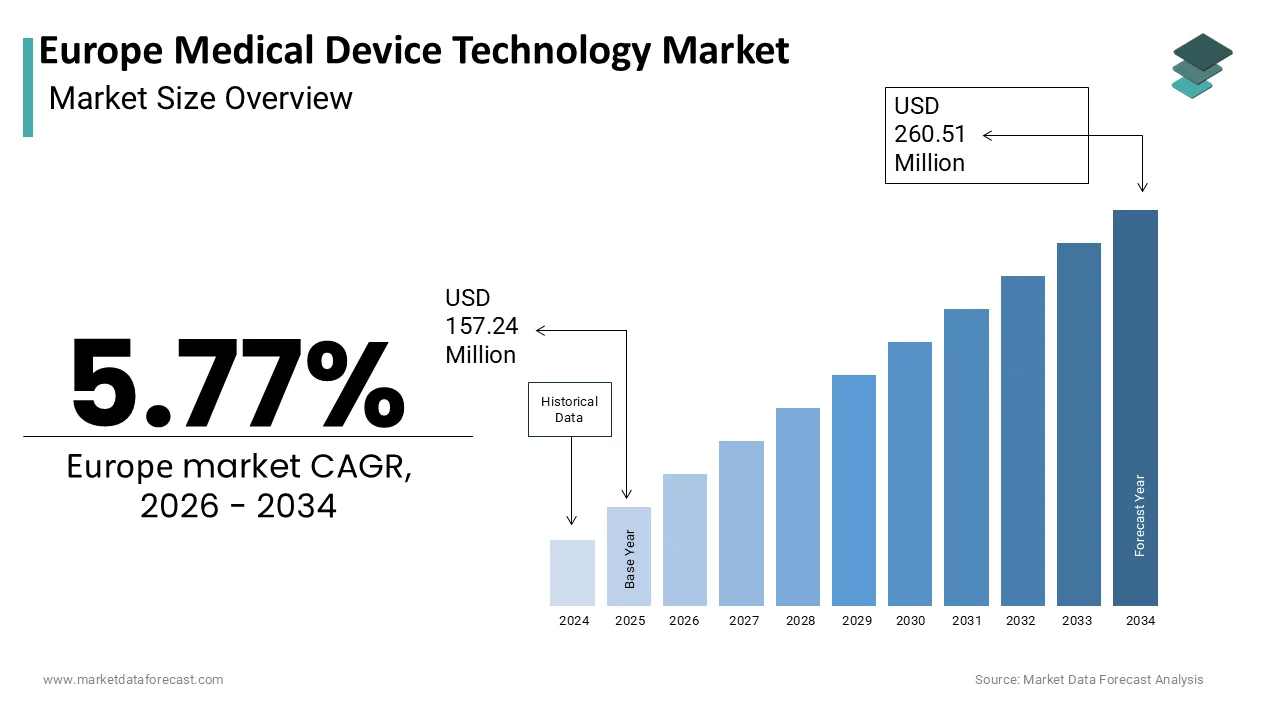
- The Europe Medical Device Technology Market was valued at USD 157.24 million in 2025.
- Expected to reach USD 260.51 million by 2034, growing at a CAGR of 5.77% from 2026 to 2034.
- Germany leads with a 22.8% market share in 2024; France follows with 16.4%.
Key Market Segments
- By Device Type: In Vitro Diagnostics (IVD) leads with 24.6% share; Diabetes Care Devices is the fastest growing at a CAGR of 10.9% from 2025 to 2033.
- By Technology: Biomarkers holds 42.3% share; Molecular Diagnostics is the fastest growing at a CAGR of 12.3% during the forecast period.
- By Country: Germany, France, UK, Italy, and Switzerland are the five primary markets.
Country-Level Breakdown
- Germany held the largest country share at 22.8% in 2024, driven by its advanced hospital infrastructure, Federal Joint Committee reimbursement framework, and headquarters of Siemens Healthineers, B. Braun, and Fresenius.
- France held 16.4% share in 2024, supported by its centralized healthcare system, the Assistance Publique Hôpitaux de Paris operating Europe's largest robotic surgery program, and a national digital health patient portal with high citizen adoption.
- United Kingdom is growing steadily, leveraging post-Brexit MHRA regulatory autonomy to accelerate innovation pathways, with active medical device trials including neural implants and AI endoscopy systems deployed within the NHS.
- Italy is a high-utilization market for diagnostic imaging and cardiovascular devices, with a high density of MRI and CT scanners relative to EU peers and high volumes of implantable cardiac and orthopedic procedures annually.
- Switzerland is projected to grow from 2025 to 2034, home to Medtronic, Roche Diagnostics, ETH Zurich, and EPFL, with mutual recognition agreements with the EU facilitating seamless product certification and market access.
Key Drivers
- Accelerating adoption of AI and machine learning in diagnostic imaging for radiology, pathology, and cardiology across EU hospitals.
- EU Beating Cancer Plan endorsement and rising adoption of robotic-assisted surgery for minimally invasive oncological procedures.
- European Commission 2023 Digital Health Action Plan promoting remote patient monitoring and connected device ecosystems for chronic disease management.
Key Players
Abbott Laboratories, Becton Dickinson, GE Healthcare, Siemens AG, Siemens Healthineers, Medtronic, Philips Healthcare, Thermo Fisher Scientific, Olympus Corporation, Qiagen N.V., bioMerieux, Johnson and Johnson Diagnostics, and Zenith Healthcare.
Europe Medical Device Technology Market Size
The Europe Medical Device Technology Market is projected to grow from USD 157.24 million in 2025 to USD 166.31 million in 2026 and reach USD 260.51 million by 2034, registering a CAGR of 5.77% during the forecast period from 2026 to 2034.
Medical device technology refers to the diagnostic, therapeutic, and monitoring and digital health solutions designed to enhance clinical outcomes, improve patient safety, and streamline healthcare delivery. This includes advanced imaging systems, robotic surgical platforms, implantable devices,point-of-care diagnosis, and artificial intelligence-enabled decision support tools. Unlike pharmaceuticals, medical devices in Europe are regulated under the Medical Device Regulation EU 2017 74,5, which emphasizes clinical evidence, cybersecurity, and post-market surveillance. According to sources, the number of CE-marked medical devices in the EU is substantial, with a smaller proportion of these classified as high-risk devices subject to stringent regulatory oversight under the Medical Device Regulation (MDR). As per research, across Germany, France, and the Netherlands, there has been a strong, continued increase in the integration of various forms of digital health technologies into routine hospital care. Furthermore, the European Union provides substantial funding for health technology innovation, including smart implants and interoperable diagnostic platforms, through programs like Horizon Europe. This convergence of regulatory rigor, clinical integration, and strategic public investment positions Europe as a global leader in responsible patient-centric medical device advancement.
MARKET DRIVERS
Accelerated Adoption of Digital Health and AI-Integrated Diagnostic Platforms
The integration of artificial intelligence and machine learning into diagnostic medical devices is a major driver of the European medical device technology market. AI-enabled tools for radiology, pathology, and cardiology are reducing diagnostic delays and improving accuracy, particularly in resource-constrained settings. According to studies, Hospitals across the European Union are increasingly adopting CE-marked artificial intelligence algorithms to assist in the detection of various pathologies, including lung nodules, brain hemorrhages, and breast cancer on medical images. Research published in peer-reviewed journals, such as The Lancet Digital Health, indicates that the use of artificial intelligence in chest X-ray interpretation has the potential to enhance diagnostic accuracy and optimize clinical workflows for detecting conditions like pneumonia. The European Medicines Agency, in collaboration with the European Commission, has established the AI Regulatory Working Group to fast-track validation of high-performance algorithms under the Medical Device Regulation. Additionally, national health services have created digital procurement frameworks that prioritize interoperable AI tools compliant with the EU’s common European health data space. This regulatory and clinical alignment is transforming AI from an experimental add-on into a standard component of diagnostic workflows across Europe.
Strong Policy Support for Surgical Robotics and Minimally Invasive Technologies
The region’s strategic emphasis on reducing hospital stays and improving surgical precision has caused widespread adoption of robotic and minimally invasive medical device platforms, which propels the expansion of the European medical device technology market. The European Union’s Beating Cancer Plan explicitly endorses robotic-assisted surgery for oncological procedures, citing reduced complications and faster recovery. The adoption of robotic systems for performing prostatectomies has substantially increased across Europe, including in the Netherlands and Germany, as a general trend in minimally invasive surgery. National health technology assessment bodies are increasingly favorable toward robotics when evidence demonstrates cost neutrality over the full care pathway. Health authorities, such as the French HAS, are evaluating and increasingly acknowledging the benefits of advanced surgical techniques like robotic colorectal surgery based on clinical trial outcomes. Furthermore, the European Institute of Innovation and Technology Health supports the growth of numerous startups in the health technology sector, including those developing innovative surgical robotics solutions. More information on their initiatives can be found on the EIT Health website. The implementation of robotic surgical systems within European hospitals is a growing trend, which reflects a significant technological shift towards enhancing surgical capabilities and improving patient outcomes.
MARKET RESTRAINTS
Stringent and Complex Compliance Requirements Under the EU Medical Device Regulation
The transition to the EU Medical Device Regulation has imposed significant operational and financial burdens on manufacturers, particularly small and medium enterprises, which restricts the growth of the European medical device technology market. Unlike the previous directive, the regulation mandates extensive clinical evaluation, technical documentation, and post-market surveillance for all device classes. According to sources, the number of Notified Bodies designated under the new EU Medical Devices Regulation has experienced a significant decrease compared to the number available under the former directives, contributing to capacity concerns in the industry. Surveys indicate that small and medium-sized enterprises (SMEs) face substantial delays in the product recertification process under the EU MDR, and that regulatory compliance has led to a significant increase in associated costs. Furthermore, the requirement for Unique Device Identification and Eudamed database registration has strained internal resources. Startups developing novel diagnostics or digital therapeutics face particular challenges in generating the clinical evidence required for high-risk classifications. These regulatory complexities have led to market withdrawals of numerous legacy devices. The regulation, though designed to improve patient safety, has inadvertently slowed the pace of innovation and hindered market entry, particularly for new entrants.
Fragmented Reimbursement Pathways Across National Healthcare Systems
Reimbursement for medical technologies remains highly fragmented across member states, despite regulatory harmonization under the EU Medical Device Regulation, which creates significant commercial uncertainty and thereby obstructs the expansion of the European medical device technology market. According to research, across Europe, the assessment and reimbursement of health technologies primarily occur at the national or regional level, leading to significant variations in scope, methodology, and requirements for manufacturers. In Germany, the G-BA (Federal Joint Committee) evaluates new medical devices for reimbursement, using a process that generally operates within established timeframes. Similarly, the United Kingdom’s National Institute for Health and Care Excellence and France’s Haute Autorité de Santé apply divergent criteria for cost-effectiveness, with one emphasizing quality-adjusted life years and the other focusing on budget impact. Digital health technologies encounter unique challenges in achieving consistent HTA and market access across different European countries due to the lack of harmonized assessment frameworks and reimbursement pathways. This patchwork forces manufacturers to prioritize markets with established pathways, typically Germany, France, and Italy, while delaying entry into Southern and Eastern Europe. The lack of cross-border reimbursement recognition undermines the scalability of innovative medical device technologies and discourages investment in pan-European launch strategies.
MARKET OPPORTUNITIES
Expansion of Remote Patient Monitoring in Chronic Disease Management Programs
The integration of connected medical devices into national chronic disease management frameworks, particularly for cardiovascular, respiratory, and metabolic conditions, creates new opportunities for the growth of the European medical device technology market. The European Commission’s 2023 Digital Health Action Plan promotes remote monitoring as a core component of integrated care with specific funding for interoperable device ecosystems. A notable trend is the increased use of wearable sensors by individuals managing heart failure for transmitting health data to care centers. Another development involves programs that provide patients with connected glucose meters and insulin pens linked to care provider dashboards. Professional medical guidelines have begun to incorporate recommendations for remote patient monitoring in managing conditions such as hypertension. The general prevalence of chronic conditions across the population suggests a significant need for accessible remote healthcare solutions. Manufacturers that align with national digital care pathways and ensure compatibility with the European Health Data Space stand to benefit from recurring service models and long-term public procurement contracts.
Growth of Personalized and Point-of-Care Diagnostic Technologies
The shift toward decentralized and precision diagnostics offers a major opportunity for innovative medical device developers in the region, which is expected to fuel the growth of the European medical device technology market. Point of care testing for infectious diseases, cardiac markers, and coagulation status is increasingly adopted in pharmacies, primary care clinics, cs and even homes. A notable trend involves the distribution of a significant number of rapid diagnostic devices specifically for respiratory infections within primary care networks across the EU. Regulatory changes now encompass specific provisions within the EU's In Vitro Diagnostic Regulation for the development and use of companion diagnostics that help guide targeted cancer therapies. Numerous devices related to these companion diagnostics have received CE marking. Companies have launched multiplex molecular platforms that deliver lab-quality results in under 30 minutes at the point of care. The European Society of Clinical Microbiology and Infectious Diseases recommends these tools to combat antimicrobial resistance through rapid pathogen identification. A heightened focus on early intervention and antibiotic stewardship is expected to drive significant growth in the market for accurate, portable, and connected diagnostic devices throughout Europe's healthcare systems.
MARKET CHALLENGES
Critical Shortage of Skilled Clinical and Technical Personnel for Advanced Device Operation
The shortage of trained clinicians, biomedical engineers, and data specialists across the region hampers the growth of the European medical device technology market. This is a major human resource challenge constraining the full utilization of advanced medical device technologies. A limited number of member states have formal certification programs for clinical engineers. There may be a need for more clinical engineering professionals to support current medical device inventories. In some instances of surgical robotics, hospitals with robotic systems may have limited numbers of dedicated training coordinators. This situation in surgical robotics can be associated with the underuse of the equipment and longer learning periods for staff. Similarly, AI-enabled diagnostic tools often remain underutilized because radiologists and pathologists lack training in algorithm validation and data interpretation. The return on investment for advanced medical devices will stay low if we do not collaboratively fund continuing education, interdisciplinary training programs, and the implementation of task-shifting strategies. This workforce bottleneck not only limits clinical impact but also discourages manufacturers from introducing complex next-generation systems in regions with insufficient technical infrastructure.
Cybersecurity Vulnerabilities in Connected and Software-Driven Medical Devices
Medical devices face heightened exposure to cybersecurity threats that can compromise patient safety and data integrity, and thereby inhibit the expansion of the European medical device technologies market. This is because medical devices are becoming increasingly interconnected and software-dependent. Vulnerabilities in certain medical devices, such as infusion pumps and pacemakers, remain a concern, potentially allowing for unauthorized access. Regulators and clinicians are exercising caution due to the risk, even though widespread patient harm hasn't been documented. Certification processes for medical devices can experience delays due to incomplete documentation concerning cybersecurity measures. The EU Medical Device Regulation now mandates a cybersecurity risk management file as part of technical documentation, but many manufacturers lack expertise in secure software development lifecycle practices. Furthermore, many hospitals often operate legacy networks incompatible with modern encryption protocols, exacerbating exposure. Many hospitals across the European Union do not routinely perform penetration testing on their connected devices. These systemic weaknesses deter the adoption of innovative digital health solutions and increase liability concerns, thereby slowing the integration of life-enhancing technologies into routine European care pathways.
REPORT COVERAGE
| REPORT METRIC | DETAILS |
| Market Size Available | 2025 to 2034 |
| Base Year | 2025 |
| Forecast Period | 2026 to 2034 |
| Segments Covered | By Device Type, Technology, and Region. |
| Various Analyses Covered | Global, Regional, and Country-Level Analysis, Segment-Level Analysis, Drivers, Restraints, Opportunities, Challenges; PESTLE Analysis; Porter’s Five Forces Analysis, Competitive Landscape, Analyst Overview of Investment Opportunities |
| Countries Covered | UK, France, Spain, Germany, Italy, Russia, Sweden, Denmark, Switzerland, Netherlands, Turkey, Czech Republic, Rest of Europe |
| Market Leaders Profiled | Abbott Laboratories, Inc., Becton, Dickinson and Company, GE Healthcare, Novartis Diagnostics, bioMerieux, Inc., Biomerica, Inc., Johnson and Johnson Diagnostics, Inc., Olympus Corporation, Qiagen N.V., Siemens AG, Thermo Fischer Scientific, Inc., and Zenith Healthcare Ltd. |
SEGMENTAL ANALYSIS
By Device Type Insights
The in vitro diagnostics (IVD) devices segment held the largest share of 24.6% of the European medical device technology market. The prominence of the IVD devices segment is attributed to its foundational role in disease screening, therapeutic monitoring, and public health surveillance across all care settings. IVDs encompass a vast range of technologies, including clinical chemistry, immunoassays, molecular tests, and point-of-care analyzers used daily in hospitals, laboratories, and pharmacies. The annual number of in vitro diagnostic (IVD) tests performed across the EU is substantial, with infectious disease testing and chronic condition monitoring accounting for the largest volumes. Regulations governing in vitro diagnostics have been updated, emphasizing the segment's significance by requiring more stringent clinical evidence and enhanced post-market traceability. These regulatory changes are encouraging manufacturers to focus on both innovation and compliance within the market. National screening programs such as Germany’s colorectal cancer early detection initiative and France’s national hepatitis C elimination strategy rely heavily on IVD platforms. Additionally, the integration of IVD data into electronic health records under the European Health Data Space enables real-time population health analytics. This combination of clinical indispensability, regulatory evolution, and digital connectivity ensures IVDs remain the cornerstone of Europe’s diagnostic and preventive healthcare infrastructure.

The diabetes care devices segment is anticipated to witness the fastest CAGR of 10.9% from 2025 to 2033. The rapid expansion of the diabetes care devices segment is driven by the rising prevalence of diabetes, the adoption of advanced insulin delivery systems, and the integration of continuous glucose monitoring into standard care pathways. A significant number of adults in Europe have diabetes. Type 2 diabetes accounts for the majority of cases. Many individuals with diabetes require increasing technological support. Certain advanced insulin and glucose monitoring technologies are covered by public health systems in a number of European countries. Adoption of these technologies is notably high among younger individuals with type 1 diabetes in some specific regions. Eligibility for continuous glucose monitoring has been expanded to a wider population of type 1 patients in one European health system, potentially broadening access to care. Manufacturers have responded with interoperable platforms that sync with national telehealth systems, enabling remote titration and digital coaching. As diabetes management shifts from episodic to continuous data-driven care, this segment is redefining chronic disease technology adoption across Europe.
By Technology Insights
In 2024, the biomarkers segment led the European medical device technology market by accounting for a 42.3% share. The leading position of the biomarkers segment is credited to its pervasive integration into diagnostic, prognostic, and therapeutic monitoring tools across oncology, cardiology, neurology, and infectious diseases. Biomarker-based assays guide treatment selection in a notable share of new cancer therapies approved. Companion diagnostic tests are widely utilized as a standard practice in the management of specific cancers, including non-small cell lung cancer, breast cancer, and colorectal cancer. Further efforts are underway to validate novel protein and genetic biomarkers, with significant funding being directed toward projects aimed at improving early disease detection. National biobanks have enabled large-scale biomarker discovery through linkage with longitudinal health data. Furthermore, the EU In Vitro Diagnostic Regulation classifies most biomarker tests as high risk requiring rigorous clinical validation, a framework that has elevated scientific standards and fostered trust among clinicians. This deep clinical embeddedness and regulatory reinforcement solidify biomarkers as the engine of precision medicine in Europe.
The molecular diagnostics segment is likely to experience the fastest CAGR of 12.3% during the forecast period due to the demand for rapid, accurate, and pathogen-specific testing in both infectious disease and oncology contexts. The experience of the pandemic permanently elevated the role of molecular platforms. A significant network of laboratories capable of advanced genetic sequencing for emerging threats is being sustained. Comprehensive genomic profiling for advanced non-small cell lung cancer patients is widely supported in oncology. The practice of comprehensive genomic profiling has been implemented across many cancer centers. There has been an increase in the availability of molecular diagnostic kits for detecting cancer mutations. The use of portable sequencers in public health laboratories has increased due to dedicated investment. The transition of molecular diagnostics from centralized labs to point-of-care settings, spurred by lower costs and increased utility, is redefining European diagnostic practices.
COUNTRY LEVEL ANALYSIS
Germany Medical Device Technology Market Analysis
Germany dominated the European medical device technology market, accounting for a 22.8% share in 2024. The supremacy of the German market is credited to its status as Europe’s most advanced and regulated healthcare ecosystem. The country maintains a robust hospital infrastructure, although the total number of hospitals is on a declining trend. The use of advanced medical technologies and procedures, including those involving robotic assistance, has shown consistent growth within the German healthcare sector, reflecting broader technological advancements. Germany's strong research and development ecosystem fosters innovation in medical technology, supporting ongoing enhancements in surgical techniques and patient care. The Federal Joint Committee actively evaluates medical devices for reimbursement, ensuring rapid adoption of clinically validated innovations such as AI radiology tools and continuous glucose monitors. Furthermore, Germany hosts the headquarters or major R and D centers of global medtech leaders, including Siemens Healthineers, B Braun, and Fresenius. This fusion of clinical demand, industrial capacity,y, and policy support establishes Germany as the undisputed innovation and commercial hub of the European medical device technology landscape.
France Medical Device Technology Market Analysis
France followed closely in the European medical device technology market and held a 16.4% share in 2024. The prominence of the French market is driven by its centralized healthcare system and strong public investment in health technology assessment. The country's healthcare system includes numerous public and private hospitals. Access to advanced diagnostic tools and surgical platforms is widely available. Medical device assessments for positive recommendations are a regular process. The positive assessments included devices incorporating artificial intelligence for medical conditions and wearable technology for patient monitoring. A national digital health approach facilitates the integration of medical device data into a unified patient portal. The patient portal is used by a significant portion of the citizen population. The country also leads in surgical robotics, with the Assistance Publique Hôpitaux de Paris operating the largest robotic surgery program in Europe. Additionally, the French Alternative Energies and Atomic Energy Commission runs the CEA Tech division, which develops biosensors and implantable electronics transferred to startups through its accelerator program. Hence, France functions as a high-volume validator and early adopter of next-generation medical technologies across Europe.
United Kingdom Medical Device Technology Market Analysis
The United Kingdom grew steadily in the European medical device technology market because of its world-class research infrastructure and post-Brexit regulatory autonomy. Despite leaving the EU, the UK maintains alignment with international standards while leveraging its Medicines and Healthcare products Regulatory Agency for faster innovation pathways. Medical device trials are active and progressing, including early-stage human studies for advanced technologies. Innovations being explored include neural implants and AI endoscopy systems. New medical technologies are being supported for accelerated development and deployment. A number of these supported medical devices have been deployed in a national healthcare setting. The UK is also home to leading academic medical centers such as Imperial College London and the University of Oxford, which partner with industry on device development through the MedTech Cooperative network. Furthermore, the British Standards Institution leads EU-wide working groups on cybersecurity for connected devices. This unique blend of scientific excellence, regulatory agility, and real-world validation infrastructure ensures the UK remains a critical trendsetter in European medical device technology.
Italy Medical Device Technology Market Analysis
Italy expanded moderately in the European medical device technology market due to its high utilization of diagnostic imaging and cardiovascular devices. The country operates a high density of MRI and CT scanners compared to many other regions in the EU. The aging population contributes to a sustained demand for implantable cardiac devices and orthopedic solutions, including many hip and knee replacements performed each year. The approval process for CE-marked devices has been streamlined, resulting in reduced market entry timelines. Additionally, Italy hosts major manufacturing facilities for global players such as GE Healthcare and Sorin Group, producing imaging systems and heart valves for European distribution. Italy is positioned as Southern Europe's primary high-throughput implementation zone for medical devices, leveraging its strong clinical adoption rates, substantial manufacturing base, and strategic public investments.
Switzerland Medical Device Technology Market Analysis
Switzerland is likely to grow in the European medical device technology market from 2025 to 2033 due to its concentration of global medtech innovation and headquarters. Home to industry giants such as Medtronic, EME, Roche Diagnostics, and soono, the country exports a notable share of its medical device production to the EU and beyond. The medtech sector is a significant employer. This sector is a major contributor to the country's exports. Mutual recognition agreements exist with the European Union, which facilitates product certification. There are established national pathways available for introducing new technologies. The country hosts world-leading research at ETH Zurich and EPFL, which have pioneered advancements in bioelectronic medicine, microfluidic diagnostics, c,s, and robotic exoskeletons. Furthermore, Switzerland’s participation in Horizon Europe ensures continued access to collaborative funding for device innovation. Switzerland's function as a global R&D and regulatory gateway gives it outsized influence in setting the technological trajectory and quality benchmarks for the entire European medical device market.
TOP LEADING PLAYERS IN THE MARKET
- Siemens Healthineers plays a pivotal role in the European Medical Device Technology Market through its advanced diagnostic imaging systems and digital health solutions. The company contributes significantly to the global market by integrating artificial intelligence into medical imaging platforms to improve diagnostic accuracy and operational efficiency. Recently, Siemens Healthineers expanded its presence in Europe by launching the next generation of its magnetic resonance imaging systems aimed at enhancing patient comfort and reducing scanning time. The company also reinforced its digital health portfolio through strategic collaborations with European healthcare providers to implement cloud-based diagnostic tools and interoperable software solutions across multiple countries.
- Medtronic is a key contributor to the European Medical Device Technology Market with a diverse portfolio spanning cardiac rhythm management, neuromodulation, and minimally invasive surgical technologies. Globally, the company drives innovation by investing heavily in research and development to create next-generation therapeutic devices. In recent months, Medtronic strengthened its European footprint by introducing an updated version of its robotic-assisted surgical platform designed to improve precision and reduce recovery times. The company also initiated partnerships with academic medical centers across Germany and France to enhance clinical training and accelerate the adoption of its advanced medical technologies across public and private healthcare institutions.
- Philips Healthcare maintains a strong position in the European Medical Device Technology Market through its integrated solutions in patient monitoring, diagnostic imaging, and telehealth services. Its global influence stems from a focused strategy on connected care platforms that enable remote patient management and data-driven clinical decisions. Recently, Philips launched a new suite of ultrasound systems tailored for point-of-care settings across European hospitals with enhanced image quality and workflow efficiency. The company also intensified its sustainability efforts by aligning product designs with circular economy principles and expanding its service offerings to support healthcare systems transitioning toward value-based care models in the region.
TOP STRATEGIES USED BY THE KEY MARKET PARTICIPANTS
Key players in the European Medical Device Technology Market consistently adopt innovation-driven strategies to maintain a competitive advantage. They prioritize strategic collaborations with academic institutions and healthcare providers to co-develop cutting-edge solutions tailored to regional clinical needs. Product portfolio expansion through regulatory-compliant launches of next-generation devices is another widely used tactic. Companies also invest significantly in digital transformation by integrating artificial intelligence, cloud computing, and cybersecurity features into their platforms. Additionally, they pursue targeted acquisitions of niche technology firms to accelerate entry into emerging segments such as robotic surgery and remote diagnostics. Geographic expansion within Europe is supported by localized customer support infrastructure and training programs. Regulatory strategy harmonization across European Union member states ensures faster market access and scalability.
COMPETITIVE LANDSCAPE
Competition in the European Medical Device Technology Market is highly dynamic, characterized by the presence of established multinational corporations and agile regional innovators. Leading companies differentiate themselves through continuous technological advancement, regulatory expertise,e, and robust distribution networks. The market features intense rivalry in segments such as imaging diagnostics, patient monitoring, and minimally invasive devices. Regulatory compliance under the European Union Medical Device Regulation presents both a barrier and a strategic focus area for participants. Companies compete not only on product performance but also on service integration, interoperability, and sustainability credentials. Strategic alliances with public health systems and private clinics further intensify competition as providers seek comprehensive solutions rather than standalone devices. Innovation cycles are accelerating with digital health interoperability and artificial intelligence becoming central to competitive positioning. This environment drives constant investment in research and development and fosters a culture of strategic agility among key players.
KEY MARKET PLAYERS
Prominent Companies leading the europe medical device technology market profiled in the Report, are
- Abbott Laboratories, Inc.
- Becton, Dickinson and Company
- GE Healthcare
- Novartis Diagnostics
- bioMerieux, Inc.
- Biomerica, Inc.
- Johnson and Johnson Diagnostics, Inc.
- Olympus Corporation
- Qiagen N.V.
- Siemens AG
- Thermo Fischer Scientific, Inc.
- Zenith Healthcare Ltd.
MARKET SEGMENTATION
This research report on the europe medical device technology market has been segmented and sub-segmented into the following categories
By Device Type
- Electromedical equipment
- Irradiation apparatus
- Dental apparatus
- in vitro diagnostics (IVD) devices
- kidney/dialysis devices
- diagnostic imaging devices
- ophthalmology devices
- orthopedic devices
- endoscopy devices
- diabetes care devices
- anesthesia & respiratory care devices
- wound management devices
By Technology
- Biomarkers
- Bio implants
- molecular diagnostics
By Country
- UK
- France
- Spain
- Germany
- Italy
- Russia
- Sweden
- Denmark
- Switzerland
- Netherlands
- Turkey
- Czech Republic
- Rest of Europe