Europe Medical Insurance Market Size, Share, Trends and Growth Analysis Report, Segmented By Type, Payor, User, Mode, Distribution Channel and Country (Russia, Germany, United Kingdom, Sweden, And Denmark, Poland, Switzerland, Netherlands, France, Italy, Spain and Rest of Europe), Industry Analysis From 2026 to 2034.
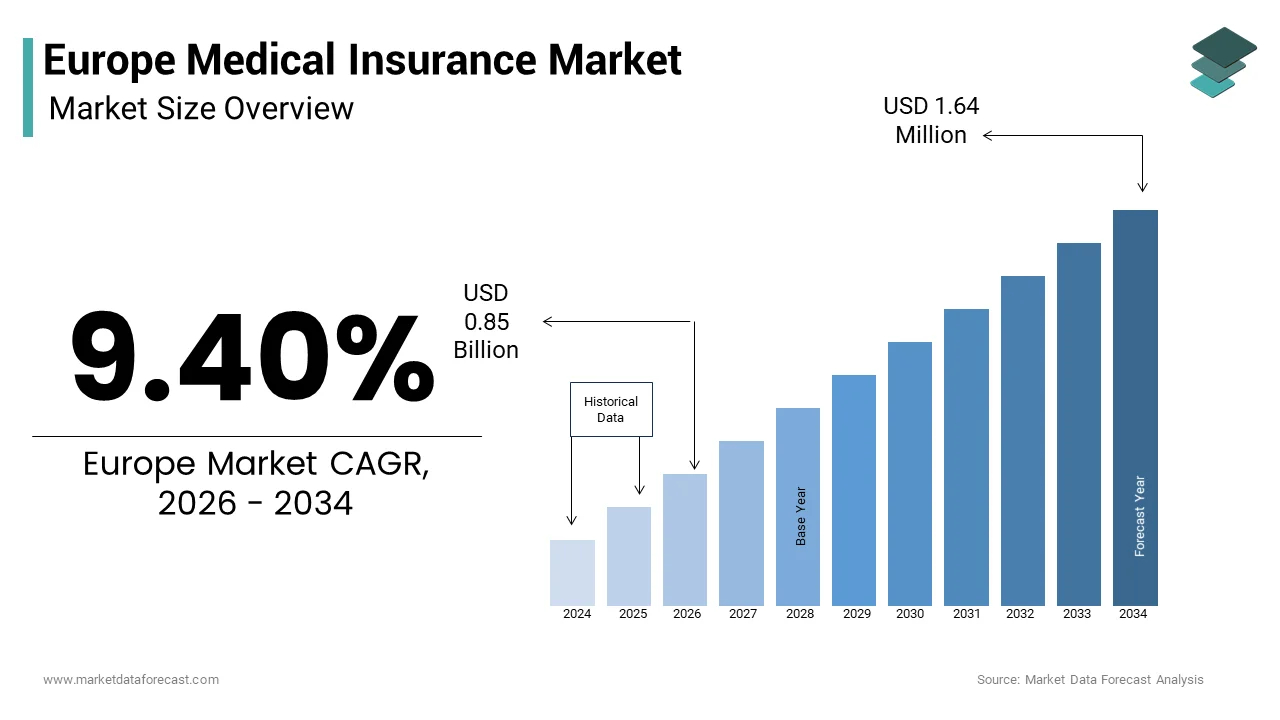
Market Size, 2025
$0.78 BnMarket Estimate, 2026
$0.85 BnMarket Forecast, 2034
$1.64 BnCAGR, 2026–2034
9.40%Europe Medical Insurance Market Size
The Europe medical insurance market size was valued at USD 0.78 billion in 2025 and is anticipated to reach USD 0.85 billion in 2026 to reach from USD 1.64 billion by 2034, growing at a CAGR of 9.40% during the forecast period from 2026 to 2034.
Current Introduction of the Europe Medical Insurance Market
The medical insurance is a private health coverage product that supplement or substitute national public healthcare systems by offering individuals and employers faster access to care broader provider choice and enhanced services, such as dental vision and mental health support. Unlike universal public systems funded through taxation, private medical insurance operates on a risk pooled premium basis and is regulated at both EU and national levels under directives like Solvency II. Furthermore, the European Commission reports that over 28% of Europeans forewent necessary medical care in 2023 due to long wait times or perceived inadequacy of public services. With an aging population 21% of EU citizens were aged 65 or older in 2023, per Eurostat and rising prevalence of chronic diseases, demand for complementary private coverage continues to grow as citizens seek timely and comprehensive health security beyond state provision.
MARKET DRIVERS
Prolonged Waiting Times in Public Healthcare Systems
The persistent and often excessive waiting periods for non-emergency procedures within publicly funded healthcare systems, which is driving the growth of Europe medical insurance market. As per Eurostat data from 2023 reveals that the average patient in the European Union waited 78 days for cataract surgery and 92 days for hip replacement, with significant variation across member states. In countries like Ireland and Estonia, median waits for specialist consultations exceed four months, prompting patients to seek private alternatives. A 2024 survey by the European Health Consumer Index found that 63% of respondents in Western Europe cited waiting times as their main reason for purchasing private health insurance. Employers increasingly offer medical insurance as a retention tool to mitigate productivity losses from delayed care, in the United Kingdom, over 45% of large firms provide private medical insurance as a standard employee benefit according to the Chartered Institute of Personnel and Development.
Rising Employer Sponsored Health Benefits Amid Talent Competition
The strategic adoption of private medical insurance by employers as a component of talent attraction and retention in tight labor is additionally fuelling the growth of Europe medical insurance market. As per Eurofound’s 2024 European Working Conditions Survey, 75% of companies in Germany, France, and the Netherlands, now include private health coverage in their compensation packages, up from thirty nine% in 2019. This trend is particularly pronounced in knowledge intensive sectors such as technology finance and professional services where competition for skilled workers is fierce. In Sweden, collective bargaining agreements increasingly mandate supplementary health benefits, while in Spain and Italy, tax incentives encourage small and medium enterprises to offer group health plans. The European Commission estimates that employer sponsored insurance covers over sixty million workers across the EU, providing not only faster access to care but also preventive services that reduce absenteeism. As workforce expectations evolve and public systems strain under demographic pressure, corporate health benefits have become a non-negotiable element of modern employment contracts by fueling consistent demand growth in the private medical insurance sector.
MARKET RESTRAINTS
Universal Public Healthcare Coverage Limiting Perceived Necessity
The existence of comprehensive universal public healthcare systems in most European countries, which diminishes the perceived necessity of private medical insurance among the general population. Nations like Sweden, Finland, and Portugal, provide near cradle to grave coverage funded through taxation by creating a cultural expectation that healthcare is a public good rather than a commercial product. According to the OECD Health Statistics 2024, out of pocket expenditures account for less than 15% of total health spending in 14 EU member states by reducing financial urgency for private coverage. In Southern and Eastern Europe, low household disposable income further limits affordability, where Eurostat reports that median monthly net earnings in Bulgaria and Romania remain below one thousand euros by making premiums for comprehensive plans unattainable for most families.
Stringent Regulatory Frameworks and Cross Border Limitations
The complex and fragmented regulatory environment governing insurance products is additionally hampering the growth of Europe medical insurance market. While the Solvency II directive provides a harmonized capital adequacy framework, product design pricing and distribution rules remain under national jurisdiction, forcing insurers to maintain separate compliance infrastructures in each market. The European Insurance and Occupational Pensions Authority notes that cross border sales of health insurance remain minimal due to differences in benefit mandates consumer protection laws and language requirements. For instance, a policy valid in Germany may not cover treatments deemed non-essential in France, limiting scalability. Additionally, some countries impose strict community rating rules that prohibit risk-based pricing, compressing margins and discouraging innovation. These regulatory silos increase operational costs and hinder the emergence of pan European health insurance products and slowing growth compared to more unified jurisdictions like the United States.
MARKET OPPORTUNITIES
Integration of Digital Health Services and Preventive Care Modules
The integration of digital therapeutics remote monitoring and preventive care programs into traditional indemnity policies is one of the major factors to pose new opportunities for the growth of Europe medical insurance market. Insurers are shifting from passive reimbursement to active health management by bundling wearables teleconsultations and AI driven wellness coaching with standard coverage. In the Netherlands, Achmea’s “Zorg van de Toekomst” program offers policyholders free access to a digital platform that tracks physical activity sleep and chronic disease markers by resulting in a 12% reduction in hospital admissions, among participants, according to a 2024 evaluation by the Dutch Healthcare Authority. Similarly, France’s AXA Partners has partnered with telehealth providers to include unlimited virtual GP visits in its corporate plans. The European Commission’s 2023 Digital Health Action Plan encourages such innovations by promoting interoperability standards and data sharing frameworks. By transforming insurance into a proactive health partnership, carriers can improve outcomes reduce claims costs and differentiate offerings in a crowded market, thereby creating sustainable value beyond mere financial protection.
Tailored Products for Aging Populations and Chronic Disease Management
The designing specialized policies for rapidly aging demographic and the growing burden of chronic conditions is also enhancing new opportunities for the growth of Europe medical insurance market. With over 21% of EU citizens aged 65 or older, a figure projected to reach 30% by 2050, per Eurostat, there is acute demand for coverage that addresses geriatric needs such as home care rehabilitation and polypharmacy management. In Germany, Allianz launched a “Silver Care” plan in 2024 that bundles hospital cash benefits with home nursing coordination and medication delivery, targeting the over sixty segment. Similarly, Italy’s Generali offers chronic disease riders that cover continuous glucose monitors and respiratory devices for diabetics and COPD patients. The World Health Organization estimates that 77% of deaths in the WHO European Region are attributable to non-communicable diseases by creating a vast addressable base.
MARKET CHALLENGES
Escalating Healthcare Costs and Medical Inflation Pressures
The relentless rise in healthcare expenditures driven by medical technology advances pharmaceutical innovation and increased service utilization is a challenging factor for the growth of Europe medical insurance market. According to the OECD Health Statistics 2024, per capita health spending in the EU grew by an average of 5.3% annually between 2019 and 2023, outpacing general inflation by over 2% age points. This medical inflation directly pressures insurer profitability, forcing difficult trade-offs between premium increases benefit reductions or risk selection. In countries like Belgium and Austria, regulators cap premium adjustments, squeezing margins further. Without effective cost containment mechanisms such as value-based care contracting or utilization management, sustained underwriting losses could destabilize for smaller carriers lacking scale to negotiate provider rates or absorb volatility.
Ethical and Equity Concerns Around Risk Selection and Access Disparities
The perception that private medical insurance exacerbates health inequities by creating a two-tier system, where quality of care correlates with income is additionally to hamper the growth of Europe medical insurance market. Critics argue that risk underwriting practices though restricted in many countries, still enable insurers to avoid high cost individuals by leaving public systems to bear disproportionate burdens. A 2024 report by the European Observatory on Health Systems and Policies highlighted that in markets with voluntary private insurance, lower income groups are significantly less likely to be covered, leading to delayed diagnoses and worse outcomes. The EU’s principle of universal access to healthcare, enshrined in the European Pillar of Social Rights, increasingly clashes with commercial insurance models that prioritize profitability. As political scrutiny intensifies, insurers face mounting pressure to adopt community rating expand coverage to pre-existing conditions and contribute to public health initiatives constraints that may limit commercial flexibility while failing to fully resolve equity concerns in mixed public private systems.
REPORT COVERAGE
| REPORT METRIC | DETAILS |
| Market Size Available | 2025 to 2034 |
| Base Year | 2025 |
| Forecast Period | 2026 to 2034 |
| CAGR | 9.40% |
| Segments Covered | By Type, Payor, User, Mode, Distribution Channel, and Region. |
| Various Analyses Covered | Global, Regional, and Country Level Analysis, Segment-Level Analysis, DROC, PESTLE Analysis, Porter’s Five Forces Analysis, Competitive Landscape, Analyst Overview of Investment Opportunities |
| Regions Covered | North America, Europe, APAC, Latin America, Middle East & Africa |
| Market Leaders Profiled | UnitedHealth Group (U.S.), AXA (France), The Cigna Group (U.S.), CVS Health (U.S.), Ping An Insurance Group (China), AIA Group Limited (Hong Kong), Bupa Global (U.K.), Elevance Health (U.S.), China Pacific Insurance (Group) Co. Ltd. (China), Allianz (Germany) |
SEGMENTAL ANALYSIS
By Type Insights
The health maintenance organization segment was the largest by holding 42.3% of the Europe medical insurance market share in 2024 with its alignment with cost containment principles and integration with national healthcare frameworks. HMO models emphasize preventive care gatekeeper referrals and fixed provider networks, which resonate with European insurers seeking to manage escalating medical costs. In countries like Germany and the Netherlands, statutory health insurers have adopted HMO like structures under “managed care” contracts that incentivize primary care coordination and reduce unnecessary specialist visits. According to the German Federal Joint Committee, over 25 million Germans are enrolled in such integrated care plans as of 2024. Similarly, France’s “contrats responsables” framework encourages insurers to offer HMO style policies that comply with government defined benefit standards by making them eligible for favorable tax treatment. A 2025 study by the European Observatory on Health Systems found that HMO plans achieved twelve% lower per capita claims costs compared to indemnity models while maintaining equivalent patient satisfaction scores.
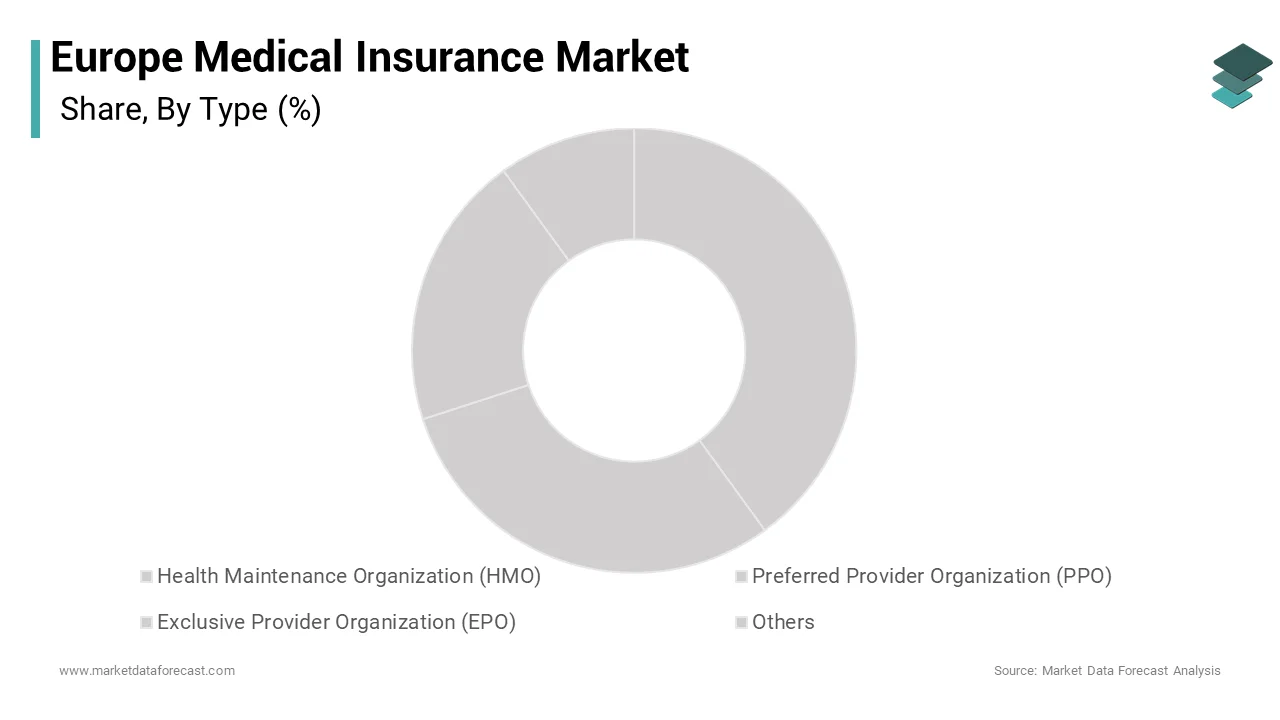
The preferred provider organization segment is projected to expand at a CAGR of 9.7% during the forecast period. The growth of the segment is likely to grow with the rising demand for flexibility and choice among affluent urban professionals and expatriates, who prioritize access over cost control. PPOs allow policyholders to consult specialists without referrals and use out of network providers at higher co-payments with a feature highly valued in fragmented European healthcare markets where cross border care is common. In Switzerland and Luxembourg, over 65% of private medical policies sold in 2024 were PPO based according to national insurance regulators, reflecting strong consumer preference for autonomy. Corporate clients also favor PPOs for international assignees, where a 2025 survey by Mercer found that 82% of multinational firms in Europe offer PPO style global medical plans to executives. As disposable incomes rise and workforce mobility increases, the PPO model’s balance of structure and freedom positions it as the highest growth segment catering to Europe’s premium and globally mobile demographic.
By Payor Insights
The public payor segment was accounted in holding 89.2% of the Europe medical insurance market share in 2024 with the continent’s foundational commitment to universal healthcare funded through taxation or social contributions. Every EU member state operates a publicly financed system that covers core medical services for all legal residents by creating a baseline of near universal access. National health services in the UK, Italy, and Spain provide comprehensive hospital and primary care with minimal user fees by reducing the financial necessity for private coverage. Even in nations with significant private markets like Germany and France, public systems remain the primary payer for the majority of treatments. This institutionalized public dominance ensures that private insurance functions largely as a supplementary layer rather than a replacement, anchoring the market structure in social solidarity rather than commercial risk pooling.
The private payor segment is expected to grow at a fastest CAGR of 7.2% during the forecast period. The growth of the segment is driven by the systemic gaps in public provision and evolving consumer expectations. While public systems guarantee access in principle, delays in non-emergency care and limitations on choice create demand for complementary private coverage. As per the Eurostat, many Europeans skipped needed care in 2023 due to long waits or perceived inadequacy figures that correlate strongly with private insurance uptake. Employer sponsored plans are a key growth vector, in Ireland and the Netherlands, over 50% of private policies originate from corporate benefits programs according to national central banks. Additionally, aging populations and rising chronic disease prevalence strain public budgets, pushing middle class households toward private top ups for faster diagnostics and specialist access. Though starting from a small base, this segment’s growth reflects a pragmatic adaptation to the realities of overstretched public systems amid demographic and epidemiological pressures.
By User and Mode Insights
The group user segment was the largest by occupying a dominant share of the Europe medical insurance market in 2024 due to employer sponsored coverage serving as a standard retention tool in competitive labor area. Large corporations in Germany, France, and the UK, routinely include private health insurance in compensation packages by covering millions of employees under master policies that offer economies of scale and simplified underwriting. According to the European Foundation for the Improvement of Living and Working Conditions, 57% of large European firms provided health benefits in 2024, up from 39% in 2019. Simultaneously, the Offline mode is a complexity of health insurance products and regulatory requirements that necessitate human guidance. Face to face consultations with brokers or HR managers remain the norm for explaining coverage nuances eligibility rules and claim procedures. In Southern and Eastern Europe, low digital literacy among older demographics further entrenches offline channels. National insurance authorities in Italy and Poland report that over 8% of new policies are still sold through in person interactions with the enduring role of trust and personalized advice in high involvement financial decisions.
The individual user segment is expected to witness a fastest 8.1% from 2025 to 2033 with the gig economy workers self-employed professionals and early retirees, who lack employer coverage. Platforms like France’s Alan and Germany’s Feather target this demographic with modular digital first policies. Meanwhile, the Online mode is expanding even faster at twelve point four% CAGR, driven by insurtech innovation and changing consumer behavior. In the Nordics, over 23% of new individual policies were purchased digitally in 2024, according to national financial supervisory authorities. These platforms offer instant quotes AI driven recommendations and seamless onboarding, appealing to tech savvy urbanites. The emergence of individualization and digitization represents a structural shift toward consumer centric, direct to consumer models that challenge traditional group based distribution.
By Distribution Channel Insights
The brokers segment was the largest by capturing 48.2% of the Europe medical insurance market share in 2024, as trusted intermediaries between insurers and complex buyer segments. Brokers design customized group plans negotiate premiums and manage renewals for employers navigating intricate regulatory environments. For individuals, especially in countries like Italy and Spain, brokers provide essential guidance on policy selection and claims support. According to the European Insurance Intermediaries Federation, over 70% of SMEs in the EU rely on brokers for health insurance procurement due to limited in house expertise. National regulations often reinforce this role in Germany, insurance mediation requires certified qualifications that brokers possess. This deep integration into the purchasing process combined with fiduciary responsibilities under the Insurance Distribution Directive ensures brokers remain the dominant channel despite digital disruption.
The direct sales segment is esteemed to register a fastest CAGR of 11.2% from 2025 to 2033 with the insurtech entrants and established carriers building proprietary digital ecosystems. Companies like Alan in France and Ottonova in Germany, bypass intermediaries entirely by offering end to end online experiences from quote to claim. These platforms leverage automation AI chatbots and seamless integrations with public health data to reduce friction and cost. A 2025 analysis by the European Insurance and Occupational Pensions Authority found that direct channels captured 32% of new individual policies in Western Europe, up from 18% in 2021. The model appeals particularly to younger demographics and urban professionals who value transparency speed and self-service. As digital trust grows and regulatory sandboxes encourage innovation, direct sales are reshaping distribution by prioritizing customer experience over traditional advisory relationships.
COUNTRY ANALYSIS
Germany Medical Insurance Market Analysis
Germany was the top performer of the Europe medical insurance market by capturing 26.3% of share in 2024 with its unique dual system of statutory and private health insurance. Over 78% of the population is covered by public sickness funds, but approximately 9 million opt for private insurance, primarily civil servants self-employed individuals and high-income earners. The German Federal Financial Supervisory Authority reports that private insurers collected over 40 billion euros in health premiums in 2024 by reflecting deep market maturity. Key drivers include aging demographics, 22% of Germans are over 65 and chronic disease prevalence, with 71% of adults managing at least one long term condition, according to the Robert Koch Institute. Insurers like DKV and Allianz offer sophisticated products integrating digital health tools and second opinion services. Germany’s strict regulatory framework under the Insurance Supervision Act ensures product standardization while allowing innovation in supplementary benefits by making it Europe’s largest and most structurally complex medical insurance market.
France Medical Insurance Market Analysis
France medical insurance market held second positioned with 17.2% of share in 2024 with its mandatory complementary health insurance model known as “mutuelles.” Since the 2016 ANI law, employers must provide private top up coverage to all employees, creating near universal supplemental insurance. According to France’s National Health Insurance Fund, over 95% of the population now holds complementary coverage, with major players like AXA and Malakoff Humanis managing tens of millions of policies. The system covers co-payments for public services and adds benefits like dental optical and alternative medicine. Rising out of pocket costs in the public system averaging 500 euros annually per household per INSEE data that further drive demand for robust top ups. Recent reforms encouraging digital health integration and chronic disease management have spurred product innovation. France’s blend of regulatory mandate high penetration and consumer expectation for comprehensive coverage establishes it as a uniquely dense and stable market within Europe.
United Kingdom Medical Insurance Market Analysis
The United Kingdom medical insurance market growth is driven by the voluntary private medical insurance primarily driven by employer benefits and individual affluence. Over 4 million people hold private health policies, with corporate schemes covering 65% of these according to the Association of British Insurers. Key growth factors include NHS waiting times median waits for elective care exceeded eighteen weeks in 2024, per NHS England and rising demand for mental health and cancer services not fully covered publicly. Insurers like Bupa and Aviva dominate through integrated provider networks and digital health partnerships. The UK’s post Brexit regulatory autonomy has enabled tailored product development, including modular policies for gig workers.
Italy Medical Insurance Market Analysis
Italy medical insurance market growth is likely to be propelled with the severe public system fragmentation and regional disparities. While the Servizio Sanitario Nazionale guarantees universal coverage, wait times vary drastically, patients in the south wait twice as long as those in the north for specialist care according to Istituto Superiore di Sanita data. This inequity drives demand for private top ups, particularly among middle class households in Southern regions. The 2022 Budget Law introduced tax incentives for health insurance premiums, accelerating uptake, over 2.5 million Italians now hold private policies per IVASS, Italy’s insurance regulator. Corporate coverage remains limited compared to Northern Europe, so individual purchases dominate.
Spain Medical Insurance Market Analysis
Spain medical insurance market growth is driven by public system strain and digital innovation. Over 3 million Spaniards now hold private health insurance up from two point one million in 2019 according to the Spanish Directorate General for Insurance with 60% citing waiting times as the primary motivator. The public system faces acute pressure, where average waits for specialist appointments reached 110 days in 2024, as per the Ministry of Health. Insurtechs like Caser Salud and Sanitas have responded with hybrid models combining physical clinics and telemedicine, offering same day appointments and integrated care pathways.
COMPETITIVE LANDSCAPE
The Europe medical insurance market is characterized by a delicate interplay between entrenched national champions agile insurtech entrants and global diversified insurers operating within highly regulated and fragmented environments. Competition is not primarily price driven but centers on product differentiation service quality and integration depth with healthcare delivery systems. Traditional players like Allianz AXA and Generali leverage scale brand trust and established provider networks to dominate corporate and high net worth segments. Meanwhile digital natives such as Alan in France and Feather in Germany disrupt the individual market with seamless user experiences modular pricing and embedded health services. Regulatory heterogeneity across member states creates barriers to pan European scaling yet also enables localized innovation. Ultimately competition transcends insurance mechanics to encompass health ecosystem orchestration making partnerships digital capability and clinical integration the true battlegrounds for market leadership.
KEY MARKET PLAYERS
A few of the dominating the players that are in the Europe medical insurance market are
- UnitedHealth Group (U.S.)
- AXA (France)
- Generali Group
- The Cigna Group (U.S.)
- CVS Health (U.S.)
- Ping An Insurance Group (China)
- AIA Group Limited (Hong Kong)
- Bupa Global (U.K.)
- Elevance Health (U.S.)
- China Pacific Insurance (Group) Co. Ltd. (China)
- Allianz (Germany)
Top Players In The Market
- Allianz SE is a leading European insurer with a significant footprint in medical insurance across Germany, France, Italy, and Spain. The company offers a comprehensive portfolio of individual group and corporate health products that integrate preventive care digital health tools and international coverage for expatriates. Allianz has strengthened its position by investing in proprietary healthcare networks such as its partnership with Helios clinics in Germany to ensure quality and cost control. In 2024, the company launched a pan European digital health platform that bundles teleconsultations wearable integration and personalized wellness coaching with its insurance policies.
- AXA SA is a dominant force in the European medical insurance market in France, Belgium, and the UK, where it operates under brands like AXA Health and AXA Partners. The company pioneered the integration of complementary health insurance with employer benefit programs following France’s mandatory “mutuelles” legislation. AXA has recently expanded its offerings to include mental health support chronic disease management and second medical opinion services across its European operations. In 2024, AXA partnered with national telehealth providers in five EU countries to embed virtual care directly into its policyholder experience. These moves reflect a strategic shift toward holistic health ecosystems that address both physical and psychological well-being while leveraging digital innovation to differentiate in a competitive landscape.
- Generali Group holds a strong presence in Southern and Central Europe, with major medical insurance operations in Italy Germany Austria and Poland. The company focuses on tailored solutions for aging populations and chronic disease management, offering products that cover home care rehabilitation and advanced diagnostics not fully reimbursed by public systems. Generali has invested heavily in data analytics to personalize premiums and prevent adverse selection while maintaining compliance with EU fairness regulations. The company launched a “Health Guardian” program in Italy and Spain that combines AI driven risk assessment with nurse navigation services to improve outcomes for diabetic and cardiovascular patients. This emphasis on value-based care positions Generali as a leader in transforming insurance from financial protection to active health partnership across diverse European markets.
Top Strategies Used By The Key Market Participants
Key players in the Europe medical insurance market employ several core strategies to navigate regulatory complexity and evolving consumer expectations. They invest in integrated digital health platforms that combine telemedicine wearables and AI driven wellness coaching to shift from passive reimbursement to proactive care management. They form strategic partnerships with hospital networks clinics and telehealth providers to ensure quality control reduce costs and guarantee timely access. They develop specialized products for aging populations and chronic disease cohorts addressing gaps in public system coverage. They leverage data analytics and predictive modeling to personalize underwriting while adhering to EU anti discrimination norms. They expand employer sponsored offerings through modular flexible plans that appeal to gig workers and multinational corporations. They comply rigorously with Solvency II and Insurance Distribution Directive requirements to maintain trust and operational stability. They advocate for policy reforms that recognize the role of private insurance in alleviating public system strain thereby shaping a favorable regulatory environment.
MARKET SEGMENTATION
This research report on the Europe Medical Insurance market is segmented and sub-segmented into the following categories.
By Type
- Health Maintenance Organization (HMO)
- Preferred Provider Organization (PPO)
- Exclusive Provider Organization (EPO)
- Others
By Payor
- Private
- Public
By User
- Individual
- Group
By Mode
- Offline
- Online
By Distribution Channel
- Direct Sales
- Agents
- Brokers
- Banks
- Others
By Country
- UK
- Russia
- Germany
- Italy
- France
- Spain
- Sweden
- Denmark
- Poland
- Switzerland
- Netherlands
- Rest of Europe
Frequently Asked Questions
Why do many Europeans still purchase private medical insurance despite public healthcare systems?
Private coverage often provides faster access to specialists and elective treatments.
What role does private insurance play alongside government healthcare programs?
It supplements public systems by covering services or waiting periods not included in state care.
Why are employers offering health insurance as part of compensation packages?
Workplace coverage helps attract talent while supporting employee wellbeing.
How does medical insurance influence patient treatment choices?
Policy coverage can determine which hospitals or specialists are accessible.
Why are digital insurance platforms becoming common in Europe?
Online policy management simplifies claims processing and customer communication.
How does an aging population affect the demand for medical insurance?
Older populations typically require more healthcare services and coverage options.
Why are preventive health programs included in many insurance policies?
Early detection programs reduce long-term healthcare costs for insurers and patients.
How do insurers assess risk when designing medical insurance plans?
They analyze demographic data, medical history trends, and healthcare utilization patterns.
Why is transparency important in medical insurance coverage terms?
Clear policies help policyholders understand treatment eligibility and cost-sharing rules.
How do cross-border healthcare rules impact insurance services in Europe?
Some policies allow treatment access in other European countries under specific agreements.
Access the study in MULTIPLE FORMATS
Purchase options starting from
$ 2000
Didn’t find what you’re looking for?
TALK TO OUR ANALYST TEAM
Need something within your budget?
NO WORRIES! WE GOT YOU COVERED!
Call us on: +1 888 702 9696 (U.S Toll Free)
Write to us: sales@marketdataforecast.com