Europe Metal 3D Printing Market Size, Share, Trends, & Growth Forecast Report By Technology (Powder Bed Fusion (SLM/EBM), Directed Energy Deposition, Binder Jetting, Bound-Metal Fused Filament (FDM-metal), Hybrid Machining-AM Systems, Other Technologies), Component, Material, End-User Industry and Country (UK, France, Spain, Germany, Italy, Russia, Sweden, Denmark, Switzerland, Netherlands, Turkey, Czech Republic and Rest of Europe), Industry Analysis From 2025 to 2033
Market Size, 2025
$2.91 BnMarket Estimate, 2026
$3.39 BnMarket Forecast, 2034
$11.49 BnCAGR, 2026–2034
16.48%Europe Metal 3D Printing Market Report Summary
The Europe metal 3D printing market was valued at USD 2.91 billion in 2025, is estimated to reach USD 3.39 billion in 2026, and is projected to reach USD 11.49 billion by 2034, growing at a CAGR of 16.48% during the forecast period from 2026 to 2034. The growth of the Europe metal 3D printing market is driven by increasing adoption across aerospace, automotive, healthcare, and industrial manufacturing for lightweight, complex, and high-performance components. Rising demand for design flexibility, rapid prototyping, and cost-efficient low-volume production is accelerating adoption across Europe. Additionally, strong government support for advanced manufacturing, sustainability initiatives, and Industry 4.0 transformation is further strengthening market expansion. The growing use of metal additive manufacturing in medical implants, defense applications, and digital manufacturing ecosystems continues to create new growth opportunities.
Key Market Trends
- Growing adoption of metal 3D printing in aerospace for lightweight, high-strength, and fuel-efficient components.
- Rising use of patient-specific metal implants and dental components in the healthcare sector.
- Increasing integration of additive manufacturing into Industry 4.0 smart factories and digital production workflows.
- Expansion of binder jetting technology for mass production of metal components.
- Strong focus on sustainability through powder recycling and resource-efficient manufacturing.
Segmental Insights
- Based on technology, the powder bed fusion segment was the largest in the Europe metal 3D printing market in 2024. The dominance of this segment is attributed to its high precision, superior mechanical properties, and wide adoption in aerospace, medical, and high-performance industrial applications.
- Based on component, the hardware segment accounted for the largest share of the market in 2024. This growth is driven by increasing investments in industrial-grade metal 3D printers by manufacturing companies and research institutions across Europe.
- Based on end-user industry, the aerospace and defense segment dominated the market in 2024. The segment’s leadership is supported by the growing use of metal 3D printed components for weight reduction, performance enhancement, and fuel efficiency in aircraft and defense systems.
Regional Insights
The Europe metal 3D printing market shows strong growth across technologically advanced economies with strong industrial bases.
- Germany was the largest contributor, accounting for 27.7% of the European market share in 2024, supported by its strong automotive, aerospace, and industrial engineering ecosystem and significant investments in advanced manufacturing technologies.
- France continues to be a key market, driven by aerospace innovation, defense modernization programs, and government-backed additive manufacturing initiatives.
- The United Kingdom is witnessing steady growth due to strong adoption in aerospace, healthcare, and research-driven innovation in additive technologies.
- Italy is emerging as an important market, particularly for medical implants, luxury engineering, and motorsports applications.
- Nordic countries such as Sweden and Denmark are gaining momentum with a strong focus on sustainable manufacturing and circular production models.
Competitive Landscape
The Europe metal 3D printing market is characterized by intense technological competition and continuous innovation. Market players are focusing on developing high-performance machines, expanding material portfolios, and offering integrated software solutions to support industrial-scale production. Strategic collaborations with aerospace companies, healthcare institutions, and industrial manufacturers are strengthening market positioning. Companies are also investing heavily in R&D to improve process reliability, speed, and cost efficiency while aligning with Europe’s sustainability and digital manufacturing goals. Prominent players in the Europe metal 3D printing market include EOS GmbH, Nikon SLM Solutions, Renishaw plc, Materialise NV, Trumpf GmbH + Co. KG, DMG MORI, GE Additive, 3D Systems Corporation, Desktop Metal Inc., Markforged Inc., HP Inc. (Metal Jet), Sandvik AB, Höganäs AB, Arcam AB (GE Additive), and Velo3D Inc.
Europe Metal 3D Printing Market Size
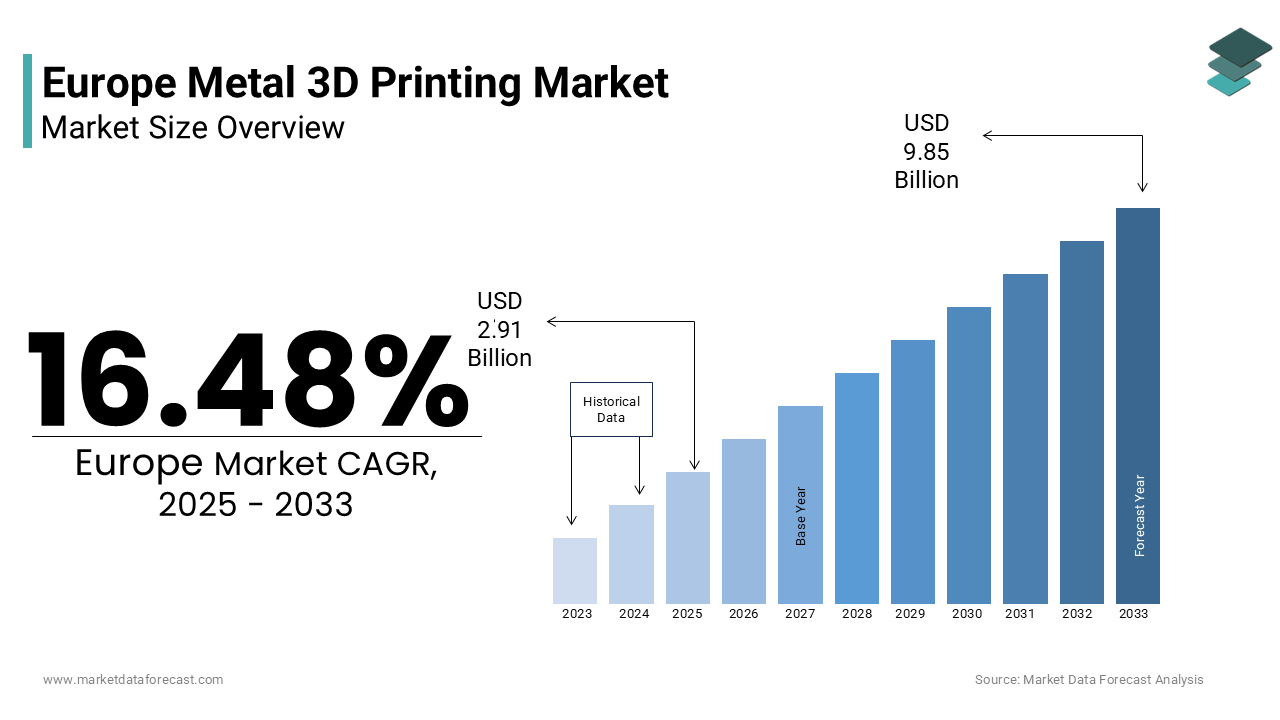
The europe metal 3D printing market size was valued at USD 2.50 billion in 2024 and is anticipated to reach USD 2.91 billion in 2025 from USD 9.85 billion by 2033, growing at a CAGR of 16.48% during the forecast period from 2025 to 2033.
Metal 3D printing refers to the additive manufacturing of functional metal components through layer-by-layer fusion of powdered alloys using technologies such as selective laser melting and electron beam melting. This approach enables complex geometries unattainable through conventional machining and supports rapid prototyping as well as end-use part production across aerospace, automotive, energy, and medical domains. Europe has emerged as a technological nucleus for industrial-scale metal additive manufacturing owing to its advanced engineering ecosystem and stringent sustainability mandates. As per Eurostat, industrial enterprises in the European Union invested over 215 billion euros in machinery and equipment in 2023, with a notable allocation toward digital production technologies. Additionally, the European Patent Office recorded more than 1200 patent families related to metal additive manufacturing between 2020 and 2024, which indicates the region’s innovation intensity. According to the European Commission, over 60% of European manufacturers now integrate some form of digital fabrication into their production workflows, reflecting a structural shift toward high-precision, resource-efficient manufacturing techniques across the continent.
MARKET DRIVERS
Accelerated Adoption in Aerospace Driven by Weight Reduction Imperatives
The European aerospace sector is a major driver of demand for metal additive manufacturing because of its relentless focus on lighter and higher‑performance components, which is majorly driving the growth of the Europe metal 3D printing market. Additive processes allow multi‑part assemblies to be consolidated into single printed structures, cutting part counts and reducing aircraft mass. Airbus reported that by the end of 2024 more than 1,000 flight‑ready metal printed parts had been installed across its commercial fleet, with titanium and nickel‑based alloys making up over 85% of those components. Weight reductions deliver direct fuel‑efficiency and emissions benefits, which is aligning with the EU’s Fit for 55 objectives. Rolls‑Royce has disclosed that its UltraFan demonstrator incorporates 30+ additively manufactured titanium components, contributing to a 25% improvement in fuel burn efficiency. According to the European Aviation Safety Agency, the average commercial aircraft in service across Europe now contains at least 15 metal printed parts and this figure expected to double by 2027. Together, these trends show how aerospace performance targets and environmental policy are reshaping material and process choices across aviation supply chains.
Strategic Push for Onshore Medical Implant Manufacturing
Demographic pressure and demand for personalised care are driving onshore metal 3D printing for medical implants, which is further boosting the expansion of the Europe metal 3D printing market. The EU contains over 111 million people aged 60+ (Eurostat 2024), a cohort projected to grow and to increase demand for customised orthopaedic and dental solutions. Metal additive manufacturing produces patient‑specific titanium implants with porous lattice architectures that better mimic bone, improving osseointegration and long‑term outcomes. According to the European Society of Orthopaedic and Traumatology, 350+ hospitals across Germany, France, Italy and the Nordics now operate in‑house or near‑shore metal printing for implants. The European Medicines Agency has streamlined pathways for Class III devices made additively, shortening average approval timelines by ~22% since 2021. Horizon Europe funding allocated €80m+ (2022–2024) to projects advancing biocompatible metal printing, including antimicrobial surface treatments and in‑process monitoring. These forces are anchoring medical‑grade metal printing as an essential capability in Europe’s healthcare infrastructure.
MARKET RESTRAINTS
High Operational Costs Limiting SME Accessibility
High capital and operating costs keep metal additive manufacturing out of reach for many European SMEs, which is primarily hampering the growth of the Europe metal 3D printing market. Industrial metal printers typically cost €500k–€2m+, while certified powders such as Inconel 718 or Ti‑6Al‑4V range €300–€600/kg, as per Fraunhofer data. Maintenance, energy use and intensive post‑processing push average annual operating costs above €180k per system. According to the data of Eurostat, 12% of manufacturing SMEs used metal additive technologies in 2024 versus 47% of large firms. The gap is widest in Southern and Eastern Europe, where capital access and technical skills lag. The ECB’s 2024 SME finance survey found 68% of small manufacturers cite upfront investment as the main barrier to adopting advanced digital production. Without targeted financing, shared‑hub models or public‑private support, these cost structures will continue to exclude smaller players and limit the technology’s diffusion.
Stringent Material Certification Protocols Delaying Industrial Scale‑Up
Regulated sectors face lengthy, fragmented certification processes for metal printed components, which is slowing industrial adoption and further hindering the growth of the Europe metal 3D printing market. Qualification for aerospace, energy and medical applications requires extensive mechanical testing, microstructural validation and traceability documentation and these steps that can add 12–18 months to qualification timelines, according to ESA assessments. Metal printed alloys show batch variability driven by powder morphology, machine settings and thermal history, so uncertainty about repeatability and certification is the primary cause of adoption delays. The Joint Research Centre attributes over 70% of industrial deployment delays to certification and repeatability concerns. In highly safety‑sensitive domains such as nuclear power, unresolved questions about irradiation resistance and crack propagation have prevented approval of printed components for primary systems. The absence of a centralized European material‑data repository forces duplicated testing across jurisdictions. Until harmonised standards and robust, shared databases exist, end‑user risk aversion will continue to constrain scale‑up despite clear technical advantages.
MARKET OPPORTUNITIES
Circular Economy Integration Through Powder Recycling Innovations
The EU’s Circular Economy Action Plan creates a strategic opening for Europe metal 3D printing market. While powder reuse has historically been constrained by oxygen uptake, particle agglomeration and morphology degradation across multiple cycles, recent process innovations now allow reliable powder regeneration while preserving flowability and chemical integrity. VTT’s collaborative work with Siemens Energy and Sandvik showed that gas‑atomised stainless‑steel powders can be reused up to 15 times without degrading tensile strength or fatigue life when combined with inline sieving and oxygen monitoring. As per the estimations of the European Environment Agency, industry‑wide recycling protocols could cut raw‑material extraction by about 34% by 2030. Germany’s Resource Efficient Manufacturing programme has funded three pilot powder‑reclamation facilities, each able to process more than 50 tonnes of used powder annually. These efforts align with the Critical Raw Materials Act’s focus on cobalt, nickel and titanium, and embedding powder regeneration into production workflows can shift metal 3D printing from a linear consumption model to a circular value chain to improve sustainability credentials and cost competitiveness.
Expansion of Defense Industrial Autonomy Through Additive Sovereignty
Europe’s push to strengthen defence supply‑chain autonomy presents a major growth vector for the Europe metal 3D printing market. Following the European Defence Agency’s 2023 call for technological sovereignty, member states are prioritising onshore production of mission‑critical parts to reduce reliance on third countries. Additive manufacturing’s rapid retooling, short‑run capability and geometric freedom suit next‑generation defence systems such as hypersonic vehicles, unmanned platforms and complex spares. According to SIPRI, European defence spending reached €293 billion in 2024, with roughly 18% directed to research and dual‑use technologies, including advanced manufacturing. The Netherlands’ Ministry of Defence, in partnership with DEMO and Thales, is establishing a sovereign metal‑printing facility to produce qualified aluminium and steel parts with full digital‑thread traceability. France’s DGA has mandated that 30% of non‑classified spare parts for legacy platforms be eligible for additive remanufacturing by 2027. These policy‑driven programmes secure supply, create high‑value testbeds for process validation and certification, and generate spillovers that can accelerate civilian adoption, which is positioning additive sovereignty as a pillar of Europe’s industrial resilience.
MARKET CHALLENGES
Skills Gap in Multidisciplinary Additive Expertise
Metal additive manufacturing requires a rare blend of metallurgical insight, digital‑design fluency and process‑engineering capability that remains in short supply across Europe, which is majorly challenging the expansion of the Europe metal 3D printing market. Success depends on real‑time parameter optimisation, thermal‑stress prediction and coordinated post‑processing as these are the skills that straddle materials science and data analytics. According to the European Skills Index 2024, only 19% of engineering graduates follow curricula that integrate additive‑manufacturing principles with materials characterisation, and the European Federation of National Engineering Associations projects a shortfall of more than 85,000 qualified additive specialists by 2027 if current trends continue. In Germany, surveys show 62% of metal‑printing installations run below 50% utilisation due to operator skill gaps. Vocational programmes are often siloed raising scrap rates, increasing failures and slowing technology transfer from labs to production. Without a coordinated upskilling agenda across academia, industry and public training bodies, Europe risks under‑utilising its installed additive capacity despite substantial investments.
REPORT COVERAGE
| REPORT METRIC | DETAILS |
| Market Size Available | 2024 to 2033 |
| Base Year | 2024 |
| Forecast Period | 2025 to 2033 |
| CAGR | 16.48% |
| Segments Covered | By Technology, Component, Material, End-User Industry and Region |
| Various Analyses Covered | Global, Regional & Country Level Analysis; Segment-Level Analysis; DROC, PESTLE Analysis; Porter’s Five Forces Analysis; Competitive Landscape; Analyst Overview of Investment Opportunities |
| Regions Covered | United Kingdom, France, Spain, Germany, Italy, Russia, Sweden, Denmark, Switzerland, the Netherlands, Turkey, and the Czech Republic |
| Market Leaders Profiled | EOS GmbH, SLM Solutions (Nikon SLM Solutions), Renishaw plc, Materialise NV, Trumpf GmbH + Co. KG, DMG MORI, GE Additive, 3D Systems Corporation, Desktop Metal Inc., Markforged Inc., HP Inc. (Metal Jet), Sandvik AB, Höganäs AB, Arcam AB (GE Additive), and Velo3D Inc. |
SEGMENTAL ANALYSIS
By Technology Insights
Among the primary technologies enabling metal additive manufacturing across Europe, the powder bed fusion (PBF) segment commanded for the dominant market position by holding the major share of the European market. The dominating position of PBF segment in this regional market is driven by its precision, repeatability and compatibility with high‑performance alloys essential for aerospace, medical and energy sectors. Powder Bed Fusion has benefited from decades of iterative refinement, making it the most validated metal printing method in mission‑critical environments. European aerospace leaders such as Airbus and Safran rely extensively on PBF to produce flight‑certified components. Space and aerospace authority reporting and qualification pipelines show that a clear majority of metal parts certified for demanding space and flight applications have been produced using PBF variants such as selective laser melting. The technology’s ability to achieve very high part density and consistent mechanical properties enables compliance with stringent mechanical and certification standards. This technical reliability has solidified PBF as the default choice for industries where failure is not an option. Moreover, research institutions such as Germany’s Fraunhofer ILT have developed in‑situ monitoring systems that enhance process control, further reducing scrap rates and shortening qualification timelines. Such ecosystem advancements reinforce PBF’s entrenched position in Europe’s high‑value manufacturing landscape.
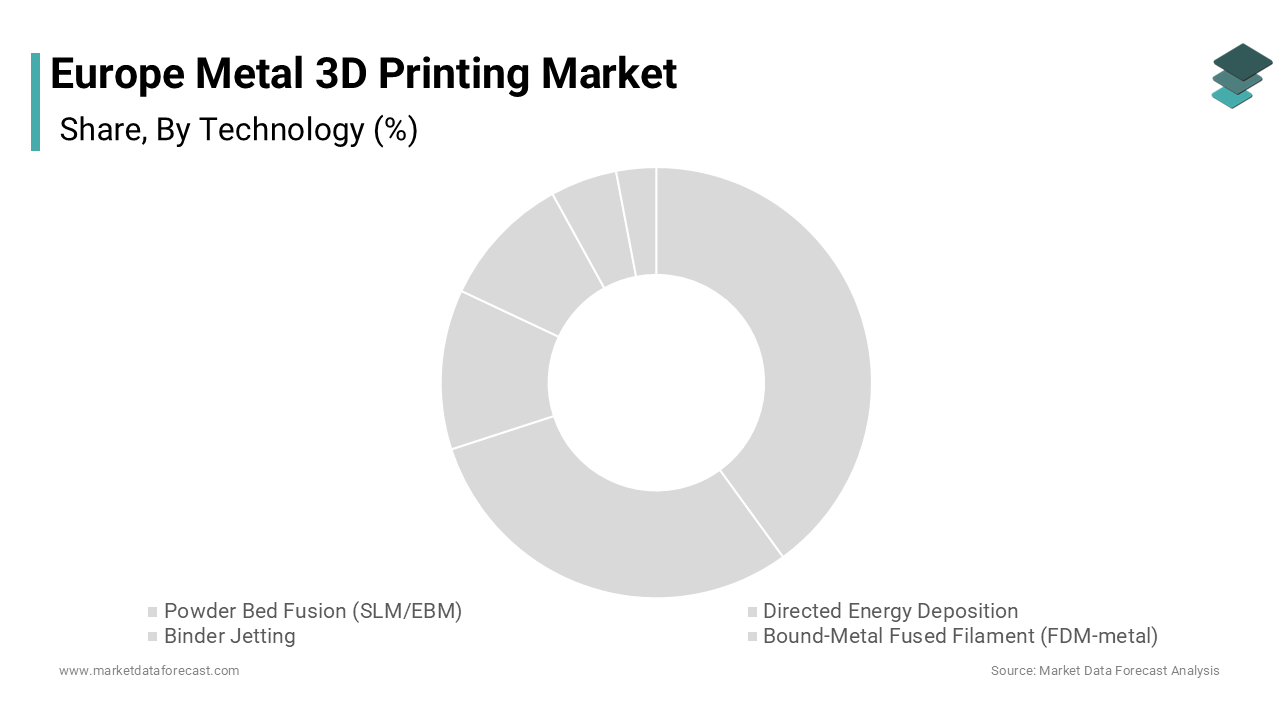
The binder jetting segment is emerging as the fastest growing metal 3D printing technology in Europe and is expected to witness a CAGR of 27.7% in the European market over the forecast period. Unlike PBF, which builds parts sequentially with a laser, Binder Jetting deposits a liquid binding agent across an entire powder layer enabling parallel production of many components in a single build. This scalability dramatically reduces cost per part and makes Binder Jetting viable for automotive and industrial tooling applications where volume matters. Recent technical studies and pilot projects report very large speed and throughput advantages for Binder Jetting on small, repeatable components. Automotive and tier‑one manufacturers have launched pilot lines and early production trials in Europe to validate binder‑jetted metal brackets, heat exchangers and other high‑volume parts with aggressive cost targets. Industry association commentary and OEM roadmaps indicate rapid integration of Binder Jetting into mainstream production platforms, shifting the technology from prototyping to serial manufacturing.
By Component Insights
The hardware segment held the highest share of the European metal 3D printing market in 2024. The growth of the hardware segment in this regional market is driven by capital investment patterns and production‑infrastructure development across industrial clusters. European manufacturers are transitioning from prototyping to serial production, necessitating substantial hardware deployment. Major industrial groups and OEMs have established dedicated metal‑printing factories equipped with multiple industrial systems. Public reporting and industry mapping show a marked increase in multi‑machine metal additive production centres across the EU in recent years, concentrated in engineering‑intensive Member States. The hardware demand is further amplified by defense and aerospace primes that mandate in‑house printing capabilities for supply‑chain security. This strategic vertical integration ensures hardware remains the foundational component of market spend as companies prioritize physical asset control over outsourced services.
The software segment is on the rise and is likely to expand at a CAGR of 23.9% over the forecast period in this regional market owing to the rising complexity of metal‑printing workflows. As metal printing shifts toward certified serial production, manufacturers require end‑to‑end software platforms that unify design, simulation, machine control and quality assurance. Legacy workflows involving disconnected tools are giving way to integrated suites that ensure traceability and repeatability. Industry guidance and aerospace procurement rules increasingly require digital‑thread compliance for additive parts, a requirement that necessitates advanced software infrastructure. Companies such as Altair and Siemens have launched Europe‑specific modules that embed EN and ISO standards directly into simulation and build‑preparation workflows. Facility case studies report meaningful reductions in build failures and qualification time when integrated software stacks are deployed. This operational efficiency is accelerating software adoption not as an auxiliary tool but as a core production enabler.
By End User Industry Insights
The aerospace and defense segment dominated the market by holding the leading share of the European market in 2024. Aerospace applications prioritize performance over cost, enabling early and extensive adoption of metal additive manufacturing. European aircraft programs incorporate dozens of PBF‑printed components per airframe to reduce weight and part count. OEM reporting and program case studies show substantial part consolidation and assembly simplification benefits from additive parts, translating into measurable reductions in assembly complexity and labor. Defence and systems agencies report widespread inclusion of additively manufactured propulsion, guidance and structural components in new programmes under development. The direct economic and environmental linkage between weight reduction and lifecycle fuel and emissions savings reinforces aerospace as the vanguard of metal‑printing adoption.
The medical and dental segment is predicted to witness a CAGR of 27.5% over the forecast period in this regional market owing to the demographic trends and regulatory advancements. Europe’s aging population is increasing demand for patient‑specific orthopedic and cranial implants, which metal 3D printing uniquely enables. Demographic projections and health‑service planning show a rising proportion of older adults and a corresponding increase in joint‑replacement and reconstructive procedures in many Member States. Metal printing allows customization of implant geometry and surface porosity to match individual bone structures, improving osseointegration and reducing revision surgeries. Clinical registry analyses and specialty‑society reports indicate lower revision rates and improved outcomes for selected additively manufactured implant designs in comparative cohorts. With substantial annual implant volumes in major European markets, the clinical and economic case for additive personalization is compelling and scalable.
REGIONAL ANALYSIS
Germany Metal 3D Printing Market Size
Germany dominated the market and commanded for the highest share of 27.7% of the regional market share in 2024. The growth of Germany in this European market is driven by the Germany’s metal additive manufacturing, commanding an estimated 28% of European metal‑AM activity. The country’s engineering heritage in automotive, aerospace and machinery create a natural ecosystem for high‑precision metal additive applications. Industry associations report hundreds of industrial adopters, and a substantial share now use metal AM for end‑use production as well as prototyping. Federal and regional programs support machine deployment, workforce development and process validation. Bavaria and Baden‑Württemberg host advanced manufacturing clusters where OEMs and research institutes collaborate on next‑generation qualification. Germany’s influence extends beyond scale to technical leadership, with German practice shaping EU‑level standards and industrial norms.
France Metal 3D Printing Market Size
France is a pivotal metal‑AM hub with concentrated strengths in aerospace, defense and energy applications. National industrial strategies prioritize advanced manufacturing and fund collaborative projects to build material databases, qualification pathways and certified production lines for safety‑critical components. Major primes operate advanced metal‑AM facilities and produce certified components for flight and power applications. Research agencies and national programs support high‑temperature and safety‑critical use cases, reinforcing France’s strategic role in Europe’s additive ecosystem.
United Kingdom Metal 3D Printing Market Size
The United Kingdom is a high‑value niche leader in metal AM, anchored in aerospace, defense and academic research. British firms and research centres have scaled additive production into serial workflows, moving key components from prototyping to certified manufacture. Strong university‑industry integration, targeted public funding and specialist recycling and qualification initiatives support closed‑loop powder management and production readiness. These capabilities position the UK as a strategic, innovation‑driven contributor to Europe’s metal‑AM landscape.
Italy Metal 3D Printing Market Size
Italy is a specialized contributor focused on medical implants and high‑performance motorsport components. The country hosts a cluster of certified medical‑device manufacturers using metal AM for patient‑specific implants, and its motorsport ecosystem leverages additive techniques for lightweight, performance‑critical parts. Regional competence centres link SMEs with research institutions to diffuse technology beyond elite firms, while public recovery and innovation funds support local capability building. Italy’s combination of craftsmanship, precision engineering and clinical translation gives it a distinctive additive identity.
Sweden Metal 3D Printing Market Size
Sweden is a strategically important adopter emphasizing sustainable production and defense readiness. Swedish industry and research programs prioritize energy‑efficient processes, circular material flows and AI‑driven quality control for metal AM. Major industrial firms operate low‑carbon facilities and procurement frameworks increasingly reference additive‑manufacturing readiness. National innovation funding supports projects that advance material reuse and process qualification, making Sweden a model for sustainable, defense‑aligned additive adoption in Northern Europe.
COMPETITIVE LANDSCAPE
Competition in the Europe metal 3d printing market is characterized by intense technological differentiation strategic partnerships and regional service localization among a mix of established engineering firms and specialized technology providers. Leading players compete not merely on machine specifications but on integrated value propositions encompassing materials software quality assurance and post processing support. The presence of strong industrial end users in aerospace automotive and medical sectors drives demand for certified repeatable solutions raising the barrier to entry for generic suppliers. National innovation policies and sustainability mandates further shape competitive dynamics favoring companies that align with Europe’s digital sovereignty and decarbonization goals. While global players maintain a presence European headquartered firms benefit from proximity to regulatory bodies technical standards organizations and advanced manufacturing clusters. This localized advantage combined with deep sector expertise ensures that competition remains innovation led and application focused rather than price driven across the region.
KEY MARKET PLAYERS
Some of the companies that are playing a dominating role in the europe metal 3D printing market include
- EOS GmbH
- SLM Solutions (Nikon SLM Solutions)
- Renishaw plc
- Materialise NV
- Trumpf GmbH + Co. KG
- DMG MORI
- GE Additive
- 3D Systems Corporation
- Desktop Metal Inc.
- Markforged Inc.
- HP Inc. (Metal Jet)
- Sandvik AB
- Höganäs AB
- Arcam AB (GE Additive)
- Velo3D Inc.
Top Players in the Europe Metal 3D Printing Market
EOS GmbH
EOS GmbH is a foundational force in Europe’s metal 3D printing ecosystem headquartered in Germany and widely recognized for pioneering industrial scale powder bed fusion technology. The company supplies high performance systems to aerospace automotive and medical sectors across the continent and globally. In recent years EOS has intensified its focus on end-to-end digital production workflows launching integrated software suites that enhance process repeatability and traceability. It has also expanded its materials portfolio in collaboration with European alloy producers to support certified applications in regulated industries. Through strategic partnerships with Airbus Siemens and leading hospitals EOS continues to shape global standards for metal additive manufacturing while reinforcing its technological leadership in Europe.
Renishaw plc
Renishaw plc based in the United Kingdom is a key enabler of precision metal additive manufacturing with a strong footprint in both European and global markets. The company designs and manufactures metal 3D printing systems renowned for accuracy and in process monitoring capabilities particularly serving dental aerospace and industrial sectors. Renishaw has recently invested in expanding its Additive Manufacturing Solutions Centres across Europe offering application development and contract printing services to lower entry barriers for new adopters. It has also deepened collaborations with academic institutions to advance metrology integration and closed loop quality control. These initiatives position Renishaw as a critical bridge between advanced engineering research and industrial deployment in metal 3D printing.
SLM Solutions Group AG
SLM Solutions Group AG headquartered in Germany is a leading innovator in selective laser melting technology with substantial influence across Europe and international markets. The company specializes in large format high throughput metal printers tailored for aerospace and energy applications. To strengthen its position SLM Solutions has accelerated its shift toward application driven solutions launching modular machine architectures and digital twin enabled production cells. It has forged alliances with major European industrial groups including Rolls Royce and Siemens Energy to co-develop certified printing workflows for serial production. Additionally, SLM has enhanced its service infrastructure with remote diagnostics and on-site support hubs across France Italy and the Nordics ensuring rapid deployment and uptime for industrial users.
Top Strategies Used by the Key Market Participants
Key players in the Europe metal 3d printing market pursue strategic initiatives centered on vertical integration application specific machine development and collaborative ecosystem building. They invest heavily in proprietary software to unify design simulation and production ensuring traceability for regulated sectors. Partnerships with aerospace defense and medical leaders enable co development of certified workflows that accelerate industrial adoption. Companies also expand regional service centers to offer contract printing training and technical support lowering entry barriers for small and medium enterprises. Additionally, they focus on sustainable operations through powder recycling closed loop material systems and energy efficient machine designs aligning with European green manufacturing mandates. These strategies collectively reinforce technological leadership customer retention and market expansion without relying solely on hardware sales.
MARKET SEGMENTATION
This europe metal 3D printing market research report is segmented and sub-segmented into the following categories.
By Technology
- Powder Bed Fusion (SLM/EBM)
- Directed Energy Deposition
- Binder Jetting
- Bound-Metal Fused Filament (FDM-metal)
- Hybrid Machining-AM Systems
- Other Technologies
By Component
- Hardware
- Software
- Services
- By Printer Type
- Industrial
- Desktop/Benchtop
By Material
- Titanium and Alloys
- Nickel-based Super-alloys
- Stainless Steel
- Aluminum and Aluminum Alloys
- Precious Metals
- Others
By End-user Industry
- Aerospace and Defense
- Automotive and Motorsports
- Healthcare (Medical and Dental)
- Oil and Gas/Energy
- Industrial Machinery and Tooling
- Electronics and Semiconductors
- Construction and Architecture
- Others
By Country
- UK
- France
- Spain
- Germany
- Italy
- Russia
- Sweden
- Denmark
- Switzerland
- Netherlands
- Turkey
- Czech Republic
- Rest of Europe
Frequently Asked Questions
What is metal 3D printing?
Metal 3D printing is an advanced manufacturing technology that creates metal parts layer by layer using additive manufacturing techniques.
What is driving the growth of the Europe metal 3D printing market?
The market is driven by rising adoption in aerospace, automotive, healthcare, and industrial manufacturing, along with growing demand for lightweight and customized components.
Which industries use metal 3D printing the most in Europe?
Major industries include aerospace and defense, automotive, healthcare (implants and devices), industrial manufacturing, and electronics.
What are the key technologies used in metal 3D printing?
Popular technologies include Selective Laser Melting (SLM), Direct Metal Laser Sintering (DMLS), Electron Beam Melting (EBM), Binder Jetting, and Directed Energy Deposition (DED).
Which countries are leading the metal 3D printing market in Europe?
Germany, the UK, France, Italy, and the Netherlands are among the leading contributors due to strong industrial and technological ecosystems.
What are the major challenges in the Europe metal 3D printing market?
High equipment costs, lack of skilled professionals, and material limitations are key challenges.
What materials are commonly used in metal 3D printing?
Common materials include titanium, aluminum, stainless steel, cobalt-chrome, nickel alloys, and other advanced metal powders.
How is metal 3D printing benefiting manufacturing industries?
It enables faster prototyping, design flexibility, reduced material waste, shorter production cycles, and cost-efficient low-volume production.
What is the future outlook for the Europe metal 3D printing market?
The market is expected to grow steadily with increasing investments in Industry 4.0, digital manufacturing, and advanced production technologies.
Who are the key players in the Europe metal 3D printing market?
Key players include EOS GmbH, SLM Solutions, Renishaw plc, Materialise NV, Trumpf GmbH, GE Additive, and 3D Systems Corporation.
Access the study in MULTIPLE FORMATS
Purchase options starting from
$ 2000
Didn’t find what you’re looking for?
TALK TO OUR ANALYST TEAM
Need something within your budget?
NO WORRIES! WE GOT YOU COVERED!
Call us on: +1 888 702 9696 (U.S Toll Free)
Write to us: sales@marketdataforecast.com