- Product Description Description
- Table of Contents TOC
- List of Table & Figure LOT
- Get Free Sample PDF Sample PDF
Market Size, 2025
$13.71 BnMarket Estimate, 2026
$17.97 BnMarket Forecast, 2034
$156.36 BnCAGR, 2026–2034
31.06%Europe Metaverse Market Report Summary
The Europe metaverse market was valued at USD 13.71 billion in 2025, is anticipated to reach USD 17.97 billion in 2026, and is projected to reach USD 156.35 billion by 2034, growing at a CAGR of 31.06% during the forecast period from 2026 to 2034. The growth of the Europe metaverse market is driven by regulatory support for digital sovereignty and secure identity frameworks, rapid adoption of digital twins across industrial sectors, and rising investments in immersive technologies such as VR, AR, and blockchain-based platforms. Increasing integration of metaverse environments in education, urban planning, public services, and enterprise collaboration is further accelerating adoption. Moreover, Europe’s distinctive focus on privacy-compliant, open, and interoperable metaverse ecosystems is shaping a purpose-driven market aligned with sustainability and ethical digital transformation.
Key Market Trends
-
Rising adoption of digital twins and immersive environments in manufacturing, infrastructure planning, and training applications.
-
Increasing use of VR and AR technologies across gaming, education, healthcare, and enterprise collaboration.
-
Growing development of blockchain-based digital identity, asset ownership, and decentralized governance frameworks.
-
Expansion of public sector metaverse initiatives for civic engagement, participatory urban design, and e-governance.
-
Strong momentum toward open-source and interoperable metaverse protocols aligned with European data sovereignty principles.
Segmental Insights
- Based on component, the hardware segment held the largest share in 2025, driven by growing adoption of VR/AR headsets, spatial computing devices, and immersive enterprise equipment across industrial and consumer use cases.
- The services segment is expected to witness the fastest growth, supported by rising demand for metaverse consulting, 3D environment development, integration services, cybersecurity compliance, and regulatory advisory.
- Based on technology, the VR and AR segments dominated the market, owing to their maturity and widespread use across gaming, simulation, education, and industrial visualization.
- The blockchain segment is projected to grow at the fastest rate, fueled by increasing demand for verifiable digital identity, asset ownership, interoperability, and decentralized governance models.
- Based on vertical, the media and entertainment segment led the market, driven by immersive storytelling, virtual concerts, social worlds, and interactive gaming ecosystems.
Regional Insights
The Europe metaverse market is experiencing strong growth across major economies, supported by industrial digitization initiatives, creative ecosystems, and supportive public policy frameworks.
- Germany leads the market, driven by Industry 4.0 adoption, advanced digital twin ecosystems, strong enterprise usage, and sovereign cloud infrastructure initiatives such as GAIA-X.
- The United Kingdom follows closely, supported by its world-class gaming industry, creative media ecosystem, fintech innovation, and strong metaverse startup environment.
- France continues to strengthen its position through government-backed immersive technology programs, luxury brand innovation in digital fashion, and growing use of metaverse tools in education and cultural engagement.
- Sweden benefits from its gaming heritage, strong digital trust culture, and advanced research in immersive technologies, with applications expanding into public planning and sustainability modeling.
- The Netherlands is emerging as a high-growth market with strong adoption of digital twins in logistics and infrastructure, active university research, and a supportive environment for open metaverse protocols.
Competitive Landscape
The Europe metaverse market is characterized by a mix of global technology giants and regional innovators, competing across enterprise applications, immersive platforms, content ecosystems, and infrastructure layers. Market participants differentiate through regulatory compliance (GDPR, data sovereignty), enterprise-grade security, and alignment with European ethical and sustainability standards. Strategic collaborations with universities, governments, and research institutions are accelerating innovation across industrial, educational, and civic metaverse use cases. The market favors companies that prioritize interoperability, trust, privacy protection, and long-term societal value, rather than purely speculative consumer engagement. Prominent players operating in the Europe metaverse market include Meta Platforms, Microsoft Corporation, NVIDIA Corporation, Epic Games, Roblox Corporation, Unity Technologies, Tencent Holdings Ltd., HTC Corporation, Valve Corporation, Varjo Technologies, Decentraland, and Animoca Brands.
Europe Metaverse Market Size
The europe metaverse market size was valued at USD 13.71 billion in 2025 and is anticipated to reach USD 17.97 billion in 2026 from USD 156.35 billion by 2034, growing at a CAGR of 31.06% during the forecast period from 2026 to 2034.
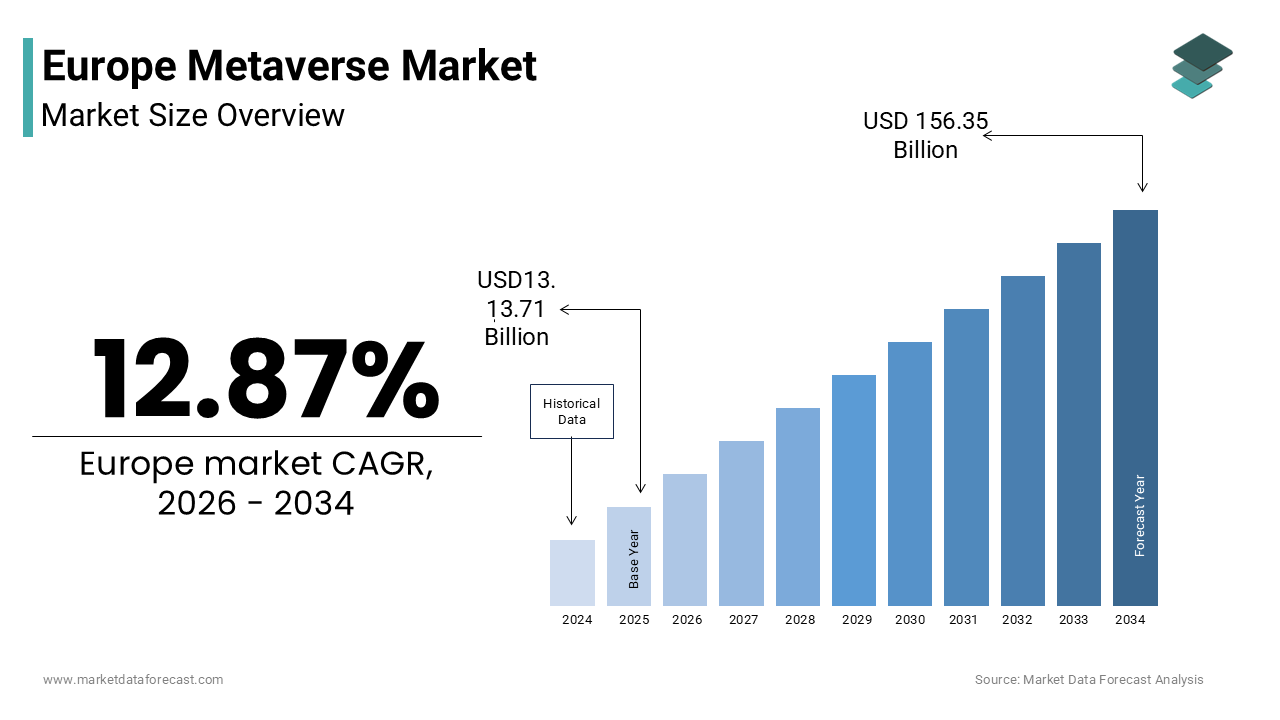
The metaverse is a persistent, immersive, 3D virtual universe that blends the digital and physical worlds. Unlike speculative global narratives Europe’s approach is anchored in regulatory rigor data sovereignty and industrial utility. As per sources, availability of high-speed fixed broadband connectivity across Europe is expanding, facilitating more data-intensive online activities. The European Union is investing heavily in high-performance computing and broader digital infrastructure to support a range of advanced, data-driven public services and scientific simulations. A growing number of European research and innovation projects are receiving substantial funding to explore and develop advanced digital technologies like digital twins and virtual collaboration tools. Cultural institutions are increasingly leveraging digital platforms to offer online experiences, broadening public engagement with their collections beyond physical visits. Crucially, Europe’s metaverse development is shaped not by consumer escapism but by industrial training urban planning education and sustainable design mandates making it a distinctively purpose driven digital frontier.
MARKET DRIVERS
Regulatory Push for Digital Sovereignty and Secure Identity Frameworks
Policy frameworks mandate user-centric data control and interoperable digital identities, which continue to accelerate the growth of the Europe metaverse market. Regulatory changes are requiring public and private services to accept standardized digital wallets for authentication. This indicates identity systems are expanding to include verification of digital personas and virtual representations. Also, this legal infrastructure eliminates reliance on centralized US based identity providers and fosters trust in virtual interactions. The European blockchain service infrastructure has expanded its operational scope across numerous member states, facilitating the use of national digital identity schemes for transactional and verification purposes. An analysis indicates a strong preference among European enterprises for metaverse platforms that incorporate national digital identity systems to ensure compliance with privacy and data governance regulations. Relevant national security and information technology agencies have begun certifying specific metaverse identity protocols for use in public sector applications. This regulatory backbone transforms the metaverse from an entertainment layer into a secure public digital utility aligned with European values of privacy autonomy and interoperability.
Industrial Adoption of Digital Twins for Sustainable Manufacturing
European industries are rapidly deploying metaverse enabled digital twins to enhance efficiency, reduce emissions, and comply with the Green Deal, which further acts as a key driver of the Europe metaverse market. Industrial activities contribute significantly to regional carbon emissions, leading to greater attention on digital simulation as a tool for decarbonization. Manufacturing firms are developing virtual copies of their production sites to track energy use, material movement, and equipment effectiveness in real-time. These digital models facilitate optimization testing virtually, lessening the reliance on physical trials and decreasing material waste. Testing manufacturing processes virtually permits the rearrangement of assembly lines without causing operational pauses. The EU’s Carbon Border Adjustment Mechanism further incentivizes such transparency as companies must document embedded emissions across supply chains, data most reliably captured in synchronized virtual environments. The Industrial Metaverse Alliance’s growing European presence highlights that integrating physical and virtual operations is vital for compliance and staying competitive.
MARKET RESTRAINTS
Fragmented National Approaches to Immersive Technology Regulation
National divergence in regulating immersive environments creates uncertainty and deployment friction for metaverse developers, despite EU level frameworks, and inhibits the growth of the Europe metaverse market. Virtual reality content moderation, avatar representation, and biometric data usage are subject to distinct rules across different European member states, creating complex compliance requirements. The application of regulations regarding emotion recognition in virtual reality training differs significantly between certain countries, with some requiring explicit approval while others allow it under general consent. Inconsistent interpretations of directives concerning user-generated virtual content are causing many metaverse startups to delay launching services across borders. Requirements for pre-release psychological impact assessments on immersive experiences targeted at minors are mandatory in certain jurisdictions but not others. This regulatory patchwork contributes to increased legal and operational costs for companies managing pan-European metaverse platforms. The full potential of Europe’s single digital market for immersive technologies remains restricted, pending deeper regulatory harmonization.
Limited Consumer Access to High Performance Immersive Hardware
Uneven access to advanced headsets and computing infrastructure particularly outside urban centers is another restraint to the Europe metaverse market. This affects the widespread metaverse participation in the region. Consumer adoption of VR/AR headsets remains concentrated in specific regions across Europe, rather than being uniformly distributed. Disparities in headset adoption exist between Northern/Western and Southern/Eastern regions, with infrastructure limitations and high hardware costs acting as barriers to broader market penetration. Efforts to use public institutions to bridge the technology gap for immersive tools also face challenges. This digital divide risks creating a two tier metaverse where only affluent urban users benefit from next generation interaction models.
MARKET OPPORTUNITIES
Public Sector Integration of Metaverse for Civic Engagement and Urban Planning
European governments are increasingly using metaverse platforms to increase democratic participation and sustainable city development, and therefore create new opportunities for the Europe metaverse market. Numerous European urban centers are increasingly adopting persistent virtual models to facilitate community input and democratic engagement in city planning. Public interaction with digital simulations has demonstrated a positive impact on user satisfaction regarding community spaces. European funding initiatives are actively supporting the development of digital, interactive environments that focus on climate resilience and inclusive design. Virtual platforms are being utilized in certain regions to enable secure, verified participation in civic discussions and planning processes. The application of immersive technologies in urban development has shown potential for reducing, or mitigating, project delays by addressing conflicts at an earlier stage. The mandatory inclusion of citizens in EU resilience planning is transitioning the metaverse from novelty to fundamental civic infrastructure, fostering scalable, participatory governance across the continent.
Rise of European Led Open Source Metaverse Protocols
A growing movement toward open interoperable metaverse standards is creating a distinct European alternative to proprietary ecosystems, which serves as a strong potential for the Europe metaverse market. European developers are increasingly launching open-source spatial computing frameworks, supported by initiatives like the Open Source Observatory (OSOR) to promote interoperability. These protocols prioritize GDPR compliance decentralized identity and cross platform asset portability. The Gaia-X initiative is advancing data sovereignty in Europe by developing open, federated data infrastructures for virtual worlds and industrial applications. Academic networks like ELLIS are contributing AI models trained on European languages and cultural contexts ensuring avatars and interactions reflect regional norms. Multiple European governments are collaborating to fund initiatives that ensure interoperability and open standards for digital, metaverse-like environments. The move towards open-source standards in European technology is attracting a growing community of independent creators and developers. Europe is cultivating a robust, innovative metaverse by anchoring it in open standards, ensuring it reflects European values of sovereignty and diversity.
MARKET CHALLENGES
Energy Consumption and Environmental Impact of Persistent Virtual Worlds
The operation of real-time rendered persistent metaverse environments poses significant sustainability challenges that conflict with the region’s climate commitments, and thereby hampers the growth of the Europe metaverse market. High-fidelity virtual reality interactions contribute significantly to energy consumption, drawing power levels comparable to multiple hours of residential refrigerator use. Data centers facilitating metaverse platforms represent a notable portion of regional electricity demand, with immersive computing driving projected annual increases in consumption. Asset verification within virtual environments, such as blockchain-based systems, adds to the energy load, and while certain network transitions have improved efficiency, they do not eliminate carbon emissions entirely. Large-scale, photorealistic virtual events can generate emissions that exceed those of in-person gatherings if reliance on non-renewable energy sources persists. Environmental regulations require greater energy transparency from virtual platform providers, though a significant portion of industry players have not yet met these reporting standards. The European metaverse risks undermining its environmental goals without the implementation of sustainable coding and renewable infrastructure.
Psychological and Social Implications of Prolonged Immersive Exposure
Extended engagement in metaverse environments raises concerns about cognitive load, social dislocation, and identity fragmentation, particularly among youth, which limits the expansion of the European metaverse market. Early studies indicate a potential connection between extended engagement in virtual environments and difficulties with attentional control or emotional responsiveness among younger users. Observers have identified instances where individuals experience challenges transitioning between virtual interactions and real-world social cues, sometimes described as a disconnection from physical surroundings. Reports from parents and guardians suggest notable shifts in behavior among children following intense periods of virtual reality gaming. The deep sensory immersion characteristic of virtual reality appears to have a more significant impact on neuroplasticity compared to traditional screen-based activities, necessitating careful moderation. Educational systems across Europe are in the early stages of adopting curriculum changes that address the complexities of immersive digital environments, with only a few nations having initiated this integration. If the metaverse lacks evidence-based ethical guidelines and public health safeguards, its social benefits could be overshadowed by unforeseen psychological harm, which Europe’s precautionary regulations are currently ill-equipped to handle.
REPORT COVERAGE
| REPORT METRIC | DETAILS |
| Market Size Available | 2025 to 2034 |
| Base Year | 2025 |
| Forecast Period | 2026 to 2034 |
| CAGR | 10.30% |
| Segments Covered | By Component, Technology, Application, Vertical Insights, and Region |
| Various Analyses Covered | Regional & Country Level Analysis, Segment-Level Analysis, DROC, PESTLE Analysis, Porter’s Five Forces Analysis, Competitive Landscape, Analyst Overview on Investment Opportunities |
| Countries Covered | UK, France, Spain, Germany, Italy, Russia, Sweden, Denmark, Switzerland, the Netherlands, Turkey, the Czech Republic, and the Rest of Europe. |
| Market Leaders Profiled | Meta Platforms, Inc., Microsoft Corporation, NVIDIA Corporation, Epic Games, Roblox Corporation, Unity Technologies, Tencent Holdings Ltd., HTC Corporation, Valve Corporation, Varjo Technologies, Decentraland, and Animoca Brands |
SEGMENTAL ANALYSIS
By Component Insights
The hardware segment dominated the Europe metaverse market by accounting for a 42.4% percent share in 2025. Widespread adoption of immersive headsets and spatial computing devices across enterprise and consumer domains primarily drives the dominance of the hardware segment. Virtual and augmented reality headset adoption has shown a notable presence in European markets, with enterprise-level procurement representing a significant portion of unit volume for training and design applications. The automotive industry has actively incorporated spatial computing devices for tasks related to virtual prototyping and assembly simulation. The expansion of high-speed network infrastructure in urban areas has facilitated improved, low-latency experiences for these devices. Additionally, EU funding programs like Horizon Europe have allocated funds for immersive technology R and D accelerating hardware innovation in countries like Finland and the Netherlands. Consumer demand is also rising with gaming and social metaverse platforms driving retail headset sales which grew year on year according to research. This confluence of industrial utility and entertainment adoption solidifies hardware as the foundational pillar of Europe’s metaverse ecosystem.
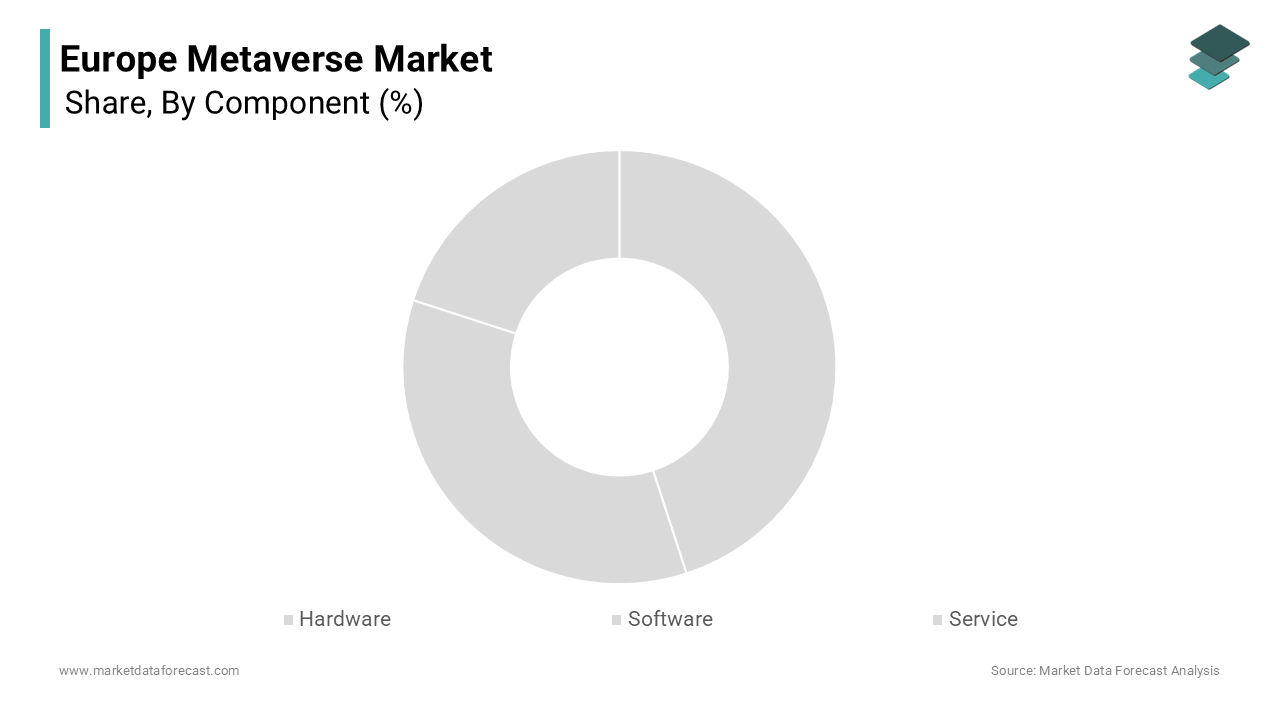
The services segment is anticipated to witness the fastest CAGR of 38.6% from 2026 to 2034 due to the increasing complexity of metaverse deployment and the need for specialized integration support. Enterprises exploring metaverse initiatives often report inadequate internal capabilities for developing 3D environments, synchronizing digital twins, and managing decentralized identities. This identified skills gap appears to be increasing reliance on external consulting services. Large technology service firms are responding by establishing specialized development and training centers focused on platforms such as Unity and Unreal Engine. Simultaneously, educational institutions are collaborating with industry partners to form alliances intended to align academic programs with the practical skills needed in the metaverse sector. The current demand for specialized metaverse proficiencies seems to exceed the available supply of skilled professionals. Furthermore, EU data governance frameworks like the Data Act require custom compliance architectures for user generated metaverse content prompting demand for legal and cybersecurity advisory services. This reliance on external expertise to navigate technical regulatory and creative dimensions ensures services will remain the most dynamically growing metaverse component across Europe.
By Technology Insights
The virtual reality and augmented reality segments together led the Europe metaverse market by capturing a 56.7% share in 2025. The leading position of the VR and AR segments is attributed to their maturity, interoperability, and broad applicability across sectors. Virtual and augmented reality technologies serve as the foundational interaction methods for most professional immersive applications, with mixed reality and blockchain acting as supporting components. Medical professionals in surgical settings are increasingly incorporating augmented reality overlays to enhance procedural efficiency. Governmental initiatives are actively investing in, and establishing, national training hubs that utilize immersive simulations for vocational education. A significant portion of younger, digitally engaged consumers are regularly utilizing virtual social platforms. The introduction of new, high-profile spatial computing hardware has increased enterprise interest in developing, and adopting, augmented reality solutions. The extensive developer ecosystem existing content libraries and proven ROI in training and design sustain VR and AR as the dominant technological backbone of Europe’s metaverse.
The blockchain technology segment is likely to experience the fastest CAGR of 41.2% from 2026 to 2034 owing to demand for verifiable digital ownership interoperable assets and decentralized governance. Several European countries are integrating blockchain technology into their digital identity frameworks to enable secure, cross-platform credentials and avatars. The European Commission is advancing a digital identity wallet initiative that will require blockchain-based verification for various digital services, including metaverse interactions. Non-fungible tokens have gained popularity in the gaming and fashion industries, particularly for authenticating virtual items. Furthermore, new regulations for crypto assets are providing legal certainty, which is prompting European firms to consider tokenizing content rights. Universities like ETH Zurich and Imperial College London are also pioneering zero knowledge proof protocols to enhance privacy in decentralized metaverses. These developments position blockchain not as a speculative add on but as the trust infrastructure enabling Europe’s vision of an open interoperable and user centric metaverse.
By Industry Vertical Insights
The media and entertainment segment held the majority share of 29.7% of the Europe metaverse market in 2025. The supremacy of the media and entertainment segment is credited to immersive storytelling live virtual experiences and interactive fan engagement. The European creative sector is seeing digital transformation, particularly the integration of virtual environments, act as a primary driver for expansion. Major media organizations are moving towards persistent virtual studios for real-time audience interaction, and public engagement with immersive content is increasing. The music and live entertainment industries are adopting hybrid models to exist in both physical and digital spaces, utilizing virtual platforms to attract a global audience and overcome geographical barriers. Gaming remains central with Ubisoft and CD Projekt leading European development of narrative driven metaverse worlds that support user generated content. Additionally the EU’s program allocated funds for immersive media projects fostering indie studio innovation. Cultural relevance and scalable content make this sector the leading force in Europe’s metaverse growth, fueled by rising connectivity and youth demand.
The education segment is on the rise and is expected to be the fastest-growing market segment, with a projected CAGR of 39.7% from 2026 to 2034. This rapid growth is propelled by institutions embracing metaverse environments for experiential learning, skill development, and inclusive access. Educational institutions at different levels are increasingly incorporating immersive digital environments into their standard academic offerings. International cooperation programs are utilizing shared virtual spaces to facilitate collaborative learning experiences that transcend physical borders. Primary education systems are beginning to adopt virtual reality as a tool for experiential learning to supplement traditional classroom instruction. Major industrial organizations are transitioning toward augmented reality simulations to conduct technical training for their workforce. Regional workforce development strategies are prioritizing digital literacy and immersive technologies as central components of long-term skill acquisition. These structural investments in future ready education ensure sustained metaverse adoption across academic and professional learning pathways in Europe.
By Application Insights
The gaming segment was the largest segment in the Europe metaverse market by occupying a 33.1% share in 2025 as it remains the most mature and widely adopted use case driving user acquisition infrastructure development and creator economies. A significant portion of the European population actively participates in online gaming, with a large segment frequently engaging in virtual environments that combine social interaction, user-created content, and integrated shopping. Prominent gaming titles frequently function as core, accessible virtual platforms, with a substantial portion of user-generated content in these spaces originating from European participants. Younger European players increasingly view personalized avatars, the ability to move progress between platforms, and virtual entertainment events as expected, standard elements of the gaming experience. Major publishers such as Embracer Group in Sweden and Focus Entertainment in France have shifted R and D budgets toward interoperable game assets and blockchain enabled ownership. Additionally, EU initiatives like the European Cloud Gaming Alliance are establishing low latency edge computing hubs in Warsaw and Lisbon to support real time multiplayer metaverse experiences. Gaming’s leading role in regional metaverse adoption reflects high ecosystem maturity and shifting consumer behavior.
The testing and inspection segment is expected to exhibit a noteworthy CAGR of 42.3% over the forecast period as industries adopt digital twin enabled metaverse environments for simulation validation and safety certification. Virtual stress testing in digital twins is increasingly used for certifying new aircraft components. This shift toward simulated environments is reducing the need for physical prototyping in aerospace. Automotive safety assessments, including crash simulations and battery fire tests, are now performed in immersive, virtual settings, and European regulations are being adapted to approve these virtual tests for automotive certification. The European Space Agency operates a metaverse testbed at its ESTEC facility in the Netherlands where engineers validate satellite deployment sequences under zero gravity conditions with most fidelity to real world physics. Similarly pharmaceutical firms like Novartis use VR inspection rooms to audit sterile manufacturing facilities remotely satisfying EU Good Manufacturing Practice requirements. Regulatory acceptance interoperability with CAD systems and cost efficiency collectively drive this segment’s exponential growth as Europe prioritizes digital validation in high risk industries.
REGIONAL ANALYSIS
Germany Metaverse Market Analysis
Germany was the top performer in the Europe metaverse market by capturing a 24.5% share in 2025, with its industrial digitization leadership and strong hardware ecosystem. The country is home to Europe’s most advanced Industry 4.0 testbeds where metaverse applications are used for factory layout simulation predictive maintenance and worker training. Digital twin and metaverse solutions are experiencing a notable rise in implementation across the German manufacturing sector. Manufacturing companies in Germany are increasingly adopting technologies that blend physical and virtual environments. Certain major German cities are functioning as key focal points for the development and testing of these digital technologies. Large, established industrial companies are spearheading the deployment of metaverse solutions in enterprise settings. A growing number of new, specialized firms are concentrating their efforts on spatial computing technologies. The German government’s GAIA X initiative ensures data sovereignty in industrial metaverses aligning with strict privacy norms. Additionally public institutions like the German Aerospace Center operate Europe’s largest virtual mission control center for satellite testing. Germany's metaverse sector thrives on industrial pragmatism rather than speculative trends, anchored by top-tier engineering talent, robust 5G infrastructure, and supportive policies.
The United Kingdom Metaverse Market Analysis
The United Kingdom was the second largest player in the Europe metaverse market by holding a 18.8% share in 2025. The growth of the Uk market is driven by its world class gaming creative media and fintech sectors. London is Europe’s leading metaverse content creation capital hosting studios from Improbable to nDreams that develop AAA virtual worlds and enterprise collaboration platforms. Creative professionals are increasingly utilizing virtual and interactive platforms for design, performance, and connecting with audiences. Within the gaming industry, there is a notable trend of studios incorporating decentralized ledger and social features. Overall, the creative and gaming sectors show a growing adoption of immersive, social, and blockchain technologies. Universities like University College London and University of Edinburgh offer specialized metaverse design degrees feeding talent into the ecosystem. Post Brexit the UK has moved swiftly to establish regulatory sandboxes for digital assets enabling faster innovation than in some EU jurisdictions. The British Museum’s virtual gallery and Barclays’ metaverse banking pilot exemplify cross sector adoption. This creative technical and regulatory agility ensures the UK remains a dynamic metaverse leader despite geopolitical shifts.
France Metaverse Market Analysis
France continues to be a major country in the Europe metaverse market due to strong government backing, luxury tech convergence, and immersive education. National initiatives in France are directing significant investment toward developing immersive technologies, prioritizing the creation of European alternatives to established international platforms. Paris acts as a central hub for fashion-related metaverse innovation, where luxury brands are designing virtual showrooms and digital wearables for both decentralized and private virtual environments. The integration of virtual reality is expanding within the educational sector, with numerous schools implementing these tools for immersive history and language learning. Also, the country hosts a major European technology conference that serves as a significant funding venue for startups focused on metaverse technologies. Public broadcasters like France Télévisions launched immersive journalism labs producing 360 degree documentaries on climate change. France is shaping a distinctively European, human-centered metaverse, focused on creativity and digital rights, by combining cultural influence, technical talent, and strategic funding.
Sweden Metaverse Market Analysis
Sweden witnessed a consistent growth in the Europe metaverse market owing to its gaming legacy sustainability focus and public digital infrastructure. Home to global studios like Mojang (Minecraft) and Hazelight the country leverages gaming as a metaverse foundation with millions of monthly Swedish VRChat users. Public sector entities are increasingly adopting virtual simulation environments for planning and emergency response scenarios. Specific urban areas are developing into central hubs for extended reality development, supported by local infrastructure and renewable energy sources. Retailers are implementing augmented reality tools to aid in product visualization, which can contribute to reduced product returns. Academic institutions such as KTH Royal Institute of Technology pioneer haptic feedback and eye tracking integration. Sweden’s combination of innovation policy environmental consciousness and digital trust makes its metaverse development both scalable and ethically grounded.
Netherlands Metaverse Market Analysis
The Netherlands is anticipated to expand in the Europe metaverse market from 2026 to 2034 due to its logistics innovation academic research and open digital culture. Amsterdam and Eindhoven serve as metaverse test zones where Port of Rotterdam uses digital twins to simulate vessel traffic and cargo handling reducing congestion. Dutch universities like TU Delft lead in human computer interaction research developing gesture based navigation and emotion aware avatars. The country’s tolerant regulatory stance has attracted metaverse protocol developers with numeorous blockchain based identity startups operating under the Dutch Digital Sandbox. Technological companies are increasingly using augmented reality for remote support, enabling experts to resolve equipment problems globally without needing to travel. A notable percentage of adults are using immersive technologies for work or leisure. The Netherlands is serving as a testing ground for implementing scalable immersive solutions, supported by digital infrastructure and technical expertise.
COMPETITIVE LANDSCAPE
Competition in the Europe metaverse market is defined by a strategic divergence between global technology giants and regional innovators each navigating the continent’s unique regulatory ethical and industrial landscape. Unlike other regions where entertainment dominates European competition centers on utility driven applications in manufacturing education urban planning and public services. Vendors are evaluated not just on technical performance but on adherence to data sovereignty environmental impact and accessibility standards. The market features intense collaboration as much as rivalry with companies co developing open protocols through EU funded consortia while simultaneously differentiating through vertical specific solutions. Regulatory scrutiny ensures that user safety privacy and interoperability remain non negotiable competitive parameters. Startups thrive in niche domains like green rendering or inclusive avatars while large firms compete on enterprise integration and public sector trust. This ecosystem fosters a metaverse vision that is less speculative and more anchored in societal value making Europe a distinct and influential arena in the global metaverse evolution.
KEY MARKET PLAYERS
Some of the companies that are playing a dominating role in the Europe metaverse market include
- Meta Platforms, Inc.
- Microsoft Corporation
- NVIDIA Corporation
- Epic Games
- Roblox Corporation
- Unity Technologies
- Tencent Holdings Ltd.
- HTC Corporation
- Valve Corporation
- Varjo Technologies
- Decentraland
- Animoca Brands
Top Players in the Market
Meta Platforms Inc
Meta Platforms Inc maintains a strong presence in the Europe metaverse market through its Horizon ecosystem and enterprise collaboration tools. The company actively engages with European developers and institutions to align its platforms with regional data privacy expectations. It also partnered with France’s Sorbonne University to pilot immersive history education modules and expanded its European metaverse safety advisory board to include regulators from Germany and Sweden. These initiatives demonstrate Meta’s commitment to embedding European ethical and regulatory norms into its global metaverse strategy while fostering local innovation.
Microsoft Corporation
Microsoft Corporation plays a pivotal role in Europe’s industrial metaverse landscape through its Mesh platform and integration with Azure Digital Twins. The company focuses on enterprise applications in manufacturing healthcare and defense where secure interoperable environments are critical. It also launched the European Immersive Developer Grant Program funding numerous startups building accessible and sustainable metaverse applications. Microsoft is solidifying its role as a trusted partner in Europe’s purposeful metaverse by focusing on data sovereignty, regulatory compliance, and cross-sector utility.
Unity Software Inc
Unity Software Inc is a foundational technology provider for European metaverse creation through its real time 3D development engine widely used in gaming automotive and architecture. The company supports thousands of European studios and enterprises building virtual worlds with localized content and accessibility features. It also introduced a new EU specific ethics dashboard that helps developers audit bias accessibility and carbon impact during development. These actions underscore Unity’s role in empowering European creators while advancing responsible and inclusive metaverse innovation.
Top Strategies Used by the Key Market Participants
Key players in the Europe metaverse market focus on regulatory alignment by embedding GDPR and Digital Services Act compliance into platform architecture. They invest heavily in sovereign cloud infrastructure to ensure data residency and build trust with public and enterprise clients. Strategic partnerships with universities national labs and cultural institutions enable localized content development and workforce upskilling. Companies also prioritize open standards and interoperability to avoid platform lock in and support EU digital sovereignty goals. Additionally they integrate sustainability metrics such as energy consumption tracking and carbon footprint dashboards to align with the European Green Deal and appeal to environmentally conscious users and regulators.
MARKET SEGMENTATION
This europe metaverse market research report is segmented and sub-segmented into the following categories.
By Component
- Hardware
- Software
- Service
By Technology
- Blockchain
- Virtual Reality and Augmented Reality
- Mixed Reality
- Others
By Application
- Gaming
- Online Shopping
- Content Creation and Social Media
- Events and Conference
- Digital Marketing
- Testing and Inspection
- Others
By Vertical Insights
- BFSI
- Retail
- Media and Entertainment
- Education
- Aerospace and Defense
- Automotive
- Others
By Country
- UK
- France
- Spain
- Germany
- Italy
- Russia
- Sweden
- Denmark
- Switzerland
- Netherlands
- Turkey
- Czech Republic
- Rest of Europe