- Product Description Description
- Table of Contents TOC
- List of Table & Figure LOT
- Get Free Sample PDF Sample PDF
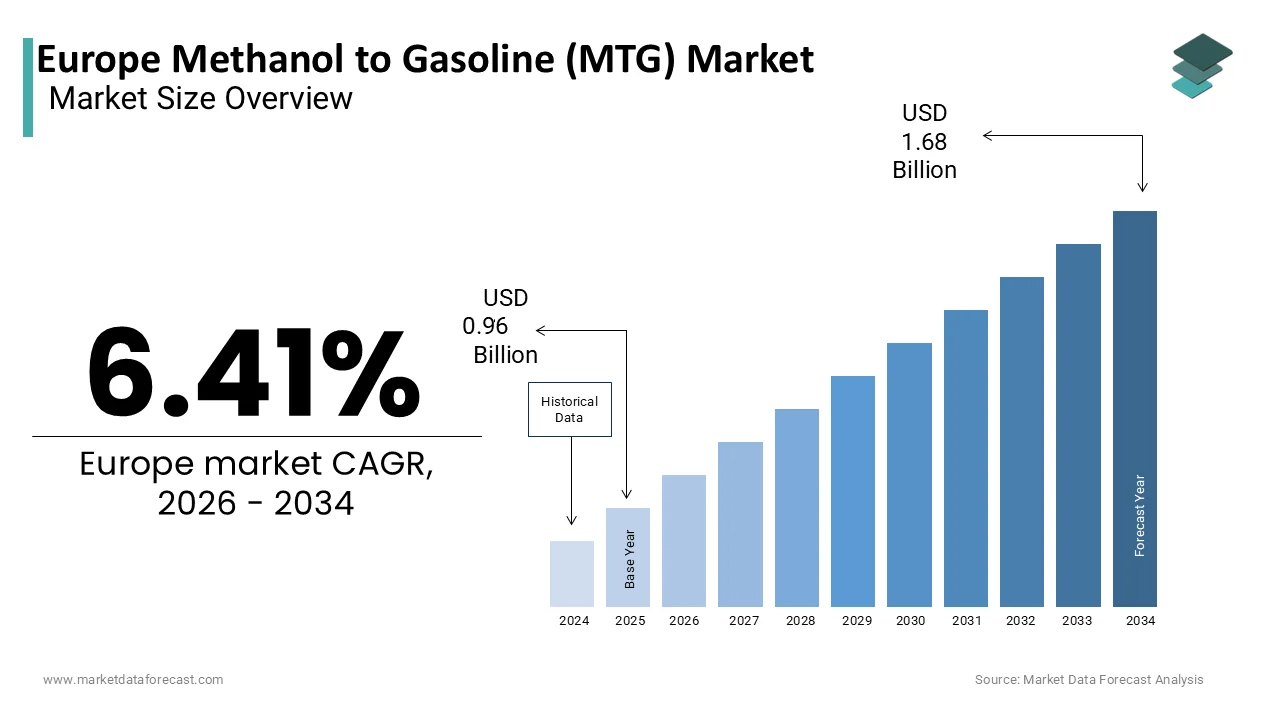
Market Size, 2025
$0.96 BnMarket Estimate, 2026
$1.02 BnMarket Forecast, 2034
$1.68 BnCAGR, 2026–2034
6.41%Europe Methanol to Gasoline (MTG) Market Size
The Europe methanol to gasoline market was valued at USD 0.96 billion in 2025, is estimated to reach USD 1.02 billion in 2026, and is projected to reach USD 1.68 billion by 2034, growing at a CAGR of 6.41% from 2026 to 2034.
The methanol to gasoline technologies and infrastructure convert methanol, which is derived from natural gas, biomass, or captured carbon dioxide, into high-octane liquid fuel compatible with existing internal combustion engines and distribution networks. Unlike conventional refining, this pathway leverages catalytic processes, such as the Mobil MTG (Methanol to Gasoline) technology, to producea clean-burning gasoline substitute with near zero sulfur and aromatic content. While still nascent in Europe, the segment is gaining strategic relevance as a potential bridge for decarbonizing hard-to-electrify transport segments, including legacy fleets, aviation support vehicles, and rural mobility. According to the European Environment Agency, over 210 million light-duty vehicles remained in operation across the EU in 2025, with average fleet turnover exceeding 14 years, creating sustained demand for liquid fuels beyond 2035. The European Commission’s ReFuelEU Aviation initiative indirectly supports methanol-derived pathways by promoting synthetic fuel development, while the Innovation Fund has allocated over 1.2 billion euros since 2023 to power-to-liquid projects involving methanol intermediates.
MARKET DRIVERS
Legacy Vehicle Fleet Longevity Sustains Demand for Drop In Liquid Fuels
The vast stock of internal combustion engine vehicles ensures prolonged demand for compatible liquid fuels well beyond regulatory phaseout timelines, creating a structural niche for methanol to gasoline synthesis. The legacy vehicle fleet longevity is escalating the growth of the European methanol-to-gasoline market. As per the European Automobile Manufacturers Association, over 208 million passenger cars were registered in the EU at the end of 2025, with only 12% classified as battery electric. Even under aggressive scrappage scenarios, the European Climate Foundation estimates that over 90 million ICE vehicles will remain on roads by 2040, primarily in regions with limited charging infrastructure. These vehicles cannot utilize ethanol blends above E10 without modification, but readily accept MTG gasolin,e which meets EN 228 specifications without engine adjustments. Finland’s Neste and Germany’s Clariant have confirmed MTG fuel compatibility with all post 2000 engines through joint testing. This technical readiness positionmethanol-deriveded gasoline as a pragmatic decarbonization vector for existing mobility assets, particularly where electrification faces grid or economic barriers.
Policy Support for Renewable Fuels of Non-Biological Origin Accelerates Pathway Development
The European Union’s formal recognition of renewable fuels of non-biological origin under the revised Renewable Energy Directive creates a dedicated compliance channel for methanol to gasoline produced from green hydrogen and captured CO₂. The policy support for renewable of non biological origin is accelerating the growth of Europe methanol to gasoline market. As per the European Commission, RFNBOs must achieve 70% lifecycle greenhouse gas savings versus fossil benchmarks and derive hydrogen exclusively from additional renewable electricity. Methanol synthesized via electrolytic hydrogen and direct air capture qualifies fully, enabling its conversion to gasoline to count toward the 5.5% RFNBO sub target in transport by 2030. Similarly, Germany’s H2Global initiative includes methanol as a tradable hydrogen carrier eligible for import subsidies. These mechanisms de-risk capital expenditure for integrated projects by guaranteeing offtake value under RED III compliance markets. With carbon contract for difference schemes emerging in France and the Netherlands, MTG developers gain additional revenue certainty, transforming a once marginal pathway into a policy-supported decarbonization instrument.
MARKET RESTRAINTS
High Production Costs Undermine Economic Competitiveness Against Fossil Gasoline
The methanol to gasoline pathway faces significant cost disadvantages due to energy-intensive upstream processes and immature scale, rendering it uncompetitive without substantial subsidy. The high production costs undermine economic competitiveness against fossil gasoline is restricting the growth of Europe methanol to gasoline market. Producing green methanol requires approximately 7.5 megawatt hours of renewable electricity per ton, translating to a base cost of 850 to 1100 euros per ton under current European power prices, as reported by the International Renewable Energy Agency. Converting this to gasoline adds another 150 to 200 euros per ton in capital and operational expenses, yielding a final fuel cost of 1.80 to 2.30 euros per liter, more than double the 2025 EU average for fossil gasoline of 1.65 euros per liter, according to Eurostat. Even with carbon pricing at 85 euros per ton, the gap remains prohibitive for mass adoption. The European Court of Auditors noted in its 2025 review that no RFNBO pathway achieves cost parity before 2035 without public support. Until electrolyzer and DAC costs decline significantly through learning effects, MTG gasoline will remain confined to niche applications with mandated offtake or premium willingness to pay, limiting scalability.
Lack of Dedicated Commercial Scale MTG Infrastructure Constrains Deployment
The lack of anycommercial-scale methanol-to-gasolinee conversion facility, relying instead on decades-old pilot plants and imported demonstration data, introduces technical and financial uncertainty for investors. This factor is also hampering the growth of Europe methanol to gasoline market. The last operational MTG plant globally, the 14000-barrel-per-day facility in New Zealand, ceased operations in 2021, leaving no active reference for modern engineering or maintenance protocols. Although the core Mobil process is licensed by Honeywell UOP, its integration with intermittent renewable inputs and digital control systems remains unproven at scale in European conditions. According to the European Technology and Innovation Platform for Sustainable Fuelsfront-endnd engineering studies for a 5000-barrel-per-day MTG unit estimate capital expenditures exceeding 900 million euros, with construction timelines of 48 months due to complex permitting under the Industrial Emissions Directive. Without a first mover to absorb demonstration risk, private financiers remain hesitant.
MARKET OPPORTUNITIES
Integration with Carbon Capture and Utilization Hubs Enables Circular Fuel Production
The emerging industrial clusters focused on carbon capture and utilization present a strategic opportunity to co-locate methanol synthesis and gasoline conversion, minimizing transport emissions and sharing infrastructure costs. This factor is also expected to contribute to new opportunities for the growth of Europe methanol to gasoline market. The North Sea Basin alone hosts over 15 planned CCU hubs, including Norway’s Longship, Denmark’s Greensan,d and the Netherlands’ Porthos, collectively targeting 10 million tons of annual CO₂ capture by 2030 as per the North Sea Energy Cooperation. These streams can feed electrolytic methanol plants using offshore wind power, with resulting methanol piped to adjacent MTG units. The Port of Rotterdam Authority has reserved land for such integrated facilities within its Energy Transition Zone by offering grid connection and CO₂ pipeline access. A 2025 feasibility study by TNO confirmed that co-location reduces levelized fuel costs by 18% through shared utilities and logistics. By embedding MTG within circular industrial ecosystems, Europe can transform waste CO₂ into certified renewable gasoline while leveraging existing port infrastructure, creating a replicable model for other coastal regions.
Military and Emergency Services Require Secure Domestic Liquid Fuel Sources
The defense and civil protection agencies are exploring methanol to gasoline as a means to ensure secu, re resilient fuel supplies independeof nt is additionally to leverage new opportunities for the growth of Europe methanol to gasoline market. According to the European Defence Agency, NATO members must maintain 90 days of strategic fuel reserves, yet over 95% of military gasoline is imported, creating vulnerability. MTG offers a path to domestic production using locally sourced renewable energy and captured carbon by enhancing energy sovereignty. Sweden’s Defence Materiel Administration launched a 2025 tender for synthetic gasoline trials using domestically produced e-methanol, citing compatibility with existing armored vehicle fleets. Similarly, France’s Direction Générale de l’Armement funds research into power to liquid fuels under its Technological Investment Program. These institutional buyers prioritize security over cost, providing stable anchor demand for initial MTG projects. Their stringent fuel specifications also drive quality standards that benefit civilian adoption.
MARKET CHALLENGES
Intermittent Renewable Energy Integration Faces Storage and Conversion Inefficiencies
The methanol to gasoline pathway suffers from cumulative energy losses that undermine its viability as a renewable energy storage solution. The intermittent renewable energy integration faces storage and conversion inefficiencies, which is a challenge for the growth of Europe methanol to gasoline market. The battery electric vehicles achieve 75 to 80% efficiency over the same cycle. This inefficiency translates into higher renewable capacity requirements; powering one gasoline equivalent vehicle via MTG demands 1.8 times more wind or solar generation than direct electrification. Europe is facing grid congestion and permitting delays for new renewables, as documented by the European Network of Transmission System Operators, where the opportunity cost of diverting clean electrons to low-efficiency fuel synthesis becomes increasingly untenable.
Regulatory Ambiguity Around Methanol Feedstock Sustainability Risks: Market Acceptance
The inconsistent definitions of eligible methanol feedstocks create uncertainty that deters investment in Europe’s methanol-to-gasoline market. This is solely to act as a significant barrier for the growth of Europe methanol to gasoline market. The Renewable Energy Directive permits methanol from biomass, biogas,s and captured CO₂ but excludes fossil-based methanol even with carbon capture, yet fails to specify verification protocols for the additionality of renewable power or the permanence of CO₂ storage. According to the European Biomass Association, over 60% of current European methanol capacity uses natural gas with partial CCS, raising questions about its eligibility for RFNBO counting. The European Commission’s delegated act on RFNBOs, published in January 202,5 still lacks clear methodologies for tracking hourly matching of electrolysis with renewable generation, a requirement for certification. Without harmonized auditing standards, fuel suppliers risk non-compliance penalties or reputational damage from greenwashing accusations.
REPORT COVERAGE
| REPORT METRIC | DETAILS |
| Market Size Available | 2025 to 2034 |
| Base Year | 2025 |
| Forecast Period | 2026 to 2034 |
| Segments Covered | By Feedstock, Reactor Type, Application, and Region. |
| Various Analyses Covered | Global, Regional, and Country-Level Analysis, Segment-Level Analysis, Drivers, Restraints, Opportunities, Challenges; PESTLE Analysis; Porter’s Five Forces Analysis, Competitive Landscape, Analyst Overview of Investment Opportunities |
| Countries Covered | UK, France, Spain, Germany, Italy, Russia, Sweden, Denmark, Switzerland, Netherlands, Turkey, Czech Republic, Rest of Europe |
| Market Leaders Profiled | ExxonMobil Corporation, Sinopec Engineering (Group) Co., Ltd., Jincheng Anthracite Mining Group, Ekobenz Sp. z o. o., Mitsui Chemicals, Inc., Methanex Corporation, Carbon Recycling International, Topsoe, Clariant, Zeogas, DKRW Energy Partners LLC |
SEGMENTAL ANALYSIS
By Feedstock Insights
The natural gas segment was the largest by holding a dominant share of the European methanol to gasoline market in 2025. Unlike coal or biomass, natural gas produces syngas with an optimal hydrogen to carbon monoxide ratio,s requiring minimal adjustment before methanol conversion. According to the International Energy Agency, over 90% of Europe’s existing methaEuropeanpaci, ty though limitedd is configured for natural gas reforming due to decades of pipeline integration and process optimization. Countries like Norway and the Netherlands leverage natural gas from North Sea fields to produce “blue methanol” with carbon capture rates exceeding 90%, as verified by DNV. This semi-renewable variant qualifies under transitional provisions of the EU Renewable Energy Directive until 2030, enabling near term MTG deployment without full green hydrogen dependency. Additionally, natural gas-derived methanol contains fewer impurities, such as sulfur or tar, which could poison MTG catalysts, ts an advantage over coal or waste biomass routes.
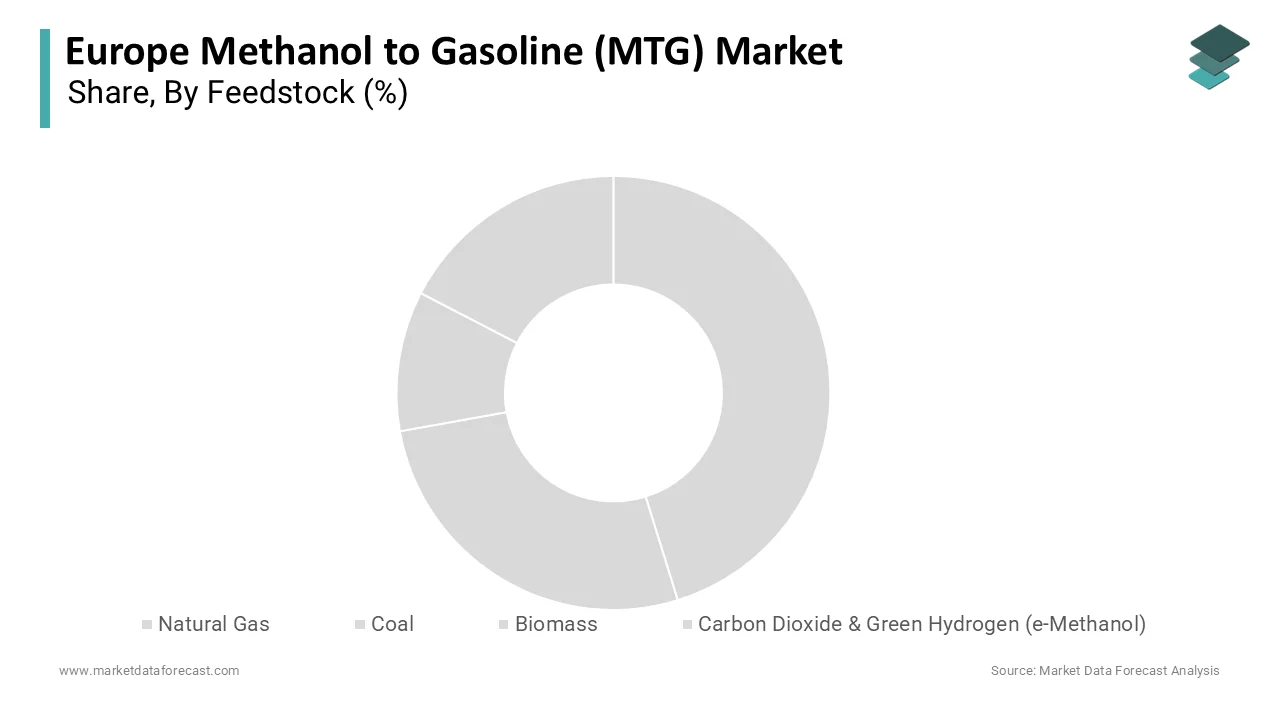
The biomass-derived methanol segment is expected to register the fastest CAGR of 21.4% from 2026 to 2034. The European Commission’s Circular Economy Action Plan explicitly promotes advanced biofuels from non-food biomass, including forestry residue,s agricultural straw, aw and municipal solid waste. According to Eurostat, the EU generates over 340 million tons of organic waste annually,lly with less than 12% currently valorized for energy. Projects like GoBiGas in Sweden and BioDME in Denmark have demonstrated efficient conversion of forest residues into clean syngas suitable for methanol synthesis. The revised Renewable Energy Directive II grants double counting for such fuels,uels accelerating their adoption. In 2025, Finland’s St1 launched a 50000 ton per year bio methanol plant using black liquor from pulp mills with offtake agreements for future MTG blending.
The biomass-based methanol qualifies as a carbon dioxide removal activity under the EU’s proposed Carbon Removal Certification Framework because the CO₂ absorbed during feedstock growth exceeds emissions from conversion when coupled with carbon capture. According to the Joint Research Centre, each ton of bio methanol produced with CCS delivers 1.8 tons of net negative emissions. This enables producers to generate certified carbon removal credits tradable under emerging compliance markets. Sweden’s Liquid Wind signten-year year offtake agreement with a consortium of airlines for eSAF derived from bio methanol with embedded removal certificates priced at 250 euros per ton.
By Reactor Type Insights
The fixed bed reactors segment held a prominent share of the European methanol to gasoline market in 2025, owing to their direct lineage from ExxonMobil’s proprietary MTG process, which exclusively uses fixed bed ZSM 5 zeolite catalyst systems. This configuration ensures precise temperature control, high selectivity toward gasoline range hydrocarbons, and minimal catalyst attrition for stable long term operation. European pilot projects such as those evaluated by Clariant in Frankfurt replicate this architecture to maintain compatibility with licensed know-how and catalyst supply chains. The modular nature of fixed-bed units also simplifies scaling from demonstration to pre-commercial levels without re-engineering core reaction dynamics. Although fluidized beds offer better heat management, they introduce catalyst loss and product variability that complicate gasoline specification compliance under EN 228 standards.
The advanced fixed bed with digitapre-commercialization segment is expected to grow at the fastest CAGR of 19.2% throughout the forecast period. Modern fixed-bed MTG units integrate digital twin technology that simulates real-time reaction kinetics using data from embedded fiber optic sensors and mass spectrometers. According to Siemens Energy, its MindSphere platform deployed at a German pilot facility increased gasoline selectivity by 4.7% and extended catalyst cycle length by 22 days through predictive thermal management. These gains directly reduce operating costs and improve carbon efficiency, key metrics for RFNBO certification. The European Institute of Innovation and Technology funds projects like DIGIMT, G, which apply machine learning to adjust feed ratios based on methanol purity fluctuations, ns ensuring consistent output quality. Companies like Haldor Topsoe now offer containerized fixed-bed MTG skids rated at 500 barrels per day with factory-tested performance guarantees.
By Application Insights
The transportation fuel segment accounted for a dominant share of the European methanol to gasoline market in 2025, with its primary design purpose as a drop-in substitute for conventional gasoline in internal combustion engines. The MTG product meets EN 228 specifications with octane ratings exceeding 95 RON, low sulfur content below 1 ppm, and near zero benzene by making it compatible with all post 2000 vehicles without modification. According to the European Automobile Manufacturers Association, over 208 million light-duty vehicles remain in operation across the EU, creating structural demand for liquid fuels beyond 2035. Fleet operators in rural regions with limited charging infrastructure view MTG as a pragmatic decarbonization option,n especially when derived from renewable sources. Trials by Deutsche Bahn and PostNord in Sweden confirm seamless performance in delivery vans and service vehicles.
The transportation fuel segment is expected to witness the fastest CAGR of 18.7% from 2026 to 2034, owing to the policy mechanisms for hard-to-abate segments. The European Commission’s 2025 revision of the Heavy Duty Vehicle CO₂ standards allows renewable liquid fuels, including MTG gasoline, to count toward fleet emission targets for light commercial vehicles under 3.5 tons. According to the study, this creates a compliance pathway for urban delivery fleets operated by companies like DHL and La Poste, which cannot fully electrify due to payload and range constraints. Multinational companies, including IKEA and Unilever,e r have signed ten-year renewable fuel offtake agreements under the World Economic Forum’s Transport Decarbonisation Initiative. In 2025, Sweden’s Liquid Wind secured binding commitments for 80% of its planned MTG output from logistics partners seeking Scope 3 emission reductions.
COUNTRY LEVEL ANALYSIS
Sweden Methanol To Gasoline Market Analysis
Sweden was the top performer of tEuropeanope methanol to gasoline market by holding 28.3% of the share in 2025, owing to theworld-leadingg integration of forest biomass, carbon capture,e and renewable electricity. The country’s vast forestry sector generates 25 million cubic meters of residues annually, according to the Swedish Forest Agency, providing abundant low-cost feedstock for bio-methanol. Projects like Liquid Wind’s FlagshipONE facility in Ornskoldsvik combine electrolytic hydrogen with captured biogenic CO₂ to produce e-methanol destined for MTG conversion. Sweden’s fossil-free electricity grid, 98% renewable as per Statistics Sweden, ensures near zero upstream emissions.
Germany Methanol To Gasoline Market Analysis
Germany's methanol to gasoline market growth is likely to grow with its chemical engineering prowess, catalyst development,t, and automotive fossil-free infrastructure. Companies like Claria,nt B, ASF, and Siemens Energy collaborate on MTG process optimization at facilities in Frankfurt and Ludwigshafen, leveraging decades of Fischer-Tropsch and methanol expertise. According to the German Aerospace Center, DLR MTG gasoline has undergone rigorous engine testing, confirming compatibility with Euro 6 and upcoming Euro 7 standards. The Federal Ministry for Economic Affairs allocated some amount in 2025 to scale power to liquid pathways under the H2Global initiative with MTG as a key derivative route. Germany’s dense network of research institutes provides analytical support for catalyst durability and emission profiling e, ensuring rapid iteration. This industrial ecosystem transforms theoretical concepts into bankable engineering packages, attractingEU-widee project developers.
Netherlands Methanol To Gasoline Market Analysis
The Netherlands methanol to gasoline market growth is expected to grow lucrativelyat an anticipated CAGR throughout the forecast period. The Porthos project will inject 2.5 million tons of captured CO₂ annually into depleted North Sea fields by 2026, as confirmed by the Port Authority, creating a secure stream ffor themethanol synthesis. Companieexpectedyon and Shell are developing electrolysis clusters powered by offshore wind to produce green hydrogen on-site. The Dutch government’s SDE++ subsidy scheme covers 60% of operational costs for RFNBO production, making MTG economically viable at current carbon prices. Crucially, the port’s existing liquid fuel terminals and pipeline network enable seamless blending and distribution of MTon-siteine into the national fuel pool.
Finland Methanol To Gasoline Market Analysis
FFinland'smethanol to gasoline market growth is driven by its advanced utilization of black liquor, a byproduct of pulp production, as a methanol feedstock. St1’s 2025 bio methanol plant in Kemi converts this waste into 50000 tons of methanol yearly with plans for MTG integration. Finland’s ambitious 2035 carbon neutrality target drives public support, where the Ministry of Economic Affairs funds demonstration projects through Business Finland grants. The cold climate also sustains demand for liquid fuels in remote regions where battery performance falters.
France Methanol To Gasoline Market Analysis
France's methanol-to-gasoline market growth is likely to be driven by the energy sovereignty concerns in defense and civil aviation. The Direction Générale de l’Armement requires secure domestic sources of drop-in fuels resilient to global oil shocks. The government’s France 2030 investFrance'slan allocated 1.5 billion euros to power to liquid technologies, with MTG highlighted for legacy vehicle compatibility. Airports like Toulouse Blagnac are testing MTG blends in ground support equipment under ReFuelEU guidelines. France’s nuclear-powered grid provides low-carbon electricity for electrolysis, ensuring high additionality scores for RFNBO certification. This blend of security policy and industrial strategy ensures sustained MTG development despite the broader electrification trend.
COMPETITIVE LANDSCAPE
Competition in the European methanol to gasoline market is defined by technological stewardship, strategic partnerships, and regulatory alignment rather than price or scale. As a nascent pre-commercial sector, the market features a triad of actors, technology licensors like Honeywell UOP who control core intellectual property,y catalyst developers such as Clariant who enhance process efficiency,cy and project integrators like Liquid Wind who assemble feedstock offtake and financing. No pure play MTG producer exists, yet competition centers on who can deliver the first bankable integrated project meeting EU sustainability criteria. Success hinges on navigating complex certification under the Renewable Energy Directive,tive demonstrating compatibility with existing engines, and securing public funding through Innovation Fund mechanisms. Unlike mature commodity markets, differentiation arises from engineering credibility policy engagement, not ecosystem orchestration. Barriers to entry remain high due to capital intensity,ity regulatory complexity,xity and reliance on unproven supply chains,hains making collaboration more than rivalry in this formative phase.
KEY MARKET PLAYERS
Some of the companies that are playing a dominating role in the global europe methanol to gasoline (mtg) market include
- ExxonMobil Corporation
- Sinopec Engineering (Group) Co., Ltd.
- Jincheng Anthracite Mining Group
- Ekobenz Sp. z o. o.
- Mitsui Chemicals, Inc.
- Methanex Corporation
- Carbon Recycling International
- Topsoe
- Clariant
- Zeogas
- DKRW Energy Partners LLC
TOP LEADING PLAYERS IN THE MARKET
- Honeywell UOP is the glow-carbonnsor of the proprietary Methanol to Gasoline technology originally developed by Mobil and remains the cornerstone enabler of MTG deployment worldwide. The company provides end-to-end engineering services, catalyst systems, and digital optimization tools for MTG plants across Europe. Its ZSM 5 zeolite catalyst formulation ensures high selectivity toward gasoline range hydrocarbons meeting EN 228 standards without post treatment. Honeywell UOP partnered with Swedish developer Liquid Wind to adapt its MTG process for intermittent renewable methanol feedstock, integrating real-time analytics to maintain product consistency. The firm also launched a modular skid-mounted MTG unit rated at 500 barrels per day, enabling faster deployment in industrial clusters. These innovations reinforce Honeywell’s role as the indispensable technology backbone for Europe’s emerging synthetic fuel ecosystem.
- Clariant International AG is a SSwitzerland-based specialtychemicals leader advancing MTG through next-generation catalyst development and process intensification. The company’s proprietary MEGA catalyst series enhances methanol conversion efficiency while reducing coking and extending regeneration cycles. Switzerland-based dedicated MTG testing facility in Frankfurt, where it netests xt-generation performance under variable green methanol purity conditions typical of power-to-liquid plants. Clariant also participates in EU-funded consortia like FUELS360 to align catalyst design with RFNBO certification requirements.
- Liquid Wind AB is a Swedish project developer pioneering integrated e-methanol to gasoline value chains using captured biogenic CO₂ and renewable hydrogen. Liquid Wind has secured funding from logistics and aviation partners seeking certified renewable fuels under ReFuelEU mandates. It finalized engineering partnerships with Honeywell UOP and Worley to design Europe’s first commercial-scale MTG unit co-located with its methanol plant. The project benefits from Sweden’s fossil-free grid and forestry residue supply, ensuring full compliance with EU additionality and sustainability criteria. Liquid Wind’s vertically integrated model demonstrates a replicable pathway for circular synthetic fuel production in Europe.
TOP STRATEGIES USED BY THE KEY MARKET PARTICIPANTS
Key players in theEuropeane methanol to gasoline market focus on adapting fixed-bed reactor technology for variable renewable methanol feedstocks through digital twin integration and advanced catalysts. They pursue vertical integration by co-locating methanol synthesis and MTG conversion within carbon capture and renewable energy hubs to minimize transport emissions and share infrastructure costs. Companies secure long-term offtake agreements with the defense logistics and aviation sectors to de-risk early production under RFNBO compliance frameworks. Strategic partnerships with electrolyzer and DAC providers ensure the feedstock additionality required for EU certification. Additionally, firms develop modular standardized MTG units to reduce capital expenditure and accelerate deployment timelines across industrial clusters.
MARKET SEGMENTATION
This research report on the europe methanol to gasoline (mtg) market is segmented and sub-segmented into the following categories.
By Feedstock
- Natural Gas
- Coal
- Biomass
- Carbon Dioxide & Green Hydrogen (e-Methanol)
By Reactor Type
- Fixed Bed Reactors
- Fluidized Bed Reactors
- Advanced Fixed Bed Reactors with Digital Twin Integration
By Application
- Transportation Fuel
- Chemical Feedstock
- Power Generation Fuel
By Country
- Sweden
- Germany
- Netherlands
- Finland
- France
- United Kingdom
- Italy
- Rest of Europe