- Product Description Description
- Table of Contents TOC
- List of Table & Figure LOT
- Get Free Sample PDF Sample PDF
Market Size, 2025
$2.35 BnMarket Estimate, 2026
$2.76 BnMarket Forecast, 2034
$10.13 BnCAGR, 2026–2034
17.63%Europe Micro Irrigation Systems Market Size, Growth, Trends & Forecast (2026–2034)
The European micro irrigation systems market size was valued at USD 2.35 billion in 2025, is anticipated to reach USD 2.76 billion in 2026, and is projected to scale up to USD 10.13 billion by 2034, registering a compound annual growth rate (CAGR) of 17.63% during the forecast period from 2026 to 2034. Driven by the European Union's Farm to Fork Strategy, escalating droughts and water scarcity across southern member states, and stringent Common Agricultural Policy (CAP) compliance linked to water efficiency, the micro irrigation industry continues to expand rapidly across the region.
Key Executive Metrics (At-a-Glance)
- 2025 Base Valuation: USD 2.35 Billion
- 2026 Current Valuation: USD 2.76 Billion
- 2034 Forecast Valuation: USD 10.13 Billion
- Compound Annual Growth Rate (CAGR): 17.63% (2026–2034)
- Dominant Technology Segment: Drip Irrigation System (leading market share backed by high water-use efficiency and compatibility with EU nutrient loss reduction mandates)
- Fastest-Growing Technology Segment: Micro Sprinkler Irrigation System (registering a notable CAGR due to suitability for high-value orchards and nurseries requiring canopy wetting and frost protection)
- Dominant Application Segment: Orchard Crops & Vineyards (capturing 42.1% market share due to regulatory imperatives to protect high-value perennial crops in water-stressed areas)
- Fastest-Growing Application Segment: Greenhouse Crops & Vegetables (expanding at the fastest CAGR driven by domestic production incentives under the Farm to Fork Strategy)
- Dominant End-User Segment: Farmers (holding a prominent share due to decentralized EU agriculture and Common Agricultural Policy eco-scheme requirements)
- Fastest-Growing End-User Segment: Industrial Growers (growing at the fastest CAGR driven by corporate sustainability reporting and ESG water stewardship mandates)
- Dominant Country Market: Spain (holding 38.2% of the market share supported by acute water stress and extensive high-value agriculture in arid regions)
Core Market Drivers
- EU Farm to Fork Strategy Mandates: Legally linking agricultural subsidies and green funds to measurable reductions in water and fertilizer consumption.
- Escalating Droughts and Water Scarcity: Climate change-induced hydrological instability and emergency water restrictions across southern EU nations like Spain, Italy, and Greece.
- Digital Farming Integration: Interoperable smart water management platforms leveraging IoT sensors, AI analytics, and satellite data.
Primary Market Restraints & Challenges
- High Upfront Investment Costs & Fragmented Structures: High initial capital expenditure combined with small, fragmented farm holdings in Eastern and Central Europe.
- Technical Expertise Deficit: Shortage of skilled extension services and maintenance infrastructure leading to emitter clogging and system failures.
- Environmental & Policy Inconsistencies: Fragmented water pricing across member states and growing regulatory pressure concerning agricultural plastic waste and microplastics.
Europe Micro Irrigation Systems Market Segmentation Breakdown
| Segment Category | Leading Sub-Segment (2025 Base) | Fastest-Growing Sub-Segment (2026–2034) |
|---|---|---|
| By Irrigation Technology | Drip Irrigation System (dominant leader offering unmatched water-use efficiency and runoff reduction) | Micro Sprinkler Irrigation System (fastest-growing due to optimal frost protection and canopy cooling) |
| By Application | Orchard Crops & Vineyards (largest share capturing 42.1% due to perennial crop protection needs) | Greenhouse Crops & Vegetables (fastest-growing application driven by export-oriented horticultural demand) |
| By End User | Farmers (dominant user category aligned with Common Agricultural Policy eco-schemes) | Industrial Growers (fastest-growing category propelled by corporate ESG reporting and water stewardship) |
| By Country | Spain (market leader holding 38.2% share driven by severe water stress and substantial subsidies) | Italy & France (fastest-growing country markets propelled by recovery funds and modern infrastructure mandates) |
Major Industry Players Profiled
Key enterprises shaping the competitive European micro irrigation systems market include Jain Irrigation Systems Ltd., Lindsay Corporation, Rivulis Irrigation Ltd., Netafim Ltd., Hunter Industries Europe, Nelson Irrigation Corporation, The Toro Company, EPC Industries Limited, Valmont Industries Inc., and T-L Irrigation.
Europe Micro Irrigation Systems Market Size
The European micro irrigation systems market was valued at USD 2.35 billion in 2025 and is anticipated to reach USD 2.76 billion in 2026 to reach USD 10.13 billion by 2034, estimated to grow at a CAGR of 17.63% from 2026 to 2034. Irrigation means the provision of water to dry land for crop development.

Micro irrigation systems are precision water delivery technologies, including drip irrigation, micro sprinklers, and subsurface emitters that apply water directly to plant root zones at controlled flow rates to maximize efficiency and minimize waste. According to the European Environment Agency, agriculture accounts for 36% of total freshwater abstraction in the EU, with southern member states exceeding sustainable withdrawal thresholds during peak growing seasons. The European Commission’s Farm to Fork Strategy mandates a 50% reduction in nutrient losses and a 20% decrease in fertilizer use by 2030, which are goals that are unattainable without precision delivery systems like micro irrigation. Furthermore, the Common Agricultural Policy now ties direct payments to water efficiency measures by making micro irrigation a practical necessity rather than an optional upgrade for European farmers navigating ecological and economic pressures.
MARKET DRIVERS
EU Farm to Fork Strategy Mandating Precision Water and Nutrient Use
The European Union’s Farm to Fork Strategy serves for micro irrigation adoption by legally linking agricultural subsidies to measurable reductions in water and fertilizer consumption is driving the growth of Europe's micro irrigation systems market. The strategy explicitly identifies micro irrigation as a key enabler for achieving its target of 20% reduction in fertilizer use and 50% cut in nutrient losses by 2030. National implementation reinforces this push, where Spain’s Ministry of Agriculture allocated 280 million euros in 2023 to subsidize drip irrigation in water-stressed regions like Murcia and Andalusia, where groundwater depletion exceeds natural recharge by 180%. Similarly, Italy’s National Recovery and Resilience Plan dedicates 1.2 billion euros to modernize irrigation infrastructure with micro systems as a prerequisite for accessing EU green funds. These policy instruments transform micro irrigation from a cost center into a compliance and funding gateway for European farmers.
Escalating Frequency of Droughts and Water Scarcity in Southern Europe
Climate change-induced hydrological instability is accelerating micro irrigation demand across southern EU member states, where droughts have become recurrent and severe. The growing frequency of droughts and water scarcity is another attribute boosting the growth of the Europe micro irrigation systems market. As per the European Environment Agency, in 2023 alone, Greece, Italy, and Spain implemented emergency water restrictions on agriculture for over 150 days in key production zones such as the Po Valley and Guadalquivir Basin. As per the European Commission’s Crisis Reserve Fund, 340 million euros were disbursed in 2023 to support drought resilience measures, including conversion to drip systems.
MARKET RESTRAINTS
High Upfront Investment Costs and Fragmented Farm Structures
The high initial capital expenditure required for system installation, which disproportionately impacts small and medium farms that dominate the EU agricultural landscape, is certainly a major factor impeding the growth of Europe's micro irrigation systems market. According to Eurostat, EU farms are smaller than 10 hectares, and some operate on part-time or subsistence models with limited access to financing. In Eastern Europe, the situation is more acute, where Romania’s National Authority for Agricultural Consulting reported that only 12% of eligible farmers applied for irrigation grants in 2023 due to co-financing requirements and complex paperwork. This financial and structural fragmentation suppresses adoption despite clear long-term water and yield benefits in Central and Eastern Europe, where farm consolidation remains slow.
Lack of Technical Expertise and Maintenance Infrastructure
The operational complexity of micro irrigation systems requires specialized knowledge for design,n installation, and ongoing maintenance, where a skill set is largely absent in Europe’s aging farming population. The lack of technical expertise and maintenance infrastructure is additionally inhibiting the growth of the Europe micro irrigation systems market. The European Irrigation Association confirmed that clogging of emitters due to poor water filtration or incorrect chemical injection is the leading cause of system failure by occurring in over 65% of non-professionally maintained installations. National extension services are under-resourced; Greece’s Ministry of Rural Development reported in 2023 that it had only 1 technician per 12000 hectares to support irrigation modernization.
MARKET OPPORTUNITIES
Integration with Digital Farming and Smart Water Management Platforms
Europe’s rapid adoption of digital agriculture that integrates with IoT sensors, AI analytics, and farm management software will certainly create new opportunities for the growth of Europe's micro irrigation systems market. According to the European Commission’s Digital Europe Programme, over 21000 farms across the EU participated in smart farming pilots in 2023, with precision irrigation as a core component. National initiatives accelerate this integration, where the Netherlands’ Top Sector AgriFood allocated 45 million euros in 2024 to develop interoperable platforms linking soil moisture data with automated irrigation controllers. Additionally, the European Space Agency’s Sentinel satellites now provide free evapotranspiration maps enabling micro irrigation systems to adjust schedules in real time.
Expansion into High Value Horticulture and Protected Cultivation
The shift toward high-value horticultural crops and protected agriculture in Europe is driving demand for advanced micro irrigation tailored to greenhouse and tunnel production. This is in addition to propelling the growth of the Europe micro irrigation systems market. These crops require precise water and nutrient delivery to maintain quality and shelf life, where conditions are optimally met by pressure-compensated drip lines and substrate-specific emitters. The European Commission’s School Fruit and Vegetable Scheme boosted domestic production incentives, which is prompting growers in Poland and Hungary to install micro irrigation in 8500 new greenhouse hectares in 2023. As per the European Vegetable Oil and Proteinmeal Industry Federation, water productivity in protected micro-irrigated systems is 2.7 times higher than open field methods.
MARKET CHALLENGES
Fragmented Water Pricing and Inconsistent Incentive Schemes Across Member States
Europe’s lack of harmonized water pricing and subsidy frameworks creates market uncertainty and suppresses investment in micro irrigation despite clear environmental benefits. The fragmented water pricing and inconsistent incentive schemes across member states are posing a challenge for the growth of the Europe micro irrigation systems market. According to the European Environment Agency, agricultural water tariffs in the EU range from 0.02 euros per cubic meter in Bulgaria to 0.45 euros in Spain, with many countries charging flat rates unrelated to consumption. This misalignment weakens the economic case for efficiency, where a 2024 OECD study found that farmers in low-tariff regions like Romania and Latvia see payback periods for drip systems exceeding 12 years compared to 4 years in high-tariff areas like Cyprus. Additionally, subsidy programs vary widely, while Germany offers streamlined grants through its Agricultural Investment Support Scheme, farmers in Croatia face bureaucratic delays exceeding nine months for irrigation funding. The European Court of Auditors noted in 2023 that the inconsistent implementation of Common Agricultural Policy eco-schemes reduced cross-border technology transfer and discouraged vendor standardization.
Degradation of Plastic Components and Microplastic Pollution Concerns
Environmental concerns over plastic waste from micro irrigation systems, particularly drip tapes and connectors, are emerging as a significant challenge to long-term sustainability. According to the European Chemicals Agency, a standard drip irrigation system uses between 30 and 60 kilograms of plastic per hectare, much of which is not recycled due to soil contamination and lack of collection infrastructure. National regulators are responding, where France’s Anti-Waste Law for a Circular Economy now requires all new irrigation systems to include a take-back scheme for end-of-life components by 2026.
REPORT COVERAGE
| REPORT METRIC | DETAILS |
| Market Size Available | 2025 to 2034 |
| Base Year | 2025 |
| Forecast Period | 2026 to 2034 |
| CAGR | 17.63% |
| Segments Covered | By Irrigation Technology, Application, End-User, And Region |
| Various Analyses Covered | Global, Regional & Country Level Analysis, Segment-Level Analysis, DROC, PESTLE Analysis, Porter’s Five Forces Analysis, Competitive Landscape, Analyst Overview on Investment Opportunities |
| Regions Covered | UK, France, Spain, Germany, Italy, Russia, Sweden |
| Market Leaders Profiled | Jain Irrigation Systems Ltd., Lindsay Corporation, Nelson Irrigation Corporation, The Toro Company, EPC Industries Limited, Valmont Industries Inc., and T-L Irrigation. |
SEGMENTAL ANALYSIS
By Type Insights
The drip irrigation segment held a dominant share of the Europe micro irrigation systems market in 2024, with its unparalleled water use efficiency and compatibility with EU sustainability mandates. National policies reinforce this preference, where Spain’s Ministry of Agriculture reported that 89% of new irrigation subsidies in 2023 were allocated exclusively to drip systems in high stress basins like the Segura River, er where groundwater overdraft exceeds natural recharge by 210%. Additionally, the European Environment Agency documented that drip irrigation reduces evaporation and runoff losses by up to 60% compared to sprinklers, making it essential for drought resilience. The technology’s precision also enables fertigation integration, aligning with the EU’s 50% nutrient loss reduction target.
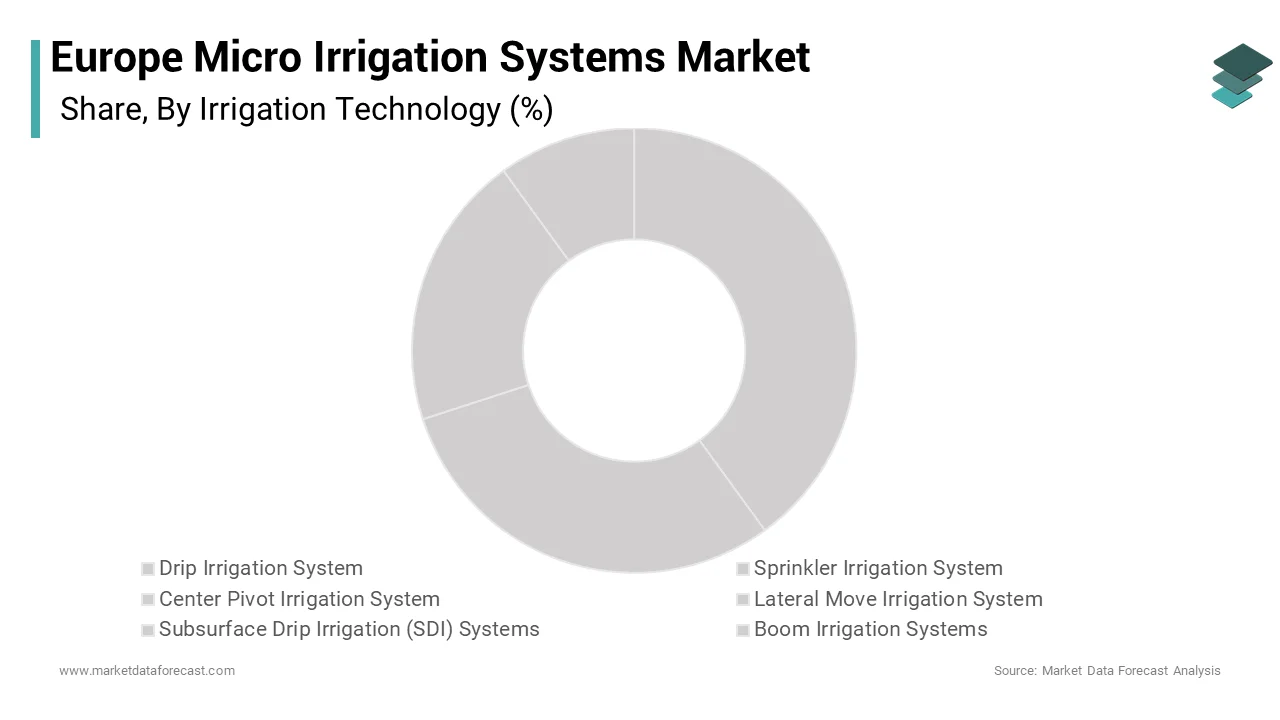
The micro sprinkler irrigation system segment is anticipated to register a CAGR of 9.6% during the forecast period, with its suitability for high-value orchards and nurseries where uniform canopy wetting and frost protection are critical. The technology also addresses emitter clogging risks in sandy soils, where the French National Institute for Agricultural Research confirmed that micro sprinklers reduced maintenance frequency by 43% compared to drip in Mediterranean vineyards with high iron content water. Additionally, the European Drought Observatory noted that micro sprinklers provide evaporative cooling during heatwaves, a growing need as summer temperatures exceed 40 degrees Celsius across southern Europe.
By Crop Insights
The orchards and vineyards segment was the largest by capturing 42.1% of the European micro irrigation systems market share in 2024, with the economic and regulatory imperative to protect high-value perennial crops in water-stressed regions. The Common Agricultural Policy now requires all new orchard and vineyard plantings receiving EU subsidies to implement water-efficient irrigation with drip or micro sprinklers as eligible technologies. Additionally, the European Wine Economy Observatory reported that precision irrigation increased grape yield consistency by twenty % during the 2023 heatwave, reducing vintage volatility.
The vegetables segment is likely to grow at the fastest CAGR of 10.2% throughout the forecast period with the EU’s push for domestic fruit and vegetable production under the School Scheme and Farm to Fork Strategy, which aims to increase per capita consumption by 20% by 2030. National initiatives amplify this trend; the Netherlands’ Top Sector AgriFood allocated 38 million euros in 2024 to modernize greenhouse irrigation for export-oriented vegetable farms, which supply 24% of EU fresh produce. These dietary policies,y climate, and export drivers position vegetables as the highest growth crop segment.
By End User Insights
The farmers segment was accounted in holding a prominent share of the Europe micro irrigation systems market in 2024, with the decentralized nature of EU agriculture, where over ten million farms manage 157 million hectares of land. The Common Agricultural Policy ties 35% of direct payments to eco schemes that mandate water-saving practices with micro irrigation as a qualifying measure. Additionally, the European Drought Observatory noted that farmer uptake of drip systems increased by thirty % in 2023 across Greece and Portugal following emergency drought subsidies.
The industrial users segment is expected to grow at the fastest CAGR of 13.2% in next coming years with the corporate sustainability commitments and industrial agro-projects such as biomass plantations and phytoremediation sites. According to the European Corporate Sustainability Reporting Directive, over 1200 multinational companies operating in Europe must now disclose water stewardship metrics by 2025, incentivizing efficient irrigation in owned agricultural assets. Additionally, industrial users deploy micro systems for landscape restoration; France’s Veolia implemented drip irrigation in 2023 at 28 contaminated sites using treated wastewater for phytoremediation. These ESG regulatory and operational imperatives position industrial users as the emerging high-growth segment.
COUNTRY ANALYSIS
Spain Micro Irrigation Systems Market Analysis
Spain's micro irrigation systems market held 38.2% of the Europe micro irrigation systems market share in 2024, with its acute water stress and extensive high-value agriculture in arid regions. National policy responds decisively, whereas the Spanish Agricultural Guarantee Fund allocated 410 million euros in 2023 exclusively for drip irrigation upgrades in Andalusia, Murcia, and Valencia, where almonds, olives, and citrus generate over 15 billion euros in annual exports. The European Drought Observatory confirmed that Spain implemented mandatory irrigation efficiency plans in 2024, requiring all new agricultural concessions to use micro systems. Additionally, the National Irrigation Plan mandates that 90% of modernized perimeters adopt pressure-compensated drip by 2027.
Italy Micro Irrigation Systems Market Analysis
Italy's micro irrigation systems market was ranked second by capturing 18.3% of share in 2024, with the Po Valley, where the EU’s most productive agricultural region. As per the Ministry of Agricultural Policies, the National Recovery and Resilience Plan allocated 1.2 billion euros to modernize 320000 hectares of irrigation infrastructure, with drip systems prioritized for vineyards and fruit orchards. The European Environment Agency documented that Italy’s groundwater depletion rate in Emilia Romagna exceeds recharge by 180% making micro irrigation essential for compliance with the Water Framework Directive.
France Micro Irrigation Systems Market Analysis
France's micro irrigation systems market growth is likely to be driven by its dual focus on climate adaptation and high-value horticulture. As per the French Biodiversity Office, 37% of agricultural land is now in water restriction zones, with the Loire and Rhône basins implementing seasonal irrigation caps. The AgriTech Plan allocated 220 million euros in 2023 to support micro irrigation in apple orchards, vvineyardsand market gardens, which supply 31% of EU fresh fruit. The European Commission’s School Fruit Scheme further incentivizes domestic production, where France distributed 180000 tonnes of locally grown apples in 2023, requiring consistent yields enabled by precision irrigation. Additionally, the French National Institute for Agricultural Research confirmed that drip systems reduced nitrogen leaching by 49% in lettucfieldids aligning with the EU’s nutrient loss targets. This policy of agronomic and market alignment ensures France’s continued expansion.
COMPETITIVE LANDSCAPE
The Europe micro irrigation systems market is characterized by a mix of global innovators, European distributors, and regional specialists competing on technical precision, on regulatory compliance, and agronomic support rather than price alone. Unlike commoditized agricultural input markets, competition here centers on water efficiency certification system durability and integration with digital farming ecosystems. Global leaders like Netafim and Rivulis leverage R and D scale but must adapt to EU-specific water quality challenges and subsidy frameworks. Local players differentiate through after-sales service and farmer training, particularly in fragmented smallholder landscapes of Southern and Eastern Europe. The absence of harmonized installation standards creates both opportunity and risk as vendors race to establish de facto norms through public partnerships. As climate pressures intensify, competition is shifting toward end-to-end solutions that combine hardware advisory services and data analytics to deliver measurable water productivity gains.
KEY MARKET PLAYERS
The major companies dominating the Micro Irrigation Systems market are
- Jain Irrigation Systems Ltd.
- Lindsay Corporation
- Rivulis Irrigation Ltd
- Netafim Ltd
- Hunter Industries Europe
- Nelson Irrigation Corporation
- The Toro Company
- EPC Industries Limited
- Valmont Industries Inc.
- T-L Irrigation
Top Players In The Market
- Netafim Ltd is a global leader in precision irrigation with a strong strategic presence across southern Europe,, pe particularly in Spain, Italy, and Greece. The company supplies advanced drip and micro sprinkler solutions tailored to Mediterranean crops, including olive vineyarvineyardsndand almonds. Itrtnered with the European Irrigation Association to develop training programs for smallholder farmers on system maintenance and fertigation best practices. Globally, Netafim contributes by setting technical benchmarks for water productivity and advocating for policy integration of micro irrigation in national climate adaptation plans. Its R and D center in Israel collaborates with EU institutions on drought-resilient irrigation protocols now deployed across water-stressed regions worldwide.
- Rivulis Irrigation Ltd plays a pivotal role in the Europe micro irrigation systems market through its extensive portfolio of drip tapes, emitters, and filtration systems designed for high-value horticulture. Headquartered in Israel with manufacturing in Spain and the Netherlands, the company serves farmers across France,ce Portu,g al, and Turkey with localized solutions for vineyards, vegetables, and fruit orchards. It also collaborated with the French National Institute for Agricultural Research to validate low-emission irrigation protocols aligned with the Farm to Fork Strategy. Globally, Rivulis advances sustainability by promoting recyclable drip products and supporting circular economy initiatives in agricultural plastic management across continents.
- Hunter Industries Europe is a key contributor to the micro irrigation landscape through its specialized micro sprinkler and precision spray technologies for orchards, nurseriesand protected cultivation. Operating from its Benelux hub, he company supplies systems to high-density fruit farms in Germany, Poland, and the Netherlands, emphasizing frost protection and canopy uniformity. In 202,4 H,n Interlaunched its EcoNet Plus controller series, compliant with EU Ecodesign Directive requirements, enabling real-time adjustment based on evapotranspiration data from Copernicus satellites. It also joined the European Innovation Partnership for Agricultural Productivity to co-develop water-saving protocols for perennial crops. Globally, Hunter extends its influence by integrating European environmental standards into its worldwide product lines, ensuring consistency in sustainability performance across markets.
Top Strategies Used By The Key Market Participants
Key players in the Europe micro irrigation systems market focus on aligning product design with EU sustainability regulations, including the Farm to Fork Strategy, Water Framework Directive, and Ecodesign requirements. They invest in smart irrigation integration by embedding IoT sensors and satellite data compatibility to enable precision water use. Strategic partnerships with national agricultural institutes and the European Irrigation Association drive farmer training and system standardization. Companies develop anti-clogging and pressure-compensated technologies tailored to southern Europe’s hard water and sandy soils. Additionally, they promote circular economy initiatives by introducing recyclable components and take-back schemes to address plastic waste concerns and meet evolving environmental legislation.
MARKET SEGMENTATION
This research report on the European micro irrigation systems market is segmented and sub-segmented into the following categories.
By Irrigation Technology
- Drip Irrigation System
- Backflow Preventers
- Filters
- Drip Tubes
- Valves
- Pressure Regulators
- Emitters
- Others
- Sprinkler Irrigation System
- Tubing
- Sprinkler Heads
- Pumping Units
- Couplers
- Fittings & Accessories
- Others
- Center Pivot Irrigation System
- Pipelines
- System Control Towers
- Water Emitters
- Central Towers
- Lateral Move Irrigation System
- Pipelines
- Sprinkler Heads
- Drive Mechanisms
- Control Panels
- Water Distribution Units
- Subsurface Drip Irrigation (SDI) Systems
- Tubing
- Pressure Regulators
- Water Filtration Units
- Drip Emitters
- Boom Irrigation Systems
- Overhead Booms
- Nozzles
- Water Pumps
By Application
- Plantation Crops
- Orchard Crops & Vineyards
- Field Crops
- Forage & Turf Grasses
- Greenhouse Crops
- Others
By End User
- Farmers
- Industrial Growers
- Others
By Country
- UK
- France
- Spain
- Germany
- Italy
- Russia
- Sweden
- Denmark
- Switzerland
- Netherlands
- Turkey
- Czech Republic
- Rest of Europe