- Product Description Description
- Table of Contents TOC
- List of Table & Figure LOT
- Get Free Sample PDF Sample PDF
Europe Microcatheter Market Size
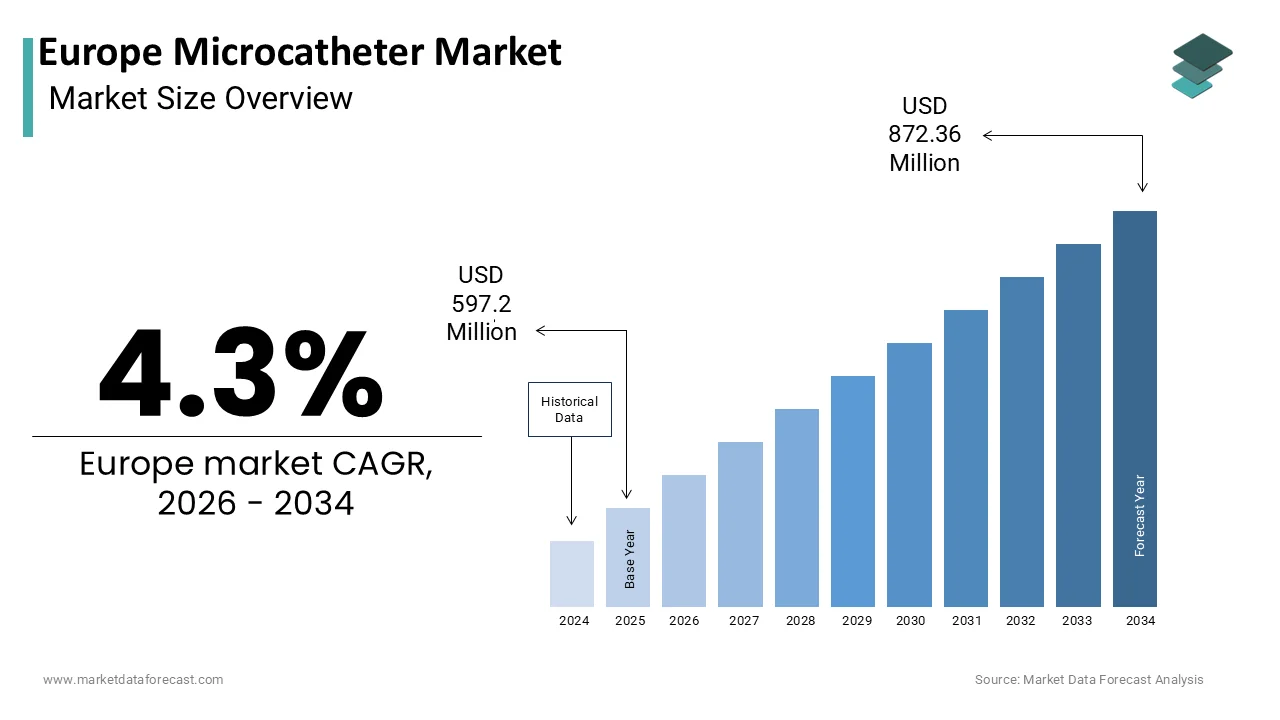
The Europe Microcatheter Market was valued at USD 597.2 million in 2025, is estimated to reach approximately USD 622.90 million in 2026, and is projected to reach about USD 872.36 million by 2034, growing at a CAGR of 4.3% from 2026 to 2034
The microcatheter is a minimally invasive medical device engineered for precise navigation through complex vascular anatomy to deliver therapeutic or diagnostic agents in neurovascular, cardiovascular, and peripheral interventions. These catheters typically measure less than three French in diameter and are indispensable in procedures such as embolization, thrombectomy, and targeted drug delivery. According to Eurostat, over 1.9 million people in the European Union died from circulatory system disorders in 2021, underscoring the persistent clinical need for advanced interventional tools.
MARKET DRIVERS
Rising Incidence of Neurovascular Disorders Fuels Demand for Precision Intervention Tools
The escalating burden of neurovascular pathologies is majorly fuelling the growth of the Europe microcatheter market. As per the European Stroke Organisation, stroke remains the second leading cause of death in Europe, with nearly 1.1 million new cases diagnosed each year. This clinical efficacy has driven national stroke care protocols in countries like Germany, France, and the United Kingdom to integrate mechanical thrombectomy as a standard of care, thereby increasing procedural volumes. The procedural dependency on microcatheters for distal vessel access and device delivery ensures sustained demand, especially as European healthcare systems expand comprehensive stroke center networks to meet the growing need.
Expansion of Minimally Invasive Peripheral and Oncological Interventions Drives Device Utilization
The broadening scope of minimally invasive peripheral and oncological interventions in Europe has significantly amplified the growth of Europe microcatheter market. As per the European Society of Vascular Surgery, peripheral artery disease affects more than 30 million adults in Europe, with severe cases often requiring endovascular revascularization. Microcatheters are essential in navigating tortuous and calcified vessels during procedures such as below-the-knee angioplasty or embolization of arteriovenous malformations. Microcatheters enable the selective delivery of chemotherapeutic agents directly to tumor-feeding arteries, minimizing systemic toxicity and enhancing treatment precision.
MARKET RESTRAINTS
Stringent Regulatory Pathways Under the EU Medical Device Regulation Delay Market Entry
The implementation of the European Union Medical Device Regulation 2017/745 has introduced significant compliance complexities that impede timely market access for microcatheter manufacturers. As per the European Commission, the regulation mandates more rigorous clinical evidence, enhanced post-market surveillance, and stricter conformity assessments by notified bodies. According to the European Association of Medical Device Manufacturers, the average time to obtain CE marking for Class III devices such as microcatheters increased from 9 to 18 months post-regulation enforcement. This delay disrupts product launch schedules and limits the availability of next-generation devices in clinical practice. Moreover, the requirement for comprehensive clinical investigations under Article 61 has raised development costs by an estimated 25 %, as reported by the Medical Technology Group Europe.
Reimbursement Uncertainties and Fragmented Healthcare Funding Across European Nations
Reimbursement heterogeneity across European healthcare systems is hindering the growth of Europe microcatheter market. As per the European Health Management Association, nearly 40 % of new medical technologies face delays of up to two years in securing national reimbursement codes post CE approval. For instance, in Spain, the Ministry of Health’s 2022 review indicated that only 28 % of innovative vascular devices received specific reimbursement within the first 18 months of market entry. This ambiguity discourages hospitals from procuring premium-priced microcatheters, especially in publicly funded settings where budget neutrality is prioritized.
MARKET OPPORTUNITIES
Integration of Artificial Intelligence and Robotics in Endovascular Procedures
The integration of artificial intelligence and robotic assistance in endovascular interventions is expected to showcase new opportunities for the growth of Europe microcatheter market in the coming years. As per the European Society of Radiology, over 60 academic medical centers across the EU are actively piloting AI-enhanced navigation systems that improve real-time catheter guidance during complex vascular procedures. These platforms rely on high-fidelity microcatheters compatible with robotic arms and sensor feedback loops to achieve sub-millimeter precision in tortuous anatomy. Additionally, robotic platforms like CorPath GRX have received CE certification for peripheral interventions, creating demand for microcatheters engineered with enhanced torque response and kink resistance.
Growing Emphasis on Outpatient and Ambulatory Interventional Care Models
The strategic shift toward outpatient and ambulatory interventional care is expected to elevate the growth of Europe microcatheter market. As per the European Observatory on Health Systems and Policies, over 65 % of vascular interventions in the Netherlands and Sweden are now performed in day surgery or ambulatory centers, a trend accelerated by post-pandemic healthcare restructuring. Similarly, the UK’s National Institute for Health and Care Excellence has endorsed ambulatory transarterial chemoembolization for select liver cancer patients, contingent on the use of precision microcatheters that minimize procedural time and contrast load. This model not only expands the procedural footprint beyond traditional hospital cath labs but also encourages the development of single-use, pre-shaped microcatheters tailored for efficiency and ease of use in resource-limited environments.
MARKET CHALLENGES
Shortage of Trained Interventional Specialists Limits Procedural Scalability
The form of a limited pool of adequately trained interventional specialists is inhibiting the growth of Europe microcatheter market. Complex microcatheter-based procedures, such as distal embolization or intracranial thrombectomy,y require extensive hands-on training and simulation experience, which many residency programs still lack. In Poland and Romania, for instance, fewer than 15 certified neurointerventionalists serve populations exceeding 35 million, severely restricting access to endovascular stroke care.
Material and Supply Chain Vulnerabilities Exacerbated by Geopolitical Instability
The geopolitical disruptions and overreliance on non-EU sources for raw materials are significant challenges for the Europe microcatheter market expansion. The 2022 energy crisis and subsequent manufacturing slowdowns in Germany and Italy, key hubs for medical device assembly, exposed vulnerabilities in just-in-time supply chains. Furthermore, the ongoing conflict in Eastern Europe has disrupted the supply of specialty resins and lubricious coatings, increasing lead times for microcatheter components by up to 14 weeks, as reported by the European Association of Medical Technology Suppliers.
REPORT COVERAGE
| REPORT METRIC | DETAILS |
| Market Size Available | 2025 to 2034 |
| Base Year | 2025 |
| Forecast Period | 2026 to 2034 |
| Segments Covered | By Product, End User, and Region. |
| Various Analyses Covered | Global, Regional, and Country-Level Analysis, Segment-Level Analysis, Drivers, Restraints, Opportunities, Challenges; PESTLE Analysis; Porter’s Five Forces Analysis, Competitive Landscape, Analyst Overview of Investment Opportunities |
| Countries Covered | UK, France, Spain, Germany, Italy, Russia, Sweden, Denmark, Switzerland, Netherlands, Turkey, Czech Republic, and the Rest of Europe |
| Market Leaders Profiled | Medtronic plc, Boston Scientific Corporation, Terumo Corporation, Cook Medical LLC, B. Braun Melsungen AG |
SEGMENTAL ANALYSIS
By Product Design Insights
The single-lumen microcatheter segment held a dominant share of the Europe microcatheter market in 2025. Single-lumen microcatheters remain the preferred choice for routine embolization due to their uncomplicated design, which reduces procedural complexity and device failure risk. As per the European Society of Interventional Radiology, over 75 % of uterine fibroid embolization and peripheral arteriovenous malformation procedures in Europe utilize single-lumen systems owing to their reliable pushability and torque response. The absence of internal partitions minimizes friction during coil or particle delivery, enhancing procedural control. Furthermore, training curricula in countries like Germany and the Netherlands emphasize foundational proficiency with single-lumen platforms before advancing to multilumen systems.
The dual-lumen microcatheter segment is projected to grow at a CAGR of 9.4 % during the forecast period. Dual-lumen microcatheters enable real-time contrast visualization while delivering coils or flow diverters, which is an advantage in intricate intracranial aneurysm repairs. Germany’s Charité Hospital reported that 90 % of its complex aneurysm interventions now employ dual-lumen platforms. This shift is further supported by updated European guidelines from the European Society of Minimally Invasive Neurological Therapy, which recommend dual access techniques for wide-neck and bifurcation aneurysms.
By Product Insights
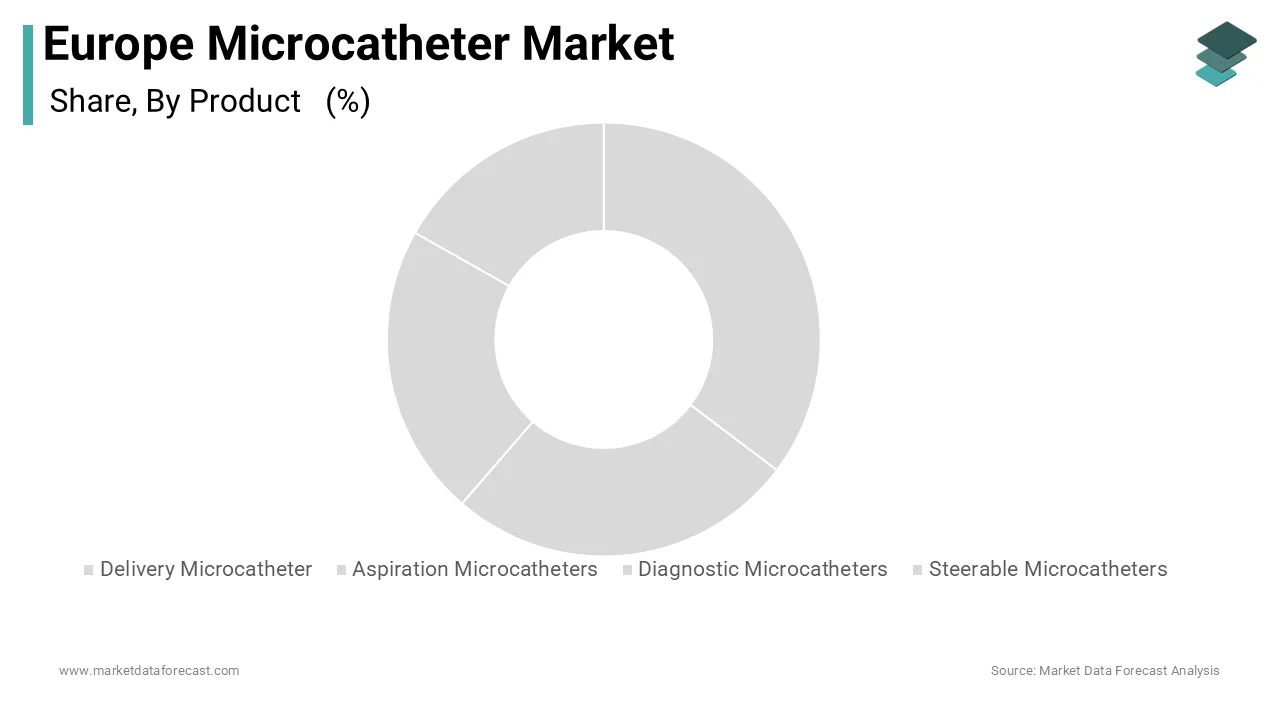
The delivery segment held a significant share of the Europe microcatheter market in 2025. As per the German Stroke Registry, over 48,000 thrombectomies were conducted in Germany in 2023, each requiring a dedicated delivery microcatheter to navigate the middle cerebral artery and deploy stent retrievers. National stroke networks in the UK and Sweden mandate the availability of delivery microcatheters in all certified comprehensive stroke centers, reinforcing their procedural indispensability.
The steerable segment is likely to grow with an expected CAGR of 10.2 % during the forecast period. The steerable microcatheters incorporate deflectable tips and responsive control mechanisms that allow operators to navigate highly tortuous or calcified vessels without guidewire dependency. As per the European Society of Vascular Surgery, over 40 % of patients undergoing lower extremity interventions in Europe are aged 75 or older, presenting with severe iliac and femoral tortuosity that challenges conventional catheters. The European Commission’s Horizon Europe program has funded three collaborative projects since 2022, focused on smart catheter steering using shape memory alloys, accelerating commercialization.
Integration with Advanced Imaging and Hybrid Operating Rooms
The proliferation of hybrid operating rooms across Europe is amplifying demand for steerable microcatheters compatible with real-time fusion imaging. According to the European Association of Neurosurgical Societies, over 220 hybrid ORs were operational in the EU by 2023, with 70 % routinely using steerable systems for combined surgical and endovascular cases. Additionally, training simulators endorsed by the European Board of Medical Specialties now feature steerable catheter modules, preparing the next generation of interventionalists.
By Application Insights
The neurology application segment was the largest and held 52.3% of the Europe microcatheter market share in 2025. Neurological applications dominate due to Europe’s significant stroke burden and endovascular stroke care infrastructure. According to the European Registry of Stroke, thrombectomy rates increased from 8 % of eligible cases in 2018 to 34 % in 2023, reflecting rapid protocol adoption. Germany alone performs over 50,000 neurointerventions yearly, according to the German Society of Neuroradiology. National stroke plans in the UK, France, and the Netherlands mandate 24/7 thrombectomy availability in urban centers by ensuring procedural continuity.
Reimbursement Support and Clinical Guidelines Favoring Microcatheter Use
Favorable reimbursement and strong guideline endorsement further entrench microcatheters in neurological care. As per the UK’s National Institute for Health and Care Excellence, mechanical thrombectomy is recommended for all patients with large vessel occlusion within 24 hours of onset, with full NHS funding. A 2022 analysis by the European Health Insurance Consortium found that 92 % of EU countries reimburse microcatheters as separate line items in neurointerventional DRGs, unlike in peripheral applications, where bundling is common. This financial recognition reduces hospital resistance to premium devices. Moreover, the European Society of Minimally Invasive Neurological Therapy’s 2023 consensus statement explicitly identifies microcatheters as essential for distal access and embolic protection.
The oncology application segment is the fastest growing, projected to expand at a CAGR of 11.3 % from 2025 to 2033. Oncology’s rapid growth is primarily driven by the increasing burden of primary and secondary liver cancers in Europe. In Italy, the National Cancer Institute reported a 28 % year on year increase in transarterial procedures between 2021 and 2023.
COUNTRY LEVEL ANALYSIS
Germany Microcatheter Market Analysis
Germany accounted in holding 24.3% of the Europe microcatheter market share in 2025 with its advanced neurointerventional infrastructure and high procedural volumes. The country performs more endovascular stroke interventions than any other EU nation, with over 50,000 thrombectomies recorded in 2023 according to the German Stroke Registry. Germany’s statutory health insurance system provides full reimbursement for CE-marked microcatheters used in approved indications, reducing financial barriers for hospitals. Additionally, the presence of leading medical device manufacturers like B Braun and Siemens Healthineers fosters local innovation and clinical collaboration.
France Microcatheter Market Analysis
The French market held 18.2% of the share in 2025. The French National Authority for Health has designated over 120 centers as thrombectomy-capable by ensuring broad geographic access. France’s public procurement system negotiates bulk pricing for medical devices, enabling cost-effective access without compromising quality. Furthermore, the University Hospitals of Paris and Lyon serve as European training hubs, annually certifying over 200 interventional fellows.
United Kingdom Microcatheter Market Analysis
The United Kingdom market is likely to grow eventually in the coming years. The National Institute for Health and Care Excellence’s 2023 update reaffirmed mechanical thrombectomy as cost-effective, leading to a 30 % increase in stroke centers offering the procedure since 2021. In 2023, the UK performed over 28,000 neurointerventions, according to the British Society of Interventional Radiology. Academic institutions like King’s College London are conducting trials on AI-assisted microcatheter navigation, supported by UK Research and Innovation funding. Despite Brexit-related regulatory adjustments, the UK maintains alignment with EU MDR standards, facilitating device access.
Italy Microcatheter Market Analysis
Italy's market growth is likely to grow with the high cardiovascular disease prevalence and growing interventional oncology adoption. The country is also a hotspot for liver cancer, with over 12,000 new hepatocellular carcinoma cases in 2023, according to the Italian National Institute of Health. Italy’s regional healthcare system allows autonomous procurement by enabling northern regions like Lombardy to invest in advanced devices while southern regions focus on cost containment.
Spain Microcatheter Market Analysis
Spain's market growth is likely to grow with the progressive stroke care reforms in interventional oncology. Spain is also Europe’s leader in transarterial radioembolization, with Hospital Clínic de Barcelona and MD Anderson Madrid performing over 3,500 procedures annually. Furthermore, Spain’s public health system provides universal coverage for embolization therapies with minimal out-of-pocket costs for patients.
COMPETITIVE LANDSCAPE
The Europe microcatheter market features intense competition among multinational corporations and specialized innovators vying for clinical adoption across neurovascular, periphera,l and oncology segments. Established players leverage extensive distribution networ,ks regulatory expert,ise and longstanding hospital relationships to maintain domin,ance while emerging firms differentiate through niche technologies such as hydrophilic coatings or shape memory alloys. The enforcement of the EU Medical Device Regulation has raised entry barriers favoring companies with robust quality management systemspost-marketarket surveillance capabilities. Competition is further shaped by national reimbursement policies, training infrastructure, and the pace of adoption of advanced interventional techniques.
KEY MARKET PLAYERS
- Medtronic plc,
- Boston Scientific Corporation,
- Terumo Corporation,
- Cook Medical LLC
- B. Braun Melsungen AG
TOP LEADING PLAYERS IN THE MARKET
- Medtronic is a pivotal contributor to the Europe microcatheter market through its comprehensive neurovascular and peripheral intervention portfolios. The company offers advanced microcatheter platforms such as the Apollo and ReACT system,s designed for precise embolization and thrombectomy. Medtronic has strengthened its European footprint by expanding its training academies in Germany and France to enhance physician proficiency with its devices. In 2023, the company launched next-generationon steerable microcatheter compatible with robotic navigation systems across EU markets. These initiatives reflect Medtronic’s commitment to integrating innovation with clinical education to support complex endovascular procedures throughout Europe.
- Terumo Corporation plays a significant role in the European microcatheter landscape with its Marathon and Finecross platforms widely used in cardiology and neurology. The company emphasizes biocompatible materials and low-profile designs to improve distal access in tortuous anatomy. Terumo has reinforced its presence by establishing a dedicated European R and D center in the Netherlands focused on microcatheter optimization for stroke and oncology applications.
- Stryker contributes substantially to the Europe microcatheter market through its Neurovascular division, offering the Flex and Sonata microcatheter lines. These devices are integral to mechanical thrombectomy and aneurysm coiling workflows across major European stroke centers. Stryker has intensified its market engagement by partnering with academic hospitals in Sweden and Italy to co- develop next generation microcatheters with enhanced trackability.
TOP STRATEGIES USED BY THE KEY MARKET PARTICIPANTS
Key players in the Europe microcatheter market prioritize strategic product innovation through continuous R and D investment to develop steerable anddual-lumenn platforms that address complex vascular anatomy. Companies actively pursue regulatory approvals under the EU Medical Device Regulation to ensure timely market access and compliance. Collaborations with academic medical centers and stroke networks facilitate real-world evidence generation and physician training. Geographic expansion into Eastern and Southern Europe is accelerated through localized distribution partnerships and inventory hubs. Additionally, firms leverage digital health integration by aligning microcatheters with robotic and AI-assisted navigation systems to enhance procedural precision and outcomes across diverse clinical settings.
MARKET SEGMENTATION
This research report on the European microcatheter market has been segmented and sub-segmented into the following categories.
By Product
- Delivery Microcatheter
- Aspiration Microcatheters
- Diagnostic Microcatheters
- Steerable Microcatheters
By End User
- Hospitals, Surgical Centers & Specialty Clinics
- Ambulatory Care Centers
By Country
- UK
- France
- Spain
- Germany
- Italy
- Russia
- Sweden
- Denmark
- Switzerland
- Netherlands
- Turkey
- Czech Republic
- Rest of Europe