- Product Description Description
- Table of Contents TOC
- List of Table & Figure LOT
- Get Free Sample PDF Sample PDF
Europe Military Drone Market Report Summary
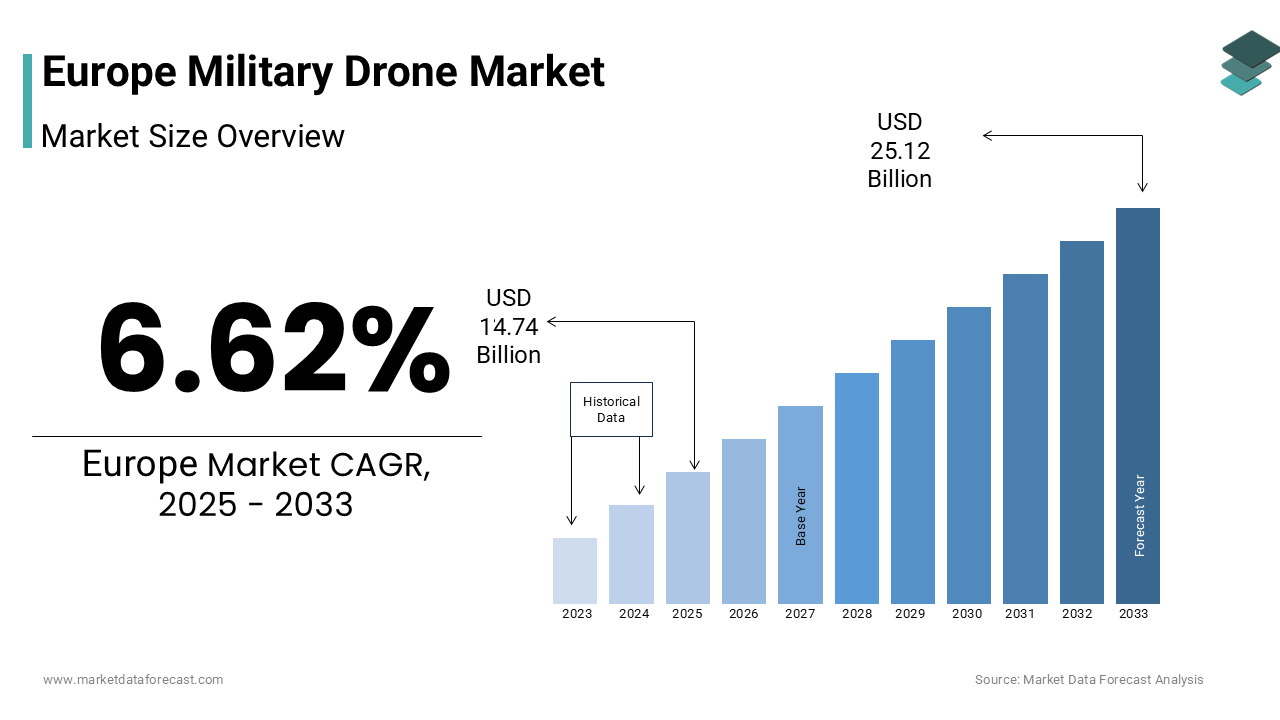
The Europe Military Drone Market was valued at USD 4.10 billion in 2024, is estimated to reach USD 14.74 billion in 2025, and is projected to reach USD 25.12 billion by 2033, growing at a CAGR of 6.62% from 2025 to 2033. Market growth is driven by the rising adoption of unmanned aerial vehicles (UAVs) for surveillance, reconnaissance, and combat operations across European defense sectors. Increasing defense modernization programs, advancements in AI-powered drone systems, and cross-border security initiatives are further boosting the demand for military drones.
Key Market Trends
- The growing use of drones for intelligence, surveillance, and reconnaissance (ISR) missions enhances battlefield awareness.
- Rising defense budgets across Europe, focusing on autonomous and AI-integrated UAV technologies.
- Strategic collaborations between European defense firms and drone manufacturers to improve aerial combat capabilities.
- Increasing demand for fixed-wing drones for long-range operations and high-altitude endurance.
- Emergence of drone swarming and hybrid propulsion technologies for enhanced mission flexibility.
Segmental Insights
- Based on Application, the Surveillance segment dominated the market, accounting for 38.2% share in 2024, driven by increased intelligence and border monitoring operations.
- Based on the Source, the Fixed-Wing Drone segment held the largest share of 34.6% in 2024 due to superior flight endurance and mission versatility.
- Based on Type, the Supermarkets segment (possibly a reporting label error; if intended, specify the correct type) accounted for a 53.5% share in 2024.
- Based on End Use, the Defense segment led the market in 2024, reflecting the region’s strong investment in combat-ready drone systems.
Regional Insights
- France was the largest contributor, holding 34.2% of the Europe military drone market share in 2024, driven by large-scale defense modernization programs and advanced UAV procurement.
- Germany – expanding surveillance and border security applications.
- United Kingdom – strong R&D ecosystem and UAV integration in armed forces.
- Italy and Spain – rising investments in tactical drone programs and joint EU defense initiatives.
Competitive Landscape
The European military drone market is dominated by leading defense and aerospace companies focusing on UAV innovation, stealth technology, and autonomous control systems. Key players include:
BAE Systems Plc, Thales SA, Leonardo S.p.A., Saab AB, Israel Aerospace Industries Ltd., AeroVironment Inc., General Atomics Aeronautical Systems, Lockheed Martin Corporation, Northrop Grumman Corporation, and Textron Systems Corporation.
Europe Military Drone Market Size
The europe military drone market size was valued at USD 4.10 billion in 2024 and is anticipated to reach USD 14.74 billion in 2025 from USD 25.12 billion by 2033, growing at a CAGR of 6.62% during the forecast period from 2025 to 2033.
The military drone is an unmanned aerial systems designed, procured, or deployed by European defense forces for intelligence, surveillance, reconnaissance, strike, and electronic warfare missions. These platforms span from hand launched mini drones to medium altitude long endurance (MALE) systems integrated into national and multinational defense architectures. In recent years, the operational tempo of European militaries has intensified due to evolving security dynamics, particularly along NATO’s eastern flank. The integration of artificial intelligence and secure datalinks further defines the current generation of European military drones, which are increasingly interoperable within coalition frameworks such as the EU’s Permanent Structured Cooperation initiative.
MARKET DRIVERS
Escalating Geopolitical Tensions Drive Urgent Force Modernization
The heightened instability along Europe’s eastern and southern borders has unprecedented investment in unmanned aerial capabilities as nations seek rapid force modernization without proportional increases in personnel. This is a major factor propelling the growth of Europe military drone market. Russia’s full scale invasion of Ukraine in February 2022 fundamentally altered threat perceptions across the continent by prompting several European governments to accelerate drone acquisition programs. According to the International Institute for Strategic Studies, sixteen European countries have revised their defense doctrines since 2022 to explicitly prioritize unmanned systems, with twelve initiating new procurement contracts for tactical and medium altitude drones. Germany alone allocated 3 billion euros in 2024 for Heron TP and future European Medium Altitude Long Endurance drone systems as part of its Zeitenwende defense policy shift. This strategic recalibration reflects not only immediate battlefield lessons from Ukraine but also long term planning for hybrid and gray zone conflicts where persistent surveillance and precision strike capabilities are decisive.
Advancements in Indigenous Defense Industrial Capabilities Fuel Domestic Demand
Europe’s pursuit of strategic autonomy in defense technology has significantly amplified demand for locally developed military drones, reducing reliance on non-European suppliers and fostering cross border industrial collaboration. The advancement in indigenous defense industrial capabilities fueling domestic demand is leveraging the growth of the Europe military drone market. According to the European Commission, this tri-national initiative aims to deliver 250 medium altitude long endurance drones to France, Germany, Italy, and Spain by 2030, with potential exports to other EU members. Concurrently, national champions such as Sweden’s Saab have influenced regional procurement trends with platforms like the Skeldar demonstrating battlefield efficacy. Finland’s recent selection of the domestic Indro OY VTOL drone for its artillery units exemplifies this trend toward sovereign capability. This industrial momentum is further reinforced by the EU’s Cybersecurity Act, which mandates secure communication protocols for all defense drones procured after 2025 by ensuring alignment with European digital sovereignty objectives.
MARKET RESTRAINTS
Stringent Export Control Regimes Limit Technology Transfer and Scalability
The rigorous multilateral and national export control mechanisms that restrict the transfer of sensitive technologies and complicate international collaboration is limiting the growth of Europe military drone market. The Wassenaar Arrangement, which includes all 27 EU member states, imposes strict licensing requirements on unmanned aerial vehicles capable of delivering payloads beyond 500 kilograms at ranges exceeding 300 kilometers. These restrictions impede joint development programs, particularly when involving non Wassenaar partners, and discourage private investment in dual use technologies. For instance, the Franco German Spanish Future Combat Air System consortium encountered repeated setbacks in integrating autonomous swarm capabilities owing to divergent national interpretations of export compliance rules.
Persistent Shortages in Skilled Workforce Hamper Operational Integration
The European military drone ecosystem is critically constrained by a shortage of personnel trained in unmanned system operations, maintenance, and data exploitation, which is another factor hampering the growth of Europe military drone market. According to a source, fewer than 1500 certified military drone operators were available across EU armed forces in 2024 against an estimated requirement of over 5000 to manage planned fleet expansions. Similarly, the Italian Army’s deployment of the RQ 11 Raven was scaled back in 2023 after frontline units struggled to interpret real time imagery without specialized analysts. As per NATO’s Allied Command Transformation, human resource bottlenecks now rank among the top three barriers to unmanned system adoption in Europe, alongside spectrum allocation and cyber resilience.
MARKET OPPORTUNTIES
Emerging Multi Domain Operations Create Demand for Integrated Drone Swarms
The evolution of European defense strategy toward joint multi domain operations for manufacturers to develop networked swarm systems capable of synchronized air, land, and maritime effects is substantially to pose new opportunities for the growth of Europe military drone market. NATO’s Allied Joint Doctrine for 2025 emphasizes the fusion of unmanned platforms across domains to overwhelm adversary defenses through massed, low cost, attritable systems. According to the French Ministry of Armed Forces, its SCORPION modernization program will integrate over 2000 micro and mini drones by 2030 operating in coordinated swarms to provide real time targeting for ground units. As per the European Commission, swarm technologies are prioritized for fast track funding under the Next Generation EU recovery instrument, with 420 million euros allocated specifically for collaborative research on autonomous coordination algorithms. Germany’s Bundeswehr has already tested the ALADIN reconnaissance drone in swarm configurations, achieving a 70 % reduction in target identification time compared to single platform operations.
Growing Emphasis on Green Defense Initiatives Spurs Electric and Hybrid Drone Innovation
Europe’s commitment to climate neutrality is reshaping military procurement priorities by creating a unique opening for developers of electric and hybrid propulsion drones that align with green defense mandates. The growing emphasis in green defense initiatives is solely elevating new opportunities for the growth of Europe military drone market. The European Defence Agency’s 2023 Green Defence Framework explicitly encourages the adoption of low emission technologies, including battery powered unmanned aerial systems for training and surveillance roles. According to the Swedish Defence Materiel Administration, its newly fielded Elistair tethered drone reduces carbon emissions by 92% compared to conventional gasoline powered equivalents while enabling indefinite hover time for base perimeter security. France’s Directorate General of Armaments has funded the HYDRA project aiming to certify a hydrogen fuel cell powered tactical drone by 2026 capable of 12 hour endurance with zero particulate emissions.
MARKET CHALLENGES
Vulnerability to Electronic Warfare Threats Undermines Tactical Reliability
Military drones operating in contested European theaters face escalating risks from sophisticated electronic warfare systems that can jam, disrupt, or hijack navigation and communication links, thereby compromising mission integrity. The vulnerability to electronic warfare threats undermines tactical reliability is one of the challenges for the growth of Europe military drone market. Russian forces in Ukraine have deployed Krasukha and Leer 3 systems capable of disabling GPS signals and data uplinks across areas exceeding 50 kilometers in radius, according to assessments by the Royal United Services Institute. As per the NATO Communications and Information Agency, less than 30 % of European military drones currently field hardened anti jamming antennas or alternative positioning systems such as Galileo PRS. The Polish Ministry of National Defence reported in 2024 that over 40 % of its short range reconnaissance drone sorties near the eastern border experienced partial or total signal degradation attributed to cross border interference.
Fragmented Regulatory Landscape Impedes Cross Border Drone Deployment
The absence of harmonized airspace regulations across European nations severely restricts the rapid deployment and operational flexibility of military drones, particularly during multinational exercises or crisis response. This factor is also to hamper the growth of Europe military drone market. Each EU member state maintains distinct rules governing unmanned flight altitudes, line of sight requirements, and no fly zones, with civil aviation authorities often lacking protocols for emergency military waivers. According to the European Union Aviation Safety Agency, only nine countries had established permanent military drone corridors by early 2025, delaying joint operations such as the EU Battle Group rotations. As per the European Defence Agency, inconsistent implementation of the U Space regulatory framework means that even identical drone models may require separate national certifications by adding up to 18 months to deployment timelines. This regulatory patchwork not only inflates administrative costs but also prevents real time asset sharing during hybrid threats such as migrant surges or sabotage incidents along critical infrastructure corridors.
REPORT COVERAGE
| REPORT METRIC | DETAILS |
| Market Size Available | 2024 to 2033 |
| Base Year | 2024 |
| Forecast Period | 2025 to 2033 |
| Segments Covered | By Type, End-Use and Region. |
| Various Analyses Covered | Global, Regional & Country Level Analysis, Segment-Level Analysis; DROC, PESTLE Analysis, Porter's Five Forces Analysis, Competitive Landscape, Analyst Overview of Investment Opportunities |
| Regions Covered | United Kingdom, France, Spain, Germany, Italy, Russia, Sweden, Denmark, Switzerland, the Netherlands, Turkey, and the Czech Republic, |
| Market Leader Profiled | BAE Systems Plc, Thales SA, Leonardo S.p.A., Saab AB, Israel Aerospace Industries Ltd., AeroVironment Inc., General Atomics Aeronautical Systems, Lockheed Martin Corporation, Northrop Grumman Corporation, and Textron Systems Corporation. |
SEGMENTAL ANALYSIS
By Application Insights
The surveillance segment was the largest and held 38.2% of the Europe military drone market share in 2024 owing to the persistent demand for real time situational awareness across land, maritime, and urban domains. European defense forces increasingly rely on unmanned platforms to monitor extended borders, and hybrid threat zones without exposing personnel. The proliferation of mini and tactical drones such as the Saab Skeldar V200 and Airbus Orbiter 3 has enabled persistent wide area surveillance even in GPS denied environments. Additionally, integration with satellite and ground sensor networks through the EU’s Secure Information Exchange System has enhanced data fusion capabilities by making surveillance drones indispensable for early warning and force protection.
The combat applications segment is anticipated to grow with a CAGR of 21.4% during the forecast period with battlefield validation in Ukraine and doctrinal shifts toward attritable strike platforms. Germany’s decision to integrate Hellfire missiles onto its Heron TP fleet further signals a move from passive observation to active engagement. The affordability of one-way attack drones, which is costing as little as 20000 euros compared to millions for cruise missiles makes them strategically attractive for high intensity scenarios. This integration of tactical utility, cost efficiency, and political willingness to deploy lethal autonomy is accelerating combat drone adoption across the continent.
By Type Insights
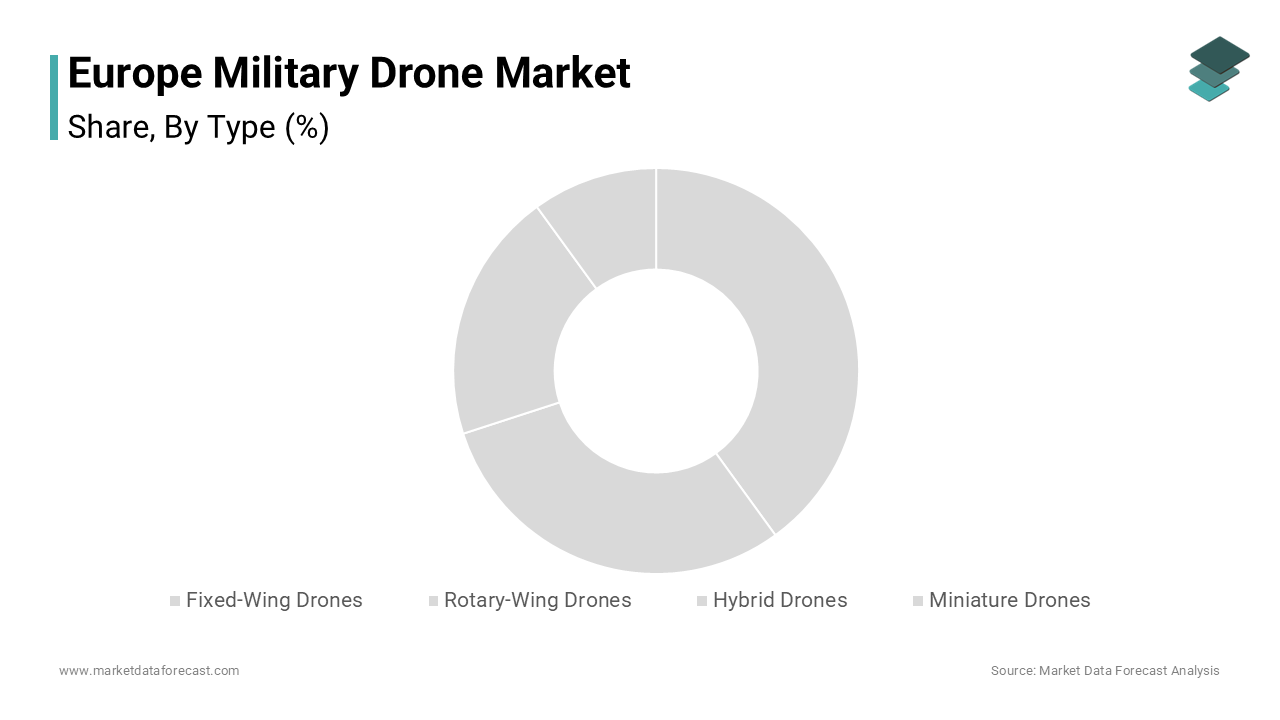
The fixed wing drones segment was the largest by accounting for 34.6% of the Europe military drone market share in 2024 due to their superior endurance, range, and payload capacity by making them ideal for strategic reconnaissance and maritime patrol missions. Platforms such as the Airbus Eurodrone and IAI Heron are routinely deployed for missions exceeding 24 hours at altitudes above 30000 feet, capabilities unmatched by rotary alternatives. Their compatibility with satellite communication links also enables beyond line-of-sight operations across transnational theaters, a requirement under NATO’s Joint Intelligence Surveillance and Reconnaissance architecture. These performance advantages, combined with mature industrial supply chains, ensure fixed wing drones remain the backbone of Europe’s unmanned aerial fleet.
The miniature drones segment is likely to witness a fastest CAGR of 21.4% during the forecast period with the infantry level integration and urban warfare demands. Weighing under 2 kilograms and often hand launched, these systems provide dismounted soldiers with immediate overhead awareness in complex terrain. Black Hornet Nano drones have been issued to frontline units since 2022, with each platoon now equipped with at least two units. France’s FELIN integrated soldier system now includes the Ninox 40 micro drone by enabling real time thermal imaging in subterranean environments. This democratization of aerial intelligence at the tactical edge is transforming small unit tactics and driving exponential growth in this segment.
By End Use Insights
The defense segment held a dominant share of the Europe military drone market in 2024 with the national armed forces’ primary role in procurement and deployment. European militaries view drones as force multipliers essential for modernizing aging fleets and addressing personnel shortages. As per the European Defence Agency, over 95% of military drone operators in Europe are active duty military personnel, not civilian agencies. The integration of drones into core combat functions, such as artillery correction, electronic warfare, and close air support further entrenches defense as the central end user. Multinational initiatives like the EU’s Permanent Structured Cooperation also channel funding exclusively through defense channels by reinforcing institutional reliance on armed forces as the primary adopters of military drone technology.
The homeland security segment is likely to grow with an anticipated CAGR of 30.1% from 2025 to 2033 owing to the rising asymmetric threats and the need for persistent monitoring of critical infrastructure. European interior ministries are increasingly deploying military grade drones for counter terrorism, border control, and disaster response. As per the French Interior Ministry, drone assisted surveillance during the 2024 Paris Olympics prevented 17 potential security breaches through real time crowd monitoring.
REGIONAL ANALYSIS
France Military Drone Market Analysis
France was the alargest contributor in the Europe military drone market by holding 34.2% of share in 2024 with its strategic autonomy doctrine and robust domestic defense industry. The country operates one of the most diversified drone fleets in Europe by ranging from the MALE Eurodrone to the micro Ninox series. The nation’s leadership in the tri national Eurodrone project ensures long term industrial relevance and export potential.
Germany Military Drone Market Analysis
Germany was positioned second by capturing 23.7% of the Europe military drone market share in 2024 with its Zeitenwende defense policy shift and urgent need to replace legacy surveillance assets. Following Russia’s invasion of Ukraine, Berlin fast tracked drone acquisitions, including 14 Heron TP systems from Israel and future participation in the Eurodrone program. The German Army now fields over 500 reconnaissance drones across its rapid reaction divisions, with plans to integrate AI enabled target recognition by 2026. The nation’s commitment to NATO interoperability and EU defense integration ensures sustained investment, making it a pivotal market for both procurement and co development.
United Kingdom Military Drone Market Analysis
The United Kingdom military drone market growth is likely to be driven by the characterized by advanced autonomous initiatives and expeditionary warfare focus. The Royal Air Force’s Protector RG1 program, based on the MQ 9B SkyGuardian, will deliver 16 armed MALE drones by 2026, each capable of 40 hour endurance missions. The nation’s Autonomous Advance Force initiative has pioneered swarm tactics, deploying coordinated drone teams in exercises from Estonia to the Indo Pacific. The Defence Science and Technology Laboratory is also testing quantum navigation for GPS denied operations, positioning the UK at the technological frontier.
Italy Military Drone Market Analysis
Italy military drone market growth is likely to grow with its dual focus on maritime surveillance and NATO interoperability. The Italian Air Force operates the Predator B and is a core partner in the Eurodrone program, with Leonardo supplying mission systems and ground control stations. The Navy’s deployment of the Falco Xplorer drone on frigates has extended patrol coverage by 300 nautical miles, which is significantly enhancing migrant and smuggling interdiction. Italy also hosts NATO’s Alliance Ground Surveillance base in Sigonella by operating five RQ 4D Phoenix drones that support collective intelligence missions.
COMPETITIVE LANDSCAPE
Competition in the Europe military drone market is intensifying as domestic champions vie with global suppliers for strategic contracts amid rising defense budgets and security concerns. European firms such as Airbus Leonardo and Saab leverage sovereign technology and policy alignment to secure government backing while non European players like Baykar and General Atomics compete through battlefield proven systems and flexible financing. The market is characterized by deep collaboration within EU defense initiatives like PESCO and the European Defence Fund which favor local industrial participation. At the same time national preferences and fragmented procurement processes create opportunities for niche specialists in swarm autonomy electronic warfare and micro drones. Innovation speed regulatory compliance and workforce readiness now determine competitive advantage more than scale alone.
KEY MARKET PLAYERS
Some of the companies that are playing a dominating role in the europe military drone market include
- BAE Systems Plc
- Thales SA
- Leonardo S.p.A.
- Saab AB
- Israel Aerospace Industries Ltd.
- AeroVironment Inc.
- General Atomics Aeronautical Systems
- Lockheed Martin Corporation
- Northrop Grumman Corporation
- Textron Systems Corporation
Top Players in the Europe Military Drone Market
Airbus Defence and Space is a cornerstone of Europe’s military drone ecosystem through its leadership in strategic unmanned programs. The company co leads the tri national Eurodrone initiative alongside Dassault Aviation and Leonardo, developing a medium altitude long endurance system tailored for European defense requirements. In 2024 Airbus delivered the first upgraded Heron TP drones to Germany under a government to government agreement with Israel, integrating European made sensors and secure datalinks. It also advanced its Zephyr high altitude pseudo satellite program, conducting stratospheric test flights to support persistent surveillance. These efforts reinforce Airbus’s role in shaping sovereign European drone capabilities while contributing to global unmanned architectures through NATO and export partnerships.
Leonardo plays a pivotal role in the European military drone market by supplying mission systems electronic warfare suites and ground control stations for major unmanned platforms. As a core partner in the Eurodrone program, Leonardo integrates its Gabbiano radar and Osprey electro optical payloads into next generation airframes. Leonardo also expanded its drone training academy in Rome to certify operators from allied nations. These initiatives enhance interoperability and position Leonardo as a critical enabler of Europe’s unmanned defense infrastructure.
Saab is a leading innovator in tactical and mini drone solutions for European armed forces. Its Skeldar V200 rotary wing platform is operational with the German and Swedish navies for ship based reconnaissance while the disposable Skeldar R80 loitering munition entered trials with multiple EU countries in 2024. Saab also supplies the Erieye radar for unmanned surveillance missions and collaborates with Finland’s Indro on hybrid VTOL systems.
Top Strategies Used by the Key Market Participants
Key players in the Europe military drone market prioritize strategic co development through multinational consortia to ensure interoperability and cost sharing. They invest heavily in artificial intelligence and secure communication protocols to meet EU cybersecurity mandates. Companies expand domestic production and final assembly lines to comply with national sovereignty requirements and technology transfer clauses. They also establish dedicated training academies and simulation centers to address operator shortages. Additionally, firms diversify into green propulsion including electric and hydrogen powered drones to align with Europe’s green defense framework.
MARKET SEGMENTATION
The research report on the europe military drone market has been segmented and sub-segmented based on categories.
By Type
- Fixed-Wing Drones
- Rotary-Wing Drones
- Hybrid Drones
- Miniature Drones
By End Use
- Defense
- Homeland Security
- Research and Development
By Application
- Surveillance
- Combat
- Logistics
- Reconnaissance
- Training
By Country
- UK
- France
- Spain
- Germany
- Italy
- Russia
- Sweden
- Denmark
- Switzerland
- Netherlands
- Turkey
- Czech Republic
- Rest of Europe