- Product Description Description
- Table of Contents TOC
- List of Table & Figure LOT
- Get Free Sample PDF Sample PDF
Europe Military Robots Market Report Summary
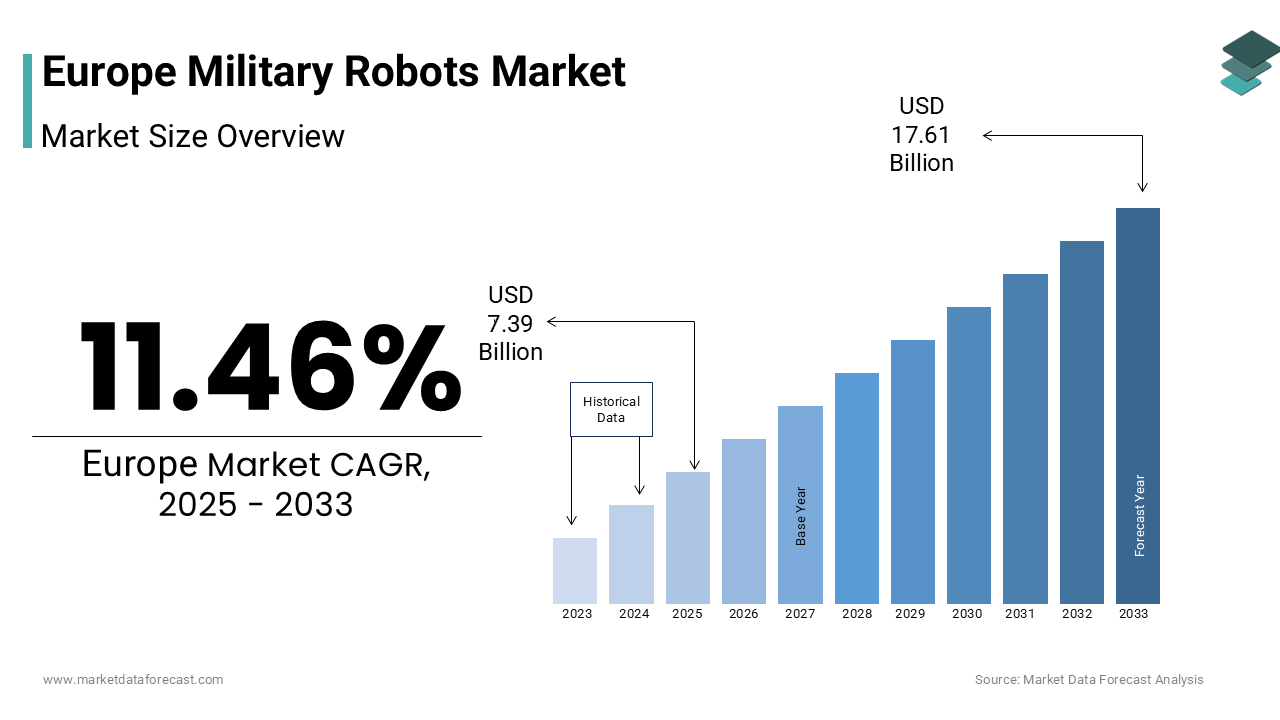
The Europe Military Robots Market Report was valued at USD 6.63 billion in 2024, is projected to reach USD 7.39 billion in 2025, and is expected to grow significantly to USD 17.61 billion by 2033, expanding at a CAGR of 11.46% from 2025 to 2033. The market growth is driven by escalating geopolitical tensions, increasing demand for unmanned and autonomous systems, and the growing focus on force protection and mission efficiency across European defense operations. Support from the European Defence Fund, NATO-led interoperability initiatives, and advancements in AI-driven robotics are accelerating the deployment of military robots across land, air, and naval domains while maintaining strict ethical and legal compliance under EU defense policies.
Key Market Trends
- Rising adoption of unmanned ground, aerial, and naval systems for surveillance, logistics, and ordnance disposal.
- Growing focus on semi-autonomous and AI-assisted operations ensuring human oversight in critical missions.
- Increasing EU and NATO collaboration for interoperable and standardized robotic systems.
- Rapid development of hybrid propulsion and electric-powered robots for stealth and endurance missions.
- Expanding use of dual-purpose robotics in disaster response, civil defense, and humanitarian operations.
Segmental Insights
- Based on platform, the land-based military robots segment dominated the market in 2024, capturing 48.5% of the share, driven by extensive deployment of unmanned ground vehicles (UGVs) for reconnaissance, explosive ordnance disposal (EOD), and logistics support.
- Based on mode of operation, the semi-autonomous segment held a dominant share due to Europe’s legal framework mandating meaningful human control in defense operations, while autonomous robots are gaining traction for non-lethal logistics and patrol missions.
- Based on mode of propulsion, electric-powered robots led the market in 2024 owing to their low noise, reduced thermal signature, and efficiency in stealth operations, while hybrid propulsion systems are anticipated to register strong growth due to extended operational endurance.
- Based on application, the Intelligence, Surveillance, and Reconnaissance (ISR) segment accounted for 39.3% of the market share in 2024, supported by the growing demand for real-time situational awareness and data-driven decision-making capabilities.
Regional Insights
- France led the Europe military robots market with a 39.2% share in 2024, supported by robust defense funding, strategic autonomy policies, and active participation in the ELEFANT and EUROMAR robotics programs.
- Germany continues to strengthen its defense robotics sector through large-scale testing and cross-border interoperability initiatives within NATO.
- The United Kingdom is accelerating adoption through its Robotics and Autonomous Systems Strategy, emphasizing human-machine teaming and battlefield automation.
- Italy is expanding investments in maritime and aerial robots, focusing on surveillance, border security, and Mediterranean operations.
Competitive Landscape
The Europe Military Robots Market is moderately consolidated, comprising leading defense contractors, research-driven consortia, and specialized robotics innovators. Market participants are focusing on AI integration, ethical compliance, scalable production, and interoperability to enhance operational readiness. Joint ventures between defense ministries, private manufacturers, and EU institutions are fostering collaborative R&D and accelerating field deployment of robotic systems across the continent. Prominent players operating in the market include Rheinmetall AG, BAE Systems plc, Thales Group, Leonardo S.p.A., Saab AB, Milrem Robotics, QinetiQ, KNDS (Nexter and KMW), Airbus Defence & Space, Patria, Cobham, General Dynamics, Elbit Systems, MBDA, Northrop Grumman, RTX, and L3Harris Technologies.
Europe Military Robots Market Size
The europe military robots market size was valued at USD 6.63 billion in 2024 and is anticipated to reach USD 7.39 billion in 2025 from USD 17.61 billion by 2033, growing at a CAGR of 11.46% during the forecast period from 2025 to 2033
The military robots are unmanned ground vehicles, unmanned aerial systems, maritime drones and autonomous support platforms designed for reconnaissance surveillance logistics explosive ordnance disposal and force protection across NATO and EU defense operations. These systems operate under human supervision or in semi autonomous modes adhering to strict ethical and legal frameworks governing the use of artificial intelligence in conflict zones. According to the European Defence Agency, over twenty two European nations now integrate military robots into active operational doctrines with particular emphasis on reducing soldier exposure in high risk environments. Furthermore, the European Union’s European Defence Fund allocated 1.8 billion euros in 2024 specifically for collaborative robotics projects under the Permanent Structured Cooperation framework. This integration of security urgency institutional coordination and ethical governance positions military robotics not as speculative hardware but as essential components of Europe’s modern defense posture.
MARKET DRIVERS
Escalating Geopolitical Tensions and Demand for Force Protection in High Risk Zones
Europe’s security environment has deteriorated significantly since 2022 by prompting armed forces to prioritize robotic systems that minimize human exposure in dangerous missions. The escalating geopolitical tensions and demand for force protection in high risk zones are driving the growth of Europe military robots market. Emerging countries are bordering unstable regions have accelerated deployment of unmanned ground vehicles for border surveillance and mine clearance. Similarly, the German Bundeswehr uses the DOK-ING MV-10 for explosive ordnance disposal in training and peacekeeping missions with zero personnel loss recorded in robotic EOD operations since 2021 as per the Federal Ministry of Defence. These deployments reflect a strategic shift toward “human out of the loop” for the most hazardous tasks with a doctrine now formalized in national defense white papers across the continent.
EU and NATO Mandates for Interoperable and Collaborative Autonomous Defense Systems
The European defense policy increasingly emphasizes joint development and technical standardization of military robots to ensure interoperability among allied forces, which is levelling up the growth of Europe military robots market. As per the European Defence Agency, the EU’s Coordinated Annual Review on Defence identified autonomous logistics and reconnaissance as priority domains for multinational investment with thirteen member states co funding the EUROMAR drone initiative in 2024. NATO’s Allied Command Transformation has established common data link protocols and AI ethics guidelines that all robotic platforms must meet for joint exercises.
MARKET RESTRAINTS
Stringent Ethical and Legal Constraints on Lethal Autonomy Under EU and International Law
The world’s most restrictive regulatory environments regarding autonomous weapons which significantly limits the scope of military robot development is restraining the growth of Europe military robots market. According to the European Parliament’s 2023, resolution on artificial intelligence in defense all robotic systems must retain meaningful human control over the use of force with a principle embedded in national procurement policies across Germany France and the Nordic states. As per the International Committee of the Red Cross, no European country has deployed or authorized fully autonomous lethal systems and research funding is explicitly barred from such applications under the European Defence Fund. This legal clarity prevents escalation but also restricts innovation in high end combat robotics compared to other global regions. Defense contractors must invest heavily in audit trails operator interfaces and fail safe mechanisms to prove human oversight by adding complexity and cost.
Fragmented National Procurement Policies and Lack of Unified Certification Frameworks
National defense acquisition processes remain highly fragmented impeding economies of scale and rapid deployment, which is additionally degrading the growth of Europe military robots market. According to the sources, only 28% of robotic defense projects in 2024 achieved cross border certification due to divergent safety testing protocols cybersecurity standards and operational validation requirements. A French unmanned ground vehicle approved for EOD may require six additional months of trials to qualify for use by the Italian Army even within the same EU framework. Moreover, small and medium defense tech firms struggle to navigate 27 different national compliance regimes limiting innovation from agile players.
MARKET OPPORTUNITIES
Integration of Military Robots into EU’s Strategic Autonomy and Defense Industrial Base
The European Union’s push for strategic autonomy has created unprecedented funding and policy support for indigenous military robotics development, which is creating new opportunities for the growth of Europe military robots market. As per the European Commission the European Defence Fund committed 1.8 billion euros in 2024 to collaborative robotics projects including the ELEFANT unmanned ground vehicle consortium led by KNDS and Rheinmetall. This initiative aims to replace aging fleets with next generation platforms built entirely within EU supply chains reducing reliance on non European suppliers. Additionally, the European Innovation Council launched the Defence Tech Catalyst program allocating 320 million euros to startups developing AI navigation swarm coordination and cyber resilient control systems for military robots.
Expansion of Non Lethal Roles in Hybrid Warfare Civil Support and Disaster Response
Military robots are increasingly deployed in non-traditional missions that align with Europe’s emphasis on comprehensive security and civil military cooperation is additionally enhancing the growth of Europe military robots market. The unmanned systems were used in 17 humanitarian and disaster relief operations across Africa and the Balkans in 2024 including flood mapping in Pakistan and radiation monitoring in Ukraine. Similarly, the Italian Navy employs autonomous surface vehicles for Mediterranean migrant route monitoring providing real time situational awareness without risking personnel. These dual use applications broaden political and public acceptance of military robotics while justifying sustained investment.
MARKET CHALLENGES
Vulnerability to Electronic Warfare Cyberattacks and GPS Spoofing in Contested Environments
Military robots operating in near peer conflict scenarios face severe risks from advanced electronic warfare capabilities that can disrupt communications navigation and sensor integrity. The vulnerability to electronic warfare cyberattacks and GPS spoofing in contested environments is challenging the growth of Europe military robots market. According to the NATO Communications and Information Agency, over 60% of unmanned systems tested in 2024 exercises experienced degraded performance or complete loss of control when exposed to GPS jamming or radio frequency spoofing with a tactic increasingly employed by state adversaries. Current countermeasures such as inertial navigation backups and encrypted datalinks add weight cost and complexity. Moreover, autonomous behaviors trained in benign environments often fail under signal denial forcing reversion to manual control.
Shortage of Specialized Defense Robotics Talent and Testing Infrastructure
Europe lacks sufficient personnel and facilities to design test and maintain advanced military robotic systems at scale, which is also restricting the growth of Europe military robots market. According to the European Defence Agency, there is a shortfall of over 8,000 engineers with expertise in autonomous systems cybersecurity and military human robot interaction across EU member states. Academic programs rarely combine robotics with defense applications and security clearance requirements limit industry academia collaboration. This talent and infrastructure gap slows innovation cycles and discourages startups from entering the defense robotics space despite available funding.
REPORT COVERAGE
| REPORT METRIC | DETAILS |
| Market Size Available | 2024 to 2033 |
| Base Year | 2024 |
| Forecast Period | 2025 to 2033 |
| Segments Covered | By Platform, Mode of Operation, Mode of Propulsion, Application and Region |
| Various Analyses Covered | Global, Regional & Country Level Analysis, Segment-Level Analysis; DROC, PESTLE Analysis, Porter's Five Forces Analysis, Competitive Landscape, Analyst Overview of Investment Opportunities |
| Regions Covered | United Kingdom, France, Spain, Germany, Italy, Russia, Sweden, Denmark, Switzerland, the Netherlands, Turkey, and the Czech Republic, |
| Market Leader Profiled | Rheinmetall AG, BAE Systems plc, Thales Group, Leonardo S.p.A., Saab AB, Milrem Robotics, QinetiQ, KNDS (Nexter and KMW), Airbus Defence & Space, Patria, Cobham, General Dynamics, Elbit Systems, MBDA, Northrop Grumman, RTX, and L3Harris Technologies. |
SEGMENTAL ANALYSIS
By Platform Insights
The land-based segment was the largest by capturing 48.5% of the Europe military robots market share in 2024 owing to their immediate applicability in ground operations where soldier protection and tactical agility are paramount. Unmanned ground vehicles are extensively deployed for explosive ordnance disposal reconnaissance logistics and perimeter security tasks that directly reduce human exposure in high threat environments. Similarly, the French SCORPION program includes the EPERVIER UGV for urban surveillance and the MARS robotic convoy system for autonomous resupply. Eastern European NATO members like Poland and Romania have accelerated procurement of tracked UGVs for border monitoring along volatile frontiers.
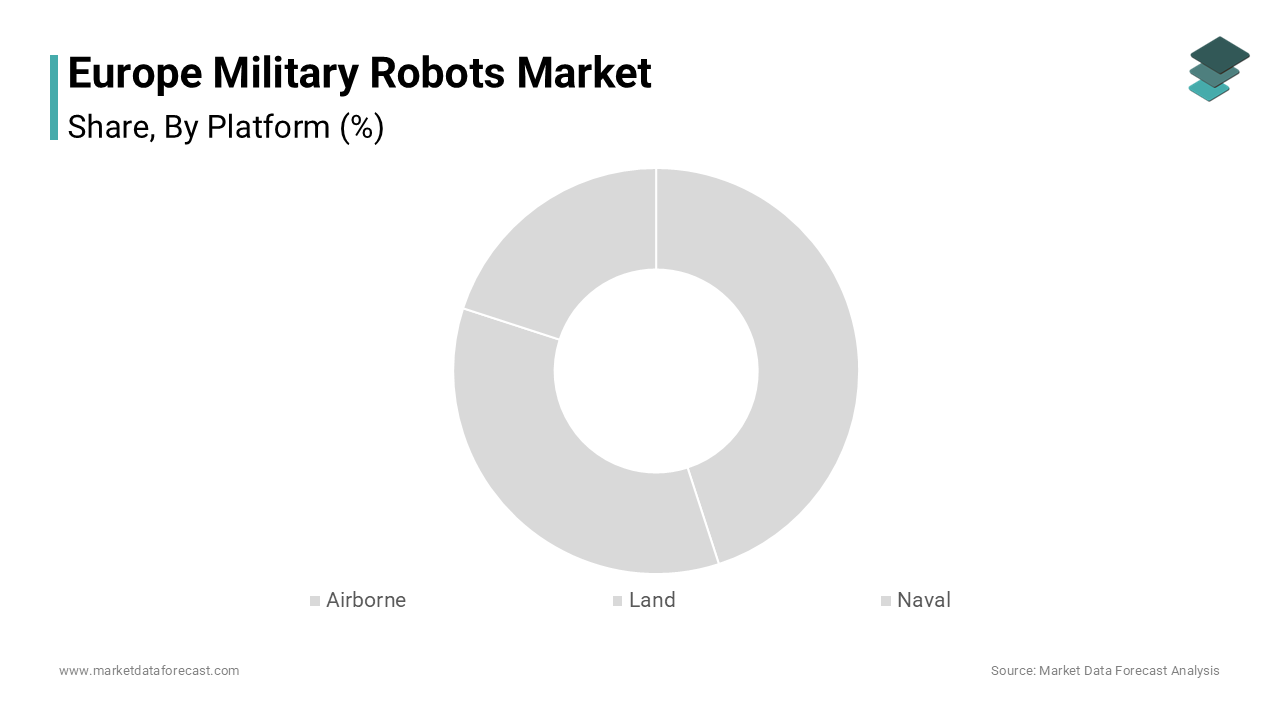
The naval segment is anticipated to grow at a fastest CAGR of 19.6% throughout the forecast period by escalating maritime security challenges in the Baltic Black and Mediterranean Seas where hybrid threats such as underwater sabotage drone incursions and illegal surveillance demand persistent monitoring. According to NATO Maritime Command, over 40 autonomous surface and underwater vehicles were deployed in 2024 for mine countermeasures and port protection across European waters. The Italian Navy operates the Pluto Plus unmanned underwater vehicle for seabed mapping and mine identification while the Swedish Navy uses the AUV62 for anti-submarine warfare training in archipelagic zones.
By Mode of Operation Insights
The semi-autonomous segment was accounted in holding a dominant share of the Europe military robots market in 2024 with Europe’s strict ethical and legal stance requiring meaningful human control over all military operations. As per the EU’s 2023, AI in Defence Guidelines lethal or high risk decisions must involve real time human authorization with a principle embedded in procurement policies across Germany France and the Nordic states. Consequently, platforms like the UK’s THeMIS UGV and France’s MAARS perform navigation and sensing autonomously but require operator approval for any engagement or intervention. This operational model balances efficiency with accountability satisfying both military effectiveness and democratic oversight.
The autonomous segment is anticipated to grow with an emerging CAGR of 17.2% throughout the forecast period with confined to non-lethal applications where human oversight is less, such as logistics convoy operations environmental monitoring and base perimeter patrols. According to the European Defence Agency, the ELEFANT project is a Franco German initiative has successfully tested fully autonomous UGV convoys that navigate complex terrain deliver supplies and return without human input during exercises in 2024. These use cases comply with EU ethics frameworks by excluding weaponization and focusing on force protection and civil support. Advances in AI explainability and fail safe protocols are gradually expanding the scope of permissible autonomy. As trust in algorithmic reliability grows autonomous systems will increasingly handle routine tasks freeing personnel for complex decision making.
By Mode of Propulsion Insights
The electric propulsion systems segment was the accounted in holding a significant share of the Europe military robots market in 2024 with the operational advantages of silent movement low thermal signature and reduced logistical burden in stealth reconnaissance and urban operations. Battery powered unmanned ground vehicles like the Estonian Milrem THeMIS and the French NiDAR UGV operate for 8 to 12 hours on a single charge with near zero acoustic detection risk. As per the Swedish Defence Materiel Administration, electric platforms reduce fuel resupply needs by up to 70% in forward operating bases by enhancing mission endurance and force protection. Additionally, the EU’s Green Defence Framework encourages low emission technologies aligning military robotics with broader climate goals. Advances in lithium sulfur and solid state batteries have extended range and cold weather performance making electric propulsion viable even in Arctic conditions.
The hybrid propulsion segment is likely to grow with a significant CAGR of 20.4% throughout the forecast period owing to the need for extended mission endurance in large scale logistics and long range surveillance where pure electric systems fall short. Hybrid unmanned ground vehicles combine diesel generators with electric motors to achieve 48 to 72 hours of continuous operation, which is essential for autonomous resupply convoys across Eastern Europe. Similarly, naval drones like the Dutch BlueWhale use hybrid diesel electric systems for weeks long maritime patrols with electric stealth during sensitive operations. The European Defence Fund’s ELEFANT program mandates hybrid options for next generation logistics robots to ensure operational flexibility across diverse theaters.
By Application Insights
The intelligence surveillance and reconnaissance segment held 39.3% of the Europe military robots market in 2024. ISR remains the primary application because it directly enhances situational awareness while minimizing risk to personnel in contested or denied areas. Unmanned aerial systems like the French Patroller and the Italian Sky Warden provide real time imagery across 200 kilometer ranges while ground robots like the UK’s THeMIS carry thermal and RF detection payloads for urban reconnaissance. The EU’s Permanent Structured Cooperation has prioritized multi domain ISR integration enabling aerial and ground robots to share data via secure mesh networks. This foundational role in force protection and decision superiority ensures ISR remains the most funded and mature application across European defense robotics.
The transportation and logistics segment is estimated to register a CAGR of 22.1% in next coming years with the urgent need to reduce soldier burden in resupply missions and enhance operational reach in dispersed battlefield environments. The German Bundeswehr’s Mission Master transports equipment for artillery units in simulated high threat zones reducing infantry fatigue and exposure. The ELEFANT program is a joint Franco German initiative that aims to field 500 autonomous logistics UGVs by 2027. NATO’s 2024 Steadfast Defender exercise validated multi-national robotic convoys that synchronized navigation across borders.
REGIONAL ANALYSIS
France Military Robots Market Analysis
France was the top performer of the Europe military robots market with 39.2% of share in 2024 with its doctrine of strategic autonomy and robust defense industrial policy. According to the French Ministry of the Armed Forces, the 2024–2030 Military Programming Law allocates 4.2 billion euros to unmanned systems including the Patroller MALE UAV and the NiDAR UGV for urban ISR. The country leads the EUROMAR naval drone initiative and co-heads the ELEFANT ground robotics consortium with Germany. As per the Direction Générale de l’Armement, over 120 robotic platforms were fielded in 2024 across Sahel and Indo Pacific operations demonstrating rapid operationalization. France’s strict ethical framework prohibits lethal autonomy but actively promotes AI for logistics reconnaissance and force protection.
Germany Military Robots Market Analysis
Germany military robots market growth is likely to be driven by its engineering excellence and commitment to European defense integration. According to the Bundeswehr, the German armed forces operate over 300 robotic systems including the Rheinmetall Mission Master and the DOK ING MV 10 EOD robot. The country co-leads the ELEFANT program and contributes 38% of the European Defence Fund’s robotics budget. As per the Federal Ministry of Defence, Germany prioritizes interoperability testing UGVs alongside Dutch and Polish forces in NATO exercises to ensure seamless data and command sharing. Strong data protection laws also mandate on board processing and encrypted links for all military robots.
United Kingdom Military Robots Market Analysis
The United Kingdom military robots market growth is ascribed to grow with its deep NATO integration and leadership in unmanned ground vehicles. According to the UK Ministry of Defence, the British Army has deployed over 150 THeMIS UGVs for reconnaissance EOD and casualty evacuation under the Robotics and Autonomous Systems Strategy. As per Defence Equipment and Support the UK prioritizes human machine teaming with soldiers controlling multiple robots via intuitive interfaces. Post Brexit the UK maintains alignment with EU defense ethics while accelerating bilateral projects with the US and Nordic allies.
Italy Military Robots Market Analysis
Italy military robots market growth is likely to grow with strategic focus on Mediterranean security and intelligence gathering. According to the Italian Ministry of Defence, the Navy operates the Pluto Plus UUV for mine countermeasures while the Army uses the Sky Warden UAV for border surveillance along North African routes. Leonardo and Fincantieri drive innovation in maritime autonomy with emphasis on corrosion resistant materials and long endurance propulsion.
COMPETITIVE LANDSCAPE
The Europe military robots market features a tightly coordinated ecosystem of national champions multinational consortia and specialized defense tech firms. Competition is defined not by price but by alignment with ethical frameworks interoperability standards and national security strategies. European players differentiate through sovereign supply chains data sovereignty and adherence to strict non lethal autonomy policies. The market is highly collaborative with joint programs under the European Defence Fund and Permanent Structured Cooperation reducing duplication and fostering innovation. Global vendors face high barriers due to security clearance requirements and preference for EU sourced systems. New entrants thrive in niche domains like Arctic robotics or civil military applications but require partnerships to scale.
KEY MARKET PLAYERS
Some of the companies that are playing a dominating role in the europe military robots include
- Rheinmetall AG
- BAE Systems plc
- Thales Group
- Leonardo S.p.A.
- Saab AB
- Milrem Robotics
- QinetiQ
- KNDS (Nexter and KMW)
- Airbus Defence & Space
- Patria
- Cobham
- General Dynamics
- Elbit Systems
- MBDA
- Northrop Grumman
- RTX
- L3Harris Technologies
Top Players in the Market
Thales Group
Thales Group is a French multinational that plays a central role in the Europe military robots market through its advanced unmanned aerial and ground systems. The company develops the NiDAR UGV for urban reconnaissance and the Watchkeeper UAV used by multiple European armed forces for intelligence surveillance and reconnaissance. Thales has strengthened its position by integrating AI powered threat detection and secure datalinks compliant with NATO STANAG standards. These innovations reflect Thales’s global strategy of delivering ethically aligned autonomous systems that prioritize soldier safety and interoperability across allied forces.
Rheinmetall AG
Rheinmetall AG is a German defense technology leader driving innovation in military robotics through its Mission Master family of unmanned ground vehicles. These platforms perform logistics reconnaissance and force protection roles for the Bundeswehr and NATO allies with electric and hybrid variants offering extended operational endurance. Rheinmetall has reinforced its European footprint by co leading the ELEFANT program with a Franco German initiative to develop next generation autonomous logistics robots.
Saab AB
Saab AB is a Swedish defense and security company that contributes significantly to the Europe military robots market with its focus on stealth autonomous systems for Arctic and maritime domains. The company’s Skeldar V 200 UAV and Ghost stealth drone provide low signature reconnaissance in extreme cold environments while its AUV62 underwater vehicle supports anti submarine warfare and mine countermeasures. Saab has strengthened its position by aligning its robotics portfolio with Sweden’s “Total Defence” doctrine which integrates military robots into civil emergency response.
MARKET SEGMENTATION
The research report on the europe military robots market has been segmented and sub-segmented based on categories.
By Platform
- Airborne
- Land
- Naval
By Mode of Operation
- Semi-Autonomous
- Autonomous
By Mode of Propulsion
- Manual
- Electric
- Hybrid
By Application
- ISR
- Search and Rescue
- Combat Support
- Transportation
- Others
By Country
- UK
- France
- Spain
- Germany
- Italy
- Russia
- Sweden
- Denmark
- Switzerland
- Netherlands
- Turkey
- Czech Republic
- Rest of Europe