- Product Description Description
- Table of Contents TOC
- List of Table & Figure LOT
- Get Free Sample PDF Sample PDF
Market Size, 2025
$1.42 BnMarket Estimate, 2026
$1.50 BnMarket Forecast, 2034
$2.40 BnCAGR, 2026–2034
6.03%Europe Mining Automation Market Report Summary
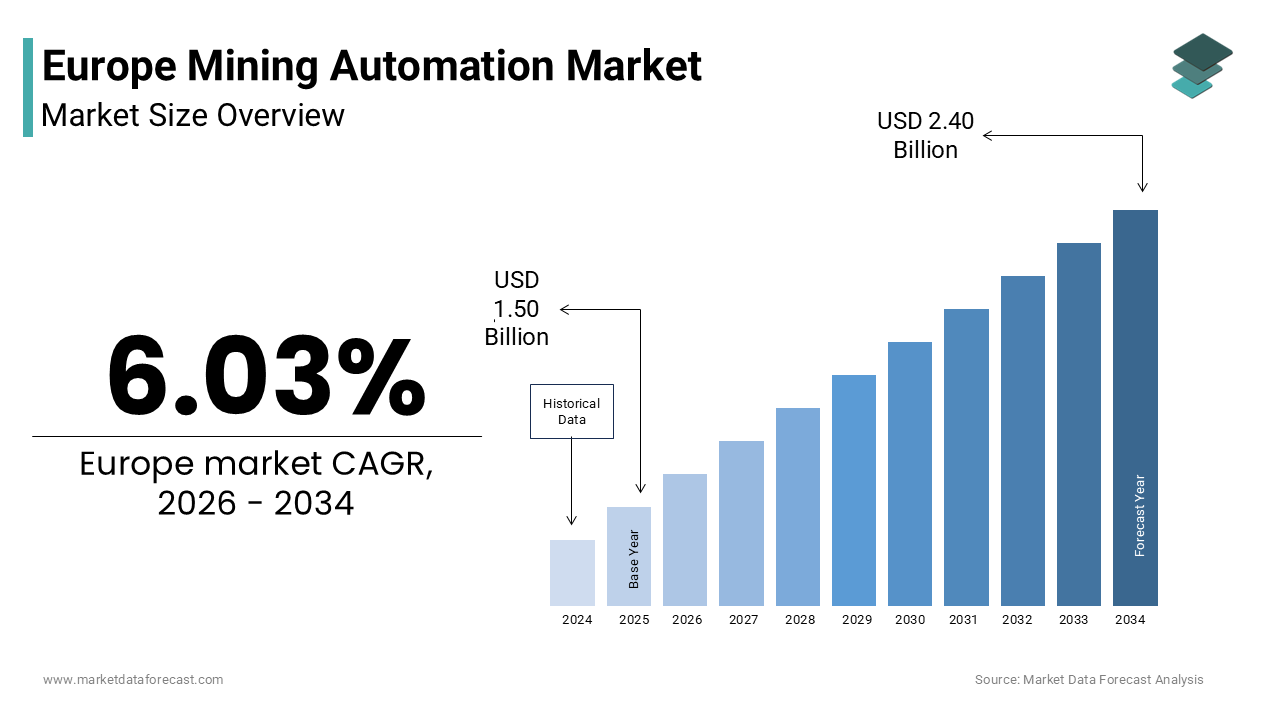
The Europe mining automation market was valued at USD 1.42 billion in 2025, is anticipated to reach USD 1.50 billion in 2026, and is projected to reach USD 2.40 billion by 2034, growing at a CAGR of 6.03% during the forecast period from 2026 to 2034. The growth of the Europe mining automation market is driven by escalating labor shortages in skilled mining roles, stringent EU safety and environmental compliance mandates, and rising dependence on automation for underground mining operations. Increasing strategic focus on critical raw materials such as lithium, rare earths, copper, and iron ore to support Europe’s green and digital transition is further accelerating adoption. Moreover, the integration of digital twins, predictive maintenance platforms, and private 5G-enabled remote operations is transforming automation from a productivity enhancer into a structural necessity for sustainable mining across the region.
Key Market Trends
- Rising adoption of autonomous haulage systems and remote-controlled drilling equipment in underground mines.
- Growing deployment of digital twins and predictive analytics platforms to optimize asset performance and reduce downtime.
- Increasing use of battery-electric and low-emission automated equipment is aligned with EU decarbonization goals.
- Expansion of real-time environmental monitoring systems for dust, emissions, ventilation, and water management compliance.
- Strengthening collaboration between mining companies, OEMs, and European research institutions for next-generation automation.
Segmental Insights
- Based on Type, the underground mining automation segment dominated the market, driven by Europe’s deep mineral reserves, strict occupational safety regulations, and the need to minimize human presence in high-risk underground environments.
- The surface mining automation segment is expected to grow at the fastest rate, supported by the revival of open-pit lithium, graphite, and critical mineral projects and the increasing use of automation for environmental compliance and energy optimization.
- Based on offering, the equipment segment held the largest share, owing to strong demand for autonomous trucks, drilling rigs, load-haul-dump vehicles, and remote-controlled machinery as the physical foundation of automation deployment.
- Based on application, the mine maintenance segment dominated the market, supported by rising adoption of condition monitoring, predictive diagnostics, and digital twin-based maintenance workflows to reduce costly downtime.
Regional Insights
The Europe mining automation market shows strong momentum across countries with strategic mineral resources, advanced technology ecosystems, and supportive regulatory frameworks.
- Sweden leads the market, driven by highly automated iron ore and critical mineral operations, strong government support, and close collaboration between miners and technology providers such as LKAB, Boliden, Epiroc, and Sandvik.
- Finland holds a strong position due to its fully digital underground mines, advanced smart mine ecosystem, and strict safety regulations requiring automated ventilation and monitoring systems.
- Poland remains a key market supported by large-scale copper mining operations, state-backed modernization programs, and increasing adoption of remote-controlled and autonomous technologies.
- Germany plays a critical role as a technology supplier hub, with companies such as Siemens and Sandvik Germany exporting advanced automation systems across Europe while also modernizing domestic operations.
- France is emerging as a high-growth market with its new lithium mining projects and state-backed industrial strategy, where automation is essential to meet stringent environmental and social compliance standards.
Competitive Landscape
The Europe mining automation market is characterized by the presence of established global OEMs and industrial automation leaders competing on system integration, regulatory compliance, and sustainability performance. Market leaders differentiate through end-to-end automation platforms, proprietary control systems, advanced safety certifications, and cybersecurity-aligned architectures. The competitive environment is further shaped by strong R&D collaboration between mining companies, technology providers, and academic institutions, particularly in areas such as autonomous navigation, battery-electric mining equipment, AI-driven optimization, and digital twin fidelity. High entry barriers related to safety validation, interoperability requirements, and long procurement cycles continue to favor established players. Prominent companies operating in the Europe mining automation market include Caterpillar Inc., Komatsu Ltd., Sandvik AB, Epiroc AB, Hitachi Construction Machinery Co., Ltd., Liebherr Group, Volvo Construction Equipment, Hexagon AB, Trimble Inc., ABB Ltd., Siemens AG, Rockwell Automation, Schneider Electric SE, Autonomous Solutions, Inc. (ASI), RPMGlobal, Micromine, Mine Site Technologies, and Remote Control Technologies Pty Ltd.
Europe Mining Automation Market Size
The europe mining automation market size was valued at USD 1.42 billion in 2025 and is anticipated to reach USD 1.50 billion in 2026 from USD 2.40 billion by 2034, growing at a CAGR of 6.03% during the forecast period from 2026 to 2034.
Mining automation refers to the integrated technologies, including autonomous haulage systems, remote-controlled drilling equipment, sensor-based ore sorting, and real-time operational analytics, that enable mining operations to function with reduced human intervention while enhancing safety, productivity, and environmental compliance. Although Europe is not a dominant global mining region by volume it maintains strategic activity in critical mineral extraction particularly in Sweden Finland and Poland where deposits of iron ore copper lithium and rare earth elements support the continent’s green and digital transition. Numerous active mines across the EU have been identified as important for raw materials under recent regulations. The European mining sector and its related supply chains support a considerable workforce, although labor challenges are emerging. Workforce shortages for technical roles in mining and quarrying are becoming more evident, and stricter safety rules concerning occupational risk management are being put in place. Automation is increasingly shifting from an optional enhancement to an operational necessity within the evolving European mineral extraction landscape
MARKET DRIVERS
Escalating Labor Shortages in Skilled Mining Roles
The region’s mining sector faces a deepening crisis in attracting and retaining qualified personnel, particularly in remote and underground operations, which is accelerating the growth of the European automation market. The mining workforce in Sweden and Finland is characterized by a mature, aging population, creating a need for new, younger entrants. This demographic gap is exacerbated by declining interest in industrial careers among younger generations. Germany’s mining industry, along with related industrial sectors, is facing a severe shortage of qualified equipment operators and technicians. To sustain operations without expanding recruitment, companies are turning to autonomous systems. Mining operations in northern Sweden are increasingly relying on around-the-clock, autonomous haulage systems, while remote drilling technology is used to move personnel away from high-risk, underground areas. These systems compensate for human resource constraints while maintaining or improving throughput. The adoption of autonomous technology in Swedish mining, particularly for transporting material, has led to a major decrease in the need for on-site personnel. This structural labor deficit ensures that automation is no longer a productivity add on but a fundamental enabler of operational continuity across Europe’s mineral-dependent economies.
Stringent EU Safety and Environmental Compliance Mandates
Regulatory frameworks across the European Union are increasingly mandating technological interventions to minimize occupational hazards and ecological impact in mining activities, which directly propels the expansion of the Europe mining automation market. Underground mining is recognized as an industry with a significantly higher risk profile compared to the broader industrial average. Regulatory updates are driving the adoption of real-time monitoring, remote operations, and digital safety protocols in underground operations. Environmental regulations are increasing the requirement for continuous emission tracking and automated dust suppression in open-pit mining. Artificial intelligence is being utilized in ventilation systems to adjust airflow based on sensor data, aiming to reduce explosion risks and improve energy efficiency. Autonomous technologies are being implemented in specific mining environments to reduce worker exposure to hazardous materials and high-risk areas. Regulatory requirements are shifting, with technology adoption becoming essential for compliance rather than just a strategic enhancement. New mining permits are increasingly incorporating specific automation mandates focused on safety and environmental controls. This regulatory tailwind ensures sustained investment in automated systems across the continent
MARKET RESTRAINTS
High Capital Expenditure and Limited ROI in Small Scale Operations
The prohibitive upfront investment required for integrated automation systems, which disproportionately affects small and medium-scale mining enterprises that constitute the majority of the continent’s operational sites, is restricting the growth of the Europe mining automation market. A significant portion of operational mines within the EU are characterized as small-to-medium scale producers based on annual ore output. For these smaller entities, the adoption of basic autonomous hauling technologies presents a substantial financial challenge, often creating an prohibitive barrier to implementation. The high capital expenditure required for autonomous system integration is particularly restrictive for mines with lower production volumes. Consequently, widespread adoption of autonomous haulage may be slower or less feasible for a majority of European mining operations. Unlike large global miners such as Boliden or Rio Tinto which amortize automation costs over decades and multiple sites smaller operators lack scale economies and access to low cost capital. Furthermore, as per a study, only a portion of European SME mines achieved a positive net present value on automation investments within five years due to lower utilization rates and fragmented equipment fleets. Public funding mechanisms such as Horizon Europe grants cover only a fraction of deployment costs and are highly competitive. Consequently, many viable mines opt for partial digitization rather than full automation delaying sector wide transformation and reinforcing a two tier market structure that limits broad adoption.
Fragmented Legacy Infrastructure and Interoperability Deficits
Existing mining infrastructure across Europe, much of it developed in the mid to late 20th century, is a significant technical barrier to seamless automation integration, which further hinders the expansion of the Europe mining automation market. This is due to outdated machinery control systems and lack of standardized communication protocols. According to sources, many underground mines operating in Eastern and Central European regions rely on older, legacy machinery, indicating a significant need for modernization to meet current safety and efficiency standards. Retrofitting these assets with modern sensors and control units often costs more than replacement yet full fleet renewal is financially unfeasible for most operators. Besides, the absence of universal data standards across equipment vendors creates interoperability challenges. Mid-sized mining operations often operate with a fragmented equipment fleet, utilizing machinery from a high number of different suppliers, which poses challenges for maintenance and integrated digital automation. This fragmentation increases integration complexity project timelines and cybersecurity vulnerabilities. Integrating automation into older, legacy mining environments is significantly more time-consuming than in new, greenfield developments, primarily due to the complexity of integrating with existing, non-digitalized infrastructure. European automation scalability remains constrained by legacy infrastructure, pending the adoption of unified, open-standard retrofit frameworks.
MARKET OPPORTUNITIES
Strategic Alignment with EU Critical Raw Materials Independence Goals
The European Union is urgently pushing to secure domestic supplies of critical minerals for electric vehicles, renewable energy, and defense, which is expected to fuel the growth of the Europe mining automation markrt. This effort is creating a powerful opportunity for mining automation to enable viable extraction from complex or previously uneconomic deposits. Under the 2023 Critical Raw Materials Act, the European Union seeks to enhance its strategic autonomy by setting 2030 targets to significantly increase the domestic extraction of critical minerals, including lithium and rare earths, while simultaneously boosting local processing and recycling capacities to reduce dependence on external, single-country suppliers. Many of these deposits such as the Norra Kärr rare earth project in Sweden or the Kodal mine in Norway are located in geologically challenging or environmentally sensitive areas where conventional mining is either too risky or prohibited. Automation offers a solution through precision extraction techniques. The use of automated drilling and AI-driven sorting at a Scandinavian graphite facility appears to correlate with higher recovery rates and reduced surface impact. Advanced technological systems utilized in European graphite mining suggest a shift toward more efficient and localized extraction processes. A lithium extraction project in Serbia indicates a reliance on automated water management and real-time monitoring to address strict environmental regulations. The integration of technology in both graphite and lithium projects highlights a trend toward automation in European critical mineral sourcing. These capabilities make automation essential for unlocking Europe’s strategic mineral potential in alignment with geopolitical and industrial policy objectives.
Emergence of Digital Twin and Predictive Maintenance Ecosystems
The integration of digital twin technology with cloud-based analytics platforms is opening new value streams in European mining operations, which provides fresh prospects for the expansion of the Europe mining automation market. These platforms enable predictive maintenance, asset optimization, and remote expert collaboration. Digital twins, virtual replicas of physical mining systems updated in real time through IoT sensors, allow operators to simulate scenarios optimize throughput and preempt failures. The implementation of a comprehensive digital twin at a Swedish gold mine has shown potential for decreasing unscheduled equipment stoppages by monitoring and predicting wear patterns on critical infrastructure. Operational reviews and reports indicate that integrating predictive maintenance via digital twin technology can contribute to lower maintenance expenditures and longer equipment lifespans. Digital twin platforms enable centralized engineering teams to support decentralized operations across multiple regions, assisting in cross-geographical knowledge sharing. The expansion of private 5G network coverage in remote mining areas facilitates the scaling of these digital ecosystems. This shift from reactive to anticipatory operations positions digital twin integration as a high growth frontier within Europe’s mining automation landscape.
MARKET CHALLENGES
Cybersecurity Vulnerabilities in Connected Mining Systems
The rapid digitalization of European mining operations has broadened the attack surface, which leads to severe cybersecurity challenges that imperil both safety and data integrity, and thereby negatively impacts the growth of the Europe mining automation market. Automated systems rely on continuous data flow between sensors control centers and cloud platforms creating multiple attack vectors. The mining industry has seen an increase in ransomware attacks, raising security awareness in the sector. These cyberattacks have caused operational shutdowns, affecting autonomous systems and production at mining sites. Cybersecurity incidents impacting mining have become more frequent in recent times. The risk is amplified by legacy operational technology systems that lack modern encryption or patch management. Many operational technology (OT) networks in the mining sector have rigid architectures that necessitate full system replacement for updates, rather than allowing incremental changes. This approach contrasts with emerging regional data sovereignty requirements, creating a conflict when global cloud infrastructures commonly used by automation providers are involved. Europe’s mining automation trajectory faces ongoing, critical cyber vulnerability, pending the comprehensive adoption of secure, zero-trust architectures and sector-specific resilience standards.
Workforce Reskilling Gaps and Cultural Resistance to Technological Change
The lack of workforce capabilities to operate, manage, and troubleshoot advanced systems, coupled with institutional resistance to operational transformation despite technological readiness, constrains the expansion of the Europe mining automation market. This persistent human factor challenge impedes the effective deployment of mining automation across the region. Frontline supervisors in European mining operations often lack formal training in digital technologies such as data analytics, remote control interfaces, and autonomous system diagnostics. This absence of training contributes to the underutilization of advanced technologies implemented in mines. Operators' discomfort with digital interfaces can lead to automated equipment, such as drilling systems, operating significantly below their full capacity, creating a gap between the adoption of autonomous systems and the capability of personnel to operate them efficiently. Cultural inertia is equally significant. In Germany’s lignite mining regions where multi-generational employment patterns persist unions have voiced concerns that automation reduces job quality and erodes traditional expertise. European extractive industry social partners have initiated efforts to enhance social dialogue, as labor negotiations regarding role redesign and training requirements are critical factors in the timely implementation of automation projects in the sector. Europe's diverse mining workforce will not realize the full benefits of automation unless we prioritize reskilling efforts and shift the mindset from worker displacement to technological augmentation.
REPORT COVERAGE
| REPORT METRIC | DETAILS |
| Market Size Available | 2025 to 2034 |
| Base Year | 2025 |
| Forecast Period | 2026 to 2034 |
| CAGR | 6.03% |
| Segments Covered | By Type, Offering Insights, Application and Country |
| Various Analyses Covered | Regional & Country Level Analysis, Segment-Level Analysis, DROC, PESTLE Analysis, Porter’s Five Forces Analysis, Competitive Landscape, Analyst Overview on Investment Opportunities |
| Countries Covered | UK, France, Spain, Germany, Italy, Russia, Sweden, Denmark, Switzerland, the Netherlands, Turkey, the Czech Republic, and the Rest of Europe. |
| Market Leaders Profiled | Caterpillar Inc., Komatsu Ltd., Sandvik AB, Epiroc AB, Hitachi Construction Machinery Co., Ltd., Liebherr Group, Volvo Construction Equipment, Hexagon AB, Trimble Inc., ABB Ltd., Siemens AG, Rockwell Automation, Inc., Schneider Electric SE, Autonomous Solutions, Inc. (ASI), RPMGlobal, Micromine, Mine Site Technologies, and Remote Control Technologies Pty Ltd. |
SEGMENTAL ANALYSIS
By Type Insights
The underground mining automation segment held the majority share of 63.1% of the Europe mining automation market in 2025. The leading position of the underground mining automation segment is attributed to the continent’s strategic focus on deep and complex mineral deposits, particularly copper lithium and iron ore, that are primarily accessed via underground methods in countries like Sweden Finland and Poland. Europe’s most economically viable mineral reserves lie at significant depths where manual operations are increasingly unsafe and inefficient. Underground iron ore mining in northern Sweden has reached significant depths, with operations extending over a kilometer below the surface. A substantial majority of the country's known iron ore reserves are located deep underground, which requires the adoption of automated drilling and remote-controlled load-haul-dump systems to maintain production. A copper-zinc mine in Finland has transitioned to fully remote operations to facilitate continuous, 24-hour extraction. Operating at great depths, such as in the Finnish case, enables mineral extraction while reducing the exposure of workers to seismic and thermal risks. These geologic realities make automation not optional but essential for accessing Europe’s core mineral wealth. EU occupational safety directives now actively discourage human entry into unstable or gaseous underground zones. New regulatory frameworks are increasing the requirement for remote-operated equipment in underground mines that experience elevated methane levels. Data indicates a significant portion of active underground copper mines in certain regions are facing hazardous gas conditions, prompting the adoption of automated technology. The implementation of automated LHD vehicles and remote command centers is reducing the number of personnel required to work underground. The transition toward automated mining techniques is associated with improvements in operational ore recovery rates. This regulatory shift transforms automation into a legal and ethical imperative across Europe’s underground mining landscape.
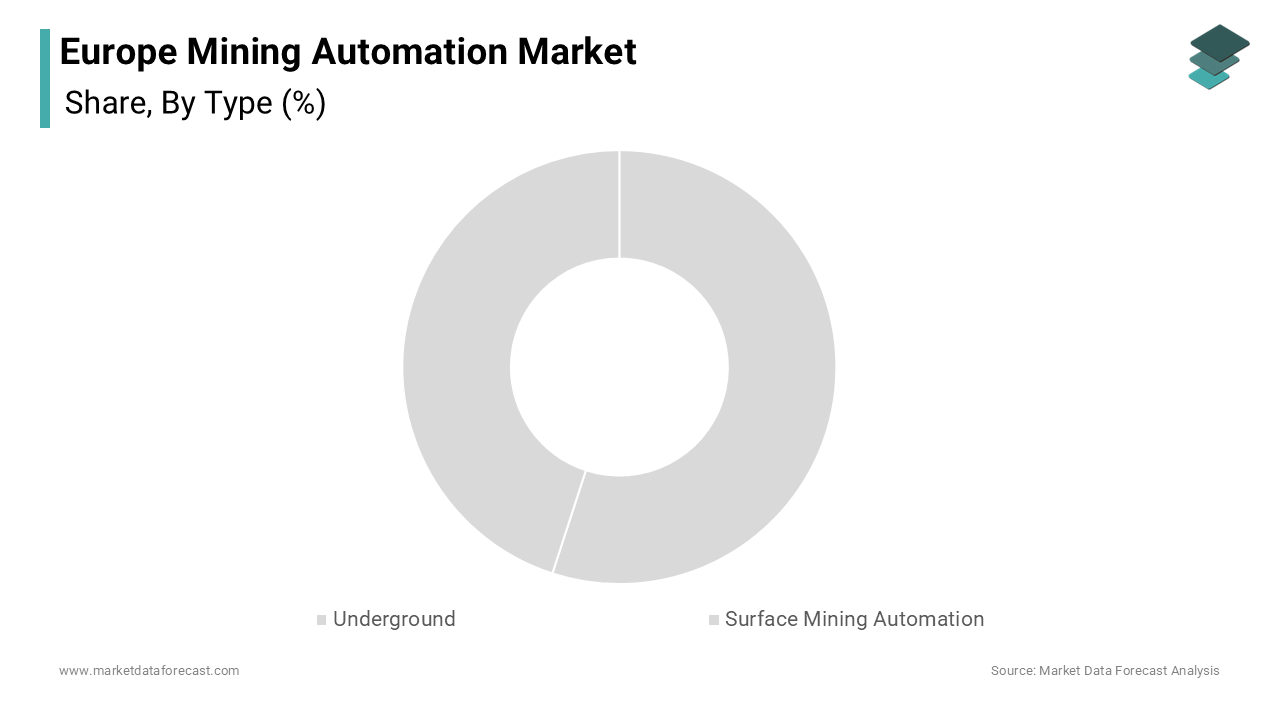
The surface mining automation segment is likely to experience the fastest CAGR of 11.3% during the forecast period due to revival of open pit critical mineral projects under EU strategic autonomy policies, and integration of real time environmental compliance monitoring. The EU’s push for domestic critical raw materials has reignited surface mining activity particularly for lithium and graphite. Serbia’s Jadar lithium borate project and Portugal’s Barroso lithium mine, both open pit, are integrating autonomous hauling and AI based ore sorting to meet fast tracked production timelines. Regulatory frameworks have streamlined the approval process for new surface mines extracting battery metals. Recently established mining operations are integrating automation from the outset to improve adherence to environmental standards and optimize energy consumption. Certain lithium extraction projects are deploying autonomous fleets with the aim of reducing diesel use. Surface mines face intense scrutiny over dust emissions water use and land disturbance. Automation enables continuous compliance through embedded sensors and adaptive controls. Automated dust suppression systems, activated by air quality sensors at a Polish open-pit mine, allow for targeted water usage instead of continuous application. The integration of on-site environmental monitoring with this technology has led to reduced water consumption while maintaining required air quality standards. Separately, an iron ore surface operation in Sweden uses drone-based volumetric surveys integrated with fleet management software to gather data that helps minimize over-excavation. Both examples illustrate a pattern of adopting data-driven, automated, or remote technologies to enhance resource use and operational efficiency. These capabilities position surface automation as indispensable for sustainable resource extraction under Europe’s stringent environmental governance framework.
By Offering Insights
The equipment segment led the Europe mining automation market by capturing a share of 52.6% in 2025. The dominance of the equipment segment is credited to the foundational role of physical assets, such as autonomous haul trucks and drilling rigs, in enabling operational automation. Major European miners are prioritizing equipment upgrades to meet production and safety mandates. Mining organizations are increasingly adopting advanced automation and clean energy technologies to modernize production systems. This involves a shift toward deploying autonomous haulage systems to improve efficiency and replacing conventional equipment with electric-powered alternatives to reduce emissions and align with sustainability goals. Additionally, the use of remote-controlled drilling and loading systems enables continuous production in hazardous, deep underground areas. These technological shifts are driven by the goal of removing personnel from high-risk zones to enhance workplace safety and the use of digital systems to optimize equipment life cycles through consistent, machine-driven operation. These investments are driven by the need to extend mine life in aging operations. Sweden’s Aitik mine has operated since 1968 and now relies on autonomous trucks to maintain output as ore grades decline. Equipment forms the tangible backbone of automation with ROI measured in uptime safety and energy metrics rather than software licensing. Leading OEMs such as Sandvik and Epiroc provide end to end automated equipment suites that reduce integration complexity. Underground load-haul-dump vehicles are increasingly incorporating unified systems that combine vehicle control, collision avoidance, and remote operation capabilities. A significant portion of new underground mining machinery purchases in Central Europe involves factory-integrated automation features. Industry trends indicate a preference for pre-installed automation solutions over retrofitting existing equipment. Automation has become a standard inclusion in new equipment sales for underground mining operations in the region. This turnkey approach accelerates deployment and ensures warranty coverage across subsystems, critical for risk averse public and state affiliated mining entities prevalent in Europe.
The software segment is on the rise and is expected to be the fastest growing segment in the market by witnessing a CAGR of 14.1% over the forecast period owing to regulatory mandate for real time emissions and safety data logging, and rise of predictive analytics for asset and energy optimization. EU regulations now require continuous digital recording of mine environmental and safety parameters. Regulatory updates regarding environmental monitoring are encouraging mining operations to adopt advanced digital tracking systems for air quality and equipment maintenance. In response to these requirements, mining companies are increasingly implementing integrated software platforms to manage operational data. The use of centralized, digital systems allows for the consolidation of data from multiple environmental and operational sensors. Automated reporting tools are being utilized to streamline the compliance process, reducing the need for manual record preparation. This regulatory digitization compels software adoption irrespective of equipment automation level. European mines face pressure to reduce carbon intensity under the EU Taxonomy for Sustainable Activities. Software platforms that forecast equipment failure or optimize haul routes based on terrain and battery state are gaining traction. Modern mining operations are incorporating digital technologies to enhance efficiency and manage resources effectively. This includes using fleet management systems for real-time monitoring and optimization of vehicle movement to lower energy use. Data analysis guides route planning to reduce fuel consumption and equipment wear. Mine planning software simulates extraction sequences to minimize waste rock movement and improve operational processes. The synchronization of geological data with engineering timelines through integrated digital modeling supports resource extraction and addresses logistical challenges. These efficiency gains make software indispensable for meeting EU climate accountability standards.
By Application Insights
The mine maintenance segment dominated the Europe mining equipment market by occupying a share of 38.1% in 2025. The dominance of the mine maintenance segment is driven by the critical role of predictive and condition-based maintenance in ensuring asset reliability in remote and hazardous mining environments where unscheduled downtime carries disproportionate costs. Underground mines in Europe typically operate on 24 7 schedules where a single conveyor or loader breakdown can halt production across multiple levels. Unplanned operational stoppages in mining operations can represent a financial burden due to lost productivity and labor expenses. Mine operators are implementing a combination of technologies, including vibration monitoring, thermal imaging, and lubricant analysis, to monitor equipment health. Data from these monitoring systems is integrated into management software to transition from reactive to proactive maintenance strategies. Predictive analysis tools can identify potential component failures, allowing maintenance teams to schedule repairs during existing operational pauses, preventing major disruptions. Mines are increasingly using digital replicas of physical assets to test maintenance procedures and train technicians without disrupting operations. LKAB’s digital twin of its Kiruna ore handling system allows engineers to simulate component replacements and validate tool paths in virtual reality. The company reported that this approach resulted in a reduction of the average repair duration. The same approach was associated with a decrease in training-related injuries. Digital twin-based maintenance protocols were adopted by various European mine sites. This adoption was facilitated by funding initiatives for digital technology development within Europe. This fusion of virtual and physical maintenance workflows cements the segment’s leadership.
The mine maintenance segment is also the fastest-growing application segment, with a projected CAGR of 12.7% from 2026 to 2034. The rapid growth of this segment is fueled by an EU mandate for digital asset registers and lifecycle tracking, as well as an aging fleet that demands condition-based monitoring over scheduled interventions. Updated European machinery regulations necessitate that certain mining equipment, when brought to market, incorporates a digital record containing detailed maintenance, energy, and material data. This regulatory evolution is encouraging mining operations to adopt software-enabled maintenance systems to create and store this required information. Industry observation indicates a significant shift toward updating maintenance modules to achieve compliance with these new documentation requirements. This legislative push transforms maintenance software from operational tool to regulatory necessity. The European mining industry is operating with an aging fleet of machinery, reflecting a trend toward extended maintenance of existing equipment rather than rapid replacement. Older assets are more prone to random failures making fixed interval maintenance inefficient. Condition based systems using AI to interpret sensor data allow interventions only when needed. Implementation of proactive vibration monitoring on critical infrastructure at the Rudna copper mine has successfully increased the operational lifespan of pumping equipment and reduced maintenance expenses. This economic imperative accelerates adoption across the continent’s mature mining base.
REGIONAL ANALYSIS
Sweden Mining Automation Market Analysis
Sweden outperformed others in the Europe mining automation market by accounting for a 24.6% share in 2025. The leading position of the Swedish market is propelled by its vast iron ore and battery mineral reserves coupled with a proactive regulatory environment that incentivizes technological adoption. LKAB alone operates numerous fully automated or remotely controlled mining sections across Kiruna and Malmberget. The Swedish government is intensifying its commitment to domestic critical mineral production and technological innovation to bolster European self-sufficiency and support the global green transition. Furthermore, Sweden’s stringent occupational safety laws, requiring zero personnel in blast zones, have made remote drilling and LHD systems standard practice. The national innovation agency Vinnova also funds collaborative R&D between Boliden Epiroc and Luleå University of Technology to develop next generation autonomous systems. This ecosystem of policy investment and technical expertise solidifies Sweden’s leadership.
Finland Mining Automation Market Analysis
Finland followed closely in the Europe mining automation market by capturing a share of 16.3% in 2025. The expansion of the Finish market is fuelled by its advanced digital infrastructure and focus on base and battery metals. The country hosts Europe’s first fully digital underground mine at Pyhäsalmi operated by First Quantum Minerals which uses an integrated platform linking autonomous LHDs drone surveying and real time ore analysis. Public funding initiatives support the development of interoperable automation technologies within the mining industry, specifically focusing on the "Smart Mine" concept. A regional mining cluster exists with a concentration of technology suppliers, facilitating a localized ecosystem for developing mining-related technology and expertise. Additionally, the Finnish Safety and Chemicals Agency enforces some of the EU’s strictest ventilation and gas monitoring rules, requiring automated response systems in all underground operations. This regulatory and technological synergy positions Finland as a testbed for scalable automation models across Europe.
Poland Mining Automation Market Analysis
Poland is also a key player in the Europe mining automation market due to KGHM’s extensive copper mining operations which span both deep underground and large open pit environments. The company's strategic planning indicates a focused investment in mining automation, specifically prioritizing autonomous haulage and remote-controlled bolting technologies. Industry trends suggest a significant rise in the adoption of factory-integrated automation within newly acquired equipment for state-affiliated mining entities. Workforce shortages in specialized technical roles are accelerating the shift toward the deployment of remote operation technologies in underground mining environments. Additionally, EU cohesion funds have supported automation retrofits in Silesian mines to improve competitiveness. This combination of scale regulatory pressure and public investment sustains Poland’s strong market presence.
Germany Mining Automation Market Analysis
Germany holds a significant share of the Europe mining automation market as the region’s leading supplier of mining automation technology. Companies like Siemens Sandvik Germany and BASF Mining Solutions develop and export control systems sensors and reagents used across EU mines. The Fraunhofer Institute for Reliability and Microintegration in Berlin has pioneered intrinsically safe communication modules for underground use now deployed in Swedish and Finnish mines. According to sources, the country exported substantial worth of mining automation hardware and software in 2023. Domestically Germany maintains small but highly automated potash and lignite operations where safety regulations mandate remote monitoring. The German Mining Heritage Foundation also funds automation trials in heritage mines repurposed for training. Thus, Germany’s influence is technological rather than extractive yet deeply embedded in the continent’s automation trajectory.
France Mining Automation Market Analysis
France is predicted to expand in the Europe mining automation market owing to its emerging lithium mining sector and state led industrial strategy. National investment strategies are prioritizing domestic battery material production through specialized, automated mining initiatives. The planned lithium extraction site in the Massif Central region is projected to be a fully automated facility within Europe. This project aims to integrate autonomous drilling and electric haulage technologies for operational efficiency. Real-time analytics are planned for implementation to enhance the processing of lithium resources. Environmental regulations in France are among the strictest, requiring zero discharge and minimal land footprint, making automation essential for compliance. Though historically a minor mining country France’s pivot to critical minerals positions it as a high growth automation adopter with significant policy backing.
COMPETITIVE LANDSCAPE
Competition in the Europe mining automation market is characterized by a concentrated landscape of established industrial technology leaders competing on system integration regulatory alignment and sustainability performance. The market features high barriers to entry due to complex safety certifications interoperability requirements and long sales cycles involving public and state affiliated entities. Leading firms differentiate through proprietary control architectures edge computing capabilities and compliance with EU directives on emissions cybersecurity and worker safety. While global players dominate the high end segment niche European vendors offer specialized solutions for legacy equipment retrofit and regional geologic conditions. Intense R&D collaboration between OEMs mining companies and academic institutions drives rapid innovation particularly in autonomous navigation battery power and digital twin fidelity. This ecosystem fosters technological advancement but demands continuous investment to maintain competitive relevance in a policy driven market.
KEY MARKET PLAYERS
Some of the companies that are playing a dominating role in the Europe Aggregates Market include
- Caterpillar Inc.
- Komatsu Ltd.
- Sandvik AB
- Epiroc AB
- Hitachi Construction Machinery Co., Ltd.
- Liebherr Group
- Volvo Construction Equipment
- Hexagon AB
- Trimble Inc.
- ABB Ltd.
- Siemens AG
- Rockwell Automation, Inc.
- Schneider Electric SE
- Autonomous Solutions, Inc. (ASI)
- RPMGlobal
- Micromine
- Mine Site Technologies
- Remote Control Technologies Pty Ltd.
Top Players in the Market
Epiroc AB
Epiroc AB is a Sweden headquartered global leader in mining automation technologies with deep integration across Europe’s underground and surface operations. The company specializes in autonomous drilling rigs battery powered loaders and digital fleet management systems designed for harsh subterranean environments. Epiroc has significantly advanced its position through the development of its Rig Control System and Certified Operator Training Program which enable seamless transition to remote operations. Epiroc also collaborates with major European miners like Boliden and LKAB to co develop safety compliant automation protocols aligning with EU occupational directives and reinforcing its role as a strategic technology partner in the global mining automation ecosystem.
Sandvik AB
Sandvik AB a Swedish multinational engineering firm plays a pivotal role in the Europe mining automation market through its AutoMine and OptiMine platforms which deliver end to end autonomy for load haul dump operations and fleet coordination. The company’s strength lies in vertically integrated hardware and software that ensure high interoperability and reliability in deep mining conditions. Recently Sandvik introduced its fully electric and autonomous TH665B LHD vehicle equipped with AI based collision avoidance and predictive maintenance analytics. This innovation supports Europe’s decarbonization goals while enhancing productivity. Sandvik also partners with research institutions like the Norwegian University of Science and Technology to refine autonomous navigation in GPS denied environments. Its solutions are deployed across critical mineral sites in Finland Sweden and Poland underscoring its contribution to both European and global mining digitalization efforts.
Siemens AG
Siemens AG a German industrial technology giant contributes to the Europe mining automation market through its industrial automation software power systems and digital twin solutions tailored for mining applications. The company provides integrated control systems for ventilation hoisting and material handling that comply with stringent EU safety and emissions standards. In 2024 Siemens enhanced its Xcelerator platform with mining specific modules enabling real time simulation of ore flow and energy consumption across entire mine sites. It also launched a cybersecurity suite certified under EU NIS2 Directive to protect operational technology networks from ransomware and data breaches. Siemens collaborates with state owned mining enterprises in Poland and Germany to modernize legacy infrastructure using modular automation retrofits. Its cross sector expertise in energy and digitalization positions it as a critical enabler of resilient and sustainable mining operations across Europe and beyond.
Top strategies used by the key market participants
Key players in the Europe mining automation market focus on developing integrated hardware software ecosystems to ensure seamless autonomy and data flow. They prioritize compliance with EU safety environmental and cybersecurity regulations through certified solutions. Strategic collaborations with mining operators research institutes and public agencies drive co innovation and pilot deployments. Investment in battery electric and low emission equipment aligns with the EU Green Deal and decarbonization mandates. Companies also expand digital service offerings such as predictive maintenance remote diagnostics and digital twin platforms to create recurring revenue streams and deepen client relationships. Localization of R&D and manufacturing within Europe further strengthens responsiveness and supply chain resilience.
MARKET SEGMENTATION
This europe mining automation market research report is segmented and sub-segmented into the following categories.
By Type
- Underground
- Surface Mining Automation
By Offering Insights
- Equipment Software
- Communication
By Application
- Mining Operations
- Mine Maintenance
- Mine Developments
By Country
- UK
- France
- Spain
- Germany
- Italy
- Russia
- Sweden
- Denmark
- Switzerland
- Netherlands
- Turkey
- Czech Republic
- Rest of Europe