- Product Description Description
- Table of Contents TOC
- List of Table & Figure LOT
- Get Free Sample PDF Sample PDF
Market Size, 2025
$0.594 TnMarket Estimate, 2026
$0.635 TnMarket Forecast, 2034
$1.84 TnCAGR, 2026–2034
6.90%Europe Mining Market Report Summary
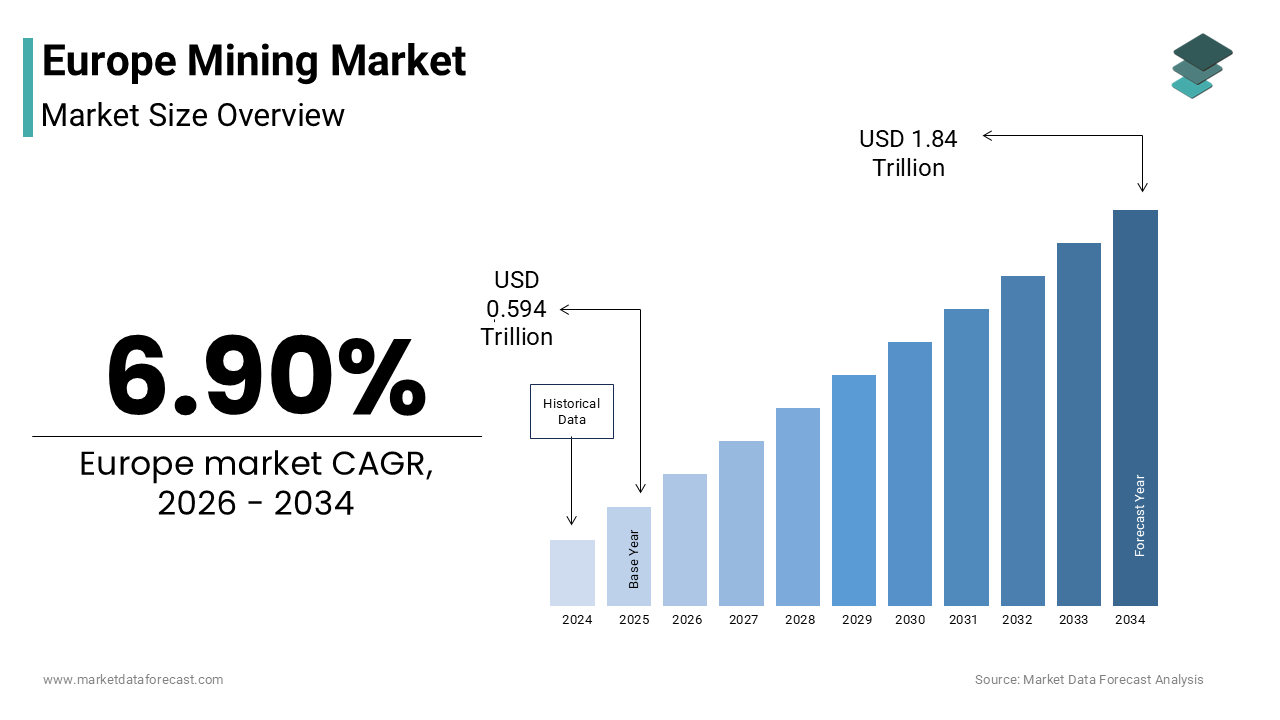
The Europe mining market was valued at USD 0.594 trillion in 2025, is estimated to reach USD 0.635 trillion in 2026, and is projected to reach USD 1.84 trillion by 2034, growing at a CAGR of 6.90% during the forecast period from 2026 to 2034. The growth of the Europe mining market is driven by the EU Critical Raw Materials Act, rising demand for battery and clean energy minerals, expansion of urban mining practices, and increasing emphasis on raw material sovereignty. European mining operations are characterized by strict environmental regulations, circular economy frameworks, and community engagement requirements that prioritize sustainable extraction over volume-driven production. Moreover, investments in legacy mine reprocessing, advanced low-impact extraction technologies, and strategic mineral exploration are further supporting market expansion across the region.
Key Market Trends
- Rising strategic mineral extraction initiatives driven by the EU Critical Raw Materials Act targeting domestic lithium, cobalt, and rare earth production.
- Growing adoption of urban mining and construction waste recycling practices to support circular material flows and reduce dependence on virgin aggregates.
- Increasing investments in legacy mine tailings reprocessing to recover battery metals while minimizing environmental disturbance.
- Emergence of deep-sea polymetallic nodule exploration programs in Nordic regions to diversify Europe’s mineral supply base.
- Strong focus on low-carbon and water-efficient mining technologies aligned with EU sustainability and taxonomy requirements.
Segmental Insights
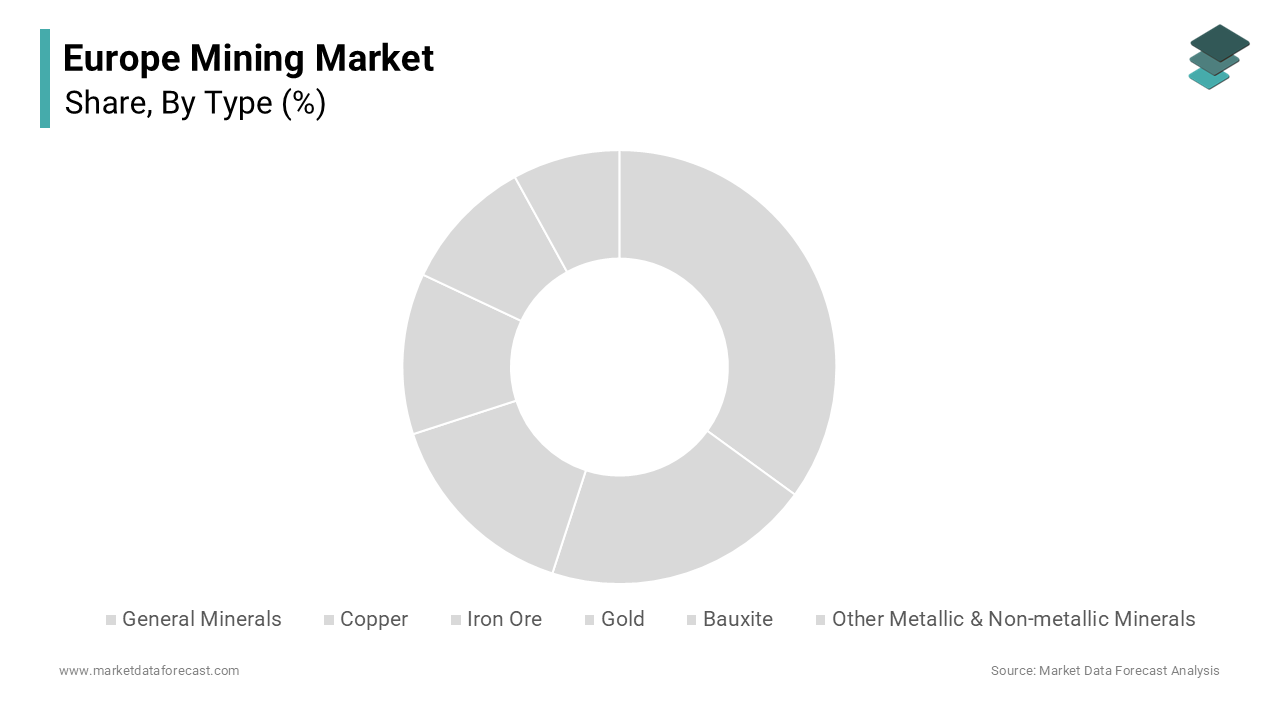
- Based on type, the general minerals segment was the largest and held 36.3% of the Europe mining market share in 2025. The dominance of this segment is attributed to consistent demand for industrial minerals such as limestone, potash, and aggregates used in construction, agriculture, and chemical manufacturing across European economies.
- Based on process, the surface mining segment accounted for 60.2% of the Europe mining market share in 2025. The segment’s leadership is driven by cost efficiency, scalability, and suitability for large-volume extraction of aggregates and industrial minerals through quarrying and open-pit operations.
- Based on service provider, the integrated mining segment occupied a prominent share of the Europe mining market in 2025. The dominance of this segment stems from vertically integrated operations covering exploration, extraction, processing, and environmental compliance, enabling greater efficiency and regulatory alignment.
Regional Insights
The Europe mining market demonstrates strong regional specialization supported by geological endowment, policy frameworks, and sustainability-driven innovation.
- Sweden was the largest contributor, accounting for 23.3% of the Europe mining market share in 2025, driven by extensive iron ore production, rare earth deposits, and renewable energy-powered mining operations.
- Finland ranked second with a significant share in 2025, supported by leadership in battery metals including lithium, nickel, and cobalt alongside advanced biohydrometallurgical processing technologies.
- Germany continues to hold a prominent position, fueled by potash and salt extraction, urban mining leadership, and emerging lithium brine exploration initiatives.
- Poland is emerging as a key market driven by large copper and silver reserves and ongoing diversification toward critical mineral recovery from tailings.
- Spain is also strengthening its role, supported by diversified base metal production, emerging lithium projects, and strategic policy reforms aimed at accelerating critical raw material development.
Competitive Landscape
The Europe mining market is characterized by the presence of established regional mining leaders and strategic mineral developers operating under strict regulatory and social oversight. Leading companies are focusing on decarbonization of mining operations, circular resource recovery, digital monitoring technologies, and strategic partnerships with downstream battery and green steel industries. Sustainability credentials, community engagement, and regulatory compliance are increasingly shaping competitive differentiation alongside production capabilities. Prominent players in the Europe mining market include Glencore plc, Rio Tinto Group, Anglo American plc, ArcelorMittal, LKAB (Luossavaara-Kiirunavaara AB), Boliden AB, K+S Aktiengesellschaft, Heidelberg Materials AG, Ferrexpo plc, and Eramet Group.
Europe Mining Market Size
The Europe mining market size was valued at USD 0.594 trillion in 2025 and is anticipated to reach USD 0.635 trillion in 2026 from USD 1.84 trillion by 2034, growing at a CAGR of 6.90% during the forecast period from 2026 to 2034.
Mining is the extraction processing and initial beneficiation of metallic minerals, industrial minerals and construction aggregates across the continent’s geologically diverse terrain. Unlike commodity driven mining regions elsewhere, European operations are tightly governed by environmental permitting social license requirements and circular economy mandates that prioritize resource efficiency over volume. The sector operates within the framework of the European Green Deal and the Critical Raw Materials Act which designate 34 minerals including lithium cobalt graphite and rare earths as essential for clean energy defense and digital technologies. According to Eurostat, the EU extracted a large volume of non-energy minerals in 2024, with aggregates making up the majority of total tonnage. As per the European Environment Agency, mining activities occupy only a small fraction of the EU’s land area, yet they face scrutiny due to water usage, biodiversity impact, and legacy pollution from historical operations. According to the Common Agricultural Policy, mineral exploration is restricted in protected rural zones, and as per the Water Framework Directive, strict limits are imposed on groundwater abstraction and discharge quality. This positions European mining not as a bulk extraction industry but as a strategic enabler of raw material sovereignty where sustainability, innovation, and community engagement define operational viability.
MARKET DRIVERS
EU Critical Raw Materials Act Accelerates Strategic Mineral Extraction
The EU Critical Raw Materials Act has become a pivotal driver of mining activity by mandating domestic sourcing targets for minerals essential to the green and digital transitions, which is primarily driving the growth of the European mining market. The legislation requires that by 2030 the EU extract a share of its annual consumption of critical raw materials including lithium, cobalt, and rare earth elements from within its borders. According to the European Commission, Europe currently imports the majority of its rare earths and lithium primarily from China and Chile, creating strategic vulnerabilities. In response, Finland has fast tracked permits for the Keliber lithium project, and Sweden’s LKAB received approval to develop Europe’s largest rare earth deposit at Per Geijer. As per the European Investment Bank, funding was allocated in 2024 to support these projects under the Innovation Fund. This policy driven push transforms previously marginal deposits into economically viable assets ensuring that mining aligns with industrial autonomy rather than global commodity cycles.
Urban Mining and Construction Waste Recycling Drive Aggregate Demand
The expansion of urban mining has emerged as a major demand driver for secondary aggregates in Europe, which is further boosting the expansion of mining market in Europe. According to the EU Construction and Demolition Waste Management Protocol, member states must recycle a significant share of non-hazardous C&D waste by weight. According to Eurostat, construction waste was generated in the EU in 2024, with the majority originating from building demolition and renovation. Countries like Germany and the Netherlands now mandate that public infrastructure projects use recycled aggregates in road bases and concrete mixes. As per the German Federal Environment Agency, recycled aggregates accounted for a growing share of total aggregate consumption in 2024 compared to earlier years. Similarly, France’s Anti Waste Law requires all demolition contractors to sort materials on site enabling high purity recovery of concrete and asphalt. This shift reduces pressure on virgin quarrying, preserves natural landscapes, and lowers transportation emissions. As cities densify and brownfield redevelopment accelerates, urban mining becomes a cornerstone of circular material flows in the European built environment.
MARKET RESTRAINTS
Stringent Environmental Permitting Delays Project Timelines
The European mining market faces prolonged development cycles due to exhaustive environmental impact assessments and multi-layer permitting processes required under the Environmental Impact Assessment Directive and Habitats Directive. According to the European Commission, the average time to obtain a mining permit in the EU exceeds that of countries such as Canada or Australia. In Portugal, the Barroso lithium project faced numerous public consultations and legal challenges before receiving conditional approval in 2024. Similarly, Finland’s Terrafame nickel mine underwent multiple permitting stages involving water boards, regional councils, and the Sami Parliament. The European Court of Justice has reinforced strict interpretation of Natura 2000 protections, making exploration near protected habitats nearly impossible. As per the European Environmental Bureau, a significant share of proposed mining projects in Western Europe have been delayed or canceled since 2020 due to biodiversity concerns or groundwater risks. This regulatory caution while ecologically justified creates significant uncertainty for investors and impedes timely supply of critical minerals needed for the energy transition.
Public Opposition and Social License Constraints Limit Site Development
Community resistance to new mining projects remains a formidable restraint across Europe driven by concerns over water contamination landscape degradation and long-term health impacts. According to the European Social Survey, a majority of EU citizens oppose new mines within a certain distance of their residence even when linked to clean energy supply chains. In Serbia, the Rio Tinto Jadar lithium project was suspended indefinitely in 2022 following nationwide protests over fears of Danube River pollution. Similarly, in Spain, local opposition in Extremadura blocked a rare earth exploration license despite national strategic interest. The Aarhus Convention guarantees public participation in environmental decisions, enabling grassroots groups to initiate legal reviews that stall projects for years. As per the European Network of Ombudsmen for the Environment, mining companies now spend extended periods on stakeholder engagement before submitting formal applications. Without early and transparent dialogue addressing cultural heritage, water rights, and post closure land use plans, projects face reputational damage and political backlash that override economic or strategic rationale.
MARKET OPPORTUNITIES
Revitalization of Legacy Mines Through Battery Metal Reprocessing
The reprocessing of historical mine tailings and slag heaps presents a significant opportunity for the European mining market. According to the Geological Survey of Finland, many abandoned sites from Europe’s industrial past contain recoverable grades of cobalt, nickel, and rare earths that were previously deemed uneconomical. In Sweden, Boliden is piloting hydrometallurgical recovery of copper and zinc from century-old tailings at its Rönnskär smelter. As per the European Institute of Innovation and Technology, the CROCODILE project demonstrated recovery of cobalt from Belgian slag using bioleaching techniques. According to the EU’s Urban Mine Platform, thousands of legacy sites across the bloc have been mapped, with several identified as having high potential for critical metal extraction. By leveraging existing infrastructure and avoiding new land disturbance, these projects align with circular economy principles while mitigating historical environmental liabilities.
Development of Deep-Sea Polymetallic Nodule Exploration in Nordic Waters
Emerging deep sea mining initiatives in Europe’s exclusive economic zones offer a frontier opportunity for the European mining market. According to the Norwegian Petroleum Directorate, deposits in Norway’s North Sea seabed could supply a significant share of the EU’s cobalt demand in the coming decades. As per the European Marine Board, deep sea nodules contain higher metal concentrations than land-based ores, reducing processing energy. The Norwegian government mandates that all licensees fund independent ecosystem monitoring and adhere to a zero-discharge policy. According to the EU’s Blue Economy Strategy, such initiatives are supported through Horizon Europe grants for low impact extraction technologies. If regulated responsibly, deep sea resources could diversify Europe’s critical mineral portfolio while minimizing surface disruption.
MARKET CHALLENGES
Fragmented National Mining Codes Undermine EU-Wide Investment Cohesion
Despite the Critical Raw Materials Act, Europe lacks a harmonized legal framework for mineral exploration creating investor uncertainty and administrative inefficiency, which is a major challenge to the European mining market growth. According to the European Federation of Geologists, permitting criteria for groundwater protection vary significantly between member states, while royalty rates differ widely across Europe. As per the European Commission’s 2024 review of national transposition, only a portion of EU countries had fully aligned their mining laws with the Critical Raw Materials Act’s strategic project designation process. Consequently, companies must navigate multiple regulatory regimes for a single mineral value chain. According to the European Business Association, this fragmentation increases legal costs considerably. Without legislative convergence, Europe’s ambition for raw material sovereignty will remain hampered by internal barriers.
High Energy and Water Intensity Conflicts With Green Transition Goals
Conventional mining operations in Europe face growing tension between resource extraction and environmental sustainability due to their substantial energy and water demands. According to the International Energy Agency, hard rock lithium mining consumes large amounts of electricity per ton of lithium carbonate equivalent. As per the European Environment Agency, copper extraction requires high volumes of water per ton of concentrate. In water-stressed regions like southern Spain and Portugal, these demands conflict with agricultural and municipal needs during droughts. According to the EU Taxonomy for Sustainable Activities, most primary mining is excluded from green investment eligibility unless stringent thresholds for renewable energy use and water recycling are met. As a result, projects such as the Portuguese Barroso lithium mine must commit to renewable power and closed loop water systems to secure financing. This dual pressure forces operators to invest heavily in technologies that raise capital costs and delay commercial production despite strategic importance.
REPORT COVERAGE
| REPORT METRIC | DETAILS |
| Market Size Available | 2025 to 2034 |
| Base Year | 2025 |
| Forecast Period | 2026 to 2034 |
| CAGR | 6.90% |
| Segments Covered | By Type, Process, Service Provider and Region |
| Various Analyses Covered | Regional & Country Level Analysis, Segment-Level Analysis, DROC, PESTLE Analysis, Porter’s Five Forces Analysis, Competitive Landscape, Analyst Overview on Investment Opportunities |
| Countries Covered | UK, France, Spain, Germany, Italy, Russia, Sweden, Denmark, Switzerland, the Netherlands, Turkey, the Czech Republic, and the Rest of Europe. |
| Market Leaders Profiled | Glencore plc, Rio Tinto Group, Anglo American plc, ArcelorMittal, LKAB (Luossavaara-Kiirunavaara AB), Boliden AB, K+S Aktiengesellschaft, Heidelberg Materials AG, Ferrexpo plc, and Eramet Group. |
SEGMENTAL ANALYSIS
By Type Insights
The general minerals segment dominated the European mining market by holding 36.3% of the regional market share in 2025. The growth of the general minerals segment in the European market is driven by their foundational role in construction, agriculture, and chemical manufacturing. These materials are essential for cement production, road base aggregates, and fertilizer blending across the continent’s 27 member states. According to Eurostat, the EU extracted a large volume of industrial minerals in 2024, with Germany, France, and Poland leading production. As per the European Cement Association, cement production required significant quantities of limestone and clay as primary inputs. Similarly, the European Fertilizer Manufacturers Association confirmed that potash is applied to EU farmland annually, sourced largely from German and Polish mines. Unlike metallic ores, general minerals benefit from established permitting pathways, shorter environmental review cycles, and proximity to end users, reducing transport emissions. Their non-strategic yet indispensable nature ensures consistent demand insulated from geopolitical volatility, making them the bedrock of Europe’s domestic mining activity.
The copper segment is a promising segment and is estimated to register a CAGR of 10.6% over the forecast period. The growing demand for electrical conductivity in renewable energy grids, electric vehicles, and data infrastructure is majorly propelling the copper segment in the European market. According to the International Energy Agency, Europe will require a significantly higher volume of copper annually by 2030 to meet its clean energy targets. Sweden’s Boliden Aitik mine expanded output in 2024 to supply Volvo and Northvolt with low carbon copper. Similarly, Finland’s Terrafame increased copper cathode production using bioleaching technology powered by renewable energy. The European Critical Raw Materials Act designates copper as a strategic material and fast tracks permitting for projects with verified recycling integration. As per the European Copper Institute, every megawatt of offshore wind capacity requires 4.3 tons of copper, while each electric vehicle uses 80 kilograms, more than triple that of combustion engines. This structural linkage to decarbonization ensures sustained investment despite high extraction costs.
By Process Insights
The surface mining segment led the market by capturing 60.2% of the European market share in 2025. The dominance of surface mining segment in the European market can be credited to its cost efficiency, scalability, and suitability for large low-grade deposits of aggregates, industrial minerals, and lignite. Open pit and quarrying methods dominate because they allow high volume extraction with lower capital intensity compared to underground operations. According to the European Aggregates Association, the majority of construction aggregates in 2024 were sourced via surface methods, primarily in Germany, Spain, and France. Lignite for power generation in Germany and Poland also relies on massive open cast mines such as Garzweiler and Belchatow. As per the European Environment Agency, surface mines benefit from clearer environmental monitoring protocols and easier rehabilitation planning under the Extractive Waste Directive. Additionally, modern GPS guided equipment enables precise contouring that minimizes landscape disruption. This operational and regulatory alignment ensures surface mining remains the default method for bulk mineral extraction across the continent.
The underground mining segment is the fastest growing segment in the Europe mining market and is estimated to register a CAGR of 8.12% over the forecast period. The growth of the underground mining segment in this regional market is likely to be driven by the rising need to access high grade metallic ores, particularly copper, nickel, and lithium that located deep beneath protected or urbanized landscapes where surface excavation is prohibited. According to the Geological Survey of Sweden, most of the country’s new critical mineral projects utilize sublevel caving or block caving methods to minimize surface footprint. Boliden’s Kankberg gold and polymetallic mine operates deep below ground with zero surface waste storage using backfill from processed tailings. Similarly, Finland’s Ylivieska lithium project employs mechanized cut and fill techniques to extract spodumene from narrow veins under forested terrain. The EU Critical Raw Materials Act incentivizes underground development by classifying it as low impact when land use change is avoided. As per the European Federation of Geologists, underground operations reduce water consumption by 40% and eliminate dust emissions, making them increasingly favored in ecologically sensitive regions.
By Service Provider Insights
The integrated mining segment led the market by occupying a share of 70.6% of the regional market share in 2025. The vertical control over exploration, extraction, processing, and compliance management. Major players like Boliden, LKAB, Heidelberg Materials and K+S operate end to end value chains ensuring quality consistency, regulatory adherence, and long-term resource planning are propelling the dominating position of integrated mining segment in the European market. According to the European Commission, most critical raw material projects are led by established mining firms that possess historical land rights, geological data, and community relationships essential for permitting success. These companies invest heavily in decarbonization, with Boliden’s Aitik mine running on 100% hydropower and LKAB aiming for fossil free pellet production by 2026. Their scale enables deployment of advanced technologies such as autonomous haulage and real time geotechnical monitoring that smaller contractors cannot afford. Additionally, integrated operators bear full responsibility for mine closure and site rehabilitation under the EU Environmental Liability Directive, reinforcing trust with regulators and local communities. This holistic ownership model remains dominant in a risk averse regulatory environment.
The independent contractors segment is the fastest growing segment in the Europe mining market and is predicted to record a CAGR of 12.5% over the forecast period owing to the trend toward asset light models where mining companies outsource specialized services such as drilling, blasting, surveying, and environmental monitoring to agile third parties. According to the European Federation of Geologists, a majority of exploration programs in 2024 were executed by independent firms leveraging drone-based LiDAR and AI powered mineralogy analysis. Companies like Boart Longyear and Epiroc provide battery electric drill rigs that reduce emissions by 90% compared to diesel units, aligning with EU Green Deal requirements. The rise of critical mineral startups lacking in house operational teams further fuels demand for turnkey service providers. National mining agencies in Portugal and Serbia now maintain pre-qualified contractor lists to accelerate project execution. This specialization enables faster deployment, lower capital risk, and access to cutting edge equipment without long term ownership burdens.
REGIONAL ANALYSIS
Sweden Mining Market Analysis
Sweden led the mining market in Europe with 23.3% of the regional market share in 2025. The leading position of Sweden in the European market is driven by its vast reserves of iron ore, base metals, and rare earth elements. The country is home to LKAB, the EU’s largest iron ore producer, extracting millions of tons annually from underground mines in Kiruna and Malmberget. According to the Swedish Geological Survey, Sweden hosts a significant portion of Europe’s known rare earth resources, including the Per Geijer deposit. The government’s Mineral Strategy prioritizes critical raw materials with fast track permitting for projects aligned with battery and magnet supply chains. Boliden operates polymetallic smelters powered entirely by renewable energy, producing copper, zinc, and gold with carbon footprints well below global averages. Additionally, Sweden mandates that all new mines submit circular economy plans detailing water recycling and tailings reuse. This blend of geological wealth, policy foresight, and green metallurgy solidifies Sweden’s dominance.
Finland Mining Market Analysis
Finland captured the second largest share of the European mining market in 2025 due to its leadership in battery metal production, sustainable extraction technologies and Finland being Europe’s only operating lithium mine at Keliber and major nickel cobalt operations at Terrafame that uses biohydrometallurgy to recover metals from black shale. According to the Geological Survey of Finland, the nation possesses a substantial share of the EU’s nickel and cobalt reserves. The Ministry of Employment and the Economy allocated funding in 2024 to support critical mineral projects under the National Battery Strategy. Finnish mines benefit from abundant hydropower and strict environmental standards, with most process water recycled onsite. Outokumpu’s Tornio stainless steel complex integrates nickel matte directly from nearby mines, reducing transport emissions. Finland’s combination of geological endowment, clean energy, and innovation in low impact processing positions it as a cornerstone of Europe’s battery value chain.
Germany Mining Market Analysis
Germany is expected to hold a prominent share of the European mining market during the forecast period. The extensive potash and salt extraction as well as growing interest in urban mining and Germany being produce millions of tons of potash annually from deep mines in Thuringia and Lower Saxony that supply a significant portion of EU fertilizer demand are driving the German market growth. K+S operates the world’s largest potash mine at Zielitz using solution mining techniques that minimize surface disruption. Germany also leads in construction mineral recycling, with the Federal Environment Agency reporting high reuse rates of demolition concrete as aggregate. The Federal Institute for Geosciences and Natural Resources recently identified lithium brine potential in the Upper Rhine Graben, prompting pilot extraction projects. While traditional hard rock mining is limited by dense population and strict zoning laws, Germany’s focus on circularity and strategic brine resources ensures continued relevance in the evolving raw materials landscape.
Poland Mining Market Analysis
Poland is estimated to register a promising CAGR in the European mining market over the forecast period. The massive copper, silver, and lignite reserves is majorly contributing to the mining market growth in Poland. KGHM Polska Miedź operates one of the world’s largest copper mines in Lubin, producing millions of tons of ore annually and yielding silver as a byproduct. According to the Polish Geological Institute, the Legnica Glogow Copper District holds vast ore reserves with notable copper grades. Despite EU pressure to phase out coal, Poland still extracts lignite yearly for power generation, though new investments focus on critical minerals. The government’s Raw Materials Policy 2040 allocates funding to explore cobalt and rare earths in copper tailings. Additionally, Poland mandates that all mining companies fund regional development programs, creating strong social license. This dual focus on legacy commodities and strategic repurposing sustains Poland’s significant role in the European raw materials ecosystem.
Spain Mining Market Analysis
Spain is projected to account for a notable share of the European mining market over the forecast period owing to its diverse geology spanning Iberian pyrite belts and Catalan potash basins. Spain is Europe’s largest producer of copper, lead, and zinc with mines in the Portugal border region yielding large volumes of copper concentrate annually, which is also favouring the mining market growth in Spain. According to the Spanish Geological Survey, Spain possesses identified lithium resources in Extremadura and Galicia, though development faces public opposition. The Ministry for Ecological Transition enforces strict water recycling rules, with mines required to achieve high reuse rates. Spain also leads in marine sand extraction for coastal restoration, with millions of cubic meters dredged in 2024 under EU habitat protection waivers. Recent reforms under the National Critical Raw Materials Strategy aim to streamline permitting for strategic projects while enhancing community benefit sharing. Spain’s mix of established base metal production and emerging critical mineral potential positions it as a key southern European supplier.
COMPETITIVE LANDSCAPE
The Europe mining market features concentrated competition among established national champions and emerging critical mineral developers operating under intense regulatory and social scrutiny. Incumbents like Boliden LKAB and KGHM dominate due to historical land rights integrated processing infrastructure and strong government ties enabling access to capital and expedited permitting. New entrants face high barriers including seven-year average approval timelines stringent water and biodiversity rules and community opposition even for strategic projects. Competition is increasingly defined by sustainability credentials rather than extraction volume with low carbon intensity circular integration and community benefit sharing becoming decisive factors. While global miners have limited presence due to sovereignty concerns European firms collaborate closely with downstream industries to form end to end value chains for batteries and green steel. This ecosystem driven rivalry fosters innovation but demands continuous investment in both environmental stewardship and technological advancement to maintain legitimacy and operational continuity.
KEY MARKET PLAYERS
Some of the companies that are playing a dominating role in the Europe Mining Market include
- Glencore plc
- Rio Tinto Group
- Anglo American plc
- ArcelorMittal
- LKAB (Luossavaara-Kiirunavaara AB)
- Boliden AB
- K+S Aktiengesellschaft
- Heidelberg Materials AG
- Ferrexpo plc
- Eramet Group
Top Players in the Europe Mining Market
Boliden AB
Boliden AB is a Swedish mining and smelting company with a commanding presence across Northern Europe operating polymetallic mines in Sweden and Finland that produce copper zinc lead gold and silver. The company contributes globally by supplying low carbon metals to electric vehicle and renewable energy manufacturers with its Aitik mine powered entirely by hydropower. Boliden’s Kankberg underground mine uses fossil free equipment and backfill technology to minimize surface impact. Recently the company expanded its Rönnskär smelter to recover critical metals from electronic waste and battery black mass aligning with EU circular economy mandates. It also launched a digital twin platform for real time geotechnical monitoring enhancing safety and efficiency across its operations reinforcing its leadership in sustainable and technologically advanced mining.
LKAB
LKAB is a state-owned Swedish enterprise and Europe’s largest iron ore producer operating deep underground mines in Kiruna and Malmberget. The company plays a pivotal role in the global green steel transition through its HYBRIT initiative which produces fossil free sponge iron using hydrogen instead of coal. LKAB also holds vast rare earth element deposits at Per Geijer containing neodymium and praseodymium essential for permanent magnets in wind turbines and electric motors. In recent actions LKAB received government approval to develop this deposit and partnered with Northvolt and Sandvik to create a fully European battery value chain. These moves position LKAB not only as a traditional miner but as a strategic enabler of Europe’s clean industrial future.
KGHM Polska Miedź S A
KGHM Polska Miedź S A is a Polish multinational and one of the world’s top copper and silver producers operating mines in Poland Germany and Chile. In Europe KGHM extracts over 30 million tons of copper ore annually from the Legnica Glogow Copper District while yielding significant silver as a byproduct. The company contributes globally by supplying refined copper cathodes to semiconductor and electrification markets. Recently KGHM launched its “Zero Harm” sustainability program targeting carbon neutrality by 2050 and invested in pilot projects to extract cobalt and rare earths from historic tailings. It also signed long term offtake agreements with European battery makers ensuring domestic supply of critical conductive materials and strengthening its role in strategic raw material security.
Top Strategies Used by the Key Market Participants
Key players in the Europe mining market prioritize decarbonization by transitioning to renewable energy sources and deploying battery electric or hydrogen powered mining equipment. They invest heavily in circular economy initiatives such as reprocessing legacy tailings and recovering critical metals from electronic waste. Companies actively pursue fast track permitting under the EU Critical Raw Materials Act by aligning projects with strategic autonomy goals. Strategic partnerships with battery automakers and green steel producers secure long term offtake agreements and validate social license. Additionally, firms implement advanced digital monitoring systems including digital twins and autonomous haulage to enhance safety resource efficiency and regulatory compliance in environmentally sensitive regions.
MARKET SEGMENTATION
This research report on the Europe Mining Market has been segmented and sub-segmented based on the following categories.
By Type
- General Minerals
- Copper
- Iron Ore
- Gold
- Bauxite
- Other Metallic & Non-metallic Minerals
By Process
- Surface Mining
- Underground Mining
By Service Provider
- Integrated Mining
- Independent Contractors
By Country
- UK
- France
- Spain
- Germany
- Italy
- Russia
- Sweden
- Denmark
- Switzerland
- Netherlands
- Turkey
- Czech Republic
- Rest of Europe