- Product Description Description
- Table of Contents TOC
- List of Table & Figure LOT
- Get Free Sample PDF Sample PDF
Market Size, 2025
$73.85 BnMarket Estimate, 2026
$79.98 BnMarket Forecast, 2034
$151.31 BnCAGR, 2026–2034
8.30%Europe Mobile Accessories Market Report Summary
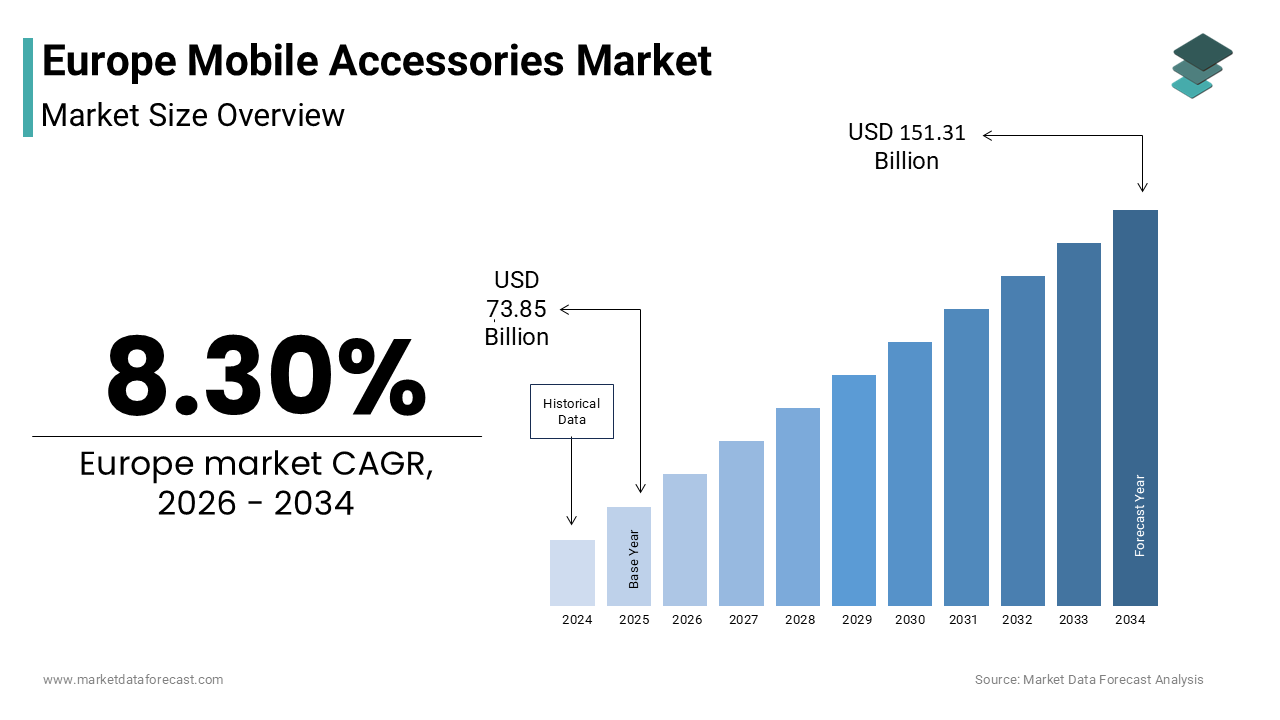
The Europe mobile accessories market was valued at USD 73.85 billion in 2025, is estimated to reach USD 79.98 billion in 2026, and is projected to reach USD 151.31 billion by 2034, growing at a CAGR of 8.30% during the forecast period from 2026 to 2034. The growth of the Europe mobile accessories market is driven by increasing smartphone dependency, rising environmental awareness, and regulatory shifts toward standardized charging and sustainable electronics. Consumers across Europe are extending the lifespan of their smartphones due to economic pressures and climate-conscious purchasing behavior, which is accelerating demand for protective, performance-enhancing, and repair-friendly accessories. The implementation of the EU Common Charger Directive and evolving sustainability frameworks encouraging repairability and durability are reshaping product design and replacement cycles. Moreover, the market is transitioning from disposable add-ons toward durable, eco-friendly, and multifunctional accessories integrated into Europe’s regulated digital ecosystem.
Key Market Trends
-
Rising adoption of durable protective accessories as European consumers keep smartphones longer to reduce environmental impact.
-
Rapid transition toward USB Type-C charging solutions following EU regulatory harmonization and universal charger mandates.
-
Increasing demand for premium sustainable accessories made from recycled or bio-based materials.
-
Growth of smart and multifunctional accessories integrating health tracking, contactless payments, and advanced connectivity features.
-
Expansion of circular business models such as accessory leasing, refurbishment, and take-back programs aligned with EU sustainability policies.
Segmental Insights
- Based on price range, the medium price segment was the largest and held a significant share of the Europe mobile accessories market in 2025. The segment’s dominance is attributed to its balance between affordability, durability, and compliance with European safety and sustainability standards, appealing to mainstream consumers.
- Based on product type, the protective cases segment accounted for the largest share of the Europe mobile accessories market in 2025. The growth of this segment is driven by longer smartphone lifecycles, increasing awareness of device protection, and strong demand for repair-supportive accessories.
- Based on distribution channel, the online retail segment was the largest, occupying a prominent share of the Europe mobile accessories market in 2025. The dominance of this segment stems from extensive product variety, competitive pricing, cross-border e-commerce access, and growing consumer trust supported by EU digital commerce regulations.
Regional Insights
The Europe mobile accessories market is experiencing steady growth across major economies, supported by evolving sustainability regulations, high smartphone penetration, and expanding digital lifestyles.
- Germany remains a key contributor, driven by strong environmental policies, repair incentives, and widespread adoption of certified protective accessories.
- France and the United Kingdom continue to show significant growth due to rising demand for standardized USB Type-C accessories, strong telecom operator partnerships, and growing awareness of eco-friendly electronics.
- Nordic countries are emerging as leaders in premium sustainable accessories, fueled by high environmental consciousness and consumer willingness to invest in durable products.
- Italy and Spain are witnessing steady expansion supported by increasing e-commerce adoption, rising smartphone usage, and growing demand for mid-range accessories that combine affordability with functionality.
Competitive Landscape
The Europe mobile accessories market is characterized by intense competition among original equipment manufacturers, specialized third-party brands, and value-focused generic suppliers. Leading companies are focusing on regulatory compliance, sustainable material innovation, and ecosystem integration to strengthen brand trust and differentiation. Strategic bundling with telecom operators, expansion of circular business models, and investments in smart accessory technologies are shaping competitive dynamics. Prominent players in the Europe mobile accessories market include Samsung Electronics Co., Ltd., Apple Inc., Xiaomi Corporation, Sony Corporation, Huawei Technologies Co., Ltd., Koninklijke Philips N.V., Panasonic Corporation, Belkin International, Inc., Anker Innovations Limited, ZAGG Inc., Spigen, Inc., Otter Products LLC, Skullcandy Inc., Case-Mate Inc., AUKEY Online, and INCIPIO Group.
Europe Mobile Accessories Market Size
The europe mobile accessories market size was valued at USD 73.85 billion in 2025 and is anticipated to reach USD 79.98 billion in 2026 from USD 151.31 billion by 2034, growing at a CAGR of 8.30% during the forecast period from 2026 to 2034
Mobile accessories are supplementary hardware products that are not essential for a mobile phone's basic operation but are used to enhance its functionality, protection, and personalization. This market operates at the intersection of consumer electronics, sustainability policy, and digital lifestyle trends. Most European adults now rely on mobile devices for daily connectivity, while financial pressures and environmental awareness are prompting consumers to keep their existing handsets for significantly longer periods than in previous years. Concurrently, the European Union faces a growing challenge with discarded electronics as the volume of new devices entering the market continues to outpace the amount of waste being successfully collected and recycled. European regulations have established a universal charging standard for portable electronics, forcing a standardized shift in hardware design to reduce consumer inconvenience and minimize redundant accessories. Furthermore, new sustainability frameworks now require brands to provide clear information on how easily their products can be fixed and the availability of components, pushing the industry toward more durable and maintainable device designs. In this context, the market is evolving from disposable add-ons to integrated, durable, and repairable components of a regulated digital ecosystem.
MARKET DRIVERS
Rising Environmental Awareness and Repair Culture Supporting Mobile Accessories Adoption in Europe
Rising economic pressures and environmental awareness are causing European consumers to hold onto their smartphones longer, which accelerates the growth of the Europe mobile accessories market. This shift is driving a surge in demand for accessories that boost protection and performance. The European Environment Agency (EEA) emphasized that the average smartphone lifespan in the EU grew from 3 years and 10 months (46 months) in 2019 to 4 years and 8 months (56 months) in 2023. This trend increases reliance on cases screen protectors and battery cases to maintain device integrity. A vast majority of mobile phone owners now prefer to service damaged components like screens or power cells rather than replacing the entire device, often utilizing protective gear to extend the hardware's functional life. Governments in several European countries have implemented financial incentives to lower the cost of fixing electronics, which has promoted a broader culture of maintaining existing devices and utilizing supplemental protective tools. Additionally, modular accessories like lens attachments and external storage expand functionality without requiring device upgrades. Environmental advocacy groups emphasize that using a single mobile device for several additional years drastically lowers personal carbon emissions, framing the maintenance of older hardware as a meaningful contribution to climate goals. This behavioral shift transforms accessories from aesthetic choices into essential tools for device longevity and circular consumption.
Regulatory Harmonization Through the EU Common Charger Directive
The European Union’s mandate for a universal USB Type C charging port across all small electronic devices by December 2024 serves as a powerful structural driver for accessory innovation and replacement cycles, which propels the expansion of the Europe mobile accessories market. As per the European Commission, the directive will apply to smartphones tablets cameras and handheld gaming consoles, affecting over 420 million devices annually. This regulation renders legacy Lightning and Micro USB cables obsolete, compelling consumers to repurchase compatible chargers and cables. The European Parliament estimates that the measure will save consumers 250 million euros yearly while reducing e waste by 11 000 tonnes annually. However, the transition period has triggered a surge in Type C accessory sales. Research indicates a substantial surge in the adoption of USB Type-C technology, resulting in dramatically higher shipments of these cables across EU retail channels as manufacturers align with upcoming standards. Manufacturers are also introducing multi-protocol hubs and magnetic adapters to ease compatibility, creating premium sub segments. Crucially, the directive includes power delivery standards ensuring fast charging interoperability, which drives demand for certified high wattage chargers. This regulatory intervention not only standardizes hardware but actively reshapes consumer purchasing behavior and product development roadmaps across the accessory landscape.
MARKET RESTRAINTS
E Waste Concerns and Regulatory Scrutiny on Disposable Accessories
Growing environmental awareness and stringent EU regulations are restraining the sale of low quality single use mobile accessories. These concerns are hampering the growth of the Europe mobile accessories market. The volume of discarded mobile phone accessories contributes to a growing waste management challenge, with new regulations requiring increased component availability and material transparency. These changes affect the economic viability of low-cost accessories, while concerns over product longevity prompt discussions on better consumer information. Additionally, legislation now restricts the disposal of unsold goods, forcing more sustainable inventory management. These measures discourage mass production of disposable accessories and penalize brands lacking take back programs. As a result, many small online sellers have exited the market, while established players face higher compliance costs. This regulatory pressure suppresses volume growth in the low end segment and shifts competition toward longevity and serviceability.
Over Saturation of Low Differentiation Products in Online Channels
The proliferation of generic, undifferentiated mobile accessories on e commerce platforms has intensified price competition and eroded brand value across the Europe mobile accessories market. Many third-party electronic accessories sold through major online marketplaces fail to meet mandatory European safety standards and often lack authentic compliance documentation. This flood of look alike products, often differing only in color or packaging, confuses consumers and compresses margins. Investigations into electronic accessories reveal that popular, low-cost power banks sold online consistently fail to deliver their advertised charging capacity. The absence of mandatory performance labeling under current EU rules allows misleading marketing, such as “fast charging” claims without wattage disclosure. Consequently, trust in online accessory purchases remains low. Due to high failure rates of third-party accessories, a significant segment of consumers is hesitant to purchase electronic components online without prior hands-on verification. This commoditization discourages innovation in mid tier segments and pushes manufacturers toward either ultra premium or ultra cheap positioning, fragmenting the market and undermining sustainable business models.
MARKET OPPORTUNITIES
Integration of Smart and Health Monitoring Features
The embedding of intelligent functionalities, such as biometric sensors, wireless power sharing, and environmental feedback into mobile accessories opens new avenues in the European mobile accessories market. Consumers in certain regions are increasingly incorporating health-focused features into their personal technology, leading to higher demand for multifunctional accessories. Newer accessories, such as wearable rings and bands, often monitor physiological metrics, making the distinction between lifestyle tech and medical devices less clear. Mobile accessories now frequently integrate advanced features like contactless payment capabilities and location tracking, particularly in metropolitan areas. Upcoming regulatory initiatives are expected to mandate that smart accessory manufacturers provide greater transparency regarding data practices and security measures. Specific regional programs are exploring financial incentives for accessories that improve device longevity or decrease energy usage. This shift to active, health-focused tools enables premium pricing models while reinforcing Europe's digital well-being agenda.
Circular Business Models and Accessory-as-a-Service Platforms
Emerging subscription and leasing models for high end mobile accessories offer a strategic opportunity to align with EU circular economy mandates while generating recurring revenue, which is anticipated to fuel the expansion of the Europe mobile accessories market. Companies like Fairphone and Back Market are piloting “accessory bundles” that include premium cases chargers and earbuds leased alongside refurbished phones, with monthly fees covering upgrades and repairs. Circular business models are increasingly recognized as a mechanism to improve product utilization rates and reduce reliance on raw material consumption. Regulatory frameworks are emerging that offer financial incentives to companies implementing take-back or reuse programs, encouraging accessory brands to adopt return schemes. Retailers are testing circular initiatives by providing store credit for worn goods, which fosters closed-loop material recovery and extends product lifecycles. Institutional funding is being directed toward supporting companies that focus on modular, repairable designs for accessory products. These service-based strategies align with the shift towards sustainability by treating accessories as, long-term, manageable, assets rather than, disposable items.
MARKET CHALLENGES
Counterfeit and Non Compliant Products Undermining Safety Standards
The influx of uncertified and counterfeit mobile accessories poses a persistent challenge to market integrity and consumer safety. This issue impedes the growth of the Europe mobile accessories market. Counterfeit mobile accessories, particularly chargers and power banks, constitute a notable portion of items intercepted at European borders and frequently lack required safety protections. Reports highlight dangerous accessories that pose risks such as overheating lithium batteries and electric shocks due to poor insulation. These hazardous products sometimes enter the market by utilizing logistics loopholes or mislabeling goods to bypass mandatory safety certifications. National market surveillance remains fragmented. This inconsistency allows hazardous goods to circulate widely, damaging consumer trust in legitimate brands. The EU must implement centralized, harmonized, and pre-import, safety-focused regulations to encourage innovation and quality investments, which are currently deterred by risks.
Lack of Standardized Performance and Durability Metrics
The absence of mandatory EU-wide labeling for key accessory attributes, such as cable data transfer speed, case drop protection rating, or power bank actual capacity, creates information asymmetry that hinders informed purchasing, fair competition, and the expansion of the Europe mobile accessories market. Many mobile accessories marketed online lack verified testing data and rely on subjective, vague descriptions. Advertised durability claims for protective cases frequently do not align with results from standardized testing scenarios. This lack of transparency makes it difficult for consumers to distinguish between manufacturers that invest in certified testing and those that use marketing to imply quality. While future regulations aim to address repairability, current standards do not mandate performance transparency for accessories. Efforts to establish technical standards for cable interoperability exist, but their adoption across the industry is not yet mandatory. The absence of mandatory standards for durability, efficiency, and safety prevents consumers from making informed comparisons, thereby hindering the market's transition toward sustainability and high-quality products
REPORT COVERAGE
| REPORT METRIC | DETAILS |
| Market Size Available | 2025 to 2034 |
| Base Year | 2025 |
| Forecast Period | 2026 to 2034 |
| CAGR | 8.30% |
| Segments Covered | By Product Type, Distribution Channel and Region |
| Various Analyses Covered | Regional & Country Level Analysis, Segment-Level Analysis, DROC, PESTLE Analysis, Porter’s Five Forces Analysis, Competitive Landscape, Analyst Overview on Investment Opportunities |
| Countries Covered | UK, France, Spain, Germany, Italy, Russia, Sweden, Denmark, Switzerland, the Netherlands, Turkey, the Czech Republic, and the Rest of Europe. |
| Market Leaders Profiled | Samsung Electronics Co., Ltd., Apple Inc., Xiaomi Corporation, Sony Corporation, Huawei Technologies Co., Ltd., Koninklijke Philips N.V., Panasonic Corporation, Belkin International, Inc., Anker Innovations Limited, ZAGG Inc., Spigen, Inc., Otter Products LLC, Skullcandy Inc., Case-Mate Inc., AUKEY Online, and INCIPIO Group. |
SEGMENTAL ANALYSIS
By Price Range Insights
The medium price range segment held the majority share of 52.6% of the Europe mobile accessories market in 2025 by striking a balance between affordability, durability, and brand trust that resonates with mainstream consumers. European smartphone users are increasingly favoring cost-effective, mid-tier accessories that offer longevity over premium, high-priced brands, aiming for maximum value. This segment benefits from strong private label offerings by major retailers which combine certified safety compliance with competitive pricing. National and regional repair incentive programs in France and Germany now subsidize the cost of fixing damaged, out-of-warranty screens and devices, prompting consumers to protect their devices with affordable accessories. The European Environmental Bureau notes that these products often use recycled plastics and modular designs that align with Ecodesign principles without premium markups. Additionally, the market for refurbished phones, driven by platforms like Back Market and Refurbed, has seen substantial growth, with these platforms frequently pairing devices with mid-range accessories to enhance overall consumer value. This strategic positioning at the intersection of regulation sustainability and mass affordability ensures the medium segment remains the market’s core.
The premium mobile accessories segment is likely to experience the fastest CAGR of 9.3% from 2026 to 2034 due to rising demand for integrated smart functionality and sustainable luxury. Consumers in Nordic and Western European countries increasingly view high end accessories as extensions of personal identity and digital well being. Prominent technology and lifestyle brands are seeing a significant rise in the adoption of ecosystem-specific accessories and sustainably sourced protective gear. The European Commission’s Digital Product Passport initiative incentivizes transparency in material sourcing pushing premium brands to highlight traceable supply chains and carbon footprints. Legislative frameworks in parts of Northern Europe are increasingly encouraging the purchase of long-lasting electronic equipment by rewarding manufacturers and consumers who prioritize repairability. Furthermore, enterprise adoption is rising. Organizations across the European Union are increasingly providing high-quality audio equipment and durable hardware protection to support the specific needs of employees in flexible work environments. This convergence of wellness aesthetics and corporate procurement transforms premium accessories from indulgences into essential tools of modern digital life.
By Product Insights
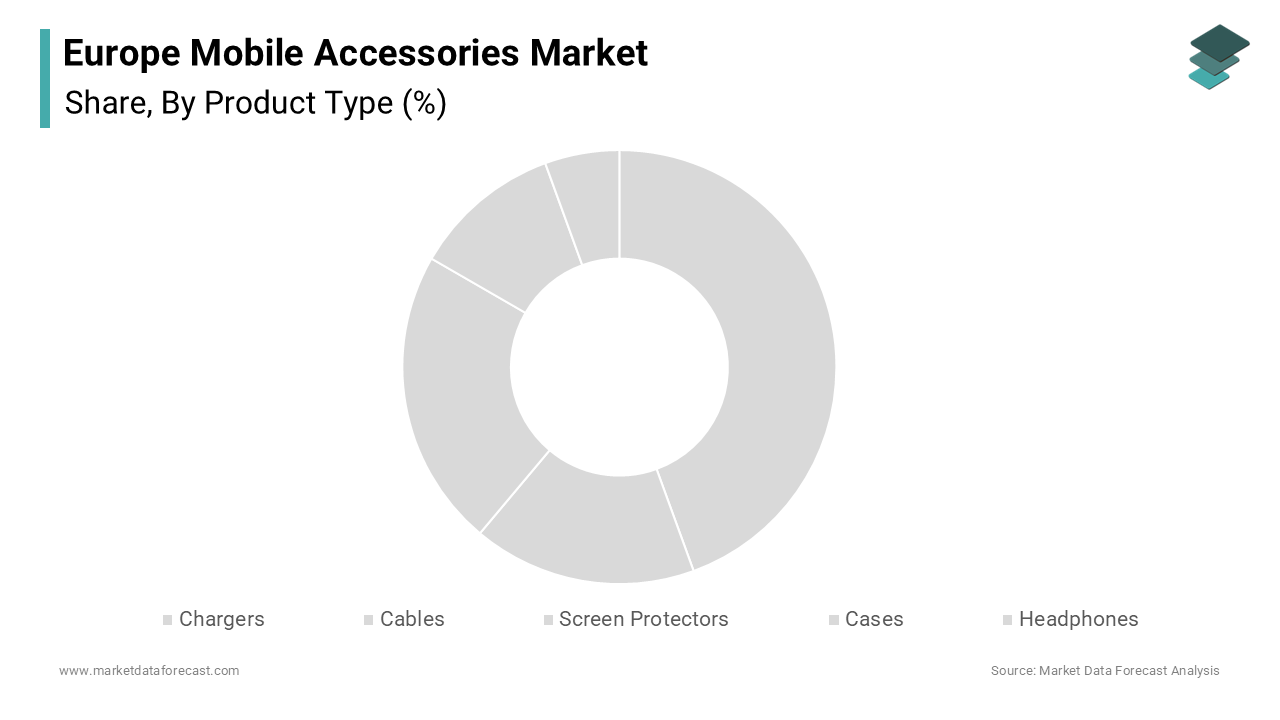
The protective cases segment was the largest segment in the Europe mobile accessories market by capturing a 38.6% share in 2025. The supremacy of the protective cases segment is attributed to the regulatory behavioral and economic factors that prioritize device longevity. According to environmental research, European consumers are keeping their smartphones longer, resulting in an extended, multi-year lifespan that is driving a trend toward investing in protective accessories to prevent damage. Research indicates a high consumer tendency to secure new phones with protective cases immediately after purchase, with a significant portion of users replacing these covers regularly due to damage or to update their device's appearance. National right to repair laws in France and Germany mandate that manufacturers provide affordable spare parts including compatible case mounting systems for screen replacements reinforcing accessory necessity. Retailers like Vodafone and Orange bundle certified drop tested cases with all new contracts while independent repair shops recommend specific models to maintain warranty validity. This functional indispensability combined with low cost and high turnover sustains protective cases as the market’s largest product category.
The power banks segment is on the rise and is expected to be the fastest growing segment in the market by witnessing a CAGR of 11.7% over the forecast period owing to increasing reliance on mobile devices for work navigation and emergency communication amid longer commutes and frequent travel. A significant portion of the European workforce has shifted toward "always-on" working arrangements, with mobile digital devices becoming critical, daily professional tools, creating a, high demand for constant power availability. International aviation safety authorities, including EASA, enforce strict regulations requiring power banks to be carried exclusively in cabin luggage, prohibiting them from checked bags, while increasing, monitoring of their use in-flight due to safety risks. Crucially the EU Battery Regulation mandates clear labeling of actual capacity and safety certifications driving consolidation toward reputable brands. Companies offer GaN enabled fast charging models with solar recharging capabilities appealing to eco conscious consumers. This shift from convenience to critical utility positions power banks as the highest growth vector in a maturing market.
By Distribution Channel Insights
The online segment dominated the Europe mobile accessories market by accounting for a 64.5% share in 2025. The dominance of the online segment is credited to convenience price transparency and vast product variety. Digital platforms, dominated by major generalist and fashion marketplaces, have become the primary channel for consumers purchasing accessories, overtaking traditional physical retail. The shift accelerated during the pandemic and sustained due to seamless integration with smartphone comparison sites and carrier upgrade portals. Online shoppers are increasingly using augmented reality tools to visualize product fit, color, and appearance before purchasing, which helps boost confidence and reduces uncertainty. Subscription models for recurring accessory needs, such as screen protector replacements, also thrive online with automated replenishment. Cross border e commerce further expands choice. A German consumer can easily access Italian designer cases or Swedish sustainable brands without markup. The EU’s Digital Services Act enhances trust through mandatory seller verification and return rights reducing perceived risk. This ecosystem of speed selection and digital engagement ensures online remains the dominant channel despite tactile limitations.
The offline distribution segment is expected to exhibit a noteworthy CAGR of 7.8% from 2026 to 2034. The rapid growth of the offline segment is fueled by experiential retail and regulatory complexity. Physical stores offer hands on testing of fit compatibility and audio quality, critical for premium accessories where trust outweighs convenience. Telecom operators like Orange and Vodafone have redesigned stores to include “accessory bars” where staff demonstrate drop tests and fast charging speeds. In France and Italy independent repair shops double as accessory hubs offering certified cases that preserve warranty validity post screen replacement. Moreover, tactile evaluation matters for materials like vegan leather or recycled aluminum which photos cannot convey. Urban pop-up stores in Berlin and Barcelona showcase limited edition collaborations blending fashion and tech. Rising demands for transparency have prompted a resurgence of offline channels, which now act as trusted advisors in a complex, safety-driven environment.
COMPETITIVE LANDSCAPE
The Europe mobile accessories market is characterized by a three tier competitive structure comprising original equipment manufacturers premium third party innovators and budget generic suppliers. OEMs like Apple and Samsung dominate the high end through ecosystem lock in and regulatory foresight while specialized brands like Anker and Belkin compete on performance transparency and sustainability. The low end remains fragmented with thousands of unbranded sellers on e commerce platforms often bypassing safety certifications. Competition intensifies around compliance as the EU enforces the Common Charger Directive Ecodesign Regulation and Digital Product Passport requirements. Trust has become the primary differentiator with consumers favoring brands that disclose material origins provide spare parts and offer take back schemes. Price sensitivity persists in Southern and Eastern Europe but is offset by growing willingness to pay for durability in Nordic and Benelux countries. Innovation focuses on extending device life enabling wireless interoperability and integrating wellness features. As regulations raise entry barriers competition is shifting from volume to value with sustainability and serviceability defining long term success.
KEY MARKET PLAYERS
Some of the companies that are playing a dominating role in the Europe Mobile Accessories Market include
- Samsung Electronics Co., Ltd.
- Apple Inc.
- Xiaomi Corporation
- Sony Corporation
- Huawei Technologies Co., Ltd.
- Koninklijke Philips N.V.
- Panasonic Corporation
- Belkin International, Inc.
- Anker Innovations Limited
- ZAGG Inc
- Spigen, Inc.
- Otter Products LLC
- Skullcandy Inc.
- Case-Mate Inc.
- AUKEY Online
- INCIPIO Group
Top Players in the Market
Apple Inc
Apple exerts significant influence in the Europe mobile accessories market through its tightly integrated ecosystem of MagSafe cases chargers and audio devices designed exclusively for iPhone users. The company’s emphasis on design precision material sustainability and seamless functionality sets industry benchmarks for premium accessories. Recently Apple expanded its European accessory lineup with recycled aluminum MagSafe wallets and USB Type C cables compliant with the EU Common Charger Directive. It also enhanced repairability by publishing service manuals and selling genuine parts through independent repair providers across Germany France and the Netherlands. Apple’s strict Made for iPhone certification program ensures third party compatibility while maintaining quality control. Apple solidifies its reputation as a responsible leader by conforming to EU regulations regarding right-to-repair and e-waste, enhancing consumer loyalty in an eco-conscious market.
Samsung Electronics Co Ltd
Samsung maintains a strong presence in the Europe mobile accessories market by offering a broad portfolio of Galaxy Buds protective cases and fast chargers tailored to its diverse smartphone range. The company has localized its accessory strategy to meet EU regulatory requirements including universal USB Type C adoption and Ecodesign compliance. In recent years Samsung launched eco conscious lines using ocean bound plastics and bio based materials across Western European markets. It also partnered with major telecom operators to bundle certified accessories with device purchases enhancing post sale engagement. Samsung’s open accessory platform allows third party developers to create compatible products fostering ecosystem growth. Samsung maintains its competitive edge across all market segments by delivering cutting-edge audio and charging tech that meets modern demands for performance and environmental responsibility.
Anker Innovations
Anker Innovations has established itself as a leading third party player in the Europe mobile accessories market by combining high performance engineering with competitive pricing and sustainability commitments. The company specializes in GaN enabled fast chargers power banks and durable protective cases that meet EU safety and environmental standards. Recently Anker expanded its European distribution through partnerships with MediaMarkt and Amazon EU while launching a take back program for end of life accessories in Germany and the Netherlands. It also introduced solar powered power banks aligned with EU off grid energy initiatives. Anker’s focus on transparent labeling actual capacity disclosure and multi device compatibility resonates with informed European consumers. Anker ditched the gimmicks for dependability, earning customer loyalty and becoming a top-tier alternative to major manufacturers.
Top Strategies Used by the Key Market Participants
Key players in the Europe mobile accessories market prioritize regulatory alignment by adopting USB Type C designs complying with Ecodesign requirements and providing repair manuals under right to repair mandates. They invest in sustainable materials such as recycled plastics bio based polymers and ocean bound plastics to meet EU circular economy goals. Companies increasingly offer certified refurbished accessories and take back programs to reduce e waste and enhance brand loyalty. Strategic bundling with smartphones through telecom operators ensures immediate post purchase engagement. Premium brands focus on smart integration including MagSafe compatibility spatial audio and health monitoring features to justify higher price points. Meanwhile value oriented players emphasize durability transparency and actual performance metrics to combat counterfeit competition. These strategies collectively address Europe’s unique blend of regulatory pressure environmental consciousness and demand for functional reliability.
MARKET SEGMENTATION
This research report on the Europe Mobile Accessories Market has been segmented and sub-segmented based on following categories.
By Product Type
- Chargers
- Cables
- Screen Protectors
- Cases
- Headphones
By Distribution Channel
- Online Retail
- Offline Retail
- Direct Sales
- Wholesale
By Country
- UK
- France
- Spain
- Germany
- Italy
- Russia
- Sweden
- Denmark
- Switzerland
- Netherlands
- Turkey
- Czech Republic
- Rest of Europe