- Product Description Description
- Table of Contents TOC
- List of Table & Figure LOT
- Get Free Sample PDF Sample PDF
Market Size, 2025
$0.34 BnMarket Estimate, 2026
$0.44 BnMarket Forecast, 2034
$2.70 BnCAGR, 2026–2034
29.14%Europe Mobile Edge Computing Market Size, Growth, Trends & Forecast (2026–2034)
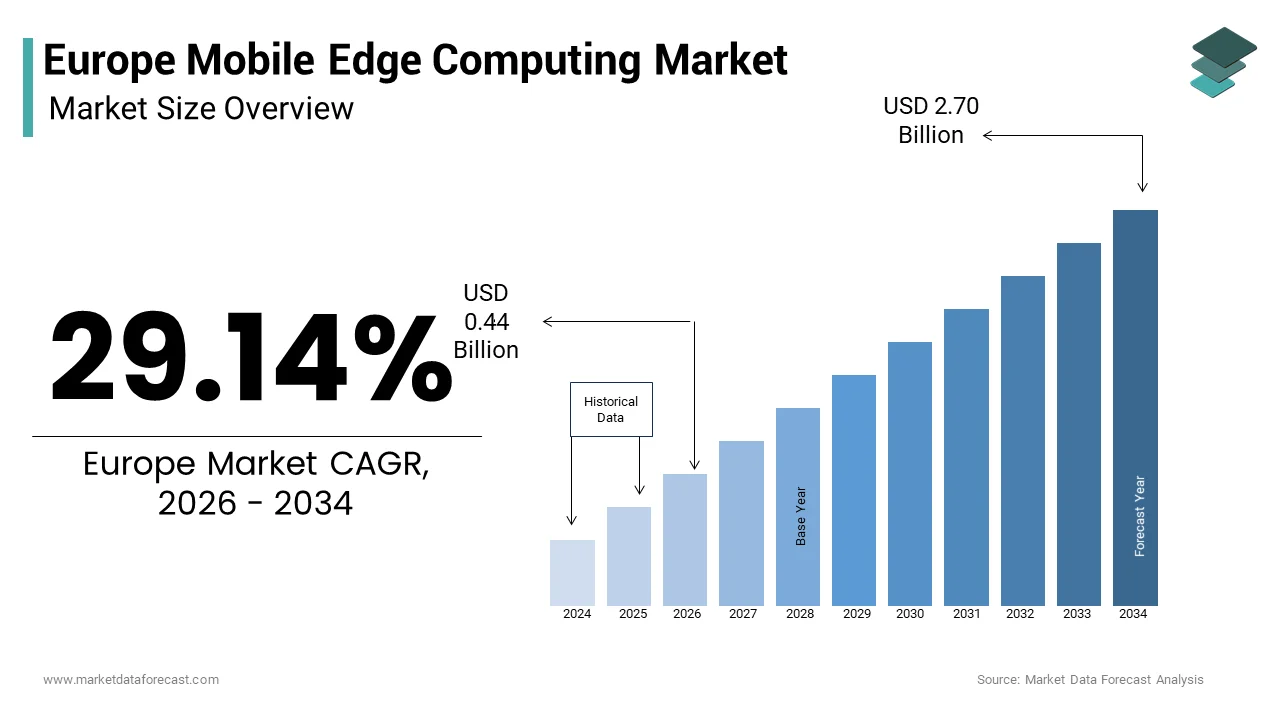
The Europe mobile edge computing market size was valued at USD 0.34 billion in 2025, is anticipated to reach USD 0.44 billion in 2026, and is projected to scale up to USD 2.70 billion by 2034, registering a compound annual growth rate (CAGR) of 29.14% during the forecast period from 2026 to 2034. Driven by surging industrial automation demands, autonomous vehicle testing, ultra-low latency enterprise requirements, and EU digital sovereignty initiatives, the European mobile edge computing sector continues to experience explosive expansion.
Key Executive Metrics (At-a-Glance)
- 2025 Base Valuation: USD 0.34 Billion
- 2026 Current Valuation: USD 0.44 Billion
- 2034 Forecast Valuation: USD 2.70 Billion
- Compound Annual Growth Rate (CAGR): 29.14% (2026–2034)
- Dominant Component Segment: Hardware (commanded 43.4% share in 2025 for fundamental infrastructure deployment)
- Fastest-Growing Component Segment: Software (projected at 25.5% CAGR for orchestration platforms)
- Dominant End-User Segment: Industrial Manufacturing (held 36.3% share in 2025)
- Fastest-Growing End-User Segment: Healthcare and Life Sciences (anticipated at 25.9% CAGR)
- Dominant Country Markets: Germany (24.4% market share) and the United Kingdom
Core Market Drivers
- Industry 4.0 & Automation: High concentration of industrial robots and smart factories requiring sub-10 millisecond deterministic response times.
- Autonomous Transport Systems: Regulatory pushes and vehicle-to-everything (V2X) requirements for instantaneous data exchange across major European transport corridors.
- Low Latency Ecosystems: Proliferation of cloud gaming, immersive media, and real-time healthcare monitoring requirements.
Primary Market Restraints & Challenges
- Regulatory Complexity: Fragmented national data sovereignty laws and diverse interpretations of EU data protection regulations.
- High Deployment Costs: Substantial capital expenditure needed for cell tower upgrades, micro data center acquisition, and physical security management.
- Interoperability & Security: Absence of standardized orchestration frameworks and expanding attack surfaces across distributed nodes.
Europe Mobile Edge Computing Market Segmentation Highlights
| Segment Category | Largest Market Segment | Fastest-Growing Market Segment |
|---|---|---|
| By Component | Hardware (43.4% share in 2025) | Software (25.5% CAGR) |
| By End-User | Industrial Manufacturing (36.3% share) | Healthcare and Life Sciences (25.9% CAGR) |
| By Country | Germany (24.4% market share) | Italy, France, and the Netherlands |
Major Industry Players Profiled
Key enterprises dominating the Europe mobile edge computing market include Huawei Technologies Co. Ltd., Nokia Corporation, Telefonaktiebolaget LM Ericsson, Deutsche Telekom, Cisco Systems Inc., Microsoft Corp. (Azure Edge Zones), Google LLC (Google Distributed Cloud Edge), Amazon Web Services Inc., Hewlett Packard Enterprise Co., and IBM Corp.
Europe Mobile Edge Computing Market Size
The Europe mobile edge computing market size was valued at USD 0.34 billion in 2025 and is anticipated to reach USD 0.44 billion in 2026 to reach USD 2.70 billion by 2034, growing at a CAGR of 29.14% during the forecast period from 2026 to 2034.
Mobile edge computing represents a transformative architectural paradigm that decentralizes computational power by positioning processing resources at the periphery of the network, specifically within or adjacent to radio access nodes. This infrastructure enables data generated by end devices to be processed locally rather than traversing long distances to centralized cloud data centers, thereby drastically reducing latency and alleviating backbone congestion. The ecosystem encompasses multi-access edge computing platforms, virtualized network functions, and distributed storage solutions that support latency-sensitive applications across industrial automation, autonomous mobility, and immersive media sectors. According to the European Telecommunications Standards Institute, the technical framework for mobile edge computing has evolved to support sub ten millisecond latency thresholds, which are critical for real time control loops in manufacturing environments. As per Eurostat, the density of internet connected devices in the European Union reached a very high level in 2024, which is creating an unprecedented volume of data that necessitates localized processing to maintain network efficiency. The European Commission emphasizes that edge computing is a foundational pillar for achieving digital sovereignty, allowing sensitive data to remain within national borders while enabling rapid decision making. This shift is further evidenced by the deployment of numerous edge nodes across major European urban centers by leading telecommunications operators as of late 2024, which is facilitating the transition from theoretical capability to operational reality. The market thus serves as the critical nervous system for the next generation of digital services, bridging the gap between physical operations and digital intelligence.
MARKET DRIVERS
Industrial Automation and Industry 4.0 Demands for Ultra Low Latency
The Europe mobile edge computing market is expected to grow steadily in the coming years, with industrial automation serving as a primary catalyst. According to the European Commission, the manufacturing industry contributes a significant share to the European Union’s gross domestic product, with digitalization initiatives under the industry 4.0 framework aimed at increasing this further. As per the International Federation of Robotics, Europe remains one of the largest markets for industrial robots globally, many of which require real time data processing for collaborative operations and predictive maintenance. Traditional cloud architectures introduce latency variations that can disrupt synchronized robotic movements or compromise safety systems, whereas edge computing ensures deterministic response times. According to the German Association of Mechanical and Plant Engineering, factories implementing edge-based control systems have reported improvements in equipment effectiveness due to reduced downtime and faster anomaly detection. The integration of artificial intelligence at the edge also enables immediate quality inspection using computer vision, which is eliminating delays associated with remote servers.
Proliferation of Autonomous Vehicles and Intelligent Transport Systems
The rapid advancement of autonomous driving technologies and intelligent transport systems across Europe is further fuelling the expansion of the European mobile edge computing market. According to the European Road Safety Observatory, road accidents remain a leading concern in the European Union, prompting regulatory pushes for vehicle to everything communication technologies that rely on instantaneous data exchange. As per the European Automobile Manufacturers Association, a growing share of new vehicle models launched in Europe feature advanced automation capabilities, which is requiring split second decision making that centralized clouds cannot support. Mobile edge computing enables vehicles to communicate with traffic lights, pedestrian sensors, and other cars in real time, which is facilitating cooperative manoeuvring and hazard avoidance. As per the European Transport Safety Council, edge enabled infrastructure can reduce reaction times in emergency scenarios compared to cloud dependent systems. Cities such as Helsinki and Barcelona have initiated pilot projects where edge nodes process traffic flow data to optimize signal timing dynamically. As regulations evolve to mandate higher safety standards, reliance on edge computing for vehicular communication becomes essential, which is driving substantial infrastructure investment across the continent.
MARKET RESTRAINTS
Fragmented Regulatory Landscape and Data Sovereignty Complexities
The heterogeneous regulatory environment across European member is hampering the European mobile edge computing market growth. According to the European Data Protection Board, while the General Data Protection Regulation provides a unified framework, national interpretations regarding the physical location of data processing nodes vary considerably, complicating distributed edge system architecture. As per the European Court of Auditors, inconsistencies in how different countries enforce data sovereignty laws can force operators to deploy redundant infrastructure in each jurisdiction, increasing capital expenditure and operational complexity. The European Commission acknowledges that differing national security protocols for critical infrastructure can delay approval of edge node installations, particularly in border regions where cross border data flows are essential. Furthermore, the lack of harmonized certification processes for edge hardware and software means vendors often face prolonged testing periods in each market before commercial launch. These regulatory hurdles inflate costs and slow down time to market for innovative edge services.
High Infrastructure Deployment Costs and Site Acquisition Challenges
The substantial financial burden associated with deploying distributed edge infrastructure and the logistical difficulties in acquiring suitable sites are further hindering the expansion of the European mobile edge computing market. According to the Body of European Regulators for Electronic Communications, the cost of upgrading existing cell towers and establishing new micro data centers to host edge computing resources is significantly higher than traditional network expansions due to requirements for power, cooling, and physical security. As per the European Investment Bank, securing funding for such capital-intensive projects is challenging, particularly for smaller telecommunications operators. The scarcity of available real estate in dense urban areas, where edge nodes are most needed, further exacerbates the problem, leading to protracted negotiations and inflated lease prices. According to the European Network and Information Security Agency, ensuring physical security for thousands of decentralized edge sites requires ongoing investment in surveillance and access control systems, adding to total ownership costs. Additionally, the energy consumption of distributed edge facilities raises concerns about sustainability and electricity expenses. These economic and logistical constraints limit the pace of rollout, which is resulting in patchy service availability that discourages enterprise adoption.
MARKET OPPORTUNITIES
Integration with Renewable Energy Grids and Smart Utility Management
The Europe mobile edge computing market is expected to expand significantly in the coming years, with renewable energy integration emerging as a transformative opportunity. According to the European Network of Transmission System Operators for Electricity, the share of renewable energy in the EU electricity mix has grown considerably, introducing volatility that requires real time balancing and load management. As per the International Energy Agency, edge computing nodes can be strategically co-located with wind farms and solar parks to process sensor data locally, enabling instantaneous adjustments to power output and grid frequency without latency issues. The European Commission’s Green Deal initiative emphasizes the need for digital tools to enhance grid resilience, creating a favorable policy environment for edge enabled smart utility solutions. Edge platforms also facilitate peer to peer energy trading within communities by executing smart contracts in real time. This convergence reduces maintenance costs, improves efficiency, and strengthens Europe’s transition toward sustainable energy.
Expansion of Immersive Media and Cloud Gaming Ecosystems
The Europe mobile edge computing market is expected to grow rapidly as immersive media and cloud gaming ecosystems expand. According to the Interactive Software Federation of Europe, the video game market generated substantial revenue in 2024, with streaming services demanding ultra-low latency to ensure smooth playability. As per the European Broadcasting Union, adoption of virtual reality and augmented reality content for live sports and entertainment is accelerating, which is requiring massive bandwidth and processing power that edge networks can deliver efficiently. Mobile edge computing allows rendering tasks to be offloaded from user devices to nearby servers, enabling high fidelity graphics on lightweight hardware and eliminating lag. The rollout of standalone 5G networks across major European cities provides the backbone for these edge hosted services, creating a synergistic effect that enhances user experience. As consumer appetite for metaverse experiences and interactive live events grows, edge infrastructure will become a critical revenue stream for telecom operators and content creators.
MARKET CHALLENGES
Interoperability Issues and Lack of Standardized Orchestration Frameworks
The Europe mobile edge computing market faces significant challenges due to interoperability issues and the absence of standardized orchestration frameworks. According to the European Telecommunications Standards Institute, while architectural frameworks have been defined, implementation varies widely among vendors, which is leading to siloed ecosystems that hinder seamless service migration. As per Gartner, the lack of standardized APIs makes it difficult for developers to deploy applications across multiple edge nodes operated by different carriers, increasing costs and time to market. The European Commission has identified interoperability as a critical barrier in its digital decade targets, noting that incompatible systems prevent the formation of a truly connected European data space. As per the International Organization for Standardization, without common protocols for resource discovery and service handover, the promise of ubiquitous edge computing remains elusive. Addressing this challenge requires collaboration among industry stakeholders to establish open standards, which is a process slowed by competitive interests and proprietary technologies.
Security Vulnerabilities in Distributed Network Architectures
Security vulnerabilities represent another major challenge for Europe’s mobile edge computing market. According to the European Union Agency for Cybersecurity, the proliferation of edge devices introduces numerous entry points for cyberattacks, as each node represents a potential vulnerability. As per a study by the University of Oxford, the physical accessibility of edge servers in public spaces makes them susceptible to tampering and hardware theft, risks less prevalent in centralized data centers. The European Cybercrime Centre warns that distributed denial of service attacks could be amplified by compromising swarms of edge devices, potentially causing widespread disruptions. Furthermore, the limited computational resources of some edge nodes restrict the deployment of robust encryption and intrusion detection systems. Ensuring end to end security requires a holistic approach that current solutions struggle to provide efficiently. As critical infrastructure increasingly relies on edge computing, the stakes for security failures rise dramatically, necessitating continuous innovation in threat detection and resilient architecture design.
REPORT COVERAGE
| REPORT METRIC | DETAILS |
| Market Size Available | 2025 to 2034 |
| Base Year | 2025 |
| Forecast Period | 2026 to 2034 |
| CAGR | 29.14% |
| Segments Covered | By Component, End-User, and Country |
| Various Analyses Covered | Global, Regional, and Country Level Analysis, Segment-Level Analysis; DROC, PESTLE Analysis; Porter’s Five Forces Analysis; Competitive Landscape; Analyst Overview of Investment Opportunities. |
| Regions Covered | UK, France, Spain, Germany, Italy, Russia, Sweden, Denmark, Switzerland, Netherlands, Turkey, Czech Republic, and the Rest of Europe |
| Market Leaders Profiled | Huawei Technologies Co. Ltd., Nokia Corporation, Telefonaktiebolaget LM Ericsson, AT&T Inc., Verizon Communications Inc., Amazon Web Services Inc., Microsoft Corp. (Azure Edge Zones), Google LLC (Google Distributed Cloud Edge), Cisco Systems Inc., Hewlett Packard Enterprise Co., IBM Corp., ZTE Corp., EdgeConneX Inc., Cloudflare Inc., Fermyon Technologies, Saguna Networks Ltd., ADLINK Technology Inc., ADVA Optical Networking SE, Akamai Technologies, CoreSite |
SEGMENTAL ANALYSIS
By Component Insights
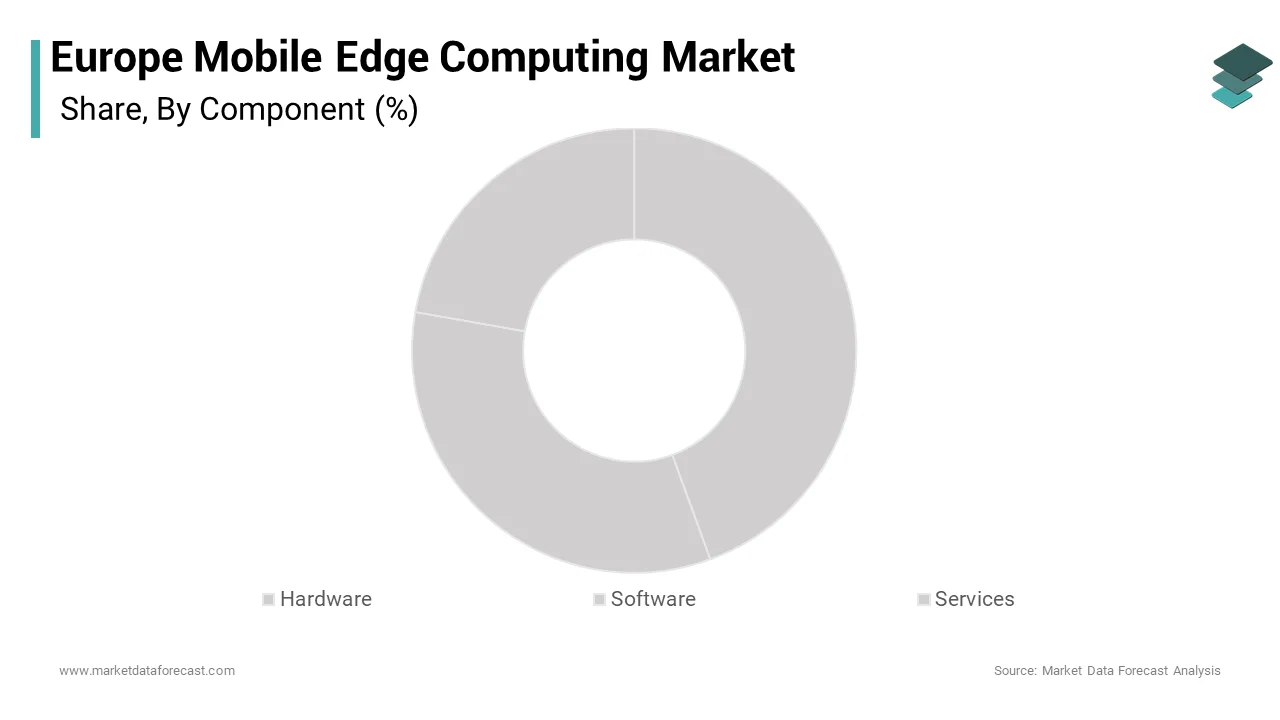
The hardware segment commanded for the highest share of 43.4% of the European market in 2025. The dominance of hardware segment in the European market is driven by the foundational necessity of deploying physical infrastructure such as edge servers, specialized routers, and radio access network equipment before any software or service can operate. According to the GSM Association, mobile operators in Europe invested heavily in network infrastructure in 2024, with a substantial portion allocated to upgrading cell towers with edge capable hardware. As per the European Telecommunications Standards Institute, each 5G base station requires specific multi-access edge computing nodes to process data locally, which is creating a direct correlation between network densification and hardware sales. According to the International Data Corporation, shipments of edge optimized servers in the region grew significantly year over year, driven by the need to handle high bandwidth video traffic and industrial sensor data.
The software segment is projected to register the highest CAGR of 25.5% over the forecast period in the European market owing to the increasing complexity of managing distributed edge environments and the rising demand for application platforms that can orchestrate workloads across hybrid cloud and edge infrastructures. According to Cloud Native Computing Foundation surveys, a majority of European enterprises now utilize Kubernetes or similar container orchestration tools to manage applications across distributed edge nodes. As per Gartner, the ability to deploy, update, and scale applications consistently across thousands of geographically dispersed edge locations requires advanced software layers. The European Commission’s push for interoperable digital services encourages the use of open-source stacks, while serverless computing models at the edge accelerate deployment cycles. This shift transforms software into a dynamic, continuously updated service, creating recurring revenue streams that grow faster than one time hardware purchases.
By End-User Insights
The industrial manufacturing segment held the dominant share of 36.3% of the European market in 2025. The growth of industrial manufacturing segment in the European market can be driven by Europe’s status as a global manufacturing powerhouse and the reliance of smart factories on ultra-low latency communications. According to the European Commission, the manufacturing sector accounts for a significant share of the EU’s gross domestic product, with strategic roadmaps targeting full digitalization of production lines by 2030. As per the German Association of Mechanical and Plant Engineering, a large majority of manufacturing firms in Germany have deployed edge computing solutions to enable real time monitoring of production equipment. According to the International Federation of Robotics, European factories lead the world in robot density, generating terabytes of data daily that require local analysis. The need to synchronize robotic arms, conveyor belts, and quality inspection cameras demands latency levels below ten milliseconds, achievable only through edge processing.
The healthcare and life sciences segment is anticipated to witness the fastest CAGR of 25.9% over the forecast period in the European market. Factors such as the urgent need for real time patient monitoring, telemedicine and AI driven diagnostic tools is majorly propelling the healthcare and life sciences segment in the European market. According to the European Health Data Space regulation, secure and real time exchange of health data is a priority, necessitating edge infrastructure that can process sensitive patient information locally. As per the European Commission, telemedicine consultations in the EU increased significantly in 2024, driven by an aging population and the need to provide care in rural areas. Edge computing enables wearable devices to stream vital signs to nearby servers for instant analysis, allowing doctors to intervene immediately in emergencies. The World Health Organization emphasizes that reducing latency in emergency response systems can improve survival rates, making edge deployment critical for ambulance services and remote clinics. Augmented reality tools for remote surgical assistance also rely on ultra-low latency connections, which is further driving adoption in healthcare.
COUNTRY LEVEL ANALYSIS
Germany Mobile Edge Computing Market Analysis
Germany held the dominant position in the Europe mobile edge computing market in 2025 with 24.4% of the regional market share. Its position is anchored in a robust manufacturing sector aggressively pursuing Industry 4.0 initiatives that rely on edge infrastructure for real time automation and robotics. According to the German Federal Ministry for Economic Affairs and Climate Action, edge computing has been designated as a key technology sovereignty area, with billions invested in research and deployment projects. As per Bitkom, over 60% of large industrial enterprises in Germany have piloted or deployed edge solutions to optimize production lines and supply chains. The presence of major telecommunications operators and technology vendors fosters a vibrant ecosystem that accelerates innovation and standardization. Germany’s central location makes it a critical hub for cross border data traffic, while strict data sovereignty laws encourage local processing. This combination of industrial demand, policy support, and technological prowess ensures Germany remains the benchmark for the wider European market.
United Kingdom Mobile Edge Computing Market Analysis
The United Kingdom held the second largest position in the Europe mobile edge computing market in 2025. The UK is characterized by a mature telecommunications sector and strong focus on financial services and smart city applications. According to Ofcom, mobile operators have activated edge computing capabilities in over 20 major cities to support low latency services for banking, gaming, and autonomous transport. As per the Department for Science, Innovation and Technology, the government’s digital strategy prioritizes edge infrastructure to enhance productivity and enable new business models in creative and financial sectors. London’s concentration of global financial institutions drives demand for edge solutions that enable high frequency trading and real time fraud detection. The UK’s leadership in artificial intelligence research further supports advanced edge AI applications. Dense urban populations and high smartphone penetration create ideal conditions for consumer facing edge services such as augmented reality and cloud gaming, securing the UK’s role as a critical pillar of the European landscape.
France Mobile Edge Computing Market Analysis
France is estimated to hold a prominent share of the Europe mobile edge computing market during the forecast period. The French market is distinguished by a state led approach to digital sovereignty and significant investments in smart infrastructure. According to the French Government’s France 2030 investment plan, substantial funding is allocated to developing sovereign cloud and edge capabilities to reduce dependency on non-European providers. As per Arcep, major operators are collaborating to deploy shared edge infrastructure in rural areas to ensure equitable access to low latency services. France’s large nuclear and renewable energy sectors are pioneering the use of edge computing for grid management and predictive maintenance, driving vertical demand. The automotive industry is integrating edge technologies for connected and autonomous vehicle testing, leveraging dedicated testbeds. Government emphasis on data localization under national security guidelines further stimulates domestic edge deployment. This strategic alignment of energy, automotive, and public sector needs ensures France remains a key growth market with a unique focus on sovereignty and sustainability.
Italy Mobile Edge Computing Market Analysis
Italy is predicted to showcase a prominent CAGR in the Europe mobile edge computing market over the forecast period. Italy is exhibiting dynamic growth driven by modernization of logistics hubs, tourism, and manufacturing. According to the Italian Ministry of Economic Development, the country is investing in digital corridors along major transport routes to support connected logistics and autonomous freight. As per the National Institute of Statistics, revitalization of the manufacturing sector in northern Italy is spurring demand for edge-based automation tools to compete globally. The tourism industry, a vital part of the economy, is exploring edge enabled augmented reality experiences to enhance visitor engagement in historical sites. Integration of Italian ports into the Trans European Transport Network requires advanced edge tracking for intermodal logistics. The government’s National Recovery and Resilience Plan includes measures to boost digital infrastructure, including edge nodes, to bridge the north south digital divide. This convergence of logistics, manufacturing, and tourism digitization is transforming Italy into a rapidly expanding market for mobile edge computing technologies.
Netherlands Mobile Edge Computing Market Analysis
The Netherlands is projected to register a notable share of the Europe mobile edge computing market during the forecast period. Netherlands is distinguishing itself as the most technologically advanced and densely connected mobile edge computing market in Europe. According to Statistics Netherlands, the Port of Rotterdam is deploying extensive edge computing infrastructure to manage autonomous cranes and optimize cargo flow, setting a global benchmark for smart port operations. As per the Royal Association of Transport and Logistics, the Netherlands has the highest density of connected vehicles per capita, driving demand for vehicle to infrastructure edge applications. The country’s flat terrain and compact size make it an ideal testbed for nationwide edge deployments and autonomous driving pilots. The Dutch government actively promotes open data standards and digital experimentation zones, facilitating rapid prototyping and scaling of edge solutions. This unparalleled level of digital maturity and strategic importance as a distribution hub ensures that while the Netherlands may have a smaller absolute market size, its influence on technology trends and adoption standards is disproportionately large.
COMPETITIVE LANDSCAPE
The competition in the Europe mobile edge computing market is intensely dynamic characterized by a complex interplay between traditional telecommunications equipment vendors mobile network operators and global cloud service providers. Established infrastructure giants leverage their deep relationships with carriers and extensive hardware portfolios to dominate the physical layer of edge deployment while simultaneously expanding into software services. Mobile network operators utilize their ownership of spectrum and network sites to offer edge hosting services directly to enterprises creating a competitive advantage through control of the connectivity pipeline. Global cloud providers enter the fray by extending their public cloud regions to the network edge offering familiar developer tools and seamless integration with existing cloud workloads. Regulatory frameworks regarding data sovereignty and digital independence foster an environment where local European players gain traction against non-domestic competitors. Companies constantly vie for ecosystem dominance by forming alliances with software developers and system integrators to build robust application marketplaces. The landscape sees frequent collaboration even among rivals as the complexity of edge architectures necessitates shared standards and interoperable interfaces to deliver seamless user experiences across borders.
KEY MARKET PLAYERS
A few of the market players that are dominating the Europe mobile edge computing market are
- Huawei Technologies Co. Ltd.
- Nokia Corporation
- Ericsson
- Deutsche Telekom
- Telefonaktiebolaget LM Ericsson
- AT&T Inc.
- Verizon Communications Inc.
- Amazon Web Services Inc.
- Microsoft Corp. (Azure Edge Zones)
- Google LLC (Google Distributed Cloud Edge)
- Cisco Systems Inc.
- Hewlett Packard Enterprise Co.
- IBM Corp.
- ZTE Corp.
- EdgeConneX Inc.
- Cloudflare Inc.
- Fermyon Technologies
- Saguna Networks Ltd.
- ADLINK Technology Inc.
- ADVA Optical Networking SE
- Akamai Technologies
- CoreSite
Top Players In The Market
- Ericsson operates as a global leader in telecommunications infrastructure and plays a pivotal role in advancing mobile edge computing capabilities across European networks. The company provides comprehensive edge cloud solutions that integrate seamlessly with five generation radio access networks to enable ultra-low latency applications for industrial and consumer use cases. Ericsson recently strengthened its market position by launching new edge automation software that simplifies deployment and management for telecommunications operators throughout the region. The firm actively collaborates with major European automotive manufacturers to develop vehicle to everything communication systems that rely on distributed computing power. Its global contribution remains significant as it sets industry standards for network slicing and edge orchestration while supporting critical infrastructure projects worldwide. Ericsson continues to invest heavily in research and development to enhance security protocols and energy efficiency within edge data centers ensuring robust performance for mission critical services.
- Nokia stands as a premier technology provider specializing in end-to-end mobile edge computing platforms that serve diverse sectors including manufacturing logistics and public safety across Europe. The company offers advanced multi-access edge computing infrastructure combined with artificial intelligence capabilities to optimize network performance and application delivery. Nokia recently expanded its edge portfolio by introducing specialized industrial edge clouds designed to support private wireless networks for smart factories and ports. It has forged strategic partnerships with cloud hyperscalers to offer hybrid solutions that bridge on premises processing with public cloud scalability. The group plays a vital role globally by driving standardization efforts within the European Telecommunications Standards Institute and deploying large scale edge trials in major cities. Nokia continuously upgrades its hardware and software stacks to support emerging use cases like augmented reality and autonomous robotics ensuring resilience against future connectivity demands while enhancing operational efficiency for enterprise customers.
- Deutsche Telekom functions as a leading telecommunications operator with deep roots in Germany and extensive mobile edge computing deployments across the European continent. The company delivers integrated edge services through its Magenta Cloud platform enabling businesses to process data closer to the source for improved speed and data sovereignty. Deutsche Telekom recently accelerated its edge strategy by opening new edge data centers in key European hubs to support low latency applications for gaming finance and healthcare sectors. It has established innovation labs where startups and enterprises can test and deploy edge native applications using its live network infrastructure. The firm contributes significantly to the global market by pioneering open edge ecosystems and advocating for interoperable standards that facilitate cross border service delivery. Deutsche Telekom remains committed to sustainability by powering its edge facilities with renewable energy and optimizing resource usage through intelligent software defined networking technologies that reduce carbon footprints while maximizing computational output.
Top Strategies Used by Key Market Participants
Key players in the Europe mobile edge computing market primarily employ strategic partnerships with cloud hyperscalers to combine local network presence with global cloud capabilities and offer hybrid solutions. Companies frequently pursue collaborations with vertical industry leaders such as automotive manufacturers and industrial automation firms to develop tailored use cases that demonstrate tangible business value. Another dominant strategy involves heavy investment in research and development to create proprietary orchestration software that simplifies the management of distributed edge resources across complex networks. Market participants also focus on acquiring specialized software startups to rapidly enhance their artificial intelligence and security portfolios without lengthy internal development cycles. Furthermore, firms actively engage in standardization bodies to shape technical specifications and ensure interoperability between different vendor ecosystems. Expanding into sovereign cloud offerings allows these entities to address strict European data privacy regulations thereby capturing government and regulated industry contracts that require local data processing and storage.
MARKET SEGMENTATION
This research report on the Europe mobile edge computing market is segmented and sub-segmented into the following categories.
By Component
- Hardware
- Software
- Services
By End-user
- Banking and Financial Services
- Retail
- Healthcare and Life Sciences
- Industrial Manufacturing
- Energy and Utilities
- Telecommunications
- Other End-users
By Country
- UK
- France
- Spain
- Germany
- Italy
- Russia
- Sweden
- Denmark
- Switzerland
- Netherlands
- Turkey
- Czech Republic
- Rest of Europe