- Product Description Description
- Table of Contents TOC
- List of Table & Figure LOT
- Get Free Sample PDF Sample PDF
Market Size, 2025
$25.81 MnMarket Estimate, 2026
$28.74 MnMarket Forecast, 2034
$67.95 MnCAGR, 2026–2034
11.36%Europe Mobile Gambling Market Report Summary
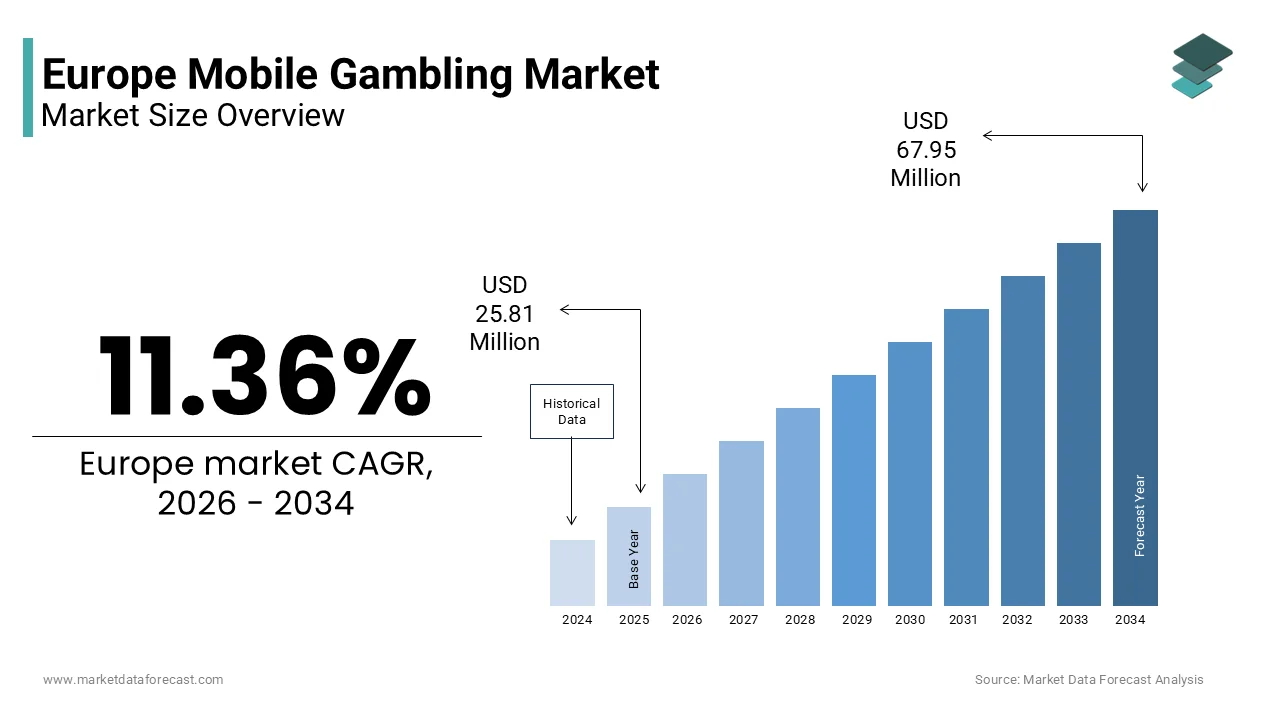
The Europe mobile gambling market was valued at USD 25.81 million in 2025, is estimated to reach USD 28.74 million in 2026, and is projected to reach USD 67.95 million by 2034, growing at a CAGR of 11.36% during the forecast period. The growth of the Europe mobile gambling market is driven by the increasing penetration of smartphones, rising popularity of mobile gaming platforms, and expanding legalization of online gambling activities across several European countries. Mobile gambling applications allow users to conveniently access betting platforms, casino games, and sports wagering services through digital devices. In addition, advancements in mobile payment systems, secure digital platforms, and real time gaming technologies are further accelerating the adoption of mobile gambling services across Europe.
Key Market Trends
- Increasing use of smartphones and mobile applications enabling convenient access to online gambling platforms.
- Growing popularity of live sports betting and real time wagering through mobile gambling applications.
- Rising integration of secure digital payment systems and digital wallets to facilitate seamless gambling transactions.
- Expansion of regulated online gambling markets across European countries supporting legal mobile betting services.
- Increasing use of advanced technologies such as live streaming, artificial intelligence, and data analytics to enhance user engagement.
Segmental Insights
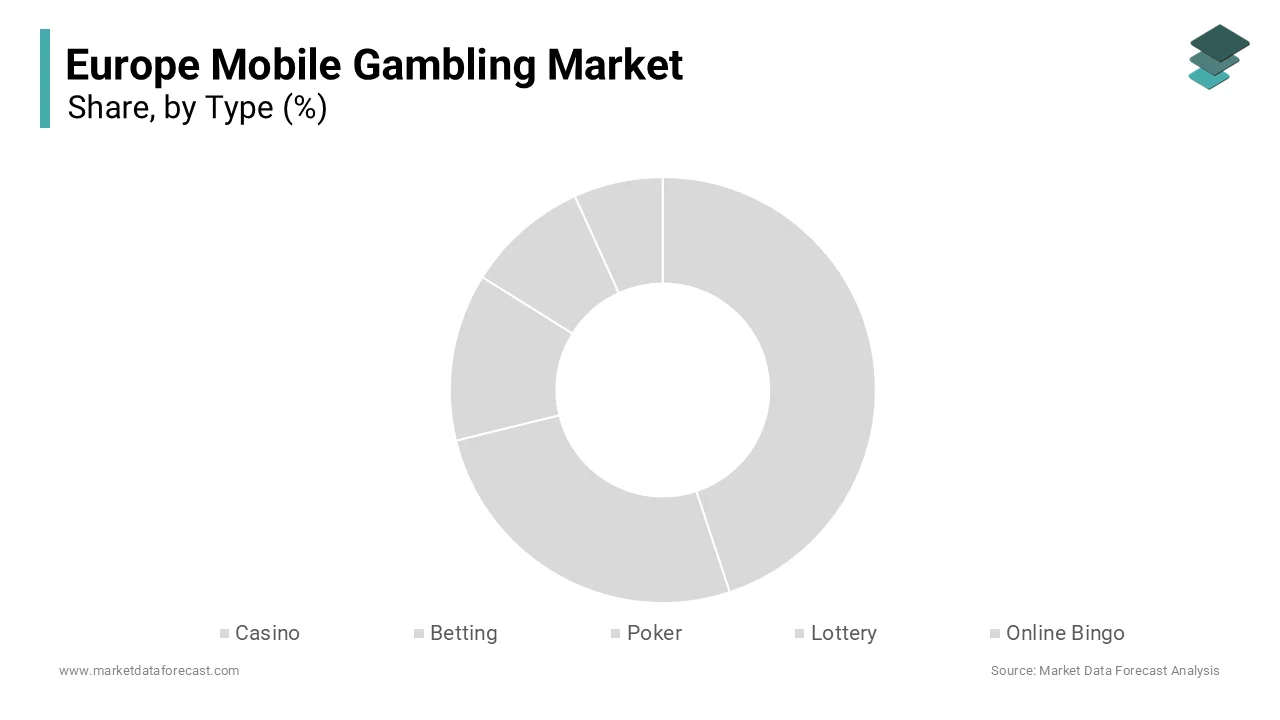
- Based on type, the betting segment accounted for 42.3% of the Europe mobile gambling market share in 2025. The popularity of mobile sports betting platforms, real time wagering options, and growing interest in sports events across Europe are major factors driving the growth of this segment.
- Based on end user, the gambling enthusiasts segment represented the dominant end user group in the Europe mobile gambling market and accounted for approximately 68% of total revenue. Frequent players and dedicated gambling users contribute significantly to market growth due to their high engagement with mobile betting applications and online gaming platforms.
Regional Insights
- The Europe mobile gambling market is witnessing strong growth across several countries due to the increasing adoption of mobile gaming technologies and expanding digital entertainment platforms.
- The United Kingdom accounted for the largest share of the Europe mobile gambling market and held approximately 26% of the regional market share. The country’s well regulated online gambling industry, high smartphone penetration, and strong consumer participation in sports betting are key factors supporting market expansion.
- Other European countries are also experiencing growing adoption of mobile gambling platforms due to expanding regulatory frameworks, increasing digital payment adoption, and rising interest in mobile based gaming entertainment.
Competitive Landscape
The Europe mobile gambling market is highly competitive with the presence of major online gambling operators and digital gaming platform providers. Companies are focusing on enhancing mobile user experience, expanding game portfolios, and integrating advanced technologies such as live betting, artificial intelligence based recommendations, and secure payment systems. Strategic partnerships, regulatory compliance, and expansion into newly legalized markets are helping companies strengthen their presence across the European mobile gambling ecosystem. Prominent players in the Europe mobile gambling market include Bet365 Group Ltd, Flutter Entertainment PLC, Entain PLC, Kindred Group PLC, Betsson AB, LeoVegas Mobile Gaming Group, Evoke PLC formerly 888 Holdings PLC, Tipico Co. Ltd, Super Group, Bragg Gaming Group, Bally’s Corporation, Kaizen Gaming, OPAP S.A., Zeal Network SE, and William Hill PLC.
Europe Mobile Gambling Market Size
The Europe mobile gambling market size was valued at USD 25.81 million in 2025 and is projected to reach USD 67.95 million by 2034 from USD 28.74 million in 2026, growing at a CAGR of 11.36%.
The mobile gambling is a digital wagering activities conducted exclusively through smartphones and tablets, encompassing sports betting, casino games, poker, and lottery services delivered via dedicated applications or mobile optimized websites. As per Eurostat, smartphone penetration across the European Union reached 87% of the population in 2024, establishing a ubiquitous hardware foundation for instant access to gambling platforms. According to the European Gaming and Betting Association, over 75% of all online gambling turnover in regulated European markets now originates from mobile devices, signaling a definitive shift away from desktop interfaces. The European Commission notes that the average mobile data consumption per user in Europe exceeds 15 gigabytes monthly, facilitating the streaming of live dealer games and high-definition sports feeds without latency issues. As per the study, the rollout of 5G networks, now covers 60% of the European population by enabling real time interaction crucial for in play betting scenarios. The General Data Protection Regulation continues to shape data handling practices by requiring operators to implement rigorous identity verification and privacy controls within mobile ecosystems.
MARKET DRIVERS
Ubiquitous High Speed Connectivity Enables Real Time Wagering
The ubiquitous high speed connectivity by eliminating technical barriers to instantaneous wagering and live engagement is propelling the growth of Europe mobile gambling market. The widespread deployment of 5G networks, across major European capitals and secondary cities ensures low latency connections essential for in play sports betting and live dealer casino experiences. According to the survey, 5G coverage in Europe is projected to reach 85% of the population by 2027, providing the bandwidth necessary for seamless high-definition video streaming of sporting events directly within betting applications. As per industry technical assessments, the reduction in latency to below 10 milliseconds allows operators to offer odds updates in real time, a critical feature for capturing value during fast moving sports matches. The European Telecommunications Standards Institute notes that network slicing technologies enable operators to guarantee quality of service for gambling applications even during peak traffic periods. This reliability fosters consumer confidence in placing significant wagers via mobile devices without fear of connection drops or delayed settlements. According to user behavior studies, 90% of mobile bettors prefer platforms that load live streams instantly, directly correlating network performance with customer retention rates. The integration of edge computing further processes data closer to the user, enhancing the responsiveness of complex gaming algorithms. As per infrastructure reports, the continuous expansion of fiber backhaul supporting mobile towers ensures that rural and urban areas alike enjoy consistent access, broadening the addressable market for mobile gambling operators throughout the continent.
Sophisticated Payment Integration Frictionless Transaction Processing
The sophisticated payment integration by removing friction from the deposit and withdrawal processes, thereby encouraging frequent mobile wagering activity. This factor is additionally to leverage the growth of Europe mobile gambling market. The adoption of open banking standards under the Revised Payment Services Directive has enabled instant bank transfers and secure authentication methods that streamline funding accounts on mobile devices. According to the European Central Bank, instant payment transactions in Europe grew by 45% in 2024, with a significant portion attributed to digital entertainment and gaming sectors. As per industry data, the integration of digital wallets such as Apple Pay, Google Pay, and local solutions like Bizum in Spain and Swish in Sweden reduces transaction times to mere seconds, significantly enhancing the user experience for impulsive betting behaviors. The implementation of strong customer authentication protocols ensures security without compromising convenience, addressing a primary concern for mobile users. According to financial technology analyses, the abandonment rate for mobile gambling transactions drops by 30% when one click payment options are available compared to traditional card entry methods. The rise of cryptocurrency acceptance in jurisdictions like Malta and Curacao licensed operators catering to European players offers an additional layer of anonymity and speed for tech savvy demographics. As per regulatory observations, the standardization of payment APIs allows operators to integrate multiple local payment methods effortlessly, ensuring market penetration across diverse European regions. This seamless financial infrastructure transforms mobile devices into powerful point of sale terminals for gambling services, driving sustained growth in transaction volumes.
MARKET RESTRAINTS
Stringent Regulatory Fragmentation Increases Compliance Complexity
The stringent regulatory fragmentation by imposing a complex web of divergent national laws that hinder scalable operations is one of the major factors restraining the growth of Europe mobile gambling market. Unlike a unified single market approach, each European country maintains its own licensing regime, tax structure, and advertising restrictions, forcing operators to maintain distinct technical and legal frameworks for every jurisdiction. According to the European Gaming and Betting Association, operators active in more than five European countries must comply with over 20 different sets of responsible gambling rules, significantly increasing operational costs. As per legal analyses, the prohibition of cross border marketing in countries like Germany and France limits the ability of operators to leverage pan European brand equity, necessitating localized marketing strategies that dilute efficiency. The varying age verification requirements and know your customer mandates require constant software updates to remain compliant by creating a heavy administrative burden. According to industry surveys, compliance costs now account for up to 15% of total revenue for multinational operators by reducing margins available for innovation and customer acquisition. The threat of sudden regulatory changes, such as blanket bans on bonuses or strict stake limits, creates an unpredictable business environment that discourages long term investment. As per strategic evaluations, the lack of harmonization prevents the realization of economies of scale, forcing smaller operators to retreat to domestic markets only. This patchwork of regulations stifles competition and innovation, as resources are diverted from product development to legal navigation and risk mitigation.
Aggressive Responsible Gambling Measures Limit User Engagement
Aggressive responsible gambling measures implemented by European regulators act as a significant restraint by intentionally limiting user engagement and spending capabilities to mitigate social harm. The aggressive responsible gambling is additionally declining the growth of Europe mobile gambling market. Governments across the region are increasingly mandating strict deposit limits, mandatory cooling off periods, and comprehensive affordability checks that directly cap revenue potential for mobile operators. According to the UK Gambling Commission, the introduction of mandatory financial vulnerability checks in 2025 is expected to reduce active high value player numbers by 20% within the first year of implementation. As per policy documents from the Swedish Spelinspektionen, blanket bans on bonus offers and free spins have led to a measurable decline in new customer acquisition rates on mobile platforms. The requirement for real time monitoring of playing patterns to detect problematic behavior forces operators to invest heavily in artificial intelligence systems that may inadvertently flag and restrict legitimate users. According to a report, the average session duration for mobile gamblers has decreased by 15% in jurisdictions with strict time out mandates. The societal pressure to prioritize player protection over commercial growth leads to restrictive advertising windows, reducing visibility during prime viewing times for sports events. As per reports, the friction introduced by frequent identity re verification prompts causes significant drop off rates during the registration process. While ethically necessary, these stringent controls create a structural ceiling on market expansion by forcing operators to compete for a shrinking pool of fully verified and unrestricted users.
MARKET OPPORTUNITIES
Esports Betting Integration Captures Younger Demographics
The e-sports betting integration by unlocking access to a younger, digitally native demographic that traditional sports betting fails to engage is also creating new opportunities for the growth of Europe mobile gambling market. The rapid growth of competitive gaming tournaments across Europe provides a vast array of betting markets tailored specifically for mobile consumption by aligning perfectly with the habits of Generation Z and Millennial users. According to Newzoo, the European esports audience is projected to exceed 90 million enthusiasts by 2026, with over 80% consuming content primarily via smartphones. As per trends, the integration of live streaming platforms like Twitch and YouTube Gaming directly into mobile betting apps allows users to watch matches and place wagers simultaneously by creating an immersive experience unavailable in traditional sports. The diverse nature of esports titles, ranging from strategy games to first person shooters, offers continuous betting opportunities throughout the year, unlike seasonal traditional sports calendars. According to market analysis, mobile first betting interfaces designed specifically for esports fans feature simplified odds displays and social sharing capabilities that resonate with this tech savvy cohort. The ability to bet on micro events within a match, such as the next kill or objective capture, leverages the high frequency nature of esports to drive engagement. As per assessments, partnerships between gambling operators and esports leagues are increasing, granting exclusive data rights that enhance the depth of mobile betting markets. This alignment of content, platform, and audience behavior positions esports as a high growth vertical capable of revitalizing user acquisition strategies.
Gamification and Social Features Enhance Retention Rates
Gamification and social features for operators to differentiate their offerings and enhance long term user retention is additionally prompting new opportunities for the growth of Europe mobile gambling market. By incorporating elements such as leaderboards, achievement badges, mission based challenges, and social sharing tools, operators can transform solitary wagering into a communal and engaging experience. According to behavioral psychology studies, the application of gamified mechanics increases user session time by up to 35% and improves daily active user metrics significantly. As per a study, mobile casinos that implement level up systems and reward tiers see a 25% higher retention rate after 90 days compared to traditional platforms. The integration of social betting pools allows friends to collaborate on wagers or compete in friendly tournaments by leveraging social networks to drive organic virality. According to reports, the use of augmented reality features in mobile apps enables users to visualize bets or interact with virtual dealers in their physical environment, adding a novel layer of immersion. The collection of user data through gamified interactions provides deeper insights into preferences by allowing for hyper personalized marketing and bonus offers. This evolution from transactional betting to experiential gaming creates a sticky ecosystem where users return not just to win money but to participate in a broader community, securing sustainable revenue streams.
MARKET CHALLENGES
Cybersecurity Threats Targeting Mobile Platforms
The cybersecurity threats targeting mobile platforms, as the value of stored financial data and user credentials attracts sophisticated criminal enterprises is a key factor to limit the growth of Europe mobile gambling market. The decentralized nature of mobile devices, often connected to unsecured public Wi Fi networks that creates vulnerabilities that hackers exploit to intercept transactions or manipulate game outcomes. According to a study, cyberattacks on the gambling sector increased by 40% in 2024, with mobile applications being the primary vector for credential stuffing and man in the middle attacks. As per security audits, many legacy mobile gambling apps lack robust encryption standards for data in transit by making them susceptible to interception by malicious actors on compromised networks. The rise of fake gambling applications on third party app stores deceives users into downloading malware that steals banking information, damaging the reputation of legitimate operators. The requirement to balance seamless user experience with rigorous security protocols creates a technical dilemma, as excessive authentication steps can drive users away. As per regulatory guidance, the NIS2 Directive imposes stricter reporting obligations for security incidents, increasing the operational burden on compliance teams. The constant arms race between security developers and cybercriminals demands continuous investment in advanced threat detection systems, straining resources especially for smaller operators. Failure to adequately protect user data can result in license revocation and irreversible brand damage, making cybersecurity a critical existential challenge.
Problem Gambling Stigma Influencing Public Policy
The problem gambling stigma influences public policy by fostering a political climate isone of the major challenges for the growth of Europe mobile gambling market. The perceived association between mobile accessibility and increased addiction rates drives populist movements to advocate for severe restrictions or outright bans on gambling advertisements and operations. According to public health surveys, over 60% of European citizens support stricter limits on mobile gambling availability due to concerns about youth exposure and family financial ruin. As per legislative trends, several member states are considering total prohibitions on gambling sponsorships in sports, which would remove a primary marketing channel for mobile operators. The negative media narrative surrounding high profile addiction cases puts immense pressure on politicians to demonstrate toughness through punitive regulation rather than balanced harm reduction strategies. According to industry advocates, the stigmatization of the sector limits its ability to engage in constructive dialogue with policymakers regarding effective responsible gambling tools. The fear of being labeled as predatory forces operators to adopt overly conservative business practices that may hinder innovation and competitiveness. As per sociological analysis, the mobile nature of gambling makes it a visible target for critics who argue it penetrates private spaces more intrusively than land based venues. This pervasive stigma complicates efforts to normalize the industry as a legitimate form of entertainment by resulting in a regulatory landscape that prioritizes restriction over sustainable growth that is constantly threatening the social license to operate.
REPORT COVERAGE
| REPORT METRIC | DETAILS |
| Market Size Available | 2025 to 2034 |
| Base Year | 2025 |
| Forecast Period | 2026 to 2034 |
| CAGR | 11.36% |
| Segments Covered | By Type, End User, and Region |
| Various Analyses Covered | Global, Regional, & Country Level Analysis; Segment-Level Analysis; DROC, PESTLE Analysis; Porter’s Five Forces Analysis; Competitive Landscape; Analyst Overview of Investment Opportunities |
| Regions Covered | UK, France, Spain, Germany, Italy, Russia, Sweden, Denmark, Switzerland, Netherlands, Turkey, and the Czech Republic |
| Market Leaders Profiled | Bet365 Group Ltd, Flutter Entertainment PLC, Entain PLC, Kindred Group PLC, Betsson AB, LeoVegas Mobile Gaming Group, Evoke PLC, Tipico Co. Ltd, Super Group, Bragg Gaming Group, Bally’s Corporation, Kaizen Gaming, OPAP S.A., Zeal Network SE, and William Hill PLC |
SEGMENTAL ANALYSIS
By Type Insights
The betting segment was accounted in holding 42.3% of the Europe mobile gambling market share in 2025 owing to the deep cultural integration of sports wagering, across the continent and the specific suitability of live in play betting for mobile interfaces. The passion for football, tennis, and horse racing in Europe creates a consistent demand cycle that aligns perfectly with mobile usage patterns during events. According to the European Gaming and Betting Association, over 85% of all sports wagers in regulated European markets are now placed via mobile devices, as users prefer the immediacy of updating bets while watching live matches. As per a so, the average frequency of betting sessions on mobile is three times higher than on desktop platforms due to the convenience of placing micro bets during game breaks. The proliferation of legalized sports leagues and the removal of state monopolies in countries like Germany and the Netherlands have further expanded the addressable market for licensed mobile bookmakers. According to consumer behavior studies, 70% of mobile bettors cite the ability to cash out early or place same game parlors as the primary reason for choosing mobile apps over physical retail locations. The integration of real time statistics and live streaming directly within betting applications creates an immersive ecosystem that retains users for longer durations. As per technological assessments, the low latency provided by 5G networks enables odds to update in milliseconds, a critical feature for high volume in play trading that solidifies the dominance of the betting segment.
The casino segment is emerging as the fastest growing category within the Europe mobile gambling market, projected to expand at a Compound Annual Growth Rate of 13.8% through 2030. This accelerated growth is fueled by the rapid advancement of live dealer technologies and the increasing sophistication of mobile slot graphics that replicate the land based experience. According to industry analysis, the introduction of 5G connectivity has reduced video lag for live dealer games to negligible levels, allowing operators to stream high definition tables with professional croupiers directly to smartphones without buffering. As per user engagement metrics, the average session length for mobile casino games has increased by 25% since the adoption of HTML5 technology, which enables seamless gameplay across all device types without requiring downloads. The diversification of game themes featuring popular culture franchises and the integration of gamified bonus rounds appeal strongly to younger demographics who previously avoided traditional casino formats. According to market research, the availability of "demo modes" in mobile casino apps allows users to practice without financial risk, significantly lowering the barrier to entry for new players. The rise of crash games and instant win variants designed specifically for short mobile attention spans drives frequent daily logins. As per regulatory observations, the legalization of online casino games in key markets like Germany and Ontario (influencing European operators) has opened vast new revenue streams. The ability of mobile casinos to offer personalized promotions based on real time playing behavior further enhances retention, positioning this segment as the primary engine for future market expansion.
By End User Insights
The gambling enthusiasts segment represents the dominant end user group in the Europe mobile gambling market, capturing approximately 68% of total revenue. This overwhelming majority stems from the high lifetime value of these users who possess deep knowledge of odds, strategies, and game mechanics, leading to consistent and substantial wagering volumes. According to behavioral studies, gambling enthusiasts account for nearly 80% of the total handle in sports betting and poker segments, driven by a disciplined approach to bankroll management and a pursuit of long term profitability. As per industry data, this demographic utilizes advanced features such as statistical analysis tools, cash out options, and multi betting slips far more frequently than casual users, generating significantly higher transaction fees and margins for operators. The loyalty of gambling enthusiasts is often secured through VIP programs and personalized account management, creating a sticky user base that is less sensitive to promotional offers and more focused on product reliability and odds quality. According to market surveys, 65% of gambling enthusiasts access mobile platforms daily, compared to sporadic usage patterns seen in other segments. The willingness of this group to adopt new technologies such as cryptocurrency payments and blockchain based transparency tools further cements their leadership. As per economic assessments, the concentration of revenue within this segment allows operators to optimize their platforms for high performance and deep liquidity, which in turn attracts more serious players. This self reinforcing cycle ensures that gambling enthusiasts remain the primary financial backbone of the mobile gambling ecosystem.
The social exuberant segment is witnessing the fastest growth, with a projected Compound Annual Growth Rate of 15.2% through 2030. This acceleration is driven by the convergence of social media interactions and gambling mechanics, where the primary motivation shifts from pure financial gain to entertainment, social status, and community engagement. According to digital trend reports, the integration of leaderboards, clan challenges, and shared bonus pools in mobile gambling apps has increased user acquisition among the 18 to 34 age demographic by 40%. As per psychological analyses, the "fear of missing out" generated by real time notifications of friends winning or participating in tournaments drives impulsive engagement and frequent app openings. The rise of influencer marketing on platforms like TikTok and Instagram, where streamers showcase big wins and interactive game sessions, acts as a powerful catalyst for converting passive observers into active participants. According to industry observations, social exuberants are highly responsive to gamified elements such as achievement badges, level progression, and virtual currency rewards that do not necessarily require real money deposits initially. The blurring lines between social gaming and real money gambling, facilitated by seamless conversion paths within apps, allows operators to nurture casual users into paying customers effectively. As per market data, the viral nature of social sharing features reduces customer acquisition costs by up to 30% compared to traditional advertising channels. This shift towards community driven gambling experiences ensures that the social exuberant segment will outpace traditional user groups in growth velocity.
REGIONAL ANALYSIS
United Kingdom Mobile Gambling Market Analysis
The United Kingdom stands as the largest national market for mobile gambling in Europe, commanding an estimated market share of 26% due to its long established regulatory framework and high consumer acceptance of online wagering. The market status here is defined by a highly saturated environment where competition focuses on brand differentiation, superior user experience, and responsible gambling tools rather than mere market entry. According to the UK Gambling Commission, over 90% of all remote gambling activity in the country is conducted via mobile devices, reflecting one of the highest mobile adoption rates globally. As per industry data, the stringent affordability checks and advertising restrictions introduced in recent years have forced operators to innovate around player retention and value extraction from verified users. The deep cultural integration of sports betting, particularly around the Premier League and horse racing, ensures consistent high volume traffic throughout the year. According to economic reports, the UK market generates the highest revenue per user in Europe, driven by a sophisticated player base willing to engage in high stake in play betting. The presence of numerous publicly listed gambling operators headquartered in London fosters a climate of transparency and technological investment. As per strategic assessments, the upcoming regulatory white paper implementation will further consolidate the market around compliant giants, setting the global standard for safe mobile gambling operations.
Germany Mobile Gambling Market Analysis
Germany holds the second largest position in the Europe mobile gambling market with a share of approximately 18%, distinguished by its massive population and the recent liberalization of its online gambling sector. The market status is characterized by a transition from a restricted gray market to a fully regulated environment following the implementation of the State Treaty on Gambling in 2021. According to the Joint Gambling Authority of the Länder, the number of licensed mobile operators has surged, creating a competitive landscape focused on compliance with strict deposit limits and advertising bans. As per consumer data, the German preference for sports betting, especially football, drives the majority of mobile turnover, although the online casino segment is rapidly gaining traction despite regulatory hurdles. The prohibition of live dealer games and strict five second spin intervals for slots have forced operators to adapt their mobile products specifically for the German jurisdiction. According to industry analysis, the high disposable income of German consumers combined with a growing trust in licensed platforms suggests significant untapped potential as the black market shrinks. The federal structure of regulation adds complexity, yet the uniform licensing approach is gradually stabilizing the market. As per market forecasts, Germany is poised to become the single most valuable growth engine in Europe as regulatory clarity improves and consumer migration to legal channels accelerates.
France Mobile Gambling Market Analysis
France ranks as the third major market, accounting for roughly 12% of the Europe mobile gambling revenue, driven by a strong tradition of horse racing and football wagering alongside a state controlled lottery monopoly. The market status is defined by the dominance of the Française des Jeux and a regulated private sector for sports betting and poker, while online casino games remain largely prohibited. According to the National Gaming Authority, mobile sports betting accounts for over 75% of the online gambling turnover in France, fueled by major sporting events like the Rugby World Cup and the Olympics. As per industry reports, the French consumer exhibits high loyalty to domestic brands but is increasingly exploring international operators for better odds and variety within the legal framework. The strict taxation regime and advertising restrictions create a challenging margin environment, forcing operators to focus on operational efficiency and high volume low margin strategies. According to technological trends, the integration of mobile payment solutions specific to the French market, such as Paylib, has streamlined the deposit process, boosting conversion rates. The ongoing debate regarding the potential opening of the online casino market represents a significant variable that could drastically alter the market dynamics. As per strategic evaluations, the strong regulatory oversight ensures a safe environment for players, maintaining public trust and sustaining steady growth in the permitted verticals.
Italy Mobile Gambling Market Analysis
Italy represents the fourth largest market with an estimated share of 10%, characterized by being one of the first European countries to establish a comprehensive licensing regime for online gambling. The market status reflects a mature ecosystem where mobile betting and poker are deeply ingrained in the cultural fabric, supported by a robust network of licensed operators. According to the Customs and Monopolies Agency, mobile channels contribute over 60% of the total online gambling revenue, with sports betting remaining the primary driver due to the intense popularity of Serie A football. As per industry data, the Italian market is known for its high frequency of micro bets and a strong preference for live in play wagering, facilitated by advanced mobile applications. The regulatory framework allows for a wide range of betting markets including political events and novelty bets, providing diverse opportunities for operators. According to economic assessments, the high tax rates on gross gaming revenue pressure operators to maintain high volumes, leading to aggressive marketing and bonus structures within legal limits. The presence of a large gray market continues to pose challenges, yet enforcement actions are increasingly effective in channeling users to licensed platforms. As per market observations, the integration of responsible gambling tools directly into mobile apps is becoming a key differentiator for operators seeking to maintain their licenses and reputations.
Sweden Mobile Gambling Market Analysis
Sweden secures the fifth position with a market share of approximately 7%, distinguished by its highly digitized society and progressive approach to online gambling regulation. The market status is defined by the re regulation in 2019 which opened the market to private operators while imposing strict consumer protection measures, resulting in a rapid migration from unlicensed to licensed sites. According to the Swedish Gambling Authority, over 85% of the gambling activity now takes place within the licensed channel, one of the highest channelization rates in Europe. As per consumer behavior studies, Swedish players are early adopters of mobile technology, with smartphone penetration driving nearly all online gambling growth. The market is characterized by a strong preference for sports betting and online casinos, with a particular interest in innovative game formats and fast payout solutions. According to industry reports, the use of BankID for seamless identity verification and payments has set a global benchmark for frictionless user onboarding in mobile gambling. The strict bonuses ban and deposit limits challenge operators to compete on product quality and user experience rather than promotional incentives. As per strategic assessments, Sweden serves as a testbed for new regulatory models and technological innovations, influencing policies across the Nordic region and beyond.
COMPETITIVE LANDSCAPE
The competition in the Europe mobile gambling market is characterized by intense rivalry between established global operators and agile local challengers vying for market share in a fragmented regulatory landscape. Incumbent giants leverage their vast financial resources and brand recognition to dominate advertising spaces and secure premium sports data rights. Meanwhile smaller specialized firms differentiate themselves through niche product offerings, superior user interface design, and innovative gamification features that appeal to younger demographics. The market witnesses frequent mergers and acquisitions as larger entities seek to consolidate their positions and eliminate competitors in key jurisdictions. Regulatory complexity acts as a significant barrier to entry favoring vendors with robust compliance frameworks and proven track records of responsible operation. Customer acquisition costs continue to rise due to advertising restrictions forcing operators to focus on retention and lifetime value optimization. This dynamic environment fosters continuous technological innovation as competitors strive to deliver faster, safer, and more engaging mobile experiences to capture and retain discerning European players in a maturing industry.
KEY MARKET PLAYERS
Some of the notable key players in the Europe mobile gambling market are
- Bet365 Group Ltd
- Flutter Entertainment PLC
- Entain PLC
- Kindred Group PLC
- Betsson AB
- LeoVegas Mobile Gaming Group
- Evoke PLC (formerly 888 Holdings PLC)
- Tipico Co. Ltd
- Super Group
- Bragg Gaming Group
- Bally’s Corporation
- Kaizen Gaming
- OPAP S.A.
- Zeal Network SE
- William Hill PLC
Top Players in the Market
- Bet365 Group Ltd stands as a premier operator in the Europe mobile gambling market, renowned for its sophisticated in play betting platform and extensive sports coverage. The company leverages proprietary technology to deliver seamless live streaming and real time odds updates directly to mobile devices across the continent. Bet365 recently invested heavily in artificial intelligence to enhance personalized user experiences and strengthen responsible gambling controls within its applications. Globally the firm expands its footprint by securing licenses in newly regulated jurisdictions while maintaining high standards of operational integrity. Their commitment to innovation includes developing custom mobile interfaces that cater to specific regional preferences and regulatory requirements. By focusing on customer retention through superior product reliability and diverse betting markets, Bet365 reinforces its status as a global leader. These strategic initiatives ensure the company remains at the forefront of the digital wagering evolution worldwide.
- Flutter Entertainment plc operates a diverse portfolio of leading mobile gambling brands including Paddy Power and Betfair that dominate the European landscape. The company excels in integrating sports betting with exchange betting models, offering unique value propositions to mobile users seeking flexibility and better odds. Flutter recently accelerated its digital transformation by migrating legacy systems to cloud native architectures to improve scalability and speed. Their global contribution involves setting benchmarks for mobile first design and responsible gaming tools that protect vulnerable players. The firm strengthens its position through targeted acquisitions of tech focused startups to enhance data analytics and customer engagement capabilities. By prioritizing sustainable growth and adhering to strict regulatory frameworks across multiple jurisdictions, Flutter ensures long term viability. These efforts solidify their role as a pivotal force shaping the future of mobile gambling entertainment globally.
- Entain plc is a major international sports betting and gaming group with a strong presence in the Europe mobile gambling market through brands like Ladbrokes and Coral. The company focuses on delivering an omnichannel experience that seamlessly connects retail operations with advanced mobile platforms. Entain recently launched innovative responsible gambling technologies using machine learning to identify and support at risk customers in real time. Their global strategy involves partnering with local operators to enter emerging markets while leveraging their robust technical infrastructure. The firm enhances its market position by investing in proprietary trading platforms that offer competitive odds and rapid settlement times. By committing to net zero carbon goals and ethical business practices, Entain appeals to socially conscious investors and consumers. These continuous improvements in technology and corporate responsibility maintain their competitive edge in the dynamic global gambling sector.
Top Strategies Used by Key Market Participants
Key players in the Europe mobile gambling market primarily employ strategic acquisitions to rapidly gain access to new technologies, customer bases, and regulated jurisdictions. Companies frequently invest heavily in proprietary software development to create unique mobile features such as live streaming and cash out options that differentiate their offerings. Another dominant strategy involves forming exclusive partnerships with sports leagues and media organizations to secure valuable data rights and advertising inventory. Vendors actively pursue localization efforts by adapting their platforms to meet specific national languages, payment methods, and regulatory compliance requirements. Additionally firms focus on implementing advanced artificial intelligence tools to personalize user experiences and enhance responsible gambling measures effectively. These combined approaches enable market leaders to navigate complex regulatory environments while driving sustainable growth and customer loyalty across the region.
Europe Mobile Gambling Market News
- In March 2024, Bet365 Group Ltd launched a new artificial intelligence driven personalization engine for its mobile app to enhance user engagement across European markets. This product launch is anticipated to allow Bet365 to offer more tailored betting experiences and strengthen the Europe mobile gambling market presence.
- In February 2024, Flutter Entertainment plc acquired a specialized data analytics startup to improve real time odds compilation and risk management capabilities. This acquisition is anticipated to allow Flutter to offer more accurate pricing models and strengthen the Europe mobile gambling market presence.
- In January 2024, Entain plc introduced advanced biometric verification tools to its mobile platforms to streamline customer onboarding and enhance security. This integration is anticipated to allow Entain to offer faster registration processes and strengthen the Europe mobile gambling market presence.
- In November 2023, Bet365 Group Ltd formed a strategic partnership with a major European football league to secure exclusive live streaming rights for mobile users. This collaboration is anticipated to allow Bet365 to offer unique content features and strengthen the Europe mobile gambling market presence.
- In October 2023, Flutter Entertainment plc expanded its responsible gambling team in London to develop new player protection algorithms for its European operations. This expansion is anticipated to allow Flutter to offer safer gaming environments and strengthen the Europe mobile gambling market presence.
MARKET SEGMENTATION
This research report on the European mobile gambling market has been segmented and sub-segmented based on categories.
By Type
- Casino
- Betting
- Poker
- Lottery
- Online Bingo
By End User
- Gambling Enthusiasts
- Social Exuberant
By Country
- UK
- France
- Spain
- Germany
- Italy
- Russia
- Sweden
- Denmark
- Switzerland
- Netherlands
- Turkey
- Czech Republic
- Rest of Europe