- Product Description Description
- Table of Contents TOC
- List of Table & Figure LOT
- Get Free Sample PDF Sample PDF
Market Size, 2025
$35.75 BnMarket Estimate, 2026
$39.11 BnMarket Forecast, 2034
$80.25 BnCAGR, 2026–2034
9.40%Executive Summary: Europe Mobile Games Market Report (2026–2034)
- Market Scope: Comprehensive analysis of the European mobile games market covering game types, platforms, business models, end-user demographics, regional leadership frameworks, and regulatory shifts.
- Market Valuation: Valued at USD 35.75 billion (2025), estimated at USD 39.11 billion (2026), and projected to reach USD 80.25 billion by 2034, registering a robust CAGR of 9.40% (2026–2034).
- Primary Growth Drivers: Widespread smartphone penetration paired with rapid 5G infrastructure rollout, strong cultural preferences for free-to-play business models with in-app engagement, and the rise of cloud gaming and mobile esports.
Key Europe Mobile Games Market Segment Metrics (2026–2034)
| Category | Leading Segment (2025 Position) | Fastest-Growing Segment |
|---|---|---|
| By Game Type | Action games (held 32.2% of market share in 2025) | Role-playing games (projected at a 9.3% CAGR) |
| By Platform | Android (occupied 58.3% of market share in 2025) | iOS (projected with a 6.8% CAGR and superior ARPU) |
| By Business Model | In-app purchase (held the largest share in 2025) | Advertising-supported model (projected at an 8.1% CAGR) |
| By End User | Male users (captured 57.6% market share in 2025) | Female users (projected with a 7.9% CAGR) |
| By Region | United Kingdom (largest contributor with 19.3% share in 2025) | France and Germany mobile gaming sectors |
Major Industry Players & Market Structure
Market Structure: Highly competitive and fragmented ecosystem characterized by a stark divide between massive global publishers and agile European studios, navigating complex EU consumer laws, localization costs, and shifting app store dynamics.
Key Mobile Gaming Companies: Supercell, King, Voodoo SAS, MAG Interactive, Kolibri Games, Wooga GmbH, and Huuuge Games.
Europe Mobile Games Market Size
The Europe mobile games market size was calculated to be USD 35.75 billion in 2025 and is anticipated to be worth USD 80.25 billion by 2034, from USD 39.11 billion in 2026, growing at a CAGR of 9.40% during the forecast period.
The mobile games are all digitally distributed interactive entertainment experiences accessed via smartphones and tablets. Unlike console or PC gaming, mobile gaming is distinguished by its accessibility, free-to-play mechanics, microtransaction model, and deep integration with social and streaming platforms. It serves a demographically diverse audience ranging from casual puzzle solvers to competitive esports participants. Regulatory and infrastructural conditions in Europe uniquely shape this market. Furthermore, the average smartphone penetration rate across the European Union stood at 84% with near universal device availability. Cultural diversity also influences content preference, with localized narratives and multilingual support being critical for engagement. Importantly, the European Union’s Digital Services Act, introduced in 2023, imposes transparency requirements on in-game purchases and algorithmic recommendation systems directly affecting monetization design.
MARKET DRIVERS
Widespread Smartphone Penetration and 5G Expansion Enable Seamless Gameplay
The near ubiquitous adoption of smartphones and rapid rollout of 5G networks are majorly fuelling the growth of the Europe mobile games market. This device saturation ensures a vast addressable audience for mobile game developers without requiring additional hardware investment from users. Complementing this hardware access the European 5G infrastructure has expanded significantly, with over 75% of the EU population covered by 5G, as reported by the sources. Low latency and high bandwidth enable sophisticated gameplay experiences previously restricted to consoles, such as real-time multiplayer shooters and cloud-streamed titles. For example, mobile esports tournaments for games like Brawl Stars and PUBG Mobile now attract over 500000 concurrent European viewers on platforms like Twitch and YouTube Gaming.
Strong Cultural Preference for Free to Play Models with In-App Engagement
European gamers exhibit a pronounced preference for free-to-play mobile games supported by optional in-app purchases rather than premium paid titles. The rising preference for free-to-play models within app engagement is driving the growth of the Europe mobile games market. This behavioral trend aligns with broader digital consumption patterns where access precedes ownership. According to a 2023 survey by the Interactive Software Federation of Europe, many monthly mobile gamers in the EU engaged exclusively with free-to-play titles while only a few purchased a paid game in the past year. This model thrives on psychological engagement mechanics such as daily rewards, limited-time events, and social leaderboards that sustain long-term retention. Games like Royal Match and Monopoly GO have achieved top-grossing status in multiple European countries by blending familiar intellectual property with incremental progression systems. Additionally, the integration of mobile games with social media platforms like Instagram and TikTok amplifies organic user acquisition through shareable moments and influencer collaborations. This cultural and economic alignment with free-to-play dynamics ensures sustained user growth and revenue generation across diverse European markets.
MARKET RESTRAINTS
Stringent Regulations on In-App Purchases and Loot Box Mechanics
The evolving consumer protection laws targeting monetization practices around in-app purchases and randomized reward systems are significantly degrading the growth of the Europe mobile games market. The European Commission’s revised Consumer Rights Directive, which took full effect in January 2025, mandates clear disclosure of odds for all loot box mechanisms and prohibits direct purchase prompts aimed at minors. The Authority for Consumers and Markets fined a major publisher 3.2 million euros in 2023 for failing to disclose drop rates in a top-grossing mobile title. These enforcement actions compel developers to redesign monetization architectures, increasing compliance costs and limiting revenue potential. Furthermore, Apple and Google have updated their App Store guidelines for European developers, requiring age gating and spending caps that disrupt established engagement loops. The cumulative effect is a regulatory environment that penalizes aggressive monetization while rewarding transparency and restraint with a shift that disadvantages studios reliant on high lifetime value extraction from small user segments.
Fragmented Language and Cultural Preferences Increase Localization Costs
Europe’s linguistic and cultural diversity for mobile game publishers seeking pan pan-regional scale is restraining the growth of Europe's mobile games market. The European Union recognizes 24 official languages and hosts distinct gaming tastes shaped by local media history and social norms. According to the European Audiovisual Observatory, mobile games achieving top 10 chart positions in Germany often fail to rank in Spain or Poland due to narrative tone, gameplay pacing, or visual aesthetics. Effective localization extends beyond translation to include character design, narrative adaptation, and payment method integration. Moreover, compliance with national age rating systems such as PEGI in most EU states and USK in Germany requires separate certification processes. In Eastern Europe, regional preferences for strategy and simulation games contrast sharply with Western Europe’s dominance of hyper casual and match three genres, further complicating unified marketing strategies.
MARKET OPPORTUNITIES
Rise of Cloud Gaming and Cross-Platform Play Expands Audience Reach
The integration of cloud streaming and cross-platform functionality is a transformative opportunity for the growth of Europe's mobile games market by dissolving traditional hardware barriers. Services like Xbox Cloud Gaming and NVIDIA GeForce NOW offer console-quality experiences directly on mobile devices without requiring local processing power. According to the European Cloud Gaming Alliance, many Europeans were engaged with cloud-streamed games on mobile in 2023, representing a year-on-year increase. This trend allows premium franchises like Forza and Assassin’s Creed to reach mobile audiences previously limited to casual titles. Simultaneously cross platform play enables mobile users to compete or cooperate with console and PC players, fostering larger, more stable communities. The European 5G Action Plan supports this shift by prioritizing edge computing infrastructure to reduce latency below 20 milliseconds, essential for real-time gameplay.
Growing Integration with Esports and Live Streaming Communities
Mobile esports is emerging as a high-potential opportunity in Europe, driven by organized tournaments, influencer ecosystem, and live streaming engagement. The growing integration with esports and live streaming communities is ascribed to elevating the growth of the Europe mobile games market. As per the European Mobile Esports Federation, mobile esports tournaments attracted over 9 million unique viewers across Europe in 2023, with games like Clash Royale and Brawl Stars leading participation. This visibility drives user acquisition as new players emulate favorite streamers’ strategies and in-game purchases. Additionally, brands are increasing sponsorship investments with Red Bull and Vodafone backing national mobile esports circuits in multiple countries. The European Commission’s Creative Europe program has also allocated 15 million euros to support indie mobile game studios developing competitive titles with local cultural narratives.
MARKET CHALLENGES
Intense Competition from Global Developers Marginalizes Local Studios
The European independent mobile game developers face severe competitive pressure from well-funded global studios primarily based in the United States, China, and South Korea that dominate app store rankings and user attention. The intense competition from global developers is anticipated to pose a challenge for the key market players. According to data from the European Games Developers Federation, the top 10 grossing mobile games in Europe in 2023 were all developed outside the EU, with no European title appearing in the top 50. These global players leverage massive user acquisition budgets exceeding 50 million euros per title and sophisticated live operations teams that deploy daily content updates and personalized monetization algorithms. The average European indie studio operates with less than 2 million euros in annual revenue and limited access to performance marketing expertise. App store algorithms further amplify this imbalance as high initial engagement triggers recommendation engine visibility, creating winner-take-all dynamics. This structural disadvantage discourages venture investment in European mobile gaming, with only 8% of European gaming venture capital allocated to mobile in 2023.
User Acquisition Costs and Platform Dependency Undermine Profitability
The increasingly challenging by soaring user acquisition costs and near total reliance on Apple’s App Store and Google Play for distribution, is additionally to hamper the growth of the Europe mobile games market. Compounding this pressure, the European Union’s Digital Markets Act, which came into force in March 2025, mandates that Apple and Google allow third-party app stores and alternative payment systems. Early data from the French Tech Observatory shows that only 3 % of iOS users in France have adopted alternative app stores six months after implementation, reducing the expected relief from platform fees. Meanwhile, developers must now maintain multiple build versions and compliance protocols, increasing operational overhead. This dual burden of expensive growth and unstable distribution channels threatens the financial viability of all but the largest mobile game studios operating in Europe.
REPORT COVERAGE
| REPORT METRIC | DETAILS |
| Market Size Available | 2025 to 2034 |
| Base Year | 2025 |
| Forecast Period | 2026 to 2034 |
| CAGR | 9.40% |
| Segments Covered | By Game type, Platform, Business Model, End User, and Region |
| Various Analyses Covered | Global, Regional & Country Level Analysis; Segment-Level Analysis; DROC, PESTLE Analysis; Porter’s Five Forces Analysis; Competitive Landscape; Analyst Overview of Investment Opportunities |
| Regions Covered | UK, France, Spain, Germany, Italy, Russia, Sweden, Denmark, Switzerland, Netherlands, Turkey, and the Czech Republic |
| Market Leaders Profiled | Supercell, King (company), Voodoo SAS, MAG Interactive, Kolibri Games, Wooga GmbH |
SEGMENTAL ANALYSIS
By Game Type Insights
The action games segment was the largest and held 32.2% of the Europe mobile games market share in 2025, with its broad accessibility fast fast-paced gameplay, and seamless integration with free-to-play monetization models. Titles like Subway Surfers and Temple Run have established enduring appeal across age groups by combining simple swipe-based controls with endless runner mechanics that encourage daily engagement. According to a 2023 survey by the Interactive Software Federation of Europe, action games are of monthly active mobile gamers in the EU aged 16 to 34. Their lightweight design also ensures compatibility with mid-range devices, which constitute over 65% of the European smartphone fleet, as per sources. Additionally, action games integrate effectively with social features such as friend leaderboards and daily challenges, which boost retention. Platforms like TikTok further amplify discovery through viral gameplay clips with #mobileactiongame hashtags generating over 8 billion views in Europe alone in 2023.
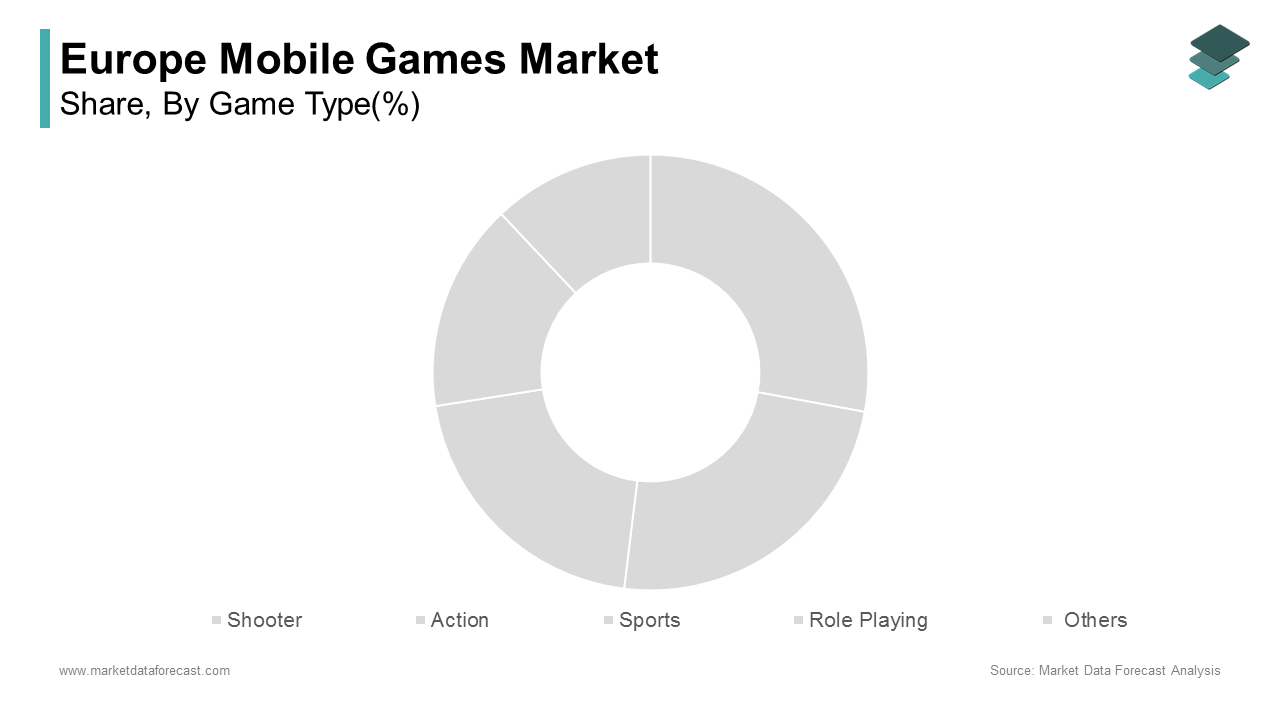
The role-playing games segment is likely to witness the fastest CAGR of 9.3% from 2026 to 2034, owing to the rising demand for narrative depth, character customization, and persistent online worlds that rival console experiences. Games like Genshin Impact and Honkai Star Rail have redefined technical expectations by delivering console-quality graphics, real-time co-op battles, and seasonal story arcs directly on mobile devices. Streaming platforms amplify engagement as RPG content dominates Twitch’s mobile categories, with 70% of top mobile streamers focusing on gacha-based RPGs according to StreamElements. Furthermore, the integration of cross-platform progression allows players to continue quests on PC or console, reinforcing long-term commitment.
By Platform Insights
The Android segment was the largest by occupying 58.3% of the Europe mobile games market share in 2025, with the platform’s device diversity, affordability, and widespread adoption across Southern and Eastern Europe. Over 65% of European households in the lowest income quartile rely exclusively on Android devices for internet access, making it the primary gateway to mobile gaming for economically diverse audiences. The open nature of the Android ecosystem also enables alternative app stores and sideloading, which gained traction following the EU’s Digital Markets Act enforcement in 2025. Additionally, game developers benefit from faster global rollout cycles on Google Play with fewer content restrictions compared to iOS, particularly for titles featuring loot boxes or competitive monetization. The platform’s compatibility with a vast range of chipsets ensures a broader reach even on devices with limited RAM or processing power. These accessibility, economic, and operational advantages sustain Android as the dominant distribution channel for mobile games across Europe.
The iOS segment is projected to grow with an expected CAGR of 6.8% throughout the forecast period, with the platform’s premium user base having higher spending capacity and superior monetization efficiency. Apple’s App Store consistently generates 30 to 40% more revenue per user than Google Play in Western Europe, as confirmed by developer earnings disclosures from companies like King and Playrix. Countries like Sweden, the UK, and Switzerland exhibit iOS penetration above 60 % among users aged 25 to 44 who drive the majority of in-app purchases. Furthermore, Apple’s privacy framework, though restrictive, has spurred innovation in contextual and first-party data-driven advertising, which benefits premium game studios with robust first-party ecosystems.
By Business Model Insights
The In-app purchase segment was the largest and held a significant share of the Europe mobile games market in 2025. This model thrives on the psychological engagement of free-to-play games where users voluntarily spend on cosmetic items, progression boosts, or battle passes after prolonged engagement. Titles like Royal Match Monopoly GO and Coin Master have mastered this approach by blending familiar intellectual property with incremental reward systems that trigger dopamine-driven spending. The model aligns with European consumer behavior, which favors access over ownership. Additionally, in-app purchases benefit from seamless payment integration via Apple ID and Google Pay, reducing friction at the point of sale. Regulatory scrutiny has prompted greater transparency with developers now disclosing odds for randomized purchases as mandated by the EU Consumer Rights Directive, yet spending remains robust.
The advertising-supported business model segment is likely to register a CAGR of 8.1% from 2026 to 2034, with the rise of hybrid monetization where games combine rewarded video interstitials and playable ads with optional in-app purchases to maximize reach and revenue. Rewarded video ads in particular have high engagement with over 45% of European mobile gamers accepting them in exchange for in-game bonuses, according to a 2025 survey by YouGov. The EU’s General Data Protection Regulation has accelerated the shift toward privacy-compliant contextual advertising, which benefits mobile games with clear genre and demographic signals. Companies like Unity and iIronSource have launched GDPR ready ad mediation platforms that preserve user anonymity while delivering targeted brand campaigns. Additionally, brands increasingly view mobile games as immersive ad environments, with Unilever and BMW running branded mini games in titles like Candy Crush Saga across Germany and the UK.
By End User Insights
The male users segment was the largest by capturing 57.6% of the Europe mobile games market share in 2025, owing to the particularly pronounced interest in genres such as action shooters and strategy, where competitive mechanics and progression systems align with traditionally male gaming preferences. In countries like Germany and Poland, over 65% of players in titles like PUBG Mobile and Clash of Clans are male as per telemetry data from developer dashboards. The segment drives high engagement in multiplayer and esports-oriented titles, which often feature leaderboards, clan systems, and real-time combat. Marketing campaigns and influencer partnerships also historically targeted male audiences, reinforcing genre conventions.
The female users segment is likely to grow with an expected CAGR of 7.9% throughout the forecast period, with the proliferation of narrative-driven social and lifestyle-oriented games that prioritize emotional engagement, collaboration, and creativity over competition. Titles like Love Nikki Dream and Project Makeover have achieved top-grossing status in France, Italy, and Sweden by blending fashion storytelling and puzzle mechanics tailored to female preferences. Social features such as guilds, messaging, and cooperative events further enhance retention. Developers are increasingly investing in diverse character representation and inclusive narratives, with UK-based studio Hutch Games launching an all-female racing RPG in 2025 featuring real-world athletes. The European Commission’s Gender Equality Strategy also encourages inclusive game design through funding initiatives.
REGIONAL ANALYSIS
United Kingdom Mobile Games Market Analysis
The United Kingdom mobile games market was the largest contributor with 19.3% of share in 2025, owing to its mature digital infrastructure, high smartphone penetration, and vibrant game development ecosystem. Over 88% of UK adults own a smartphone, as per Ofcom, with average monthly mobile data usage exceeding 14 gigabytes by enabling seamless gameplay and updates. London hosts over 200 mobile game studios, including King, the creator of Candy Crush Saga, which alone contributes significantly to national revenue. The UK’s advertising technology sector also supports sophisticated user acquisition and monetization strategies with companies like Adjust and Branch headquartered in the capital. Additionally, the UK ranks among Europe’s top three markets for mobile esports, with tournaments for Brawl Stars and Clash Royale drawing live audiences in Manchester and Birmingham.
Germany Mobile Games Market Analysis
Germany was ranked second with 16.2% of Europe's mobile games market share in 2025, with high spending power, strong data privacy awareness, and a preference for strategy and puzzle genres. German mobile gamers spent an average of 36 euros annually on in-app purchases in 2023. The nation also hosts major publishing operations for global studios, including Activision Blizzard and Electronic Arts, which localize content for the DACH region. Germany’s strict youth protection laws under the Youth Media Protection State Treaty have shaped responsible monetization practices with clear labeling of paid elements. Furthermore, the federal government’s GameStartUp initiative provides grants to indie studios developing culturally relevant mobile titles. Cities like Berlin and Hamburg have emerged as innovation hubs with coworking spaces and accelerators dedicated to mobile game development.
France Mobile Games Market Analysis
The French mobile games market is likely to host new opportunities for growth in next coming years, owing to the strong support for local developers and a preference for narrative and social simulation games. Over 120 mobile game studios operate in France, including Ubisoft Mobile and Voodoo, with the latter achieving global success through hyper casual innovation. French gamers exhibit high engagement with female-oriented and lifestyle games, with titles like Project Makeover and Love Nikki consistently ranking in the top 10 grossing charts. Additionally, France leads in mobile game streaming with Twitch streamers in Paris and Lyon building communities exceeding 300000 followers. The upcoming implementation of the EU’s Digital Services Act is being closely monitored by French regulators to ensure transparency in algorithmic recommendations. These cultural policies and digital dynamics make France a dynamic and influential market in Southern and Western Europe.
Italy Mobile Games Market AnalysisThe
mobile games market is expected to have prominent growth opportunities throughout the forecast period, with the high smartphone penetration among youth, a passion for ssports-themedgames and growing interest in mobile esports. Over 85% of Italians aged 18 to 34 play mobile games regularly, as per ISTAT, with football management and action titles like FIFA Mobile and FC 24 dominating downloads. Telecom operators like TIM and Vodafone offer gaming data bundles that include mobile game subscriptions, boosting accessibility. Italy also hosts regional game jams and incubators in Milan and Rome, supported by the Ministry of Culture to nurture local talent. The Italian Communications Authority has implemented clear guidelines on loot boxes requiring probability disclosure, which has increased consumer trust. Furthermore, Italian streamers on platforms like Twitch Italia have popularized competitive mobile gaming among younger audiences.
COMPETITION OVERVIEW
The Europe mobile games market features intense competition characterized by a stark divide between global giants and agile regional studios. Large publishers dominate revenue charts through massive marketing budgets, sophisticated live ops, and extensive intellectual property portfolios, yet face growing scrutiny over monetization ethics and data practices. Meanwhile, European indie developers leverage local narratives, cultural authenticity, and niche gameplay to build loyal communities, albeit with limited scale. The competitive landscape is further shaped by stringent regulatory frameworks such as the Digital Services Act and national gambling laws that restrict certain mechanics like loot boxes and social casino features. User acquisition costs continue to rise, pressuring smaller studios to innovate in organic growth through TikTok virality and influencer collaborations. Cross-platform cloud gaming and mobile esports are emerging battlegrounds where early movers gain a strategic advantage. Success in this market increasingly depends on balancing global scalability with regional sensitivity while navigating Europe’s unique blend of consumer protection, digital rights, and cultural diversity.
Top Strategies Used by the Key Market Participants
Key players in the Europe mobile games market focus on hyper-localized content development to resonate with diverse cultural preferences across the region. They invest heavily in data analytics and machine learning to optimize user acquisition, retention, and monetization in real time. Companies increasingly adopt hybrid casual strategies blending easy onboarding with deeper meta progression to improve lifetime value. Strategic partnerships with telecom operators, streaming platforms, and social media networks enhance distribution and user engagement. Additionally, firms are proactively integrating responsible gaming features and transparent monetization disclosures to align with evolving EU consumer protection regulations and build long-term trust with European audiences.
KEY MARKET PLAYERS
Major Players of the Europe mobile Games Market include
- Supercell
- King (company)
- Voodoo SAS
- MAG Interactive
- Kolibri Games
- Wooga GmbH
Leading Players in the Europe Mobile Games Market
King (a subsidiary of Activision Blizzard)
King is a London-based mobile game developer best known for the globally successful Candy Crush Saga franchise. The company plays a pivotal role in the European mobile games market by combining data-driven live operations with accessible match-three gameplay that appeals to a broad demographic. King contributes significantly to the global market through its mastery of free-to-play monetization and player retention strategies. In recent years, the company has strengthened its European footprint by expanding its Barcelona studio to focus on new casual IP and enhancing its responsible gaming tools to comply with EU consumer regulations. King also launched seasonal in-game events tied to European cultural moments such as Carnival and Midsummer, boosting local engagement across the region.
Voodoo
Voodoo is a Paris-based mobile game publisher renowned for pioneering the hyper casual genre with titles like Helix Jump and AAquapark.io. The company has reshaped user acquisition economics in Europe through its data science-driven publishing model that rapidly tests and scales lightweight games. Voodoo contributes to the global mobile ecosystem by offering indie developers a publishing platform with full creative and technical support. It also partnered with European telecom operators to bundle games into data plans, improving accessibility in price-sensitive markets.
Huuuge Games
Huuuge Games is a Warsaw headquartered developer specializing in social casino and casual multiplayer experiences such as Huuuge Casino. The company has carved a distinct niche in the Europe mobile games market by emphasizing real-time social interaction and community building within free-to-play frameworks. Huuuge Games contributes globally by demonstrating how non-gambling themed social casino mechanics can achieve high engagement in regulated markets. Recently, the company strengthened its European presence by launching localized tournaments in Italy, Spain, and the UK and enhancing its responsible gaming features to align with national advertising standards. It also integrated TikTok’s ad platform for performance marketing to reach younger demographics across the region.
MARKET SEGMENTATION
This research report on the Europe mobile games market has been segmented and sub-segmented based on game type, platform, business model, end user, and region.
By Game Type
- Shooter
- Action
- Sports
- Role Playing
- Others
By Platform
- Android
- iOS
- Others
By Business Model
- In-app Purchase
- Advertising
- Paid Purchases
By End User
- Male
- Female
By Region
- UK
- France
- Spain
- Germany
- Italy
- Russia
- Sweden
- Denmark
- Switzerland
- Netherlands
- Turkey
- Czech Republic
- Rest of Europe