- Product Description Description
- Table of Contents TOC
- List of Table & Figure LOT
- Get Free Sample PDF Sample PDF
Market Size, 2025
$21.46 BnMarket Estimate, 2026
$22.79 BnMarket Forecast, 2034
$36.81 BnCAGR, 2026–2034
6.18%Europe Modular Construction Market Report Summary
The Europe modular construction market was valued at USD 21.46 billion in 2025, and is estimated to reach USD 22.79 billion in 2026, and is projected to grow from USD 36.81 billion by 2034, expanding at a CAGR of 6.18% during the forecast period from 2026 to 2034.
Market growth is driven by Europe’s increasing need for faster, cost-efficient, and sustainable construction solutions. Modular construction offers benefits such as reduced labor dependency, shorter project timelines, minimized material waste, and improved energy performance—aligning well with Europe’s climate goals and housing pressures. The region’s shift toward low-carbon building methods, the rise of public infrastructure projects, and growing demand for flexible educational, healthcare, and institutional facilities are further accelerating modular adoption. Additionally, advancements in design automation, off-site manufacturing technologies, and digital construction workflows are making modular systems more scalable and economically viable across European markets.
Key Market Trends
- Increasing adoption of Permanent Modular Construction (PMC) for long-term residential, institutional, and commercial projects.
- Rising preference for steel-based modular structures due to their strength, recyclability, and suitability for multi-story installations.
- Accelerated demand for energy-efficient and low-carbon building solutions, driven by EU sustainability mandates and green building certifications.
- Growth of off-site manufacturing technologies, including BIM-integrated design, automated fabrication, and precision assembly.
- Expansion of public-sector modular projects, especially in healthcare, education, and affordable housing, as governments seek rapid deployment solutions.
Segmental Insights
- By Type, the Permanent Modular Construction (PMC) segment was the leading category in 2025, driven by its widespread use in schools, hospitals, residential complexes, and long-term commercial structures where durability, quality control, and rapid installation are essential.
- By Material, the steel segment held the largest share at 52.6% in 2025. Steel’s structural strength, recyclability, and flexibility make it the preferred material for modular buildings requiring high-load capacity and architectural precision.
- By Application, the education and institutional segment dominated the market with a 31.2% share in 2025, supported by strong demand for modular classrooms, student housing, healthcare extensions, and public-office facilities that require fast, scalable deployment.
Regional Insights
- Germany led the market with a 19.2% share in 2025, driven by rapid infrastructure modernization, the push for sustainable construction, and strong adoption of industrialized building methods.
- United Kingdom, the UK, followed with a 15.8% share, supported by government-backed housing programs, modular-friendly regulations, and high acceptance of off-site building solutions.
- France remains a major contributor, with demand influenced by urban densification policies and stringent climate legislation, pushing developers toward modular and low-carbon construction.s The Netherlands is experiencing moderate growth due to its emphasis on circular construction models, recycled materials, and water-adaptive building designs.
- Sweden, Sweden is expected to expand steadily from 2025 to 2033, supported by its leadership in timber-based modular systems, sustainable building innovation, and smart urban development initiatives.
Competitive Landscape
The Europe modular construction market is moderately consolidated, with competition driven by technological innovation, project delivery speed, material quality, and sustainability performance. Companies are investing in advanced off-site manufacturing facilities, digital engineering tools, and low-carbon materials to meet evolving regulatory and environmental demands. Strategic partnerships between builders, architects, and modular solution providers are expanding capabilities across large-scale public and private projects, while increasing emphasis on circular construction models is reshaping long-term industry strategies.
Major companies operating in the Europe modular construction market include Laing O'Rourke, Skanska, Modulaire Group, KLEUSBERG, Berkeley Group, Bouygues Batiment International, Daiwa House Modular Europe Ltd., Modubuild, Elements Europe, and Moelven Industrier ASA.
Europe Modular Construction Market Size
The Europe modular construction market size was valued at USD 21.46 billion in 2025 and is anticipated to reach USD 22.79 billion in 2026 to reach USD 36.81 billion by 2034, growing at a CAGR of 6.18% during the forecast period from 2026 to 2034.
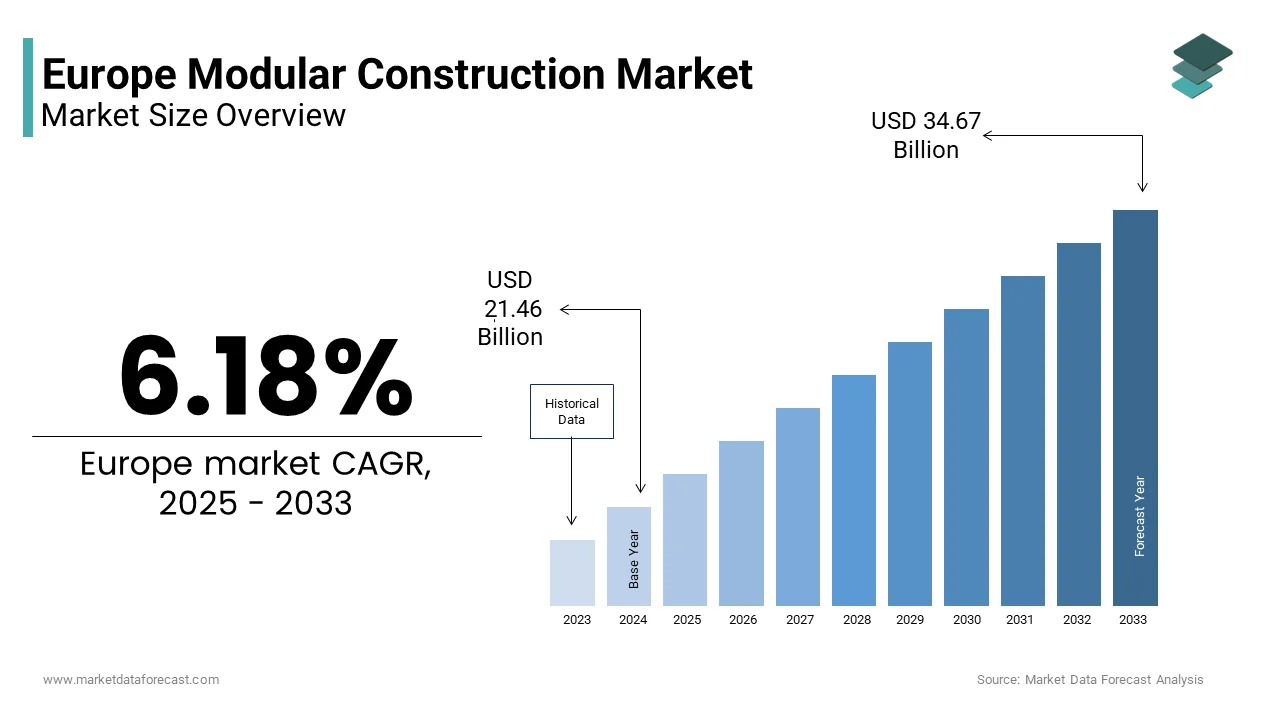
Modular construction refers to an off-site building method wherein volumetric units or panels are fabricated in controlled factory environments and subsequently assembled on location to form complete structures. This approach diverges from conventional construction through its emphasis on precision engineering, reduced onsite labor, and accelerated project timelines. The practice aligns with Europe’s intensifying need for housing, healthcare, and educational infrastructure amid chronic labor shortages and tightening environmental regulations. According to research, the European Union has experienced a significant and growing housing gap in recent years, driven by various factors, with a particularly acute shortage of affordable housing observed in Germany. Simultaneously, the built environment in the European Union is a major consumer of energy and a significant source of greenhouse gas emissions, highlighting a critical need for substantial improvements in sustainable and efficient building systems. Modular construction emerges not merely as a technique but as a strategic response to urban densification pressures, decarbonization mandates under the European Green Deal, and the imperative for resilient supply chains following recent geopolitical disruptions. Its integration into national infrastructure strategies reflects a paradigm shift in how Europe conceptualizes built environments in the twenty-first century.
MARKET DRIVERS
Accelerated Project Timelines Drive Adoption Across Public Infrastructure Sectors
The compression of construction schedules through modular methods has become a decisive driver in the Europe modular construction market. This is particularly true for schools, hospitals, and emergency housing. Building practices following traditional methods usually take a significant amount of time for educational facilities of average size. The use of modular techniques in building design can significantly decrease how long it takes to complete a project. Many new school buildings now include elements of off-site construction as a common approach to meet the need for more space. Certain hospital construction projects utilizing modular methods have been able to become operational in a comparatively short timeframe, faster than is typically possible with conventional building schedules. A key advantage in speed comes from running project tasks simultaneously: the foundation can be worked on at the location while the individual parts are being made elsewhere. This approach avoids common delays that happen when bad weather interferes with on-site building work. Cities in some regions have adopted the regular use of modular construction provide social housing quickly. This method is used to rapidly deploy thousands of housing units to address immediate shelter needs. The ability to deliver habitable, code-compliant structures within weeks rather than years positions modular construction as an indispensable tool for responsive governance in Europe’s evolving urban landscape.
Stringent EU Green Building Regulations Reinforce Demand for Factory-Built Solutions
The region’s regulatory architecture, particularly the Energy Performance of Buildings Directive and the upcoming Carbon Border Adjustment Mechanism, exerts profound influence on construction methodologies, which further accelerates the Europe modular construction market. Modular construction inherently aligns with these frameworks through material optimization, waste reduction, and energy-efficient assembly protocols. Factories producing modular units generate less construction waste compared to on-site builds. Moreover, controlled environments enable precise insulation placement and airtightness control, directly contributing to the EU’s target of achieving net-zero operational emissions for all new buildings by 2030. Modular construction projects under building certification programs consistently show improved performance compared to conventional projects in whole-life carbon metrics. The revision of the Construction Products Regulation in 2024 further compels manufacturers to disclose environmental product declarations, a requirement that modular producers satisfy more readily due to standardized production logs. A majority of publicly funded modular housing projects are achieving high-level eco-label certification tiers. This regulatory tailwind transforms compliance from a cost center into a competitive differentiator, embedding modular approaches within Europe’s decarbonization roadmap.
MARKET RESTRAINTS
Fragmented National Building Codes Impede Cross-Border Scalability
Persistent discrepancies in national building codes and certification protocols, despite the European Union’s harmonization efforts through the Construction Products Regulation, are major barriers to the Europe modular construction market. Each member state maintains distinct structural load requirements, fire safety classifications, and acoustic performance thresholds that complicate the replication of standardized modular designs across borders. For instance, seismic design categories mandated in Italy’s NTC 2018 differ materially from Germany’s DIN 1055 standards, necessitating costly redesigns for manufacturers seeking pan-European deployment. Operating modular construction firms in multiple countries can lead to higher average compliance costs compared to operating in only one country. Different nations have unique thermal regulations for modular wall assemblies, requiring incompatible insulation specifications. Variations in national regulations and specifications can cause permitting approvals to be delayed. The absence of a unified digital permitting framework exacerbates delays, with modular projects requiring many separate authority validations in Spain versus those in Denmark. Mutual recognition of modular certifications is essential for realizing economies of scale, stimulating investment, and driving innovation within the sector.
Perception Gaps and Lack of Skilled Workforce Limit Mainstream Acceptance
Deep-seated misconceptions about modular construction’s durability, aesthetic flexibility, and long-term value persist among developers, architects, and end users across the region, despite empirical evidence to the contrary, which ultimately inhibits the expansion of the Europe modular construction market. As per a study, a notable share of European property investors still associate modular buildings with temporary or low-quality structures, a legacy of postwar prefabrication. This perception gap translates into reduced demand from premium segments, where modular penetration remains less in luxury residential markets. Compounding this issue is a severe shortage of professionals trained in Design for Manufacture and Assembly principles. There is a noticeable skills gap concerning digital fabrication competencies within the construction sector. Training programs that focus specifically on modular construction techniques are currently limited in availability across several regions. The integration of modular construction topics into traditional vocational training programs remains infrequent. The absence of experts for complex modular integrations heightens the risk of project budget overruns and quality deviations, reinforcing negative perceptions. Modular construction's market growth will remain limited by outdated perceptions and a lack of skilled professionals until the industry and academia collaborate to promote it as a high-performance building solution, not just a low-cost option.
MARKET OPPORTUNITIES
Retrofitting Aging Infrastructure Through Modular Insertion Techniques Presents High Growth Potential
The continent’s vast stock of aging public buildings, particularly schools and healthcare facilities constructed between 1950 and 1980, offers a fertile ground for modular intervention via insertion or pod replacement strategies, which in turn provides new opportunities for the growth of the Europe modular construction market. Rather than full demolition, modular units can be slotted into existing structural grids to upgrade outdated interiors with minimal disruption. Across European regions, a large number of educational facilities need significant upgrades to meet modern standards for energy efficiency and accessibility. Initiatives are underway in some areas to improve school infrastructure, often incorporating modern construction techniques such as modular refurbishments. In specific Northern European countries, there is a push to update healthcare facilities, like nursing homes, with improved amenities for residents, utilizing methods that have shown efficiencies in project timelines. These interventions leverage modular precision to enhance thermal performance, accessibility, and infection control without displacing occupants, a critical advantage in publicly funded assets where continuity of service is nonnegotiable. This niche, though technically demanding, aligns with circular economy principles by extending building lifespans and avoiding embodied carbon from new construction.
Public-Private Partnership Frameworks Unlock Large-Scale Modular Deployment in Social Housing
The acute housing affordability crisis across European urban centers has caused innovative financing models wherein public entities provide land and regulatory fast tracking while private modular developers deliver turnkey units, which offer fresh prospects for the expansion of the Europe modular construction market. Such partnerships mitigate the capital intensity that historically deterred modular adoption. In the Netherlands, public initiatives and municipal land policies are increasingly promoting industrialized and modular construction methods to accelerate the delivery of much-needed affordable housing units. Spain's national housing plan encourages innovative building techniques and efficiency in construction through various funding streams, supporting the modernization and industrialization of the housing sector. Industry analyses and general reports suggest that modular housing projects often demonstrate faster project delivery compared to traditional construction, which helps in more rapidly addressing urgent housing demands. Finnish housing corporations utilize efficient, modern construction techniques, including modular systems, which contribute to cost management and enable the consistent supply of housing within a stable market. These structured frameworks convert policy intent into scalable delivery, positioning modular construction as the operational engine of Europe’s social housing revival.
MARKET CHALLENGES
Supply Chain Vulnerabilities Exacerbated by Geographic Concentration of Module Factories
Its vulnerability to supply chain disruptions due to the high geographic concentration of fabrication facilities hampers the growth of the Europe modular construction market. The modular construction sector in core Western European nations, notably Germany and the Netherlands, features a high concentration of advanced manufacturing facilities. Supply chain vulnerabilities, such as disruptions to major inland waterways like the Rhine River, pose significant risks to the timely transport and delivery of oversized modular components. Simultaneously, reliance on specialized components such as automated lifting systems and precision steel framing ties the sector to narrow supplier pools. The broader construction industry experienced extended lead times and production challenges for various materials and equipment due to widespread supply chain volatility and material shortages in recent years. Unlike traditional construction, which can substitute local materials, modular production demands exact component conformity, leaving little room for improvisation. The war in Ukraine further exposed dependencies on Eastern European suppliers for insulation and electrical subassemblies. Exports and production of various construction insulation materials, including phenolic foam, have experienced fluctuations in response to volatile petrochemical feedstock prices and evolving energy efficiency regulations. The market will remain vulnerable to logistics failures and sourcing issues until manufacturing diversifies and inventory buffers are used strategically.
Integration Complexities With Legacy Building Management Systems in Retrofit Projects
The seamless integration of prefabricated units with existing building management systems, especially in deep energy retrofits of midcentury structures, remains one of the major constraints to the Europe modular construction market. Many hospitals, universities, and government buildings upgraded with modular extensions rely on decades-old HVAC, fire alarm, and security networks that lack standardized communication protocols. Modular retrofit projects in the UK often encounter significant challenges with integrating existing operational technology systems, frequently necessitating the use of custom middleware solutions to bridge compatibility gaps. In Germany, as in other regions, modular construction projects can experience interoperability failures between different building automation and control architectures, such as KNX and BACnet. Issues stemming from the integration of diverse and sometimes incompatible control systems remain a notable barrier to the efficient implementation of modular building solutions. These technical mismatches not only inflate budgets but also compromise energy performance, as smart sensors embedded in new modules cannot relay data to legacy dashboards, nullifying real-time optimization benefits. Modular additions will continue to operate as isolated components within larger physical ecosystems, reducing their overall lifecycle value proposition, until Europe implements mandatory open data standards for public building infrastructure.
REPORT COVERAGE
| REPORT METRIC | DETAILS |
| Market Size Available | 2025 to 2034 |
| Base Year | 2025 |
| Forecast Period | 2026 to 2034 |
| CAGR | 6.18% |
| Segments Covered | By Type, Material, Application & Region |
| Various Analyses Covered | Global, Regional & Country Level Analysis, Segment-Level Analysis, DROC, PESTLE Analysis, Porter’s Five Forces Analysis, Competitive Landscape, Analyst Overview on Investment Opportunities |
| Regions Covered | UK, France, Spain, Germany, Italy, Russia, Sweden, Denmark, Switzerland, Netherlands, Turkey, Czech Republic & Rest of Europe |
| Market Leaders Profiled | Laing O'Rourke, Skanska, Modulaire Group, KLEUSBERG, Berkeley Group, Bouygues Batiment International, Daiwa House Modular Europe Ltd., Modubuild, Elements Europe, Moelven Industrier ASA |
SEGMENTAL ANALYSIS
By Type Insights
In 2024, the Permanent Modular Construction (PMC) segment was the prominent segment in the Europe modular construction market and captured a substantial share. The prominence of the PMC segment is credited to its alignment with long-term infrastructure needs across housing, education, and healthcare. Unlike temporary solutions, PMC units are engineered to meet the same durability, safety, and aesthetic standards as conventional buildings while retaining offsite efficiency benefits. An additional driver is institutional demand for code-compliant, scalable, and sustainable facilities. The German government, through the Federal Ministry of Housing, Urban Development, and Building, actively promotes the use of serial and modular construction methods across publicly funded housing projects as a key strategy to significantly accelerate project timelines, reduce costs, and address the national housing deficit. NHS England has integrated the use of modern methods of construction (MMC), including modular techniques, into its capital investment strategies to streamline the development of healthcare infrastructure, such as new primary care centers and hospitals, amidst budget constraints and the need for rapid delivery of facilities. Crucially, PMC benefits from full integration into national building registries, enabling mortgage financing and long-term asset valuation, factors that relocatable units lack. This institutionalization, coupled with lifecycle cost advantages. PMC reduces operational expenditures compared to traditional builds, solidifies its market leadership.
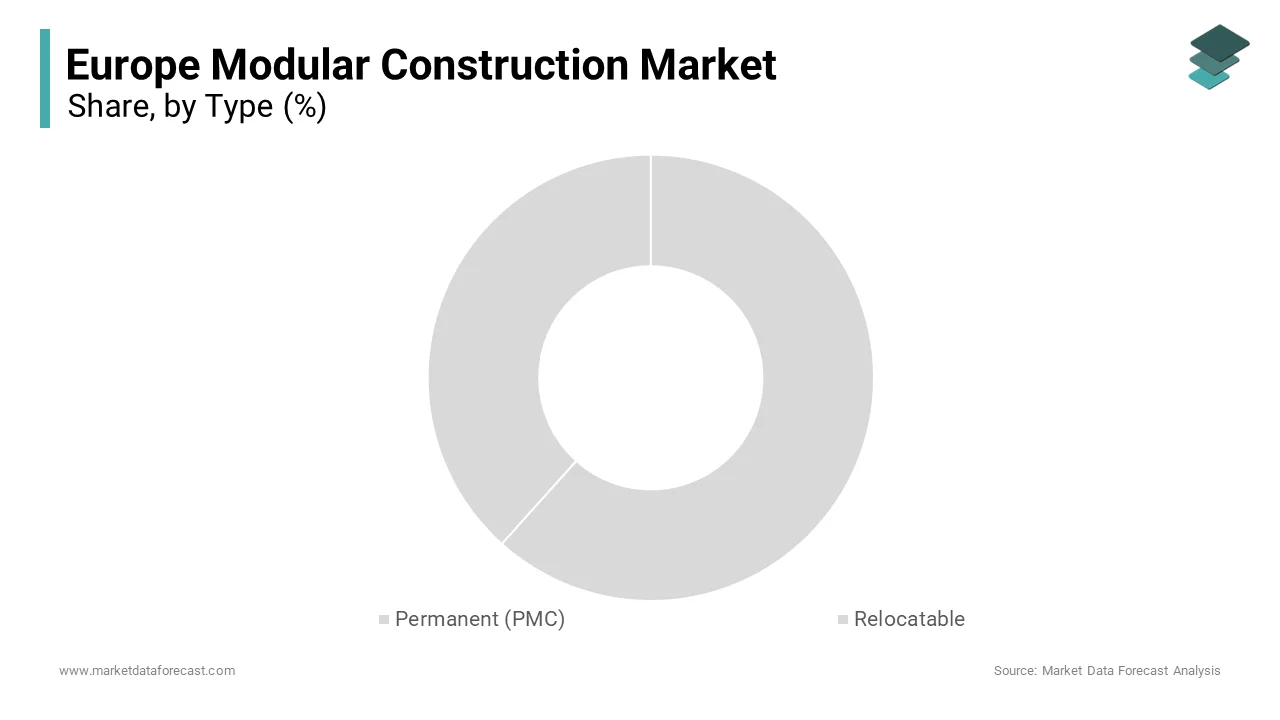
The relocatable modular construction segment is estimated to register the fastest CAGR of 9.4 % from 2025 to 2033 due to Europe’s escalating need for flexible, short-term spatial solutions in response to humanitarian, educational, and industrial contingencies. A different accelerator is the migrant crisis, which has prompted governments to adopt rapidly deployable shelter systems. French authorities are increasingly utilizing temporary and adaptable housing solutions to manage the growing demand for accommodation for asylum seekers amid consistently high arrival numbers. In parallel, the education sector utilizes relocatable classrooms to manage enrollment surges without capital-intensive expansions. There is a growing interest in Sweden in the use of modular construction methods for educational facilities as a way to quickly address needs for increased school capacity and potentially expedite building timelines. Additionally, industrial firms leverage relocatable units for on-site offices and worker accommodations in remote energy or mining projects, particularly in Eastern Europe. This operational agility, combined with declining unit costs, positions relocatable construction as Europe’s most dynamically expanding segment.
By Material Insights
The steel segment held the leading share of 52.6% of the Europe modular construction market in 2024. The leading positioning of the steel segment is attributed to its structural versatility, rapid fabrication compatibility, and resilience in multistory applications, critical for urban infill projects. Steel’s high strength-to-weight ratio enables taller modular stacks, directly addressing density mandates in cities like Berlin and Amsterdam, where height restrictions favor vertical expansion over footprint growth. Moreover, steel’s compatibility with automated welding and robotic assembly lines in factories such as those operated by Laing O’Rourke in the UK enhances precision and throughput. The material also aligns with circular economy goals. Regulatory tailwinds further support adoption, as the revised Eurocode 3 now includes specific design protocols for modular steel systems, reducing certification ambiguity that previously hindered uptake.
The wood segment is anticipated to witness the fastest CAGR of 11.2% from 2025 to 2033. The rapid expansion of the wood segment is fuelled by Europe’s aggressive embodied carbon reduction policies and advances in engineered timber technologies, suchas cross-laminated timber and dowel-laminated timber. Austria and Finland show a trend towards using mass timber in new public modular school construction. The environmental imperative is clear. Wood-based modular buildings generally have a lower embodied carbon footprint compared to structures made of steel or concrete. Furthermore, wood’s biophilic properties enhance occupant well-being, a factor increasingly codified in building standards. Guidelines in Norway support the incorporation of timber interiors within publicly funded healthcare modular units. Digital fabrication has also resolved historical limitations. CNC routers now cut timber modules with millimeter precision, enabling complex geometries previously exclusive to steel. Policy and funding initiatives at the European level provide a supportive framework for the continued use and innovation of sustainable materials like wood in construction.
By Application Insights
The education and institutional segment dominated the Europe modular construction market by occupying a 31.2% share in 2024. The dominance of the education and institutional segment is because of systemic underinvestment in public infrastructure, coupled with demographic pressures. Across the European Union, a substantial portion of existing school buildings requires significant renovation and modernization to comply with contemporary safety, energy efficiency, and accessibility requirements. Modular construction offers a turnkey solution that aligns with compressed academic calendars and stringent public procurement rules. In France, local authorities and municipalities are increasingly adopting modular construction solutions to rapidly accommodate student needs and address infrastructure challenges as part of broader educational facility investment plans. Danish public sector construction strategies encourage efficient and cost-effective building methods for new educational facilities, including the use of industrialized and modular construction approaches, to improve delivery times and manage budgets effectively. These projects often integrate smart learning environments with prefabricated AV and HVAC systems, enhancing pedagogical quality without compromising speed. The segment’s institutional backing, recurring budget allocations, and low political risk ensure its sustained market leadership.
The healthcare segment is likely to experience the fastest CAGR of 12.7% from 2025 to 2033. The swift growth of the healthcare segment is driven by bypost-pandemicc healthcare infrastructure gaps, aging populations, and the rise of decentralized care models. Europe’s population aged 65 and over is experiencing a significant and continuing increase, a trend confirmed by Eurostat population statistics. The proportion of older people in the population is growing steadily. Modular construction excels in this context by enabling rapid deployment of sterile, code-compliant units with integrated medical gas and data systems. The UK's health system is prioritizing the use of rapidly deployed, often modular, diagnostic hubs as part of its strategy to reduce waiting lists. These facilities are installed much faster than traditional construction, accelerating the delivery of essential services. Healthcare planning in Germany, as in other nations, emphasizes robust infection control measures in all facilities, with a focus on structural quality and compliance with established hygiene recommendations from bodies like the Robert Koch Institute. Furthermore, modular isolation wards have become standard in pandemic preparedness plans across Sweden and the Netherlands, ensuring surge capacity without permanent capital lockup. This convergence of demographic urgency, clinical efficacy, and fiscal pragmatism fuels healthcare’s ascent as the highest growth application segment.
COUNTRY ANALYSIS
Germany Modular Construction Market Analysis
Germany led the Europe modular construction market by capturing a 19.2% share in 2024. The supremacy of the German market is propelled by its robust manufacturing base, housing crisis, and policy coherence. Germany currently experiences a significant and widely recognized housing deficit, a situation that is expected to continue to worsen if the pace of new construction does not accelerate. In response, the federal government’s “Bündnis für Wohnen” coalition has hasfast-trackedd zoning reforms that explicitly favor modular developments, including pre-approved designs for up to six-story buildings. Industrial giants like Bosch and Siemens have repurposed automotive assembly lines for modular housing. Regulatory alignment further accelerates adoption. Germany’s updated Baunutzungsverordnung now treats modular and conventional builds identically for mortgage and land use purposes, removing historical stigma. Germany's structural and strategic leadership position is reinforced by its deeply integrated supply chains and consistent public sector demand.
United Kingdom Modular Construction Market Analysis
The UK followed closely in the Europe modular construction market and held a 15.8% share in 2024. The demand for modular construction in the UK is credited to its mature offsite ecosystem and institutional procurement mandates. Following a review that emphasized issues with traditional construction methods, the UK government has integrated modern construction techniques into essential infrastructure initiatives. The justice system incorporates these methods for new facilities, resulting in faster project completion, and a long-term school building initiative has designated specific funds for off-site construction methods to develop numerous schools. Current building safety regulations require digital modeling for relevant public structures, a need met by integrated modern construction processes. Despite Brexit-related supply chain friction, the UK’s early standardization and client readiness sustain its market position.
France Modular Construction Market Analysis
France is also a major player in the Europe modular construction market, with urban densification mandates and climate legislation. Regulatory changes encourage specific construction methods for new public buildings. Certain building systems meet low-carbon certification standards more easily than conventional on-site construction techniques. A major European city has approved a substantial number of modular housing units as part of its local housing strategy. A specific urban district now features one of the continent's tallest residential towers built using modular construction. Projects utilizing modular methods demonstrate reduced emissions compared to traditional construction. These emission reductions are primarily attributed to improved waste management and streamlined material transport. A policy is in place to accelerate permits for modular projects in designated development areas. A growing percentage of new municipal housing projects are now utilizing modular construction methods. The market trend is defined by the integration of efficiency, sustainability goals, and social equity objectives in construction practices.
Netherlands Modular Construction Market Analysis
The Netherlands is growing moderately in the Europe modular construction market due to its circular construction mandates and water-adaptive design. New government buildings in the Netherlands are required to meet high standards for material circularity. The government's housing programs are delivering numerous modular apartments that are designed for full disassembly and reuse. Infrastructure authorities are using modular construction for temporary site offices, allowing units to be easily moved and reused across different projects. Dutch firms are leaders in floating construction, utilizing modular designs for floating homes that are engineered to adapt to changing water levels. Modular construction is a significant portion of new housing starts in urban regions, driven by the need to efficiently use available land and build resilient homes. The Netherlands’ fusion of climate adaptation and circularity cements its distinct market role.
Sweden Modular Construction Market Analysis
Sweden is predicted to expand in the Europe modular construction market from 2025 to 2033 by leveraging modular construction to uphold its welfare state commitments amid population growth. There is a need for a substantial number of new homes, and modular construction methods are being considered to help meet this target while maintaining quality. A national housing strategy directs that a portion of municipal land reserves be used specifically for modular housing developments. One city consistently provides aseveralmodular apartments each year as part of its housing initiatives. The region has strict energy efficiency requirements for public housing, which are being addressed through controlled production environments to achieve efficient insulation and airtightness. Modular construction is seeing increased use in elderly care living situations. The consistent indoor environmental quality provided by modular construction is associated with positive effects on resident well-being. So, Sweden exemplifies how social policy and construction innovation converge to drive market expansion.
COMPETITIVE LANDSCAPE
The Europe modular construction market features intense competition characterized by a mix of large multinational construction firms, specialized modular manufacturers, and agile regional players. Competition is not solely price-driven but increasingly hinges on technological sophistication, regulatory compliance, sustainability credentials, and speed of delivery. Major firms differentiate themselves through proprietary factory systems, digital integration capabilities, and strategic alignment with national housing or healthcare policies. Regional players often compete on local code expertise and community relationships, particularly in complex urban retrofit projects. The market lacks a dominant single player, fostering continuous innovation in materials, logistics, and assembly techniques. Consolidation is gradually increasing as companies seek scale to manage rising compliance and capital costs. However, fragmentation persists due to national regulatory differences, limiting pan-European dominance and encouraging collaborative ecosystems over pure market share battles.
KEY MARKET PLAYERS
- Laing O'Rourke,
- Skanska
- Modulaire Group
- KLEUSBERG
- Berkeley Group
- Bouygues Batiment International
- Daiwa House Modular Europe Ltd.
- Modubuild
- Elements Europe
- Moelven Industrier ASA
Top Players In The Market
- Bouygues Construction is a leading French industrial group with deep expertise in off-site and modular building techniques across Europe. The company has significantly advanced the integration of digital design andfactory-basedd assembly in public infrastructure projects. Recently, Bouygues launched its “Open Source Factory” initiative in France, a dedicated modular production facility focused on schools and social housing that combines robotics with sustainable materials. The company has also partnered with academic institutions to develop next-generation timber modular systems compliant with France’s stringent low-carbon building regulations. These actions reinforce its commitment to accelerating delivery while meeting national decarbonization mandates through scalable industrialized construction.
- Skanska is a major Nordic construction and development firm that has embedded modular construction into its core delivery model for healthcare and educational facilities across Sweden, the UK, and Norway. The company operates its own modular manufacturing unit in Wolverhampton, UK, which produces fully fitted volumetric modules for hospitals and student housing. This innovation enhances quality control and lifecycle management, aligning with Sweden’s welfare-driven public procurement standards and strengthening Skansika’s role as a technology-enabled modular solutions provider in Northern Europe.
- Algeco is a pan-European modular space solutions provider with operations in over 20 countries, specializing in both relocatable and permanent modular buildings for public and private sectors. The company has intensified its focus on sustainable modular design by launching its “Green Module” program in 2024, which features recycled steel frames, bio-based insulation, and solar-ready roofs. It also collaborates with local governments on circular economy pilot projects, ensuring modules can be disassembled and repurposed after initial use. These initiatives position Algeco as a responsive and environmentally conscious leader in flexible modular infrastructure.
Top Strategies Used By The Key Market Participants
Key players in the Europe modular construction market are prioritizing vertical integration by owning or partnering with dedicated module factories to ensure supply chain control and production consistency. They are investing heavily in digitalization through building information modeling and digital twin technologies to enhance design accuracy and operational efficiency. Strategic public-private partnerships with municipal and national governments enable access to land and fast-tracked permitting. Companies are also standardizing product platforms to achieve economies of scale while maintaining customization for local codes. Additionally, sustainability is central to their strategies, with widespread adoption of low-carbon materials, circular design principles, and energy-efficient manufacturing processes to align with EU regulatory mandates and client expectations.
MARKET SEGMENTATION
This research report on the Europe modular construction market is segmented and sub-segmented into the following categories.
By Type
- Permanent (PMC)
- Relocatable
By Material
- Concrete
- Steel
- Wood
By Application
- Commercial
- Healthcare
- Educational & Institution
- Hostility
- Others (Residential, Religious Buildings)
By Country
- UK
- France
- Spain
- Germany
- Italy
- Russia
- Sweden
- Denmark
- Switzerland
- Netherlands
- Turkey
- Czech Republic
- Rest of Europe