- Product Description Description
- Table of Contents TOC
- List of Table & Figure LOT
- Get Free Sample PDF Sample PDF
Market Size, 2025
$31.88 BnMarket Estimate, 2026
$33.03 BnMarket Forecast, 2034
$43.90 BnCAGR, 2026–2034
3.62%Europe Molluscicides Market Size, Growth, Trends & Forecast (2026–2034)
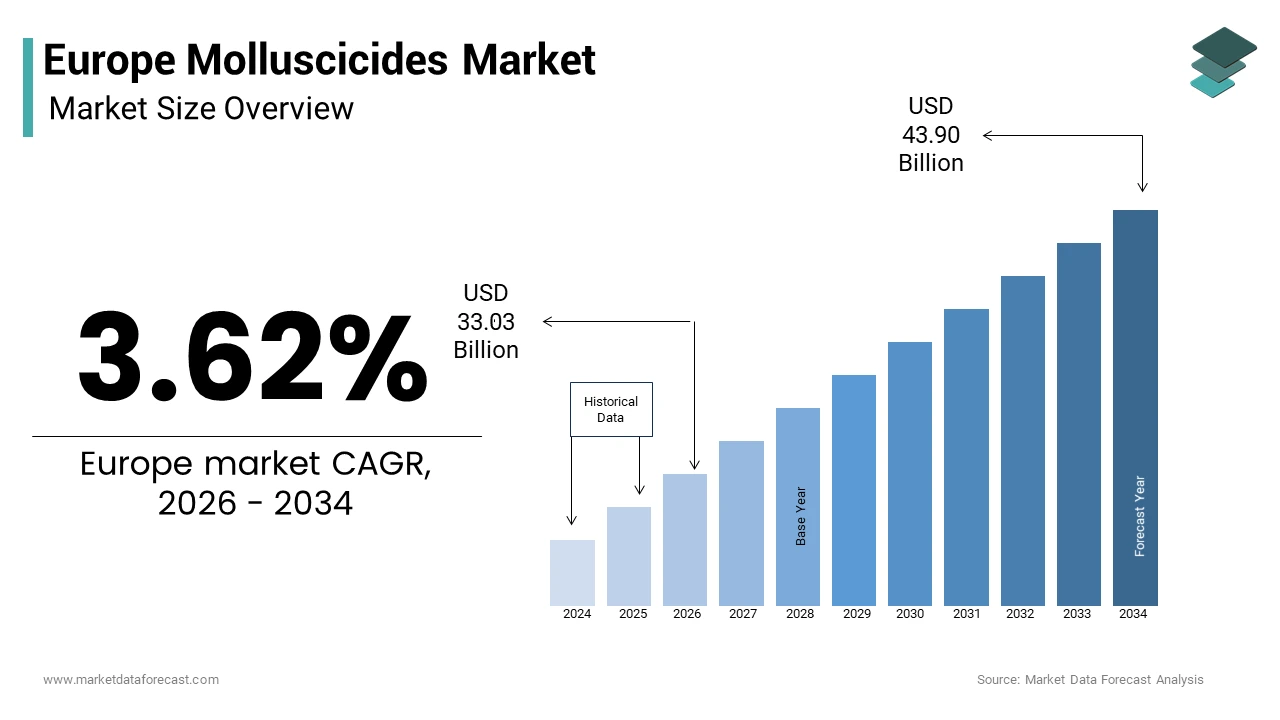
The European Molluscicides Market size was valued at USD 31.88 billion in 2025, is anticipated to reach a valuation of USD 33.03 billion in 2026, and is projected to expand to USD 43.90 billion by 2034, registering a compound annual growth rate (CAGR) of 3.62% during the forecast period from 2026 to 2034. Growth is heavily supported by escalating crop loss pressures from slug infestations, expanding organic horticulture, and strict regulatory transitions toward safer active ingredients.
Key Executive Metrics (At-a-Glance)
- 2025 Base Valuation: USD 31.88 Billion
- 2026 Current Valuation: USD 33.03 Billion
- 2034 Forecast Valuation: USD 43.90 Billion
- Compound Annual Growth Rate (CAGR): 3.62% (2026–2034)
- Dominant Type Segment: Ferrous Phosphate (capturing 61.6% share in 2025 due to organic certification approvals and environmental safety)
- Fastest-Growing Type Segment: Biological Molluscicides (projected at a rapid CAGR of 14.4% driven by EU biodiversity targets)
- Dominant Source Segment: Chemical Molluscicides (accounting for 77.8% share in 2025 due to immediate knockdown and reliable broad-scale utility)
- Dominant Application Segment: Field Crops (holding 51.5% share in 2025 across extensive cereal and oilseed production zones)
- Fastest-Growing Application Segment: Horticulture Crops (expanding at a 12.2% CAGR driven by protected farming and zero-blemish standards)
- Dominant Country Market: United Kingdom (leading with a 21.9% share in 2025 due to high maritime slug pressures)
Core Market Drivers
- Cereal & Oilseed Infestations: Heightened slug damage in major crop belts like France, Germany, and the UK, exacerbated by conservation tillage practices.
- Protected Horticulture Expansion: Surging demand for high-value leafy greens and fruits under protected glasshouses requiring strict cosmetic standards.
Primary Market Restraints & Challenges
- Rigorous Regulatory Bans: Prohibition of key active ingredients like metaldehyde following European Food Safety Authority risk assessments, narrowing options.
- Efficacy Inconsistencies: Variable field performance under heavy rainfall or adverse soil chemistry, creating operational challenges for growers.
Europe Molluscicides Market Segmentation Breakdown
| Segment Category | Largest (Dominant) Sub-Segment | Fastest-Growing Sub-Segment |
|---|---|---|
| By Type | Ferrous Phosphate | Biological Molluscicides |
| By Source | Chemical | Biological |
| By Application | Field Crops | Horticulture Crops |
| By Mode of Application | Pellets | Sprays / Specialized Biocontrols |
| By Country | United Kingdom | Netherlands & Spain |
Major Industry Players Profiled
Key corporations steering the European molluscicides market include BASF SE, Neudorff GmbH KG, Certis Europe B.V., Lonza Group AG, Doff Portland Ltd., Bayer CropScience AG, Adama Agricultural Solutions Ltd., De Sangosse SAS, American Vanguard Corporation, and other leading agricultural input providers.
 Download Free Sample Report
Europe Molluscicides Market Size
The European molluscicides market size was valued at USD 31.88 billion in 2025 and is anticipated to reach a valuation of USD 33.03 billion in 2025 and USD 43.90 billion by 2034, growing at a CAGR of 3.62% from 2026 to 2034.
Molluscicides are specialized agrochemical formulations designed to control slugs and snails that inflict significant damage on a wide range of agricultural and horticultural crops across Europe. These pests thrive in the region’s temperate and humid climate, particularly in Western and Central Europe, where consistent rainfall and mild winters create ideal conditions for mollusk proliferation. As per Eurostat, in 2023, the average price of one hectare of arable land in the European Union was €11,791, and renting one hectare of arable land or permanent grassland was most expensive in the Netherlands. Slug damage is recognized as a major threat to cereals and oilseed crops, particularly during wet growing seasons, where infestations can significantly reduce yields. As per the European Alien Species Information Network, the Spanish slug (Arion vulgaris) is a highly invasive species that has spread across much of Europe since the 1950s, with its expansion linked to favorable climatic conditions. Integrated pest management remains a cornerstone of EU agricultural policy, and the persistent threat to crop germination and early growth stages sustains demand for targeted molluscicidal interventions. Current regulatory frameworks under the EU Plant Protection Products Regulation strictly govern active ingredients, pushing innovation toward safer, more selective chemistries that align with environmental sustainability goals.
MARKET DRIVERS
Escalating Crop Losses Due to Slug Infestations in Cereal and Oilseed Production
Slug pressure has intensified across Europe’s major cereal belts, directly threatening food security and farm profitability, which is majorly driving the growth of the European molluscicides market. Slug damage is recognized as a major cause of yield losses in cereals and oilseed crops, particularly in France, Germany, and the UK, where prolonged autumn rainfall often delays sowing and creates moist seedbeds favorable for mollusk activity. Oilseed rape, a critical rotation crop, is especially vulnerable during emergence, with studies from the Julius Kühn Institute in Germany confirming significant stand reductions in untreated fields. As per the European Commission’s Joint Research Centre, slugs are increasingly ranked among the top pest concerns in Northwestern Europe, surpassing certain insect threats. This shift is exacerbated by conservation tillage practices, adopted on 31% of EU arable land as per Eurostat, which retain crop residue and moisture, inadvertently sheltering slug populations. Consequently, farmers increasingly rely on targeted molluscicide applications at sowing to protect seedling establishment, driving consistent demand for effective and approved formulations despite regulatory constraints.
Expansion of High-Value Horticultural and Organic Specialty Crops
The growth of intensive horticulture, including leafy greens, strawberries, and nursery plants, has amplified the need for precise mollusk control in moisture-rich environments, which is further contributing to the expansion of the European molluscicides market. As per the European Union’s Farm to Fork Strategy monitoring data, the area under protected horticulture increased by 12% between 2020 and 2023, reaching over 280,000 hectares, with significant expansion in the Netherlands, Spain, and Belgium. These crops are highly susceptible to cosmetic damage from snail and slug feeding, rendering produce unmarketable even with minor blemishes. In organic systems, where synthetic pesticides are restricted, approved iron phosphate-based molluscicides have become indispensable. As per the Research Institute of Organic Agriculture, a majority of certified organic vegetable growers in Germany and France use molluscicides as a core component of their pest strategy. Furthermore, urban fringe farming and vertical agriculture initiatives in cities like Copenhagen and Milan face heightened mollusk risks due to dense planting and irrigation, creating new demand niches. This convergence of aesthetic quality standards, organic certification requirements, and peri-urban cultivation trends sustains robust molluscicide usage beyond traditional field crops.
MARKET RESTRAINTS
Stringent Regulatory Restrictions on Active Ingredients Under EU Legislation
The European Union maintains one of the world’s most rigorous regulatory regimes for plant protection products, which severely limits the chemical arsenal available for mollusk control and is a significant restraint on the European molluscicides market growth. Metaldehyde, once the dominant active ingredient, was banned for outdoor use across the EU in 2022 following a European Food Safety Authority risk assessment that identified unacceptable contamination levels in surface water bodies. As per the European Environment Agency, metaldehyde was frequently detected in monitored UK rivers during winter months before the ban, posing risks to aquatic organisms. Although iron phosphate is permitted, its efficacy is lower under heavy infestation or prolonged rain, requiring multiple applications. As per the European Commission’s 2024 review of approved substances, only two active ingredients are currently authorized for molluscicidal use in the EU, creating formulation homogeneity and limiting agronomic flexibility. National authorities in countries like Sweden and Austria impose additional usage restrictions, such as buffer zones near waterways, further constraining application windows. This regulatory bottleneck stifles innovation and forces growers to rely on a narrow suite of tools, undermining integrated pest management resilience.
Environmental and Non-Target Toxicity Concerns
Molluscicides pose documented risks to non-target organisms, particularly birds, earthworms, and aquatic invertebrates, which is triggering ecological caution among regulators and conservation groups and further hampering the growth of the European molluscicides market. According to a 2023 study by the Leibniz Institute for Zoo and Wildlife Research, exposure to residual molluscicide granules reduced earthworm reproduction rates in field trials conducted in Brandenburg, Germany. Earthworms are critical for soil structure and nutrient cycling, and their decline undermines broader agroecological health. Additionally, the Royal Society for the Protection of Birds reported in 2024 that granular bait formulations can be mistaken for grit by ground-feeding birds such as thrushes and pheasants, leading to secondary poisoning incidents. These ecological trade-offs have fuelled opposition from environmental NGOs and influenced national pesticide reduction targets under the EU Biodiversity Strategy 2030, which aims to cut chemical pesticide use by 50%. Consequently, farmers face growing pressure to minimize molluscicide applications, even when economically justified, slowing market expansion despite clear agronomic need.
MARKET OPPORTUNITIES
Development and Adoption of Bio-Based and Microbial Molluscicides
Innovation in biological control agents offers a promising pathway to align mollusk management with EU sustainability mandates, which is a promising opportunity in the European molluscicides market. Research institutions across Europe are advancing microbial solutions, including nematode-based products and slug-specific fungi, which target pests without harming beneficial fauna. Field trials of Phasmarhabditis hermaphrodita have shown strong suppression of slug populations in cereal crops under commercial conditions. Similarly, a consortium led by Wageningen University in the Netherlands developed a protein-derived biopesticide that disrupts mollusk feeding behavior without systemic toxicity. According to the European Biocontrol Industry Association, investment in bio molluscicide research and development increased significantly in 2023, which is supported by Horizon Europe grants targeting alternatives to chemical pesticides. These innovations cater to both conventional farms seeking reduced environmental impact and organic producers requiring effective non-synthetic tools, which is creating a dual market avenue poised for regulatory and commercial acceleration.
Integration with Precision Agriculture and Digital Farming Platforms
The convergence of molluscicide application with digital agronomy tools enables targeted, data-driven interventions that minimize chemical use while maximizing efficacy, which is another notable opportunity in the European molluscicides market. Soil moisture sensors, weather forecasting APIs, and slug risk prediction models such as the UK’s “SlugWatch” platform now inform spray timing and placement at the field zone level. As per the European Commission’s Digital Farming Observatory, 41% of large arable farms in Western Europe used agronomic decision support systems in 2023, up from 27% in 2020. Companies like Bayer and Syngenta have begun embedding mollusk risk alerts into their digital platforms, recommending application only when environmental conditions exceed preset thresholds. In Germany, pilot programs using GPS-guided granule applicators reduced molluscicide use while maintaining crop protection, according to data from the Thünen Institute. This precision approach not only complies with EU pesticide reduction goals but also lowers input costs, enhancing farmer adoption. As connectivity and analytics mature, molluscicides will transition from blanket treatments to intelligent, need-based interventions.
MARKET CHALLENGES
Variable Field Efficacy Due to Climatic and Soil Conditions
The performance of molluscicides is highly contingent on environmental factors, which leads to inconsistent field results that erode grower confidence and are a major challenge to the European molluscicides market growth. Granular formulations lose effectiveness when heavy rainfall dissolves or displaces bait within short periods, a frequent occurrence during autumn sowing in maritime climates. As per the Met Office, the UK experienced its wettest October in over two decades in 2023, with rainfall levels in key cereal regions reducing molluscicide persistence. Similarly, iron phosphate degrades rapidly in alkaline soils, which cover a significant share of arable land in Southern and Eastern Europe, as per the European Soil Data Centre. Field trials conducted by the French National Institute for Agricultural Research confirmed notable efficacy variations between clay and sandy loam soils under identical application rates. This unpredictability forces farmers to reapply products or combine them with cultural controls, increasing costs and labor. Until formulations are engineered for broader environmental resilience, efficacy volatility will remain a critical barrier to reliable pest management and consistent product adoption.
Limited Awareness and Access Among Small aMedium-Sizedzed Farms
Despite the agronomic necessity, many small and medium-sized farms across Southern and Eastern Europe lack access to modern molluscicides or the knowledge to deploy them effectively, which is further challenging the expansion of the European molluscicides market. As per the European Commission’s Farm Structure Survey, farms under 20 hectares constitute 78% of all agricultural holdings in the EU, yet they account for less than 30% of total agrochemical expenditure. In countries like Romania and Bulgaria, extension services remain underfunded, and digital advisory tools are rarely localized into regional languages. Assessments by the Food and Agriculture Organization of the United Nations highlight that many smallholders in the Carpathian Basin struggle to correctly identify approved molluscicide products, often resorting to ineffective home remedies or unregistered substances. Distribution networks in rural areas are sparse, with agrochemical retailers concentrated in urban centers. This knowledge and access gap not only compromises crop protection but also increases the risk of illegal or off-label use. Bridging this divide requires targeted education campaigns and decentralized supply chains, a complex challenge in Europe’s highly fragmented agricultural landscape.
REPORT COVERAGE
| REPORT METRIC | DETAILS |
| Market Size Available | 2025 to 2034 |
| Base Year | 2025 |
| Forecast Period | 2026 to 2034 |
| CAGR | 3.62% |
| Segments Covered | By Type, Source, Application, Mode of Application, And By Country |
| Various Analyses Covered | Global, Regional & Country Level Analysis; Segment-Level Analysis, DROC, PESTLE Analysis, Porter’s Five Forces Analysis, Competitive Landscape, Analyst Overview of Investment Opportunities |
| Regions Covered | UK, France, Spain, Germany, Italy, Russia, Sweden, Denmark, Switzerland, Netherlands, Turkey, Czech Republic, & Rest of Europe |
| Market Leaders Profiled | Lonza Group AG, Doff Portland Ltd., Bayer CropScience AG, Adama Agricultural Solutions Ltd., BASF SE, Marrone Bio Innovations, Inc., De Sangosse SAS, American Vanguard Corporation, Neudorff GmbH Kg, Certis Europe B.V. |
SEGMENTAL ANALYSIS
By Type Insights
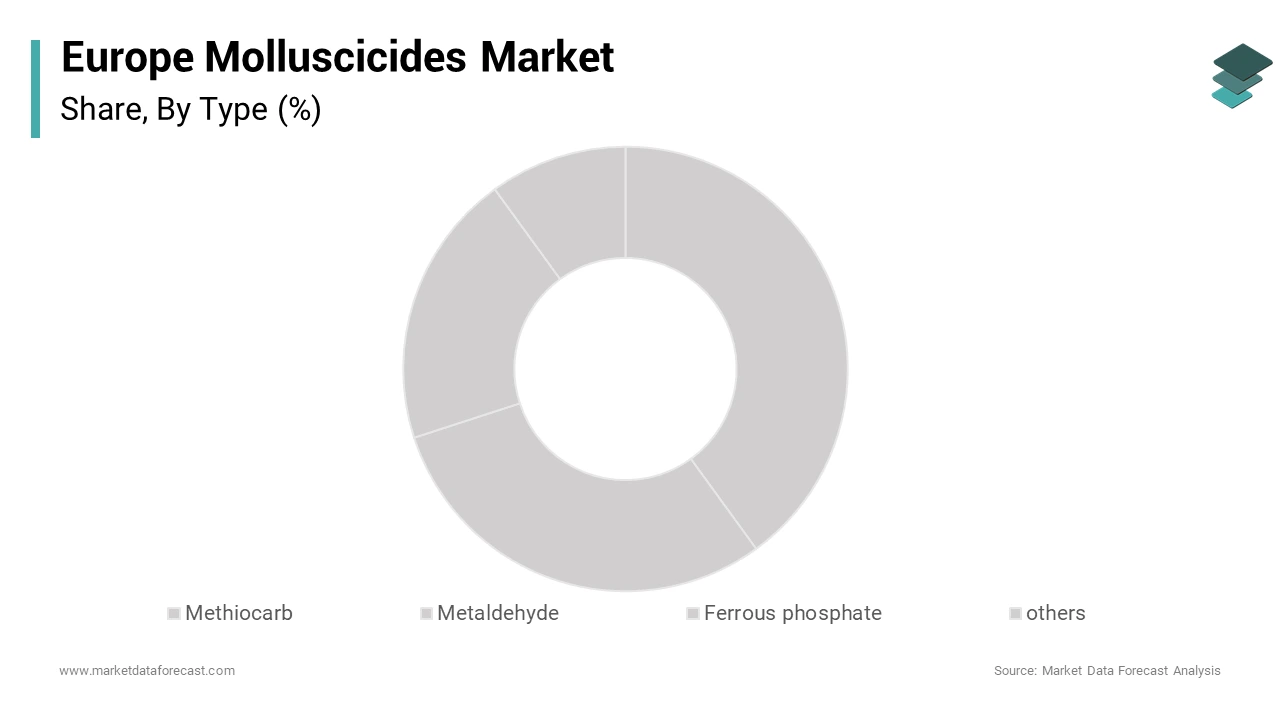
The ferrous phosphate segment dominated the market by holding 61.6% of the European molluscicides market share in 2025. Ferrous phosphate’s leadership stems from its approval under EU organic regulations and favorable environmental safety profile compared to legacy chemistries. Ferrous phosphate is the only synthetic molluscicide authorized for use in certified organic farming across all 27 European Union member states as per the European Commission’s Implementing Regulation (EU) 2023 211,5 which updated permitted substances for organic production. This dual eligibility enables seamless integration across both conventional and organic supply chains. According to the Research Institute of Organic Agriculture, a majority of organic vegetable growers in France, Germany, and the Netherlands relied on ferrous phosphate-based products in 2023 to manage slug pressure without compromising certification. National authorities, including the UK Health and Safety Executive and Germany’s Federal Office of Consumer Protection and Food Safety, ty classify ferrous phosphate as non-hazardous to birds, earthworms, and aquatic life when used as directed. This regulatory trust has led to its inclusion in national integrated pest management guidelines in 19 EU countries,ries as confirmed by the European Food Safety Authority’s 2024 pesticide usage review. The convergence of legal permissibility, agronomic necessity, and ecological safety solidifies ferrous phosphate as the cornerstone of European mollusk control.
The biological molluscicides segment is a promising segment and is estimated to record a CAGR of 14.4% over the forecast period, owing to the breakthroughs in microbial formulations and rising alignment with EU biodiversity and chemical reduction targets. Parasitic nematodes such as Phasmarhabditis hermaphrodita have demonstrated consistent field efficacy against key slug species without non-target organisms. Field trials conducted in France confirmed strong slug suppression in winter wheat and oilseed rape using stabilized nematode formulations applied via standard granule spreaders. According to the European Biocontrol Manufacturers Association, commercial availability of nematode products expanded to 14 EU countries in 2023, up from 8 in 2020. The European Commission’s Horizon Europe program granted funding in 2023 to a pan-European consortium developing cold-tolerant nematode strains for Nordic and Alpine regions. These innovations overcome historical limitations of biologicals, such as narrow application windows and temperature sensitivity, enabling broader geographic adoption.
By Source Insights
The chemical molluscicides segment held 77.8% of the regional market share in 2025. Chemical dominance reflects entrenched use patterns, infrastructure compatibility, and immediate efficacy expectations, particularly in large-scale arable systems. Chemical molluscicides, particularly ferrous phosphate, deliver rapid knockdown and visible bait consumption, providing growers with immediate feedback on pest activity. According to field data from the Julius Kühn Institute in Germany, untreated winter barley plots experienced significant stand loss due to slugs, whereas chemically treated plots maintained strong emergence. This reliability is critical during narrow sowing windows in autumn when delayed crop establishment can reduce yields, as confirmed by the European Commission’s Joint Research Centre. Chemical granules integrate seamlessly with existing farm equipment such as precision seeders and fertilizer spreaders, eliminating the need for specialized application machinery. In contrast, biological agents often require specific moisture and temperature conditions to activate, limiting their use in erratic weather. For risk-averse farmers managing hundreds of hectares, predictability outweighs ecological benefits, entrenching chemical use despite regulatory headwinds.
The biological molluscicides segment is estimated to register a CAGR of 14.4% over the forecast period, owing to the regulatory tailwinds, technological maturation, and shifting farmer attitudes toward ecological resilience. European governments are embedding biological molluscicides into broader agroecology frameworks that reward ecosystem services. In 2024, Sweden’s Rural Development Program began offering financial incentives to farms using approved biocontrol agents against slugs as part of its “Nature Positive Agriculture” initiative. Similarly, the Netherlands’ Action Plan for Crop Protection includes biological molluscicides in its list of “preferred substances” eligible for expedited licensing and reduced inspection frequency. According to the European Commission’s Common Agricultural Policy monitoring dashboard, 16 member states now link direct payments to reduced risk pesticide use, with biologicals qualifying as full compliance tools. This policy alignment transforms biological adoption from a niche choice into a financially rational strategy, particularly for farms participating in environmental stewardship schemes.
By Application Insights
The field crops segment led the market by commanding for 51.5% of the regional market share in 2025. Winter wheat, oilseed rape, and barley are exceptionally susceptible to slug damage during seedling emergence, a vulnerability exacerbated by conservation tillage and delayed sowing. According to the European Commission’s crop monitoring unit, slug feeding reduced winter wheat plant populations in 2023 across major production zones in France, Germany, and the UK. Oilseed rape suffers even greater risk, with stand losses documented by the Julius Kühn Institute in untreated fields. These crops cover over 60 million hectares in the EU as per Eurostat, making even minor yield impacts economically significant. Molluscicide application at sowing is now considered a standard agronomic practice in high-risk regions, with many large arable farms in Northwestern Europe using targeted treatments annually. The scale of production and narrow economic margins in field crops necessitate cost-effective, reliable protection, driving consistent demand for approved molluscicides.
The horticulture crops segment is anticipated to grow at a CAGR of 12.2% over the forecast period, owing to the intensification of urban agriculture and stringent cosmetic quality standards. Europe’s protected horticulture area grew in 2023, reaching over 290,000 hectares according to the European Commission’s agricultural statistics. Greenhouses, polytunnels, and vertical farms create wa, rm humid microclimates ideal for slug proliferation yet leave minimal room for cultural controls. Leafy greens, strawberries, and salad crops grown in these systems cannot tolerate even minor feeding damage, as it renders produce unmarketable. In the Netherlands, many lettuce growers apply molluscicides preventively during transplanting as per data from Wageningen Economic Research. Urban fringe farms supplying metropolitan markets in cities like Paris and Berlin operate under similar constraints with zero tolerance for blemishes. This intensification trend, coupled with year-round production cycles, sustains recurring molluscicide demand far exceeding that of seasonal field crops.
COUNTRY LEVEL ANALYSIS
United Kingdom Molluscicides Market Analysis
The United Kingdom led the market and held 21.9% of the regional market share in 2025. The dominance of the UK in the European market is driven by its oceanic climate, high slug pressure, and intensive arable farming systems. Persistent autumn rainfall creates ideal conditions for slug proliferation, particularly in winter wheat and oilseed rape fields. As per the UK Department for Environment, Food and Rural Affairs, these crops cover millions of hectares combined. The UK experienced its wettest October in over two decades in 2023, exacerbating crop losses and accelerating molluscicide use despite the 2022 ban on metaldehyde. Ferrous phosphate adoption surged, with many farms in East Anglia and Yorkshire applying it at sowing according to the Agriculture and Horticulture Development Board. The country’s advanced agrochemical distribution network ensures rapid product availability, while digital pest forecasting tools like SlugWatch provide real-time risk alerts. Although regulatory constraints are stringent, the economic imperative to protect high-value cereal crops sustains the UK’s position as Europe’s leading molluscicide market.
France Molluscicides Market Analysis
France occupied 18.8% of the European molluscicides market share in 2025 and is supported by its vast arable expanse and strong horticultural sector. The country cultivates millions of hectares of winter cereals and is Europe’s largest producer of oilseed rape, according to FranceAgriMer. Slug damage is a chronic issue, particularly in the northern regions of Hauts de France and Normandy,dy where heavy clay soils retain moisture well into spring. Research by the French National Institute for Agricultural Research has documented yield losses in untreated wheat plots. France’s vegetable sector, concentrated in Brittany and the Loire Valley, relies heavily on molluscicides to meet retailer cosmetic standards. The government’s Ecophyto II plan restricts chemical use but explicitly permits ferrous phosphate and biologicals, creating a dual track adoption model. National subsidies covering bio molluscicide costs further stimulate innovation. This blend of large-scale agronomy and premium horticulture ensures France remains a high-volume, high-value market.
Germany Molluscicides Market Analysis
Germany is estimated to account for a promising share of the European molluscicides market over the forecast period, owing to the technologically advanced farming, environmental regulation, and a robust organic sector. The country cultivates millions of hectares of cereals and leads the EU in organic farmland, as per the Federal Ministry of Food and Agriculture. German organic vegetable growers are legally required to use only approved substances, making ferrous phosphate indispensable for slug control. In conventional systems, integrated pest management guidelines issued by the Julius Kühn Institute recommend molluscicide use only when slug counts exceed thresholds, yet many large farms apply preventively due to narrow sowing windows. The 2023 amendment to the Plant Protection Act banned all granular pesticides near water bodies but exempted ferrous phosphate due to its low ecotoxicity. Germany’s dense network of agricultural retailers ensures product accessibility, while research institutions drive biological innovation. This balance of regulation, pragmatism, and innovation defines Germany’s influential market role.
Netherlands Molluscicides Market Analysis
The Netherlands is expected to witness a healthy CAGR in the European molluscicides market over the forecast period, owing to itshyper-intensivee horticulture, protected cultivation, and export orientation. Despite covering only 1.8 million hectares of agricultural land, the country is Europe’s second-largest agricultural exporter, with greenhouse vegetables, flowers, and ornamentals generating billions of euros annually, according to Statistics Netherlands. These high-value crops are grown in moisture-rich environments highly conducive to slug activity, yet cosmetic standards are uncompromising. As per Wageningen Economic Research, many Dutch lettuce and strawberry growers apply molluscicides during transplanting. The Netherlands also leads in biological adoption, with a significant share of horticultural farms using nematode-based products supported by government subsidies under the National Growth Fund. Distribution is highly efficient, with agrochemical suppliers delivering rapidly to greenhouse clusters in Westland and North Brabant. This combination of export-driven quality demands and bioinnovation sustains the Netherlands’ outsized market influence.
Spain Molluscicides Market Analysis
Spain is predicted to hold a notable share of the European molluscicides market during the forecast period owing to its expanding horticultural exports, peri-urban farming, and climate-induced pest shifts. The country is the EU’s largest producer of fresh vegetables, exporting millions of tons annually primarily to Germany, France, and the UK, as per the Spanish Ministry of Agriculture. Intensive production in regions like Almería and Murcia uses drip irrigation and plastic mulch, which create microhabitats for slugs despite arid surroundings. Exporter audits have revealed that mollusk damage is a significant cause of leafy green rejections, prompting increased molluscicide use. Spain’s growing urban agriculture sector, supporting hundreds of thousands of small plots in cities like Madrid and Barcelona, faces high slug pressure in irrigated gardens. The government’s 2023 Sustainable Agriculture Strategy offers tax incentives for biocontrol adoption, yet ferrous phosphate remains dominant due to cost and availability. As climate change increases winter rainfall in southern Europe, slug risk is projected to rise, which is making Spain a dynamic and fast-evolving market in Southern Europe.
COMPETITIVE LANDSCAPE
TheEuropeane Molluscicides Market is characterized by a strategic duality between established chemical solutions and emerging biological alternatives driven by evolving regulatory and sustainability demands. Competition is not primarily price-based but centers on regulatory compliance, environmental safety,y product reliability, ty and technical support quality. Large multinational agrochemical firms leverage their global scale and regulatory expertise to maintain leadership in ferrous phosphate offerings while specialized biocontrol companies gain ground through innovation in nematode and microbial technologies. The market is further shaped by national differences in farming practic climate-inducedced pest pressur,,e, and organic certification rules,s creating regional adoption disparities. Companies differentiate through integrated approaches combining products with digital advisory services, training,g and stewardship programs. As the EU tightens chemical pesticide restrictions,n s competition increasingly hinges on the ability to deliver effective residue-free, ecologically sound mollusk control solutions that meet both agronomic and policy requirements.
KEY MARKET PLAYERS
Some of the major competitors in the Molluscicides market are
- Lonza Group A
- Doff Portland Ltd
- Bayer CropScience AG
- Adama Agricultural Solutions Ltd.
- BASF SE
- Marrone Bio Innovations, Inc.
- De Sangosse SAS
- American Vanguard Corporation
- Neudorff GmbH Kg
- Certis Europe B.V.
Top Players In The Market
BASF SE
BASF SE is a global leader in crop protection with a strong presence in theEuropeane molluscicides market through its ferrous phosphate-based formulations designed for both conventional and organic farming systems. The company leverages its extensive R and D infrastructure to develop environmentally compatible molluscicide solutions that align with EU regulatory standards. In 2024, BASF expanded its biological portfolio by launching a new granular ferrous phosphate product with enhanced rainfastness for use in high moisture regions such as the UK and Ireland. It also partnered with agricultural cooperatives in France and Germany to deliveron-farmm training on integrated slug management. These initiatives reinforce BASF’s commitment to sustainable crop protection while strengthening its distribution reach and technical support capabilities across Western Europe.
Neudorff GmbH
Neudorff GmbH is aGermany-basedd pioneer in organic and biological plant protection products and a key supplier of approved molluscicides for the European organic sector. The company specializes in iron phosphate formulations under brands such as Ferramol, which are certified for organic use across all EU member states. In 20,24 Neudorff increased production capacity at its Kassel facility by 40% to meet rising demand from horticultural growers in the Netherlands and Belgium. It also launched a multilingual digital advisory platform offering region-specific slug risk forecasts and application guidance. By combining regulatory compliance, product efficacy,y and farmer education in Neudorff has solidified its position as a trusted partner for environmentally conscious growers throughout Europe.
Certis Europe B.V.
Certis Europe B.V. is a prominent developer and distributor of biopesticides, including biological molluscicides based on naturally occurring organisms. The company plays a critical role in advancnon-chemicalical slug control through its partnerships with European research institutions and participation in EU-funded innovation programs. In 2024, Certis introduced next-generation nematode-basedmolluscicide in Denmark and Sweden following successful field trials demonstrating over 70% efficacy under Nordic conditions. It also collaborated with the European Biocontrol Industry Association to streamline regulatory dossiers for microbial products across multiple member states. These actions enhance Certis Europe’s ability to deliverscience-backedd sustainable solutions aligned with the EU’s chemical reduction agenda.
Top Strategies Used by the Key Market Participants
Key players in the European Molluscicides Market focus on reformulating existing products to meet stringent environmental regulations while maintaining field efficacy. They invest heavily in research and development of biological and bio-based alternatives to synthetic chemistries to align with the EU’s Farm to Fork and Biodiversity Strategy targets. Companies actively pursue regulatory approvals for new active substances across multiple member states to ensure pan-European market access. Strategic collaborations with agricultural cooperatives, extension services, and digital farming platforms help disseminate usage best practices and build grower trust. Additionally, they expand production capacity and localized distribution networks to ensure product availability during critical application windos particularly in high-pressure slug regions.
MARKET SEGMENTATION
This research report on the European molluscicides market is segmented and sub-segmented into the following categories.
By Type
- methiocarb
- Metaldehyde
- ferrous phosphate
- others
By Source
- biological
- as well as chemical
By Application
- field crops
- industrial
- turf & ornaments
- horticulture crops
By Mode of Application
- pellets
- powder
- sprays
By Country
- UK
- France
- Spain
- Germany
- Italy
- Russia
- Sweden
- Denmark
- Switzerland
- Netherlands
- Turkey
- Czech Republic
- Rest of Europe